Como a Amazon deixou o Prime fácil de assinar e difícil de cancelar
A FTC obteve US$ 2,5 bilhões da Amazon por uma adesão ao Prime que dava para acionar sem querer e um cancelamento feito para esgotar você. Veja como reconhecer o mesmo truque em qualquer lugar.
Negócios e economia · 2026-09-20
Você entrou para comprar alguma coisa. Um botão chamativo prometia entrega grátis, e você tocou nele. Semanas depois apareceu uma cobrança, e quando você tentou interrompê-la, a saída virava mais uma tela pedindo que você ficasse. Se isso soa familiar, um tribunal federal acaba de dizer em voz alta o que você já suspeitava : foi construído assim.
Em setembro de 2025, a Comissão Federal de Comércio dos Estados Unidos, a FTC, órgão que fiscaliza práticas comerciais abusivas, chegou a um acordo de US$ 2,5 bilhões com a Amazon pela forma como inscrevia as pessoas no Prime e pela forma como as fazia sair. O valor inclui uma multa de US$ 1 bilhão, a maior já aplicada por descumprir uma regra da FTC, e até US$ 1,5 bilhão devolvido aos clientes. O que torna o caso incomum é que um juiz já havia decidido contra a Amazon no mérito antes de a empresa aceitar pagar, dois dias após o início do que seria um julgamento com júri de um mês.
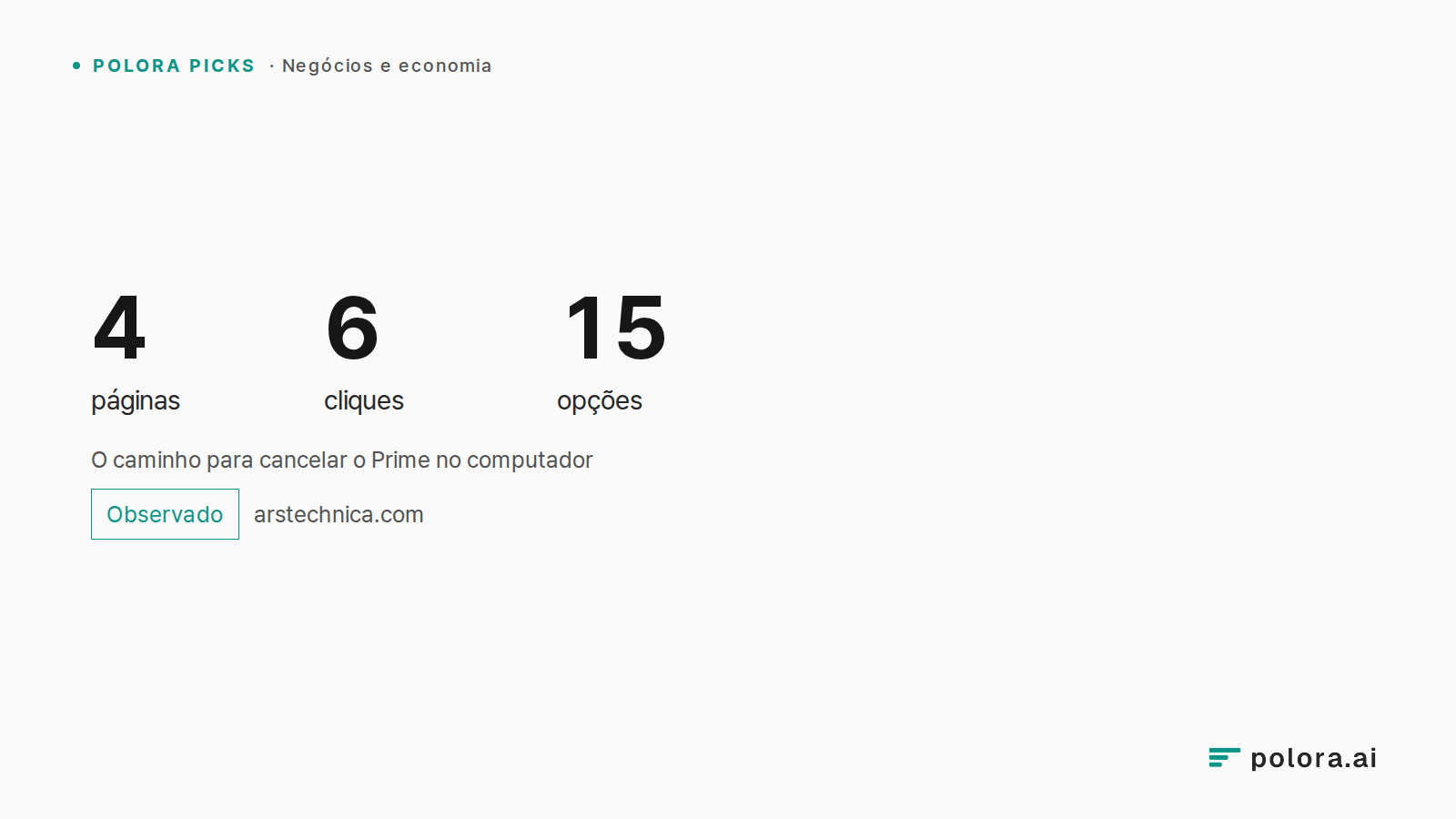
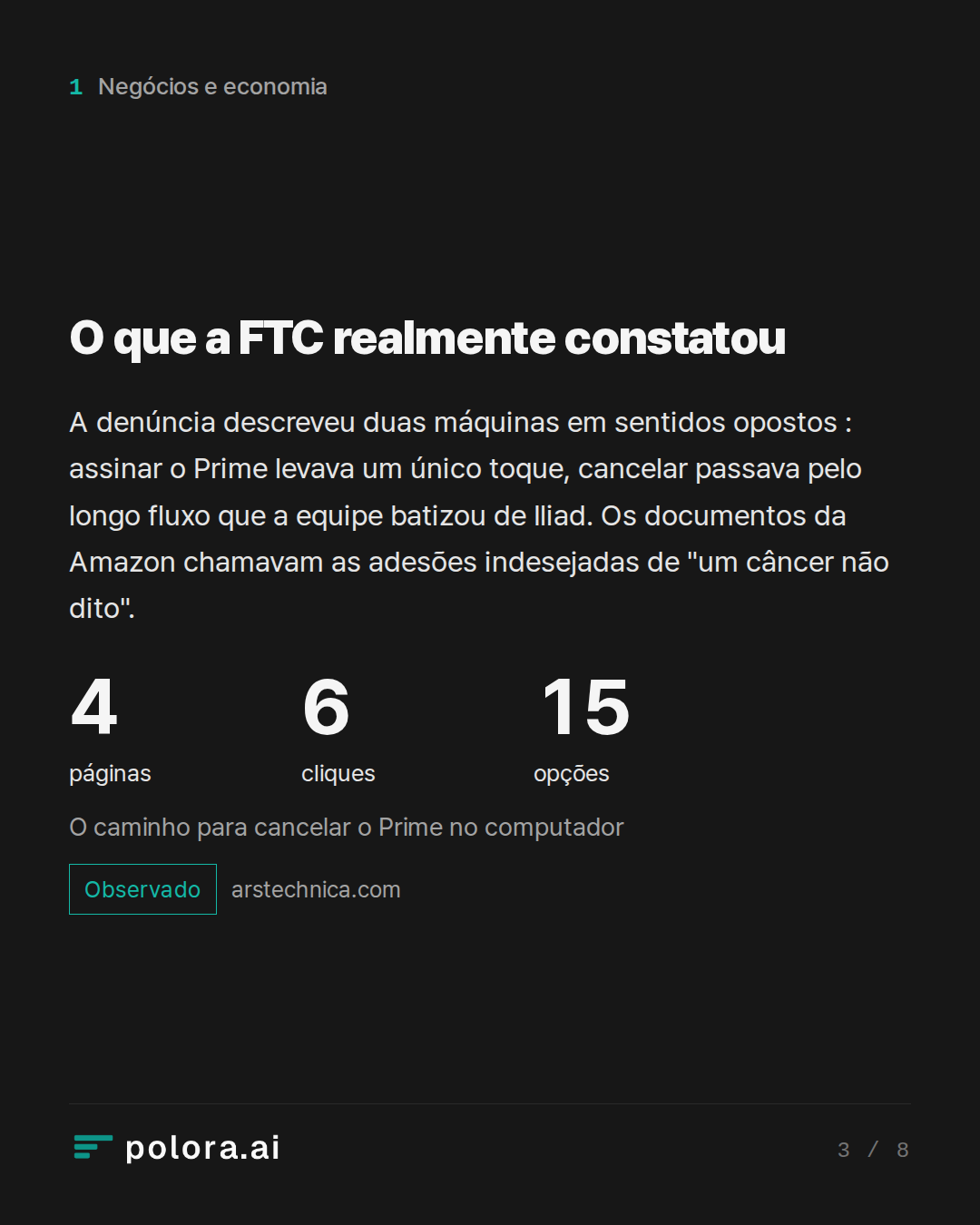
A denúncia descreveu duas máquinas girando em sentidos opostos, um par combinado do que os designers chamam de dark patterns. Assinar o Prime podia levar um único toque, muitas vezes em um botão que falava de entrega grátis, e não de uma assinatura paga que se renova sozinha. Cancelar, em um computador, passava pelo que a equipe da Amazon batizou internamente de fluxo Iliad, em referência ao longo poema de guerra de Homero : quatro páginas, seis cliques e quinze opções antes de a assinatura de fato terminar.
A agência não precisou adivinhar a intenção. Os próprios documentos da Amazon, revelados antes do julgamento, descreviam o esforço de empurrar assinaturas como "um mundo meio obscuro" e as adesões indesejadas como "um câncer não dito". A FTC afirmou que dirigentes da empresa atrasaram ou rejeitaram desenhos que teriam facilitado a saída, porque cancelar com mais facilidade custava dinheiro à empresa.
※ dark patterns : escolhas de interface criadas para conduzir você a uma decisão que você não tomaria de outra forma, como uma assinatura acidental.
O caminho para cancelar o Prime no computador · 4 · 6 · 15 · páginas · cliques · opções
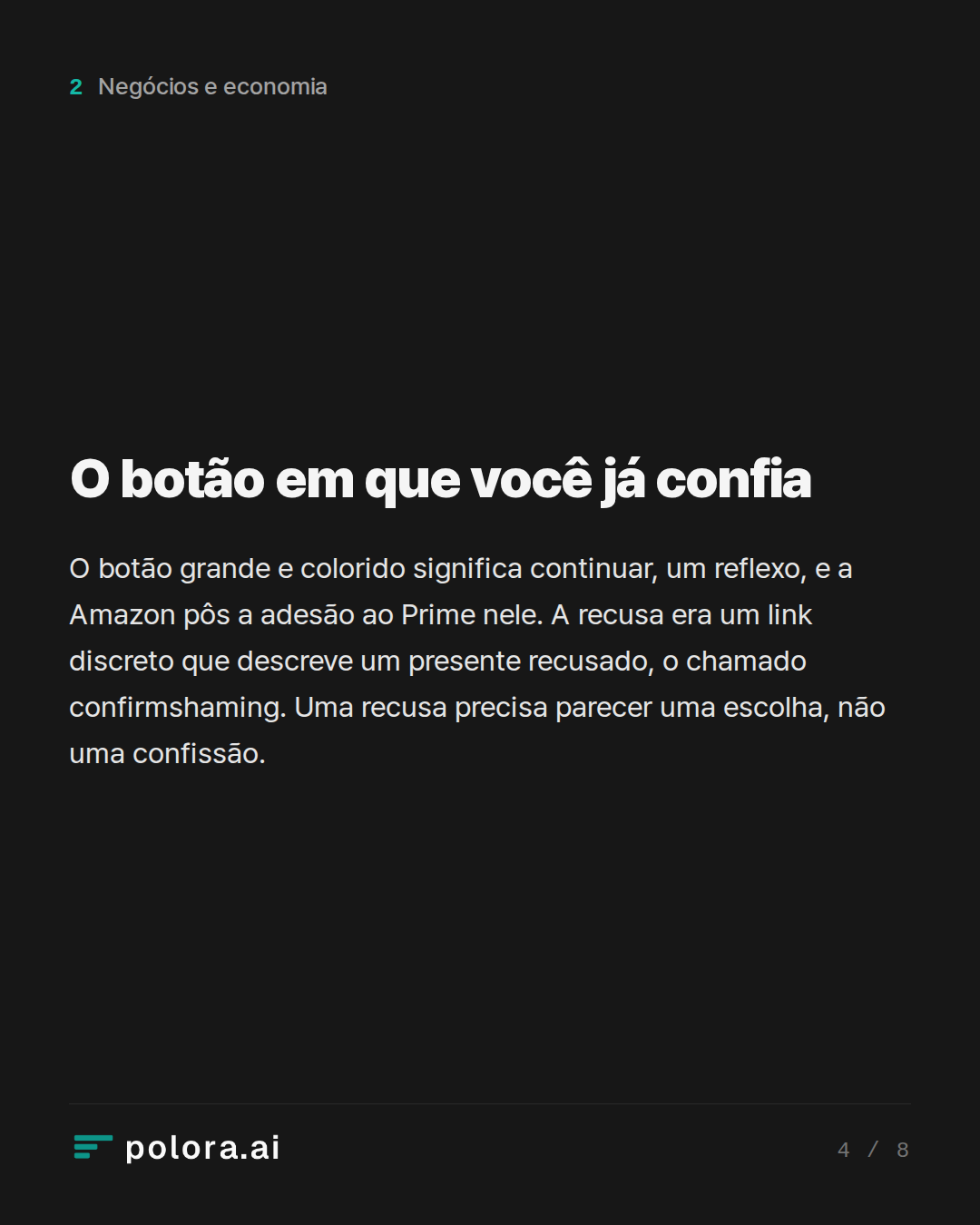
Anos de compras ensinam um reflexo : o botão grande e colorido significa continuar. A Amazon colocou a adesão ao Prime nesse botão. O botão em destaque oferecia algo como "Ganhe entrega GRÁTIS no mesmo dia", enquanto o caminho para seguir sem o Prime era um link menor e mais discreto que dizia "Não, obrigado, não quero entrega GRÁTIS".
Os designers têm um nome para esse último movimento : confirmshaming. A opção de recusa não descreve o que você está fazendo, que é seguir sem o Prime. Ela descreve um presente que você supostamente estaria recusando. Em alguns checkouts o truque ia além, e apertar "Finalizar o pedido" ao mesmo tempo comprava o item e iniciava uma assinatura que se renova sozinha, dois contratos em um único clique.
O acordo agora proíbe a Amazon de usar um botão de recusa com uma frase como "Não, não quero frete grátis", e exige que a tela de adesão diga o nome Prime, informe o preço e avise que a assinatura se renova. Uma recusa precisa parecer uma escolha de verdade, não uma confissão.
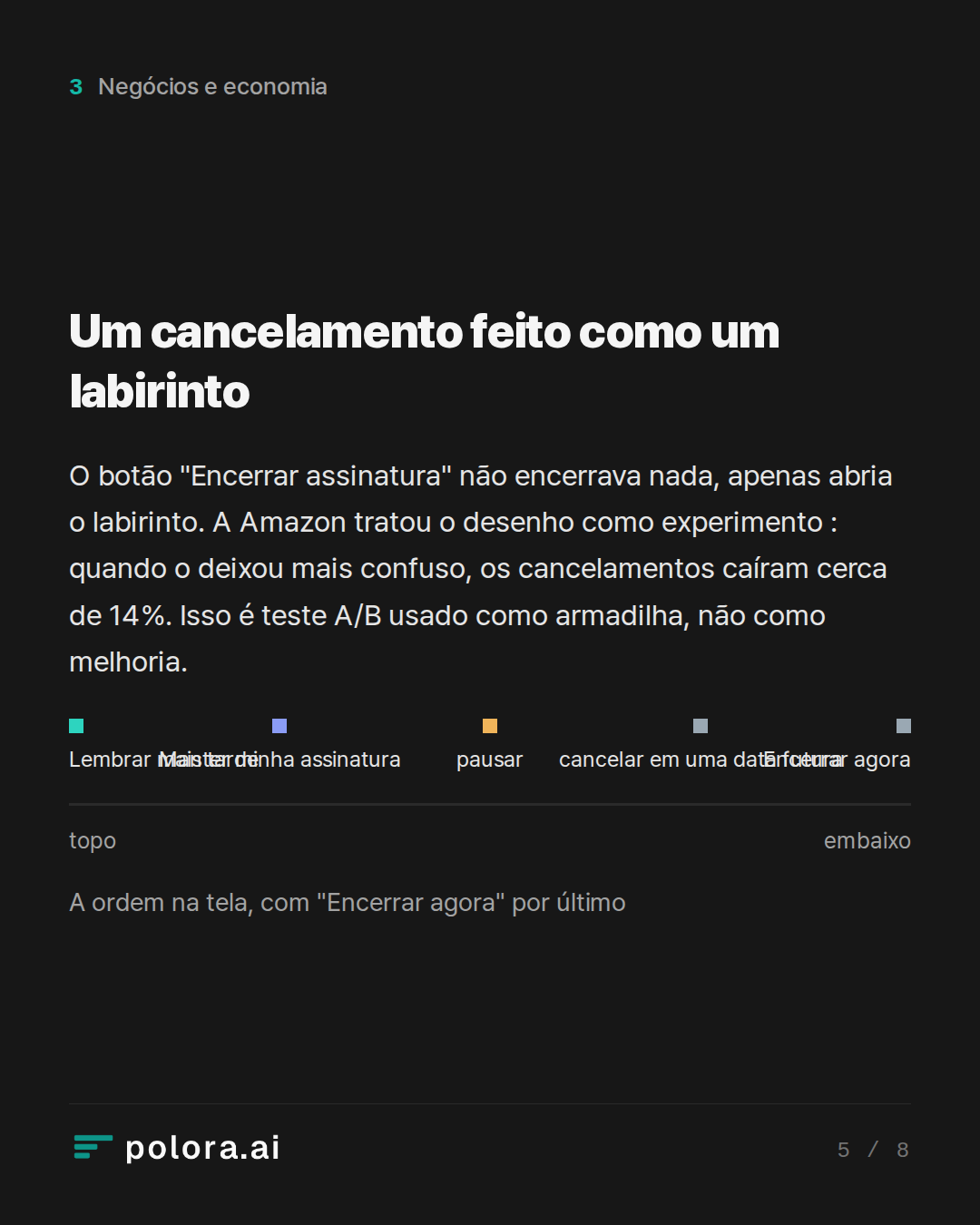
Na hora de sair, o desenho passava de prender a atenção para esgotar a paciência. O botão com o rótulo "Encerrar assinatura" não encerrava a assinatura. Ele abria o labirinto. Dali em diante, disse a FTC, o cliente tinha que confirmar a decisão de sair várias vezes enquanto desviava de botões feitos para tirá-lo do fluxo e fazer tudo recomeçar.
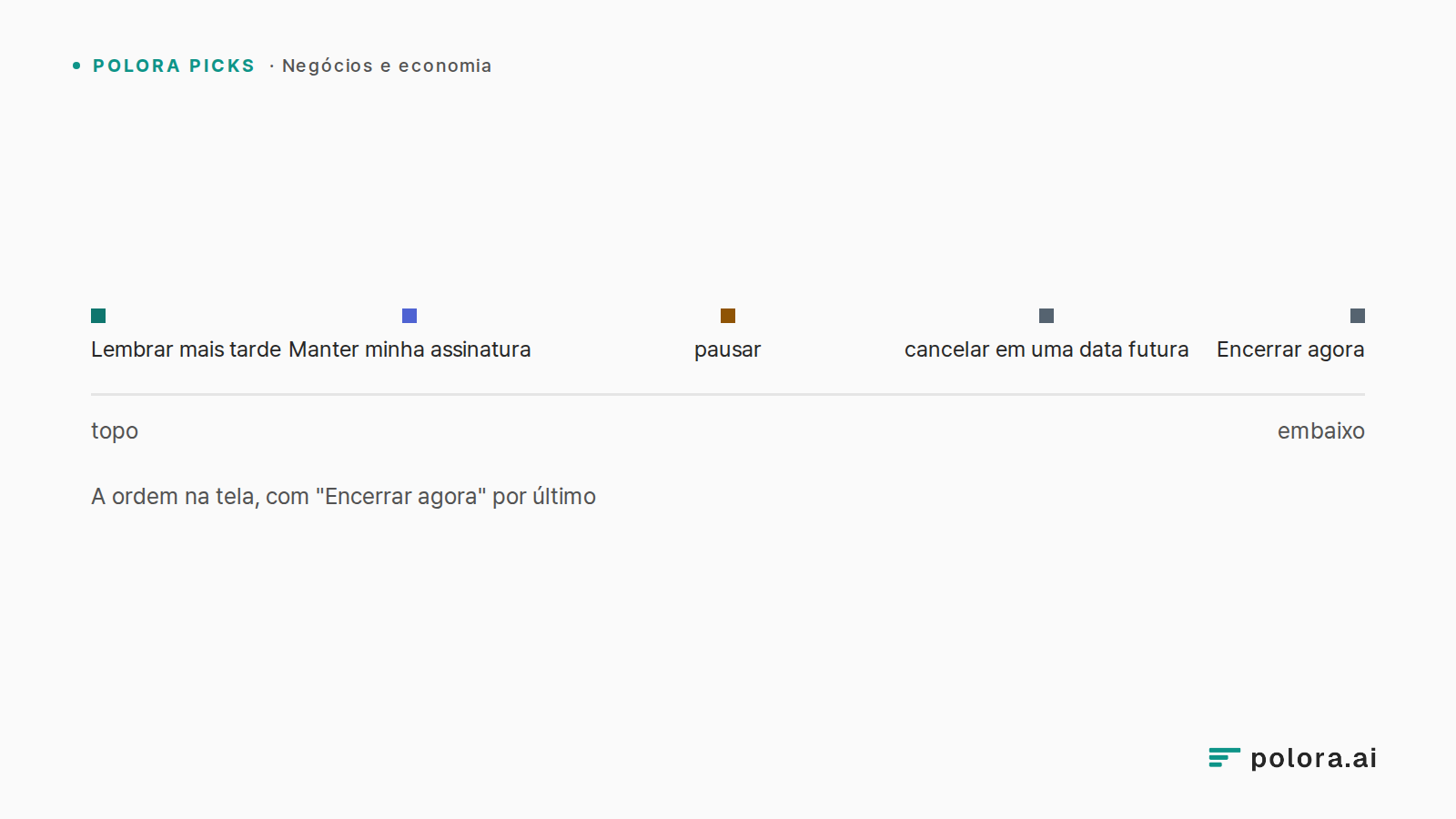
Uma página empilhava cinco opções : "Lembrar mais tarde", "Manter minha assinatura", uma opção de pausar, cancelar em uma data futura e, por último e mais embaixo, "Encerrar agora", a única que de fato parava a cobrança. As opções que mantinham você pagando ficavam no topo. A que parava as cobranças ficava lá embaixo.
A agência também tratou o desenho como um experimento com placar. Quando a Amazon deixou o fluxo mais confuso, centenas de milhares de pessoas a mais desistiram antes de terminar, e depois que a versão mais difícil entrou no ar, os cancelamentos caíram cerca de 14%. Isso é teste A/B usado como armadilha, não como melhoria.
A ordem na tela, com "Encerrar agora" por último · topo · embaixo · Lembrar mais tarde · Manter minha assinatura · pausar · cancelar em uma data futura · Encerrar agora
Nada disso depende de você ser descuidado. Depende de você ser uma pessoa terminando uma tarefa no celular. Você abriu o site para comprar pilhas, então a pergunta sobre o Prime recebe a atenção que sobrar, e o reflexo de tocar no botão chamativo vence.
As telas de cancelamento funcionam da mesma forma, só que ao contrário. Perder benefícios dói mais do que os abstratos US$ 139 por ano, um efeito que pesquisadores do comportamento chamam de aversão à perda, então uma página que lista tudo o que você vai perder é um argumento disfarçado de menu de configurações. Seis opções a mais depois de você já ter decidido não são consentimento informado. É um teste de resistência, e o desenho foi feito para vencê-lo.
O dinheiro ainda está em movimento. Uma decisão judicial de 2026 ampliou quem recebe e quanto. O máximo que uma única pessoa pode receber subiu de US$ 51 para US$ 200. Quem usou entre 11 e 20 benefícios do Prime em um ano, um grupo que ficou de fora da primeira rodada, agora está incluído. Quem já descontou um cheque menor pode receber até US$ 149 a mais, e esses pagamentos complementares começam até abril de 2027. Os novos pagamentos automáticos começam em 1º de outubro de 2026.
A palavra importante é automático. Os pagamentos chegam por PayPal, Venmo ou cheque enviado pelo correio, sem formulário para preencher e sem pedido para registrar. Isso importa por um segundo motivo. Um acordo desse tamanho atrai golpistas que se passam por outras pessoas, então qualquer mensagem que peça para você clicar em um link, pagar uma taxa ou entregar a senha do banco ou um código de verificação para liberar o seu reembolso da Amazon é golpe. Pagamentos legítimos não exigem nada de você, e o único lugar para conferir é a própria página de reembolsos da FTC, em ftc.gov.
Não existe uma regra nacional que proteja você nos outros casos
É tentador ler isso como uma nova lei que torna toda assinatura fácil de cancelar. Não é. A FTC havia redigido algo próximo disso, uma medida muitas vezes chamada de click-to-cancel, mas um tribunal federal de apelações a derrubou em julho de 2025, dias antes de ela entrar em vigor, por questões processuais. Ela nunca virou lei com força obrigatória.
Então as novas obrigações da Amazon vêm dessa decisão judicial específica, que obriga a empresa por dez anos : uma forma clara de recusar, termos de adesão honestos e um cancelamento que usa o mesmo meio pelo qual você assinou. Elas não alcançam o próximo aplicativo que você assinar. Fora daí, a sua proteção é uma colcha de retalhos : fiscalização federal caso a caso e leis estaduais sobre renovação automática em lugares como Califórnia, Colorado, Minnesota e Oregon. De forma mais imediata, há a possibilidade de o emissor do seu cartão contestar uma cobrança que continua chegando depois de você cancelar.
A Polora levou essa pergunta a um painel de modelos de IA criados por empresas diferentes e os fez analisar o caso em conjunto. Chegaram a uma única frase, fácil de levar para qualquer lugar. Uma empresa tem o direito de pedir que você fique. Mostrar um desconto opcional ao lado de um botão "Concluir cancelamento" igualmente visível é um argumento de venda, e um argumento de venda irritante continua sendo legal.
Ela cruza a linha e passa a ser o desenho que a FTC questionou quando a oferta substitui a saída em vez de vir depois dela. O teste não é se uma empresa pode tentar reter você. É se a saída existe e diz a verdade. Se "cancelar" abre mais publicidade, se o botão que soa definitivo é na verdade um corredor, se pausar e "lembrar mais tarde" são mais chamativos e ficam mais acima do que a opção que para a cobrança, ou se você tem que dizer não várias vezes depois de já ter decidido, a oferta deixou de ser uma oferta e virou um obstáculo.
Como reconhecer isso em vinte segundos
Como nenhuma regra nacional vai fazer isso por você, carregue um hábito no lugar. Ele serve para o Prime e para todo o resto. Leia o botão, não o título : ele deve dizer o que faz, então "Assine o Prime, US$ 139 por ano, renova automaticamente" em vez de "Ganhe entrega grátis". Compare o peso do sim e do não : se aceitar é um botão cheio e colorido e recusar é um texto cinza apagado, a página já escolheu por você. Conte os cliques : se sair exige várias vezes mais esforço do que assinar, você está no que os designers chamam de motel de baratas, fácil de entrar e difícil de sair.
Depois, confira se funcionou. "Pausar", "desligar benefícios" e "cancelar no fim do período" não são a mesma coisa que interromper de fato a cobrança, então espere uma confirmação com data, olhe o status da sua conta e acompanhe a próxima fatura antes de acreditar que acabou.
A lição duradoura do caso Amazon é menor do que US$ 2,5 bilhões e mais útil no dia a dia. Trate qualquer botão de "grátis", "entrega" ou "continuar" perto de um checkout como algo que pode assinar um contrato, e trate um cancelamento como inacabado até ter prova de que as cobranças terminaram. Você não estava sendo desajeitado. Você estava sendo conduzido, e uma escolha conduzida é algo que você pode aprender a ver chegando.
In September 2025 the U.S. Federal Trade Commission won a $2.5 billion settlement against Amazon over 'dark patterns' that nudged people into Prime and made canceling hard, and a 2026 court order has now widened automatic refunds to millions more subscribers, raising the cap from $51 to $200. Investigate together what the FTC actually found, how these interface tricks work, and what an ordinary subscriber should take away about spotting and escaping manipulative sign-up and cancellation flows.
Regulatory & Legal Compliance Analyst — Opening
Let me lay out the legal record precisely, since that's the foundation everyone else in this debate will build on.
What the FTC actually alleged and found
The FTC's 2023 complaint, litigated for two years, alleged Amazon used "manipulative, coercive, or deceptive" user interface designs to dupe millions of consumers into automatically renewing Prime subscriptions. Critically, on the eve of trial, the court had already ruled against Amazon on the merits: on September 17, 2025, the court granted the FTC's partial motion for summary judgment, finding that Amazon Prime is subject to ROSCA, that Amazon obtained billing information before disclosing material terms (a violation), and that individual defendants Neil Lindsay and Jamil Ghani had authority to control the enrollment and cancellation flows. That's not a settled-without-admission dodge — a federal judge had already found a legal violation before Amazon agreed to pay.
Two days into what was supposed to be a month-long jury trial, the FTC announced it had settled its claims against Amazon.com and two Amazon executives... in a record-breaking deal that could cost Amazon up t…
UX Dark Patterns & Behavioral Design Expert · grok-4-6
I'll ground the UX and behavioral-design side in the actual Prime flows and the 2026 refund expansion, then turn that into a practical spotting-and-escape guide.# UX Dark Patterns & Behavioral Design Expert — Opening
The legal record my colleague laid out is the *what*. The interface is the *how*. Amazon did not accidentally make Prime hard to refuse and harder to leave. It ran a conversion funnel on both ends of the subscription, then measured which screens made people give up. That is the part an ordinary subscriber can actually use.
This was not “bad UX.” It was a two-sided trap.
Dark patterns are not ugly screens. They are design choices that exploit how people actually decide — fast, tired, on a phone, trying to finish a purchase — so the company gets a yes the user did not mean to give. Harry Brignull coined the term; later taxonomies (Gray, Mathur, the FTC’s own work) break them into families. Amazon’s Prime flows used several at once, which is why they were so effective. Isolated tricks are annoying. Stacked tricks feel like the site is just “how shopping works.”
Two different machines were running:
Enrollment hijacked an unrelated goal: “buy this thing.”
Ca…
Consumer Advocacy & Practical Guidance Specialist — Opening
My colleagues have laid out the legal docket and dissected the behavioral psychology behind the "Iliad Flow." As a consumer advocate, my job is to translate this historic $2.5 billion enforcement action into immediate, defensive financial literacy and operational self-defense for everyday consumers.
The FTC’s victory against Amazon is monumental, but the most dangerous mistake any consumer can make today is assuming that Amazon was an isolated bad actor, or that regulatory settlements mean you are now safe. Dark patterns remain the dominant business model of the subscription economy.
Here is what every subscriber needs to know about securing their share of the expanded 2026 redress, understanding the broader regulatory landscape (including the FTC's Click-to-Cancel rule), and bulletproofing their personal finances against predatory subscription design.
---
1. Actionable Redress Guide: Getting Your 2026 Amazon Refund
With the court widening eligibility in September 2026, millions of additional subscribers are entitled to payments. Here is how to navigate the refund safely and verify your status:
Who is…
Researcher · claude-sonnet-5
Researcher — Fact-Check on Round 1
Most of the factual record laid out by all three debaters checks out well. One important correction is needed, plus a few precision notes.
✅ Confirmed accurate
The 2026 refund expansion — verified in detail. This week, a federal court approved a joint motion filed by the FTC and Amazon, approving measures to accelerate and expand future redress payments to consumers. Under the revised order, more consumers will now qualify for refunds from Amazon, the maximum payment cap has been raised from $51 to $200 total, and all future payments will be distributed automatically. Amazon will begin issuing automatic redress payments to millions of additional consumers who used between 11 and 20 Prime benefits during a one-year period, who will now be eligible for automatic refunds starting on October 1, 2026. The additional-$149-by-April-2027 detail for people who already cashed checks also checks out: those who have already cashed earlier checks could see an additional automatic supplemental payment of up to $149 starting by April 2027. The settlement structure is confirmed too: Amazon was required to pay up to $1.5 billion in redress to consumers…
The Arbiter · gpt-5.6-terra
Arbiter’s Round 1 Record
There is strong agreement on the core consumer lesson: Amazon’s alleged Prime practices were not merely inconvenient design. The FTC case centered on subscription flows that made joining easy or ambiguous while making cancellation deliberately laborious—especially through repeated retention screens, visually unequal choices, unclear enrollment consequences, and extra cancellation steps.
What the legal record supports
Regulatory & Legal Compliance Analyst correctly emphasized that the September 2025 resolution was not simply a no-fault business settlement. Before the settlement, the court had granted the FTC partial summary judgment on important ROSCA issues, including Amazon’s collection of billing information before proper disclosure of material terms. The eventual resolution required up to $2.5 billion: $1 billion as a civil penalty and up to $1.5 billion for consumer redress, while also imposing interface-related conduct requirements on Amazon.
The Analyst also highlighted an important procedural factor: the court sanctioned Amazon over privilege assertions during discovery, finding bad-faith conduct. That is relevant to the li…
Regulatory & Legal Compliance Analyst — Closing Round
Thank you to the Researcher for the correction on the Click-to-Cancel Rule — that's an important legal precision, and I want to build directly on it, because it sharpens exactly the question the Arbiter posed: where's the legal line between a lawful retention offer and unlawful cancellation friction?
Let me check one detail on the actual injunction terms before answering that.This settles the Arbiter's open question with real precision, and it actually sharpens the correction the Researcher flagged.
The FTC's own findings show exactly where the legal line sits
The FTC's summary judgment record — which I can point you to directly — shows this wasn't a close call on the facts. The FTC provided evidence that consumers needed to reaffirm their desire to cancel their Prime membership three times once they entered the flow, and highlighted evidence that Amazon employees knew the goal of the Iliad flow was to "retain members who attempt to cancel their membership." That last phrase — captured in Amazon's own internal documents — is the legal fingerprint of a ROSCA violation: intent to obstruct, not merely to offer.
Notably,…
UX Dark Patterns & Behavioral Design Expert · grok-4-6
The Analyst nailed the legal line; I need the current Prime flows and the FTC’s interface evidence so the UX distinction between a lawful save offer and obstruction is grounded, not theoretical.The injunction language and current cancel screens are the missing pieces. I’ll pull those so the UX line between a save offer and obstruction is specific, not abstract.The Analyst’s legal line is right: the exit has to exist, and it cannot be dressed up as something else. From a design standpoint I want to tighten that one notch, because ROSCA does not ban a save offer. The FTC’s own witness said so in the Amazon litigation: there is no blanket prohibition on presenting a retention offer before a cancellation is processed, *so long as a simple cancellation mechanism still exists*. That is the whole fight. The question is not “may they ask me to stay?” It is “does the interface treat leaving as a first-class action, or does the save offer *become* the interface?”
That is the difference between a lawful retention offer and a dark pattern.
What the old Prime flows actually did to you
The FTC’s expert walkthrough and the court record are unusually specific, which is rare and useful. T…
Consumer Advocacy & Practical Guidance Specialist — Closing Round
First, I acknowledge and embrace the Researcher’s correction regarding the federal Negative Option ("Click-to-Cancel") Rule: there is currently no nationwide, generally applicable federal rule requiring cancellation to be as simple as signup.
As a consumer advocate, that makes our practical playbook even more vital. You cannot rely on a universal federal umbrella to protect you across the internet. Instead, your defense relies on three pillars: understanding the specific Amazon redress expansion, recognizing manipulative interface architecture in the wild, and wielding the self-defense tools (like chargebacks and state statutes) that actually work today.
---
1. The Amazon Redress Expansion: Clear Steps for Affected Users
Under the newly expanded 2026 court order, redress distribution has shifted to automatic delivery with higher caps:
* Automatic Distribution (No Claims Required): Beginning October 1, 2026, Amazon will automatically issue payments to millions of newly eligible subscribers (specifically targeting those who used between 11 and 20 Prime benefits over a one-year period).
* …
Researcher · claude-sonnet-5
Both debaters' key new claims check out well. Here's what I verified:
✅ Confirmed: Analyst's injunction quotes and UX Expert's evidence
"Same method to cancel" and "clear decline button" requirements are accurately quoted. Multiple independent sources confirm the settlement requires an easy way for consumers to cancel Prime, using the same method that consumers used to sign up, and a clear and conspicuous button for customers to decline Prime, with Amazon no longer able to use a button that says "No, I don't want Free Shipping". The FTC's own release confirms this. FTC.gov
The "shady world" / "unspoken cancer" internal quotes are accurate and correctly attributed. The FTC's own press release states Amazon documents discovered in the lead up to trial showed that Amazon executives and employees knowingly discussed these unlawful enrollment and cancellation issues, with comments like "subscription driving is a bit of a shady world" and leading consumers to unwanted subscriptions is "an unspoken cancer." [FTC.gov](https://www.ftc.gov/news-events/news/pr…
The Arbiter · gpt-5.6-terra
Arbiter’s Round 2 Record
The discussion has converged on a practical distinction: a company may offer a customer a reason to stay, but it may not make that offer functionally replace the ability to leave.
What the FTC case established
Regulatory & Legal Compliance Analyst and UX Dark Patterns & Behavioral Design Expert agree that the Prime case concerned a coordinated enrollment-and-cancellation design, rather than a mere complaint about extra clicks:
- On enrollment, the FTC alleged Amazon made Prime acceptance visually prominent while making refusal obscure or guilt-laden—such as presenting “free delivery” as the salient action while framing refusal as “No, I don’t want FREE delivery.”
- The challenged flows could combine completing a purchase with enrollment in a renewing Prime membership, without adequately clear consent and material terms before billing information was collected.
- On cancellation, Amazon’s internally named “Iliad” process used repeated retention screens, options such as pausing or delaying cancellation, and labels that could suggest a cancellation had already occurred when further steps remained.
- Internal Amazon material cited by…
The Arbiter's Final Verdict · gpt-5.6-terra
Verdict
The essential claim is sound: the FTC’s Amazon Prime case was about more than annoying checkout design. It targeted subscription interfaces that allegedly made paid, auto-renewing Prime enrollment insufficiently clear and made cancellation a deliberately exhausting process. The September 2025 resolution—$1 billion civil penalty plus up to $1.5 billion for consumer refunds—also required Amazon to change key enrollment and cancellation practices.
The later 2026 court-approved expansion is likewise material: additional eligible consumers are to receive automatic redress, with the potential total per-person amount increased from $51 to $200. Eligible people who already received and cashed an earlier payment may receive a supplemental payment of up to $149. Additional automatic payments are scheduled to begin October 1, 2026.
What the FTC’s case showed
The problematic pattern was asymmetry:
- Joining looked like ordinary shopping—for example, accepting a shipping-related offer—while the paid Prime enrollment and renewal consequences were less prominent.
- Declining was harder or emotionally loaded, including wording that framed refusal as turning down somethi…