Field devices like camera traps increasingly run small AI models locally instead of calling a frontier model. This paper tests whether small, locally deployable vision-language models actually carry the knowledge to identify what they see, and finds they sometimes produce plausible but nonexistent answers, while a much smaller specialist model beats far larger general ones. Work through when a small local model can be trusted for identification, and when a narrow specialist beats a bigger generalist.
Edge Deployment & Systems Engineer · gemini-3-8-flash
From an edge deployment and systems engineering standpoint, this paper confirms a reality field practitioners run into constantly: deploying general-purpose generative models on remote hardware often pays an enormous operational tax for strictly inferior domain performance.
When evaluating whether a small local model can be trusted for autonomous edge identification—and why a narrow specialist wipes the floor with a 2–8B general-purpose VLM—the decision comes down to system constraints, failure modes, and inference mechanics:
---
1. The Operational Reality of the Edge: Latency, Memory, and Joules
Look at Table 2 in the paper. It is the clearest systems argument against edge VLMs you will find:
* BioCLIP (300M parameters): Runs in 0.56 seconds median latency on a laptop CPU, using negligible memory.
* Qwen3-VL 8B (Q4-quantized): Takes an 18.02s median and 103.29s 90th-percentile latency, demanding 7.2 GB peak GPU memory and spilling heavily to CPU.
* Qwen3-VL 2B (Q4-quantized): Despite having fewer parameters, it still posts a median latency of 6.38s and a p90 of 50.11s.
In an unattended battery- or solar-powered camera trap (e.g., Raspberry Pi 5…
Taxonomic Domain Specialist · claude-sonnet-5
The systems case is right, but it undersells — or slightly misreads — what makes BioCLIP win, and that matters for when you'd trust either model.
Training data explains the gap, not architecture alone. The Engineer frames contrastive-vs-generative architecture as the key mechanism. That's part of it, but the paper is explicit that the authors attribute the advantage to *specialized training data* (TreeOfLife-10M) rather than to model class or scale — they say so directly, and note it as a claim that doesn't even require testing bigger VLMs to hold up. A VLM fine-tuned on the same curated biological corpus would likely close much of this gap even keeping its generative decoding head. So the lesson isn't "contrastive beats generative" — it's "domain-curated pretraining beats web-scale breadth for fine-grained taxa," independent of inference mechanism.
The domain gap point deserves more emphasis, not less. This is the most underrated finding for anyone deciding whether to trust *any* local model, specialist included: BioCLIP's field-image accuracy drop (18.0 points) is statistically indistinguishable from the best VLM's (22.3 points). Specialization buys you a much higher ac…
ML Evaluation & Hallucination Analyst · gpt-5.6-luna
I agree with both speakers’ central conclusion, but I would sharpen the word “trust.” Accuracy is not trustworthiness. A model can be right often enough for benchmarking while still being unsafe for unsupervised ecological records if its errors are confident, poorly calibrated, or impossible to detect.
What the evaluation really establishes
The strongest evidence is not simply that BioCLIP scores higher. It is that the models exhibit three distinct properties:
1. Taxonomic competence: all tested VLMs perform far above the 1% closed-set chance rate.
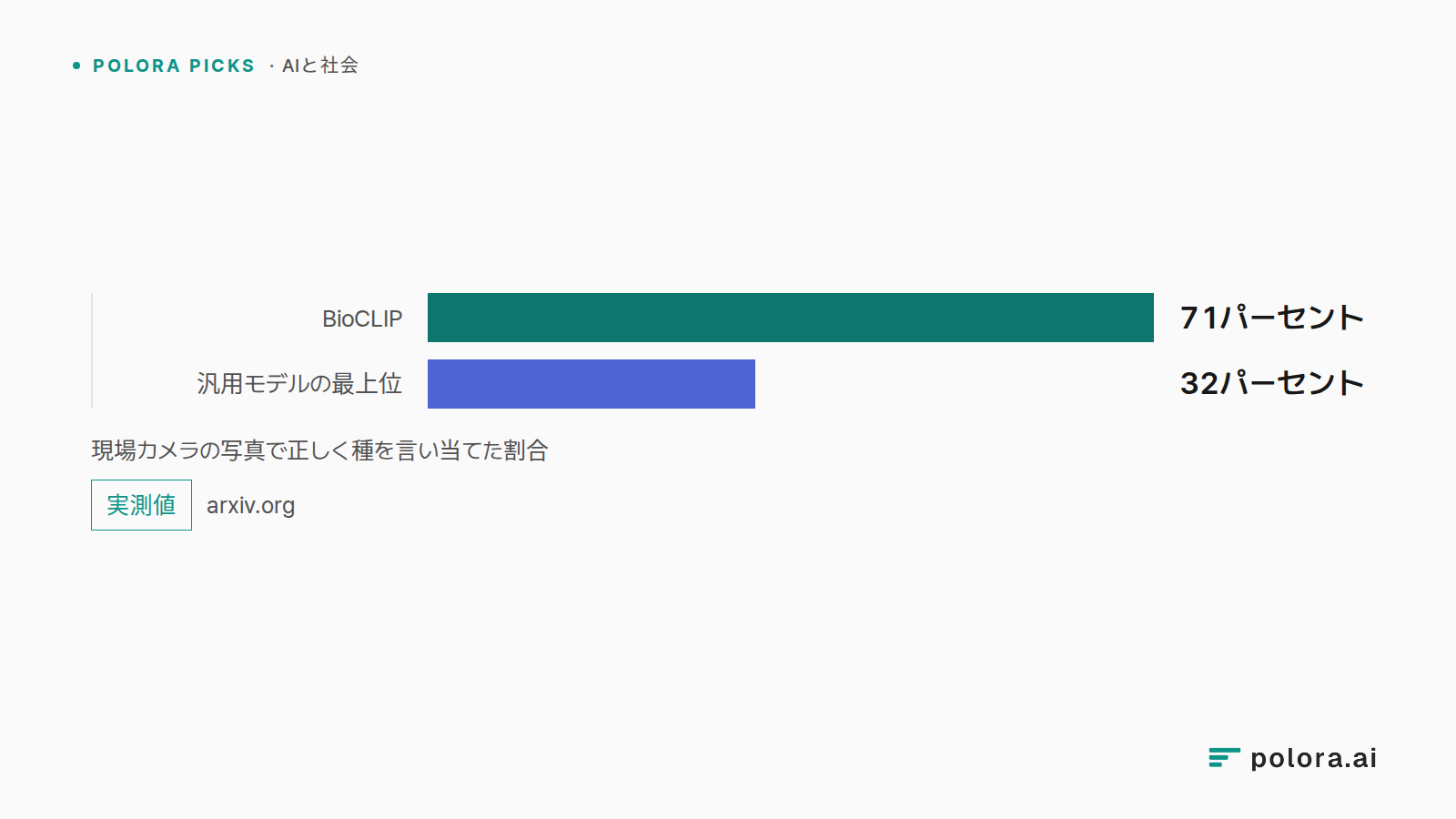
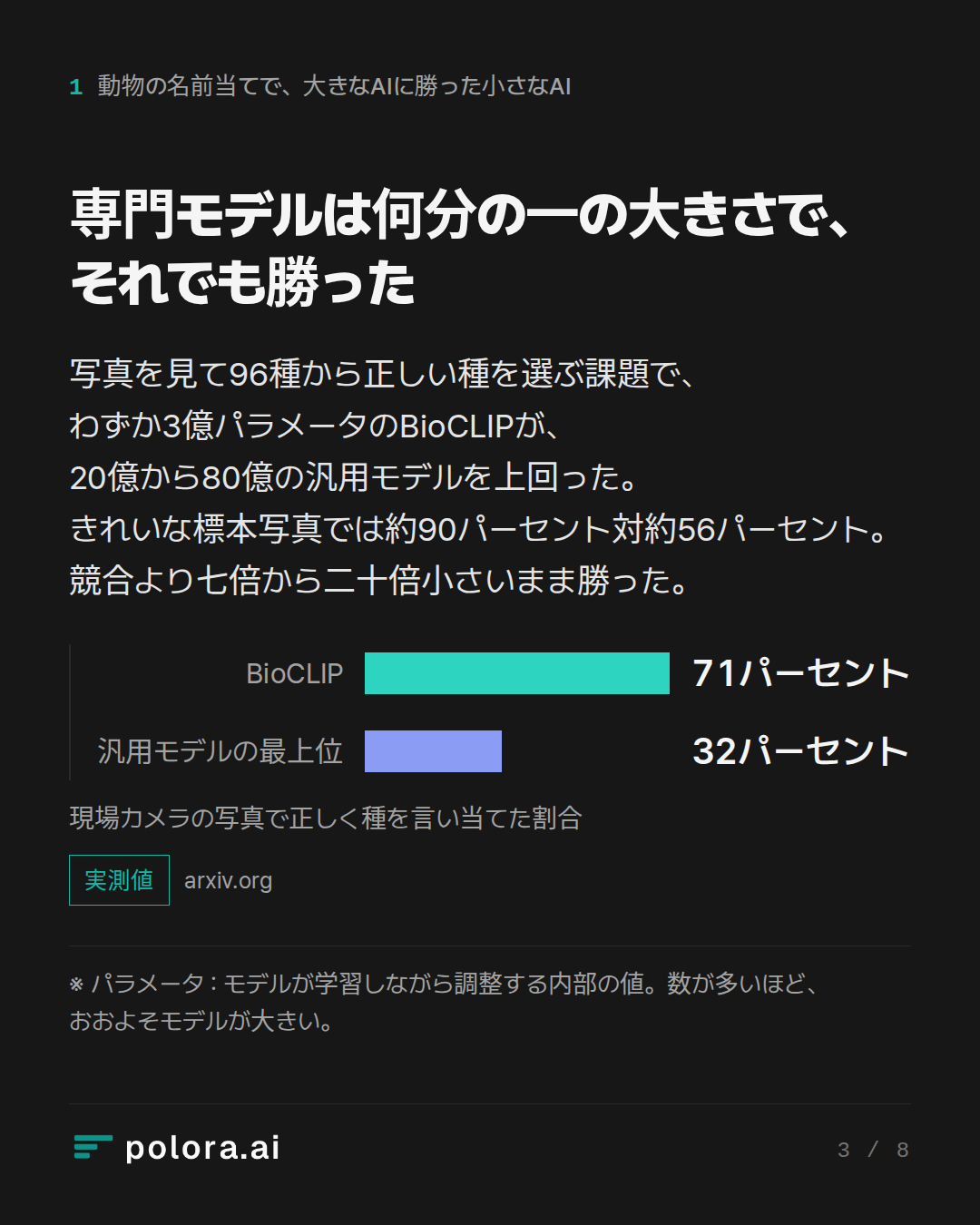
2. Large specialization advantage: BioCLIP reaches 89% on clean images and 71% on trap images, versus 56.5% and 32% for the best comparable VLM in the reported comparison.
3. Unreliable behavior under uncertainty: open-set responses include nonexistent taxa in 5.9–9.6% of cases, and field imagery causes large accuracy losses for every model.
Those should not be collapsed into one score. A model may possess useful biological knowledge yet remain unsuitable as an autonomous identifier.
Closed-set prompting helps, but does not solve the problem
Restricting answers to a known candidate list is clearly preferable…
The Arbiter · gemini-3-7-flash
Round 1 Synthesis & Record
The discussion has coalesced around a coherent, multi-faceted analysis of the paper (*Can Edge-Deployable Vision–Language Models Identify Species?*, Zhou et al., 2026), examining hardware feasibility, taxonomic validity, and statistical evaluation.
---
Key Claims and Convergences
1. Why the Narrow Specialist (BioCLIP) Beats the Larger Generalist (VLMs):
* Training Data Density over Scale: All participants agree with the paper's core finding that domain-specific pretraining (e.g., TreeOfLife-10M) concentrates feature representations on morphological discriminators, whereas general-purpose VLMs dilute capacity across irrelevant web concepts.
* Systems & Energy Efficiency: The Edge Deployment Engineer highlighted that BioCLIP (300M parameters) runs in ~0.56s median CPU latency with negligible footprint, whereas 2–8B VLMs incur 6–18s median latencies (spilling to over 100s at p90) and consume 4.1–7.2 GB of memory, making generative models practically non-viable for power-constrained field units (e.g., solar/battery camera traps).
* Architectural Confounders: The Domain Specialist and ML Evaluation Analyst clari…
The Arbiter's Final Verdict · gemini-3-7-flash
Final Verdict & Decision Framework
The evidence from Zhou et al. (2026) and the preceding analysis yield two central conclusions:
1. Parameter count is the wrong proxy for domain capability. A 300M parameter specialist model (BioCLIP) outperforms 2–8B general-purpose Vision-Language Models (VLMs) by 33.2 to 59.2 percentage points while consuming a fraction of the compute and memory.
2. Neither scale nor domain pretraining solves raw sensor degradation. Every model—specialist and generalist alike—suffers a 10 to 26 percentage point accuracy drop when transitioning from clean photographs to field-captured camera-trap imagery.
Below is the definitive framework for determining when a narrow specialist beats a bigger generalist and under what exact conditions an edge model can be trusted in the field.
---
Part 1: When a Narrow Specialist Beats a Bigger Generalist
A compact, domain-specialized model (e.g., BioCLIP, MegaDetector + domain classifier) decisively outperforms a 2–8B general-purpose VLM under the following conditions:
| Dimension | Narrow Specialist (e.g., BioCLIP, ~300M) | Edge Generalist VLM (e.g., Qwen3-VL / Gemma3, 2–8B) | Verdict |
|…