Rockstarは、Grand Theft Auto 6をゲーム機向けに発売すると認めた。一部の報道によれば、PC版はこのスタジオの通例よりも早く登場するかもしれないという。PC版の発売日は公式には決まっておらず、そこはまだ噂の域を出ない。それでも一度立ち止まって考える価値があるのは、そこに添えられた理由だ。ゲーム機の価格が上がり続けており、それが、大作ソフトをまずゲーム機に出すという古くからの習慣を静かに緩めつつある。
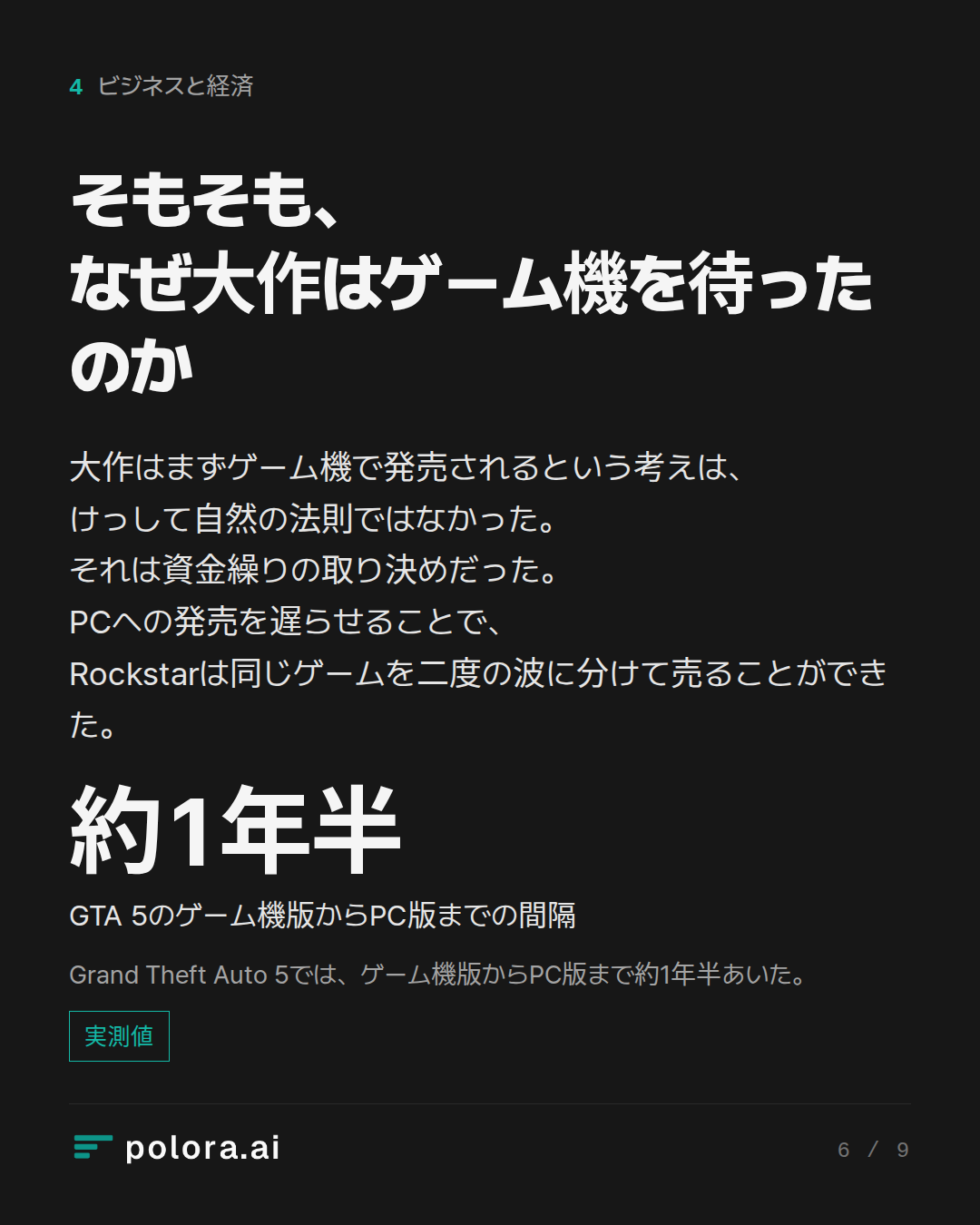
大作はまずゲーム機で発売されるという考えは、けっして自然の法則ではなかった。それは資金繰りの取り決めだった。Grand Theft Auto 5は2013年にゲーム機へ、PCへはおよそ一年半後に届き、Red Dead Redemption 2も、もっと短い間隔で同じ型をなぞった。これを支えていたものが二つある。ゲーム機の持ち主は、新しい機械に数百ドルを使ったばかりであることが多く、すぐに定価を払う構えができていた。そしてゲーム機メーカーは、これらのゲームを、自社のハードを持つ理由として大々的に宣伝した。それは、金をかけずに得られる注目として莫大な価値があった。PCへの発売を遅らせることで、Rockstarは同じゲームを二度の波に分けて売ることができた。
Grand Theft Auto 5では、ゲーム機版からPC版まで約1年半あいた。 · 約1年半 GTA 5のゲーム機版からPC版までの間隔
Rockstar may bring Grand Theft Auto 6 to PC earlier than usual, and reporting ties the timing to rising console prices. Work through why game console makers are raising prices now and how that shifts the old assumption that the biggest games launch on console first, so a reader understands the economics behind where and when a game shows up.
AAA Game Publishing & Distribution Strategist · claude-sonnet-5
Let me lay out the publishing/distribution logic here, because this isn't really a hardware story first — it's a platform-strategy story that hardware prices happen to accelerate.
Why console prices are rising now: tariffs on components (especially anything routed through China), memory/DRAM and NAND price spikes tied to AI datacenter demand crowding out consumer supply, and general semiconductor cost inflation. Sony and Microsoft have both pushed through price increases in 2025-2026 outside their normal cycles — that's unusual and signals margin pressure, not just "new gen premium pricing."
Why this matters for GTA 6's platform strategy specifically: Rockstar/Take-Two make console versions timed exclusives historically (GTA5 was console-first by over a year on PC) because:
1. Console install base was reliably huge and consolidated (fewer SKUs, fewer support headaches).
2. Piracy/anti-cheat/anti-tamper control is easier on closed platforms — big for GTA Online's monetization.
3. Console marketing deals (timed exclusivity money from Sony/Microsoft) subsidized the release.
What's shifting: if console hardware gets more expensive, adoption slows or plateaus — fewer new cons…
Hardware Manufacturing & Platform Economist
Consoles are not priced like TVs. They are subsidized platforms: Sony and Microsoft historically sold hardware at or below cost so they could lock in a decade of software, online, and accessory margin. That bargain only works if bill of materials (BOM) is falling or at least stable, and if software attach is huge. Both legs are under pressure now, which is why sticker prices are going up and why a GTA-class title can rationally show up on PC sooner.
Why console makers are raising prices *now*
1. Silicon and memory are not on the old Moore’s-Law discount schedule. A current-gen SoC is a large, high-performance chip on a relatively expensive node, plus GDDR, plus a custom SSD controller. After the 2021–23 shortage, DRAM/NAND and foundry pricing did not collapse into a long, steep decline the way late-cycle consoles used to enjoy. When the *variable cost of the box stays high*, the old “lose $50–150 per unit at launch, recoup later” model becomes a *structural* loss, not a marketing loss.
2. The rest of the BOM inflated and stayed inflated. Power supplies, chassis, cooling, optical (where it still exists), pac…
Participant 3 · deepseek-v4-flash
The reporting makes sense only if you stop treating "console first" as a law of nature. It was a financing arrangement, and rising console prices are the bill coming due.
Why console prices are rising now — four forces
1. The silicon discount died. For 20 years, each console generation got a *cheaper* process node at launch than the previous gen's mid-life refresh — that's how Sony and Microsoft delivered more power at the same $399–$499. That curve has flattened. Advanced-node wafers no longer fall ~40–50% in cost per transistor, so a next-gen box's BOM simply costs more. There is no cheaper future node to wait for. This is the first generation where we saw mid-life *price increases* instead of price cuts — a structural sign, not a blip.
2. AI ate the memory market. Memory is the second-biggest cost line in a console after the SoC. HBM/AI demand consumed fab capacity and pushed DRAM and NAND prices up sharply in 2025–26, so 16GB of GDDR7 plus a 2TB SSD costs materially more than the same spec would have a few years ago. Consoles can't dodge commodity markets.
3. Tariffs and supply-chain politics. Consoles are assembled in Asia and sold globally; the 2025–26 tar…
Researcher · grok-4-6
I'll check the GTA 6 PC-timing reports, recent console price moves, and the hardware-cost claims against current sources.The rumor looks concentrated in one VGC/podcast thread; I’ll open that reporting plus the official price and memory-cost statements next.Here is what currently checks out against public reporting, and what does not. The rumor in the topic is real; it is also thin. The console-price story is not.
The Arbiter · gpt-5.6-terra
The debate has a useful core insight but overstates several links. The evidence supports cost pressure and changing platform strategy; it does *not* yet establish that rising console prices caused Rockstar to shorten a PC window.
What is solid
- Console prices rising mid-cycle is unusual. Sony has raised PS5 prices in various markets, Microsoft has lifted prices on Xbox hardware, and newer premium hardware such as PS5 Pro has reset expectations upward. Tariffs/trade exposure, exchange rates by region, component costs, logistics, and the difficulty of extracting late-generation manufacturing savings all plausibly contribute.
- The old console subsidy model is under strain. Platform holders once could accept low or negative hardware margins because exclusive software, game-store commissions, subscriptions, accessories, and a growing installed base repaid the subsidy. As development costs rise and first-party games become less permanently exclusive, that recovery case is less certain.
- PC is economically more important than in earlier Rockstar cycles. Steam is a mature global premium market; cross-platform development pipelines are more established; and a GTA re…
The Arbiter's Final Verdict · gpt-5.6-terra
The most defensible conclusion is that an earlier GTA 6 PC release is plausible, but the claimed link to console price rises is an economic influence—not an established cause.
Console makers are raising prices because the old lifecycle economics have weakened. Modern consoles use costly custom chips, memory, storage, cooling, and globally exposed supply chains. Tariffs, exchange rates, logistics, and slower manufacturing cost reductions make it harder to do what earlier generations routinely did: cut prices as the generation matures. At the same time, Sony and Microsoft have more reason to protect hardware margins because game-development costs are higher, subscriptions complicate the old “sell the box cheaply, earn it back later” model, and permanent exclusivity is less central than it once was.
That matters to publishers because a pricier console can slow the expansion of the console audience. If a player already owns a capable PC, a PC edition has no additional console purchase attached. A long PC delay therefore means postponing sales to a large, mature global market—and, for a game built around GTA Online, postponing participation in a recurring-spend ecosystem and split…