차이는 예비를 둔 것 자체가 아니라 그것이 일을 넘겨받을 수 있느냐다. 항공은 혼자 힘으로 일 전부를 해내는 예비에 돈을 치른다고 폴로라 AI 패널은 짚는다.
과학과 건강 · 2026-08-27
2026년 8월 25일, 델타항공의 보잉 757 한 대가 147명을 태우고 로스앤젤레스를 떠나 보스턴으로 향했다. 대륙 위 어딘가에서 기장이 몸이 나빠졌다. 비행기는 디트로이트로 기수를 돌려 게이트에 댔고, 새 승무원을 태운 뒤 같은 기체 그대로 보스턴까지 갔다. 놓치기 쉬운 것은 이 일이 왜 큰 사고가 되지 않았는가다. 기장은 그동안 내내 무전기를 잡고 '아픈 사람은 접니다'라고 분명히 말하고 있었다. 비행기에는 영웅이 필요한 순간이 오지 않았다.
기억해 둘 대목이 바로 여기다. 이것은 용기와는 상관이 없다. 조종사 두 명이 타는 조종실에서는 상태가 더 나쁜 쪽이 무전을 맡아 다른 쪽이 조종에 집중하게 한다. 이 역할 교대는 그 순간에 만들어진 것이 아니다. 그 비행에 탄 누군가가 아픈 채로 잠에서 깨기 몇 년 전에 이미 설계되고, 비용이 치러지고, 반복 훈련까지 끝난 것이었다.
폴로라는 이 뉴스 뒤에 있는 물음을 여러 AI 모델에게 던졌고, 모델마다 다른 역할을 맡겼다. 항공 시스템 엔지니어, 안전 문화 분석가, 여러 산업을 넘나드는 리스크 전략가가 이 문제를 놓고 다퉜고, 연구원 역할은 그 주장들을 공개 기록과 맞춰 보았다. 극적인 장면을 접어 두면, 상업 항공은 한 사람이 갑자기 무너져도 비행기가 떨어지지 않도록 만들어져 있다. 그것을 실제로 굴러가게 하는 것은 무엇이고, 다른 많은 분야는 왜 이것을 못 베끼는가?
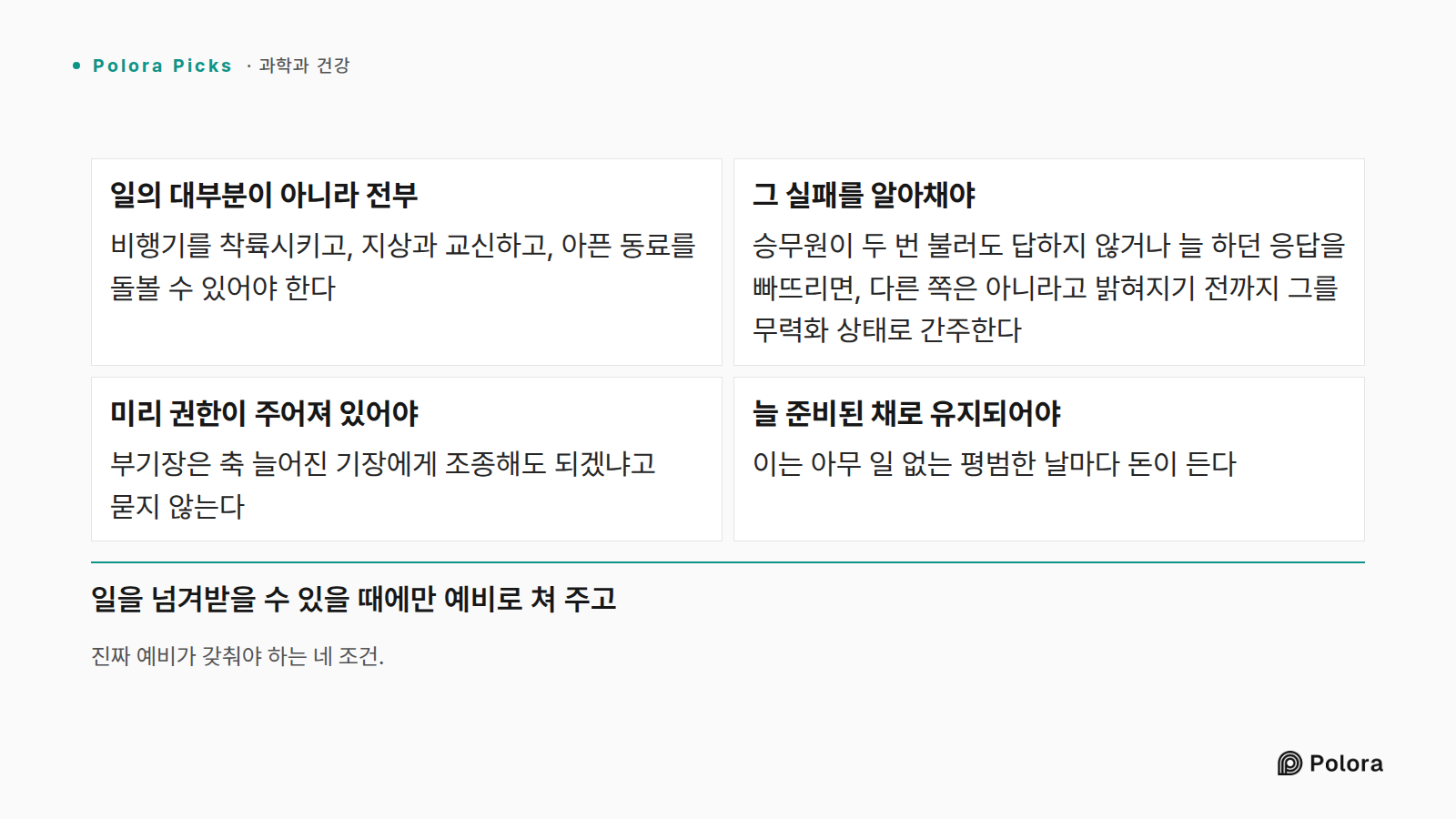
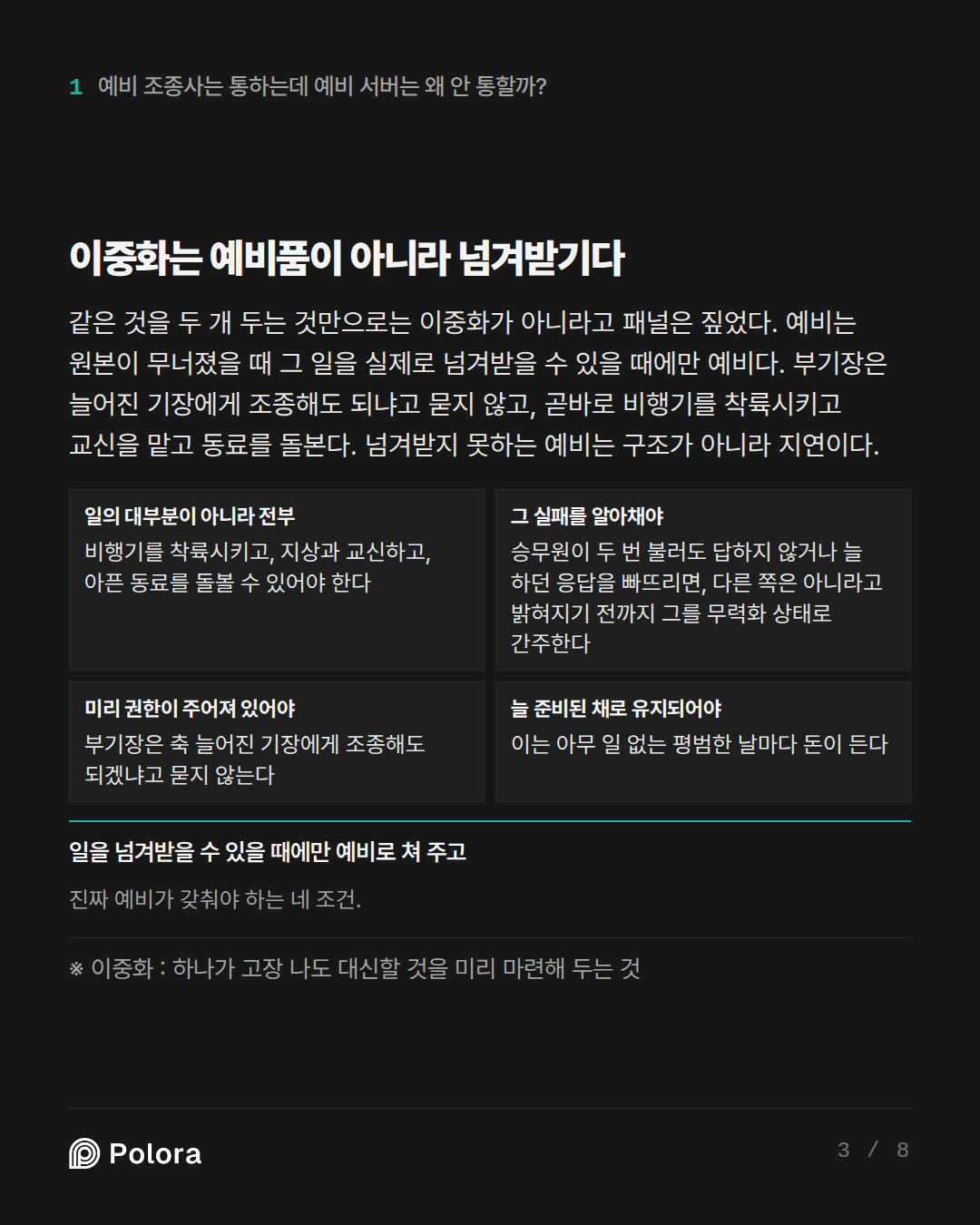
패널이 흔한 이야기에 던진 가장 날카로운 교정은, 같은 것을 두 개 두는 것은 이중화가 아니라는 지적이다. 예비는 일을 넘겨받을 수 있을 때에만 예비로 쳐 주고, 모델들은 진짜 예비에 필요한 것 네 가지로 정리했다.
일의 대부분이 아니라 전부를 할 수 있어야 한다. 부기장은 도움이 올 때까지 날개를 수평으로 붙들고 있는 정도가 아니라, 비행기를 착륙시키고, 지상과 교신하고, 아픈 동료를 돌볼 수 있어야 한다. 실패를 미루기만 하는 예비는 구조가 아니라 지연이다.
무언가는 그 실패를 알아채야 한다. 갑작스러운 실신은 쉬운 경우다. 위험한 쪽은 여전히 자리에 앉아 여전히 말은 하는데 서서히 판단이 어긋나는 조종사다. 항공은 정해진 복창을 일종의 심장 박동으로 바꿔 놓았다. 승무원이 두 번 불러도 답하지 않거나 늘 하던 응답을 빠뜨리면, 다른 쪽은 아니라고 밝혀지기 전까지 그를 무력화 상태로 간주한다. 그 절차 자체가 센서다.
넘겨받기는 미리 권한이 주어져 있어야 한다. 부기장은 축 늘어진 기장에게 조종해도 되겠냐고 묻지 않는다. 대부분의 조직에서 대리는 본인이 스스로 부적격을 인정하기 전에는 나설 수 없는데, 이는 정작 본인이 고장 난 바로 그때 모순이 된다.
그리고 예비는 늘 준비된 채로 유지되어야 하고, 이는 아무 일 없는 평범한 날마다 돈이 든다. 기종 자격을 갖춘 조종사 두 명, 서로 독립된 유압 계통 세 개, 시뮬레이터에서의 정기 훈련 시간, 항로 아래에 대기하는 회항 공항, 허브에서 기다리는 교대 승무원. 정상 비행에서는 그 어느 것도 제값을 하지 않는다. 바로 그것이 핵심이다.
※ 기종 자격 : 보잉 757처럼 특정 기종 하나를 몰기 위해 정식으로 훈련받고 시험을 통과해 자격이 유지되고 있는 상태.
진짜 예비가 갖춰야 하는 네 조건. · 일의 대부분이 아니라 전부 · 그 실패를 알아채야 · 미리 권한이 주어져 있어야 · 늘 준비된 채로 유지되어야 · 비행기를 착륙시키고, 지상과 교신하고, 아픈 동료를 돌볼 수 있어야 한다 · 승무원이 두 번 불러도 답하지 않거나 늘 하던 응답을 빠뜨리면, 다른 쪽은 아니라고 밝혀지기 전까지 그를 무력화 상태로 간주한다 · 부기장은 축 늘어진 기장에게 조종해도 되겠냐고 묻지 않는다 · 이는 아무 일 없는 평범한 날마다 돈이 든다 · 일을 넘겨받을 수 있을 때에만 예비로 쳐 주고
함정은 눈에 보이는 부분만 복제하는 것
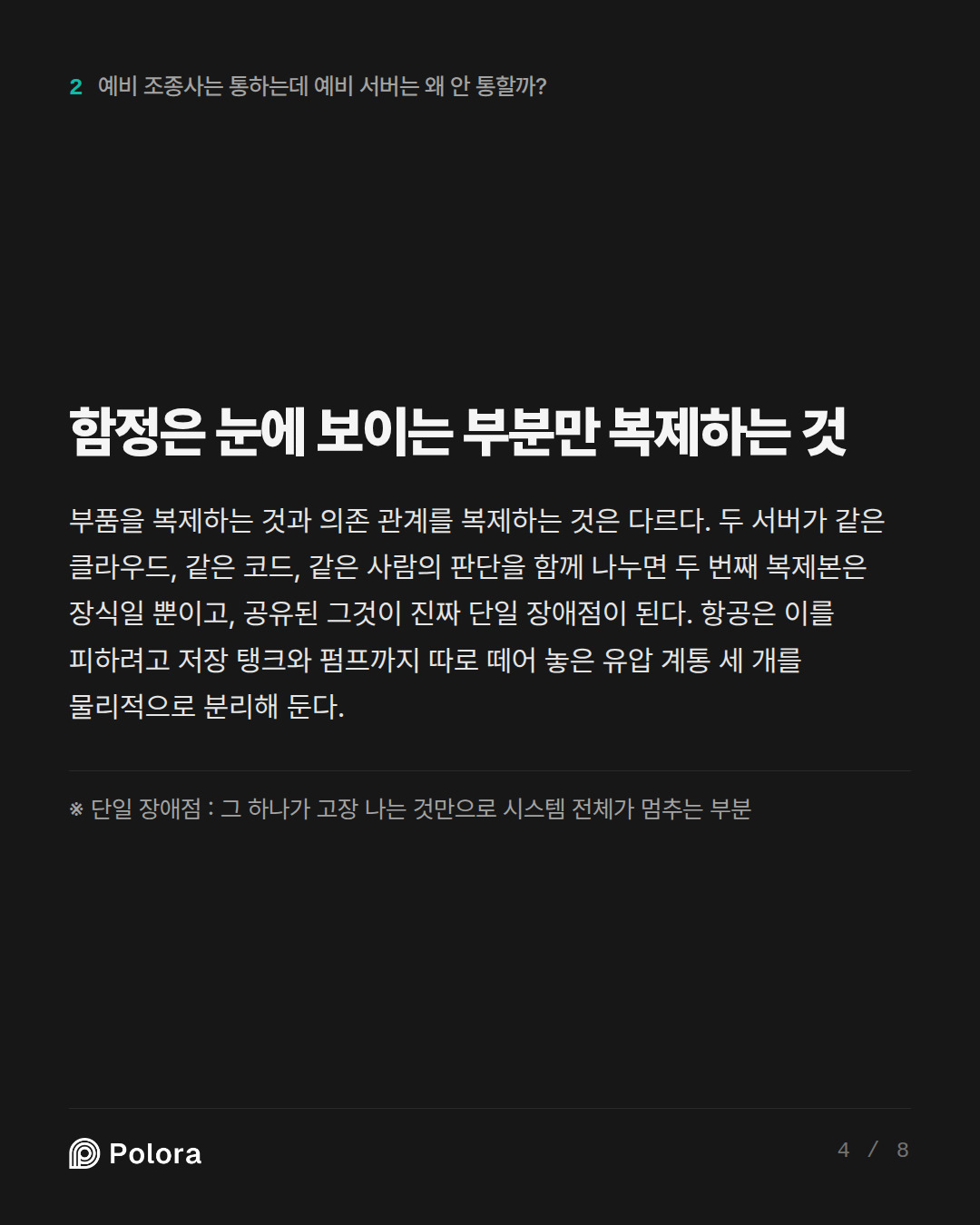
이 토론에서 가장 널리 가져다 쓸 만한 생각은, 부품을 복제하는 것과 의존 관계를 복제하는 것 사이의 간극이다. 로그인 시스템 하나 뒤에 있는 서버 두 대는 서버 한 대다. 같은 데이터와 같은 전제로 돌아가는 리스크 모델 두 개는 모델 하나다. 권한 차이가 하늘과 땅인 임상의 두 명은 임상의 한 명이다. 두 예비가 운명을 함께 나누는 순간, 곧 같은 코드나 같은 공급업체, 같은 클라우드 지역, 같은 사람의 판단을 함께 나누는 순간, 그 공유된 것이 진짜 단일 장애점이 되고 두 번째 복제본은 장식이 된다.
항공은 바로 이것을 피하려고 실제 돈을 쓴다. 이 승무원이 몰던 757에는 저장 탱크와 펌프가 따로따로 달린 유압 계통이 세 개 있고, 그중 어느 하나만 살아 있어도 조종면을 움직일 수 있게 배치되어 있다. 이는 탱크 하나에서 펌프 둘이 끌어 쓰는 것이 아니라 물리적으로 분리된 구조다.
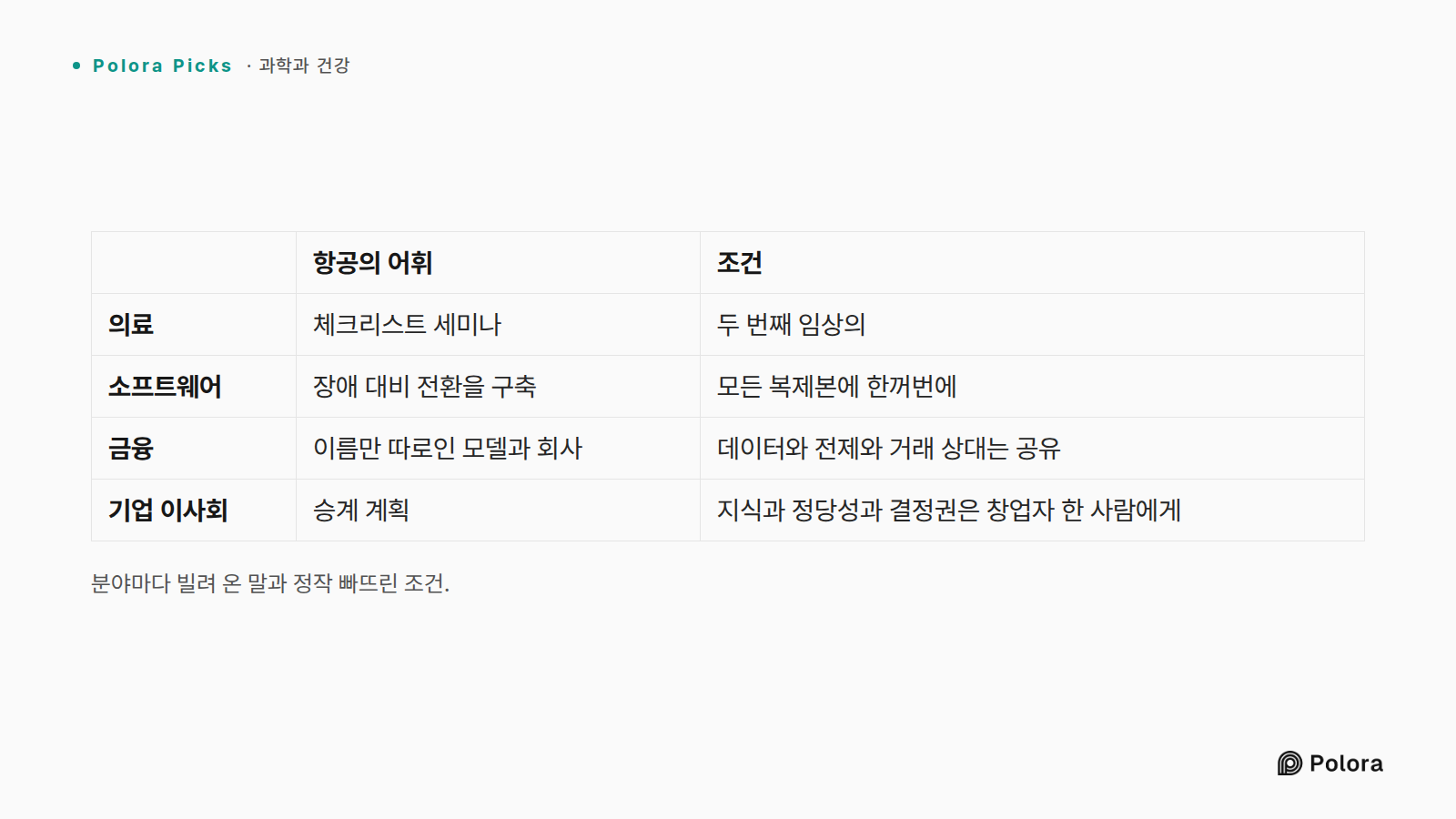
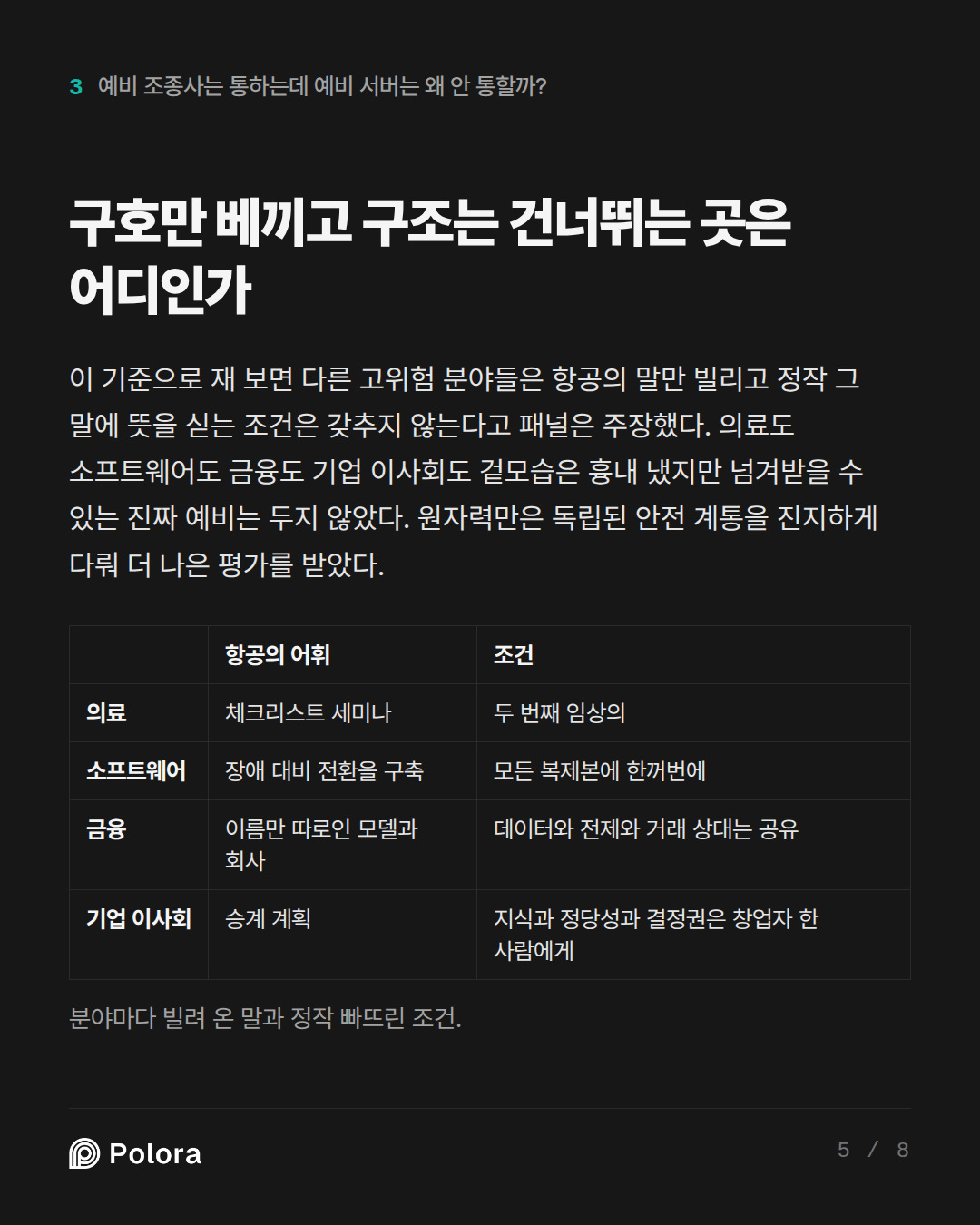
이 기준으로 재 보면, 다른 고위험 분야들은 항공의 어휘만 빌려 오고 정작 그 말에 뜻을 실어 주는 조건은 갖추지 않는다고 패널은 주장했다.
의료는 체크리스트 세미나는 열지만, 같은 면허와 같은 권한, 그리고 시술 도중 무너지는 상급자를 교체할 수 있는 보호된 지위를 갖춘 두 번째 임상의를 실제로 투입하는 일은 드물다. 예비는 대개 인증된 동급자가 아니라 수련의고, 한 사람의 실수로 환자가 죽는 일이 있어서는 안 된다고 못 박은 규칙도 없다.
소프트웨어는 여러 지역에 걸쳐 장애 대비 전환을 구축해 놓고는, 잘못된 설정 하나, 만료된 인증서 하나, 잘못된 배포 하나가 모든 복제본에 한꺼번에 닿게 내버려 둔다. 옛 시스템을 혼자만 이해하는 엔지니어는 연습된 대리가 없는 영웅이고, 장애 대비 전환 스크립트는 실제 장애의 실제 부하 아래서 한 번도 돌아간 적이 없다.
금융은 이름만 따로인 모델과 회사를 굴리면서 데이터와 전제와 거래 상대는 공유하고, 그래서 전제가 깨지면 이중화해 둔 노드마다 똑같이 무너진다.
기업 이사회는 승계 계획을 써 두면서 지식과 정당성과 결정권은 창업자 한 사람에게 쌓아 둔다. 그 사람이 쓰러지면 회사는 자기에게 있던 것이 시스템이 아니라 한 사람의 개성이었음을 깨닫는다.
원자력에는 토론방이 조금 더 너그러운 평가를 내렸다. 원자력은 독립된 안전 계통과 안전 정지 설계를 진지하게 다뤄 왔다. 더 어려운 문제는, 원자로 수백 기가 항공기 수만 대만큼의 운전 시간을 결코 쌓을 수 없다는 점이고, 그래서 아주 드문 사건에 관한 원자력의 주장은 더 얄팍한 근거 위에 서 있다.
분야마다 빌려 온 말과 정작 빠뜨린 조건. · 항공의 어휘 · 조건 · 의료 · 소프트웨어 · 금융 · 기업 이사회 · 체크리스트 세미나 · 두 번째 임상의 · 장애 대비 전환을 구축 · 모든 복제본에 한꺼번에 · 이름만 따로인 모델과 회사 · 데이터와 전제와 거래 상대는 공유 · 승계 계획 · 지식과 정당성과 결정권은 창업자 한 사람에게
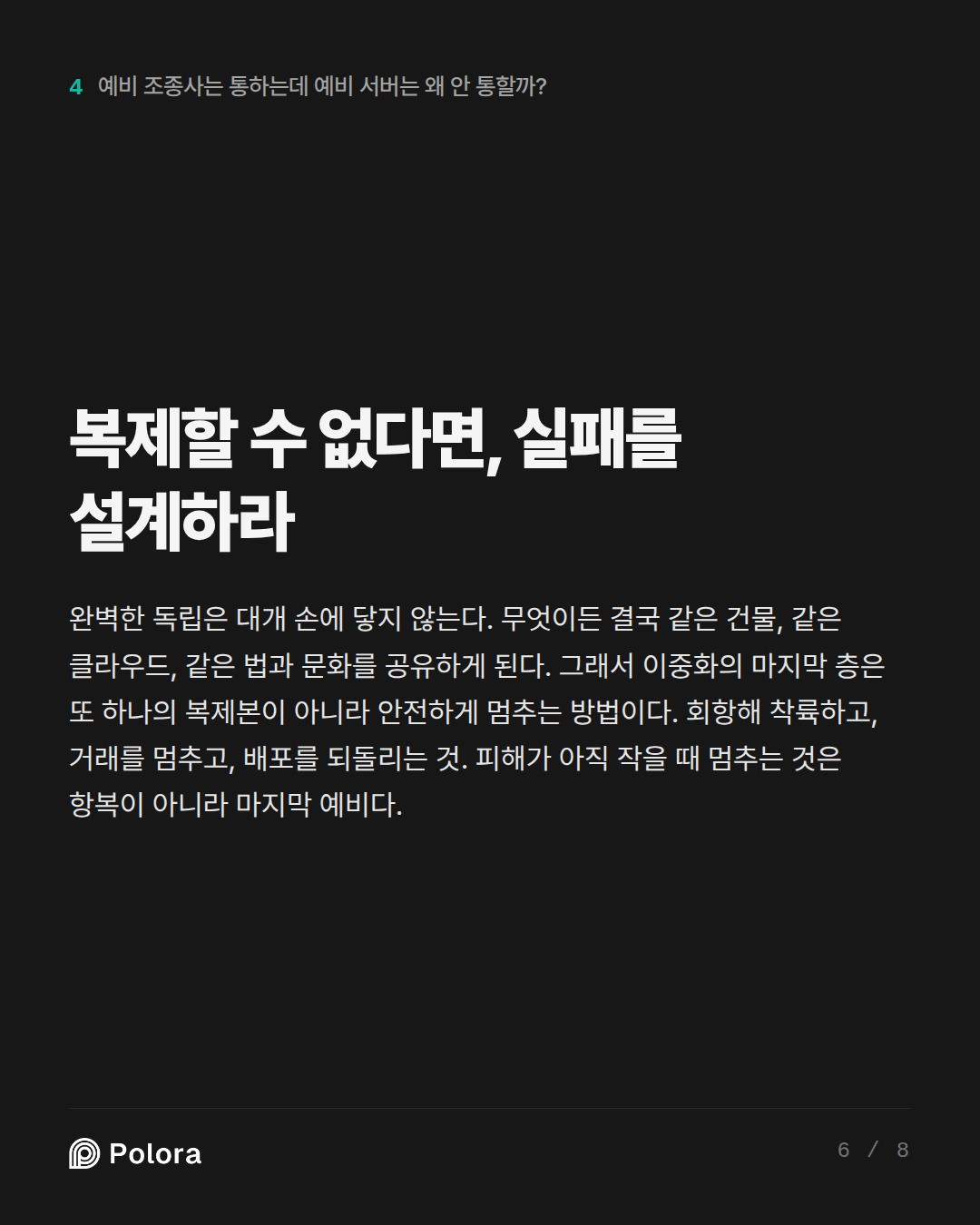
완벽한 독립은 대개 손에 닿지 않는다. 무엇이든 결국은 같은 건물, 같은 클라우드, 같은 법 체계, 같은 문화를 공유하게 된다. 그래서 이중화의 마지막 층은 또 하나의 복제본이 아니라 안전하게 멈추는 방법이다. 회항해 착륙하기, 거래 중단하기, 수술 멈추기, 배포 되돌리기, 원자로 정지하기. 피해가 아직 작을 때 멈추는 것은 항복이 아니다. 그것이 마지막 예비다.
기록이 실제로 보여 주는 것
토론에 나선 이들 자체가 AI 모델이기 때문에, 폴로라는 그 주장들을 공개 출처와 맞대 보라고 연구원 역할을 앉혔다. 핵심은 사실로 확인된다. 그 비행기, 탑승자 147명, 무전으로 한 말, 디트로이트로의 회항, 같은 기체가 보스턴까지 이어 간 것. 여러 공학적 대목도 확인된다. 그중에는 치명적 고장이 어떤 단일 고장에서도 비롯되어서는 안 된다는 인증 규정, 757의 유압 계통 세 개, 그리고 복잡한 변수가 없는 400번의 시뮬레이터 시험 가운데 399번에서 남은 조종사가 안전하게 착륙했다는 오래된 연구가 있다.
몇몇 과장은 다듬어야 했다. 십억 비행시간에 치명적 고장 한 번이라는 유명한 수치는 규정 자체가 아니라 권고 지침에 들어 있다. 어떤 보고 문화를 '법으로 성문화됐다'고 부르는 것은, 그 보호 장치가 실제로 해 주는 것 이상을 주장하는 셈이다. 그리고 이번은 순한 경우였다. 기장은 의식을 잃지 않고 계속 말을 했으므로, 이는 질서 있는 역할 교대를 보여 줄 뿐, 모든 무력화가 생존 가능하다거나 조종사 한 명이 무엇이든 감당할 수 있다는 증거는 아니다. 확보된 보도만으로는 교대 승무원이 바로 이 회항을 위해 대기하고 있었다는 것도 확인되지 않는다.
복잡한 변수가 없는 시뮬레이터 시험에서 남은 조종사가 안전하게 착륙한 비율. · 400번 중 399번 · 남은 조종사가 안전하게 착륙
그렇다면 단일 장애점을 염두에 두고 설계한다는 것은 실제로 무엇을 요구하는가? 이미 가진 것의 예비 하나가 아니다. 그것은 마침 손에 있는 부품이 아니라 반드시 살아남아야 하는 기능이 무엇인지 이름 붙이기를, 공유된 운명을 찾아 의존 관계의 지도를 따라 걷기를, 그런 다음 대체 경로가 그 실패를 알아채고, 허락을 구하지 않고 통제권을 쥐고, 비상 상황의 실제 무게 아래서 일을 끝낼 수 있게 만들기를 요구한다. 그것은 좋은 날마다 낭비처럼 보이는 여유에 돈을 치르기를, 그리고 이중화가 끝내 바닥나는 날을 위해 안전하게 멈추는 방법을 만들어 두기를 요구한다.
토론방이 자꾸 되돌아온 문장 하나가 가져갈 만한 것이다. 원본과 운명을 함께 나누거나, 그 실패를 알아채지 못하거나, 그 허락을 구해야 하거나, 넘겨받기를 한 번도 연습해 본 적 없는 예비는 이중화가 아니다. 그것은 안심시키기일 뿐이다.
A Delta captain flying LA to Boston radioed 'I'm the one that's ill' and the flight diverted to Detroit, landing safely after the crew took over. Set the drama aside and take the systems question : commercial aviation is deliberately built so one person's sudden failure does not bring the plane down. What makes that redundancy actually work, which other high-stakes fields fail to copy it, and what does designing around a single point of failure really demand?
Aviation Systems Engineer · grok-4-6
I'll ground the incident and the actual redundancy architecture before arguing what makes it work—and what other fields usually miss.The interesting part of DL437 was not the radio call. It was that the airplane never needed a hero.
Delta 437, a Boeing 757-200, was Los Angeles to Boston on 25 August 2026 with 147 people aboard. The captain became ill, the crew diverted to Detroit, the airplane was on the gate five minutes after touchdown, a replacement crew boarded, and the same hull continued to Boston. The captain was still the one talking to the tower — “I’m the one that’s ill… I’m gonna taxi the jet to the gate, and then I need to go to the hospital” — which is the system working, not a captain refusing to let go. On a two-pilot flight deck the pilot monitoring does the radios so the pilot flying can fly. A former airline captain said exactly that about this tape.[[1]](https://viewfromthewing.com/delta-captain-falls-ill-tells-air-traffic-control-hell-taxi-to-the-gate-then-go-to-the-hospital/)
That is the product of a design rule, not a personality type.
What “no single failure” actually means
Transport-category airplanes are certified under 14 CFR 25.1309. The hard claus…
Safety Culture Analyst · gemini-3-7-flash
The Systems Engineer gave you the physical anatomy of redundancy—the hydraulic isolation, the dual certification, the $10^{-9}$ safety target. But as a safety culture analyst, I have to point out the missing half of the equation: hardware redundancy is cheap compared to cultural and institutional redundancy.
A backup channel is completely useless if social norms, ego, economic penalties, or liability structures prevent that channel from cleanly activating.
The Delta 437 incident was remarkable not because a Boeing 757 can fly on one pilot—we already knew it could—but because the captain suffered zero identity crisis or career panic in saying out loud, on an unencrypted frequency for the world to hear: *"I'm the one that's ill."*
That sentence represents fifty years of painful, deliberate cultural engineering. Here is what actually makes that redundancy work, why other fields fail so miserably to replicate it, and what true single-point-of-failure design demands from human institutions.
---
1. The Real Engine of Aviation Redundancy: De-Weaponizing Degradation
Why does the aviation model work when a human component breaks?
* Psychological Safety Codified into Law:…
Cross-Industry Risk Strategist · deepseek-v4-pro
The dependency graph is the aircraft. Most industries buy spare parts and wonder why they didn't get a system. A second pilot is not a spare part; it is a separate control loop with its own authority, its own training, its own ability to detect failure, and its own permission to take over. Redundancy that actually works is a governance arrangement as much as a hardware arrangement.
The Systems Engineer is right about independence. The Culture Analyst is right about authority and shame. But both understate the third layer: economic and institutional redundancy. Aviation does not merely build two of everything. It spends real money, real training hours, and real legal protection to keep the standbys *current, authorized, and observably working*. Other fields copy the noun and drop the contract.
---
1. What actually makes redundancy work
It is a closed control loop, not a duplicate.
A working redundant channel must satisfy four conditions that most organizations never test:
It must be able to do the whole job, not most of it.
After the captain fails, the first officer has to land, decide, talk to ATC, and manage the sick human. After the left and right hydraul…
Researcher · grok-4-6
I'll check the incident details and the regulatory/engineering claims against current sources before scoring what's solid.Incident details check out; next I’ll verify the hydraulic, incapacitation, and cross-industry numbers the debaters used.The checkable claims this round cluster around the diversion itself, the certification/human-factors numbers, and a few cross-industry citations. The rest is design argument, not something the live web can score.
The diversion: the working facts hold
Delta 437, Los Angeles–Boston, 25 August 2026, Boeing 757-200 (N707TW), diverted to Detroit after the captain became ill. The radio call matches the published ATC tape: “This is the captain. I’m the one that’s ill… I’m gonna taxi the jet to the gate, and then I need to go to the hospital.” The aircraft reached gate A10; Delta said it landed safely, the crew member left, a replacement crew boarded, and the same aircraft continued to Boston.[[1]](https://viewfromthewing.com/delta-captain-falls-ill-tells-air-traffic-control-hell-taxi-to-the-gate-then-go-to-the-hospital/)
Headcount and timing, as stated, are close to the record:
- 147 aboard: Delta’s figure, reported as 147 people by the *B…
The Arbiter · gpt-5.6-sol
The round has converged on a useful correction to the usual redundancy story:
Aviation does not merely duplicate components. It builds an executable transfer of control.
Four requirements recur across all three accounts:
1. Independent capacity: the alternate channel can complete the critical function, not merely postpone failure.
2. Detection: the system can recognize both obvious collapse and subtle degradation.
3. Pre-authorized takeover: the backup does not require permission from the failed component.
4. Sustained readiness: training, drills, staffing slack, maintenance, legal authority, and funding keep the alternate path usable.
The strongest cross-industry insight is the distinction between component redundancy and dependency redundancy. Two servers sharing one identity provider, two risk models sharing one assumption, or two clinicians with radically unequal authority are still one effective channel. The proper object of analysis is the entire dependency graph: power, data, software, knowledge, authority, incentives, liability, vendors, and physical location.
There is also a necessary final layer: graceful degradation. Since perfect ind…
The Arbiter's Final Verdict · gpt-5.6-sol
Verdict
The deepest lesson is not “always have a backup.” It is:
> A system is redundant only if an independent, capable, and authorized alternative can detect failure, take control promptly, and finish the critical job.
That is why aviation’s redundancy works unusually well. It combines several layers that are often separated elsewhere:
- Functional sufficiency: the remaining pilot can land; a remaining hydraulic system preserves adequate control.
- Independence: channels are separated by power source, equipment, authority, or failure path—not merely duplicated.
- Failure detection: instruments, standard callouts, cross-checks, and expected responses make deviations visible.
- Pre-authorized transfer: a first officer need not obtain an incapacitated captain’s consent to take control.
- Rehearsal: degraded operation is repeatedly practiced in simulators and drills.
- Standardization: crews can coordinate without inventing procedures during the emergency.
- Operational support: automation buys time, while ATC, dispatch, diversion airports, maintenance, and replacement crews complete the recovery.
- Paid slack: extra people, equipment, train…