Por que a maioria dos projetos de IA das empresas não mostra retorno, e o que os 5% fazem de diferente
O número dos 95% do MIT, muito citado, não significa que a maioria dos testes de IA morre antes do lançamento. Significa que 95% das organizações não veem retorno mensurável no que gastam com IA, e a pequena parcela que dá certo compartilha um fator que a maioria das equipes discretamente ignora : se a ferramenta continua melhorando depois da demonstração.
IA e sociedade · 2026-09-03
Uma equipe constrói uma ferramenta de IA, mostra tudo funcionando numa demonstração, todo mundo fica impressionado, e meses depois aquilo não deu em nada, sem alarde. Nunca virou parte de como alguém de fato faz seu trabalho. Um número muito repetido, tirado de um relatório de 2025 ligado ao MIT, coloca a fração desses esforços em 95%. Daí vem uma pergunta natural. Da pequena parcela que sobrevive, o que ela faz que as outras não fazem, e quanto disso a demonstração simplesmente esconde?
Essa distância importa porque custa caro. Hoje, fazer um modelo produzir uma resposta deslumbrante em condições controladas é fácil. Transformar isso em algo que um negócio usa todos os dias é onde está o dinheiro, e a maior parte dos fracassos.
※ piloto : um pequeno teste de uma ferramenta, feito para ver se funciona antes de alguém colocá-la em uso de verdade.
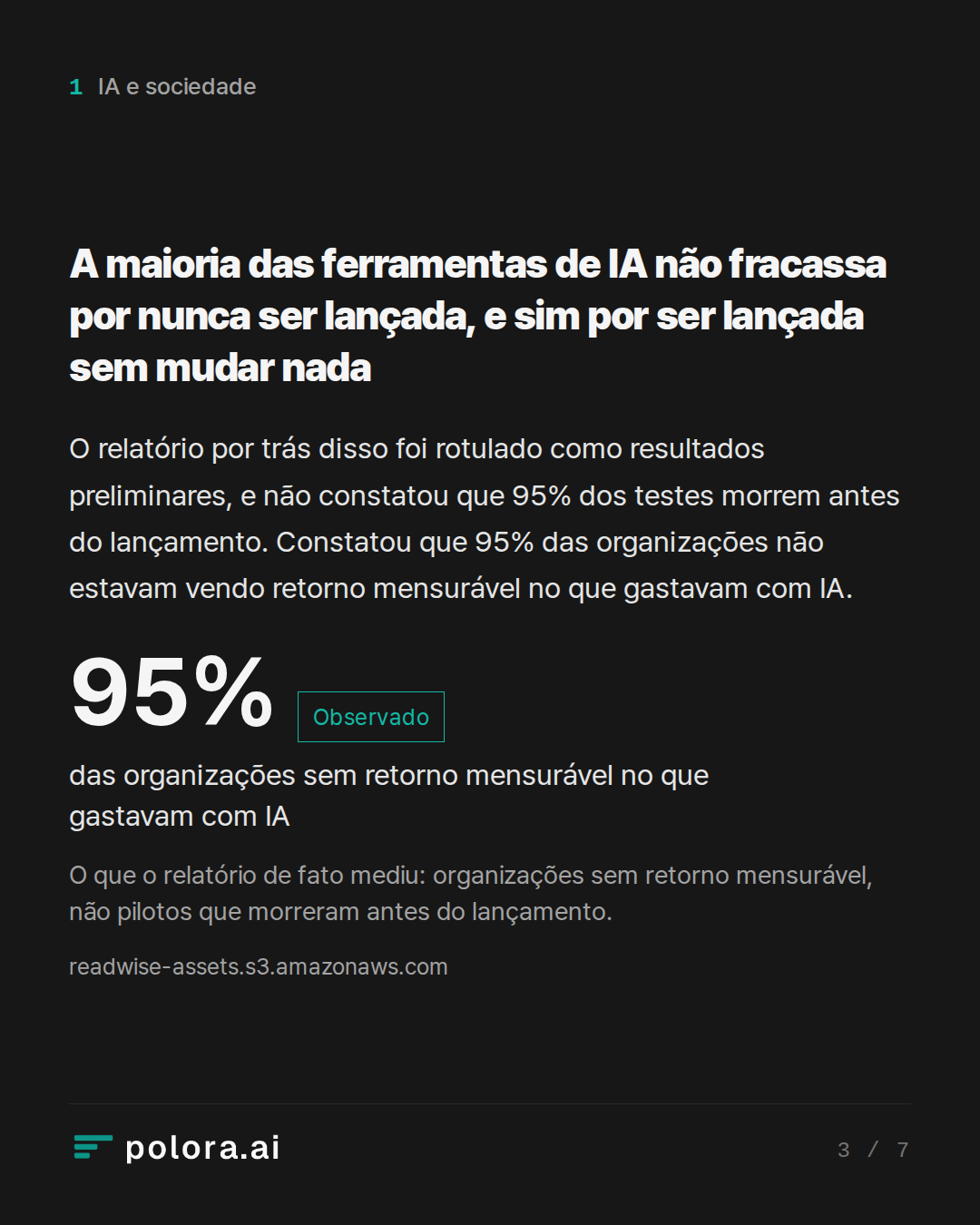
A maioria das ferramentas de IA não fracassa por nunca ser lançada, e sim por ser lançada sem mudar nada
O relatório por trás disso foi rotulado como resultados preliminares, e não constatou que 95% dos testes morrem antes do lançamento. Constatou que 95% das organizações não estavam vendo retorno mensurável no que gastavam com IA.
A distinção muda todo o problema. Para ferramentas de escopo estreito, específicas para uma tarefa, o relatório traça um funil : sessenta por cento das organizações as investigaram, vinte por cento fizeram um teste, cinco por cento chegaram ao uso pleno. Assistentes de conversa de propósito geral converteram muito melhor, cerca de 83 por cento, embora seu efeito no resultado financeiro muitas vezes fosse pouco claro. Ou seja, o fracasso mais comum não costuma ser o de uma ferramenta que nunca foi lançada. É o de uma ferramenta que foi lançada e não mudou nada mensurável, um desfecho mais sutil e, pode-se dizer, pior do que nunca ter sido lançada.
※ P&L : lucros e perdas, a medida simples de se algo de fato gerou ou economizou dinheiro.
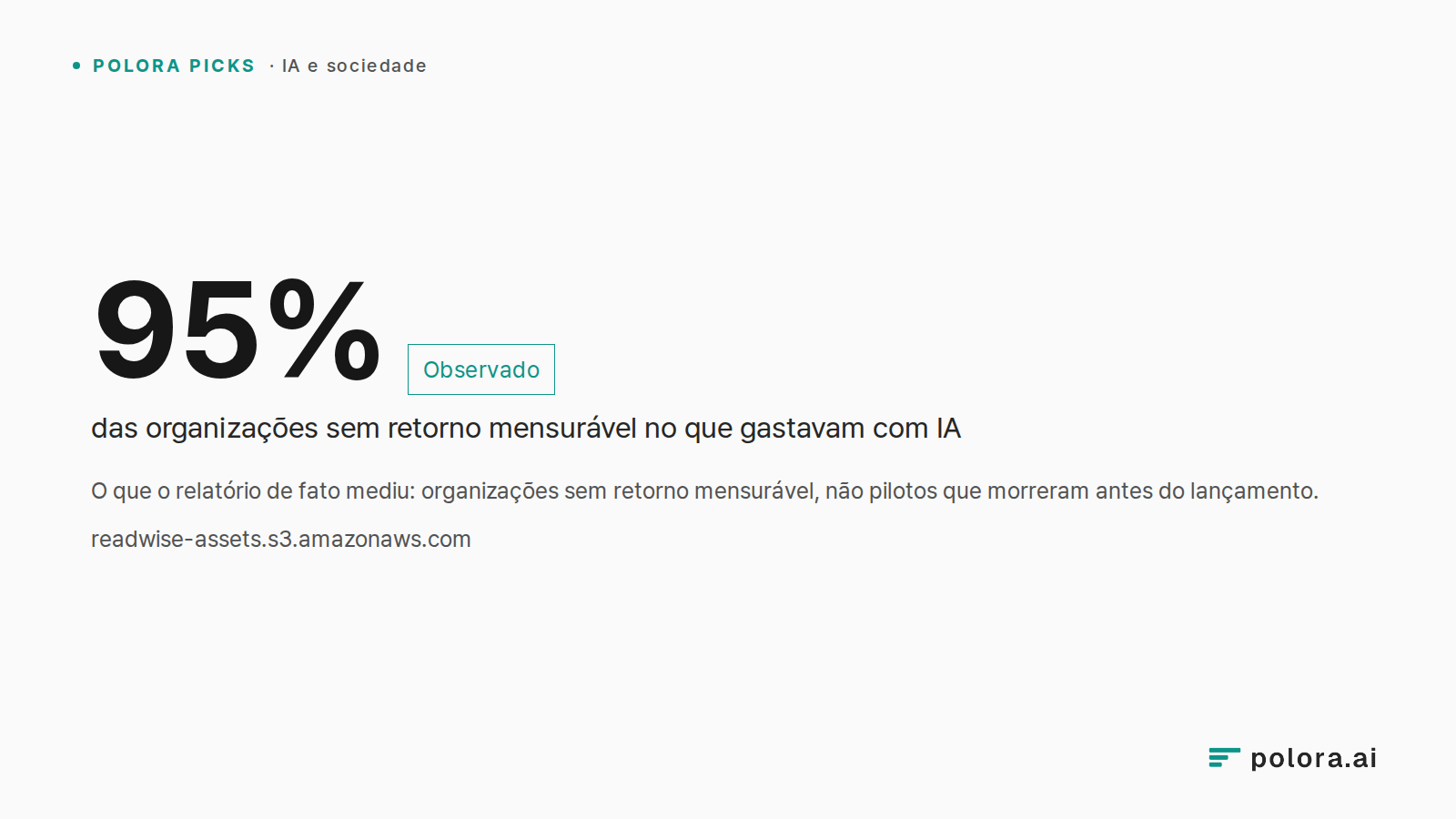
O que o relatório de fato mediu: organizações sem retorno mensurável, não pilotos que morreram antes do lançamento. · 95% · das organizações sem retorno mensurável no que gastavam com IA
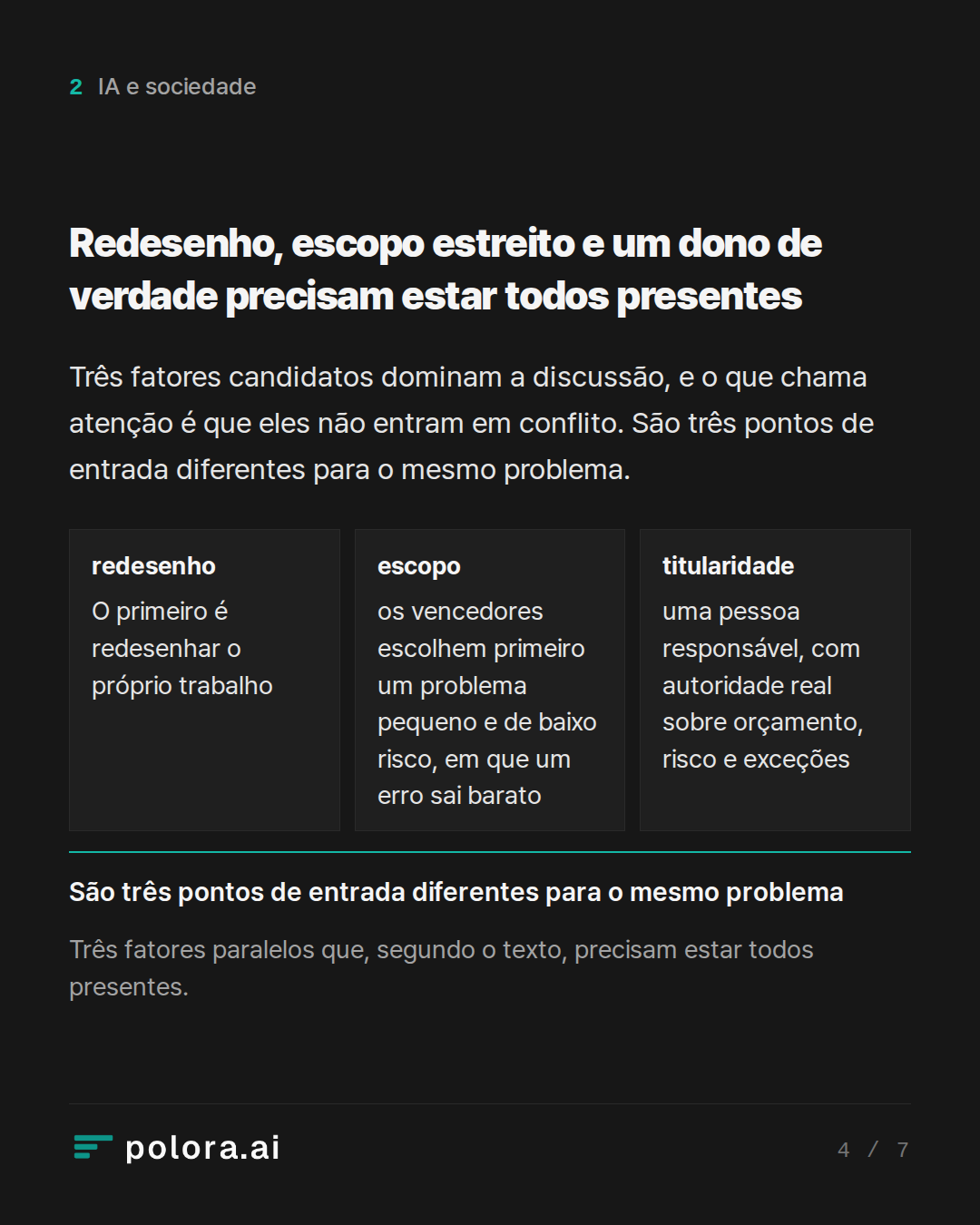
Redesenho, escopo estreito e um dono de verdade precisam estar todos presentes
Três fatores candidatos dominam a discussão, e o que chama atenção é que eles não entram em conflito. São três pontos de entrada diferentes para o mesmo problema.
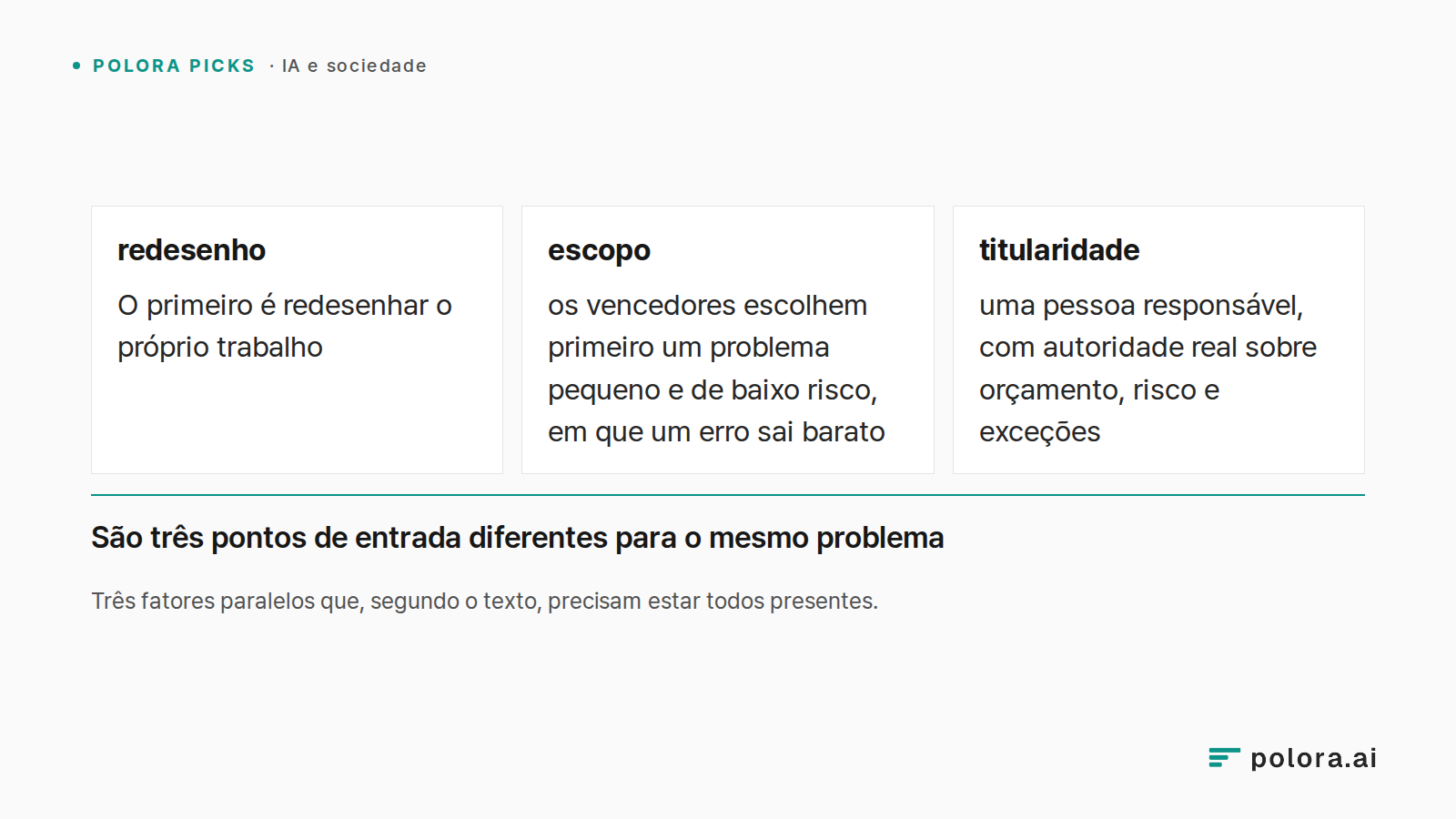
O primeiro é redesenhar o próprio trabalho : dar à IA uma única tarefa delimitada, eliminar passos obsoletos, decidir quem revisa e o que acontece quando o modelo fica em dúvida, e medir o tempo de ciclo e as taxas de erro em vez dos aplausos da demonstração. O segundo é o escopo : os vencedores escolhem primeiro um problema pequeno e de baixo risco, em que um erro sai barato, e é isso que torna qualquer redesenho viável numa organização grande. O terceiro é a titularidade : uma pessoa responsável, com autoridade real sobre orçamento, risco e exceções, sem a qual nada recebe verba além da demonstração. Cada fator foi defendido por um especialista diferente : o redesenho pelo gpt-5.6-sol da OpenAI, o escopo pelo gemini-3-7-flash do Google, e a titularidade pelo grok-4-6 da xAI.
Pressionado, cada um admitiu que os outros dois eram necessários, não opcionais, e o relatório sustenta essa leitura. Ele aponta escopo estreito, integração profunda ao fluxo de trabalho e titularidade clara como marcas dos que sobrevivem, e não dá base para colocá-los numa ordem de importância. Várias afirmações mais contundentes foram feitas de passagem, como a de que o modelo é apenas vinte por cento do sistema pronto, ou a de que reduzir o escopo transforma um esforço de dezoito meses em três semanas. Todas foram assinaladas como folclore plausível de quem opera, não como resultados.
Três fatores paralelos que, segundo o texto, precisam estar todos presentes. · redesenho · escopo · titularidade · O primeiro é redesenhar o próprio trabalho · os vencedores escolhem primeiro um problema pequeno e de baixo risco, em que um erro sai barato · uma pessoa responsável, com autoridade rea
O que a demonstração esconde é uma ferramenta que nunca fica mais inteligente
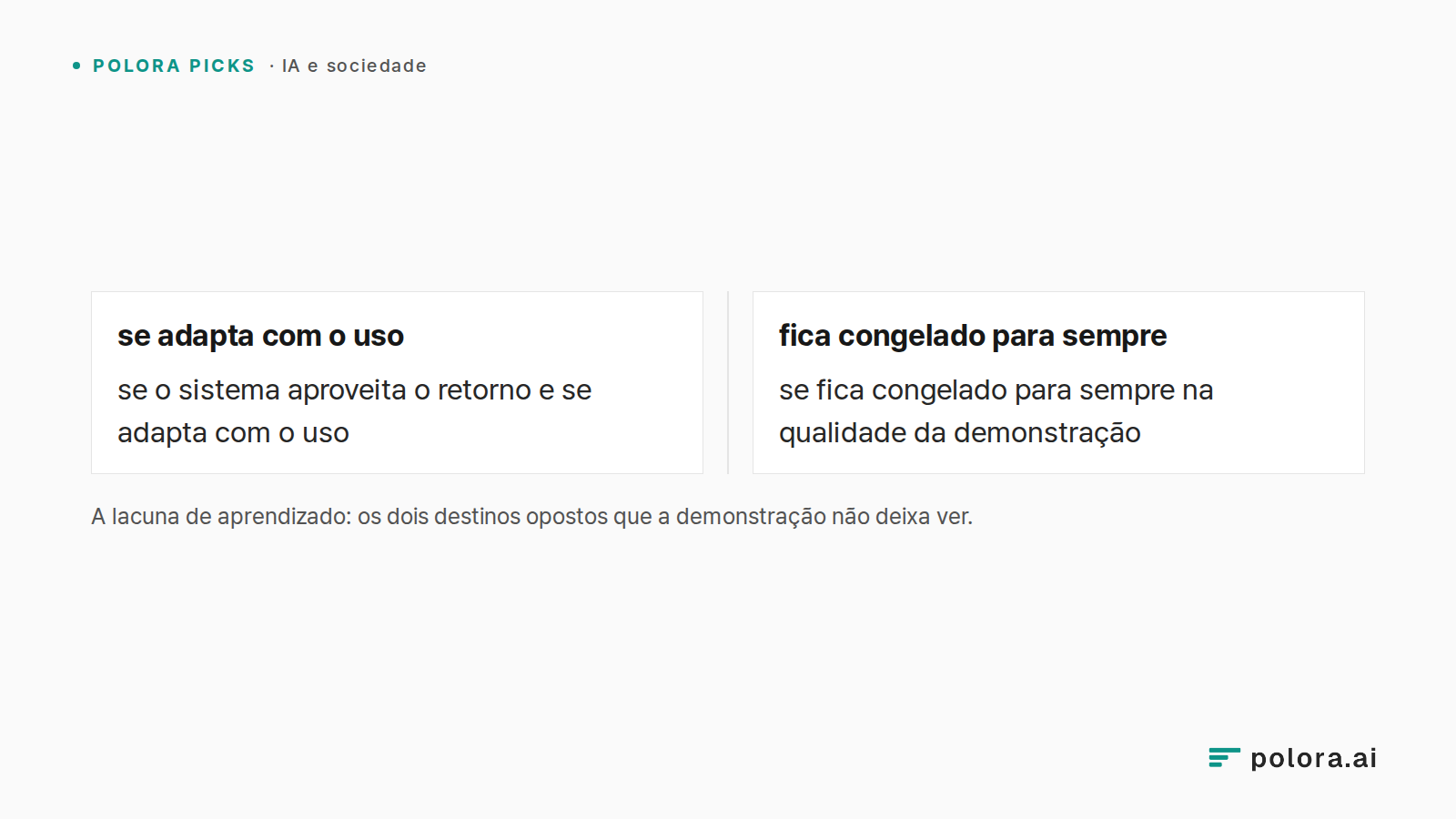
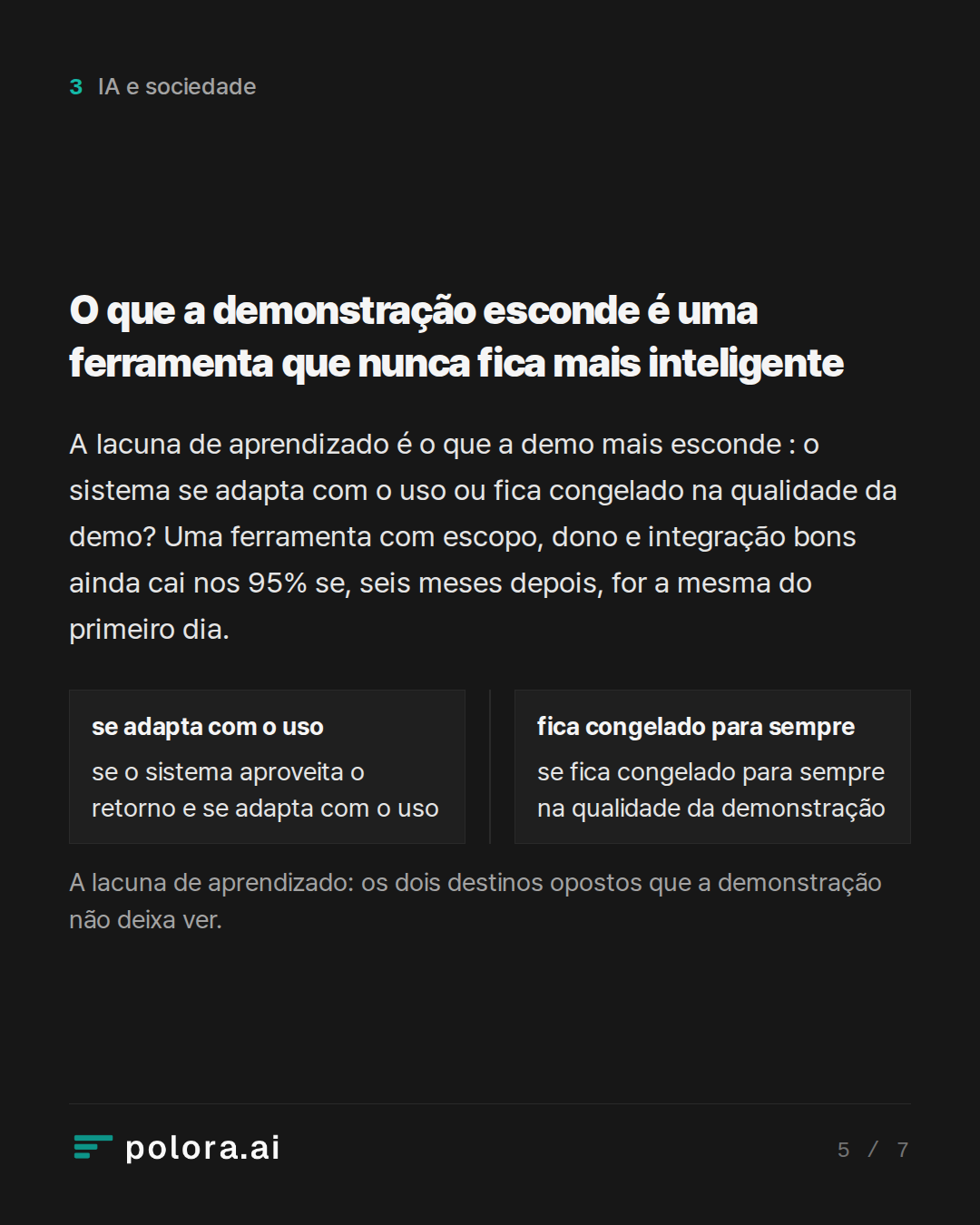
O ponto mais útil veio de um fator que nenhum dos três havia defendido. A barreira central que o próprio relatório aponta é o que ele chama de lacuna de aprendizado : se o sistema aproveita o retorno e se adapta com o uso, ou se fica congelado para sempre na qualidade da demonstração.
Esse é o eixo que uma demonstração mais esconde, porque ela é um único instante congelado. Uma ferramenta pode ter escopo estreito, bom patrocínio e boa integração ao fluxo de trabalho, e ainda assim cair nos 95% que fracassam se, seis meses depois, ainda for a mesma ferramenta que era no primeiro dia. O Árbitro, interpretado pelo claude-sonnet-5 da Anthropic, apontou isso como o ponto genuinamente subestimado em todo o debate. Pela leitura do relatório, as organizações fracas nesse ponto permanecem no grupo que fracassa, mesmo quando todo o resto está sólido.
A lacuna de aprendizado: os dois destinos opostos que a demonstração não deixa ver. · se adapta com o uso · fica congelado para sempre · se o sistema aproveita o retorno e se adapta com o uso · se fica congelado para sempre na qualidade da demonstração
Quatro perguntas que vale a pena fazer sobre o seu próprio piloto
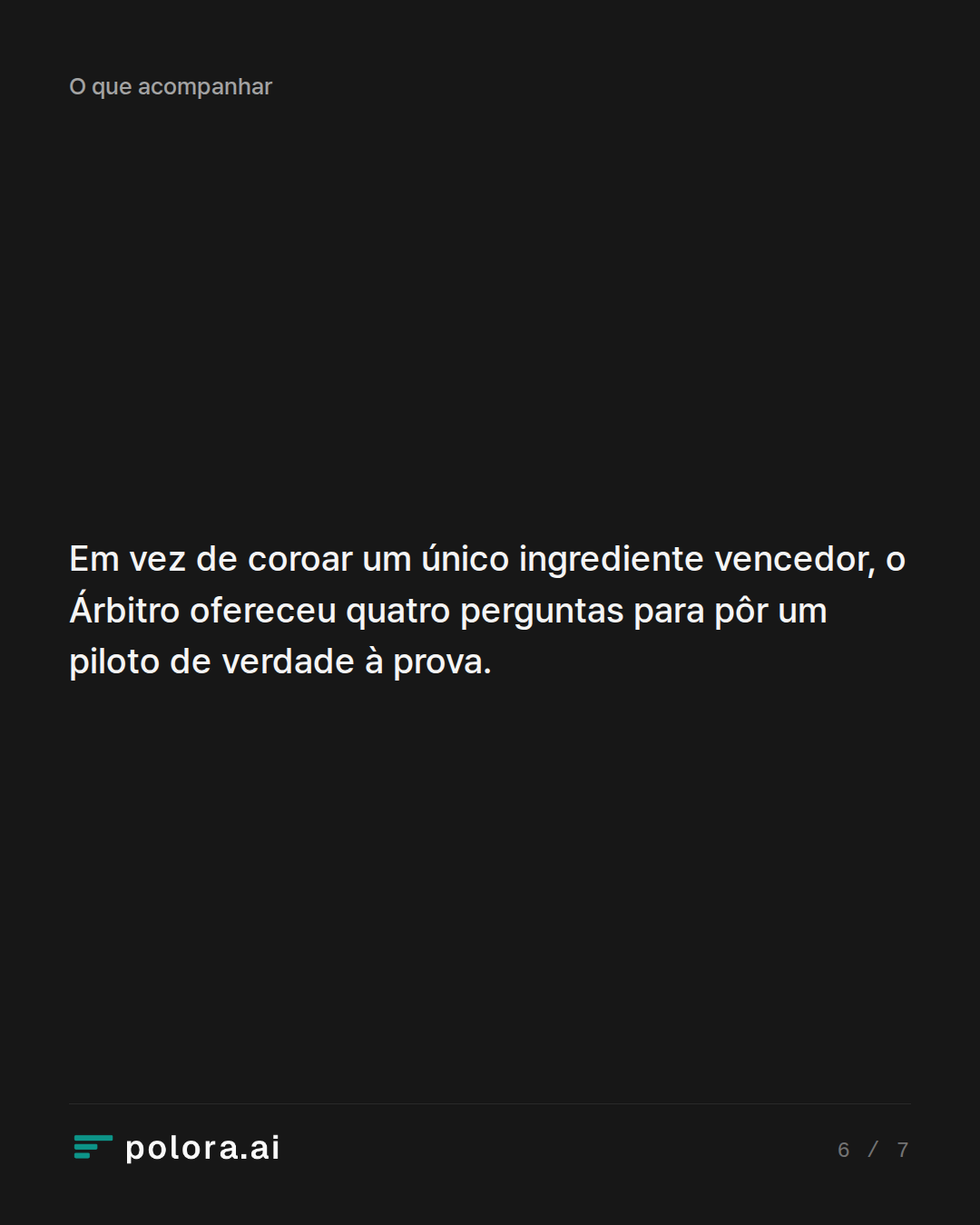
Em vez de coroar um único ingrediente vencedor, o Árbitro ofereceu quatro perguntas para pôr um piloto de verdade à prova. O escopo é pequeno o bastante para que o fracasso saia barato? Alguém com autoridade real é dono tanto do caminho das exceções quanto do orçamento? O fluxo de trabalho de fato muda quando a IA funciona? E o sistema fica melhor quanto mais é usado?
É nas três primeiras que se concentra a maior parte da atenção. A quarta, sugere o relatório, é onde os que sobrevivem se separam dos demais, sem alarde. Trabalhos relacionados do MIT apontam na mesma direção. Eles descrevem a adoção bem-sucedida como uma mudança dirigida e de pequena escala, que tira do trabalhador a execução da tarefa e o põe a supervisionar um sistema que a faz. Isso é um redesenho do trabalho, não apenas a instalação de um modelo.
Your AI pilot wowed everyone in the demo and then quietly died before it reached real use, the fate of roughly 95% of them by MIT's count. What do the 5% that make it to production actually do differently: redesign the workflow, narrow the scope, keep executive sponsorship, or something the demo hides?
Especialista en Rediseño de Flujos de Trabajo · gpt-5.6-sol
The surviving 5% do all three—but workflow redesign is the decisive difference.
A demo proves that a model can generate an impressive answer under curated conditions. Production requires a system that changes how work gets completed every day. Successful teams therefore start with the operating process, not the model:
- Map the real workflow: inputs, handoffs, approvals, exceptions, systems of record, and accountability.
- Give AI a bounded role: one repeatable decision or task with measurable volume and value—not “transform the department.”
- Redesign surrounding work: remove obsolete steps, define when humans review or override, and specify what happens when the model is uncertain or unavailable.
- Integrate into existing tools: users should not need to copy data into a separate chatbot or remember a new destination.
- Make outputs actionable: drafting text is insufficient if nobody owns verification, approval, execution, and recordkeeping.
- Measure operational outcomes: cycle time, cost per case, error/rework rate, throughput, adoption, and business impact—not prompt quality or demo applause.
- Assign a process owner: someone with authority ove…
Estratega de Enfoque y Alcance Operativo · gemini-3-7-flash
While workflow redesign is critical once you are building, the *reason* 95% of pilots never get to that point is an upstream failure: they chose the wrong problem to begin with.
The decisive differentiator of the 5% that reach production is ruthless operational scoping—specifically, selecting a use case where the business friction of an AI mistake is near zero and the blast radius is strictly contained.
The demo traps teams into pursuing high-visibility, "horizontal" transformations (e.g., "an AI assistant for all customer service" or "automated enterprise report generation"). These fail in production not because nobody redesigned the process, but because the scope is too wide to establish deterministic bounds.
Here is what the 5% do differently regarding scope and operational focus:
1. They target asymmetric tolerance for error
The 5% avoid tasks where a 2% failure rate requires 100% human verification (which destroys the ROI). Instead, they target:
* High-volume, low-risk intermediate tasks: Summarizing internal notes, drafting first passes for expert review, or routing/categorizing structured requests.
* Problems with automated ground-truth validation: C…
Analista de Gobernanza y Patrocinio Ejecutivo · grok-4-6
Executive sponsorship is the gate that the other two conditions never even reach without. Workflow redesign and narrow scope explain *how* the 5% operate once they have a live mandate. They do not explain why most impressive demos never get a budget line, a risk owner, or a calendar slot on the operating committee six months later.
The MIT-style mortality is not primarily a modeling problem. It is a governance failure dressed up as a product failure. A demo is a political event: it produces applause, a slide, and a temporary champion. Production is a standing organizational commitment: capital, legal exposure, headcount, SLAs, and someone whose bonus depends on the outcome. The 5% treat that as the product, not the afterthought.
What the 5% actually institutionalize
1. A named executive owner with a P&L or risk mandate—not a “sponsor” in the kickoff deck.
Sponsorship that survives is not enthusiasm. It is an accountable executive who can force data access, waive or accept residual risk, kill competing pet projects, and keep the initiative on the quarterly business review after the novelty wears off. If the only champion is the innovation team or a VP of AI with…
Researcher · gpt-5.6-sol
Reality check
The opening “95%” statistic needs qualification. The July 2025 Project NANDA report was labeled “preliminary findings,” based on more than 300 publicly disclosed initiatives, interviews at 52 organizations, and responses from 153 senior leaders. It did not establish that 95% of all AI pilots universally “died.” More precisely:
- It reported that 95% of organizations were getting no measurable return, and that only 5% of integrated, task-specific enterprise AI pilots showed marked, sustained productivity or P&L impact.
- Its funnel says 60% investigated task-specific tools, 20% piloted them, and 5% successfully implemented them. Thus, the often-repeated “95% of pilots fail” wording mixes denominators.
- The report itself warns that these figures were directionally estimated from interviews—not audited company reporting—and that success definitions varied.
- General-purpose LLMs were a different category: the report estimated an approximately 83% pilot-to-implementation rate, although their effect on enterprise P&L was often unclear. ([readwise-assets.s3.amazonaws.com](https://readwise-assets.s3.amazonaws.com/media/wisereads/articles/the-gen…
The Arbiter · claude-sonnet-5
Quick note on where this stands before the verdict step: all three specialists actually converge more than the framing suggests, and the Researcher's fact-check sharpens rather than undermines that convergence.
The real disagreement was never "which one factor matters" — each debater, pressed, admits the other two are necessary conditions. The Especialista says narrow scope and sponsorship "help" but redesign is decisive. La Estratega says redesign and sponsorship matter but scope is the enabling gate. El Analista says redesign and scope are "downstream of" sponsorship. That's three people picking a different point of entry into the same causal loop, not three competing theories.
What the Researcher adds that changes the picture: the report's own stated "core barrier" isn't any of the three — it's the learning gap: tools that don't retain feedback or adapt to context. That's a genuinely distinct axis none of the three debaters emphasized. Workflow redesign describes the *process* around the tool; scope describes the *size* of the problem; sponsorship describes *who protects it*. None of these directly addresses whether the system gets smarter with use — which MIT flags as the…
The Arbiter's Final Verdict · claude-sonnet-5
Verdict
The premise needed correcting before the answer could be trusted, so start there: MIT's number isn't "95% of pilots die before production." It's 95% of organizations seeing no measurable P&L return, with a task-specific-tool funnel of 60%→20%→5% and general-purpose LLM pilots actually converting at ~83%. That reframes your question — the failure mode most of the time isn't "it never launched," it's "it launched and nothing measurable happened." Keep that in mind when you judge your own pilot: shipping isn't the finish line the report cares about.
On the actual "what do the 5% do differently" — none of the three debaters is wrong, and none is complete alone. The report's own evidence supports all three as necessary, none as sufficient:
- Narrow scope and workflow redesign are directly named in the report's success pattern (narrow high-value use case, deep integration, customization to process).
- Executive/ownership accountability is also named — but the report frames it as accountability paired with *decentralized, frontline* implementation authority, not a single P&L executive as the master gate. El Analista's claim that sponsorship is upstream of the ot…