A Tesla opera em Austin um táxi sem volante e sem pedais, e os órgãos reguladores abriram uma revisão em menos de um dia. Veja o que um passageiro pode de fato verificar antes de confiar em um desses carros.
IA e sociedade · 2026-09-06
Em 3 de setembro de 2026, a Tesla começou a operar um robotáxi sem volante e sem pedais nas ruas de Austin, no Texas. Não há nada dentro do carro para o passageiro segurar. No dia seguinte, o principal órgão de segurança viária dos Estados Unidos abriu uma revisão do veículo. Um carro que elimina todos os controles humanos, somado a uma apuração oficial que chegou em menos de um dia, é o motivo para ler este texto com calma, em vez de apenas passar os olhos por ele.
※ robotáxi : um táxi que se dirige sozinho, sem motorista humano ao volante.
O que o órgão regulador está de fato verificando
A revisão é mais restrita do que parece à primeira vista. O pesquisador do grupo, que confrontou a discussão com fontes oficiais, constatou que o órgão regulador abriu o que chama de Consulta de Auditoria, e que ela se refere à autocertificação da Tesla. Nos Estados Unidos, a própria fabricante certifica que um veículo cumpre as normas federais de segurança, e nenhum órgão do governo aprova cada modelo antes de ele ir à venda. A apuração pergunta se a base usada pela Tesla para certificar um carro sem controles tradicionais se sustenta.
Duas coisas decorrem disso. Uma apuração aberta não é uma conclusão de que o carro sofreu um acidente ou de que é inseguro. É uma verificação do raciocínio por trás dos documentos. E o carro não circula sob uma autorização especial do governo. Ele está na rua porque a Tesla o declarou em conformidade, e essa declaração agora está sendo examinada.
※ autocertificação : a própria empresa declara que seu veículo cumpre as regras de segurança, em vez de um órgão do governo aprová-lo antes.
Este texto nasce de um debate que a Polora conduziu entre vários modelos de inteligência artificial, cada um com um papel : um engenheiro de segurança, um defensor da segurança pública, um especialista no comportamento das pessoas sob estresse, um pesquisador que leu a web e conferiu as afirmações, e um moderador que ponderou a troca. Eles não são pessoas nem especialistas reais, e nenhum deles fala sozinho pelo grupo inteiro. O que segue é o que cada um observou, e o ponto em que chegaram a um acordo.
Por que retirar o volante eleva a exigência
O engenheiro fez uma observação que contraria a intuição. Um volante pode oferecer uma falsa sensação de segurança, porque o passageiro não consegue, de forma realista, assumir o controle no espaço de um ou dois segundos que uma falha repentina permite. Um carro concebido desde o início para se dirigir sozinho pode ser mais seguro justamente porque não se espera que ninguém lá dentro o socorra.
Mas essa mesma escolha remove o último recurso de reserva, então o engenheiro sustentou que o serviço inteiro, e não apenas o carro, precisa responder a perguntas mais difíceis : o que acontece quando um sensor é bloqueado ou a conexão cai, se o carro consegue entender um policial fazendo sinal para o trânsito seguir, e se ele consegue encontrar um lugar de fato seguro para parar em vez de travar em uma faixa com trânsito. A conclusão dele foi que um veículo assim pode transportar passageiros agora, mas apenas como uma operação bem delimitada e acompanhada de perto, e não como um produto acabado vendido como se o problema estivesse resolvido.
O que um passageiro pode observar sem ser engenheiro
Ninguém no grupo achou que uma pessoa comum pudesse inspecionar o software, então eles se voltaram para coisas que qualquer um consegue observar. Antes de chamar o carro, os participantes sugeriram verificar se o serviço diz com clareza onde e quando funciona, e se continua oferecendo corridas em chuva forte, sob ofuscamento de luz ou perto de uma cena de emergência. Um serviço que age como se funcionasse em qualquer lugar, argumentaram eles, está fazendo uma afirmação de marketing, e não de segurança.
Ao entrar, o especialista no comportamento das pessoas sob estresse olharia para duas coisas : se há um meio claramente identificado de falar com uma pessoa de verdade em vez de um robô de conversa, e se as portas têm um mecanismo físico de abertura evidente que um passageiro assustado, um idoso ou uma criança consiga encontrar e usar depois que o carro parar. O teste dele era direto. Se você não consegue dizer como um parente nervoso sairia do carro e buscaria ajuda, disse ele, isso por si só já é motivo para recuar.
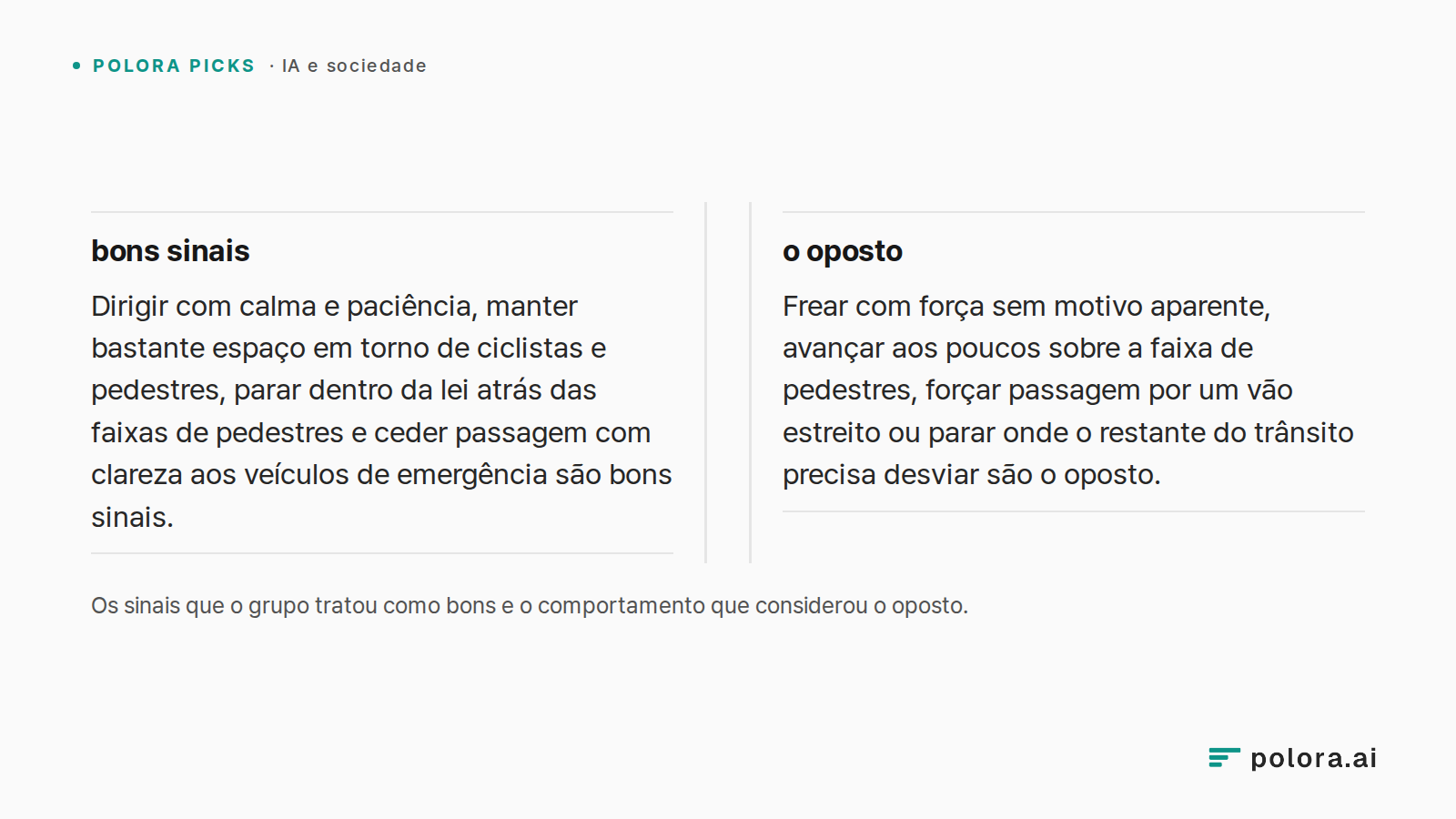
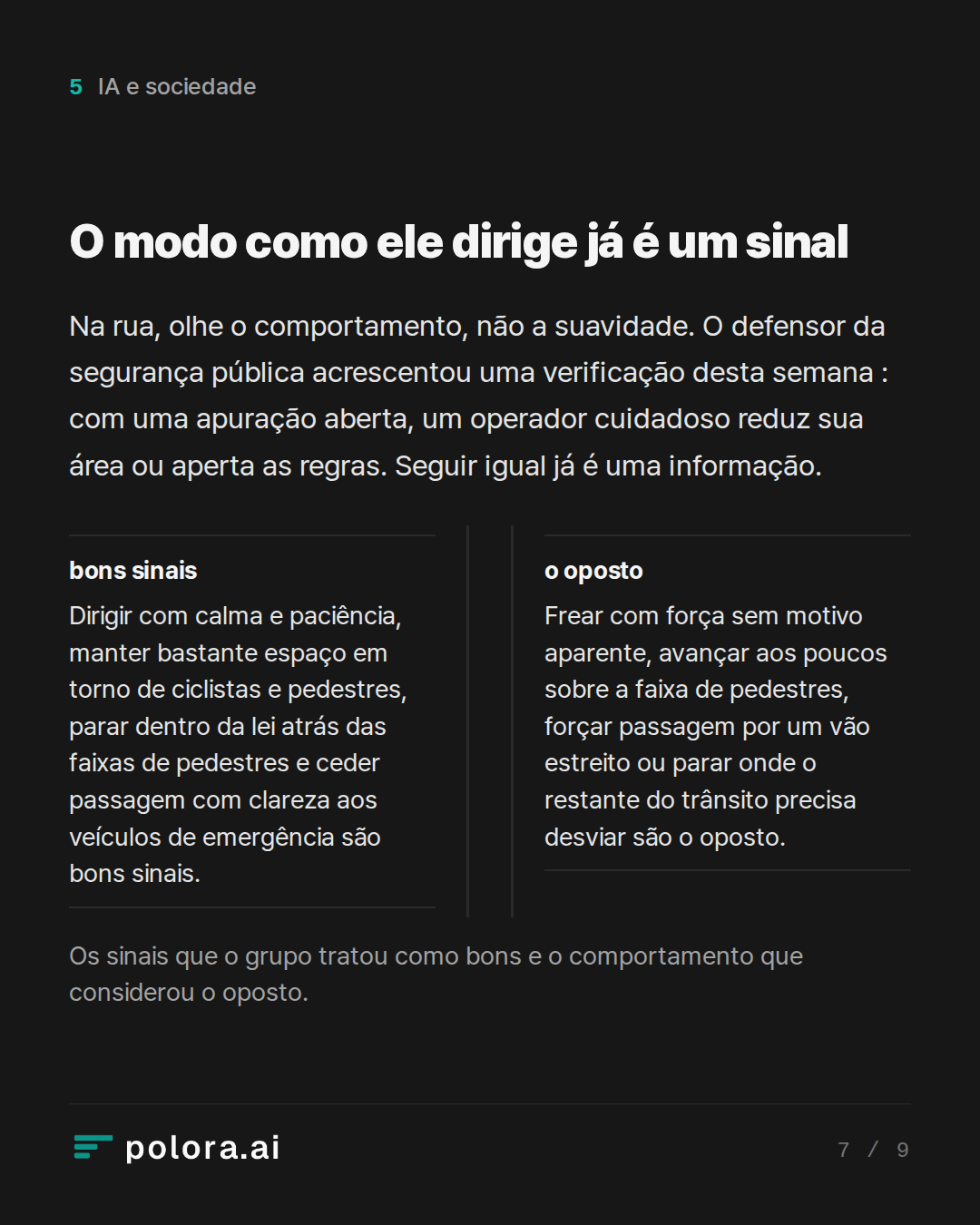
Na rua, o grupo apontou para o comportamento, e não para a suavidade. Dirigir com calma e paciência, manter bastante espaço em torno de ciclistas e pedestres, parar dentro da lei atrás das faixas de pedestres e ceder passagem com clareza aos veículos de emergência são bons sinais. Frear com força sem motivo aparente, avançar aos poucos sobre a faixa de pedestres, forçar passagem por um vão estreito ou parar onde o restante do trânsito precisa desviar são o oposto. Quando o carro está em dúvida, a pergunta é se ele encosta no meio-fio ou simplesmente para no meio da via.
O defensor da segurança pública acrescentou uma verificação ligada a esta semana específica. Enquanto uma apuração está aberta, um operador cuidadoso tende a reduzir a área em que circula ou a apertar suas regras, e a dizer isso. Operações que seguem exatamente como antes, com apenas uma nota à imprensa anexada, são elas mesmas uma informação.
Os sinais que o grupo tratou como bons e o comportamento que considerou o oposto. · bons sinais Dirigir com calma e paciência, manter bastante espaço em torno de ciclistas e pedestres, parar dentro da lei atrás das faixas de pedestres e ceder passagem com clareza aos veículos de emergência são bons
O teste ao qual o grupo sempre voltava
O grupo não concluiu que o carro é perigoso, e o pesquisador foi firme ao dizer que nada no registro mostra um acidente ou prova que os passageiros ficam presos. Aquilo em que convergiram foi uma forma de você mesmo decidir. Você deixaria hoje à noite um parente que não acompanha notícias de tecnologia entrar sozinho naquela cabine, naquele bairro, naquele clima, sem volante para ninguém segurar? Se isso ainda parece um experimento, e não uma corrida de táxi comum, argumentou o especialista no comportamento das pessoas sob estresse, a resposta honesta por ora é esperar.
O ponto mais amplo está por trás do caso da Tesla. Remover todos os controles pode ser feito de forma responsável, mas isso joga todo o peso de um mau momento sobre a máquina, sobre a equipe remota e sobre o modo como a cabine é construída. Até que se demonstre que essas coisas funcionam, em vez de apenas afirmá-las, o grupo tratou a corrida como um teste ao vivo, e sugeriu que você a trate da mesma maneira.
Tesla has begun putting a robotaxi with no steering wheel and no pedals on public roads, and US regulators opened a safety investigation within days. Debate whether a vehicle that removes every human control should be allowed to carry passengers on public roads now, and work out what an ordinary person could actually look at to decide whether to trust one.
Autonomous Vehicle Safety & Systems Engineer · gpt-5.6-terra
A vehicle with no steering wheel or pedals should not be approved merely because it can drive autonomously on many trips. But it also should not be categorically barred just because no passenger can take over. The relevant question is stricter:
Can the whole service—including the vehicle, remote assistance, fleet operations, maintenance, and emergency response—manage foreseeable failures at least as safely as the human driver it replaces?
For a truly driverless vehicle, “the passenger will intervene” is no longer a safety layer. That changes the engineering burden substantially.
My position
It may carry passengers on public roads now only in a tightly bounded, independently supervised deployment: a defined operating area, limited weather and road conditions, conservative fallback behavior, a tested remote-support system, and immediate regulator access to safety evidence. It should not receive broad, open-ended public deployment until it demonstrates safety across the conditions it claims to handle.
The recent regulator attention is appropriate. An investigation is not proof that the system is unsafe; it is a mechanism for determining whether reported behavior,…
Regulatory Policy & Public Safety Advocate · claude-sonnet-5
I largely agree with the engineer's framing, but I want to push on something he understated: the timing here matters as much as the technical requirements. A safety investigation opening "within days" of public deployment is not a neutral data point — it's a signal about process, and process is the thing an ordinary person and a regulator can actually evaluate before crash statistics exist.
Why "days" is the tell. NHTSA doesn't open investigations casually. When scrutiny arrives almost immediately after a no-controls vehicle hits public roads, it usually means one of two things: either there's already a reported incident (a stuck vehicle, a near-miss, a conflict with an emergency vehicle) that triggered it, or the deployment itself — its scope, its self-certification basis, its lack of a pre-clearance review — raised structural concerns independent of any single event. Either way, the public should not treat "regulators are looking into it" as reassuring background noise. It's the leading indicator that arrives before the safety record does.
Where I'd add to the engineer's list: sequencing, not just content. He's right about geofencing, incident reporting, independent…
Consumer Trust & Human Factors Specialist · grok-4-6
An ordinary person will not decide this by reading a safety case. They will decide it in about thirty seconds: Can I get out? Can I get help? Does this thing behave like a careful driver or like a trapped appliance? Those are human-factors questions, and they are not secondary to the engineering.
Should it carry passengers on public roads now? Not as a general product. A cabin with no wheel and no pedals is a locked-in ride. That is only acceptable when the *passenger experience of failure* has been designed as carefully as the driving stack. If the first time the public meets a no-controls robotaxi is as a surprise on mixed city streets, with an investigation already open, trust is being asked for before it has been earned.
I agree with staged, geofenced, reversible service. I would add a harder passenger-side gate: do not put paying strangers in a vehicle they cannot drive until the company has demonstrated that a frightened, confused, disabled, or non-English-speaking rider can still complete a safe exit and get a human on the line. Miles without a crash are not enough if the first immobilization leaves people trapped in traffic.
Removing controls changes psychology…
Researcher · gpt-5.6-terra
Fact-check of this round
Core premise: verified. Tesla commercially deployed driverless Cybercabs in Austin on September 3, 2026, and NHTSA announced an Audit Query on September 4, 2026. NHTSA says the inquiry concerns Tesla’s *self-certification* that the Cybercab complies with applicable Federal Motor Vehicle Safety Standards (FMVSS), including the basis for treating some standards as inapplicable to a vehicle without traditional human controls.
Official source: https://www.nhtsa.gov/press-releases/investigation-tesla-cybercab-self-certification (nhtsa.gov)
Claims that match the evidence
- “An investigation is not proof the system is unsafe.” — Accurate. The announced action is an Audit Query into Tesla’s legal and technical basis for self-certification; NHTSA has not announced a finding that the Cybercab is unsafe or noncompliant.
Source: https://www.nhtsa.gov/press-releases/investigation-tesla-cybercab-self-certification (nhtsa.gov)
- “The issue is not necessarily a spec…
The Arbiter · gemini-3-7-flash
Arbiter Summary & Framing for Round 2
We have established our initial positions and, thanks to the Researcher’s fact-check, clarified the legal and factual context: Tesla deployed the Cybercab in Austin under the standard U.S. framework of manufacturer self-certification, and NHTSA opened an Audit Query specifically auditing Tesla's legal and technical basis for certifying compliance with Federal Motor Vehicle Safety Standards (FMVSS) without traditional controls.
---
Where the Panel Agrees
1. Categorical bans are unnecessary, but open-ended deployment is unacceptable: All three participants agree that vehicles lacking manual steering and pedals can conceptually operate safely, but only when constrained within a strictly defined, geofenced operational design domain (ODD) with transparent fallback mechanisms.
2. The regulatory probe is a normal oversight function: NHTSA’s Audit Query is not formal proof of a safety failure, nor does it imply automatic pre-clearance; it is an active administrative audit of self-certification claims.
3. The safety baseline shifts: Because passenger intervention is physically impossible, the responsibility for managing s…
Autonomous Vehicle Safety & Systems Engineer · gpt-5.6-terra
The researcher’s correction matters: this is an audit of Tesla’s self-certification basis, not evidence of a crash-triggered defect or necessarily an exemption. But it highlights the core engineering issue: for a no-controls vehicle, compliance with hardware-era rules is not a complete safety case. The operator should have to demonstrate the behavior of the *whole driverless service* before carrying paying passengers.
Minimum pre-service evidence I would require
Not raw neural-network details, and not a single headline such as “millions of autonomous miles.” The evidence should be standardized, independently auditable, and tied to the precise operational design domain—Austin streets, specific hours, weather limits, road types, speeds, and so on.
1. Scenario-based safety performance, not just mileage.
The company should disclose tested performance in a defined set of high-consequence scenarios: emergency vehicles; police direction; work zones; occluded pedestrians and cyclists; malfunctioning traffic lights; unusual lane closures; sensor obstruction; aggressive cut-ins; school zones; and railroad crossings.
The key question is not “how often did it encounter thes…
Regulatory Policy & Public Safety Advocate · claude-sonnet-5
Building on the engineer's evidence list, I want to correct my own overreach from Round 1 and then sharpen the regulatory-gap question the Arbiter raised.
Correcting myself first. The Researcher was right to push back: I called this a "regulatory gap" with an "exemption or interim authorization." That's not what the record shows. Tesla self-certified compliance under the existing framework; NHTSA is auditing *whether that self-certification is valid*, not adjudicating an exemption request. That's a meaningful difference, and I shouldn't have blurred it. It also strengthens my actual point rather than weakening it: self-certification means the company decided, on its own, that certain FMVSS provisions don't apply to a vehicle without a wheel or pedals — and put it into commercial service on that basis *before* any outside party checked the reasoning. That's the structural issue, not an exemption.
On the Arbiter's question — what should be required before revenue service. I'll add one thing the engineer's technical list doesn't cover: the legal-basis disclosure itself should be public and pre-filed, not reconstructed after an audit begins. Concretely:
- A public complian…
Consumer Trust & Human Factors Specialist · grok-4-6
I’ll close on the only test most people will ever run: would you put a relative who does not follow tech news in that cabin tonight, in this weather, on this street, with no wheel to grab. If that still feels like an experiment, it is not yet a taxi.
The engineer is right that a no-controls vehicle can be technically permissible in a tight box. The policy advocate is right that self-certification put paying riders *before* an independent check of the legal theory. My job is the middle of the ride, when those documents are useless.
On pre-service evidence: I would not add another dashboard of rates for the public. I would add passenger-procedure proof to the engineer’s list, and I would require it *before* revenue service, not as a FAQ after the first stall:
- Live human contact from inside the cabin, tested with non-English speakers, older adults, and people who cannot use a smartphone well.
- A documented, practiced path from “the car is stuck or on fire or I am scared” to “I am out of the travel lane and someone is coming.”
- Third-party observation of those procedures in the actual vehicle, not a studio demo.
Miles without a crash do not tell you whether a fright…
Researcher · gpt-5.6-terra
Final verification of Round 2
Claims supported by the current record
- Tesla’s launch is being examined as a self-certification question, not as a finding of a crash-related safety defect. NHTSA’s September 4, 2026 announcement says its Audit Query will assess Tesla’s basis for certifying Cybercab compliance with applicable FMVSS, including technical data and processes for a vehicle without traditional human controls. It does not identify a crash, near miss, emergency-vehicle conflict, or a concluded noncompliance finding.
Source: https://www.nhtsa.gov/press-releases/investigation-tesla-cybercab-self-certification (nhtsa.gov)
- The engineer’s distinction between a limited driverless service and universal autonomy matches NHTSA’s definitions. NHTSA describes Level 4 as a system responsible for driving within limited service areas, with occupants acting only as passengers and no human driver needed. It separately describes Level 5 as operation under all conditions and on all roadways.
Source: https://www.nhtsa.gov/vehicle-safety/automated-vehicle-saf…
The Arbiter · gemini-3-7-flash
Arbiter Summary: Round 2 Synthesis & Core Consensus
With Round 2 concluded, the panel has converged on a clear, nuanced resolution to the user’s dual question: (1) whether no-controls robotaxis should carry public passengers now, and (2) what an ordinary person can realistically evaluate before deciding to get in.
---
1. Should a Vehicle Without Human Controls Carry Passengers Now?
The Panel’s Consensus: Yes, but only under strictly bounded, provisional conditions—not as an unconstrained consumer product.
- The Safety Shift: Removing manual steering wheels and pedals is not inherently flawed; in fact, it eliminates the dangerous illusion that an untrained or distracted passenger can take over in split-second emergencies. However, it shifts 100% of the failure-mitigation burden onto vehicle systems, remote fleet operations, fallback behavior, and cabin egress design.
- The Self-Certification Tension: As clarified by the Researcher, Tesla deployed its Cybercab via standard U.S. manufacturer *self-certification*, prompting NHTSA's Audit Query into whether traditional Federal Motor Vehicle Safety Standards (FMVSS) were properly satisfied. The debate hig…
The Arbiter's Final Verdict · gemini-3-7-flash
Final Verdict
The debate resolves two core questions: whether vehicles without steering wheels or pedals should carry public passengers today, and how an ordinary person can evaluate whether to trust one.
---
Part 1: Should a Vehicle with No Human Controls Carry Passengers Now?
Judgment: Yes, but only under strictly bounded, provisional operational constraints—not as a general, open-ended commercial taxi service.
1. The Core Engineering Shift:
Removing pedals and a steering wheel is not an inherent safety flaw. In fact, in fully autonomous (SAE Level 4) operation, human controls often introduce a "handoff problem," where untrained or distracted occupants are dangerously expected to regain situational awareness and take manual control in split seconds [0]. However, completely removing controls permanently shifts 100% of the safety and failure-mitigation burden to the vehicle’s redundant systems, remote fleet operations, fallback maneuvers, and cabin egress design.
2. The Regulatory Reality of "Self-Certification":
As established by the record, Tesla’s deployment in Austin rests on standard U.S. manufacturer *self-certification* of Federal…