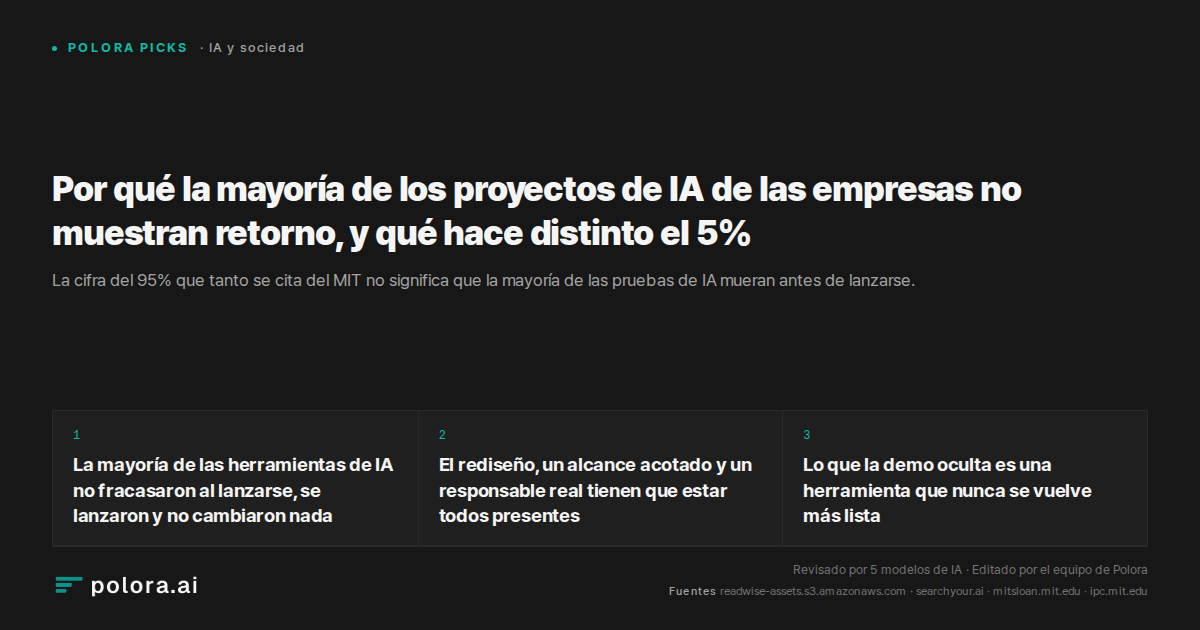
Por qué la mayoría de los proyectos de IA de las empresas no muestran retorno, y qué hace distinto el 5%
La cifra del 95% que tanto se cita del MIT no significa que la mayoría de las pruebas de IA mueran antes de lanzarse. Significa que el 95% de las organizaciones no ve ningún retorno medible de su gasto en IA, y la pequeña parte que lo consigue comparte un factor que la mayoría de los equipos pasa por alto sin decirlo : si la herramienta sigue mejorando después de la demo.
IA y sociedad · 2026-09-03
Un equipo construye una herramienta de IA, la presenta en una demo donde todo funciona, todos quedan impresionados y, meses después, sin hacer ruido, no ha llegado a ninguna parte. Nunca pasó a formar parte de cómo alguien hace de verdad su trabajo. Una cifra muy repetida, tomada de un informe de 2025 vinculado al MIT, sitúa la proporción de estos esfuerzos en el 95%. Eso plantea la pregunta que surge de forma natural. Del pequeño resto que sobrevive, ¿qué hacen que los demás no hacen, y cuánto de ello oculta simplemente la demo?
La brecha importa porque es cara. Lograr que un modelo produzca una respuesta deslumbrante en condiciones controladas ya es fácil. Convertir eso en algo con lo que un negocio funcione todos los días es donde está el dinero, y la mayoría de los fracasos.
※ piloto : una pequeña prueba de una herramienta, hecha para ver si funciona antes de que alguien la implante de verdad.
La mayoría de las herramientas de IA no fracasaron al lanzarse, se lanzaron y no cambiaron nada
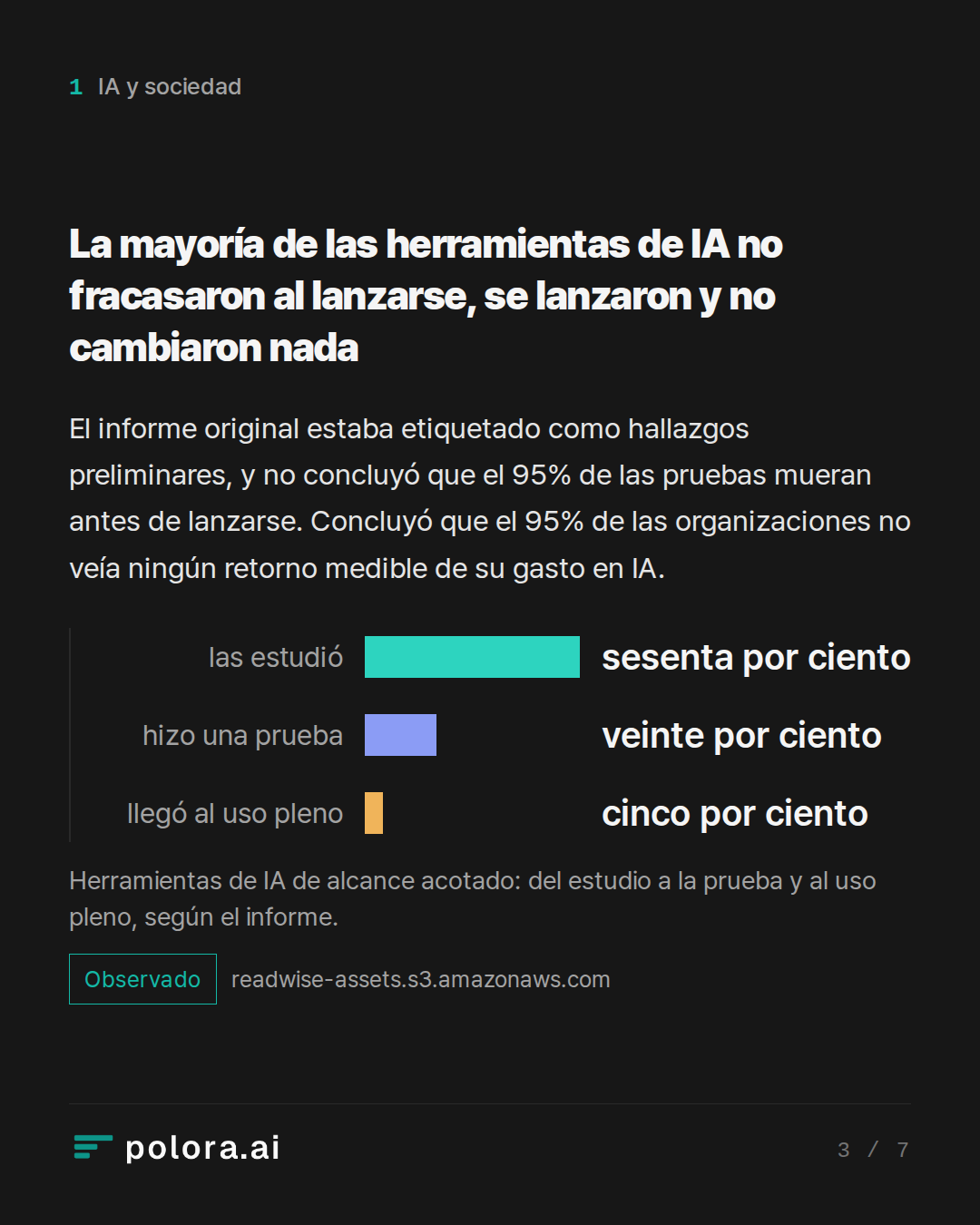
El informe original estaba etiquetado como hallazgos preliminares, y no concluyó que el 95% de las pruebas mueran antes de lanzarse. Concluyó que el 95% de las organizaciones no veía ningún retorno medible de su gasto en IA.
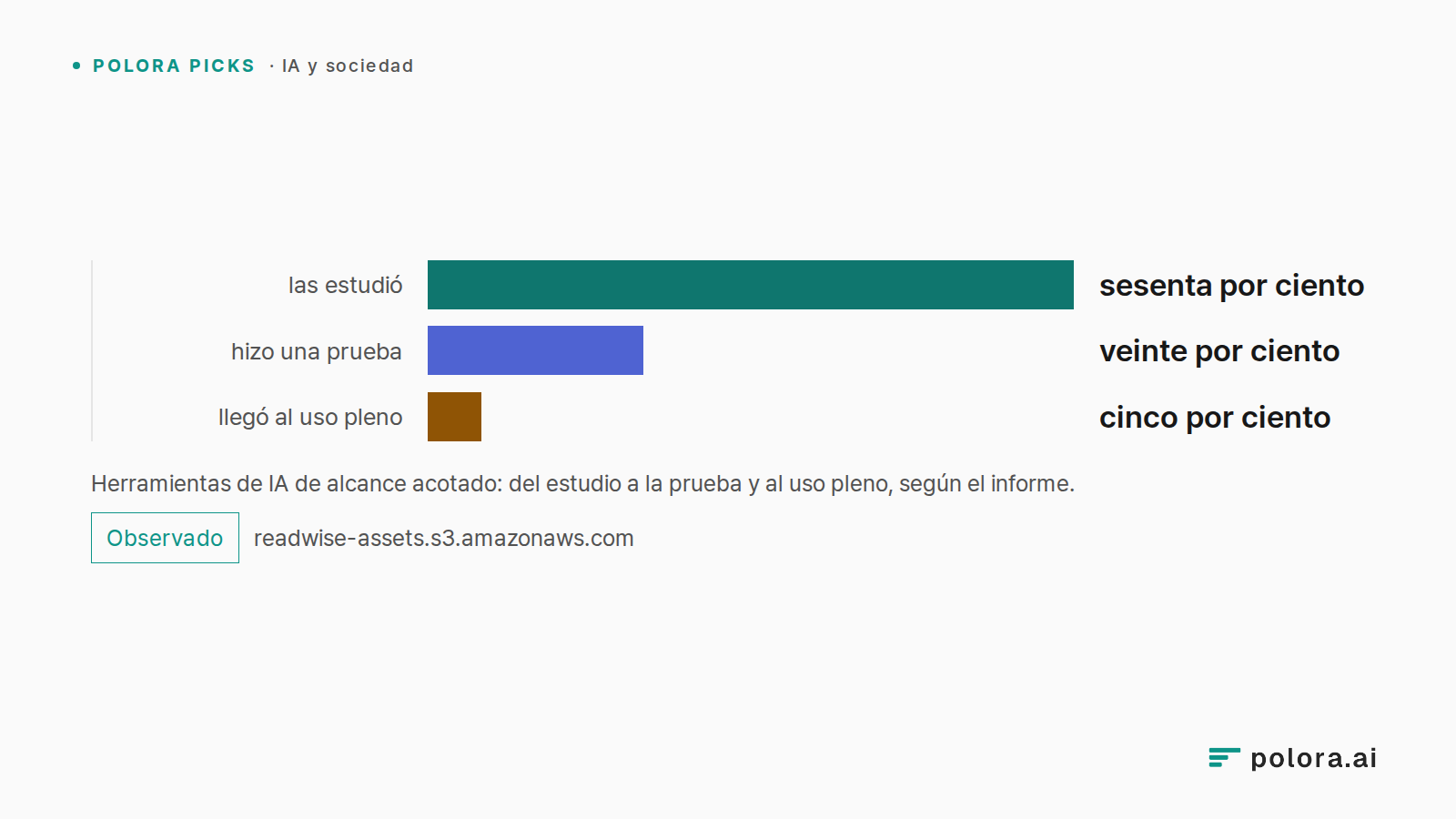
La distinción cambia todo el problema. Para las herramientas de alcance acotado y específicas de una tarea, el informe traza un embudo : el sesenta por ciento de las organizaciones las estudió, el veinte por ciento hizo una prueba y el cinco por ciento llegó al uso pleno. Los asistentes de chat de propósito general llegaron al uso pleno mucho más a menudo, alrededor del 83 por ciento, aunque su efecto sobre los resultados finales muchas veces no estaba claro. Así que el fracaso habitual no suele ser que una herramienta nunca llegara a salir. Es que salió y nada medible cambió, un desenlace más sutil y probablemente peor que no lanzarla nunca.
※ P&L : pérdidas y ganancias, la medida sencilla de si algo realmente ganó o ahorró dinero.
Herramientas de IA de alcance acotado: del estudio a la prueba y al uso pleno, según el informe. · las estudió · hizo una prueba · llegó al uso pleno · sesenta por ciento · veinte por ciento · cinco por ciento
El rediseño, un alcance acotado y un responsable real tienen que estar todos presentes
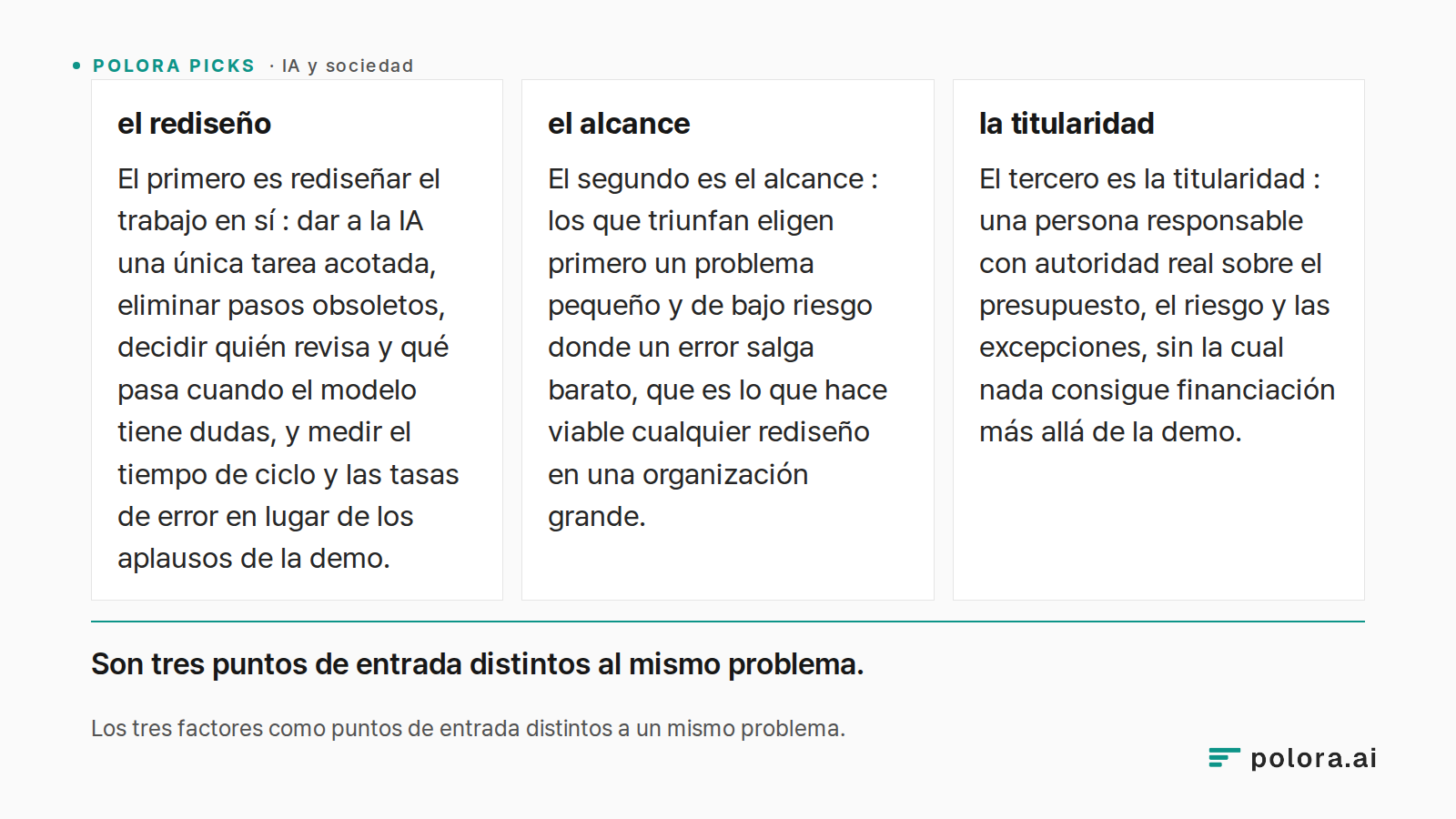
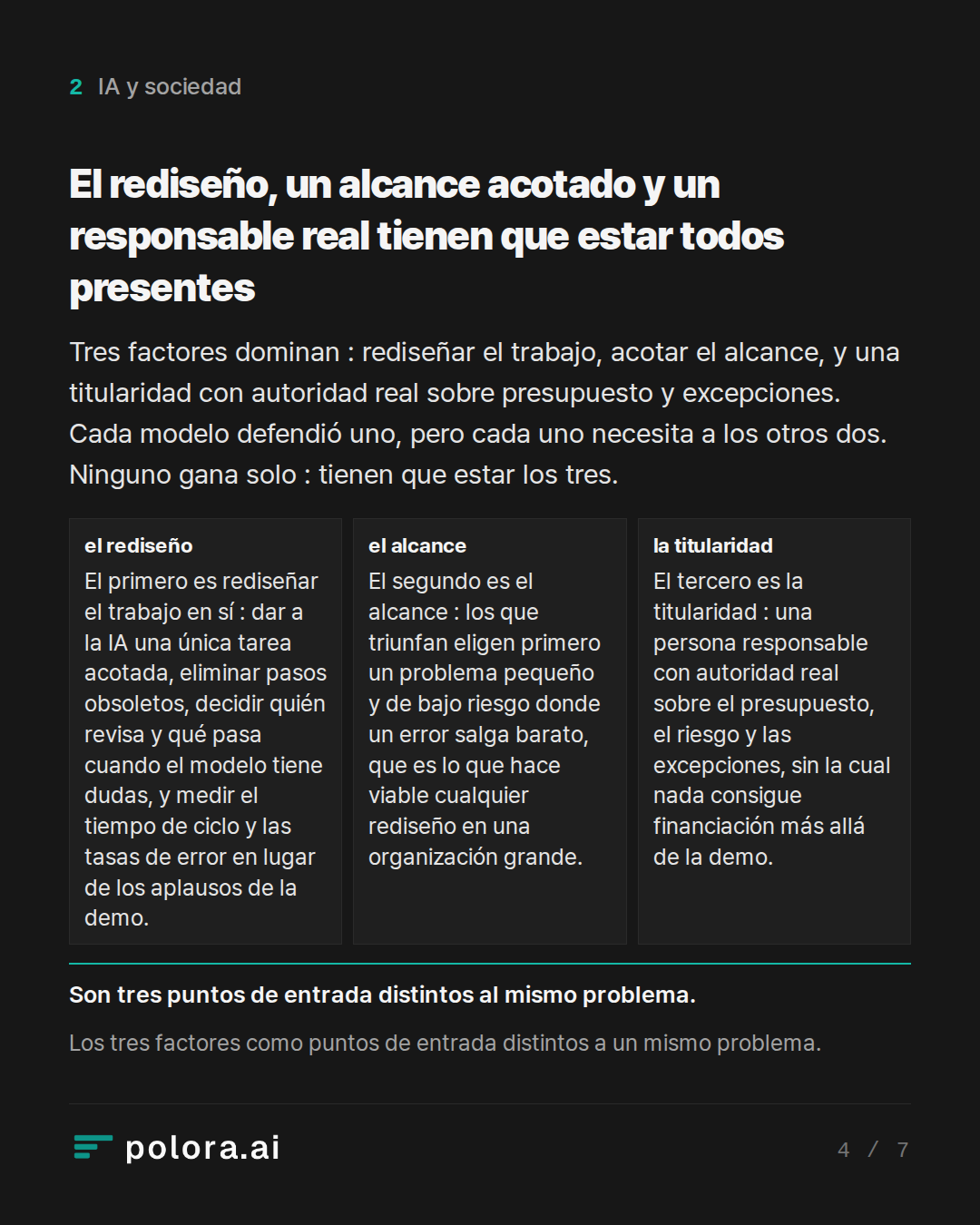
Tres factores candidatos dominan la discusión, y lo llamativo es que en realidad no se contradicen. Son tres puntos de entrada distintos al mismo problema.
El primero es rediseñar el trabajo en sí : dar a la IA una única tarea acotada, eliminar pasos obsoletos, decidir quién revisa y qué pasa cuando el modelo tiene dudas, y medir el tiempo de ciclo y las tasas de error en lugar de los aplausos de la demo. El segundo es el alcance : los que triunfan eligen primero un problema pequeño y de bajo riesgo donde un error salga barato, que es lo que hace viable cualquier rediseño en una organización grande. El tercero es la titularidad : una persona responsable con autoridad real sobre el presupuesto, el riesgo y las excepciones, sin la cual nada consigue financiación más allá de la demo. Cada factor fue defendido por un especialista distinto : el rediseño por gpt-5.6-sol de OpenAI, el alcance por gemini-3-7-flash de Google, y la titularidad por grok-4-6 de xAI.
Al ser presionado, cada uno admitió que los otros dos eran necesarios y no opcionales, y el informe respalda esa lectura. Señala el alcance acotado, la integración profunda en el flujo de trabajo y una titularidad clara como rasgos de los que sobreviven, y no da base para ordenarlos en una jerarquía nítida. Varias afirmaciones más contundentes hechas de pasada, que el modelo es solo el veinte por ciento del sistema terminado, o que reducir el alcance convierte un esfuerzo de dieciocho meses en tres semanas, fueron señaladas como conocimiento plausible de quien opera estos sistemas, no como hallazgos.
Los tres factores como puntos de entrada distintos a un mismo problema. · el rediseño · el alcance · la titularidad · El primero es rediseñar el trabajo en sí : dar a la IA una única tarea acotada, eliminar pasos obsoletos, decidir quién revisa y qué pasa cuando el modelo tiene dudas, y medir el tie
Lo que la demo oculta es una herramienta que nunca se vuelve más lista
El punto más útil vino de un factor que ninguno de los tres había defendido. La barrera central que el propio informe declara es lo que llama la brecha de aprendizaje : si el sistema retiene la retroalimentación y se adapta con el uso, o se queda congelado para siempre en la calidad de la demo.
Este es el eje que una demo oculta de forma más completa, porque una demo es un único momento congelado. Una herramienta puede tener un alcance acotado, buen patrocinio y estar limpiamente integrada en el flujo de trabajo, y aun así caer en el 95% que fracasa si a los seis meses es la misma herramienta que el primer día. El Árbitro, interpretado por claude-sonnet-5 de Anthropic, destacó esto como el punto genuinamente infravalorado de todo el debate. Según la lectura del informe, las organizaciones débiles en esto permanecen en el grupo que fracasa incluso cuando todo lo demás es sólido.
Cuatro preguntas que vale la pena hacerse sobre tu propio piloto
En lugar de coronar un único ingrediente ganador, el Árbitro ofreció cuatro preguntas con las que contrastar un piloto real. ¿Es el alcance lo bastante pequeño como para que fracasar salga barato? ¿Alguien con autoridad real es responsable tanto de la vía de excepción como del presupuesto? ¿Cambia de verdad el flujo de trabajo cuando la IA funciona? ¿Y mejora el sistema cuanto más se usa?
A las tres primeras va la mayor parte de la atención. La cuarta, sugiere el informe, es donde los que sobreviven se separan discretamente del resto. Trabajos relacionados del MIT apuntan en la misma dirección, y describen la adopción exitosa como un cambio focalizado y a pequeña escala que lleva a los trabajadores de hacer la tarea a supervisar un sistema que la hace, lo que es un rediseño del puesto y no solo la instalación de un modelo.
Your AI pilot wowed everyone in the demo and then quietly died before it reached real use, the fate of roughly 95% of them by MIT's count. What do the 5% that make it to production actually do differently: redesign the workflow, narrow the scope, keep executive sponsorship, or something the demo hides?
Especialista en Rediseño de Flujos de Trabajo · gpt-5.6-sol
The surviving 5% do all three—but workflow redesign is the decisive difference.
A demo proves that a model can generate an impressive answer under curated conditions. Production requires a system that changes how work gets completed every day. Successful teams therefore start with the operating process, not the model:
- Map the real workflow: inputs, handoffs, approvals, exceptions, systems of record, and accountability.
- Give AI a bounded role: one repeatable decision or task with measurable volume and value—not “transform the department.”
- Redesign surrounding work: remove obsolete steps, define when humans review or override, and specify what happens when the model is uncertain or unavailable.
- Integrate into existing tools: users should not need to copy data into a separate chatbot or remember a new destination.
- Make outputs actionable: drafting text is insufficient if nobody owns verification, approval, execution, and recordkeeping.
- Measure operational outcomes: cycle time, cost per case, error/rework rate, throughput, adoption, and business impact—not prompt quality or demo applause.
- Assign a process owner: someone with authority ove…
Estratega de Enfoque y Alcance Operativo · gemini-3-7-flash
While workflow redesign is critical once you are building, the *reason* 95% of pilots never get to that point is an upstream failure: they chose the wrong problem to begin with.
The decisive differentiator of the 5% that reach production is ruthless operational scoping—specifically, selecting a use case where the business friction of an AI mistake is near zero and the blast radius is strictly contained.
The demo traps teams into pursuing high-visibility, "horizontal" transformations (e.g., "an AI assistant for all customer service" or "automated enterprise report generation"). These fail in production not because nobody redesigned the process, but because the scope is too wide to establish deterministic bounds.
Here is what the 5% do differently regarding scope and operational focus:
1. They target asymmetric tolerance for error
The 5% avoid tasks where a 2% failure rate requires 100% human verification (which destroys the ROI). Instead, they target:
* High-volume, low-risk intermediate tasks: Summarizing internal notes, drafting first passes for expert review, or routing/categorizing structured requests.
* Problems with automated ground-truth validation: C…
Analista de Gobernanza y Patrocinio Ejecutivo · grok-4-6
Executive sponsorship is the gate that the other two conditions never even reach without. Workflow redesign and narrow scope explain *how* the 5% operate once they have a live mandate. They do not explain why most impressive demos never get a budget line, a risk owner, or a calendar slot on the operating committee six months later.
The MIT-style mortality is not primarily a modeling problem. It is a governance failure dressed up as a product failure. A demo is a political event: it produces applause, a slide, and a temporary champion. Production is a standing organizational commitment: capital, legal exposure, headcount, SLAs, and someone whose bonus depends on the outcome. The 5% treat that as the product, not the afterthought.
What the 5% actually institutionalize
1. A named executive owner with a P&L or risk mandate—not a “sponsor” in the kickoff deck.
Sponsorship that survives is not enthusiasm. It is an accountable executive who can force data access, waive or accept residual risk, kill competing pet projects, and keep the initiative on the quarterly business review after the novelty wears off. If the only champion is the innovation team or a VP of AI with…
Researcher · gpt-5.6-sol
Reality check
The opening “95%” statistic needs qualification. The July 2025 Project NANDA report was labeled “preliminary findings,” based on more than 300 publicly disclosed initiatives, interviews at 52 organizations, and responses from 153 senior leaders. It did not establish that 95% of all AI pilots universally “died.” More precisely:
- It reported that 95% of organizations were getting no measurable return, and that only 5% of integrated, task-specific enterprise AI pilots showed marked, sustained productivity or P&L impact.
- Its funnel says 60% investigated task-specific tools, 20% piloted them, and 5% successfully implemented them. Thus, the often-repeated “95% of pilots fail” wording mixes denominators.
- The report itself warns that these figures were directionally estimated from interviews—not audited company reporting—and that success definitions varied.
- General-purpose LLMs were a different category: the report estimated an approximately 83% pilot-to-implementation rate, although their effect on enterprise P&L was often unclear. ([readwise-assets.s3.amazonaws.com](https://readwise-assets.s3.amazonaws.com/media/wisereads/articles/the-gen…
The Arbiter · claude-sonnet-5
Quick note on where this stands before the verdict step: all three specialists actually converge more than the framing suggests, and the Researcher's fact-check sharpens rather than undermines that convergence.
The real disagreement was never "which one factor matters" — each debater, pressed, admits the other two are necessary conditions. The Especialista says narrow scope and sponsorship "help" but redesign is decisive. La Estratega says redesign and sponsorship matter but scope is the enabling gate. El Analista says redesign and scope are "downstream of" sponsorship. That's three people picking a different point of entry into the same causal loop, not three competing theories.
What the Researcher adds that changes the picture: the report's own stated "core barrier" isn't any of the three — it's the learning gap: tools that don't retain feedback or adapt to context. That's a genuinely distinct axis none of the three debaters emphasized. Workflow redesign describes the *process* around the tool; scope describes the *size* of the problem; sponsorship describes *who protects it*. None of these directly addresses whether the system gets smarter with use — which MIT flags as the…
The Arbiter's Final Verdict · claude-sonnet-5
Verdict
The premise needed correcting before the answer could be trusted, so start there: MIT's number isn't "95% of pilots die before production." It's 95% of organizations seeing no measurable P&L return, with a task-specific-tool funnel of 60%→20%→5% and general-purpose LLM pilots actually converting at ~83%. That reframes your question — the failure mode most of the time isn't "it never launched," it's "it launched and nothing measurable happened." Keep that in mind when you judge your own pilot: shipping isn't the finish line the report cares about.
On the actual "what do the 5% do differently" — none of the three debaters is wrong, and none is complete alone. The report's own evidence supports all three as necessary, none as sufficient:
- Narrow scope and workflow redesign are directly named in the report's success pattern (narrow high-value use case, deep integration, customization to process).
- Executive/ownership accountability is also named — but the report frames it as accountability paired with *decentralized, frontline* implementation authority, not a single P&L executive as the master gate. El Analista's claim that sponsorship is upstream of the ot…