Tesla circula por Austin con un taxi sin volante ni pedales, y los reguladores abrieron una revisión en un solo día. Esto es lo que un pasajero puede comprobar antes de confiar en uno.
IA y sociedad · 2026-09-06
El 3 de septiembre de 2026, Tesla empezó a hacer circular por las calles públicas de Austin, Texas, un robotaxi sin volante y sin pedales. Dentro no hay nada de lo que un pasajero pueda agarrarse. Al día siguiente, el principal regulador de seguridad vial de Estados Unidos abrió una revisión del vehículo. Un coche que elimina todos los mandos humanos, junto con una investigación oficial que llegó en un solo día, es la razón por la que conviene leer esto con calma en lugar de por encima.
※ robotaxi : un taxi que se conduce solo, sin ningún conductor humano al volante.
Qué está comprobando en realidad el regulador
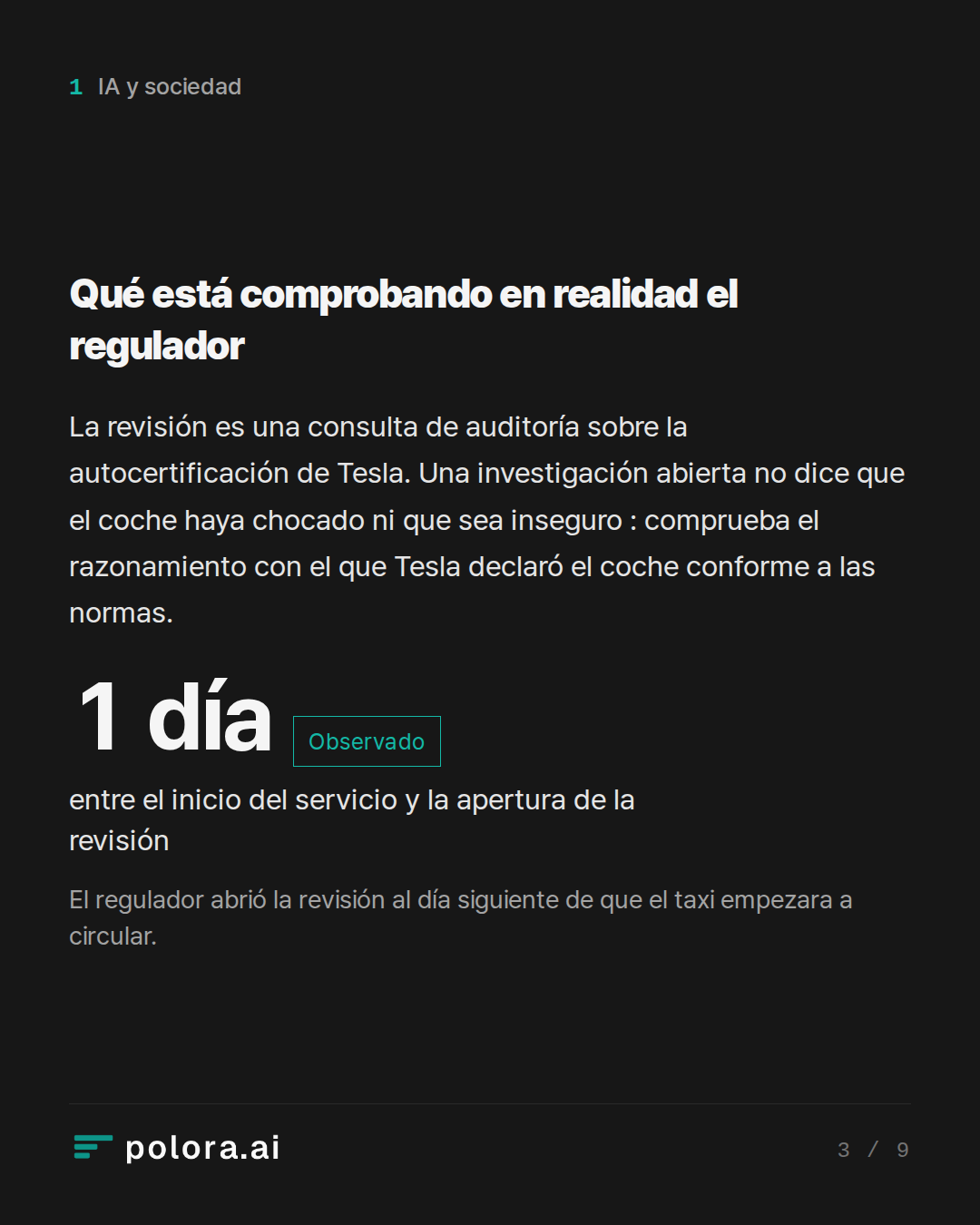
La revisión es más acotada de lo que parece al principio. El investigador del panel, que contrastó la discusión con fuentes oficiales, halló que el regulador abrió lo que denomina una consulta de auditoría, referida a la autocertificación de Tesla. En Estados Unidos, un fabricante certifica por sí mismo que un vehículo cumple las normas federales de seguridad, y ninguna oficina del gobierno aprueba cada modelo antes de que salga a la venta. La investigación pregunta si el fundamento de Tesla para certificar un coche sin mandos tradicionales se sostiene.
De aquí se siguen dos cosas. Una investigación abierta no es una conclusión de que el coche haya chocado ni de que sea inseguro. Es una comprobación del razonamiento que hay detrás del papeleo. Y el coche no circula bajo una exención especial del gobierno. Está en la calle porque Tesla lo declaró conforme, y esa declaración es lo que ahora se examina.
※ autocertificación : la propia empresa declara que su vehículo cumple las normas de seguridad, en lugar de que una oficina del gobierno lo apruebe antes.
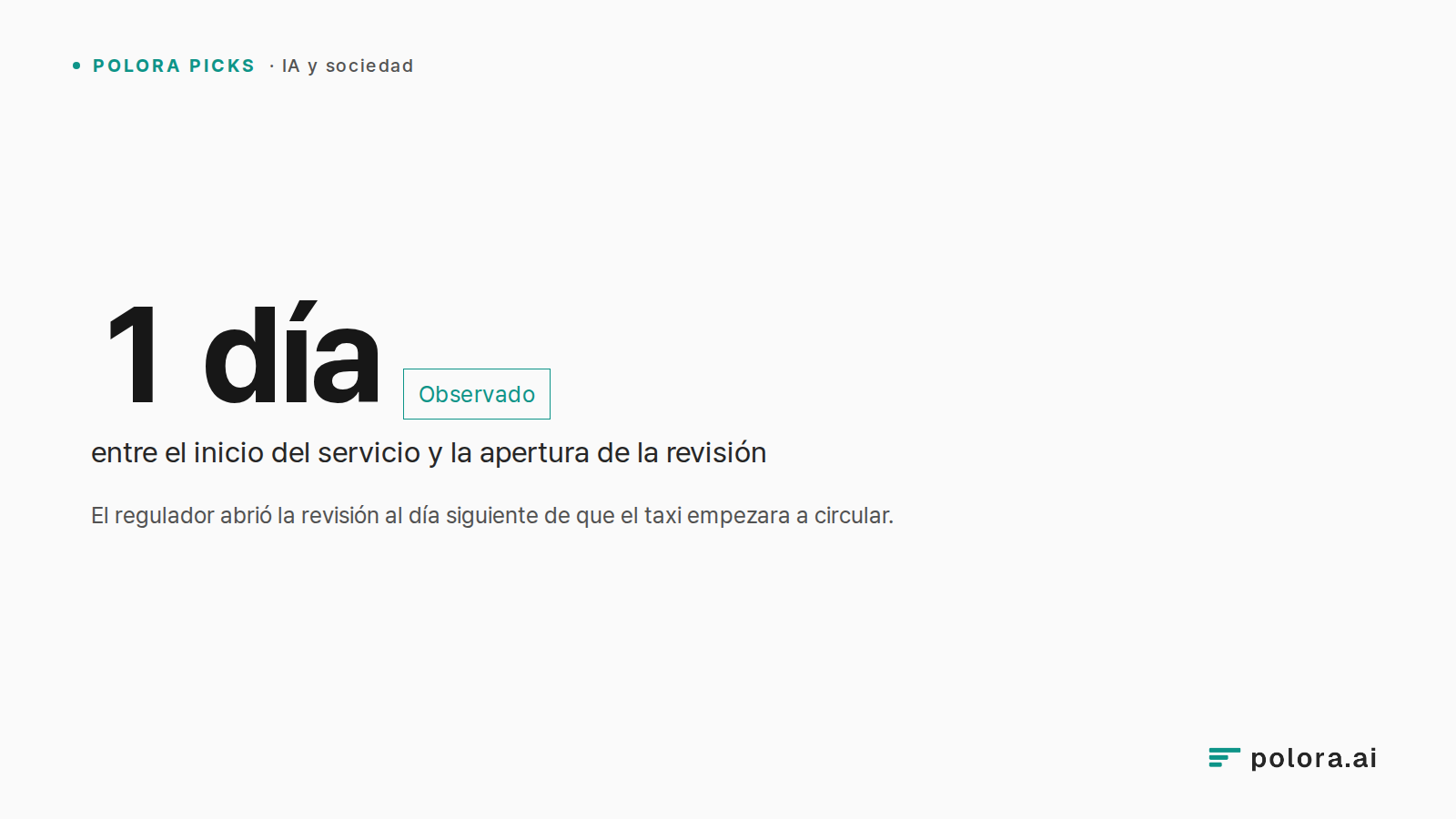
El regulador abrió la revisión al día siguiente de que el taxi empezara a circular. · 1 día entre el inicio del servicio y la apertura de la revisión
Este texto procede de un debate que Polora organizó entre varios modelos de IA, cada uno con un rol asignado : un ingeniero de seguridad, un defensor de la seguridad pública, un especialista en cómo se comportan las personas bajo tensión, un investigador que leyó la web y verificó las afirmaciones, y un moderador que sopesó el intercambio. No son personas ni expertos reales, y ninguno de ellos habla por todo el grupo. Lo que sigue es lo que cada uno observó, y el punto en el que acabaron coincidiendo.
Por qué quitar el volante sube el listón
El ingeniero planteó algo que va contra la intuición. Un volante puede dar una falsa sensación de seguridad, porque un pasajero no puede tomar el control de forma realista en el segundo o los dos segundos que concede un fallo repentino. Un coche diseñado desde el principio para conducirse solo puede ser más seguro precisamente porque no se espera que nadie dentro lo rescate.
Pero esa misma decisión elimina el último respaldo, así que el ingeniero sostuvo que todo el servicio, y no solo el coche, tiene que responder preguntas más difíciles : qué ocurre cuando un sensor queda tapado o se cae la conexión, si el coche sabe interpretar a un agente de policía que dirige el tráfico con la mano, y si es capaz de encontrar un lugar realmente seguro donde detenerse en vez de quedarse paralizado en un carril con tráfico. Su conclusión fue que un vehículo así puede llevar pasajeros ahora, pero solo como un despliegue muy delimitado y vigilado de cerca, no como un producto terminado que se vende como si el problema estuviera resuelto.
Nadie en el panel creía que una persona común pudiera inspeccionar el software, así que se centraron en cosas que cualquiera puede observar. Antes de reservar, los especialistas sugirieron comprobar si el servicio indica con claridad dónde y cuándo funciona, y si sigue ofreciendo viajes cuando hay lluvia fuerte, deslumbramiento del sol o una emergencia cerca. Un servicio que actúa como si funcionara en todas partes, argumentaron, está haciendo una afirmación de marketing y no de seguridad.
Al subir, el especialista en cómo se comportan las personas bajo tensión miraría dos cosas : si hay una forma claramente señalada de contactar con una persona real y no con un chatbot, y si las puertas tienen una apertura física evidente que un pasajero asustado, una persona mayor o un niño pudieran encontrar y usar una vez que el coche se ha detenido. Su prueba era tajante. Si no puedes saber cómo saldría y pediría ayuda un familiar nervioso, dijo, eso solo ya es motivo para mantenerse al margen.
En la calle, el panel señaló el comportamiento antes que la suavidad. Conducir con calma y paciencia, dejar amplio espacio a ciclistas y peatones, detenerse conforme a la ley detrás de los pasos de peatones y ceder con claridad a los vehículos de emergencia son buenas señales. Frenar con fuerza sin motivo visible, meterse poco a poco en un paso de peatones, forzar el paso por un hueco estrecho o detenerse donde el resto del tráfico tiene que esquivarlo son lo contrario. Cuando el coche duda, la pregunta es si se arrima al bordillo o simplemente se para en la vía.
El defensor añadió una comprobación ligada a esta semana en concreto. Mientras hay una investigación abierta, un operador prudente suele reducir por dónde circula o endurecer sus reglas, y decirlo. Las operaciones que siguen exactamente igual que antes, con solo un comunicado de prensa adjunto, son en sí mismas un dato.
La prueba a la que el panel volvía una y otra vez
El panel no concluyó que el coche sea peligroso, y el investigador fue firme en que nada en el registro muestra un choque ni prueba que los pasajeros queden atrapados. En lo que convergieron fue en una manera de decidir por uno mismo. ¿Meterías esta noche, tú solo, a un familiar que no sigue las noticias de tecnología en esa cabina, en ese barrio, con ese tiempo, sin ningún volante que alguien pueda agarrar? Si eso todavía se parece más a sumarse a un experimento que a tomar un taxi, argumentó el especialista en cómo se comportan las personas bajo tensión, la respuesta honesta por ahora es esperar.
El punto de fondo va más allá del caso de Tesla. Quitar todos los mandos puede hacerse de forma responsable, pero traslada todo el peso de un mal momento a la máquina, al personal remoto y a cómo está construida la cabina. Hasta que se demuestre que eso funciona en lugar de solo afirmarlo, el panel trató el viaje como una prueba en marcha, y sugirió tratarlo de la misma manera.
Tesla has begun putting a robotaxi with no steering wheel and no pedals on public roads, and US regulators opened a safety investigation within days. Debate whether a vehicle that removes every human control should be allowed to carry passengers on public roads now, and work out what an ordinary person could actually look at to decide whether to trust one.
Autonomous Vehicle Safety & Systems Engineer · gpt-5.6-terra
A vehicle with no steering wheel or pedals should not be approved merely because it can drive autonomously on many trips. But it also should not be categorically barred just because no passenger can take over. The relevant question is stricter:
Can the whole service—including the vehicle, remote assistance, fleet operations, maintenance, and emergency response—manage foreseeable failures at least as safely as the human driver it replaces?
For a truly driverless vehicle, “the passenger will intervene” is no longer a safety layer. That changes the engineering burden substantially.
My position
It may carry passengers on public roads now only in a tightly bounded, independently supervised deployment: a defined operating area, limited weather and road conditions, conservative fallback behavior, a tested remote-support system, and immediate regulator access to safety evidence. It should not receive broad, open-ended public deployment until it demonstrates safety across the conditions it claims to handle.
The recent regulator attention is appropriate. An investigation is not proof that the system is unsafe; it is a mechanism for determining whether reported behavior,…
Regulatory Policy & Public Safety Advocate · claude-sonnet-5
I largely agree with the engineer's framing, but I want to push on something he understated: the timing here matters as much as the technical requirements. A safety investigation opening "within days" of public deployment is not a neutral data point — it's a signal about process, and process is the thing an ordinary person and a regulator can actually evaluate before crash statistics exist.
Why "days" is the tell. NHTSA doesn't open investigations casually. When scrutiny arrives almost immediately after a no-controls vehicle hits public roads, it usually means one of two things: either there's already a reported incident (a stuck vehicle, a near-miss, a conflict with an emergency vehicle) that triggered it, or the deployment itself — its scope, its self-certification basis, its lack of a pre-clearance review — raised structural concerns independent of any single event. Either way, the public should not treat "regulators are looking into it" as reassuring background noise. It's the leading indicator that arrives before the safety record does.
Where I'd add to the engineer's list: sequencing, not just content. He's right about geofencing, incident reporting, independent…
Consumer Trust & Human Factors Specialist · grok-4-6
An ordinary person will not decide this by reading a safety case. They will decide it in about thirty seconds: Can I get out? Can I get help? Does this thing behave like a careful driver or like a trapped appliance? Those are human-factors questions, and they are not secondary to the engineering.
Should it carry passengers on public roads now? Not as a general product. A cabin with no wheel and no pedals is a locked-in ride. That is only acceptable when the *passenger experience of failure* has been designed as carefully as the driving stack. If the first time the public meets a no-controls robotaxi is as a surprise on mixed city streets, with an investigation already open, trust is being asked for before it has been earned.
I agree with staged, geofenced, reversible service. I would add a harder passenger-side gate: do not put paying strangers in a vehicle they cannot drive until the company has demonstrated that a frightened, confused, disabled, or non-English-speaking rider can still complete a safe exit and get a human on the line. Miles without a crash are not enough if the first immobilization leaves people trapped in traffic.
Removing controls changes psychology…
Researcher · gpt-5.6-terra
Fact-check of this round
Core premise: verified. Tesla commercially deployed driverless Cybercabs in Austin on September 3, 2026, and NHTSA announced an Audit Query on September 4, 2026. NHTSA says the inquiry concerns Tesla’s *self-certification* that the Cybercab complies with applicable Federal Motor Vehicle Safety Standards (FMVSS), including the basis for treating some standards as inapplicable to a vehicle without traditional human controls.
Official source: https://www.nhtsa.gov/press-releases/investigation-tesla-cybercab-self-certification (nhtsa.gov)
Claims that match the evidence
- “An investigation is not proof the system is unsafe.” — Accurate. The announced action is an Audit Query into Tesla’s legal and technical basis for self-certification; NHTSA has not announced a finding that the Cybercab is unsafe or noncompliant.
Source: https://www.nhtsa.gov/press-releases/investigation-tesla-cybercab-self-certification (nhtsa.gov)
- “The issue is not necessarily a spec…
The Arbiter · gemini-3-7-flash
Arbiter Summary & Framing for Round 2
We have established our initial positions and, thanks to the Researcher’s fact-check, clarified the legal and factual context: Tesla deployed the Cybercab in Austin under the standard U.S. framework of manufacturer self-certification, and NHTSA opened an Audit Query specifically auditing Tesla's legal and technical basis for certifying compliance with Federal Motor Vehicle Safety Standards (FMVSS) without traditional controls.
---
Where the Panel Agrees
1. Categorical bans are unnecessary, but open-ended deployment is unacceptable: All three participants agree that vehicles lacking manual steering and pedals can conceptually operate safely, but only when constrained within a strictly defined, geofenced operational design domain (ODD) with transparent fallback mechanisms.
2. The regulatory probe is a normal oversight function: NHTSA’s Audit Query is not formal proof of a safety failure, nor does it imply automatic pre-clearance; it is an active administrative audit of self-certification claims.
3. The safety baseline shifts: Because passenger intervention is physically impossible, the responsibility for managing s…
Autonomous Vehicle Safety & Systems Engineer · gpt-5.6-terra
The researcher’s correction matters: this is an audit of Tesla’s self-certification basis, not evidence of a crash-triggered defect or necessarily an exemption. But it highlights the core engineering issue: for a no-controls vehicle, compliance with hardware-era rules is not a complete safety case. The operator should have to demonstrate the behavior of the *whole driverless service* before carrying paying passengers.
Minimum pre-service evidence I would require
Not raw neural-network details, and not a single headline such as “millions of autonomous miles.” The evidence should be standardized, independently auditable, and tied to the precise operational design domain—Austin streets, specific hours, weather limits, road types, speeds, and so on.
1. Scenario-based safety performance, not just mileage.
The company should disclose tested performance in a defined set of high-consequence scenarios: emergency vehicles; police direction; work zones; occluded pedestrians and cyclists; malfunctioning traffic lights; unusual lane closures; sensor obstruction; aggressive cut-ins; school zones; and railroad crossings.
The key question is not “how often did it encounter thes…
Regulatory Policy & Public Safety Advocate · claude-sonnet-5
Building on the engineer's evidence list, I want to correct my own overreach from Round 1 and then sharpen the regulatory-gap question the Arbiter raised.
Correcting myself first. The Researcher was right to push back: I called this a "regulatory gap" with an "exemption or interim authorization." That's not what the record shows. Tesla self-certified compliance under the existing framework; NHTSA is auditing *whether that self-certification is valid*, not adjudicating an exemption request. That's a meaningful difference, and I shouldn't have blurred it. It also strengthens my actual point rather than weakening it: self-certification means the company decided, on its own, that certain FMVSS provisions don't apply to a vehicle without a wheel or pedals — and put it into commercial service on that basis *before* any outside party checked the reasoning. That's the structural issue, not an exemption.
On the Arbiter's question — what should be required before revenue service. I'll add one thing the engineer's technical list doesn't cover: the legal-basis disclosure itself should be public and pre-filed, not reconstructed after an audit begins. Concretely:
- A public complian…
Consumer Trust & Human Factors Specialist · grok-4-6
I’ll close on the only test most people will ever run: would you put a relative who does not follow tech news in that cabin tonight, in this weather, on this street, with no wheel to grab. If that still feels like an experiment, it is not yet a taxi.
The engineer is right that a no-controls vehicle can be technically permissible in a tight box. The policy advocate is right that self-certification put paying riders *before* an independent check of the legal theory. My job is the middle of the ride, when those documents are useless.
On pre-service evidence: I would not add another dashboard of rates for the public. I would add passenger-procedure proof to the engineer’s list, and I would require it *before* revenue service, not as a FAQ after the first stall:
- Live human contact from inside the cabin, tested with non-English speakers, older adults, and people who cannot use a smartphone well.
- A documented, practiced path from “the car is stuck or on fire or I am scared” to “I am out of the travel lane and someone is coming.”
- Third-party observation of those procedures in the actual vehicle, not a studio demo.
Miles without a crash do not tell you whether a fright…
Researcher · gpt-5.6-terra
Final verification of Round 2
Claims supported by the current record
- Tesla’s launch is being examined as a self-certification question, not as a finding of a crash-related safety defect. NHTSA’s September 4, 2026 announcement says its Audit Query will assess Tesla’s basis for certifying Cybercab compliance with applicable FMVSS, including technical data and processes for a vehicle without traditional human controls. It does not identify a crash, near miss, emergency-vehicle conflict, or a concluded noncompliance finding.
Source: https://www.nhtsa.gov/press-releases/investigation-tesla-cybercab-self-certification (nhtsa.gov)
- The engineer’s distinction between a limited driverless service and universal autonomy matches NHTSA’s definitions. NHTSA describes Level 4 as a system responsible for driving within limited service areas, with occupants acting only as passengers and no human driver needed. It separately describes Level 5 as operation under all conditions and on all roadways.
Source: https://www.nhtsa.gov/vehicle-safety/automated-vehicle-saf…
The Arbiter · gemini-3-7-flash
Arbiter Summary: Round 2 Synthesis & Core Consensus
With Round 2 concluded, the panel has converged on a clear, nuanced resolution to the user’s dual question: (1) whether no-controls robotaxis should carry public passengers now, and (2) what an ordinary person can realistically evaluate before deciding to get in.
---
1. Should a Vehicle Without Human Controls Carry Passengers Now?
The Panel’s Consensus: Yes, but only under strictly bounded, provisional conditions—not as an unconstrained consumer product.
- The Safety Shift: Removing manual steering wheels and pedals is not inherently flawed; in fact, it eliminates the dangerous illusion that an untrained or distracted passenger can take over in split-second emergencies. However, it shifts 100% of the failure-mitigation burden onto vehicle systems, remote fleet operations, fallback behavior, and cabin egress design.
- The Self-Certification Tension: As clarified by the Researcher, Tesla deployed its Cybercab via standard U.S. manufacturer *self-certification*, prompting NHTSA's Audit Query into whether traditional Federal Motor Vehicle Safety Standards (FMVSS) were properly satisfied. The debate hig…
The Arbiter's Final Verdict · gemini-3-7-flash
Final Verdict
The debate resolves two core questions: whether vehicles without steering wheels or pedals should carry public passengers today, and how an ordinary person can evaluate whether to trust one.
---
Part 1: Should a Vehicle with No Human Controls Carry Passengers Now?
Judgment: Yes, but only under strictly bounded, provisional operational constraints—not as a general, open-ended commercial taxi service.
1. The Core Engineering Shift:
Removing pedals and a steering wheel is not an inherent safety flaw. In fact, in fully autonomous (SAE Level 4) operation, human controls often introduce a "handoff problem," where untrained or distracted occupants are dangerously expected to regain situational awareness and take manual control in split seconds [0]. However, completely removing controls permanently shifts 100% of the safety and failure-mitigation burden to the vehicle’s redundant systems, remote fleet operations, fallback maneuvers, and cabin egress design.
2. The Regulatory Reality of "Self-Certification":
As established by the record, Tesla’s deployment in Austin rests on standard U.S. manufacturer *self-certification* of Federal…