In September 2025 the U.S. Federal Trade Commission won a $2.5 billion settlement against Amazon over 'dark patterns' that nudged people into Prime and made canceling hard, and a 2026 court order has now widened automatic refunds to millions more subscribers, raising the cap from $51 to $200. Investigate together what the FTC actually found, how these interface tricks work, and what an ordinary subscriber should take away about spotting and escaping manipulative sign-up and cancellation flows.
Regulatory & Legal Compliance Analyst — Opening
Let me lay out the legal record precisely, since that's the foundation everyone else in this debate will build on.
What the FTC actually alleged and found
The FTC's 2023 complaint, litigated for two years, alleged Amazon used "manipulative, coercive, or deceptive" user interface designs to dupe millions of consumers into automatically renewing Prime subscriptions. Critically, on the eve of trial, the court had already ruled against Amazon on the merits: on September 17, 2025, the court granted the FTC's partial motion for summary judgment, finding that Amazon Prime is subject to ROSCA, that Amazon obtained billing information before disclosing material terms (a violation), and that individual defendants Neil Lindsay and Jamil Ghani had authority to control the enrollment and cancellation flows. That's not a settled-without-admission dodge — a federal judge had already found a legal violation before Amazon agreed to pay.
Two days into what was supposed to be a month-long jury trial, the FTC announced it had settled its claims against Amazon.com and two Amazon executives... in a record-breaking deal that could cost Amazon up t…
UX Dark Patterns & Behavioral Design Expert · grok-4-6
I'll ground the UX and behavioral-design side in the actual Prime flows and the 2026 refund expansion, then turn that into a practical spotting-and-escape guide.# UX Dark Patterns & Behavioral Design Expert — Opening
The legal record my colleague laid out is the *what*. The interface is the *how*. Amazon did not accidentally make Prime hard to refuse and harder to leave. It ran a conversion funnel on both ends of the subscription, then measured which screens made people give up. That is the part an ordinary subscriber can actually use.
This was not “bad UX.” It was a two-sided trap.
Dark patterns are not ugly screens. They are design choices that exploit how people actually decide — fast, tired, on a phone, trying to finish a purchase — so the company gets a yes the user did not mean to give. Harry Brignull coined the term; later taxonomies (Gray, Mathur, the FTC’s own work) break them into families. Amazon’s Prime flows used several at once, which is why they were so effective. Isolated tricks are annoying. Stacked tricks feel like the site is just “how shopping works.”
Two different machines were running:
Enrollment hijacked an unrelated goal: “buy this thing.”
Ca…
Consumer Advocacy & Practical Guidance Specialist — Opening
My colleagues have laid out the legal docket and dissected the behavioral psychology behind the "Iliad Flow." As a consumer advocate, my job is to translate this historic $2.5 billion enforcement action into immediate, defensive financial literacy and operational self-defense for everyday consumers.
The FTC’s victory against Amazon is monumental, but the most dangerous mistake any consumer can make today is assuming that Amazon was an isolated bad actor, or that regulatory settlements mean you are now safe. Dark patterns remain the dominant business model of the subscription economy.
Here is what every subscriber needs to know about securing their share of the expanded 2026 redress, understanding the broader regulatory landscape (including the FTC's Click-to-Cancel rule), and bulletproofing their personal finances against predatory subscription design.
---
1. Actionable Redress Guide: Getting Your 2026 Amazon Refund
With the court widening eligibility in September 2026, millions of additional subscribers are entitled to payments. Here is how to navigate the refund safely and verify your status:
Who is…
Researcher · claude-sonnet-5
Researcher — Fact-Check on Round 1
Most of the factual record laid out by all three debaters checks out well. One important correction is needed, plus a few precision notes.
✅ Confirmed accurate
The 2026 refund expansion — verified in detail. This week, a federal court approved a joint motion filed by the FTC and Amazon, approving measures to accelerate and expand future redress payments to consumers. Under the revised order, more consumers will now qualify for refunds from Amazon, the maximum payment cap has been raised from $51 to $200 total, and all future payments will be distributed automatically. Amazon will begin issuing automatic redress payments to millions of additional consumers who used between 11 and 20 Prime benefits during a one-year period, who will now be eligible for automatic refunds starting on October 1, 2026. The additional-$149-by-April-2027 detail for people who already cashed checks also checks out: those who have already cashed earlier checks could see an additional automatic supplemental payment of up to $149 starting by April 2027. The settlement structure is confirmed too: Amazon was required to pay up to $1.5 billion in redress to consumers…
The Arbiter · gpt-5.6-terra
Arbiter’s Round 1 Record
There is strong agreement on the core consumer lesson: Amazon’s alleged Prime practices were not merely inconvenient design. The FTC case centered on subscription flows that made joining easy or ambiguous while making cancellation deliberately laborious—especially through repeated retention screens, visually unequal choices, unclear enrollment consequences, and extra cancellation steps.
What the legal record supports
Regulatory & Legal Compliance Analyst correctly emphasized that the September 2025 resolution was not simply a no-fault business settlement. Before the settlement, the court had granted the FTC partial summary judgment on important ROSCA issues, including Amazon’s collection of billing information before proper disclosure of material terms. The eventual resolution required up to $2.5 billion: $1 billion as a civil penalty and up to $1.5 billion for consumer redress, while also imposing interface-related conduct requirements on Amazon.
The Analyst also highlighted an important procedural factor: the court sanctioned Amazon over privilege assertions during discovery, finding bad-faith conduct. That is relevant to the li…
Regulatory & Legal Compliance Analyst — Closing Round
Thank you to the Researcher for the correction on the Click-to-Cancel Rule — that's an important legal precision, and I want to build directly on it, because it sharpens exactly the question the Arbiter posed: where's the legal line between a lawful retention offer and unlawful cancellation friction?
Let me check one detail on the actual injunction terms before answering that.This settles the Arbiter's open question with real precision, and it actually sharpens the correction the Researcher flagged.
The FTC's own findings show exactly where the legal line sits
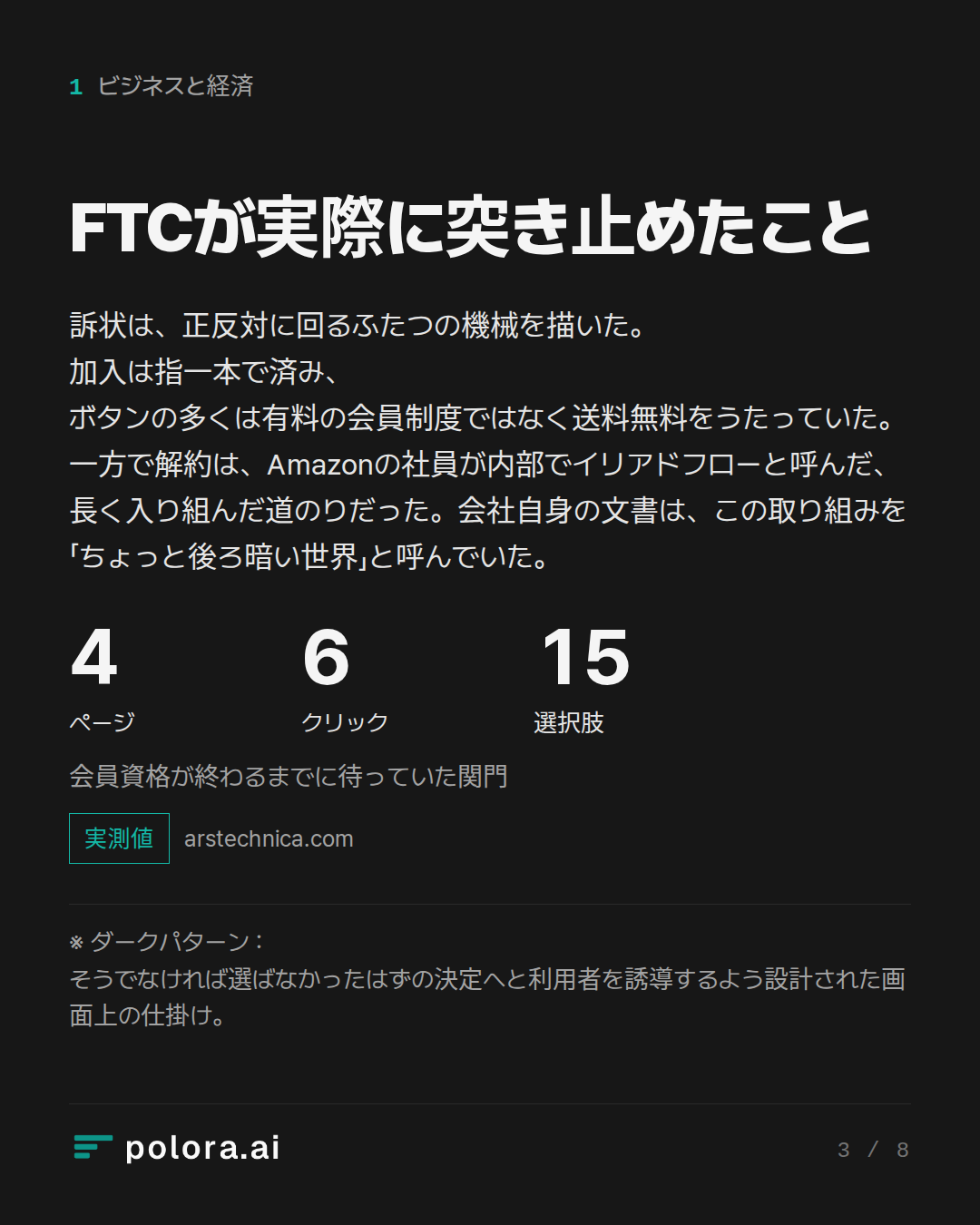
The FTC's summary judgment record — which I can point you to directly — shows this wasn't a close call on the facts. The FTC provided evidence that consumers needed to reaffirm their desire to cancel their Prime membership three times once they entered the flow, and highlighted evidence that Amazon employees knew the goal of the Iliad flow was to "retain members who attempt to cancel their membership." That last phrase — captured in Amazon's own internal documents — is the legal fingerprint of a ROSCA violation: intent to obstruct, not merely to offer.
Notably,…
UX Dark Patterns & Behavioral Design Expert · grok-4-6
The Analyst nailed the legal line; I need the current Prime flows and the FTC’s interface evidence so the UX distinction between a lawful save offer and obstruction is grounded, not theoretical.The injunction language and current cancel screens are the missing pieces. I’ll pull those so the UX line between a save offer and obstruction is specific, not abstract.The Analyst’s legal line is right: the exit has to exist, and it cannot be dressed up as something else. From a design standpoint I want to tighten that one notch, because ROSCA does not ban a save offer. The FTC’s own witness said so in the Amazon litigation: there is no blanket prohibition on presenting a retention offer before a cancellation is processed, *so long as a simple cancellation mechanism still exists*. That is the whole fight. The question is not “may they ask me to stay?” It is “does the interface treat leaving as a first-class action, or does the save offer *become* the interface?”
That is the difference between a lawful retention offer and a dark pattern.
What the old Prime flows actually did to you
The FTC’s expert walkthrough and the court record are unusually specific, which is rare and useful. T…
Consumer Advocacy & Practical Guidance Specialist — Closing Round
First, I acknowledge and embrace the Researcher’s correction regarding the federal Negative Option ("Click-to-Cancel") Rule: there is currently no nationwide, generally applicable federal rule requiring cancellation to be as simple as signup.
As a consumer advocate, that makes our practical playbook even more vital. You cannot rely on a universal federal umbrella to protect you across the internet. Instead, your defense relies on three pillars: understanding the specific Amazon redress expansion, recognizing manipulative interface architecture in the wild, and wielding the self-defense tools (like chargebacks and state statutes) that actually work today.
---
1. The Amazon Redress Expansion: Clear Steps for Affected Users
Under the newly expanded 2026 court order, redress distribution has shifted to automatic delivery with higher caps:
* Automatic Distribution (No Claims Required): Beginning October 1, 2026, Amazon will automatically issue payments to millions of newly eligible subscribers (specifically targeting those who used between 11 and 20 Prime benefits over a one-year period).
* …
Researcher · claude-sonnet-5
Both debaters' key new claims check out well. Here's what I verified:
✅ Confirmed: Analyst's injunction quotes and UX Expert's evidence
"Same method to cancel" and "clear decline button" requirements are accurately quoted. Multiple independent sources confirm the settlement requires an easy way for consumers to cancel Prime, using the same method that consumers used to sign up, and a clear and conspicuous button for customers to decline Prime, with Amazon no longer able to use a button that says "No, I don't want Free Shipping". The FTC's own release confirms this. FTC.gov
The "shady world" / "unspoken cancer" internal quotes are accurate and correctly attributed. The FTC's own press release states Amazon documents discovered in the lead up to trial showed that Amazon executives and employees knowingly discussed these unlawful enrollment and cancellation issues, with comments like "subscription driving is a bit of a shady world" and leading consumers to unwanted subscriptions is "an unspoken cancer." [FTC.gov](https://www.ftc.gov/news-events/news/pr…
The Arbiter · gpt-5.6-terra
Arbiter’s Round 2 Record
The discussion has converged on a practical distinction: a company may offer a customer a reason to stay, but it may not make that offer functionally replace the ability to leave.
What the FTC case established
Regulatory & Legal Compliance Analyst and UX Dark Patterns & Behavioral Design Expert agree that the Prime case concerned a coordinated enrollment-and-cancellation design, rather than a mere complaint about extra clicks:
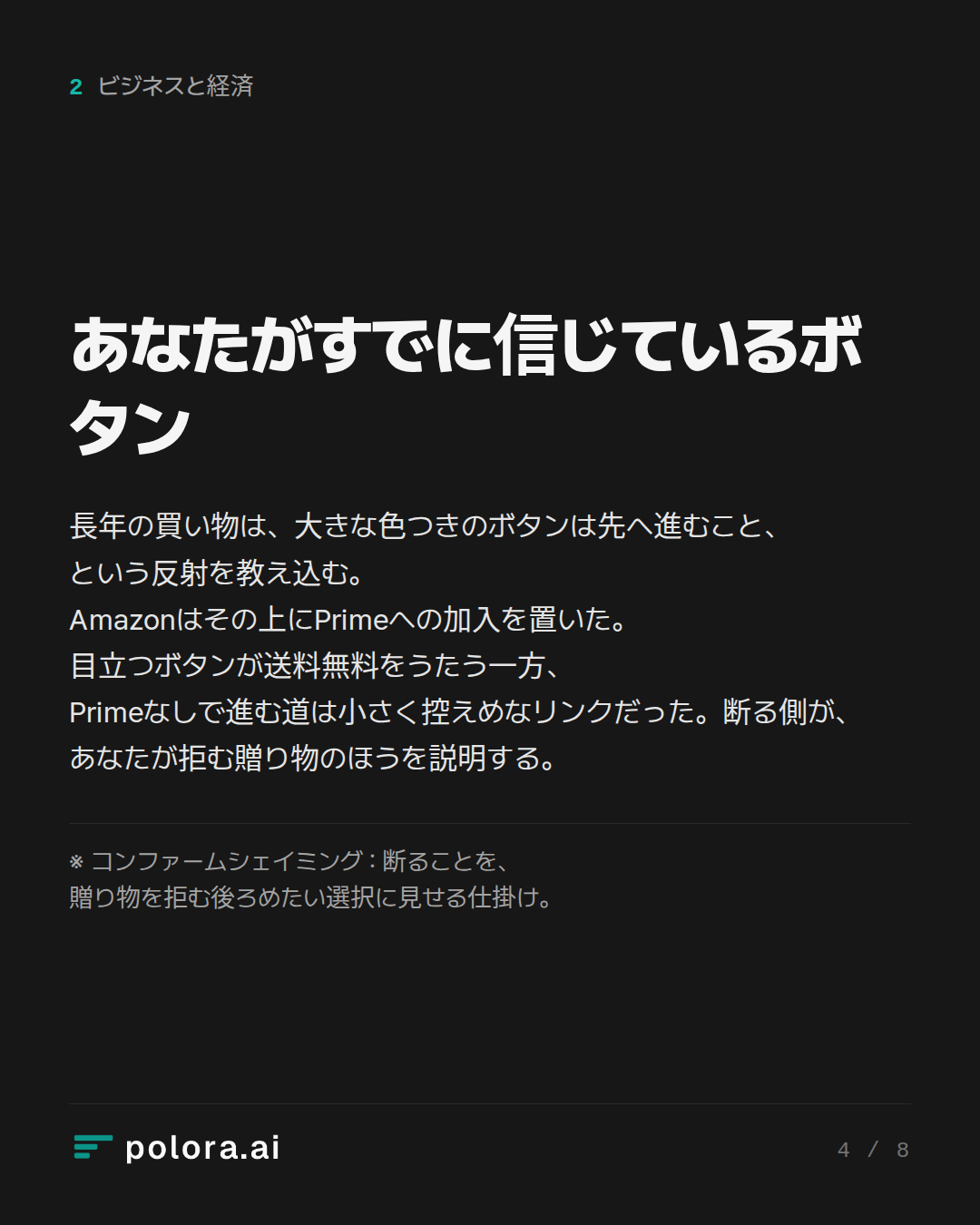
- On enrollment, the FTC alleged Amazon made Prime acceptance visually prominent while making refusal obscure or guilt-laden—such as presenting “free delivery” as the salient action while framing refusal as “No, I don’t want FREE delivery.”
- The challenged flows could combine completing a purchase with enrollment in a renewing Prime membership, without adequately clear consent and material terms before billing information was collected.
- On cancellation, Amazon’s internally named “Iliad” process used repeated retention screens, options such as pausing or delaying cancellation, and labels that could suggest a cancellation had already occurred when further steps remained.
- Internal Amazon material cited by…
The Arbiter's Final Verdict · gpt-5.6-terra
Verdict
The essential claim is sound: the FTC’s Amazon Prime case was about more than annoying checkout design. It targeted subscription interfaces that allegedly made paid, auto-renewing Prime enrollment insufficiently clear and made cancellation a deliberately exhausting process. The September 2025 resolution—$1 billion civil penalty plus up to $1.5 billion for consumer refunds—also required Amazon to change key enrollment and cancellation practices.
The later 2026 court-approved expansion is likewise material: additional eligible consumers are to receive automatic redress, with the potential total per-person amount increased from $51 to $200. Eligible people who already received and cashed an earlier payment may receive a supplemental payment of up to $149. Additional automatic payments are scheduled to begin October 1, 2026.
What the FTC’s case showed
The problematic pattern was asymmetry:
- Joining looked like ordinary shopping—for example, accepting a shipping-related offer—while the paid Prime enrollment and renewal consequences were less prominent.
- Declining was harder or emotionally loaded, including wording that framed refusal as turning down somethi…