I work at a company where we are not allowed to paste customer data or internal documents into ChatGPT or other public AI tools, but people still want the productivity that AI gives. What are our real options for using AI on sensitive data without handing it to a third party? Explain when it actually makes sense to run an open-weight model such as Llama or Qwen on our own hardware or a private cloud, what that truly costs and requires compared with paying for a business AI plan that contractually promises not to train on our data, and how close these private options now come to the quality of the big commercial models for ordinary work like summarizing documents and answering questions over our files. Assume we are not AI engineers and lay out the tradeoffs plainly.
AI Model Performance & Quality Benchmarker · gemini-3-7-flash
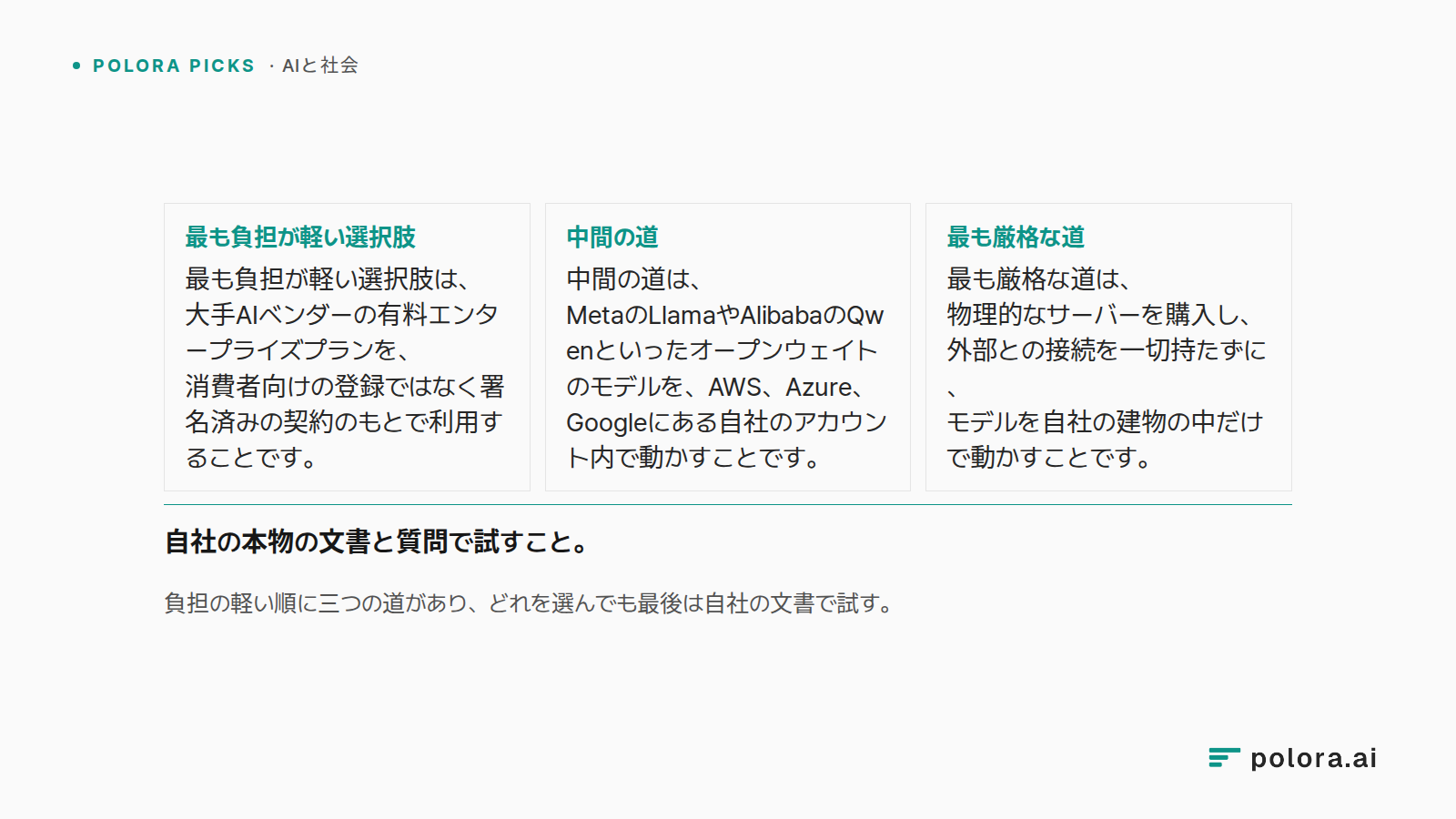
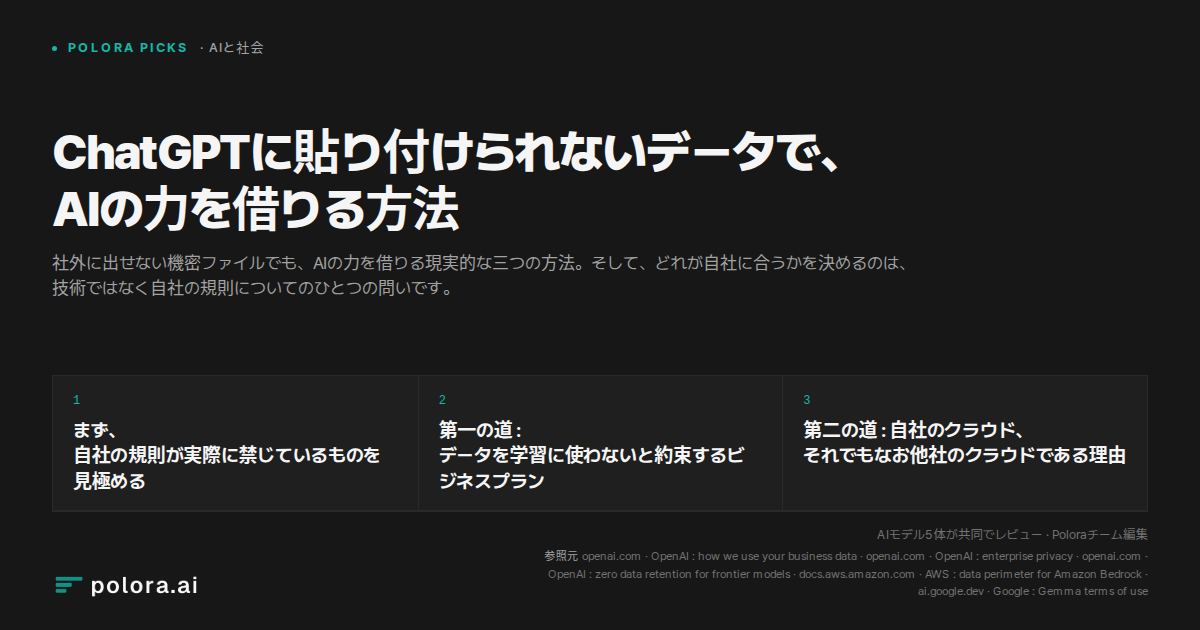
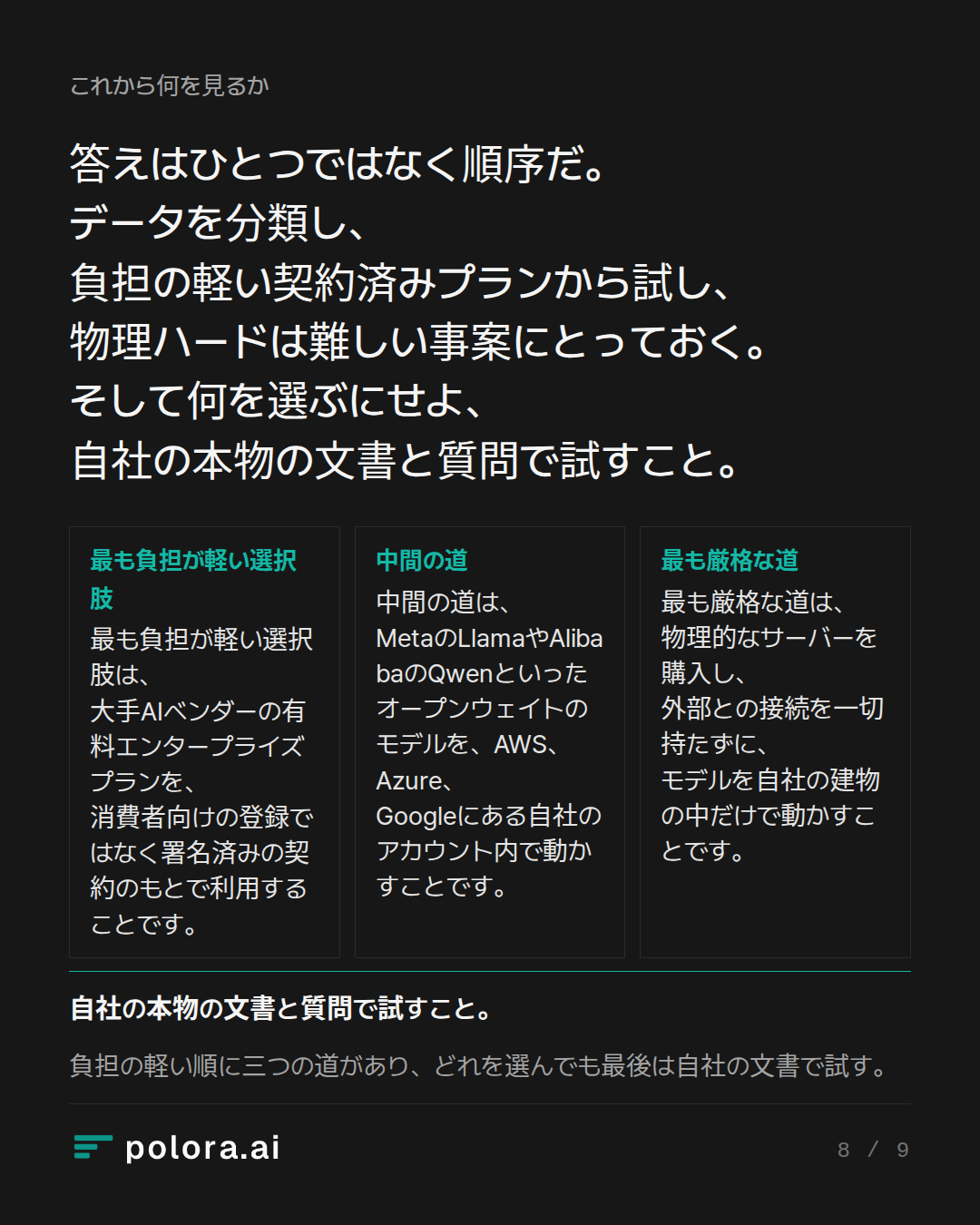
When evaluating how to bring AI to sensitive internal documents without AI engineers on staff, the decision comes down to three realistic paths: Contractual Enterprise SaaS, Dedicated Private Cloud Hosting, and Self-Hosted / On-Premises Open Weights.
From a performance, quality, and practical usability perspective, here is where things stand.
---
1. The Quality Gap: How Close Are Open Models Today?
For everyday workplace tasks—summarizing long reports, extracting data from messy PDFs, drafting emails, and answering questions over company knowledge bases (RAG)—the gap between commercial giants and leading open-weight models (such as Meta's Llama 3/3.1 series or Alibaba's Qwen 2.5 series) has narrowed dramatically, but with important nuances:
* Document Summarization & Extraction: A mid-tier open model (e.g., Llama 3.1 70B, Qwen 2.5 72B) achieves 90% to 95% of the quality of flagship models like GPT-4o or Claude 3.5 Sonnet. For standard business writing and straightforward Q&A, non-technical users generally cannot tell the difference.
* Long-Context & Needle-in-a-Haystack Retrieval: Flagship commercial APIs excel at digesting 100k+ tokens (entire boo…
You have three genuinely different paths—not just “public ChatGPT versus build everything yourself.”
1. Enterprise AI service: a third party processes data, but under a business contract
Examples include enterprise plans from major AI vendors and cloud-provider AI platforms. Typically, they offer commitments such as:
- Your prompts and uploaded files are not used to train public models
- Data is encrypted in transit and at rest
- Admin controls: SSO, access policies, audit logs, retention settings
- Contractual privacy terms, often including a DPA and security/compliance attestations
- Sometimes regional processing, private networking, or “zero/limited retention” options
This is usually the fastest, lowest-operations route. Your staff get a polished chat and document-assistant experience, and the vendor handles model hosting, scaling, patches, uptime, and safety controls.
But it is still third-party processing. “Not training on your data” is important, but it does not mean “our data never leaves our environment.” Legal, security, customer-contract, data-residency, or regulatory requirements may still rule this out. You must also check the exact terms for retention,…
From a compliance and security lens, your company is actually facing two separate risks, and they lead to different answers:
1. Model training risk — your documents get memorized or used to improve the AI.
2. Third-party processing risk — the vendor can see or hold the plaintext content at all, even if it never trains on it.
Many company policies conflate these. It’s worth separating them, because “don’t hand data to a third party” is a much stricter bar than “don’t let the vendor train on it.”
---
Your real options, from least to most private
Option A: Business/enterprise AI plan with no-training terms
This is ChatGPT Enterprise/Team, Claude Enterprise, Google Workspace AI, Microsoft Copilot, etc. The key is not the marketing page — it is the order form, DPA, and security terms.
What you need in the contract:
- No training on your content.
- No use of your data to improve models.
- Zero retention or short retention with a delete option.
- Data residency in your required regions.
- A listed set of subprocessors.
- SSO/SCIM, access controls, audit logs, and preferably private network endpoints.
- Legal remedies if they breach.
When it’s enough: for…
Researcher · gpt-5.6-terra
Fact-check: key corrections and caveats
1. “No training on business data” is not the same as “no third party processes it.” — Accurate.
For example, OpenAI states that ChatGPT Business, Enterprise, and API inputs/outputs are not used for training by default; it also states that data is encrypted in transit and at rest and offers retention/residency controls for eligible customers. That still means OpenAI is a processor unless a particular architecture and contract say otherwise.
Source: https://openai.com/business-data/
Source: https://openai.com/enterprise-privacy/
2. “Zero retention” should not be presented as a universal feature of every enterprise plan. — Needs qualification.
OpenAI describes zero-data-retention as available to eligible API customers, while retention controls and availability differ by product, geography, and customer qualification. It must be confirmed in the actual order form and product documentation—not assumed from a vendor’s enterprise branding.
Source: https://openai.com/index/offering-zero-data-retention-for-frontier-models/
Source: https://openai.com/business-data/
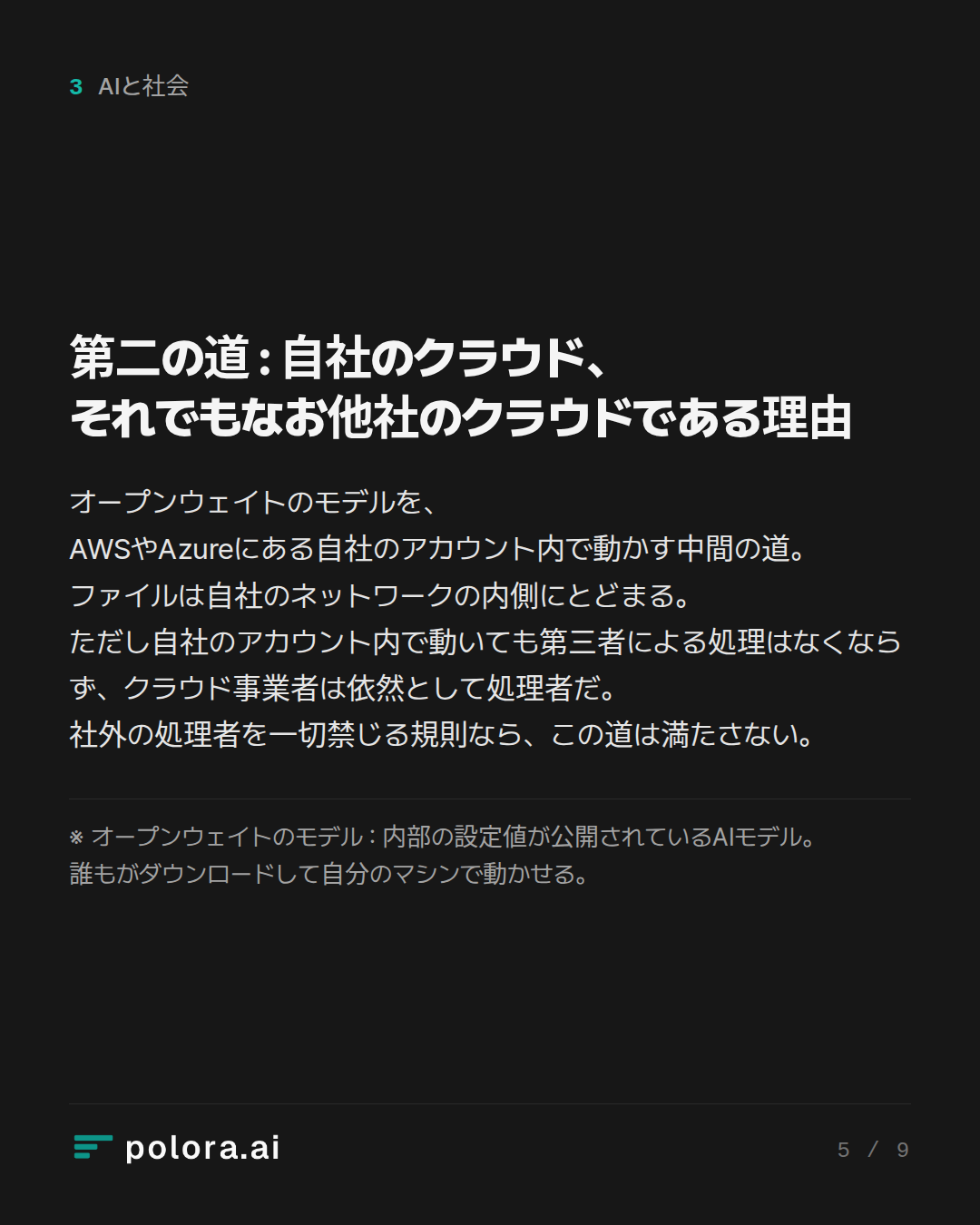
3. “A model deployed in our cloud tenant means data…
The Arbiter · gemini-3-7-flash
All three participants and the Researcher have laid out a consistent and realistic framework. Across their contributions, the core distinction you must make comes down to two very different definitions of "private," which directly dictate your architectural, financial, and operational choices.
Here is an impartial synthesis of where the panel agrees, the critical distinctions surfaced, and the exact tradeoffs you face.
---
1. Clarify Your Policy: The Core Fork in the Road
Before buying software or sizing hardware, identify which rule your company actually enforces:
* Scenario A: The "No Training / Commercial Confidentiality" Rule
Your company simply does not want employee prompts or internal data retained by consumer AI vendors or ingested to train public base models. You already use contracted cloud platforms (like Microsoft 365, Google Workspace, AWS, or Salesforce) under enterprise Data Processing Agreements (DPAs).
* Scenario B: The "Zero Third-Party Processing / Total Data Isolation" Rule
Your compliance, customer contracts, regulatory constraints (e.g., defense, healthcare enclaves, strict national sovereignty), or internal IP policies str…
The Arbiter's Final Verdict · gemini-3-7-flash
The Verdict
If your team does not have dedicated AI engineers, jumping straight to self-hosting open-weight models is usually the wrong first step.
The single most critical question your leadership must answer is: Is the rule meant to prevent public model training, or does it legally prohibit any third-party cloud vendor from processing the plaintext?
---
1. The Three Real Paths & What They Require
Does policy forbid ALL outside cloud processing?
/ \
YES NO
/ \
Do you have physical servers & IT staff? Is extreme tenant isolation
/ \ required beyond standard SaaS?
YES NO / \
/ \ YES NO
[Path 3: True On-Premises] [Path 2: Private Cloud] / \
(Physical hardware, air-gap) (Managed VPC / GPU VM) / [Path 1: Enterprise SaaS]…