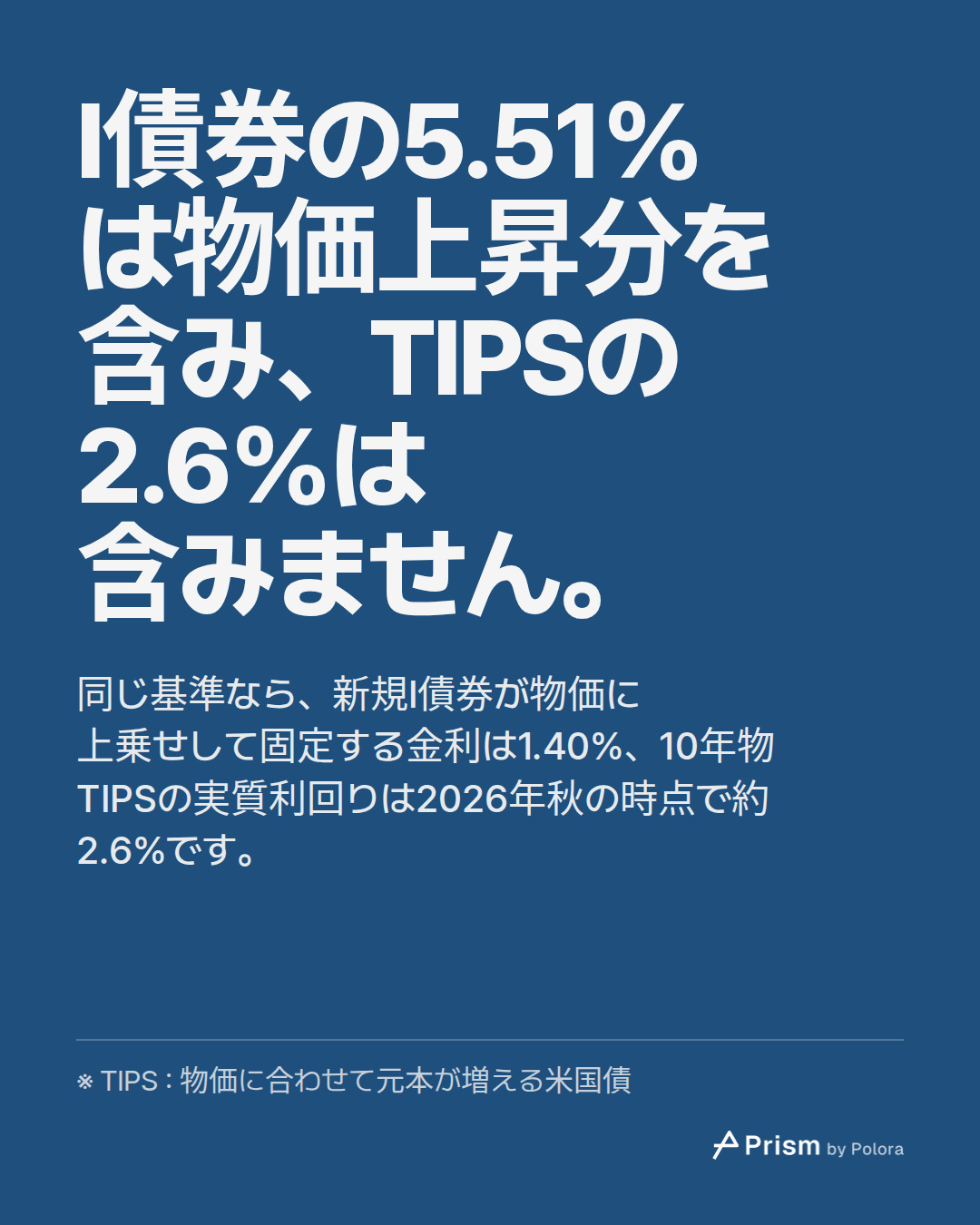
Why does an I bond paying 5.51% lock in less than a TIPS yielding 2.6%?
Alpha · deepseek-v4-pro
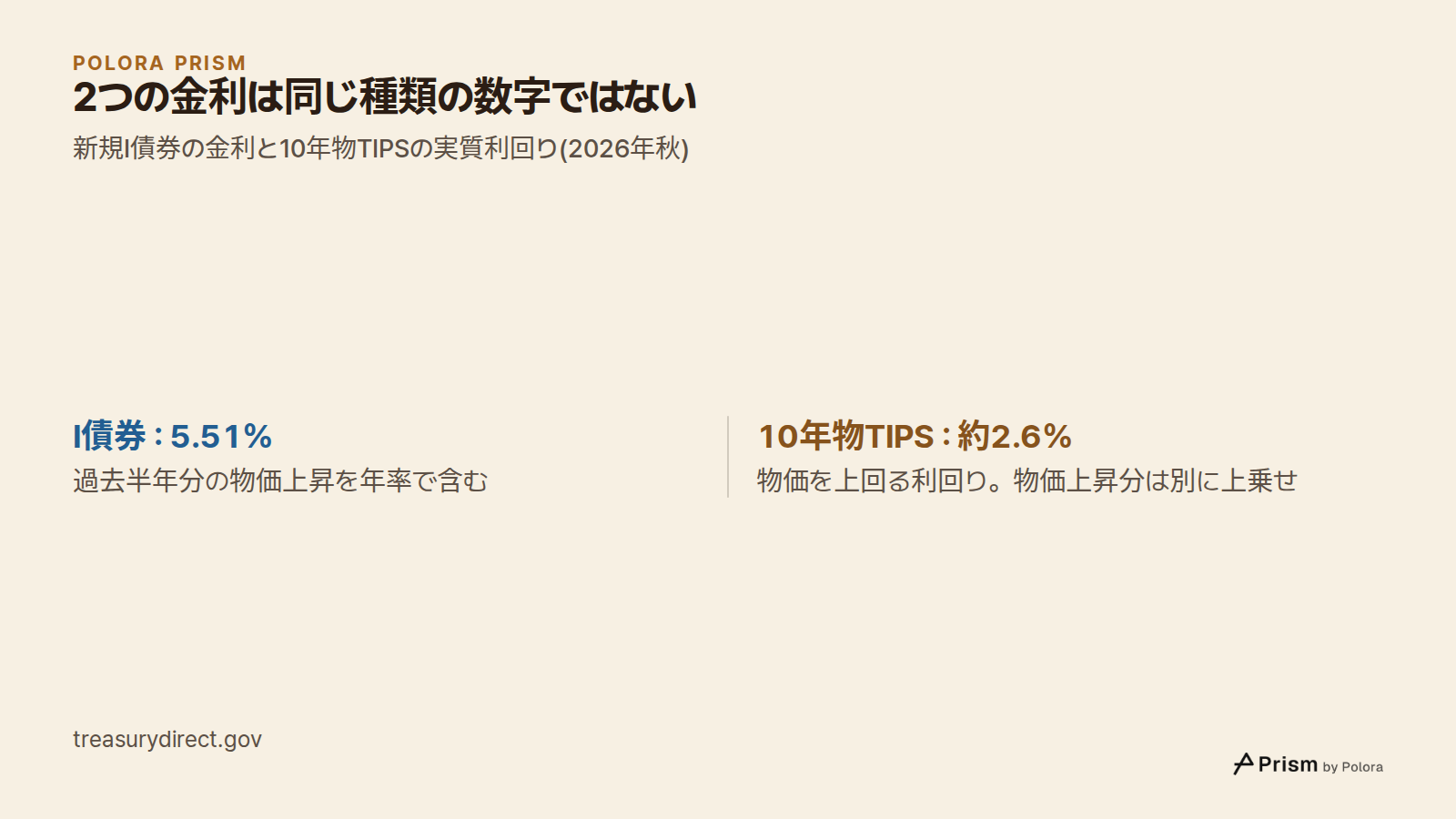
The apparent paradox comes from comparing two numbers that measure different things.
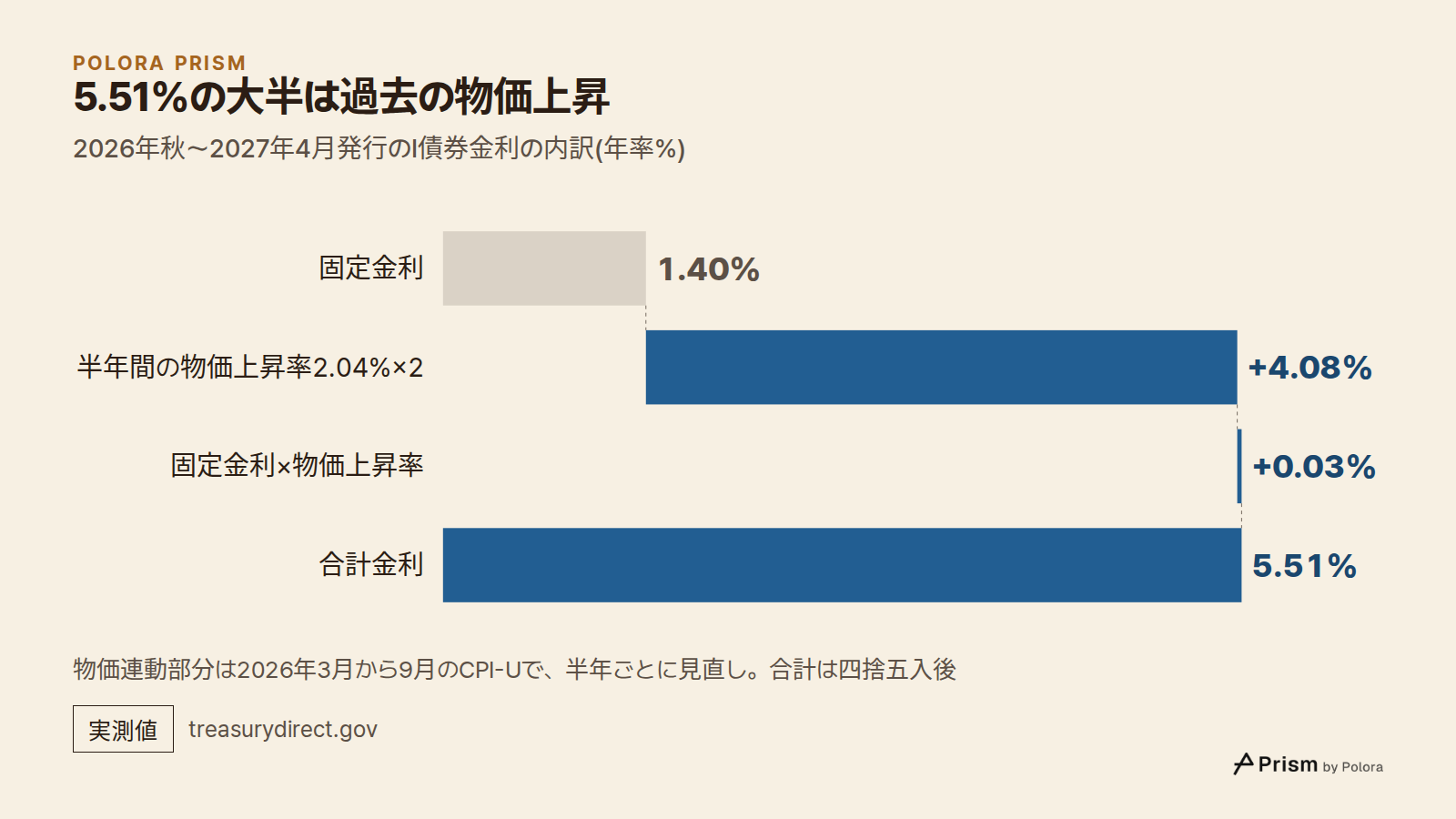
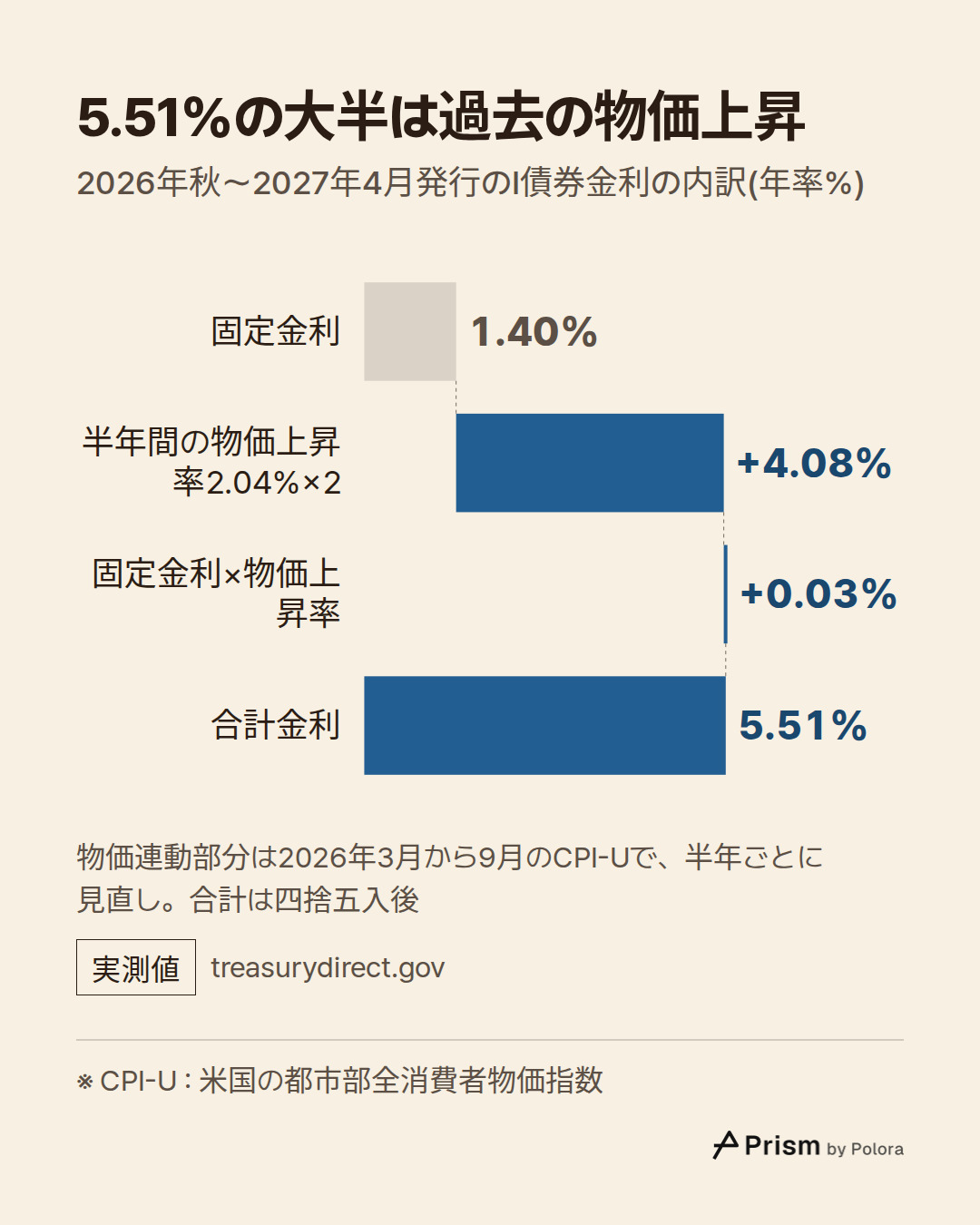
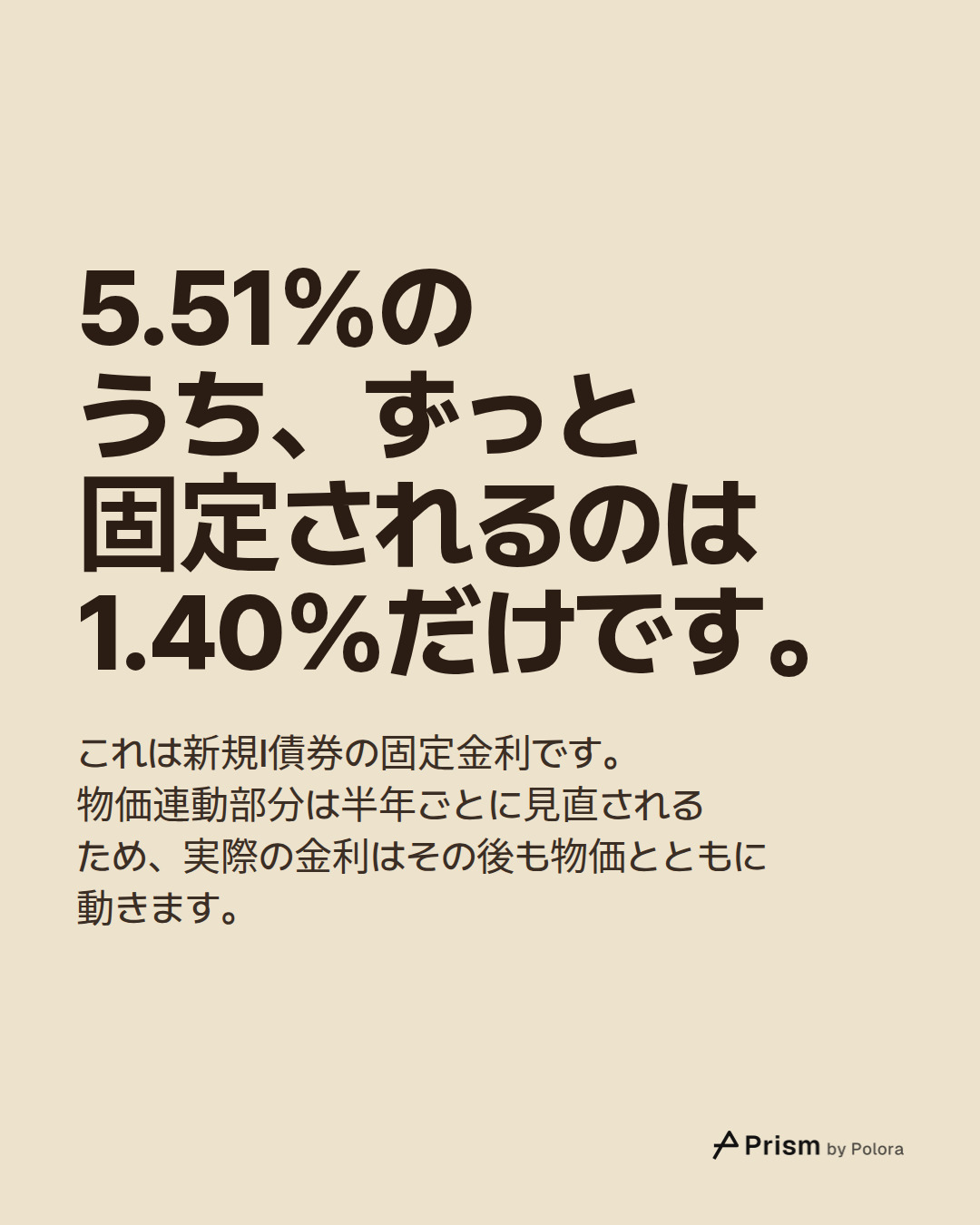
The I bond's 5.51% is a composite annual rate, built from two parts:
- a fixed rate of 1.40%, set at purchase and locked for the bond's life, and
- a six-month inflation adjustment of 2.04%, annualized by doubling it.
So roughly:
1.40% + 2 × 2.04% + a small cross-term ≈ 5.51%
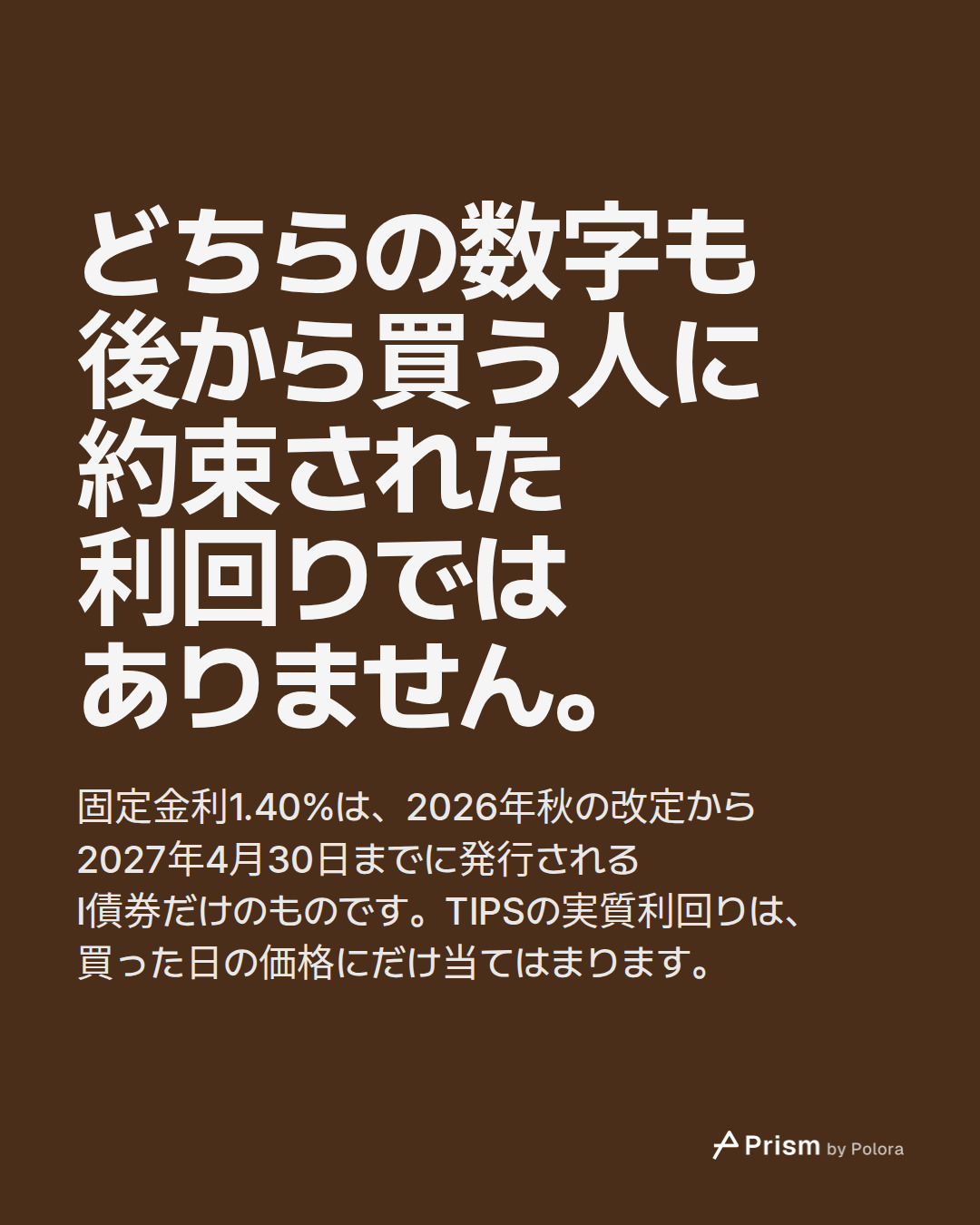
Of that, only the 1.40% is actually locked in. The inflation component resets every six months. If inflation is lower over the next six months, the composite rate falls; if it is higher, the rate rises. The 5.51% is not a promise for 30 years — it is mostly a look back at inflation that already happened, paid forward for six months.
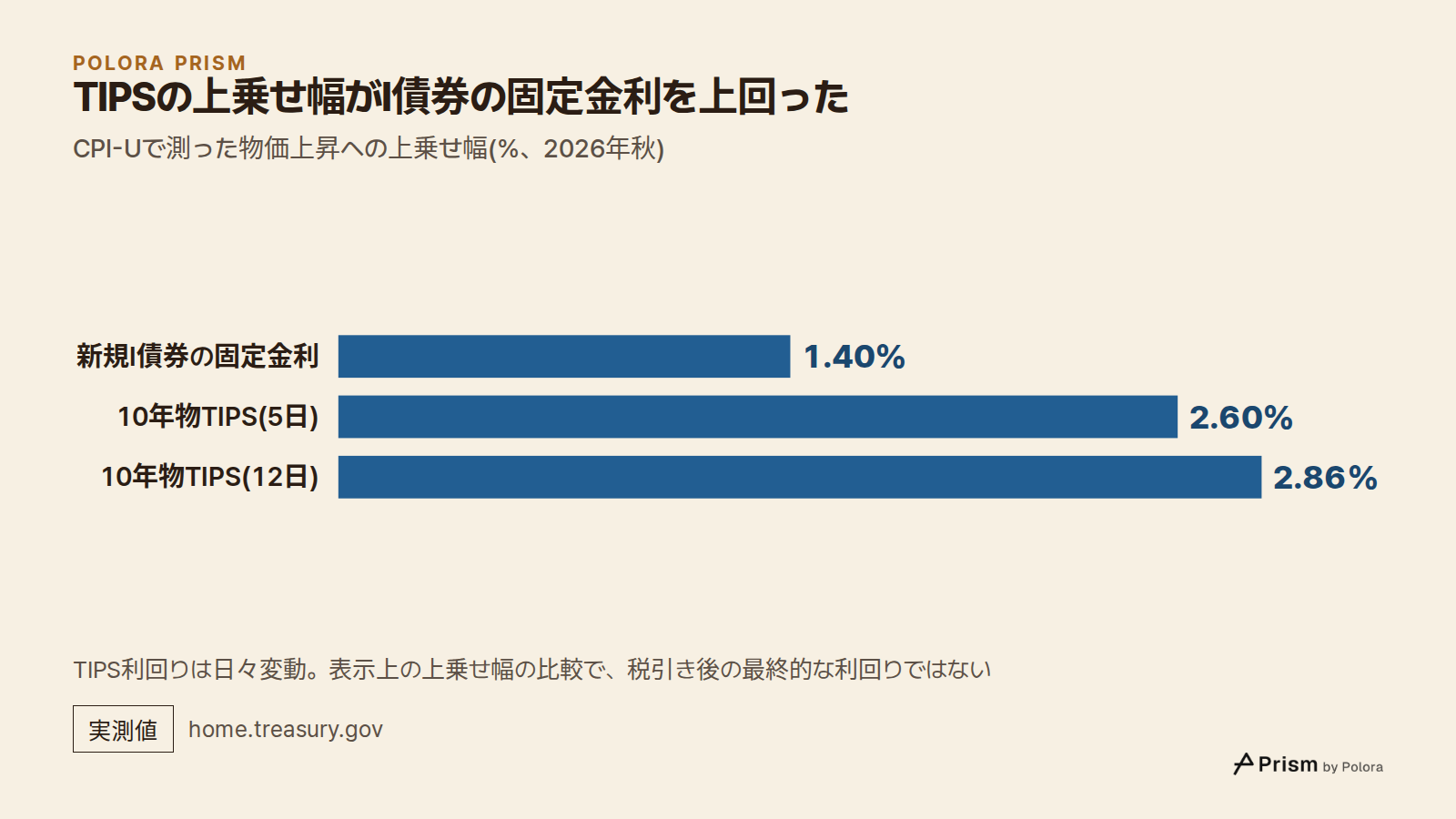
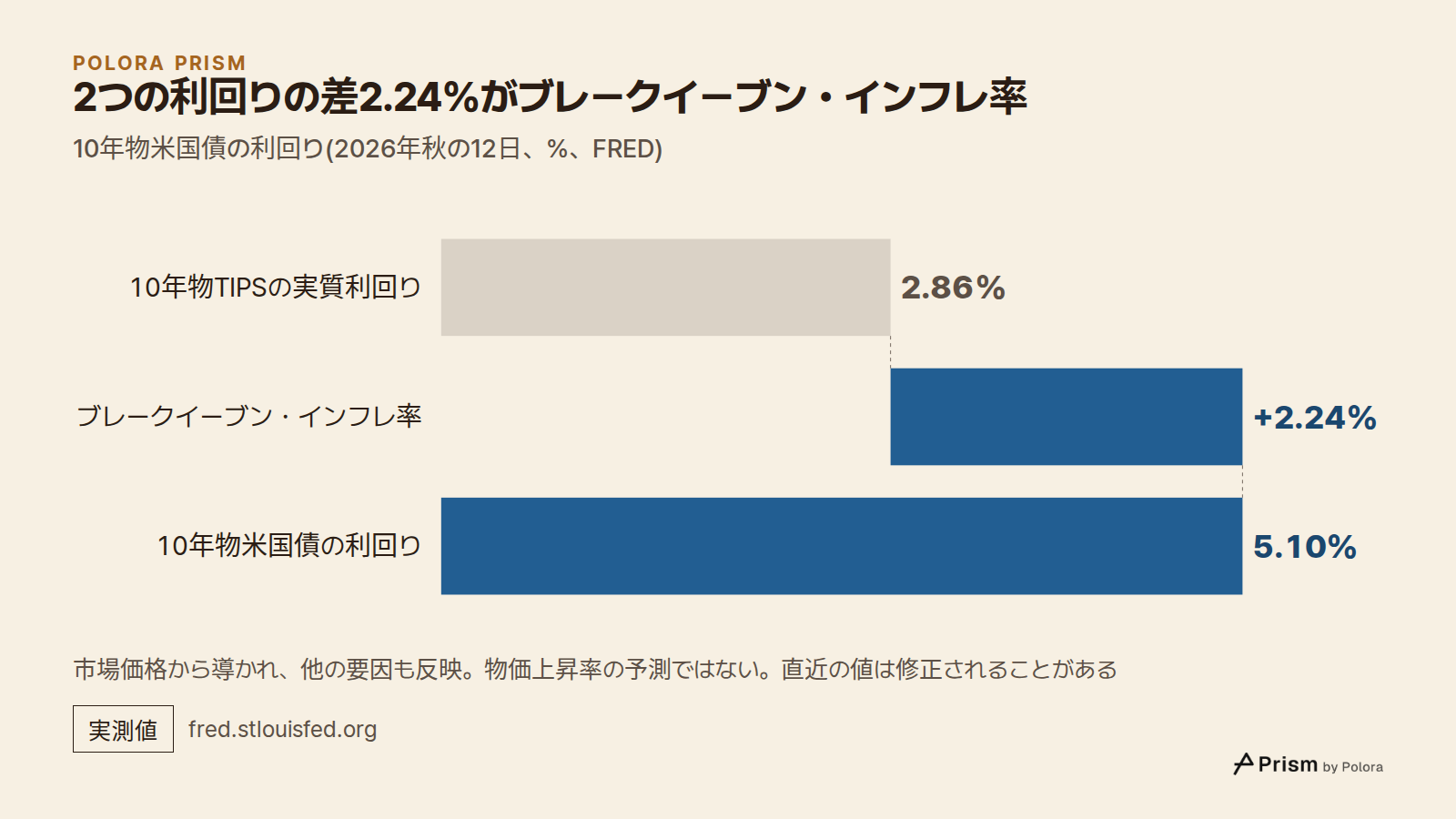
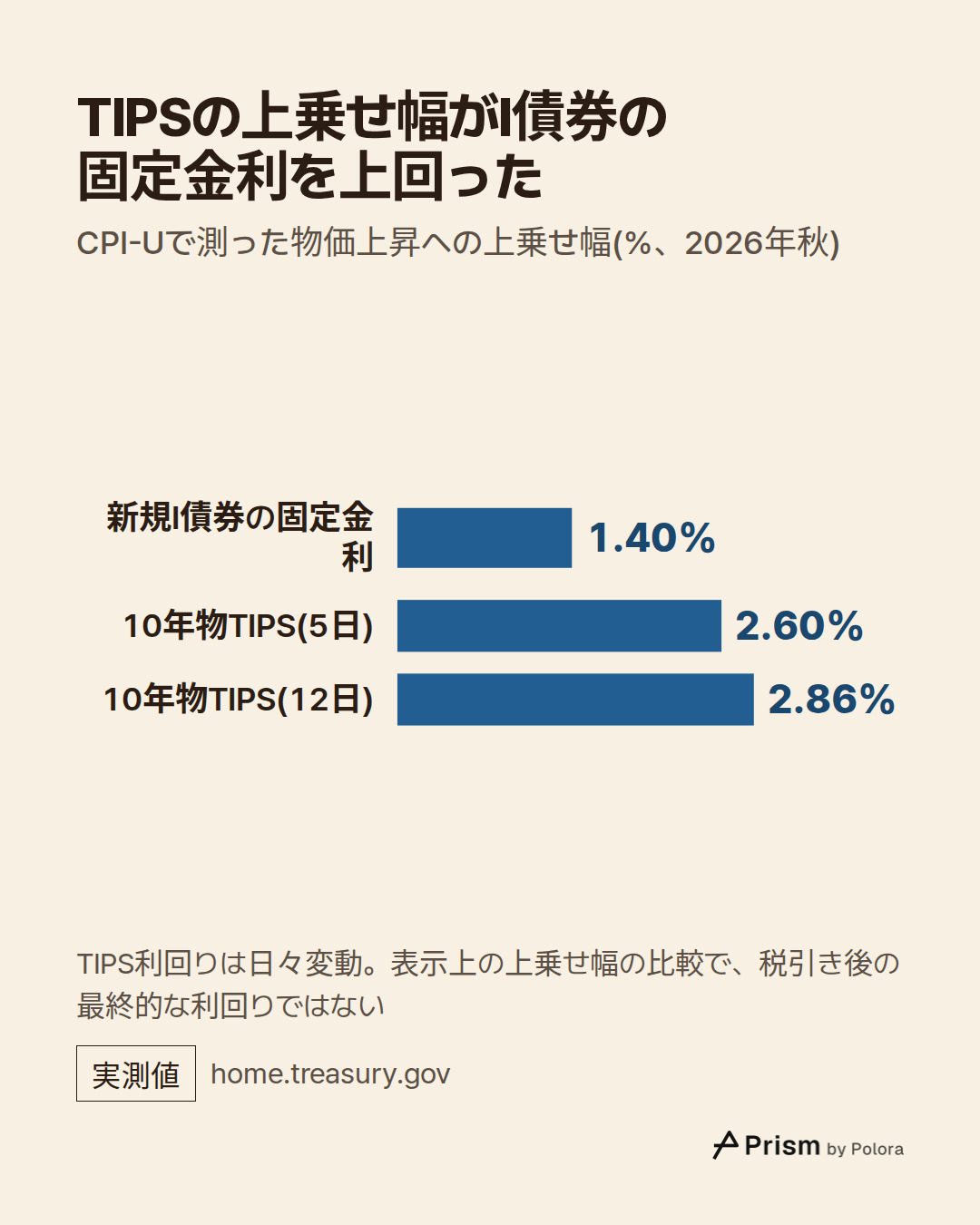
The TIPS 2.6%, by contrast, is a real yield: the return *above* CPI-U inflation for someone who buys at today's market price and holds to maturity. Inflation is added on top of it, not already baked into the headline number.
Put side by side as the same kind of number:
- new I bond: about 1.40% above future inflation
- 10-year TIPS bought near 2.6%: about 2.6% above future inflation
That is why the instrument with the smaller headline yield locks in the larg…
Beta · gpt-6-sol
Alpha has the central comparison right, but I would narrow the word “guarantees.” Treasury lists the November 2026 I bond’s 5.51% as a composite rate: 1.40% fixed for the bond’s life, plus a 2.04% *six-month* inflation figure incorporated into the current rate. The composite resets every six months; it is not 5.51% locked in for 30 years. Treasury’s formula confirms the arithmetic. (treasurydirect.gov)
A TIPS yield near 2.6% is instead a yield above inflation at a particular purchase price, if the security is held to maturity. There is an important precision issue in the manuscript: FRED’s DFII10 is a *10-year constant-maturity market yield*, not an offer to buy one identified bond at exactly that yield. FRED records 2.86% on November 12, 2026 and 2.89% on November 17; the manuscript should keep “about 2.6%” anchored to its early-November date, not present it as today’s purchasable rate. (fred.stlouisfed.org)
The strongest objection to the manuscript’s angle is its claim that, “whatever inflation turns out to be,” a TIPS holder earns the…
Gamma · gemini-3.1-pro
Alpha and Beta have thoroughly covered the core mechanics and the real-yield comparison. I will clear the remaining specific fact-checks the editor asked for, based on live search results.
1. The CPI-U index levels and the 2.04% calculation
The manuscript’s index numbers are correct. The Consumer Price Index for All Urban Consumers (CPI-U, not seasonally adjusted) was indeed 330.213 in March 2026 and rose to 336.940 in September 2026.
*Arithmetic:* 336.940 ÷ 330.213 - 1 = 2.037%, which Treasury rounds to the 2.04% six-month inflation rate.
*Source:* BLS CPI-U data (series CUUR0000SA0), widely cited on financial tracking sites like cpichart.com and tipswatch.com.
2. The 5.00% rate on older I bonds
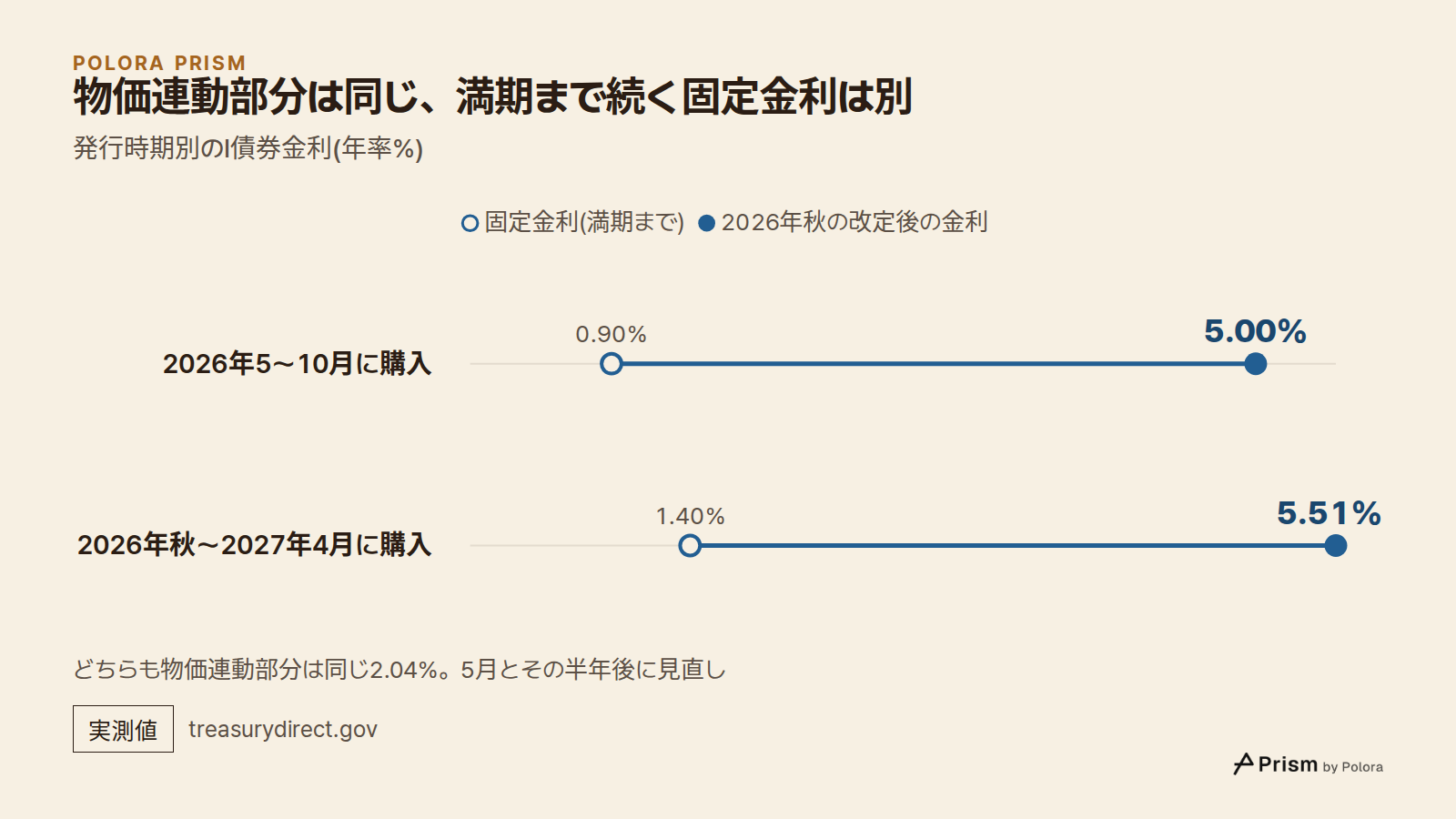
The manuscript claims bonds bought from May to October 2026 carry a 0.90% fixed rate and now earn 5.00%. This is accurate.
*Arithmetic:* 0.0090 fixed + (2 × 0.0204 inflation) + (0.0090 × 0.0204) = 0.04998, which rounds to 5.00%.
*Source:* TreasuryDirect's historical fixed rate tables confirm the 0.90% fixed rate for that May-October 2026 window.
3. "Roughly three quarters" of the 5.51% is inflation
The manuscript's interpretive arithmetic holds up. The annualized inflatio…
Researcher · gpt-6-luna
The central explanation is sound, and the key market-rate figures can be checked against Treasury’s own daily series. But one important distinction needs tightening: the comparison is between the I bond’s fixed-rate component and the TIPS market’s quoted real yield—not a guarantee that every investor’s eventual return will rank the same way.
- I bond rate: TreasuryDirect explains that the composite rate combines a fixed rate with an inflation rate that changes every six months. Its current page has not yet been updated to confirm the manuscript’s stated November 2026 rates of 1.40% fixed and 5.51% composite, so I could not independently verify those particular announced figures from that page this turn. The formula and reset mechanism are documented there. TreasuryDirect: I bond interest rates (treasurydirect.gov)
- CPI figures: BLS’s September 2026 release confirms the September CPI-U index level of 336.940; its historical table shows 330.213 for March. Those levels imply a…
The Arbiter · gpt-6-sol
The debaters agree on the distinction the reader needs: 5.51% is an I bond’s current composite rate, while 2.6% is a dated TIPS real-yield quote. Their substantive disagreement is about how far the manuscript can take that comparison. Beta and the Researcher caution that comparing the two locked-in *rate components* does not establish which investment will produce the higher eventual after-tax return.
One source gap in the discussion is now closed. TreasuryDirect’s page, read this turn, explicitly lists 5.51% for I bonds issued November 2026–April 2027, comprising 1.40% fixed and 2.04% semiannual inflation. It also lists 0.90% fixed for May–October 2026 issues and 5.00% as their rate for the six-month earning period beginning November 2026. That is stronger support than the snippets cited earlier; the earlier report that TreasuryDirect had not yet updated should not carry forward. (treasurydirect.gov)
Two wording points remain for the verdict. TreasuryDirect says an individual I bond’s rate changes every six months from its issue month, rather than every May 1 and November…
The Arbiter's Final Verdict · gpt-6-sol
Verdict
The manuscript’s premise stands. The 5.51% is a new I bond’s *current composite rate*: it combines a 1.40% fixed rate, which stays with that bond for its life, with an inflation component that changes every six months. The 2.6% is a *real-yield quote* for 10-year TIPS in early November 2026: it measures yield above inflation, at the relevant market price, if held to maturity. Thus the like-for-like comparison is 1.40% fixed on the I bond versus about 2.6% real yield on the TIPS, not 5.51% versus 2.6%. The smaller headline number describes the larger stated margin above inflation.
What the checks support—and what needs changing
- I bond figures and arithmetic: TreasuryDirect lists 5.51% composite, 1.40% fixed, and 2.04% six-month inflation for bonds issued November 2026–April 2027. Its formula gives \(1.40\% + 2(2.04\%) + (1.40\% \times 2.04\%) \approx 5.51\%\). BLS reports the cited March and September CPI-U levels, 330.213 and 336.940; their increase rounds to 2.04%. Calling the annualized inflation portion “roughly three quarters” of 5.51% is fair arithmetic. [TreasuryDirect](https://www.treasurydirect.gov/savings-bonds/i-bonds/i-…