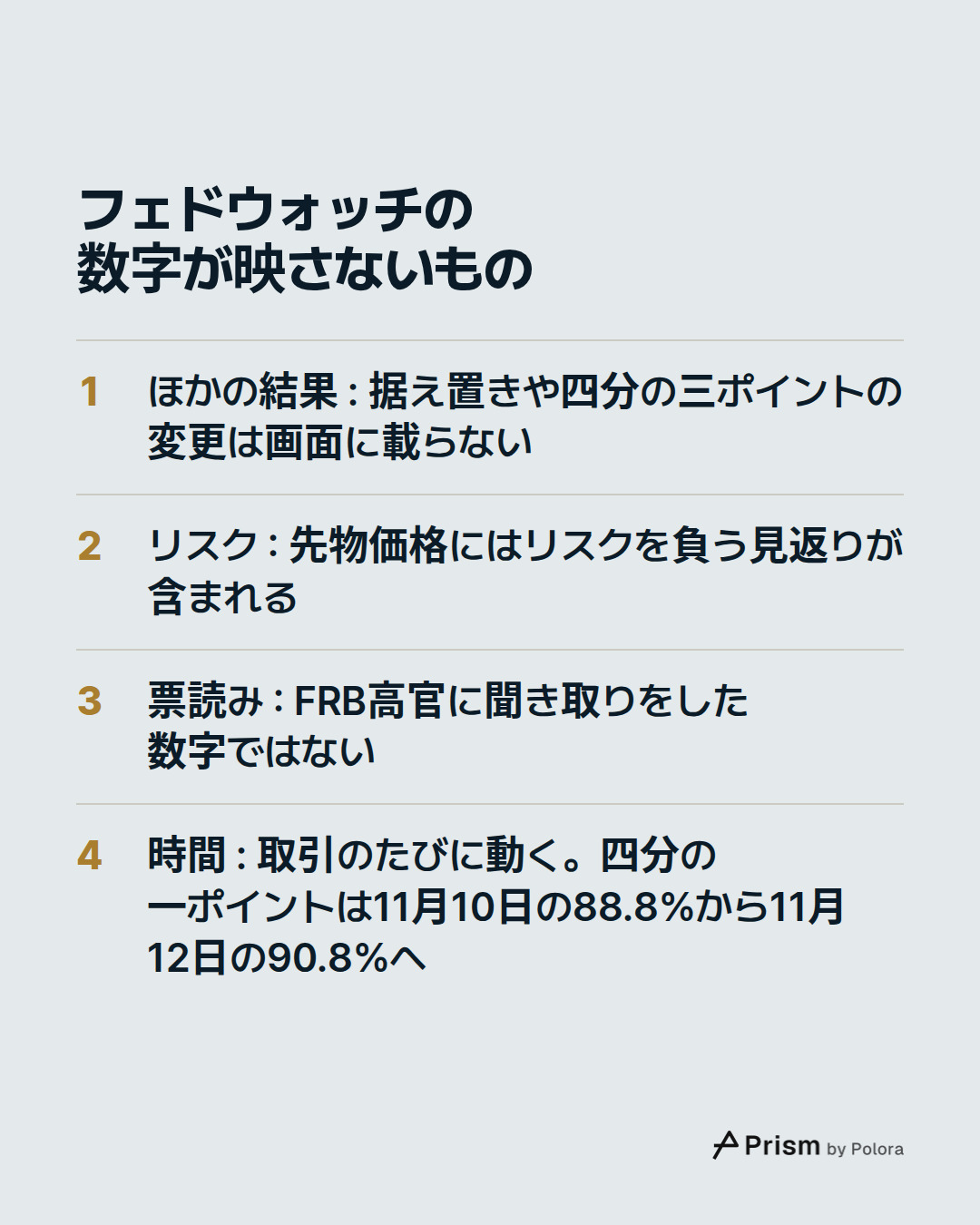
二つ目の空白はリスクです。先物は自分のお金を賭けた人たちが売買しており、価格には予想だけでなく、そのリスクを負う見返りとして彼らが求める分も含まれます。モニカ・ピアツェシとエリック・スワンソンがJournal of Monetary Economics(2008年)に発表した研究は、FF金利先物の超過リターンが平均してプラスで、景気循環とともに変動してきたことを示し、このリスクプレミアムを無視すると、先物価格から読み取る政策金利の見通しに偏りが生じると結論づけています。
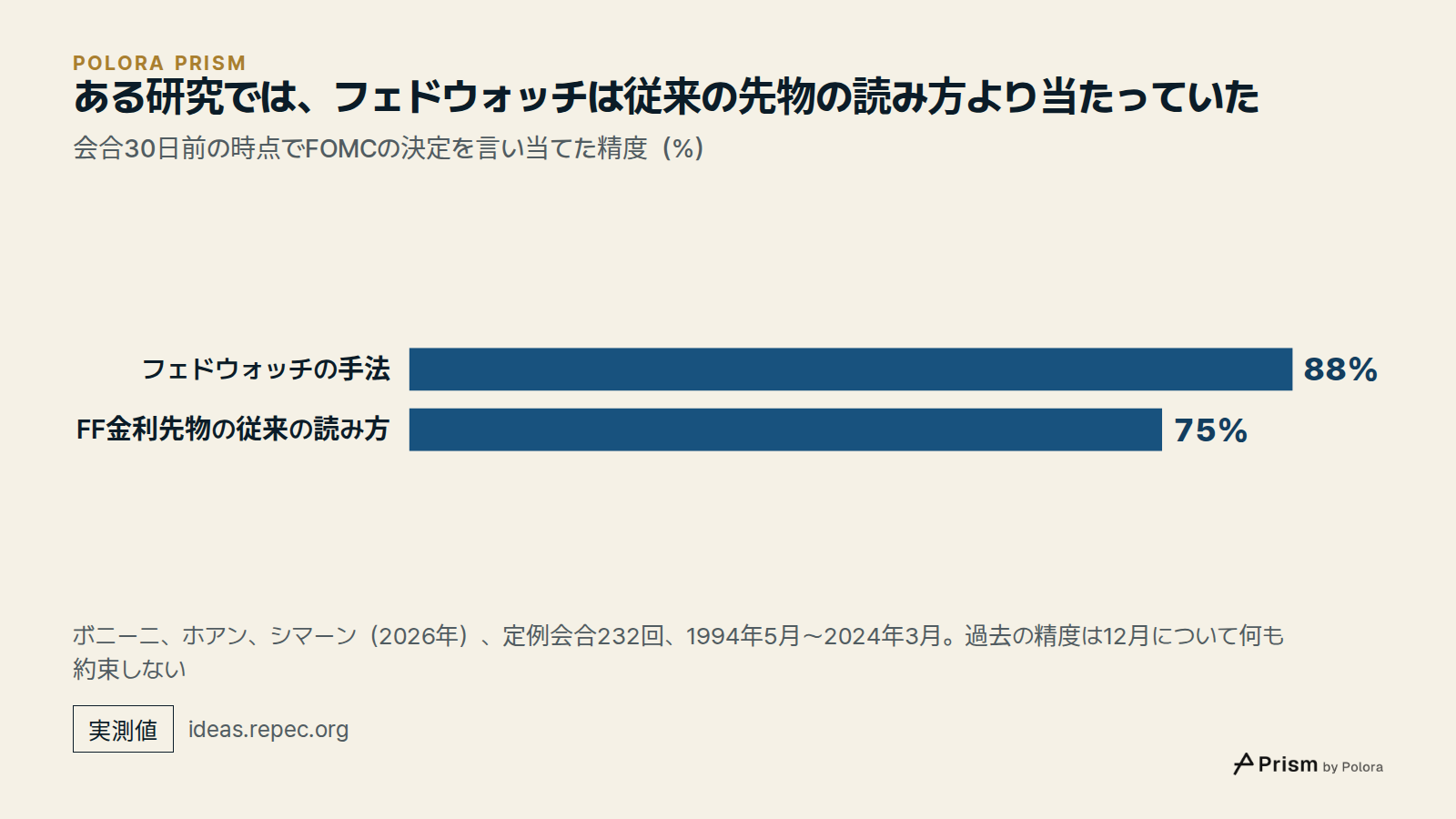
実績の記録はあります。ただし、限界つきです。スティーブンス工科大学のステファノ・ボニーニ、シェンユー・ホアン、マジード・シマーンは査読誌Journal of Futures Markets(2026年)の論文で、会合の30日前の時点でフェドウォッチの手法はFOMCの決定を88%の精度で言い当て、FF金利先物の従来の読み方では75%だったと報告しています。対象は1994年5月から2024年3月までの定例会合232回です。11月12日は12月の会合のおよそ4週間前にあたります。
What does a 91% chance of a December Fed rate hike actually measure?
Alpha · deepseek-v4-pro
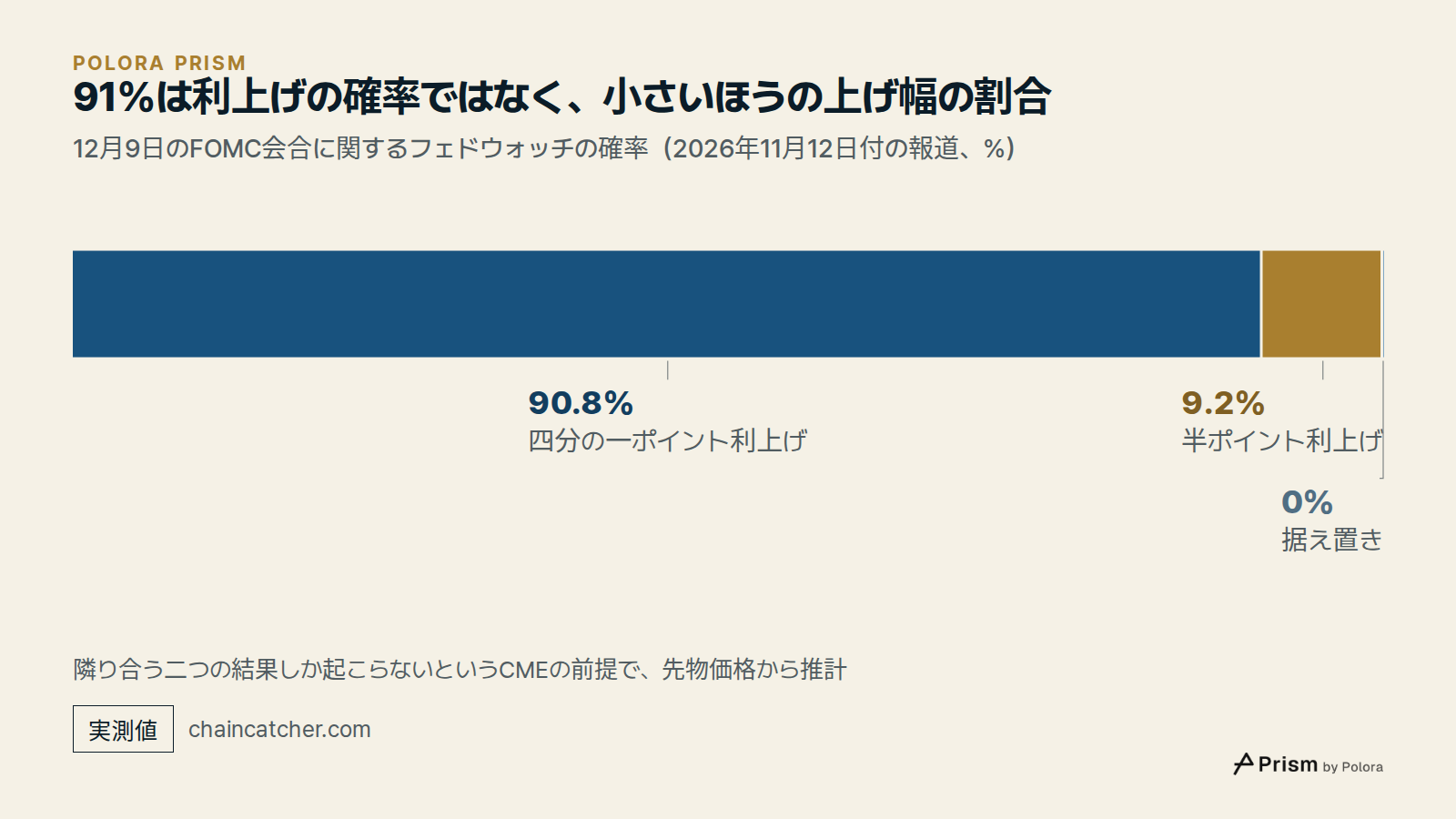
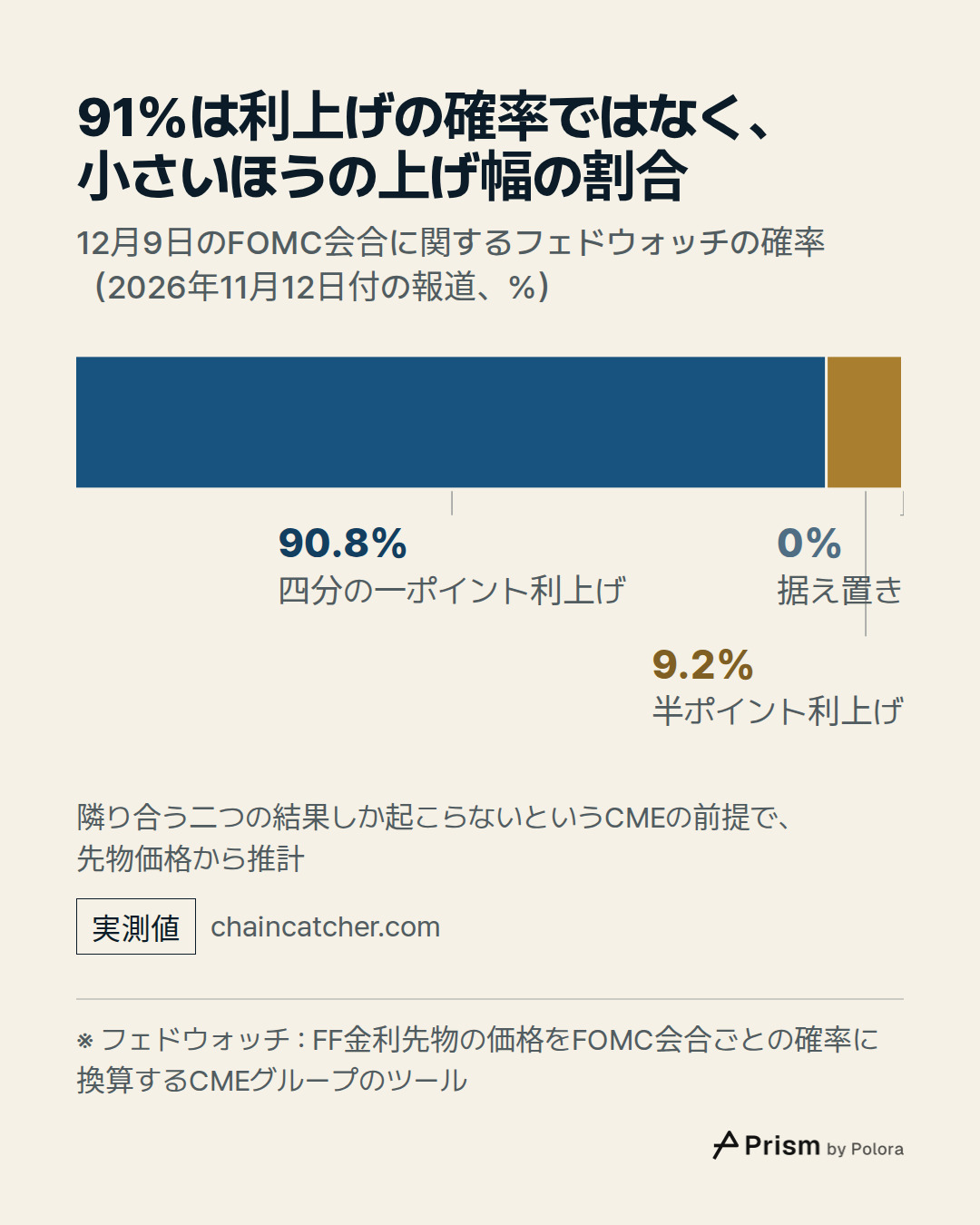
A 91% chance of a December Fed hike does not measure the chance that the Fed hikes. It measures something narrower: the market-implied share of probability assigned to a quarter-point hike rather than a half-point hike, under a restrictive two-outcome assumption.
Where the number comes from
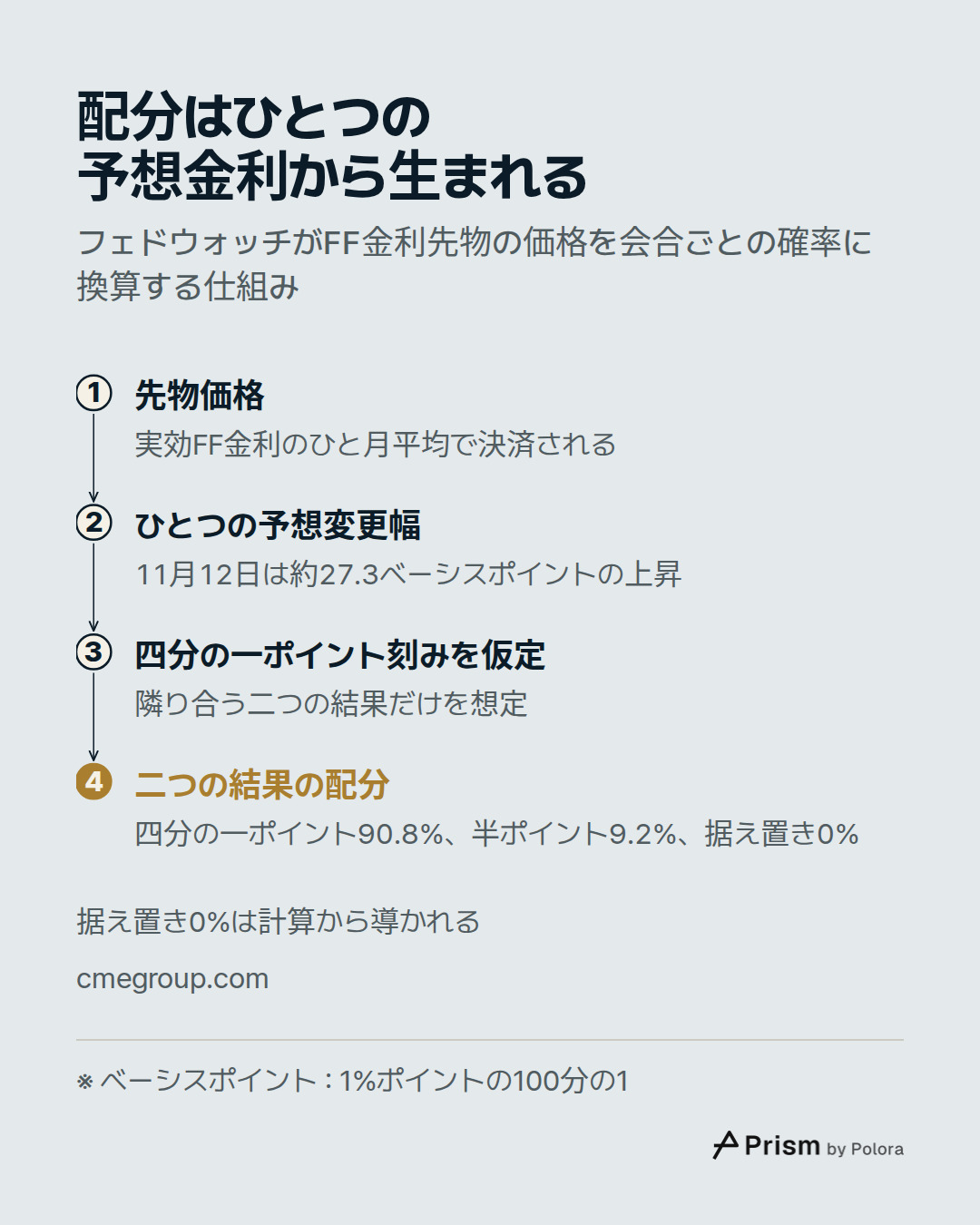
CME FedWatch starts from 30-day fed funds futures. Those contracts settle against the arithmetic average of the daily effective federal funds rate during the contract month, which is why the price is quoted as 100 minus the expected average rate. But a single futures price gives you only one number: the average rate the market is pricing for December.
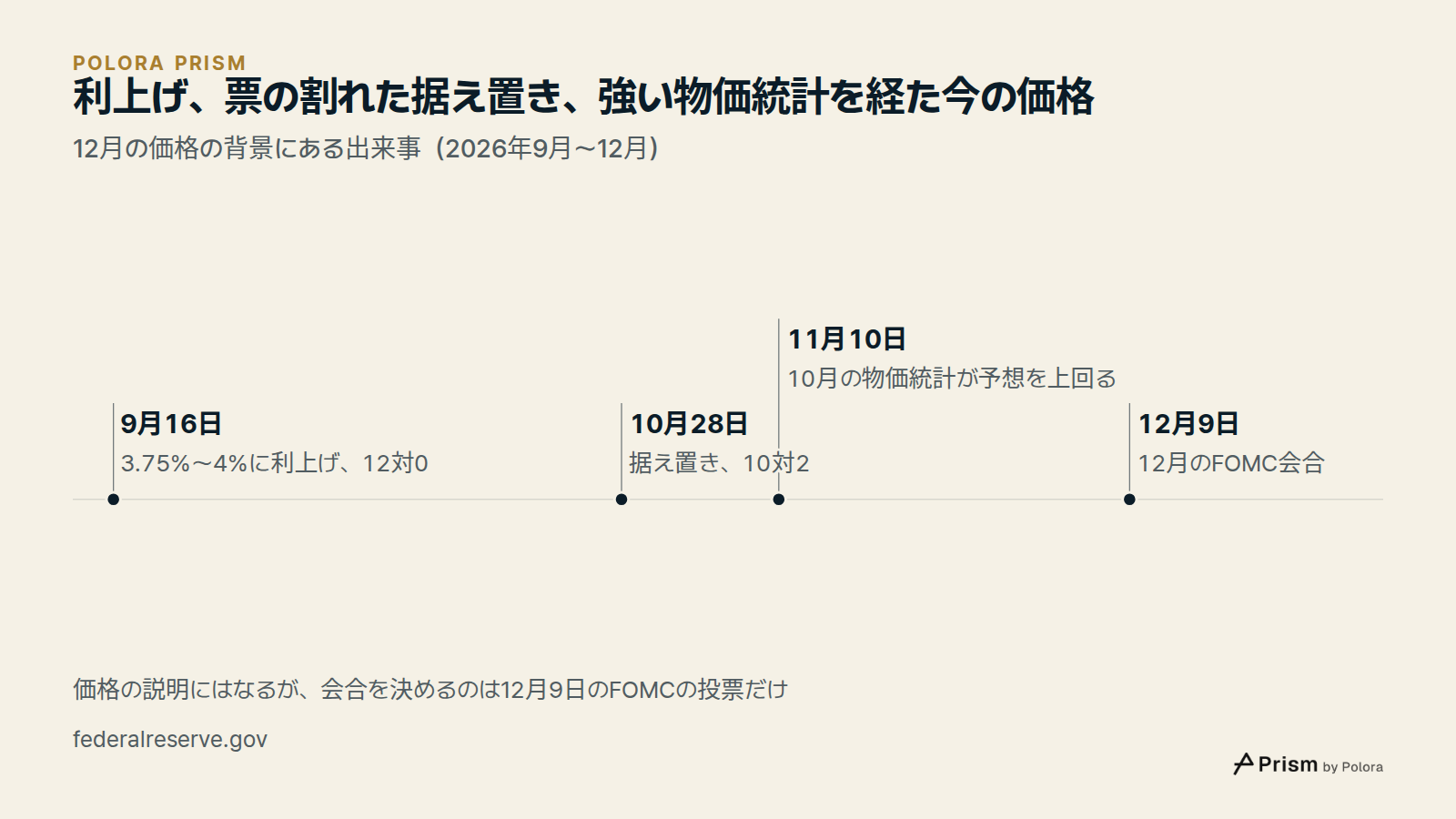
To turn that one number into probabilities, the tool has to assume a menu of possible Fed actions. It assumes the Fed moves in quarter-point steps, and it usually restricts the possible outcomes to the two neighbouring steps around the implied rate. In mid-November 2026, the December futures price implied a post-meeting target rate roughly 27 basis points above the current 3.75%–4.00% range. That is between one and two quarter-point hikes, so the two outcomes the method considered were:
- a 25 basis point hike to 4.00%–4.25%, and
- a 5…
Beta · gpt-6-sol
The manuscript’s central distinction is sound, but its headline is too absolute. If the cited FedWatch reading really showed roughly 91% for a 25-basis-point hike, 9% for a 50-basis-point hike, and 0% for a hold, then 91% labels the quarter-point outcome—not the sum of all hike outcomes. Within that *particular FedWatch calculation*, the displayed hike outcomes sum to 100%. That does not establish that a hike is certain in the world outside the model. CME describes its nearest-meeting calculation as assigning weights to two adjacent 25-basis-point outcomes. (cmegroup.com)
Here is what I could check for the editor:
- Mechanism: supported, with a correction. CME says 30-day fed funds futures are quoted as 100 minus the expected arithmetic average of the daily effective federal funds rate for the contract month; they ultimately settle against that month’s average. FedWatch uses futures prices and assumptions about 25-basis-point moves to infer meeting outcomes. Thus, if the reported split is 90.8%/9.2%, its weighted increase is 27.3 basis points: \(0.9…
Gamma · gemini-3.1-pro
Here is what I found regarding the manuscript’s claims, building on the previous checks:
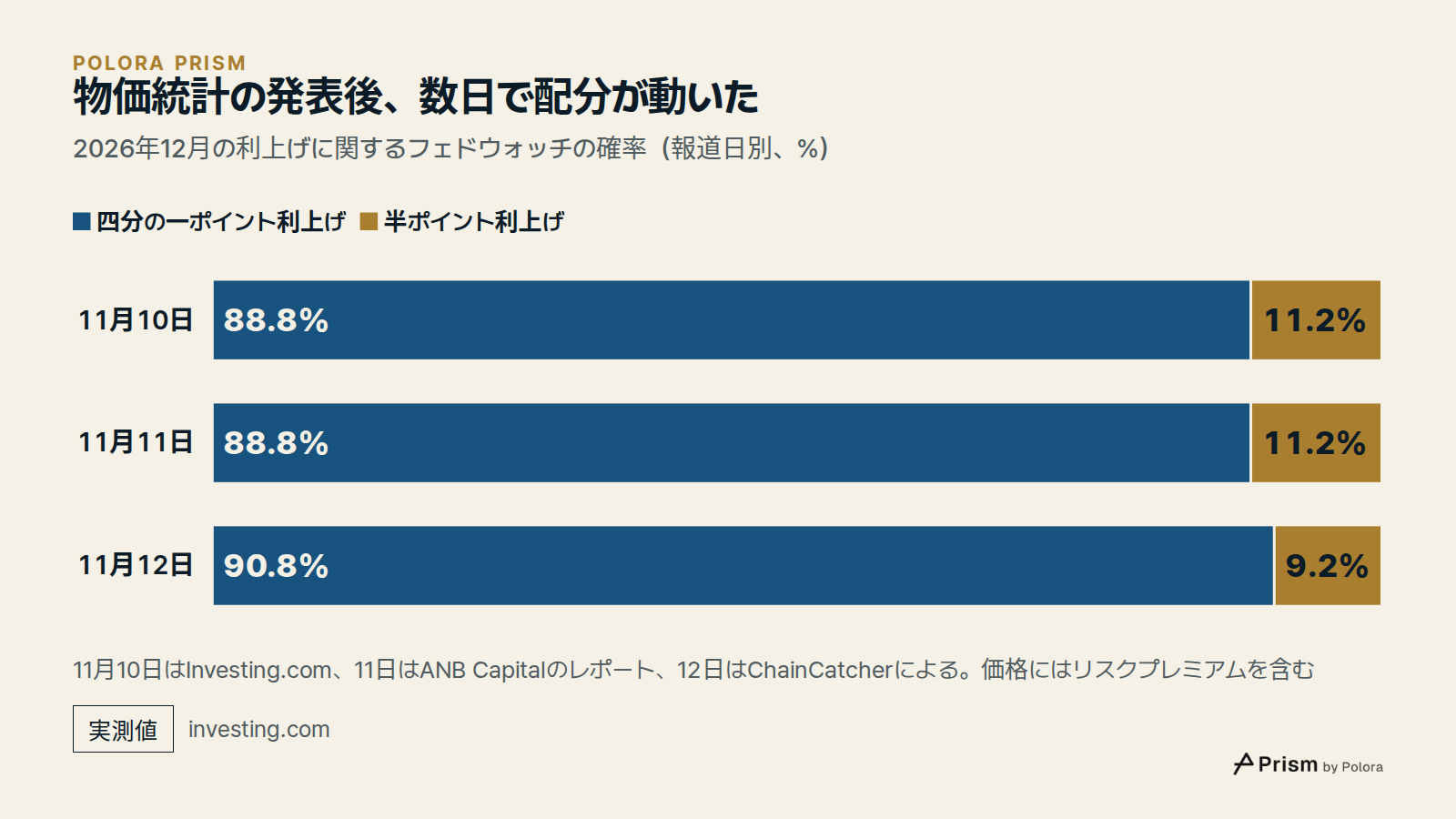
* The 90.8% / 9.2% split and timestamp: Supported for November 12. Multiple financial portals reporting on November 12, 2026, confirm that CME FedWatch showed a 90.8% probability for a 25-basis-point hike and a 9.2% probability for a 50-basis-point hike. The editor should update the text to specify November 12, rather than blending it with November 11 or using the brief's 91.2%. (Sources: tradingkey.com, kucoin.com)
* The 27-basis-point calculation: Supported. The arithmetic (0.908 × 25 + 0.092 × 50 = 27.3) is correct. As CME’s methodology restricts probabilities to the two adjacent quarter-point increments bracketing the implied rate, a hold (0 basis points) receives a 0% weight by construction because the implied rate of 27.3 is between 25 and 50.
* Waller's comments on CNBC: Supported. On November 10, 2026, Federal Reserve Governor Christopher Waller stated he would support a 25-basis-point rate increase in December and that a 50-basis-point hike should be considered if October inflation data came in hot (core CPI of…
Researcher · gpt-6-luna
CME’s own methodology supports the basic explanation, with an important nuance: FedWatch is not simply splitting one futures contract into two outcomes. It uses 30-day fed funds futures prices—quoted as 100 minus the contract month’s average effective federal funds rate—and, for a meeting month, uses the surrounding monthly rates to infer the rate change around the meeting. Under its assumptions, it assigns probabilities to two adjacent outcomes, typically one 25-basis-point step apart. (cmegroup.com)
For the reported 90.8% / 9.2% split, the weighted move is 27.3 basis points: \(0.908 \times 25 + 0.092 \times 50\). That makes the displayed 0% hold a consequence of the model’s selected outcomes—not independent evidence that a hold is impossible. The timestamp is better supported as November 12 than November 11: a dated report that day gives the 90.8%/9.2% figures, while I did not find a primary CME snapshot verifying that exact reading. (uat2049.chaincatcher.info)
The manuscr…
The Arbiter · gpt-6-sol
The voices agree on the key distinction: if the reported FedWatch screen showed about 91% for a quarter-point hike and 9% for a half-point hike, the 91% labels the quarter-point outcome, not the total of the displayed hike outcomes. CME’s published method supports the two-adjacent-outcome calculation. It also shows why the manuscript’s phrase “split one futures price” needs care: the calculation can use surrounding contract months to infer the change at a meeting. (cmegroup.com)
The consequential open point is which reading, and when. The Researcher found a November 12 report of the 90.8%/9.2% split, but no primary CME snapshot establishing that exact split on both November 11 and 12. Beta also found a different November 11 reading. The manuscript should not combine those figures or dates without a timestamped source.
There is a difference of emphasis, not arithmetic: Alpha stresses that a displayed 0% hold is produced by the restricted calculation; Beta warns that saying the price is “not a forecast” goes too far, since market-implied probabilities can b…
The Arbiter's Final Verdict · gpt-6-sol
Verdict
For the reported November 12 FedWatch reading, “91%” measured the market-implied weight on a *quarter-point* December hike—not the probability of *any* hike. The report put about 9% on a half-point hike and 0% on a hold. That exact split is supported by a dated secondary report, not by a primary CME snapshot; it should not be attributed to both November 11 and 12 without further evidence.
Here is what the number rests on. CME’s methodology uses prices of 30-day federal funds futures to infer the rate change around a meeting, then assigns weights to adjacent quarter-point outcomes. At the reported 90.8%/9.2% split, the weighted move is 27.3 basis points: \(0.908 \times 25 + 0.092 \times 50\). The displayed 0% for a hold follows from choosing 25 and 50 basis points as the two outcomes; it is not separate proof that a hold is impossible. The calculation can use surrounding months’ futures prices, so the manuscript’s “one futures contract” description is too simple.
The manuscript’s premise stands fo…