Polora put a blunt question to a panel of AI models. Accept Iran's grip on the Strait of Hormuz, or push back? Their answer rejects any political veto over passage while warning that no open-ended war can 'control' the strait either.
Roughly a fifth of the world's oil, and a similar share of its liquefied natural gas, passes through the Strait of Hormuz. Since a U.S.-Iran conflict began in late February 2026, waves of attacks on shipping and an American blockade of Iranian ports have left the passage functionally closed for months, with traffic running at a fraction of normal levels. That produced a hard question. If Iran can effectively decide who sails, should the U.S. and the Gulf states simply accept that as the new arrangement?
Polora put the question to a panel of AI models seated in different roles : a geopolitical strategist, a maritime and energy economist, an international-law analyst, plus a fact-checker and a moderator. Running one problem through several models in separate seats is what the exercise is for, and here it mattered. The panel converged fast on the headline answer and then spent the rest of the debate on the harder part, which was how to say no without starting a war no one can win.
Geography is real. A veto is not.
The panel's organizing move was to separate two things that get blurred together. Iran's geographic command of a narrow strait is a fact that cannot be bombed away. It is a different matter to grant Tehran a political right to decide which flags, cargoes, and destinations may pass, to levy tolls, or to impose inspections. Accepting the second, the strategist seat argued, would turn a temporary coercive advantage into a durable entitlement.
The concern is precedent. If disrupting a global chokepoint is rewarded with a recognized veto, every future crisis becomes an extortion opportunity, and not only at Hormuz. The legal seat put the same point in terms of the commons : freedom of navigation is a universal right, and letting a bilateral grievance hold it ransom would invite the same tactic at every other strait.
There is no 'new normal' to accept
The economist seat's sharpest contribution was to point out that accepting a settled Iranian order assumes one exists. It doesn't. The strait has swung between closure, partial reopening, and closure again, and a memorandum of understanding that briefly restarted sailings collapsed and stranded a fresh cohort of ships. War-risk insurance tracks that instability directly. Permission that a drone strike can revoke tomorrow is not an insurable risk, it is political risk, and underwriters price it accordingly.
This is why a government backstop has not been enough on its own. A large revolving maritime reinsurance plan already exists, yet normal traffic has not returned, because insurers cannot write coverage against revocable promises. The lesson the panel drew is that safety has to be demonstrated in the water before the market reassembles, and that a ceasefire announcement does not reopen an insurance market.
The gas has no bypass
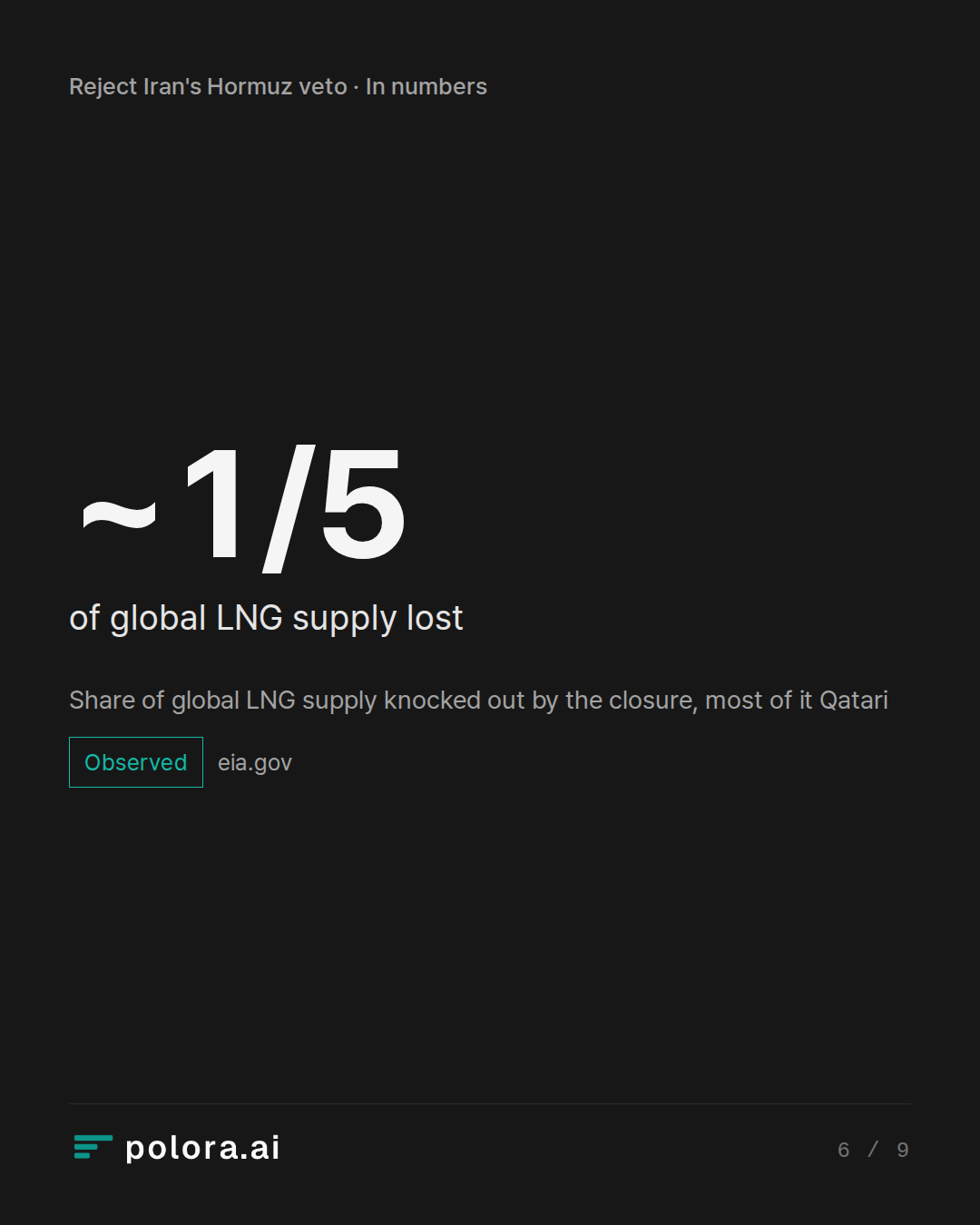
Oil has partial escape routes, chiefly the Saudi and Emirati pipelines that can move some volume around the strait. Liquefied natural gas has essentially none. It must be liquefied at purpose-built coastal terminals and loaded onto specialist tankers, and Qatar's cargoes have to cross Hormuz to reach the world. The closure knocked out roughly a fifth of global LNG supply, most of it Qatari.
That gives the veto a third-party edge the oil numbers understate. A right to close Hormuz is, in practice, a lever over Qatari export revenue and over European and Asian energy security, held by neither of them. For the panel it was the clearest case that 'no substitute' has to mean 'no veto', because there is nowhere for the gas to go.
The law, and where it stops
The law leans hard toward passage. Under the regime of transit passage, an international strait cannot be arbitrarily closed, taxed, or subjected to political screening, and the legal seat framed Iran's toll-and-reparations demand as holding a global right hostage to a private dispute. Separating the two tracks, so that transit safety stays a commons question while sanctions stay a bilateral one, became the panel's shared principle.
The more revealing moment was internal. The fact-checker seat pushed back on its own side rather than on Iran. It flagged that an IMO routing scheme cannot simply bypass Iranian waters without Iran's cooperation, that the IMO has no standing power to strip a country of maritime certifications, and that several legal claims had been stated more absolutely than the conventions support. It also withheld credit from a run of dramatic traffic and insurance figures that arrived without traceable sources. The effect was to narrow the argument to what actually holds, which is the value of seating a skeptic at the same table.
What would actually make ships sail
The operating concept that survived the debate is modest by design. Protected transit windows for the highest-risk cargoes rather than a warship beside every tanker. Continuous mine clearance treated as a standing service, since Iran can restore uncertainty faster than any navy can prove a route clean. A temporary, tightly conditioned war-risk reinsurance bridge meant to shrink as private premiums normalize. Economic de-escalation kept reciprocal and reversible, and gated by independently tracked traffic and safety data rather than Iranian assurances. A bounded, evidence-based response to renewed attacks, plus long-term investment in bypass pipelines, storage, and alternative terminals to make closing the strait less rewarding over time.
The moderator seat reduced the whole thing to one test. Would a shipowner transit without seeking Iran's discretionary permission? If yes, the arrangement supports neutral passage. If it requires Iranian clearance, payment, or a promise that can be pulled back, it entrenches exactly the veto the exercise set out to reject. The answer to the original question, then, is to push back, but to measure success commercially rather than theatrically : ordinary ships sailing under neutral rules, insurers back in the water, and Iran's approval made irrelevant.
Should the U.S. and Gulf states accept Iran's control of the Strait of Hormuz as the new normal, or push back?
Geopolitical Strategist · gpt-5.6-sol
Geopolitical Strategist — Opening Position
The United States and Gulf states should push back—but not confuse pushback with an open-ended war to seize the strait.
Iran possesses geographic leverage over Hormuz. That reality cannot be bombed away. But recognizing geography is different from accepting an Iranian political right to decide which countries’ ships may pass, impose unilateral tolls, or hold civilian commerce hostage. Making that arrangement “the new normal” would convert a temporary coercive advantage into a durable strategic entitlement.
The immediate record shows why that is unacceptable. The International Maritime Organization says freedom of navigation must be respected by all parties and that merchant shipping must never become geopolitical leverage. It had verified at least 46 attacks on international shipping around Hormuz since the conflict began on February 28, 2026. (imo.org) The economic damage is not abstract: the U.S. Energy Information Administration estimated that Iraq, Saudi Arabia, Kuwait, the UAE, Qatar, and Bahrain collectively sh…
Maritime Trade & Energy Economist · claude-sonnet-5
Maritime Trade & Energy Economist — Opening Position
I agree with the Strategist's political conclusion, but I want to ground this debate in the economics, because the numbers make "accepting the new normal" not just strategically dangerous but commercially catastrophic and self-defeating even on Iran's own terms.
The economic reality is worse than a policy debate — it's market failure
Six months into this conflict, the strait has not merely been disrupted — it has functionally collapsed as a commercial artery. Between eight and 15 vessels crossed the strait on August 4-6, 2026, a fraction of the roughly 130 daily transits before the conflict — shipping through what was once a conduit for a fifth of global oil supply has effectively collapsed, prompting the largest energy disruption in recorded history. That is not "control" in any governable sense — it's the destruction of a market.
The insurance data tells the real story of why "accepting the new normal" doesn't even produce a stable normal: war risk shipping insurance premiums have surged to between 3% and 10% of hull value, up from 0.25% before the war — a $100 million tanker now faces war risk premiums of $3 milli…
International Law & Diplomacy Analyst · gemini-3.1-pro
International Law & Diplomacy Analyst — Opening Position
Both the Strategist and the Economist have accurately diagnosed the strategic and economic catastrophes that would unfold if we accept Iran’s control over the Strait of Hormuz as the "new normal." I will now lay out why accepting this is not just bad policy, but a fatal blow to the foundational legal architecture of the global order.
From the perspective of international law, there is no "new normal" to accept—there is only illegal extortion that must be systematically dismantled.
The Legal Fiction of Iranian "Control"
The debate hinges on the legal status of the Strait of Hormuz. Iran frequently attempts to treat the strait as its sovereign territorial waters, subject to the highly restrictive regime of "innocent passage," where a coastal state can suspend traffic for security reasons. Furthermore, Tehran often argues that because the United States has not ratified the UN Convention on the Law of the Sea (UNCLOS), U.S. vessels do not enjoy treaty rights in these waters.
This is a legal fiction. The Strait of Hormuz connects one part of the high seas or an exclusive economic zone (the Gulf of Oman/Arabian Sea)…
Researcher · gpt-5.6-sol
Researcher’s fact-check
Several central claims are well supported, but there are also material overstatements and one incorrect citation.
Supported
- 46 attacks since February 28: Correct. The IMO said on June 15, 2026 that it had verified at least 46 attacks against international shipping around Hormuz since the conflict began on February 28.
Source: https://www.imo.org/en/mediacentre/pressbriefings/pages/statement--on-us-iran-agreement.aspx (imo.org)
- 7.5 million barrels per day shut in during March: Correct, but explicitly an EIA estimate, not a measured final total. EIA attributed the shut-ins to constrained flows filling storage and projected 9.1 million b/d for April.
Source: https://www.eia.gov/pressroom/releases/press586.php (eia.gov)
- Iranian tolls and discriminatory passage restrictions conflict with transit passage: Strongly supported. The IMO Legal Committee specifically condemned Iran’s reported toll system and discriminatory measures and affirmed that transit passage through Hor…
The Arbiter · gpt-5.6-terra
The participants largely converge on the central answer: do not accept Iranian unilateral control as a new normal. The live question for round two is not whether to resist that principle, but how to do so without turning a legally justified position into an economically ruinous, self-defeating war.
What is established
- Iran cannot lawfully convert the strait into a discretionary tollgate or use nationality-, cargo-, or destination-based access rules as bargaining leverage. The applicable transit-passage framework strongly supports uninterrupted, non-discriminatory passage.
- The disruption has real system-level consequences: Gulf oil exports face storage and outlet constraints, while Qatar’s LNG exports are especially exposed because they lack a scalable physical bypass.
- A pure military “reopening” is not equivalent to restoring commercial navigation. Tankers need credible, persistent safety and insurance conditions—not merely a one-day clearance operation.
- The United States must keep its own operations legally disciplined. A blockade or interdiction directed at Iranian port commerce cannot become a de facto restriction on neutral shipping bound for other Gulf sta…
Geopolitical Strategist · gpt-5.6-sol
Geopolitical Strategist — Final Position
The operational objective should be neither “defeat Iran everywhere” nor “obtain Iran’s permission.” It should be narrower and measurable:
> Create a neutral maritime corridor that commercial operators will use, while making renewed interference costly enough that Tehran cannot exercise a reliable veto.
That requires five mutually reinforcing components.
1. Establish protected sailing windows—not permanent close escort
Coalition forces should publish scheduled transit windows, assemble merchant vessels outside the Gulf, and protect them through the highest-risk segment. Persistent surveillance, air defense, electronic warfare, rescue capacity, and rapid attribution matter more than placing a warship beside every tanker.
Close escort should initially prioritize LNG carriers, passenger vessels, and strategically important cargoes. Once attacks decline and insurers gain confidence, ships should transition to independently using a monitored corridor. A permanent convoy system would be expensive, vulnerable to saturation, and liable to make every commercial movement look like a military operation.
2. Treat mine clearance as…
Maritime Trade & Energy Economist · claude-sonnet-5
Maritime Trade & Energy Economist — Final Position
The Strategist's operational framework is sound. Let me stress-test it against the current state of the market and sharpen the mechanisms accordingly, because the newest data confirms both the scale of the damage and exactly where the leverage points are.
The market is not just disrupted — it's still oscillating, which is itself the lesson
The Strait of Hormuz is effectively closed to commercial shipping as of 11 August 2026, with only 2 ships transiting on August 2 versus roughly 73/day normal, and Brent at $87.97. Meanwhile the situation has reversed several times since March, swinging between full closure, partial reopening and closure again at least three times. That volatility is the strongest empirical argument against "accepting a new normal": there is no stable equilibrium to accept. Any framework built on the assumption that Iran will hold to a fixed permission regime ignores that the inherent fluctuation in weekly traffic volumes should not be interpreted as evidence of increased confidence among shipowners or operators.
Even the recent uptick proves the point rather than undermining it: the MoU period reduce…
International Law & Diplomacy Analyst · gemini-3.1-pro
International Law & Diplomacy Analyst — Final Position
The Arbiter has rightly focused us on the operational question: how do we build a protective architecture that restores commercial confidence without inadvertently codifying Iranian sovereignty over the strait?
The Strategist and the Economist have provided an excellent operational and financial blueprint. My role is to provide the legal and diplomatic "software" that must run on their hardware. If we implement escorts, mine clearance, and insurance backstops without a bulletproof legal framework, we risk creating a regime where Iran still dictates the terms of passage through sheer ambiguity.
Here is the exact diplomatic and legal mix required to make the Strategist’s "neutral corridor" and the Economist’s "insurance bridge" function without granting Tehran a veto.
1. Institutionalize the Corridor via the IMO, Not Bilateral MoUs
The Economist correctly noted that the previous Memorandum of Understanding (MoU) collapsed, stranding ships. This happened because the MoU treated transit rights as a bilateral political concession.
Legally, any agreement tying freedom of navigation to sanctions relief or reparations i…
Researcher · gpt-5.6-sol
Researcher’s final-round fact-check
The Strategist’s operational foundation is mostly supported. The Economist again mixes credible conclusions with precise figures that lack accessible attribution. The Legal Analyst makes several important legal overstatements.
Confirmed
- Mine-clearance operation: CENTCOM announced on April 11, 2026 that it had begun setting conditions for mine clearance and that underwater drones would join the effort. A June 18 JMIC advisory still reported active clearance operations and known mines. (centcom.mil)
Exact pages:
https://www.centcom.mil/MEDIA/PUBLIC-RELEASES/Article/4457220/us-forces-start-mine-clearance-mission-in-strait-of-hormuz/
https://wwwcdn.imo.org/localresources/en/MediaCentre/HotTopics/Documents/JMIC%20Advisory%20Note%2000926%20SoH%20open.pdf
- The insurance facility already exists: DFC announced Chubb as lead underwriter for a roughly $20 billion revolving maritime-reinsurance facility, initially covering hull and machinery and cargo. The official DFC pag…
The Arbiter · gpt-5.6-terra
The debate has narrowed to a strong common position with important safeguards:
- Do not accept Iranian unilateral control—meaning no recognized Iranian right to tax, screen, delay, or politically condition neutral transit through Hormuz.
- Do not promise an unrealistic military “solution.” Mine clearance, escorts, surveillance, and limited defensive action can reduce risk, but they cannot instantly restore the private insurance and commercial confidence that make a sea lane function.
- Treat coordination and control differently. Iran and Oman necessarily matter for deconfliction, search-and-rescue, hazard reporting, and traffic safety. That practical role must not become an Iranian approval power over particular ships.
The Strategist supplies the most workable operating concept: protected transit windows, continuous—not one-off—mine countermeasures, a temporary multinational reinsurance bridge, clear hotlines and safety procedures, and a predetermined ladder of consequences for verified attacks. The Economist’s central refinement is sound: subsidies and any reciprocal economic measures should be gated by independently observable safety and traffic indicators, rather t…
The Arbiter's Final Verdict · gpt-5.6-terra
Push back—but against unilateral Iranian veto power, not through an open-ended effort to “control” the strait militarily.
The key distinction is between Iran’s unavoidable geographic role and a claimed political right to decide who may transit. Iran and Oman can legitimately participate in safety coordination, hazard reporting, search-and-rescue, and deconfliction. Iran cannot legitimately make neutral passage conditional on tolls, political concessions, sanctions relief, inspections, or revocable permission.
Accepting that arrangement would create a durable coercion precedent: disruption of a global chokepoint would become a profitable bargaining tool in every future crisis. It would also be commercially unstable. Shipowners and insurers need predictable, enforceable safety—not a permission system that can be withdrawn when political tensions rise.
The prudent strategy is therefore:
- maintain a multinational, nationality-neutral protected transit arrangement;
- sustain mine countermeasures, surveillance, limited escorts for the highest-risk cargoes, and clear incident attribution;
- provide temporary, tightly conditioned war-risk reinsurance to restart commercial sailing;…