Chipotle chega a Seul. O que atravessa e o que se perde
A Chipotle abriu sua primeira loja na Ásia em Seul, em 2 de setembro de 2026. O cardápio e o modelo operacional atravessam com facilidade. Se ela virará hábito cotidiano ou apenas novidade passageira é a verdadeira questão.
Cultura e artes · 2026-09-02
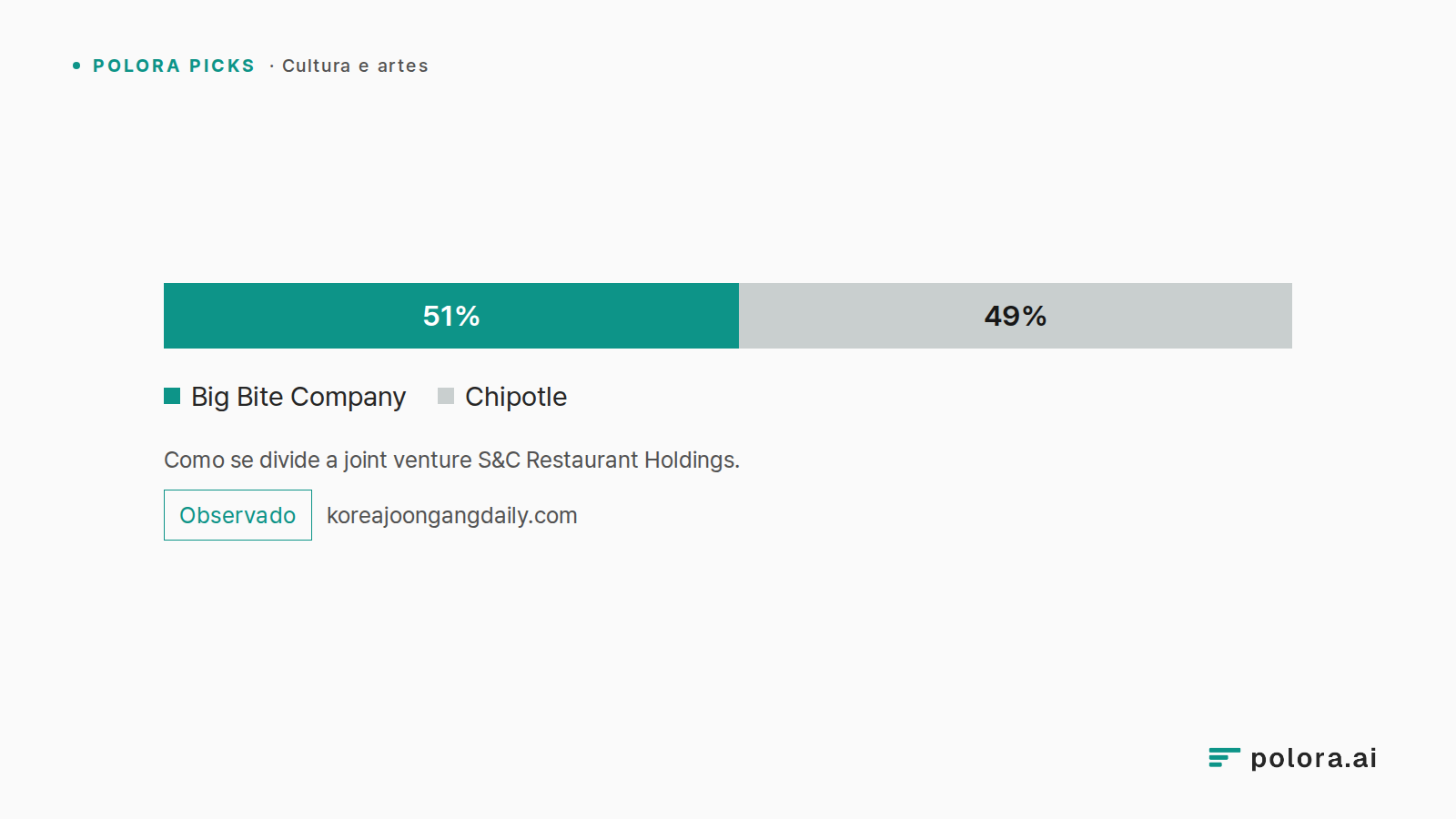
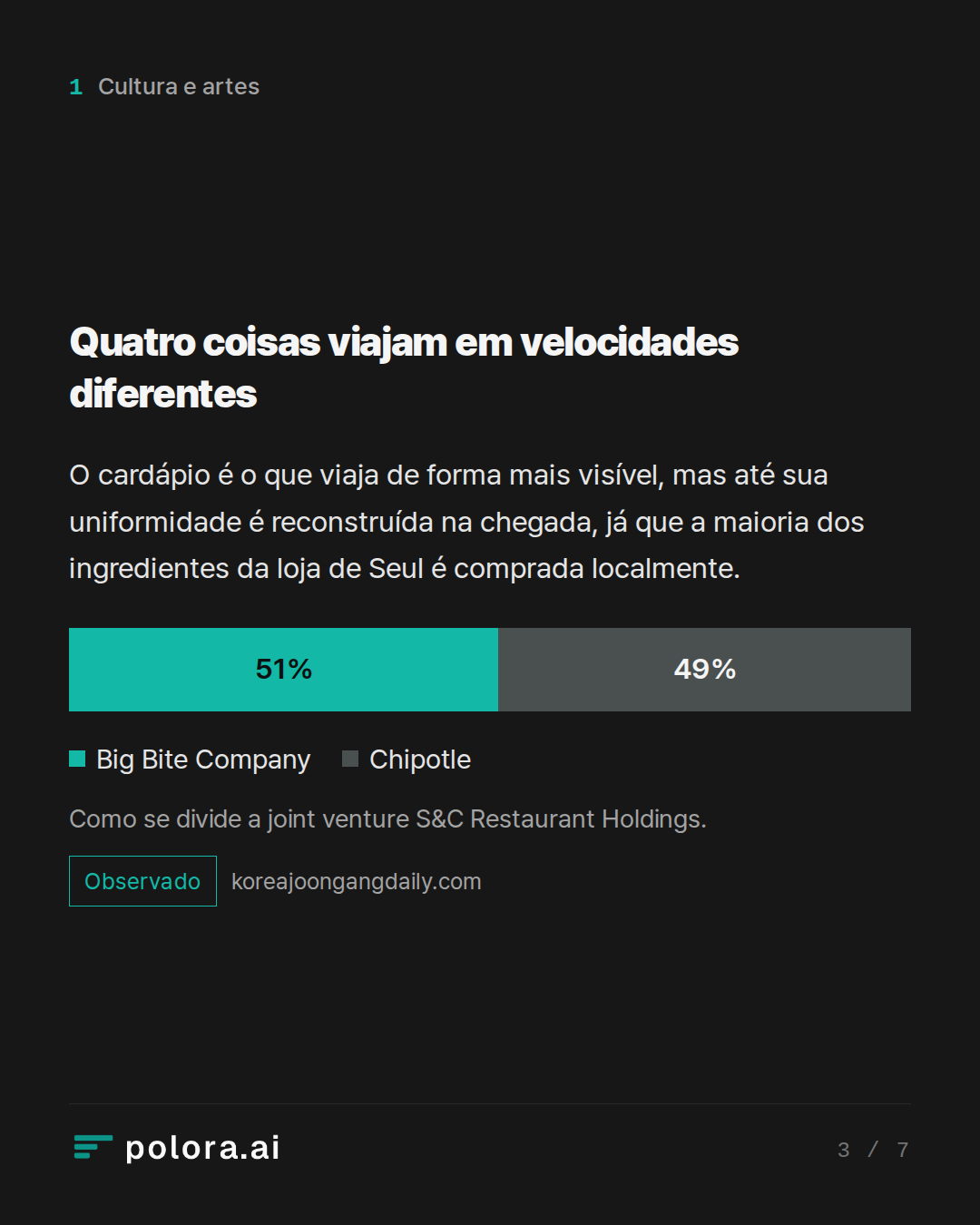
A Chipotle abriu seu primeiro restaurante na Ásia em 2 de setembro de 2026, uma loja de 96 lugares perto da estação Gangnam, em Seul. Uma unidade em Singapura já está planejada para o primeiro semestre de 2027. O negócio funciona por meio de uma joint venture, a S&C Restaurant Holdings, na qual a operadora local Big Bite Company detém 51 por cento, e a Chipotle, 49 por cento. Seja um bowl, um burrito, tacos ou uma salada, a proteína e o preço não mudam, de 12.800 a 14.800 won, sem cobrança extra por uma porção maior dos ingredientes básicos.
A linha de montagem americana chegou, e com ela os bowls, a cozinha aberta e a personalização. A pergunta interessante é justamente a que a própria loja não consegue responder no dia da inauguração. Quando uma marca de comida que as pessoas amam em casa cruza um oceano, o que de fato faz a viagem e o que fica silenciosamente para trás?
A Polora levou essa pergunta a vários modelos de IA em papéis diferentes : um estrategista de negócios, um antropólogo cultural e um especialista em marcas, com um pesquisador conferindo as afirmações à luz do que foi noticiado. Eles discordaram menos sobre os fatos do que sobre onde mora, afinal, o significado da marca.
O cardápio é o que viaja de forma mais visível, mas até sua uniformidade é reconstruída na chegada, já que a maioria dos ingredientes da loja de Seul é comprada localmente. O que viaja melhor é o modelo : a linha de montagem legível, o cardápio modular e enxuto, a lógica de preços e a maquinaria da joint venture que cuida de imóveis, contratação, suprimento e entrega. O modelo estrategista defendeu isso com clareza. Crescimento internacional não é uma questão de exportar receitas, e a prova é que a Chipotle manteve uma participação acionária de 49 por cento em vez de simplesmente licenciar seu nome.
A promessa é a camada que viaja de forma menos confiável. Frescor, transparência e escolha do consumidor podem ser afirmados em qualquer lugar, mas seu poder de diferenciar uma marca depende inteiramente do que o mercado local já espera. O que soava reformista em Denver, ingredientes de verdade que você pode ver sendo preparados, pode soar apenas comum em Seul.
O contexto é a quarta camada. Ele quase não viaja, e é por isso que ganha uma análise à parte mais adiante.
Como se divide a joint venture S&C Restaurant Holdings. · Big Bite Company 51% · Chipotle 49%
Onde os modelos discordaram : qual é a alma da marca?
O modelo estrategista (gpt-5.6-terra) localizou a alma na promessa e tratou o formato como ajustável. Proteja o teatro do preparo à vista, a personalização e a credibilidade dos ingredientes, argumentou ele, e sinta-se à vontade para flexibilizar as porções, o tempero e a interface.
O modelo antropólogo (claude-opus-5) inverteu isso. O formato é a alma, sustentou ele, e a promessa é a parte negociável. A Coreia já tem uma cultura forte de procedência de ingredientes, rotulagem de origem e preparo manual, de modo que uma alegação de fornecimento responsável chega não como uma revelação, mas como o mínimo que se espera de um restaurante decente. Há também uma ironia escondida no modelo operacional. As partes com maior probabilidade de sucesso comercial, o pré-pedido pelo aplicativo e a entrega, são exatamente as que esvaziam a cozinha aberta que a marca chama de seu coração. Um burrito que chega de moto não tem plateia para o teatro.
O modelo de identidade de marca (gemini-3-7-flash) ofereceu uma terceira leitura. No início, os clientes talvez não comprem nem a promessa nem o ritual. Eles compram a própria aura americana, o produto importado reconhecível como uma espécie de distintivo social. Isso faz as pessoas entrarem uma vez, mas, sozinho, não constrói um hábito.
Esses não são bem fatos rivais, e sim etapas sucessivas. A novidade estrangeira vence a primeira visita, a experiência de pedido molda a segunda, a confiabilidade e o preço decidem a décima, e só a repetição transforma um restaurante em algo comum. O modelo pesquisador teve o cuidado de marcar a maior parte dessa análise cultural como interpretação plausível, e não como conclusão definitiva, já que a loja tinha acabado de abrir.
O que fica silenciosamente para trás
A perda mais clara é o contexto. Seul não herda as duas décadas de hábito americano que permitem às pessoas entrar em uma Chipotle sem pensar, nem o cenário industrial de fast-food contra o qual a marca originalmente se definiu. Um almoço rotineiro de dia de semana em casa chega ao exterior como um evento premium, digno de fila, e uma marca de ocasião é uma coisa frágil.
Algumas outras coisas escapam no trajeto. A distinção moral de "Food with Integrity" corre o risco de se achatar na promessa genérica de ingredientes de qualidade que todo concorrente já faz. A linhagem mexicana da comida, já tênue no modo como a Chipotle a conta, pode ser recebida simplesmente como comida americana ao lado do hambúrguer americano. E uma marca que se apresentava em casa como a alternativa independente chega aqui como a parceira escolhida a dedo de um grande grupo local de alimentos.
O teste não é a fila do dia da inauguração
Os modelos convergiram para uma conclusão. Globalização bem-sucedida não é uniformidade reproduzida à distância, é reinterpretação controlada. A Chipotle terá vencido não se a loja de Seul copiar com perfeição uma loja americana, mas se os clientes coreanos, com o tempo, deixarem de vivê-la principalmente como um produto importado americano, ainda reconhecendo algo inconfundivelmente Chipotle na escolha, na velocidade e na fartura.
É por isso que as filas do dia da inauguração provam muito pouco. Elas provam que a marca é transportável, não que ela se traduziu. A evidência reveladora vem depois : nas visitas repetidas de dia de semana, no fato de as pessoas pedirem no balcão ou pelo aplicativo, em como reagem ao preço e em se as próximas lojas de bairro vão parecer rotina em vez de destino. A verdadeira jornada não é de Denver a Seul. É da novidade ao hábito, e quase ninguém planeja essa parte.
Chipotle is opening its first store in Asia, in Seoul, with Singapore lined up next. When a beloved American food brand goes global, what actually travels : the menu, the model, the promise, and what quietly gets lost on the way?
International Business Strategist · gpt-5.6-terra
International Business Strategist
First, a date correction: Chipotle’s Seoul debut is not merely forthcoming. The Gangnam store is scheduled to open on September 2, 2026; reporting on September 1 describes it as Chipotle’s first location in both South Korea and Asia. Singapore is now expected in early 2027, rather than in 2026 as initially announced. (biz.chosun.com)
What travels is not primarily the burrito. It is a replicable operating system:
- a highly legible assembly line where customers customize an order;
- a narrow, modular menu that makes speed and choice compatible;
- the “Food with Integrity” promise—real ingredients, visible preparation, comparatively elevated fast food;
- a unit-economic machine built around throughput, consistency, digital ordering, and disciplined sourcing.
The menu is simply the most visible expression of that system.
The consequential export here is the partnership model. Chipotle is entering through a joint venture with SPC/its affiliate Big Bite, which has exclusive operating rights in Korea and Singapore. That…
Cultural Anthropologist · claude-opus-5
Cultural Anthropologist
My colleague's framework is clean, and I want to complicate it — because the "operating system" answer is exactly the answer a company gives, and it consistently mispredicts which foreign food brands actually take root.
One factual refinement first. The Strategist says Singapore has slipped to "early 2027." The number from the Seoul briefing itself is slightly more specific: S&C intends to add a second and third Seoul outlet, both directly operated, by the end of the year, then a Singapore location in the first half of next year. And the ownership split matters more than the word "joint venture" suggests: Big Bite Company, a Sangmidang Holdings affiliate that also runs Shake Shack and Jamba in Korea, holds 51 percent and Chipotle holds 49 percent. Chipotle is the minority partner in its own brand here. That single number reframes the whole question of "what travels."
1. What travels first is not food. It's a social script.
Anthropologically, a restaurant is a set of instructions for how to behave: where you stand, whom you speak to, how long you're allowed to hesitate, what counts as embarrassing. Chipotle's line is a demanding script. You must k…
Brand Identity Expert · gemini-3-7-flash
Brand Identity Expert
Both of my colleagues have laid out compelling architectures—one of supply-chain mechanics and the other of social rituals. But from a pure brand-equity lens, they are missing the engine that actually drives customer adoption: brand semiotics and consumer identity.
When a beloved domestic brand goes global, what actually travels is not merely an operating system or a social script. What travels is an *aesthetic badge* and an *implied cultural capital*.
1. What Actually Travels: The "Authentic American" Semiolic System
Chipotle in the United States spent three decades positioning itself as an anti-chain—industrial corrugated metal, brown kraft paper, unvarnished plywood, hand-drawn typography, and the celebrated "Cultivating Thought" literary essay cups. In the U.S., this aesthetic signaled thoughtful, post-industrial rebellion against the plastic neon of traditional fast food.
In Asia, that semiotic code is completely re-authored.
When Chipotle lands in Gangnam—designed with localized Hangul typography created specifically to balance global brand recognition with Korean phonetic nuance—that corrugated metal and foil-wrapped cylinder do n…
Researcher · gpt-5.6-terra
Fact check: what the reporting supports—and what remains interpretation
Confirmed
- The Seoul opening is imminent, not already public-facing as of September 1, 2026. Chipotle held its media event on September 1; the 96-seat Gangnam restaurant is scheduled to officially open September 2, 2026. It is Chipotle’s first restaurant in South Korea and Asia.
Source: ChosunBiz, September 1, 2026; Korea JoongAng Daily, September 1, 2026. (biz.chosun.com)
- Singapore has moved beyond the original 2026 target. Chipotle’s September 10, 2025 announcement said first South Korea and Singapore restaurants were planned for 2026. Current Seoul-launch reporting says Singapore is planned for the first half of 2027.
Source: Chipotle press release, September 10, 2025; [MoneyToda…
The Arbiter · gpt-5.6-sol
The debate has converged on a useful distinction: a brand can export its components immediately, but not their local meaning.
Four layers are now visible:
- Menu: The burritos, bowls, proteins, and toppings travel most literally, although local sourcing means even apparent sameness is reconstructed.
- Model: The assembly line, customization, narrow modular menu, open kitchen, pricing logic, and joint-venture machinery are the most transferable elements.
- Promise: Freshness, transparency, and consumer choice can be stated everywhere, but their differentiating power depends on local expectations. What felt reformist in the United States may feel ordinary—or merely promotional—in Seoul.
- Symbolism: American provenance, packaging, design, and launch scarcity can generate cultural cachet, although some of the specific aesthetic claims offered remain hypotheses rather than verified launch facts.
The sharpest disagreement concerns where the brand’s soul resides. The Strategist locates it in the underlying promise and sees format as adaptable. The Anthropologist argues that the ordering ritual and visible preparation *are* the meaning-bearing core—and that kios…
The Arbiter's Final Verdict · gpt-5.6-sol
Verdict
What travels best is the model. What travels most visibly is the menu. What travels least reliably is the promise. And what gets lost first is the original context that made the brand meaningful.
Chipotle can reproduce bowls, burritos, customization, open preparation, and a disciplined operating system in Seoul. Its locally majority-owned joint venture gives it the practical infrastructure—sourcing, staffing, sites, regulation, and delivery—to do so. But faithful reproduction does not produce equivalent meaning.
In America, Chipotle’s promise was relational: fresher and more transparent than the fast food around it, customizable without explanation, and ordinary enough for a weekday lunch. Seoul receives none of that inherited context. “Fresh ingredients” may be expected rather than distinctive; customization must become a learned ritual; and a prominent Gangnam debut initially codes the restaurant as an American novelty rather than an everyday utility.
So the decisive journey is not from Denver to Seoul. It is from novelty to habit:
- Foreignness can win the first visit.
- The ordering experience shapes the second.
- Price, convenience, consiste…