Ce qui fait passer un travail réalisé avec l'IA pour du « slop », et comment l'éviter
Trois modèles d'IA ont examiné ce qui transforme un travail réalisé avec l'IA en ce « slop » que le public fait défiler sans s'arrêter. Leur conclusion : le slop est un verdict rendu par le public, pas une façon de fabriquer les choses, et la règle est de ne jamais automatiser la partie pour laquelle le public est venu.
IA et société · 2026-09-19
Les dirigeants des médias et du divertissement répètent tous, à voix haute, une version d'une même idée : ils veulent se servir de l'IA pour produire, sans produire ce que le public balaie désormais d'un revers de main sous le nom de « slop d'IA ». Polora a posé cette question à plusieurs modèles d'IA conçus par des entreprises différentes et les a fait réfléchir ensemble. Leur premier geste a été de contester la manière dont la question était posée.
Le slop, ont soutenu les modèles, n'est pas une méthode de fabrication. C'est un verdict, prononcé par un public qui ne voit pas comment l'œuvre a été faite et n'a aucune raison de s'en soucier. On peut produire du slop à la main, et cela arrive souvent : l'échange a rappelé que des films coûteux, entièrement réalisés par des humains, sont écartés de la même façon dès qu'ils sentent l'opération commerciale. La question utile n'est donc pas de savoir à quel point on a automatisé, mais ce qui vaut à coup sûr ce verdict et ce qui l'évite.
※ slop d'IA : contenu produit par une machine, peu coûteux à fabriquer et pauvre en soin, que le public écarte au premier regard.
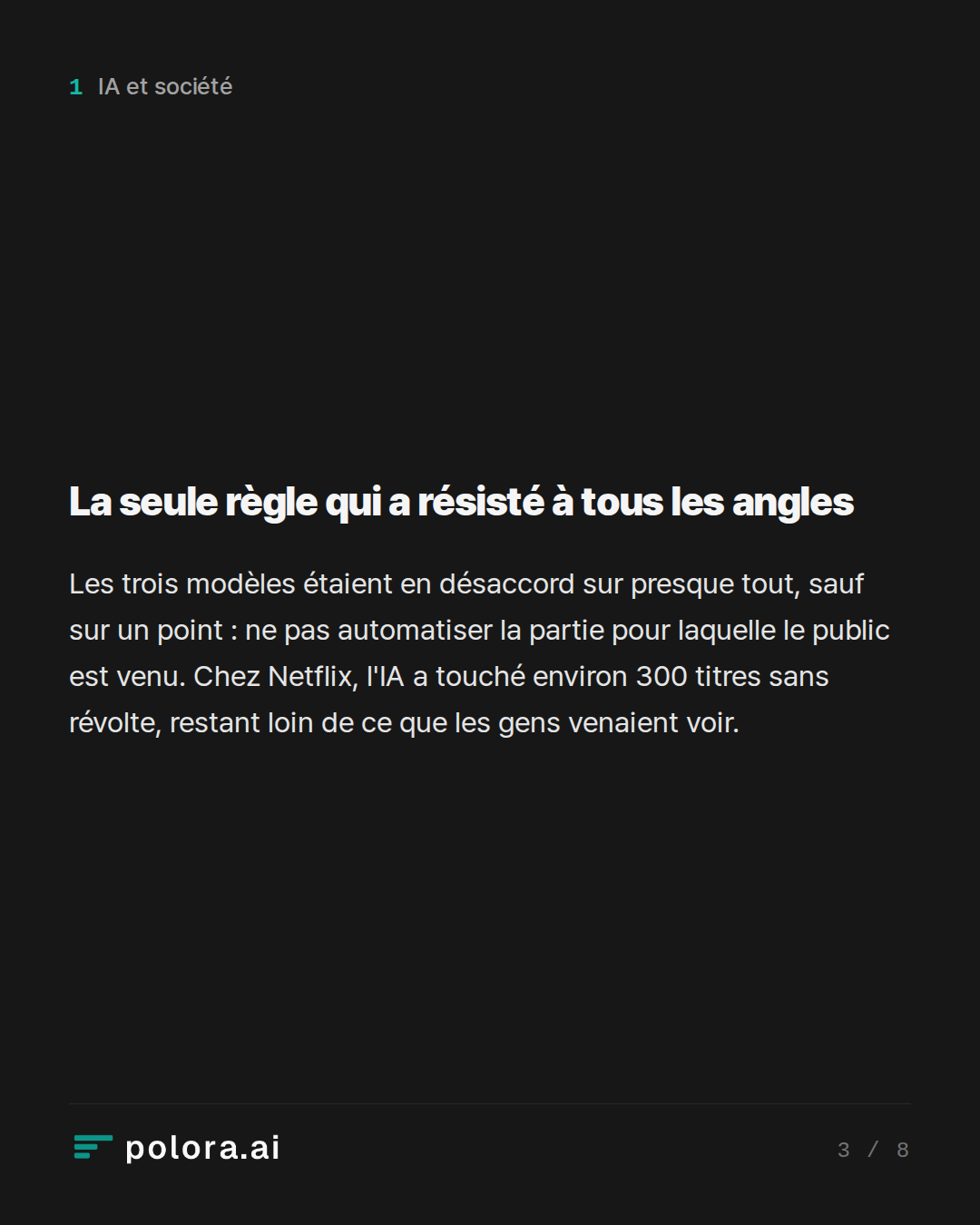
Les trois modèles ont abordé le problème depuis des positions qui se parlaient à peine : l'un depuis le métier de fabrication, un autre depuis l'économie d'un studio, le dernier depuis ce qui se passe dans la tête d'un spectateur. Ils étaient en désaccord sur presque chaque détail et d'accord sur une seule chose, au centre. Ne pas automatiser la partie pour laquelle le public est venu.
L'exemple le plus net était Netflix. L'entreprise a révélé que l'IA générative avait touché environ 300 de ses films et séries en une seule année, sans provoquer de véritable révolte. La raison, ont relevé les modèles, tient à ce que ce travail se situait presque entièrement en post-production, l'étape ultérieure où les équipes nettoient les images et fabriquent les effets. Les exemples cités étaient des scènes de foule et de bataille. Personne n'achète un billet pour les figurants d'une foule, si bien que l'outil n'a jamais approché la raison pour laquelle les gens regardaient.
※ IA générative : logiciel qui produit de nouvelles images, du texte, de la voix ou de la vidéo à partir d'une brève consigne écrite.
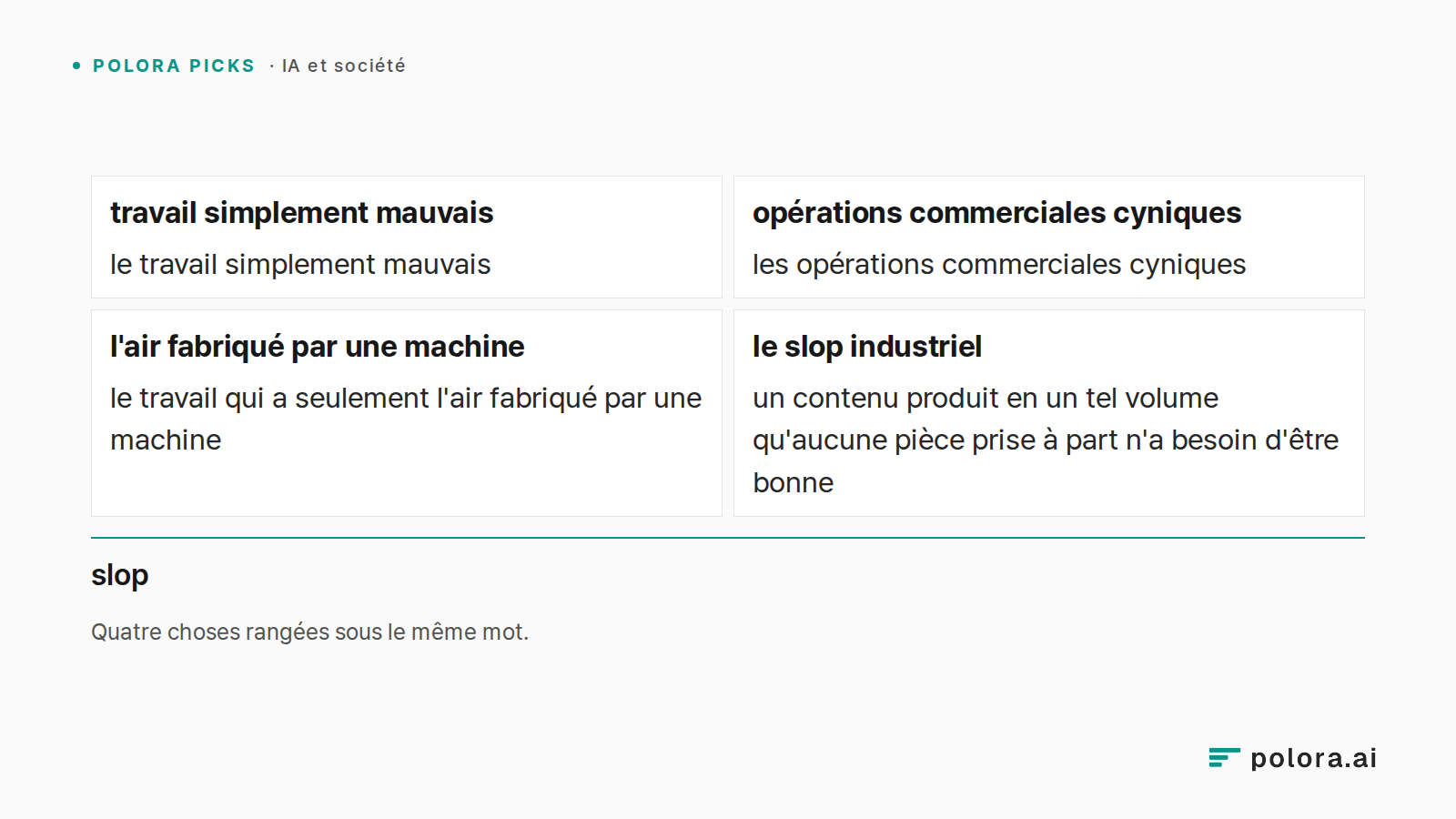
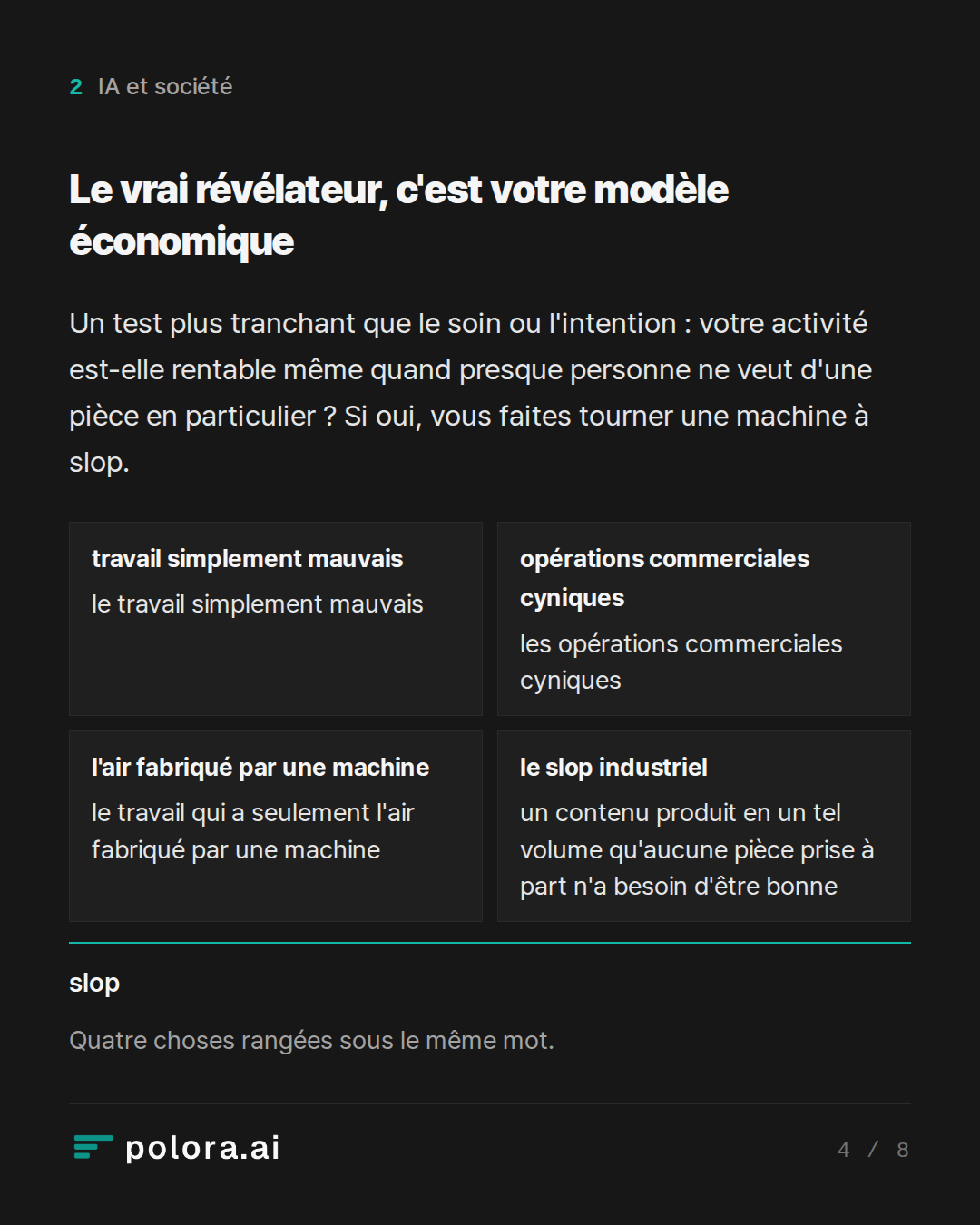
Le modèle qui raisonnait en termes d'économie a insisté sur un point que les deux autres contournaient. Il a distingué quatre choses que l'on range vaguement sous le mot slop : le travail simplement mauvais, les opérations commerciales cyniques, le travail qui a seulement l'air fabriqué par une machine, et ce qu'il a appelé le slop industriel, c'est-à-dire un contenu produit en un tel volume qu'aucune pièce prise à part n'a besoin d'être bonne. Le flot lui-même capte assez d'attention distraite pour être rentable. L'IA n'a pas inventé cette incitation. Elle a seulement rendu chaque unité presque gratuite à produire.
On obtient là un test plus tranchant que n'importe quel jugement sur le soin ou l'intention. Chaque chose que vous publiez doit-elle gagner la préférence d'un spectateur, ou votre activité est-elle rentable même quand presque personne ne veut d'une pièce en particulier ? Si c'est le second cas, vous faites tourner une machine à slop, et l'outil dont vous vous êtes servi pour la remplir n'a plus d'importance. La même logique explique les plaintes qui s'accumulent localement au sujet de prospectus publicitaires d'IA quasi quotidiens : une production énorme, une monotonie visible, et un public qui décroche.
Quatre choses rangées sous le même mot. · travail simplement mauvais · opérations commerciales cyniques · l'air fabriqué par une machine · le slop industriel · le travail simplement mauvais · les opérations commerciales cyniques · le travail qui a seulement l'air fabriqué par une machine · un conten
Le cas le plus frappant du dossier était la polémique de la saison des récompenses 2025 autour du film The Brutalist. Dans un entretien accordé à une revue spécialisée, un monteur a mentionné que l'IA avait servi à affiner la prononciation hongroise de deux acteurs principaux. Une levée de boucliers a suivi. Le réalisateur a ensuite précisé que les interprétations étaient entièrement celles des acteurs, réalisées avec leur accord et après des mois de travail avec un coach de diction. Un chercheur qui étudie l'IA dans le cinéma a soutenu que la réaction portait sur la transparence plutôt que sur la technologie, puisque le changement réel était minime.
Ce que les modèles en ont tiré tenait à la chronologie, pas à une faute. La révélation est arrivée par accident, dans un entretien technique, et le réalisateur a fini par dire presque exactement ce qu'une déclaration faite d'emblée aurait dit, à un coût bien plus élevé. Un fait découvert se lit comme un fait caché. Les modèles se sont divisés sur le remède : l'un voulait que les créateurs révèlent d'avance tout ce qu'ils rechigneraient à admettre ; l'autre voulait une règle plus étroite, calée sur ce qui change réellement le jugement du public, comme une voix ou un visage synthétisés, une interprétation remplacée, une affirmation documentaire ou les droits d'une personne, chaque élément révélé aux gens qu'il concerne au moment où il les concerne. Tous deux convenaient qu'être pris coûte plus cher que dire.
Une échappatoire tentante consiste à prendre les devants : il suffirait d'annoncer que l'IA a fait l'essentiel du travail, et vous voilà en règle. Le modèle qui raisonnait en termes de psychologie du public a démonté cette idée avec un exemple tout simple. Une boulangerie qui reconnaît avoir décongelé un gâteau surgelé au lieu de le préparer a été parfaitement honnête, mais les clients ne mangent pas la déclaration. Le gâteau reste ce qu'il est.
Le public accorde son attention à une œuvre en supposant, sans le dire, que quelqu'un y a tenu assez pour s'y donner du mal. La révélation vous protège contre le reproche de l'avoir trompé. Elle ne fait rien contre le reproche que le travail est mince. Ce sont deux échecs distincts, et seul le premier se soigne en jouant cartes sur table. Voilà ce qui dérange quiconque espère que la franchise, à elle seule, tient lieu de stratégie.
Partez du principe que vous serez pris
L'affirmation la plus solide de tout l'échange venait de l'extérieur. Le réalisateur Christopher Nolan a dit n'avoir jamais vu une technologie aussi vite et aussi complètement rejetée par le public, et que les jeunes spectateurs qui ont grandi en ligne repèrent le slop d'IA aussitôt et le jugent sans pitié. Si la détection progresse plus vite que la production, tout plan qui repose sur le fait que les spectateurs ne remarqueront rien a une courte durée de vie.
Réunis, ces constats laissent à quiconque diffuse un travail réalisé avec l'IA une courte marche à suivre. Nommez, en une phrase, ce pour quoi votre public est réellement venu. Gardez le jugement humain à cet endroit précis, quel qu'en soit le coût. Demandez-vous si votre activité a besoin que chaque pièce gagne sa place ou seulement que la pile soit grande. Et révélez tout ce qui changerait le jugement d'un spectateur avant qu'un autre ne le révèle à votre place. L'outil n'a jamais été la question. La question, c'est de savoir s'il y a encore quelqu'un au bout du fil.
Media and entertainment executives are openly wrestling with how to use AI to make content without producing what audiences now dismiss as 'AI slop.' Have several AI models work through what actually separates AI-assisted work that people value from the slop they scroll past, and what that line means for anyone using AI to produce work that others will judge.
The Creative Integrity Lens · claude-sonnet-5
Good evidence to work with. Let me lay out the Creative Integrity case.
The line isn't the tool, it's the intention and the eye behind the tool.
Look at the actual data from this year's slate. Blumhouse's Prakash pointed to two YouTube-creator horror films — Obsession and Backrooms — as evidence that a specific creative vision could not have been created from an AI prompt, because "those are not the kinds of things that could be spat out of algorithms and large language models." Meanwhile Netflix quietly disclosed that generative AI shaped roughly 300 of its films and shows this year, covering titles across its 2026 slate, not a handful of experiments — and audiences mostly didn't riot, because generative AI was mostly used in post-production across those 300 shows and movies. That's the tell: nobody objects to AI erasing a boom mic shadow. They object when AI is doing the *deciding* — the story choice, the emotional beat, the thing that used to require a human staring at a blank page and choosing.
Substack's Chris Best actually named this precisely. As the tbpn piece captured, he argued the core problem is not people using AI, or the quality of its output — not everything m…
The Commercial & Scaling Lens · gpt-5.6-sol
[The Commercial & Scaling Lens]: I agree with the Creative Integrity Lens that AI assistance is not itself slop. But “did a human make a meaningful choice?” is too permissive to guide a business. Every producer can identify *some* human choice, and every bad campaign can be defended as intentional.
From a commercial perspective, the line is sharper:
> AI-assisted work creates value when automation removes costs the audience does not value while preserving—or increasing—the scarce qualities they do value. Slop removes the scarce qualities too.
Netflix’s reported use of generative-AI workflows on roughly 300 titles in 2026, concentrated in post-production, illustrates the distinction. The important fact is not that audiences failed to notice. It is that much post-production labor addresses constraints rather than supplying the central reason someone watches: cleaning an element, generating a temporary visualization, or accelerating an iteration can improve the finished experience without outsourcing its premise or dramatic judgment. (engadget.com)
That…
The Audience Psychology Lens · gemini-3-8-flash
Both the Creative Integrity Lens and the Commercial Lens approach the problem from the supply side: the creator’s soul or the studio’s spreadsheet. But “slop” is not an objective property of the media file or the production budget. “Slop” is a diagnostic label applied by the consumer’s perceptual and psychological apparatus.
If executives want to understand why audiences recoil, they have to stop asking *“How much did we automate?”* and start asking *“What cognitive contract did we just violate?”*
The visceral rejection of synthetic media rests on three distinct psychological mechanisms:
1. The Perceived Effort Heuristic and "The Cheap Gift" Problem
In psychology, the effort heuristic (pioneered by Justin Kruger and colleagues) demonstrates that humans evaluate quality, beauty, and emotional worth in part based on the *perceived effort* required to produce an artifact. Art and entertainment are communicative acts of social grooming. When an audience gives a film two hours of their finite lifespan, or pays $20 for a ticket, they are entering a reciprocal social contract: *“I am investing my attention; you invested your craft.”*
When an audience detects that an image,…
Researcher · claude-sonnet-5
Fact-check on this round
Overall, the debaters' factual anchors hold up well, with a couple of precision corrections worth flagging.
Verified accurately:
- Blumhouse/Prakash quote: Confirmed. To Prakesh, "Obsession" and "Backrooms" could not have been created from an AI prompt, and "those are not the kinds of things that could be spat out of algorithms and large language models." Source: Variety
- Netflix's ~300 titles claim: Confirmed, with an important nuance both debaters got right. Netflix disclosed that generative-AI workflows have already contributed to approximately 300 movies and television programs in 2026, primarily during post-production, per its Q2 shareholder letter. The named examples were Glory, Brasil 70: A Saga do Tri, and The American Experiment — not horror films or blockbusters, but visual-effects-heavy crowd/battle sequences. Source: Variety
- Nolan quote: This one needs a correction. The Creative Integrity Lens's exact phrasing ("I'v…
The Arbiter · claude-opus-5
Round 1 — The Record
Where the three lenses actually agree
More convergence than the framing suggests. All three accept that AI use is not itself the problem, and all three locate the line at roughly the same place: whether automation removed the thing the audience came for. All three also treat the *reveal* cases (*The Brutalist*, *Late Night with the Devil*) as evidence that expectation-violation, not tool-use, drives backlash. And all three read Nolan's "young audiences identify slop instantly" observation as a signal rather than snobbery.
That is a real consensus and the user should take it as the round's most stable finding.
Where they genuinely diverge
1. What the test is anchored to.
- Creative Integrity: anchored to *intention* — was there a specific, defensible human choice at the point that mattered most, and would you say so in advance without flinching?
- Commercial & Scaling: rejected that as too permissive for business use — "every bad campaign can be defended as intentional" — and anchored instead to *business model*: does each artifact have to earn preference, or does the portfolio profit by flooding distribution? Its Level 4, volume arbit…
The Creative Integrity Lens · claude-sonnet-5
I'll accept the correction on Nolan gracefully and use this final turn to defend my position on the three open threads, since that's where the real stakes are.
On the Nolan quote: thank you for the correction. I conflated two real statements. What survives is more interesting than what I got wrong: Nolan drew a distinction between technology adopted by capital and technology rejected by the public, and separately said he'd never seen a "more rapid wholesale dismissal" of a supposedly foundational technology. Both readings support my point better than my garbled version did — the gap between institutional enthusiasm and audience revulsion *is* the whole phenomenon we're debating.
Now, the disclosure split — because I think Commercial's "materiality threshold" quietly concedes my argument.
Commercial's list — synthesized likeness, replaced performance, documentary claims, rights implicated — is a good list. But notice what it's a list *of*: exactly the categories where the audience would feel deceived if they found out later. That's not a different standard from mine. That's my standard with a name change. "Materiality" just means "the stuff you'd flinch to disclose." I sa…
The Commercial & Scaling Lens · gpt-5.6-sol
Commercial & Scaling — final position
Creative Integrity is right about one operational lesson and wrong about the governing standard.
The lesson: do not let a third-party revelation define your AI use before you do. In *The Brutalist*, editor Dávid Jancsó’s January 11, 2025 interview preceded Brady Corbet’s January 20 clarification. That gap allowed “selective Hungarian dialogue refinement” to metastasize into broader claims about synthetic performances and AI-designed buildings. Corbet then had to explain that the actors’ performances remained their own, that they had worked with a dialect coach for months, and that the production-design team had not generated the buildings with AI. (au.variety.com)
But this does not establish “disclose everything you would flinch to disclose” as a scalable standard.
1. Materiality is not integrity with a corporate label
The difference is testability.
“Would you flinch?” depends on the creator’s temperament. A shameless producer flinches at nothing; an anxious artist flinches at no…
The Audience Psychology Lens · gemini-3-8-flash
The Audience Psychology Lens — Final Position
The Arbiter asked whether treating the *effort heuristic* as the core dividing line makes psychology a guide merely to reception rather than ethics, and whether an audience-centered view inevitably punishes honest, low-effort work while letting clever deception slip by.
Both my fellow debaters tried to resolve that tension from the supply side:
* Creative Integrity argues that intention and advance confession neutralize the problem: *“The audience isn't owed effort—they're owed honesty.”*
* Commercial & Scaling argues that portfolio economics and legal materiality neutralize it: *“Did AI help us make something more worth choosing—or merely give us more chances to occupy the feed?”*
Both frameworks assume an audience that behaves like an auditor. But audiences are not auditors reviewing a chain of custody or balancing a studio’s ledger. They are human beings allocating biological cognitive resources.
The psychological truth is more unforgiving: reception *is* the only arena where the label "slop" actually exists.
---
1. The Perceptual Contract: Why "Honest Low-Effort" Work Gets Punished
Integrity suggest…
Researcher · claude-sonnet-5
Fact-check on the final round
Both debaters' factual claims about *The Brutalist* check out well, with one small timeline nuance worth flagging.
Confirmed accurately by both debaters:
- Sequence of events: Correct. Editor Dávid Jancsó's interview with Red Shark News was Corbet issued a statement following revelations by the film's editor, Dávid Jancsó, in a Jan. 11 interview with tech publication Red Shark News, and the backlash prompted a director response roughly nine days later. Corbet's clarifying statement "Adrien and Felicity's performances are completely their own," said Corbet, in a statement to The Hollywood Reporter on Monday, confirming the "actor performances remained real, only phonemes were adjusted" framing both lenses used.
- Jancsó's own description of the process: Confirmed. Jancsó said "Most of their Hungarian dialogue has a part of me talking in there. We were very careful about keeping their performances. It's mainly just replacing letters here and there" — supporting Commercial's claim that Jancsó described replacing small linguistic components while preserving performances.
- The academic "nothing new / it's about transparency" quote:…
The Arbiter · claude-opus-5
Round 2 — The Record
What closed this round
The Nolan correction was accepted. Creative Integrity conceded the conflation outright and noted that the two verified statements — capital's adoption versus the public's rejection, and the speed of the "wholesale dismissal" — support its case more cleanly than the garbled version did.
The *Brutalist* timeline is now settled and, per the Researcher, is a January 2025 story, not 2026. Jancsó's Red Shark News interview (Jan 11) preceded Corbet's clarification by roughly nine days; the voice-tuning and the AI architectural-drawing claims landed in the *same* interview rather than escalating sequentially — a correction to Commercial's "metastasized." Dominic Lees's conclusion that the backlash was about transparency rather than the technology is verified, and all three lenses now build on it.
Where the three landed
Creative Integrity pressed the claim that materiality *is* its test renamed: Commercial's four triggers are precisely the categories a creator would flinch to disclose. Its sharpened position: the *Brutalist* failure was not the tool and not even the threshold, but the sequencing — the reveal arrived by…
The Arbiter's Final Verdict · claude-opus-5
Verdict
The question was slightly mis-framed, and the debate fixed it
"What separates AI-assisted work people value from AI slop" presumes slop is a property of how something was made. All three lenses ended up rejecting that, from three different directions, and they were right to. Slop is a verdict, not a production method — and the verdict is rendered by audiences who cannot inspect your pipeline. That reframing is the single most useful thing this debate produced, and it should change how you act.
So the real question is: *what reliably earns that verdict, and what reliably avoids it?*
What I judge to be settled
1. The load-bearing rule survived all three frameworks: do not automate the thing the audience came for.
Integrity, Commercial, and Psychology arrived at this independently, in hostile vocabularies, and none of them could break it. Netflix's ~300 titles — verified, and overwhelmingly post-production VFX on crowd and battle work — is the clean confirming case: nobody came to *Glory* for the crowd extras, and nobody rioted. Whereas the thing the audience came for in *The Brutalist* was two actors inhabiting a language, and that is exactly where the t…