Rank these skilled trades for a US adult aged 35 to 45 who has no college degree and is thinking about leaving an office job: electrician, HVAC technician, plumber or pipefitter, power line worker, welder, elevator installer and repairer, industrial maintenance technician, and solar installer. Rank them by which will be the best bet over the next five years (2026 to 2031), weighing four things together: expected pay and job openings using current Bureau of Labor Statistics data and apprenticeship pay, how long and how costly it is to get from zero to earning, whether the body can still do the work at 55 or 60, and how exposed the work is to automation, AI, or a slowdown in data center and grid construction. Say which trade you would put first, which one looks strongest on paper but ranks lower for this person, and what single fact about the reader's situation would change the order.
Economic ROI and Market Demand Analyst · gpt-5.6-luna
My ranking: best five-year bet for this particular person
I would rank them:
1. Industrial maintenance technician
2. Electrician
3. HVAC technician
4. Plumber or pipefitter
5. Elevator installer and repairer
6. Solar installer
7. Power line worker
8. Welder
This is not simply a ranking by maximum salary. It is a ranking for a 35-to-45-year-old office worker starting near zero, who needs a reasonable path to income, a job that can plausibly be sustained at 55 or 60, and protection from both automation and a construction downturn.
1. Industrial maintenance technician — my first choice
This is the best overall risk-adjusted option. The work is less dependent on one construction boom than electrical contracting, data centers, solar installations, or new housing. Factories, warehouses, utilities, hospitals, and other facilities need maintenance during both expansions and slowdowns.
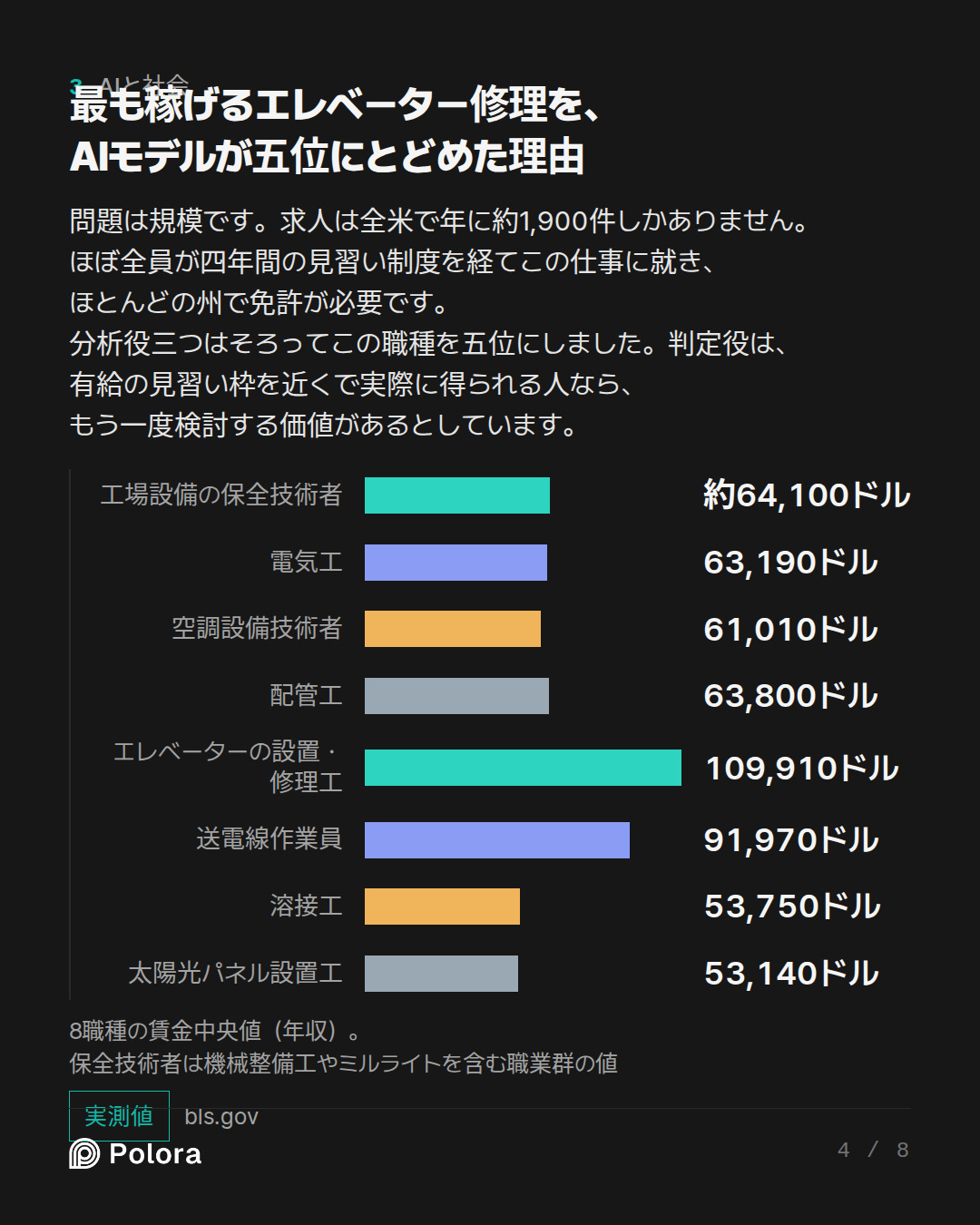
BLS reports a 2025 median wage of about $64,100, projected employment growth of 14% from 2025 to 2035, and roughly 51,900 openings annually across industrial machinery mechanics, maintenance workers, and millwrights. Industrial machinery mechanics a…
Physical Ergonomics and Career Longevity Specialist · claude-sonnet-5
Thanks, Luna — solid economic groundwork. I'm going to reorder this significantly, because the question explicitly asks whether the body can still do this work at 55 or 60, and that's my lane. A 35-to-45-year-old starting from zero doesn't get a 20-year runway to "age into" a supervisory job — they get maybe 10-15 productive field years before joints, backs, and shoulders start dictating the schedule instead of the employer. That changes the math more than Luna's ranking reflects.
My ranking, weighted for a body that has to last
1. Electrician
2. Industrial maintenance technician
3. HVAC technician
4. Solar installer
5. Elevator installer and repairer
6. Plumber or pipefitter
7. Welder
8. Power line worker
Why electrician moves to #1
Electrical work is unusually kind to an aging body *relative to its pay tier*. Most of the physically brutal tasks — heavy conduit bending, trenching, large gear installs — happen on new-construction crews. A 35-year-old entering the trade can spend early years there, then deliberately migrate into service, troubleshooting, controls, low-voltage, and residential/commercial repair, where the physical load i…
Automation and Structural Exposure Forecaster · gemini-3-7-flash
My Ranking: The Automation, Capital-Cycle, and Structural Exposure Lens
Both Luna (Economics) and the Ergonomics Specialist have laid out the wage baselines and physical wear-and-tear realities. However, looking at the 2026–2031 horizon through the lens of technological disruption, macro capital-expenditure cycles (data centers, IRA/CHIPS Act rollouts, grid buildouts), and entry lock-in risk, some critical fault lines emerge that reshape the ranking.
For an office worker entering at age 35–45, the real structural risk isn't just physical burnout—it is investing 3 to 5 years into an apprenticeship only to find your specific skill bracket commoditized by automation, modularized by prefabrication, or crushed by a capex pullback.
Here is the risk-adjusted ranking:
---
The 2026–2031 Structural Ranking
1. Industrial Maintenance Technician
2. HVAC Technician
3. Electrician
4. Plumber or Pipefitter
5. Elevator Installer and Repairer
6. Power Line Worker
7. Welder
8. Solar Installer
---
Detailed Analysis: Technological Moats and Structural Exposure
┌────────────────────────────────────────────────────────────────────────┐
│…
Researcher · gpt-5.6-luna
Verification of the claims
The central economic claims are mostly directionally sound, but several figures and conclusions need correction or qualification. The current BLS benchmark is 2025 data with projections through 2035, not 2026–2031 specifically.
Claims that are substantially supported
- Industrial maintenance is a strong candidate. BLS reports 2025 median pay of about $64,100, 14% projected growth from 2025–35, and approximately 51,900 annual openings for the combined occupation. Industrial machinery mechanics alone are projected at 17.8% growth and about 44,400 annual openings. (bls.gov)
- Electrician remains a broad-market option. The occupation had about 821,000 jobs in 2025, and BLS describes work across construction, manufacturing, government, and self-employment, with possible specialization in areas such as solar and controls. (bls.gov)
- HVAC has strong projected demand.…
The Arbiter · gpt-6-sol
Round record
The three analysts agree on the leading group—industrial maintenance, electrician, and HVAC—but not its order. The Economic ROI Analyst and Automation Forecaster put industrial maintenance first, emphasizing its potentially shorter paid entry route, broad maintenance demand, and opportunity to work on automated equipment. The Ergonomics Specialist puts electrician first, arguing that an experienced electrician may have more ways to move toward troubleshooting or service work as they age. That lighter-duty transition is a plausible career strategy, not a guaranteed outcome. The Automation Forecaster puts HVAC ahead of electrician because repair work may be less dependent on new construction; the Researcher found that comparative claim unproven. (bls.gov)
They also agree that elevator installer and repairer is strongest on pay but a less dependable first plan for this career changer: BLS reports a $109,910 median wage, yet approximately 1,900 annual openings nationally. The small market and demanding work warrant attention; assertions abo…
The Arbiter's Final Verdict · gpt-6-sol
My ranking for a 2026–2031 career change
I would put industrial maintenance technician first, assuming you can take an entry-level pay cut and have no major physical restriction. It offers a plausible route into *paid* on-the-job training rather than requiring you to finish a long apprenticeship before earning, and the work is not tied solely to new construction. That is a judgment about the best overall bet—not a promise that every entry-level maintenance job is accessible without experience.
| Rank | Trade | Why it lands here |
|---|---|---|
| 1 | Industrial maintenance technician | Strong demand: the combined BLS machinery-mechanics, maintenance-workers and millwrights category has about 51,900 annual openings and a $64,100 median wage. Paid on-the-job training can make the transition faster, though millwright routes can take longer. Troubleshooting equipment should remain valuable alongside automation; shifts, machinery hazards and physical repairs are the trade-offs. |
| 2 | Electrician | A large, varied occupation with routes into service, controls and maintenance—not just data-center or grid construction. A paid apprenticeship commonly takes…