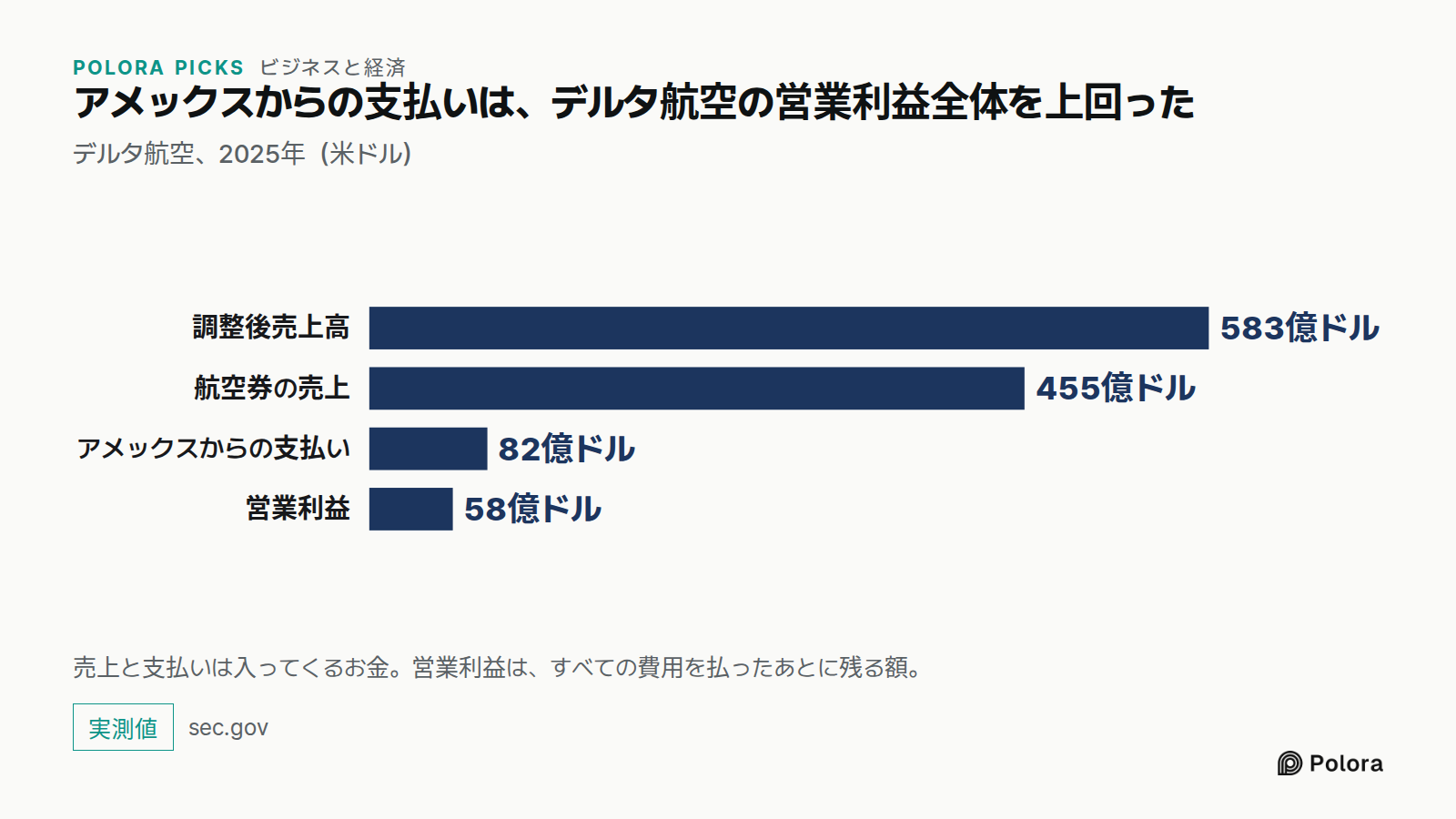
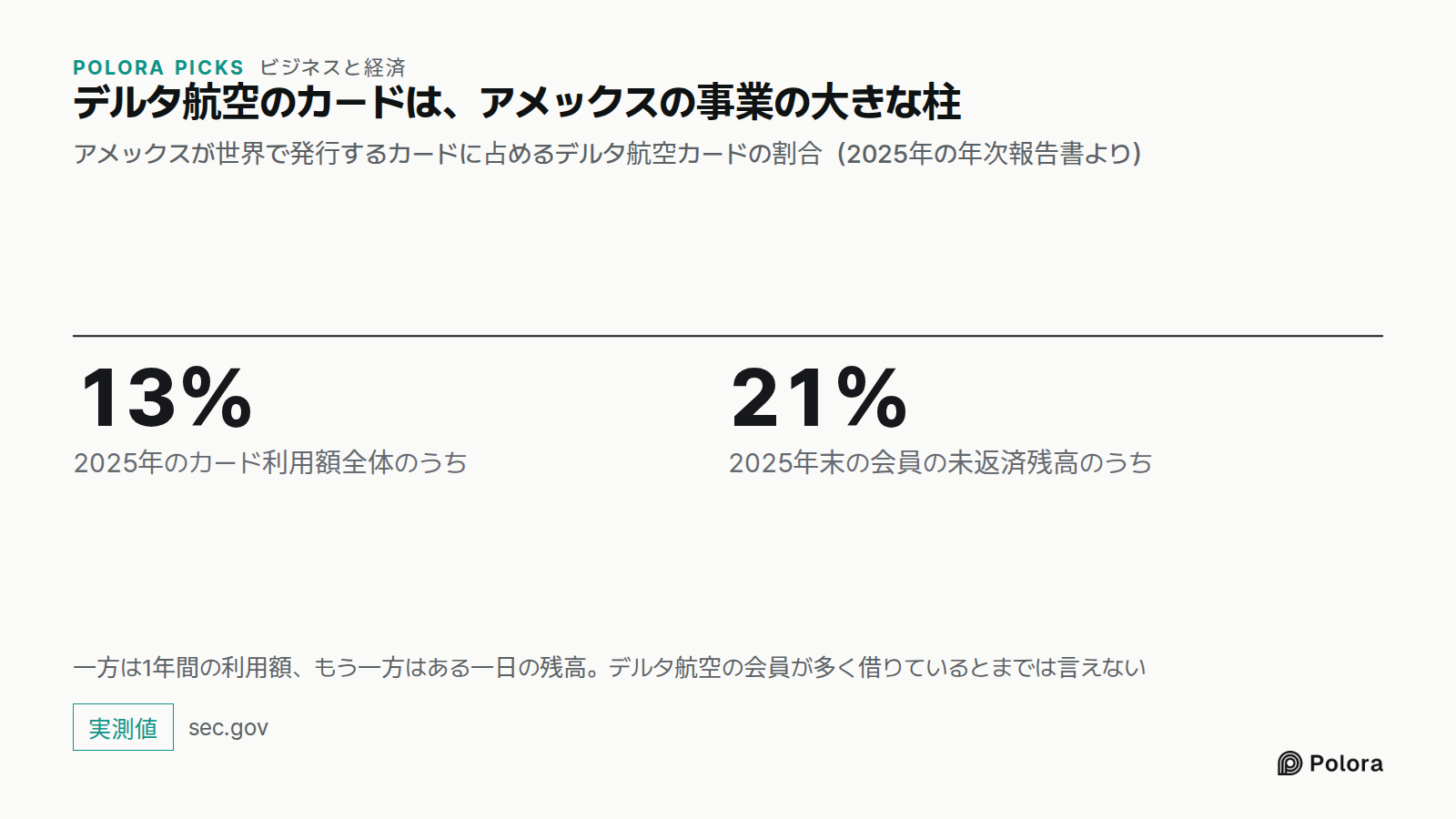
旅行ブログ「View from the Wing」を書くゲイリー・レフ氏は、これらの報告書をもとに試算しています。アメックスは2025年の自社カードの利用総額を約1.67兆ドルとしているので、その13%にあたる約2170億ドルがデルタ航空のカードで支払われた計算になります。82億ドルをこれで割ると、会員が1000ドル使うごとに、アメックスはデルタ航空に約38ドルを払ったことになります。これは四捨五入された割合をもとにした同氏の推計で、どちらの会社も公表している数字ではありません。レフ氏は、この規模の支払いを、店がカード決済のたびに払う手数料だけでまかなうのは難しいと見ています。そこで同氏が目を向けるのが、会員が返済を先送りした残高にかかる利息です。支払いのうち実際にどれだけを利息がまかなっているのかは、どちらの会社も明らかにしていません。
Do airlines make more money from credit cards than from flying?
Alpha · claude-sonnet-5
Does the headline question hold up? My read as Alpha
I checked the manuscript's core numbers against Delta's own December-quarter/full-year 2025 release and the Amex 10-K, and the arithmetic is sound.
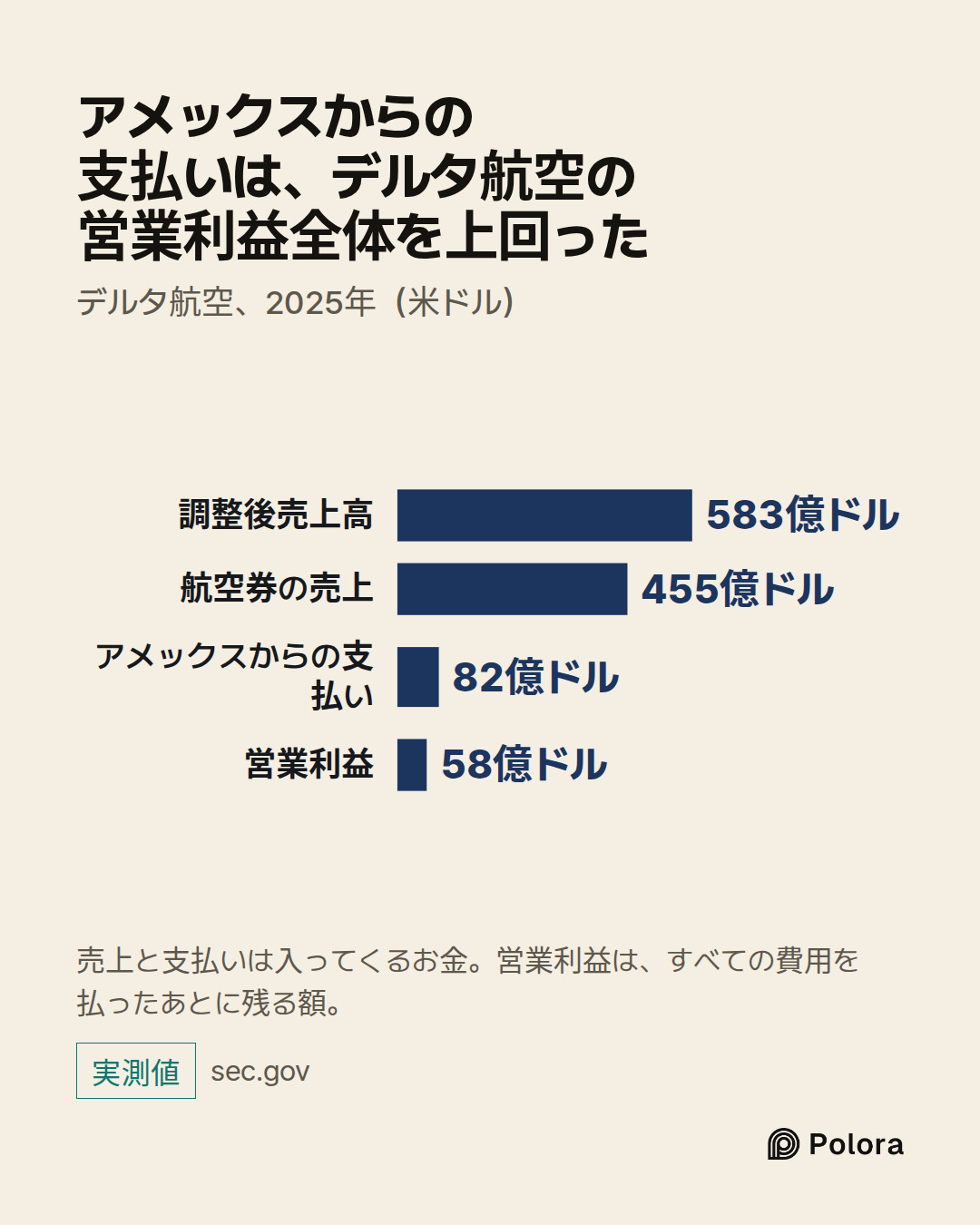
The central numbers check out. Delta's full-year 2025 non-GAAP operating revenue was $58.3 billion with operating income of $5.8 billion, and separately American Express remuneration in 2025 grew 11 percent to $8.2 billion, driven by double-digit growth in co-brand spend in each quarter of the year. So the manuscript's $8.2B > $5.8B comparison is real and traceable to Delta's own press release, not a blogger's estimate. The 10-K itself frames this as a self-reported highlight, not something critics dug out: Delta's filing text states "remuneration from American Express totaled $8.2 billion, which we expect to grow to $10 billion over the next few" years.
Where I'd push back on the manuscript's framing — the answer is still clearly "no," and the piece undersells how clearly "no" it is. Note the manuscript uses *adjusted* ($58.3B) revenue as the denominator for the 14% figure, but Delta's GAAP operating revenue was $63.4 billion, which the researcher's brief itself flags —…
Beta · gpt-6-sol
My verdict: the manuscript’s answer, “No,” stands—but two supporting claims need more than a qualification. Delta’s 2025 figures show that payments from American Express exceeded *Delta’s total operating profit*, not that credit cards earned more profit than flying. Delta does not disclose a separate profit figure for the partnership. Alpha is right to stress the revenue-versus-profit distinction, but the comparison is still useful if it is presented as a measure of scale, not a division of profit. (sec.gov)
Here is what I found in the filings:
| Manuscript claim | Check and necessary condition |
|---|---|
| $45.5 billion of tickets; roughly 78% of $58.3 billion adjusted revenue. | Supported: main-cabin ticket revenue was $23.391 billion and premium-ticket revenue $22.097 billion, totaling $45.488 billion. Delta’s adjusted operating revenue was $58.287 billion after excluding $5.077 billion of third-party refinery sales. The ratio is about 78%. These ticket lines do *not* include the separately reported $4.237 billion of loyalty travel awards. ([sec.gov](https://www.sec.gov/Ar…
Gamma · gemini-3.1-pro
My read as Gamma: Closing the loop on the manuscript's final claims and the economic reality.
Alpha and Beta have thoroughly audited the SEC filings and the core revenue-versus-profit framing. I will focus on the remaining unverified claims—the blogger's math and the program rules—and then address the underlying economic premise the manuscript rests on.
Here is what I found on the outstanding checks:
The View from the Wing calculation
*Claim: Gary Leff estimates the bank paid Delta roughly $38 for every $1,000 charged on Delta cards, based on $1,670 billion in total Amex billed business and a 13 percent Delta share.*
* Supported: The arithmetic is sound and the attribution is correct. If Amex's total billed business is $1,670 billion, 13 percent of that yields an implied Delta card spend of $217.1 billion. Dividing Delta’s $8.2 billion remuneration by $217.1 billion equals approximately $0.0377 per dollar spent, or $37.77 per $1,000. The manuscript correctly identifies this as a derived estimate based on rounded percentages rather than a published corporate figure. (Source: https://viewfromthewing.com/amex-pays-delta-3-8-cents-per-dollar-charged-why-banks-pay-more…
Researcher · gemini-3-7-flash
Here is the verification of the claims in the manuscript, tested against official corporate filings, primary disclosures, and published terms:
---
1. Verification of Manuscript Claims
| Claim / Section | Verification Status | Source & Nuance |
| :--- | :--- | :--- |
| Delta 2025 Ticket Revenue: Sold $45.5B in tickets (economy + premium), ~78% of $58.3B adjusted revenue (excluding refinery sales). | Supported | Source: Delta Air Lines 2025 Form 10-K & Earnings Release.<br>• Main cabin ($23,391M) + Premium ($22,097M) = $45,488M ($45.5B).<br>• Adjusted revenue of $58,287M excludes $5,077M in third-party refinery sales.<br>• Arithmetic holds: $45.488B / $58.287B = 78.0%. |
| Amex Remuneration Ratios: Amex paid $8.2B (+11% YoY), ~14% of adjusted revenue, and ~1.4× the $5.8B operating profit. | Supported (with context) | Source: Delta 2025 10-K / Earnings Release.<br>• On adjusted revenue ($58…
The Arbiter · gpt-6-sol
The round has converged on a distinction the final answer must preserve: Delta receives substantial payments from American Express, but the filings do not show that credit cards earn more *profit* than flying. The $8.2 billion Amex figure is remuneration received in 2025; the $5.8 billion figure is Delta’s operating income after expenses. Comparing them shows scale, not which activity is more profitable. Alpha emphasized that thin airline margins make such a comparison less surprising; Beta emphasized that the partnership’s own profit is not separately disclosed. (sec.gov)
What the participants established for the manuscript:
- Tickets and the headline arithmetic: Alpha, Beta, and the Researcher agreed that Delta reported $45.488 billion in main-cabin and premium ticket revenue—about 78% of its $58.287 billion *adjusted* operating revenue. They also agreed that $8.2 billion in Amex remuneration was up 11%, amounted to about 14% of adjusted revenue, and was about 1.4 times operating income. Alpha and Beta noted the necessary second denominator: it was about 13% of GAAP revenue, not…
The Arbiter's Final Verdict · gpt-6-sol
No—not if “make more money” means revenue, and we can’t establish it if it means profit.
Delta is a useful example. In 2025, it reported $45.5 billion in ticket revenue, compared with $8.2 billion in payments from American Express. Those payments were substantial—about 1.4 times Delta’s $5.8 billion operating profit—but that compares a payment received with profit *after expenses*. It does not show that cards were more profitable than flying. Delta does not separately disclose the profit from its Amex partnership. (Delta 2025 10-K; full-year results)
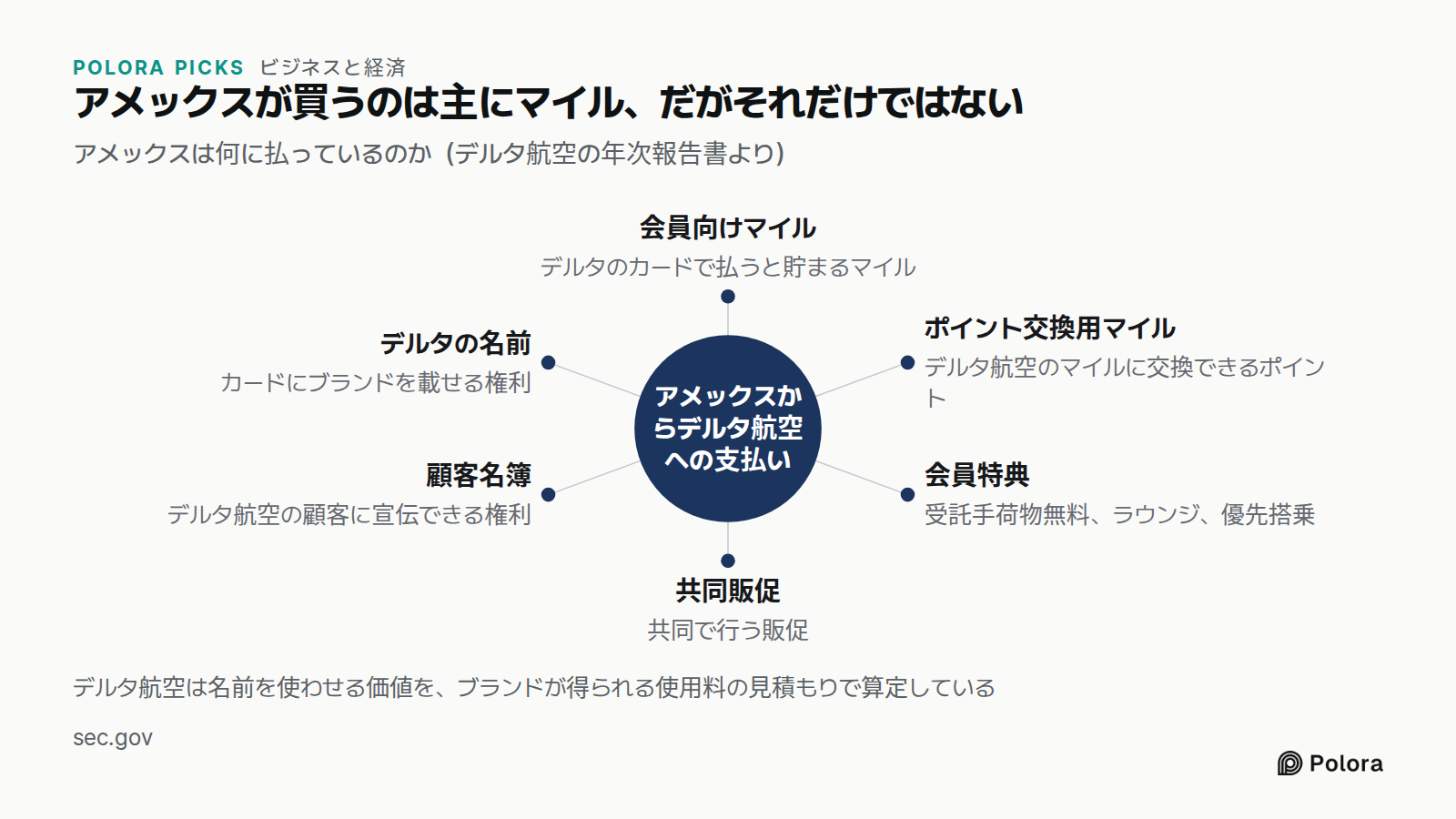
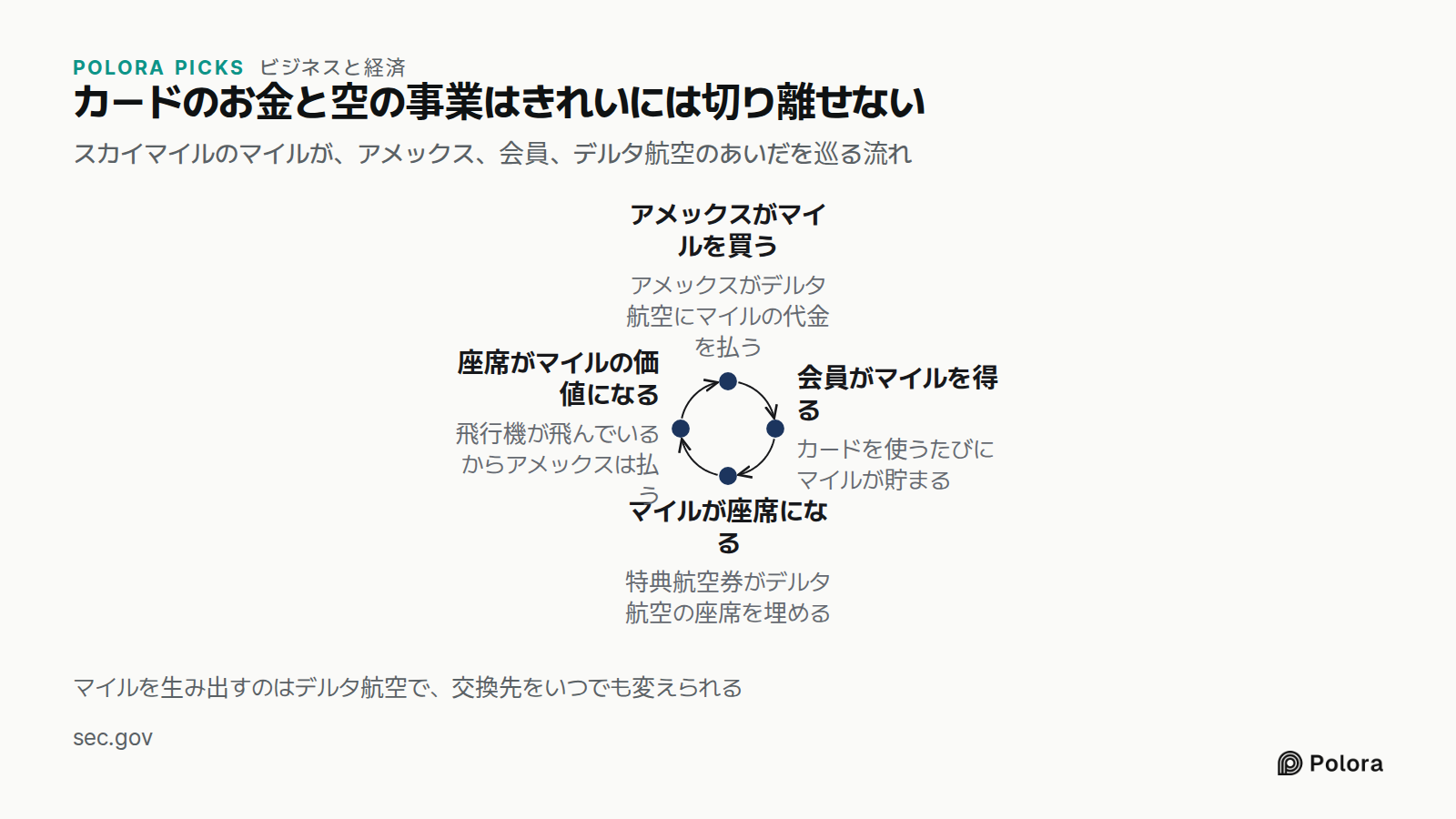
The bank pays for miles as well as marketing rights and cardholder benefits. Some payments for miles become airline revenue only when those miles are redeemed for flights, so the card business and flying are intertwined. Other airlines disclose their partnerships differently, making a simple industry-wide ranking unreliable. The sound conclusion is that credit-card partnerships are hugely important to some airlines—not that airline…