Do car dealerships actually make money selling new cars?
Alpha · claude-sonnet-5
Opening assessment: the manuscript's core numbers check out, with small rounding quirks worth flagging.
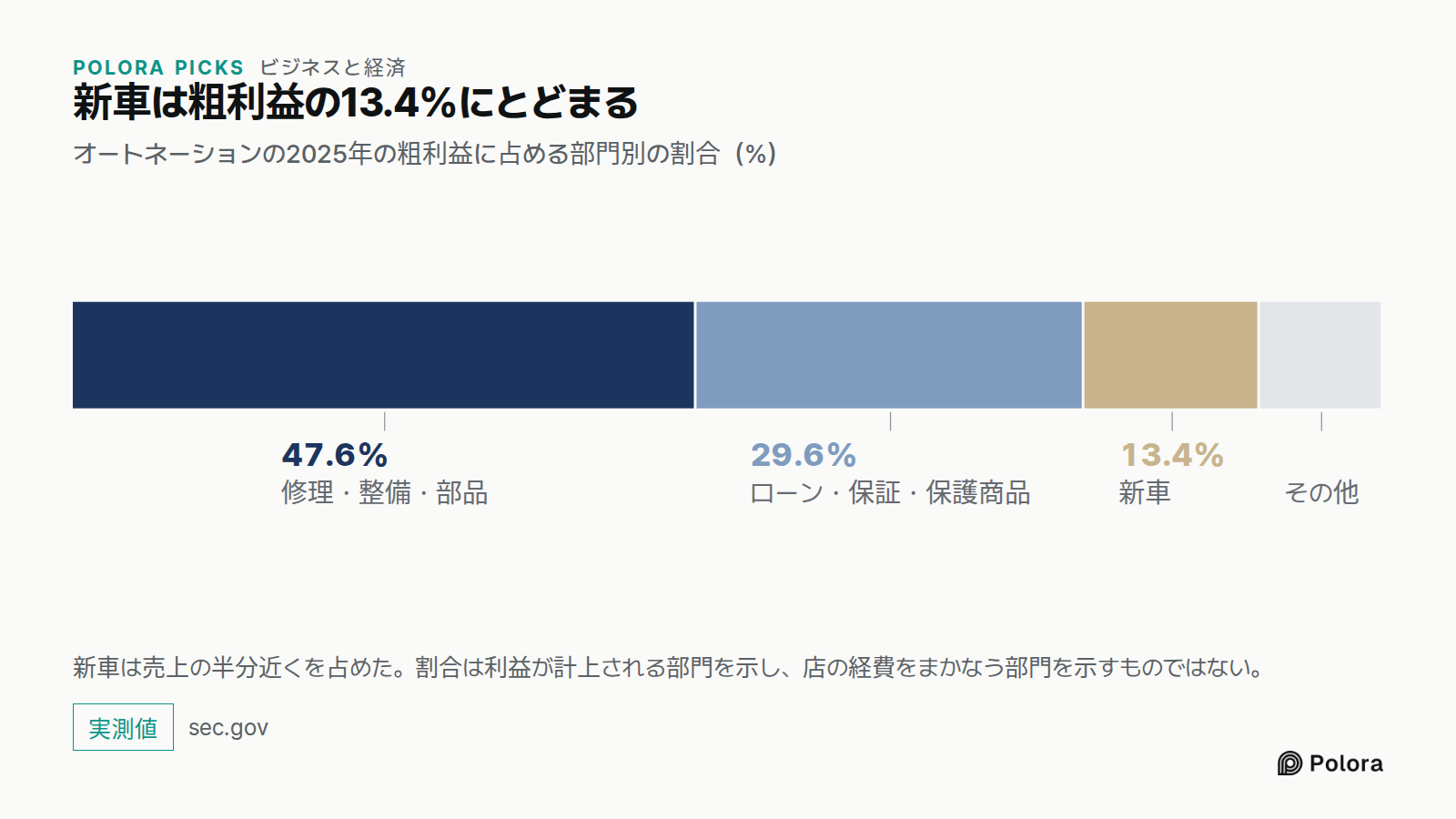
I verified the central AutoNation claim directly against the 10-K text. The filing states plainly: "For the year ended December 31, 2025, new vehicle sales accounted for 49% of our total revenue and 13% of our total gross profit. Used vehicle sales accounted for 28% of our total revenue and 9% of our total gross profit. Our parts and service operations, while comprising 17% of our total revenue, contributed 48% of our total gross profit. Our finance and insurance sales, while comprising 5% of our total revenue, contributed 30% of our total gross profit." That matches the manuscript's 13.4%/47.6%/29.6% breakdown almost exactly (the 10-K's rounded headline percentages are 13/48/30, the annual report table gives the more precise 13.4/47.6/29.5–29.6 depending on which year-over-year table you read). So the "almost half the revenue, an eighth of the profit" framing is sound and traceable to https://www.sec.gov/Archives/edgar/data/350698/000162828026007800/an-20251231.htm.
I also confirmed the 2025 gross-profit decline direction: "Our total gross profit increased 3% during 2025,…
Beta · gpt-6-sol
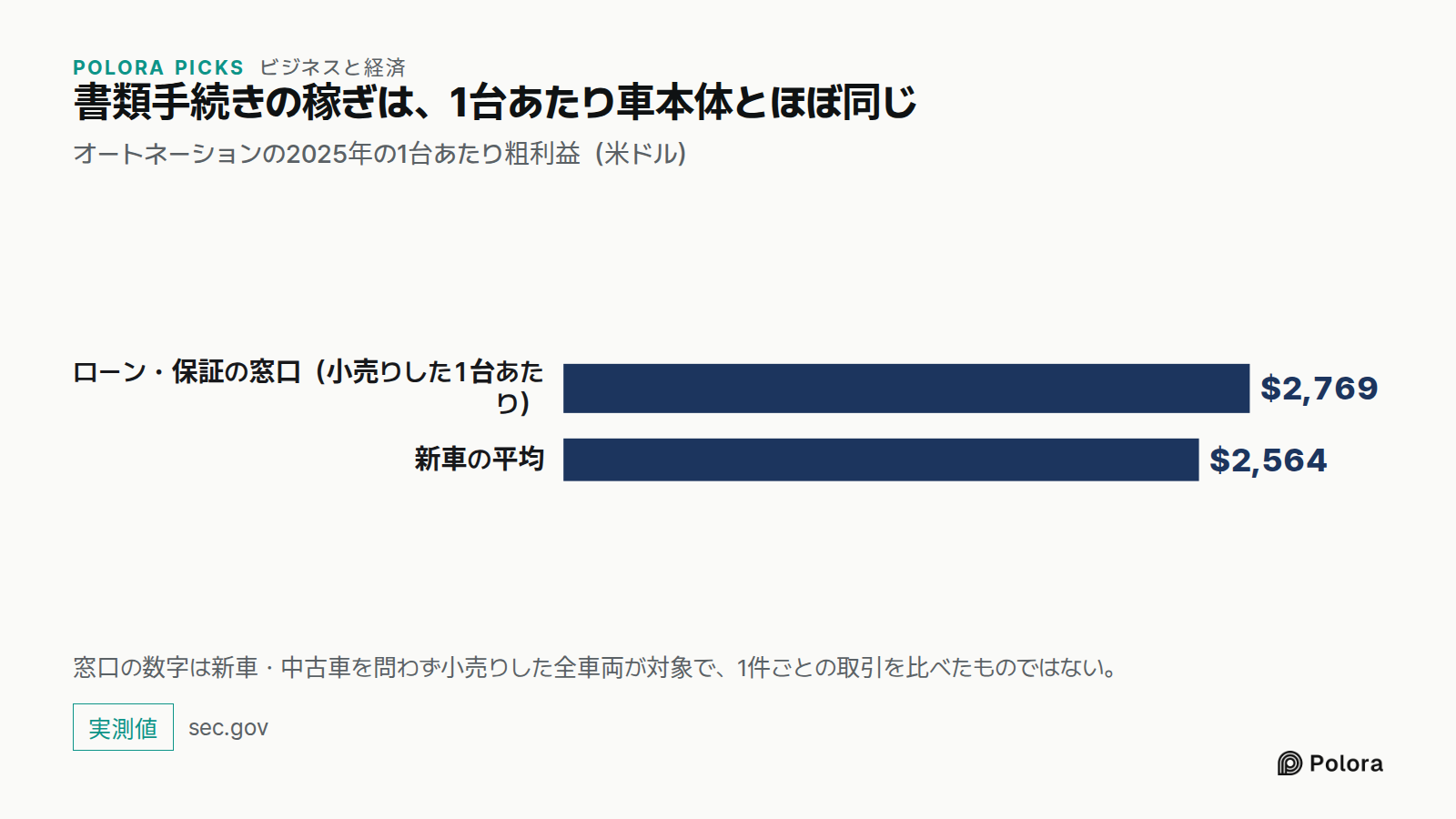
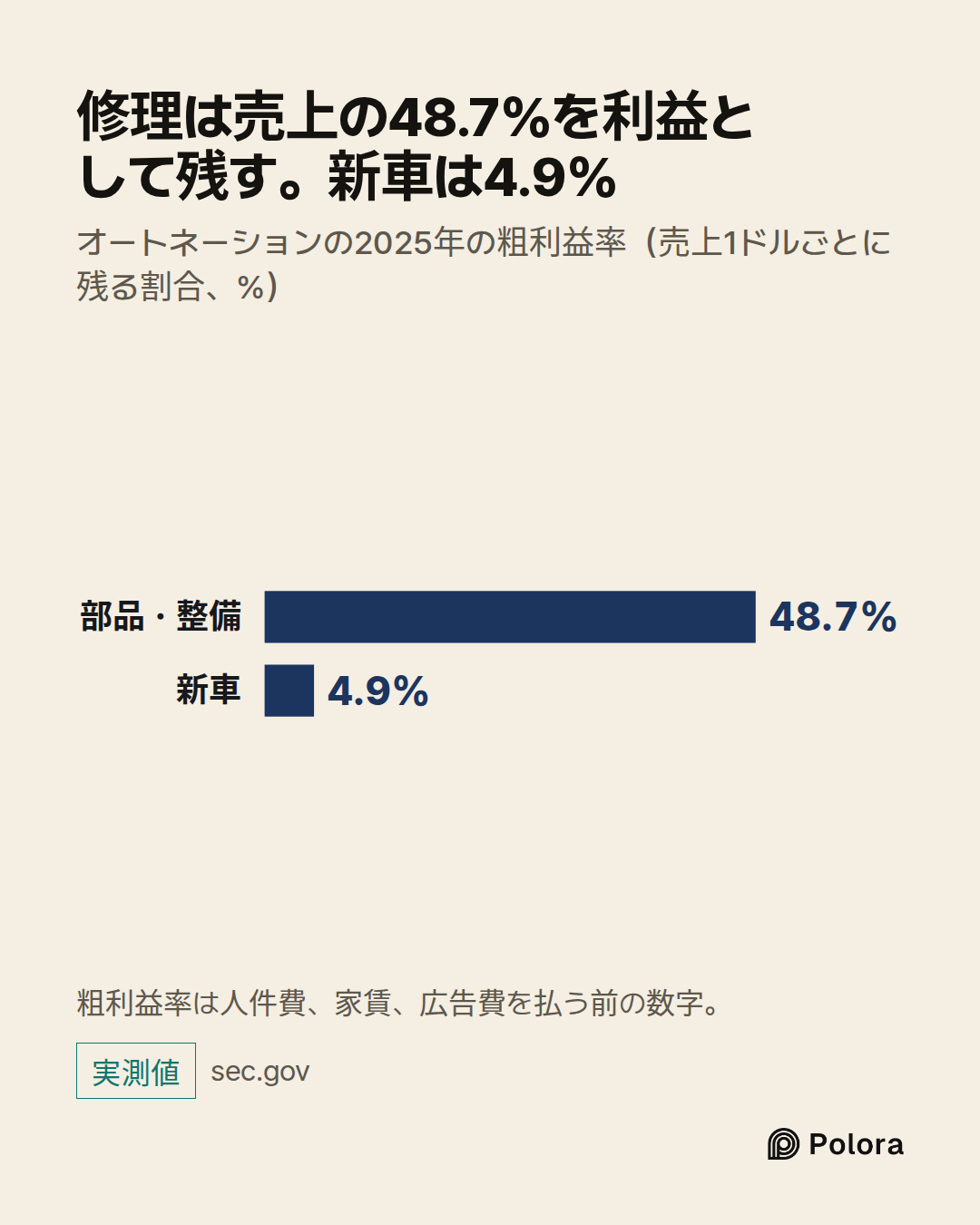
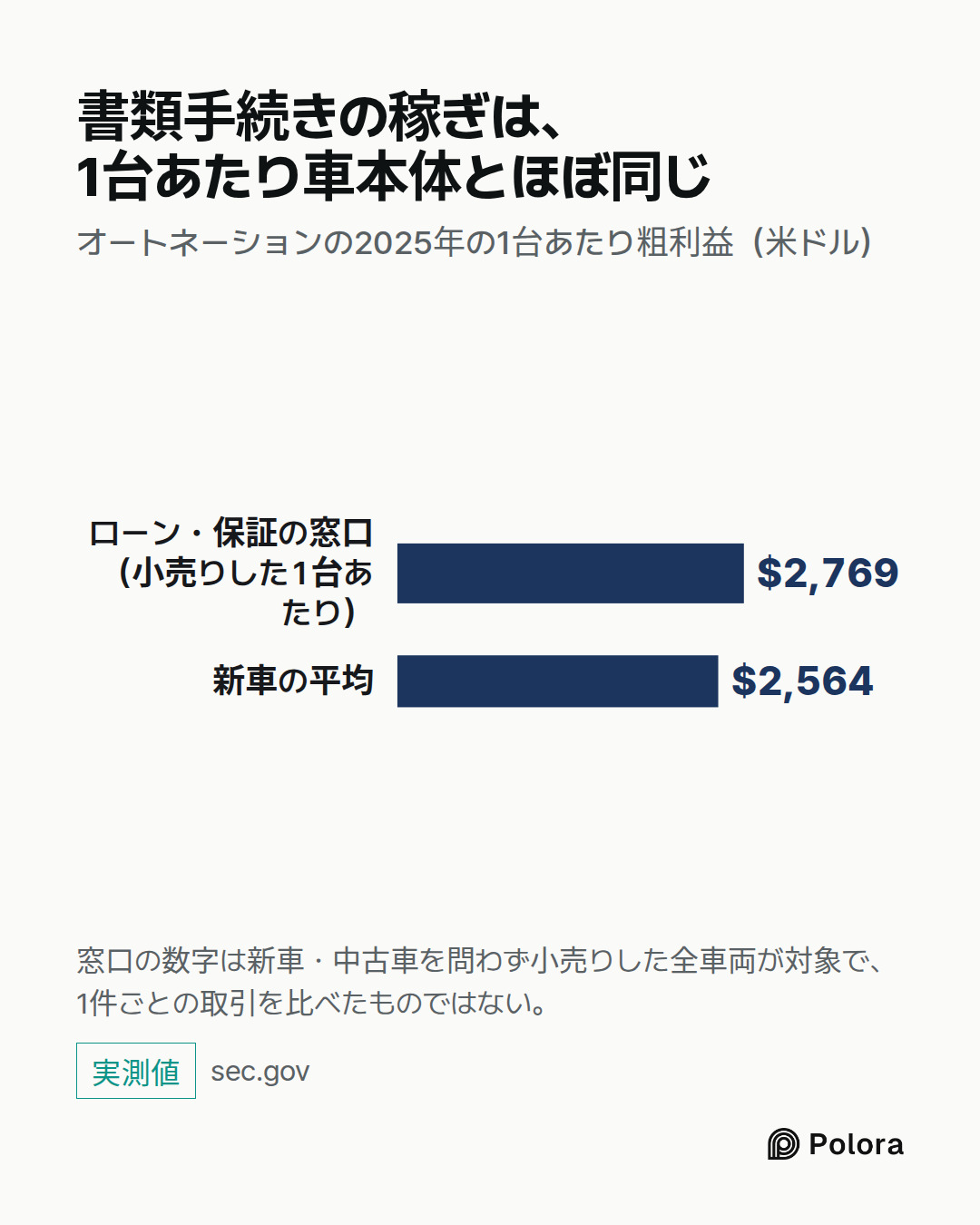
Yes. Dealers generally make gross profit selling new cars; the mistake is to confuse a small share of the dealership’s *total* profit with a loss on each sale. AutoNation reported $2,564 in new-vehicle gross profit per vehicle in 2025, before dealership-wide expenses. New vehicles supplied 13.4% of its gross profit, compared with 9.3% from used vehicles, 29.6% from finance and insurance (F&I), and 47.6% from parts and service. Its 245 *stores* held 323 new-vehicle franchises, so “about 245 dealerships” is a reasonable shorthand if “stores” is meant. (sec.gov)
Address: https://www.sec.gov/Archives/edgar/data/350698/000162828026007800/an-20251231.htm
I would make three corrections to the manuscript’s interpretation:
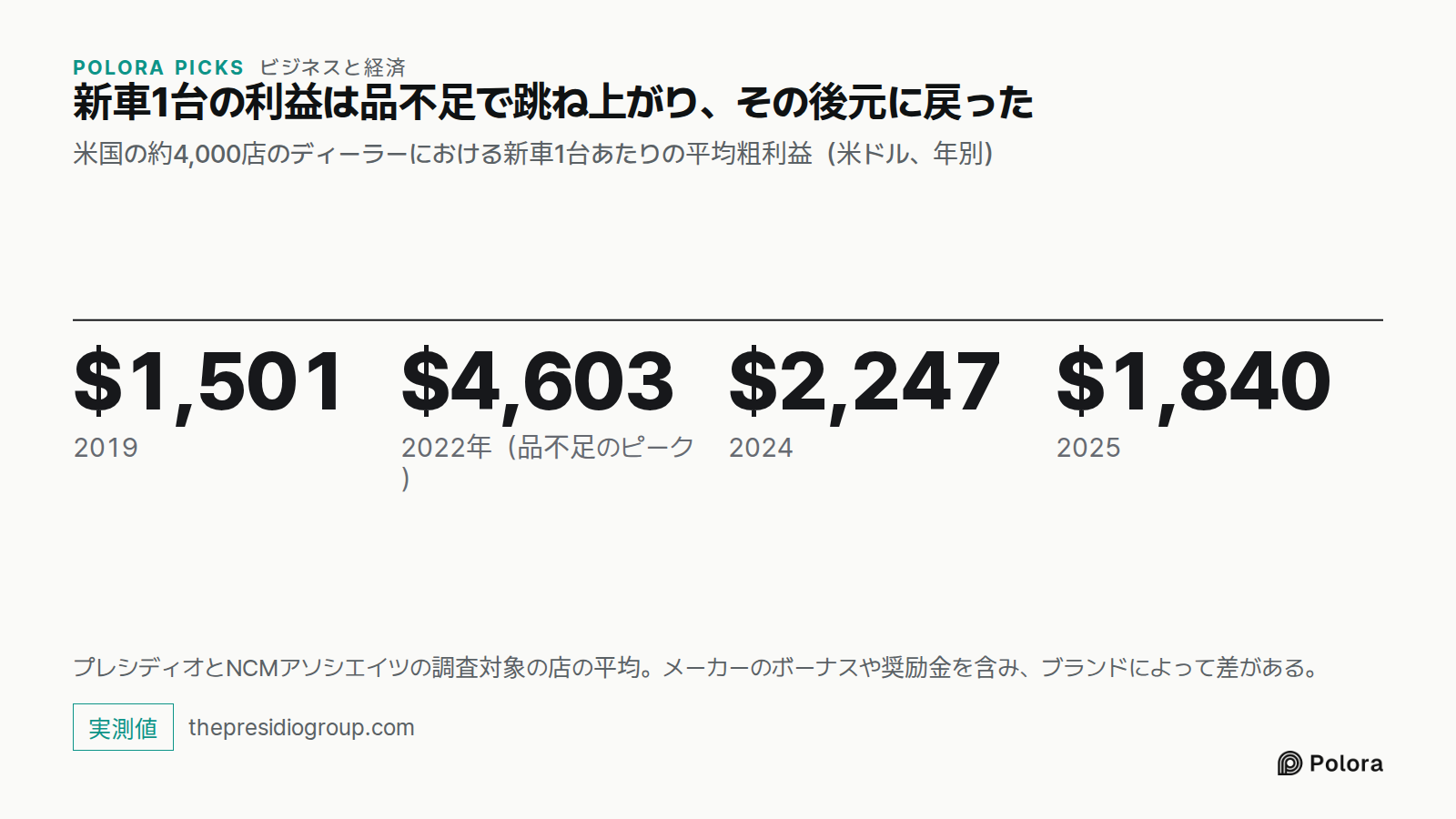
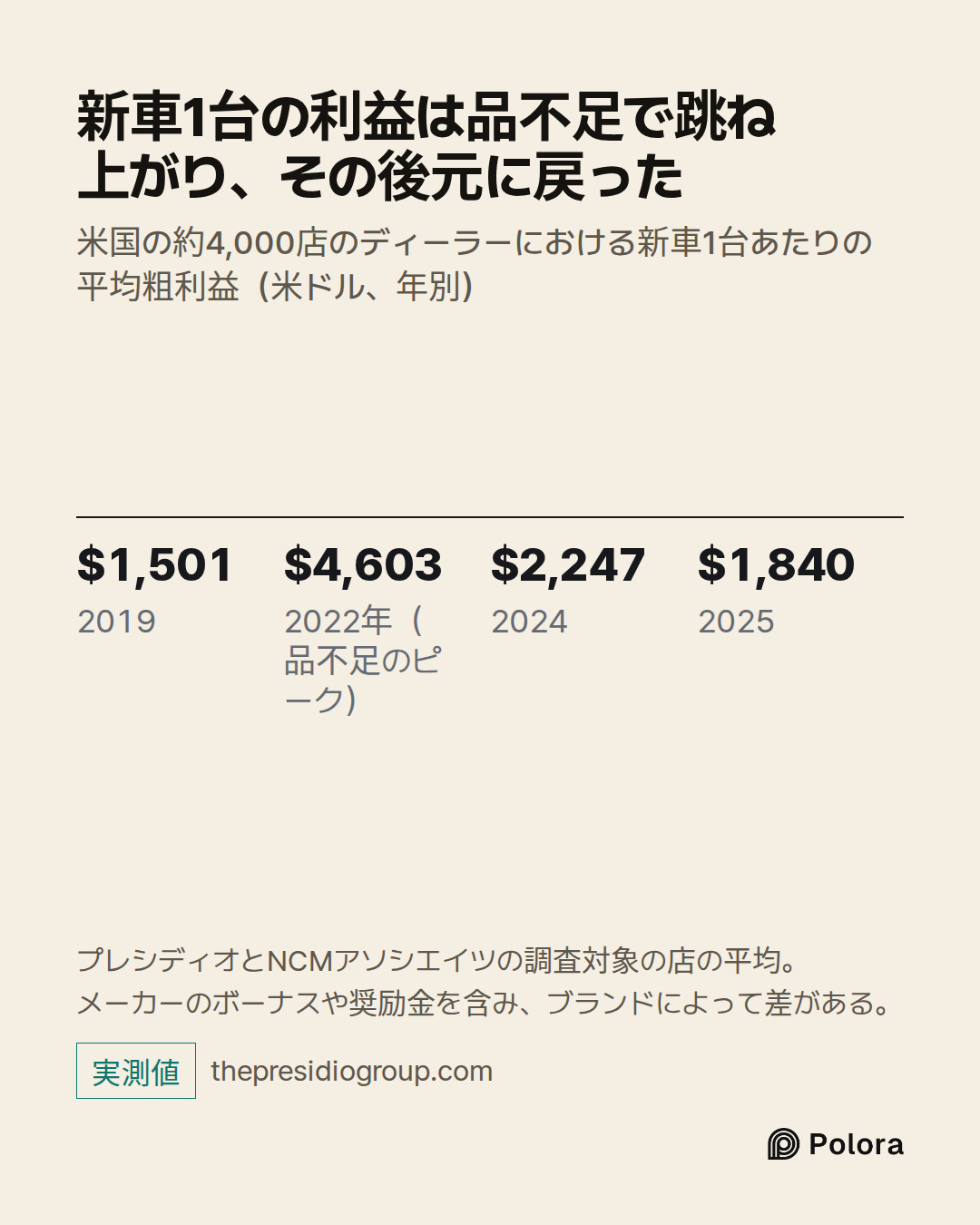
- “A little, and less each year” overstates the trend. AutoNation’s new-vehicle gross profit fell in 2025, but “less each year” is not established. Presidio–NCM’s chart shows $1,501 per new vehicle in 2019, $4,603 in 2022, $2,247 in 2024 and $1,840 for the second quarter of 2026. It also shows $1,840 for *full-year 2025*: those identical figures refer to different periods.…
Gamma · gemini-3.1-pro
Both Alpha and Beta have thoroughly dismantled the manuscript's overreliance on AutoNation's specific numbers to represent the entire industry, and Beta correctly caught the denominator mismatch in the F&I comparison. I will focus on the remaining unverified claims and the broader economic reality of the dealership model.
The Shortage Years and Sticker Price Claim
The manuscript claims that during the chip shortage, "buyers paid close to sticker or above it." This is accurate and widely documented by automotive analysts. In 2022, Kelley Blue Book and Edmunds consistently reported that the Average Transaction Price (ATP) for new vehicles was frequently hundreds or even thousands of dollars above the Manufacturer's Suggested Retail Price (MSRP). This was a historical anomaly driven by supply chain constraints, supporting the manuscript's assertion that the 2021-2023 margins were the exception, not the rule.
Franchise Laws and Direct Sales
The manuscript's summary of franchise laws ("Every state has laws limiting or banning carmakers from selling directly to buyers") is functionally correct but lacks nuance. While the foundation of these laws dates back to the 1930s to prot…
Researcher · gemini-3-7-flash
Verification of Manuscript Claims Against Current Sources
1. AutoNation Financial Breakdown (2025)
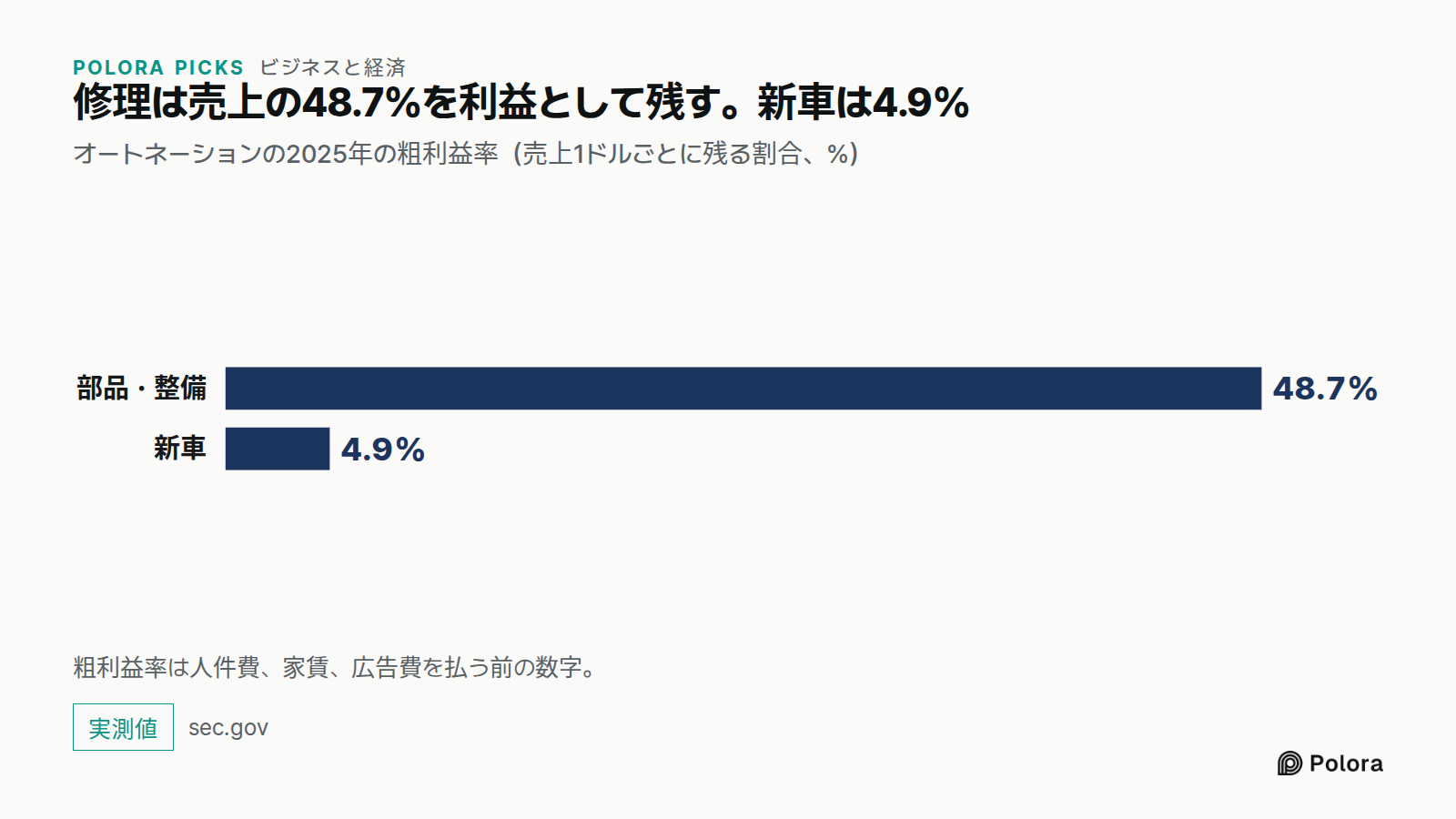
* Claims: $13.5B new-car revenue out of $27.6B total; gross profit shares: new 13.4%, used 9.3%, F&I 29.6%, parts & service 47.6%; new GP per vehicle $2,564 on $52,075 ASP (4.9% margin); F&I total $1,464.4M ($2,769/retail vehicle); parts/service margin 48.7%; new-car gross profit fell 14% while service and F&I grew; store count ~245 (with 323 franchises).
* Status: Verified.
* Source: AutoNation Form 10-K (FY 2025).
* Nuance/Correction:
* As Beta pointed out, the denominator for the F&I comparison is per retail vehicle (new and used combined) ($2,769), whereas $2,564 is per new vehicle. Comparing them side-by-side to show that the F&I desk makes more per sale requires explicitly noting this blended base.
* In the broader public peer group (e.g., Lithia Motors and Penske Automotive Group), new and used vehicle sales similarly generate ~80–85% of total retail revenue but only ~30–35% of total gross profit, while service/parts and F&I produce ~65–70%.
---
####…
The Arbiter · gpt-6-sol
The round has converged on the central distinction: a dealership can make money on a new car without the new-car department being its largest source of gross profit. The remaining work is to keep that distinction intact in the manuscript, rather than turn it into a claim that new cars are generally sold at a loss.
- AutoNation: Alpha verified the filing’s broad revenue and profit mix; Beta and the Researcher confirmed the detailed figures. The 2025 filing reports $13.5 billion in new-vehicle revenue—48.9% of total revenue—but 13.4% of gross profit. Used vehicles supplied 9.3% of gross profit, parts and service 47.6%, and F&I 29.6%. New vehicles earned $2,564 in gross profit per new vehicle, at a 4.9% margin, before shared expenses. The filing identifies 245 stores with 323 new-vehicle franchises, making “about 245 dealerships” shorthand for stores, not franchises. AutoNation’s new-vehicle gross profit fell 14% in 2025 while parts/service and F&I grew; that supports a 2025 decline, not the headline’s “less each year.” (sec.gov)
Address: https://www.sec.gov/Archives/edgar/dat…
The Arbiter's Final Verdict · gpt-6-sol
Yes. Selling a new car generally produces *gross profit* for a dealership, but new cars often account for a much smaller share of its gross profit than their share of sales revenue suggests.
AutoNation’s 2025 filing is a concrete example: new vehicles brought in 48.9% of revenue but 13.4% of gross profit. It reported $2,564 gross profit per new vehicle, a 4.9% margin. Parts and service contributed 47.6% of total gross profit, and finance and insurance contributed 29.6%.
That does not mean the $2,564 was net profit after salaries, rent and advertising, or that dealerships routinely sell new cars at a loss. Nor can the new-car sale be cleanly separated from the financing, trade-in and future service business it may bring. The defensible answer is: dealers do make money selling new cars, but much of the dealership’s gross profit is recorded in the businesses alongside and after the sale.