Why are mortgage rates above 7% when the Fed's rate is under 4%?
Alpha · deepseek-v4-pro
The short answer: the Fed's rate and a mortgage rate are prices for two very different loans.
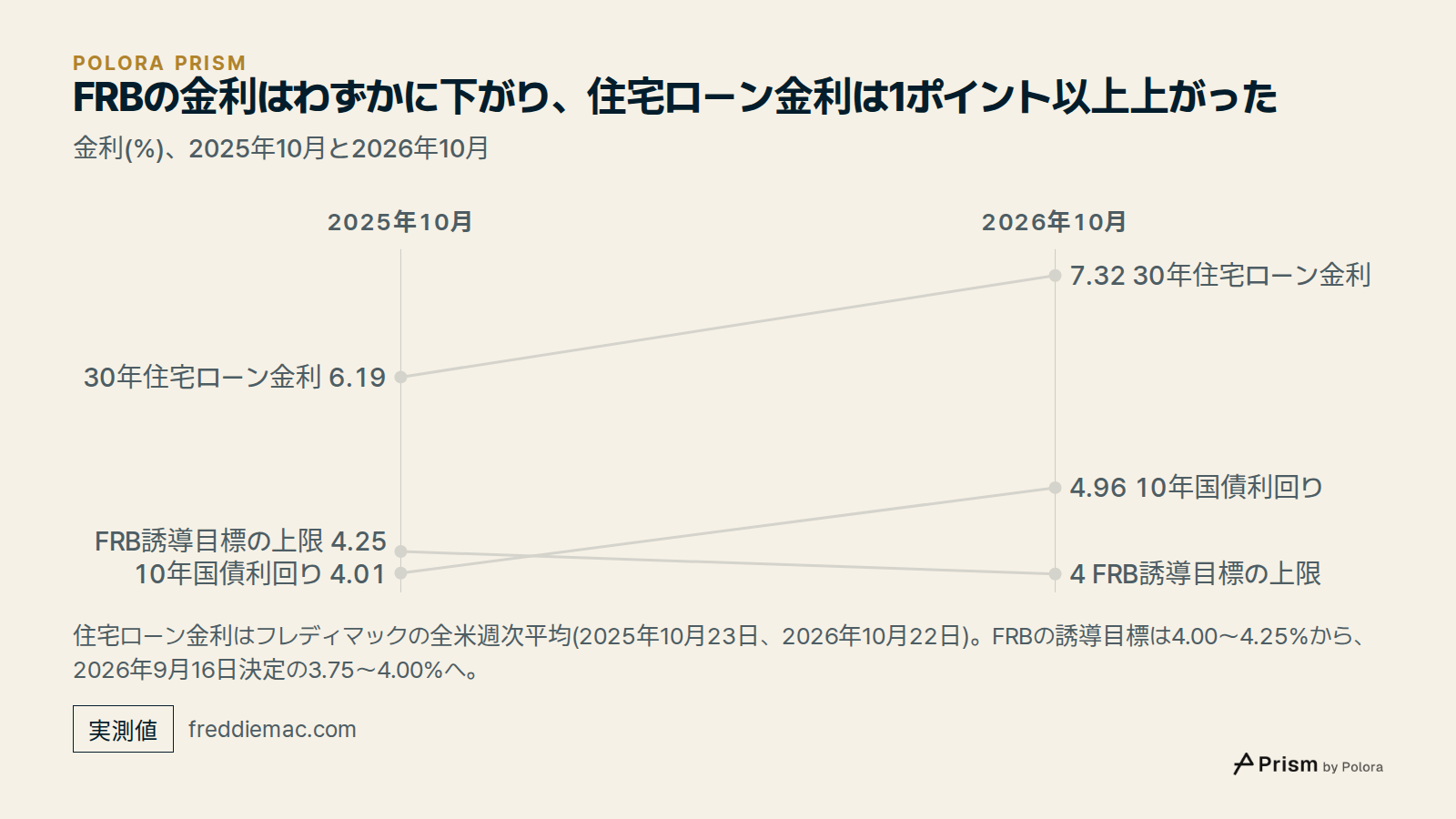
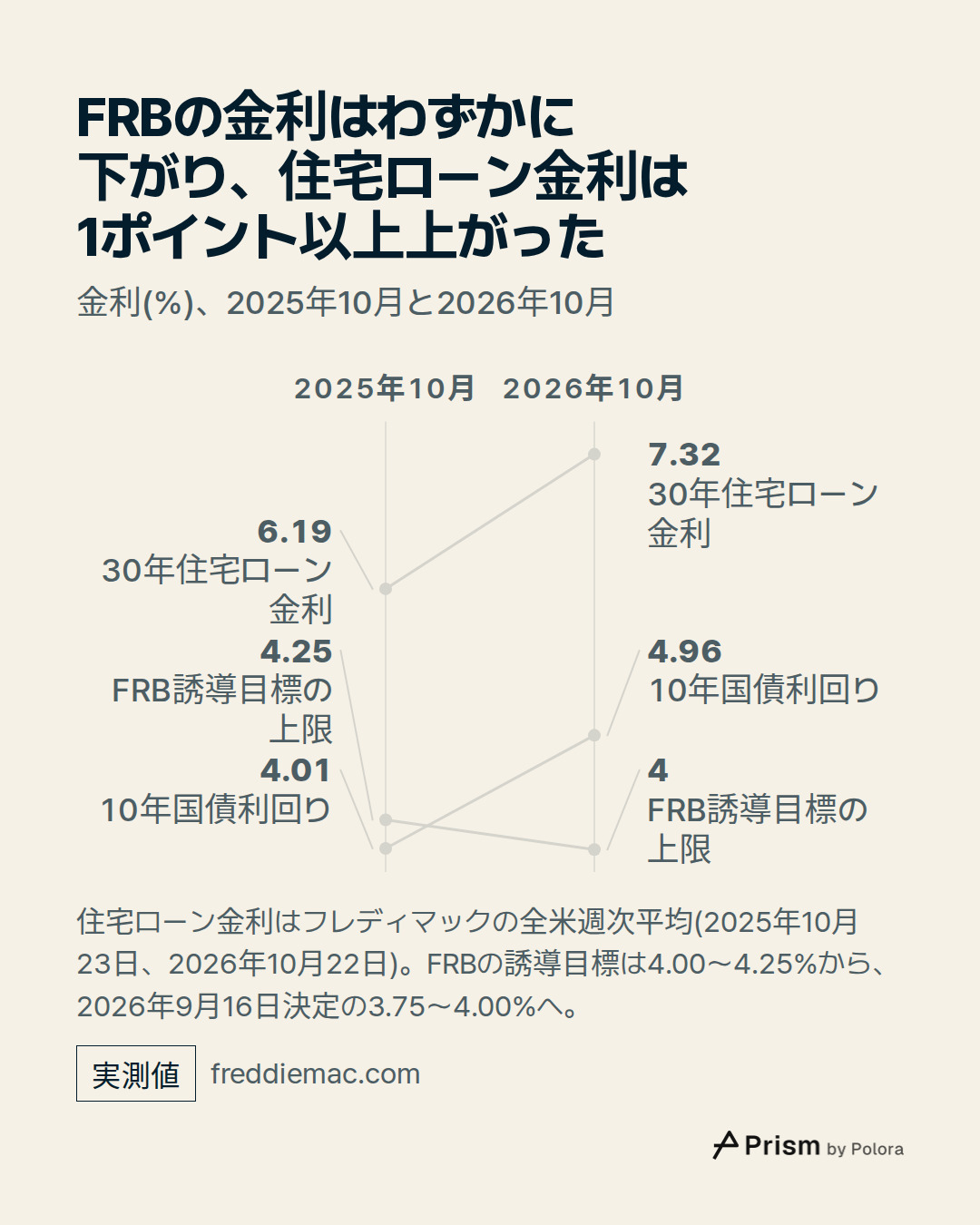
The Federal Reserve's target range — 3.75% to 4.00% since September 16, 2026 — is for overnight borrowing between banks. A 30-year mortgage is a decades-long loan, and it is not priced off that overnight rate. Most U.S. mortgages are packaged into mortgage-backed securities and sold to investors, and those investors compare a mortgage bond with the safest long-term bond of similar length: the 10-year Treasury.
Why the 10-year instead of 30 years? Because a 30-year mortgage rarely lasts 30 years. Borrowers sell the house, refinance, or pay down principal early, so investors treat a mortgage bond as more like a loan of about ten years.
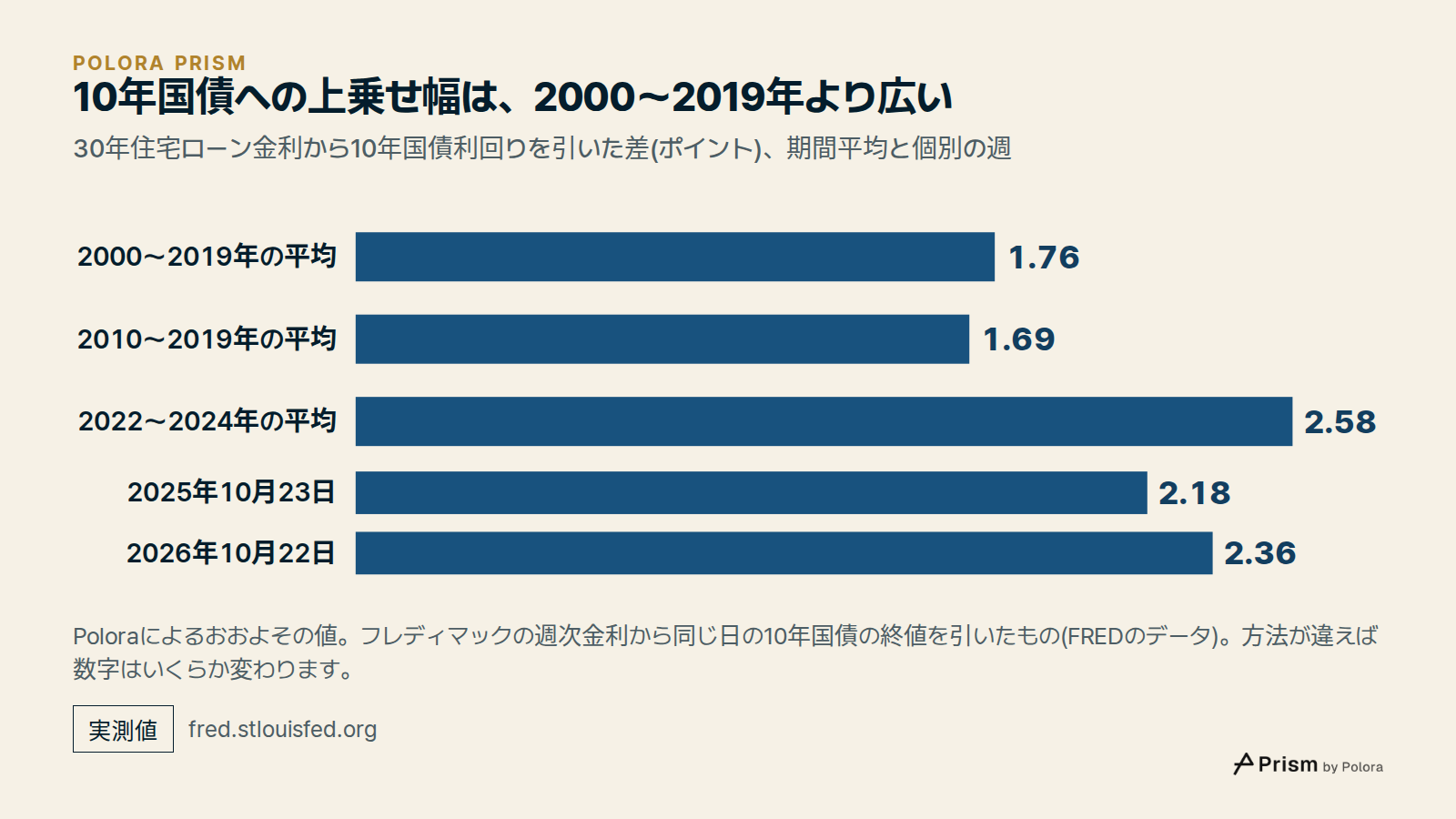
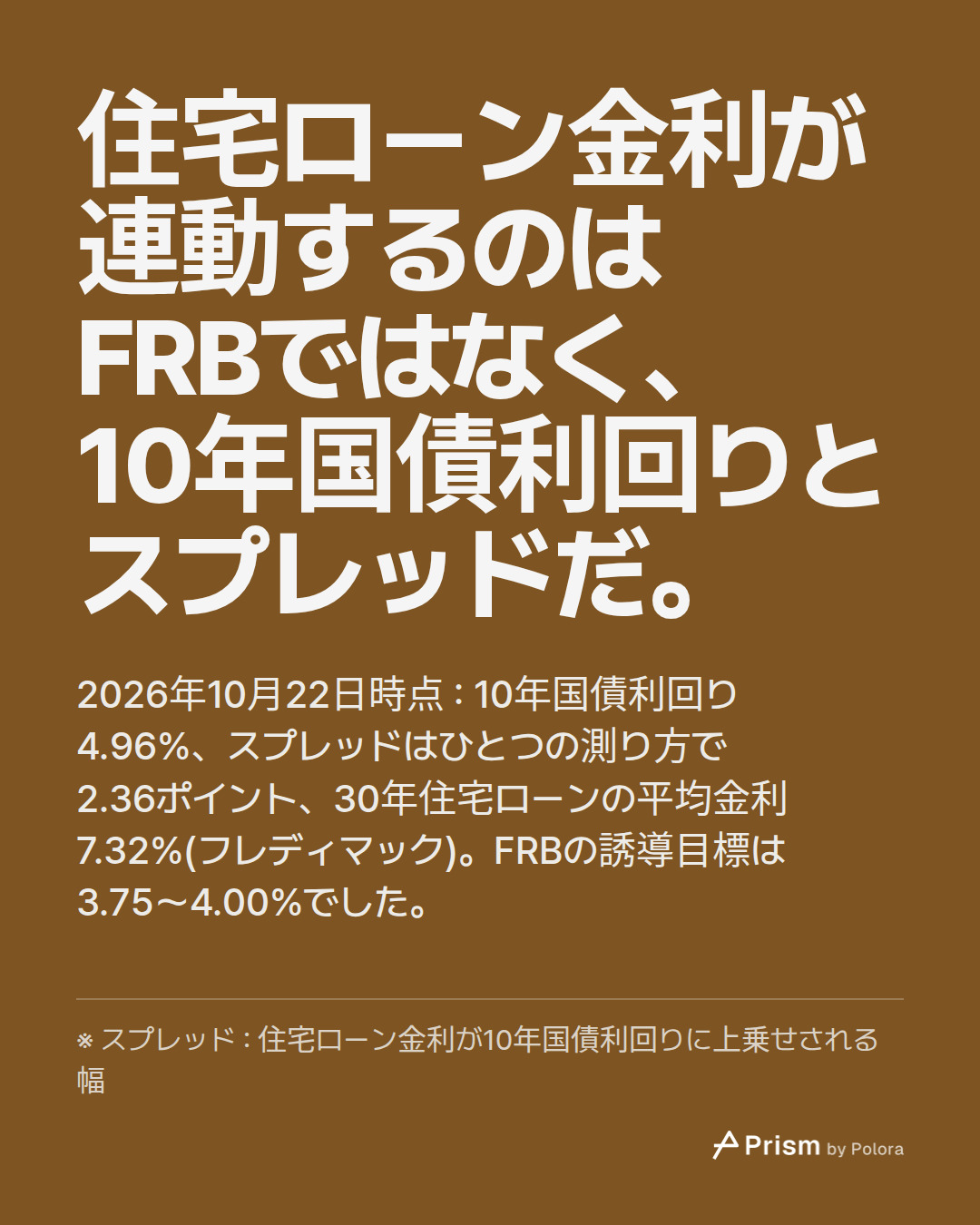
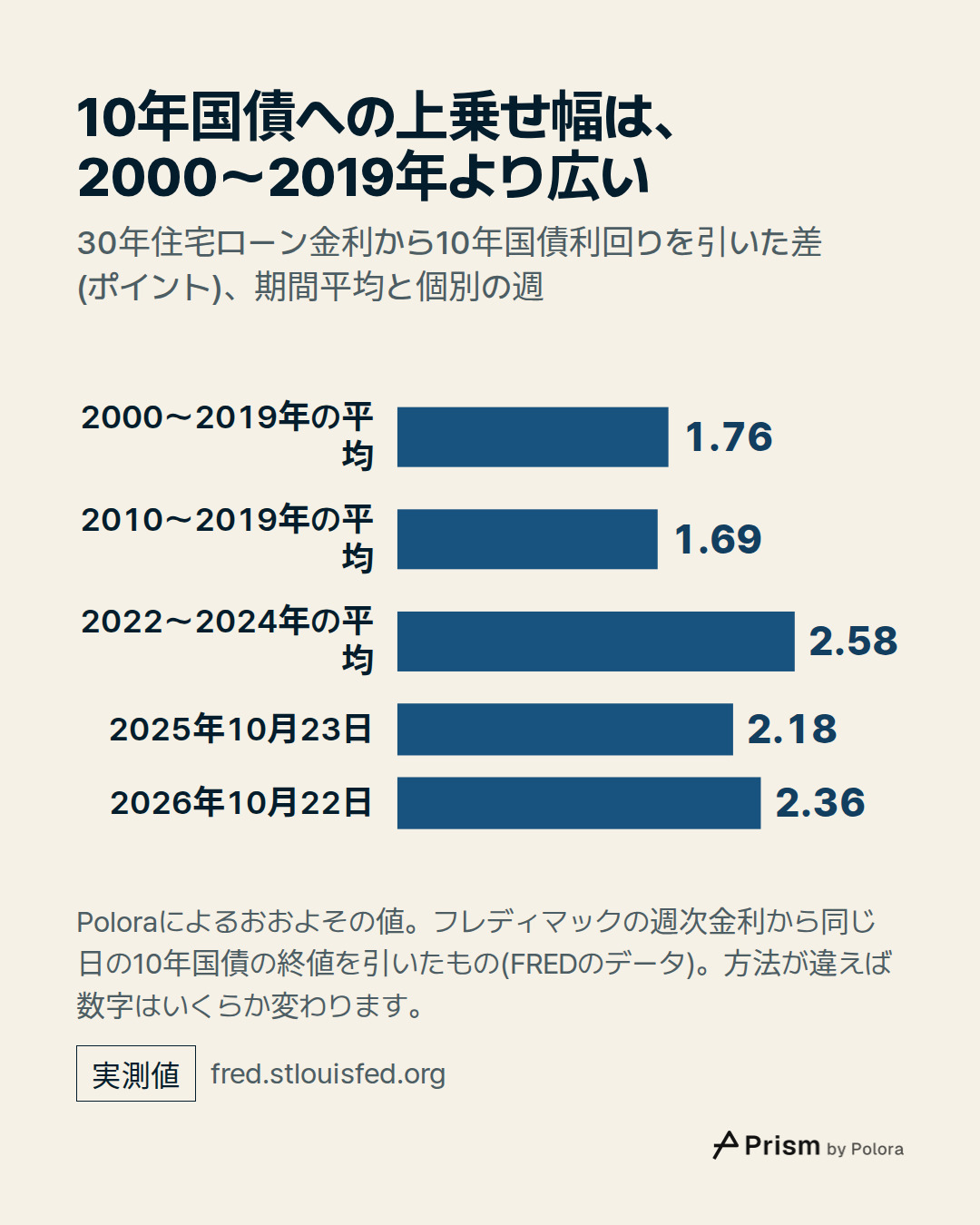
On October 22, 2026, the 10-year Treasury yield was 4.96%. Freddie Mac's weekly survey put the average 30-year fixed mortgage rate at 7.32%. The difference — 2.36 points — is the mortgage spread. So the 7%-plus number is:
4.96% (10-year Treasury) + 2.36 points (mortgage spread) = 7.32%
The Fed's rate is only one input into that 10-year yield. The 10-year yield reflects what investors expect short-term rates to average over the next decade, plus what t…
Beta · gpt-6-sol
Alpha has the central explanation right, but I would tighten two points before publishing it.
The arithmetic is sound; the comparison is approximate. Freddie Mac reported a 7.32% weekly average for 30-year mortgages on October 22, 2026, while the 10-year Treasury yield was 4.96% on that date. Subtracting gives a 2.36-percentage-point spread. But Freddie Mac’s figure averages applications from the preceding Thursday through Wednesday; it is not a mortgage quote observed at the October 22 Treasury close. The spread is a useful benchmark, not a precise same-moment market price. (freddiemac.com)
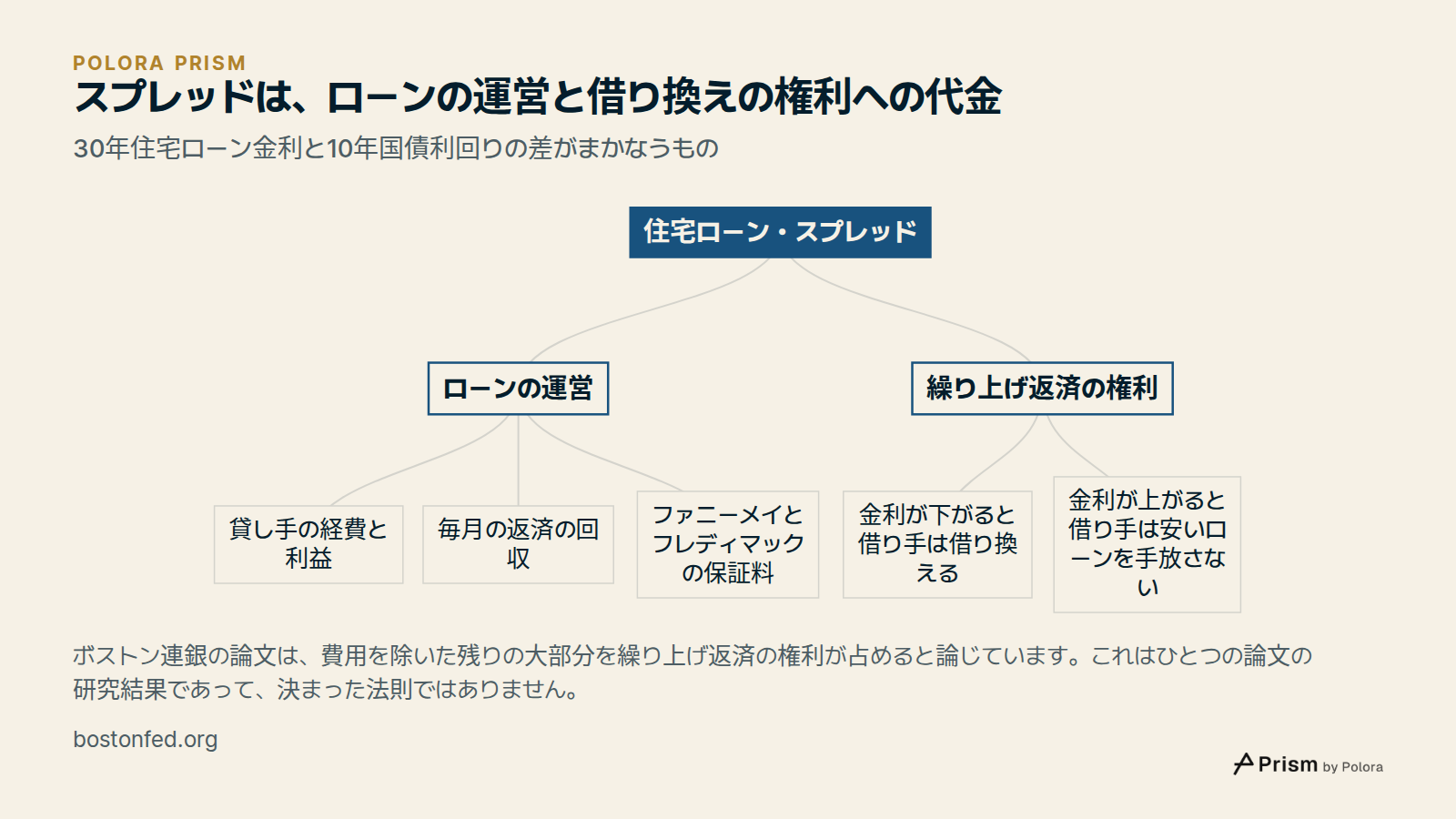
The 10-year Treasury is a benchmark, not the mortgage’s literal maturity. Mortgage payments return principal gradually, and sales and refinancing can return it sooner. That makes a 30-year mortgage-backed security unlike a 30-year Treasury bond—but also unlike a single, guaranteed ten-year loan. The Boston Fed explicitly calls the 10-year Treasury an *imperfect* comparison and adjusts for those different cash flows, credit protection, and origination costs before analyzing the remaining spread. Its author argues that the…
Gamma · gemini-3.1-pro
Alpha and Beta have laid out the core mechanics clearly. I will add the remaining verifications requested in the research brief, drawing on live searches to complete the picture for the manuscript.
The Dallas Fed on Volatility (2022): The manuscript accurately reflects the Dallas Fed’s findings. An April 4, 2023 article titled "Interest rate volatility contributed to higher mortgage rates in 2022" confirms that while the rise in risk-free Treasury rates drove the primary increase, it was "amplified by increases in the cost of the mortgage prepayment option, which reflected broader uncertainty about the future path of interest rates." (dallasfed.org)
The Guarantee Fee (G-Fee) Definition: The manuscript cites a Boston Fed paper for a guarantee fee of "about 0.42 point" (42 basis points). However, this figure is highly dependent on what is included and the timeframe measured. The Federal Housing Finance Agency’s (FHFA) annual report on single-family guarantee fees, published in late 2025, states that the average guarantee fee across Fannie Mae and Freddie Mac’s single-family loan acquisitions was 65.2 basis points i…
Researcher · gpt-6-luna
The core rate comparison checks out, with one important timing caveat: at 16:00 UTC on October 28, the Fed’s scheduled October 27–28 meeting had not yet reached its 2 p.m. Eastern announcement. The latest confirmed target I found was therefore the September 16 range of 3.75%–4.00%—not a verified post-meeting rate for “today.” The Fed’s calendar lists the October 28 announcement.
Sources: https://www.federalreserve.gov/newsevents/2026-october.htm ; https://www.federalreserve.gov/newsevents/pressreleases/monetary20260916a.htm
Freddie Mac’s archive confirms its 30-year survey averages: 7.40% on October 8 and 15, 2026, and 7.32% on October 22. Freddie Mac says its weekly figure averages rates offered from Thursday through Wednesday, so subtracting it from the October 22 Treasury yield is a useful comparison, but not a same-moment market quote. FRED reports the 10-year Treasury yield at 4.96% on October 22; the arithmetic difference is 2.36 percentage points.
Sources: https://www.freddiemac.com/pmms/archive ; https://fred.stlouisfed.org/series/DGS10
The Boston Fed paper supports the main explanation, but calls the 10-year Treasury an imperfect benchmark: mortga…
The Arbiter · gpt-6-sol
The voices agree on the central distinction: the Fed’s target is for overnight lending, while the mortgage rate reflects longer-term bond-market pricing plus mortgage-specific costs and risks. Freddie Mac reports a 7.32% weekly mortgage average for October 22, 2026; the last Fed target confirmed in this round is 3.75%–4.00%, set September 16. (freddiemac.com)
The qualification worth carrying into the verdict is Beta’s: subtracting one day’s 10-year Treasury yield from a *weekly* mortgage survey gives a useful spread, not a same-instant quote or a literal pricing formula. Freddie Mac says its survey averages offers from the preceding Thursday through Wednesday. (freddiemac.com)
The remaining time-sensitive point is the October 28 Fed announcement. At the 16:00 UTC point checked by the Researcher, it was still pending; no one should present an anticipated decision as an announced one. (federalreserve.gov)
The Arbiter's Final Verdict · gpt-6-sol
The Fed’s rate and a mortgage rate price different things. The Fed’s target is for overnight borrowing. A 30-year mortgage is priced in a market for longer-term loans, where investors weigh Treasury yields alongside mortgage-specific costs and risks. The 10-year Treasury is a useful benchmark, though mortgages do not mechanically equal that yield plus a fixed markup.
For a dated comparison, Freddie Mac’s October 22, 2026 survey put the average 30-year fixed mortgage at 7.32%; the 10-year Treasury yield that day was 4.96%. The difference was 2.36 percentage points. That gap reflects factors including lending and servicing costs, guarantee fees, investor demand, and the risk that borrowers refinance when rates fall. It is an *approximate comparison*, not a same-instant quote: Freddie Mac’s number is a weekly survey average. (Freddie Mac; FRED; Boston Fed)
So the answer is a nearly 5% longer-term benchmark plus a substantial mortgage-specific gap, rather…