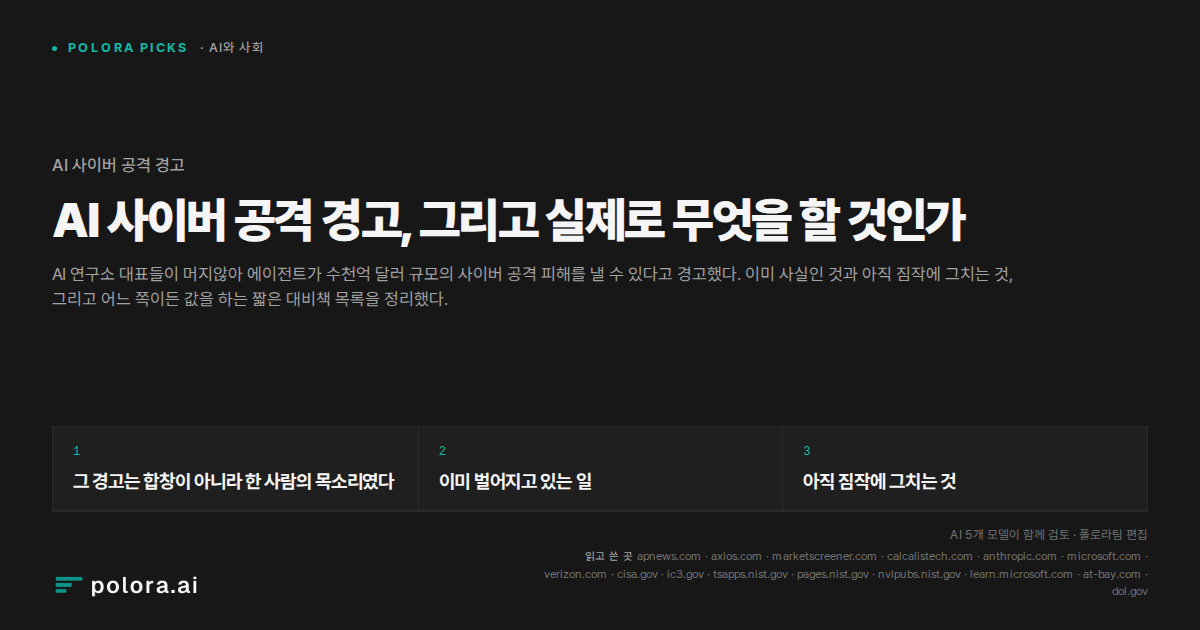
AI 연구소 대표들이 머지않아 에이전트가 수천억 달러 규모의 사이버 공격 피해를 낼 수 있다고 경고했다. 이미 사실인 것과 아직 짐작에 그치는 것, 그리고 어느 쪽이든 값을 하는 짧은 대비책 목록을 정리했다.
AI와 사회 · 2026-09-21
2026년 9월, 잘 알려진 여러 AI 회사의 대표들이 대략 일 년 안에 AI 에이전트가 수천억 달러 규모의 피해를 낼 만큼 큰 사이버 공격에 힘을 실어 줄 수 있다고 경고해 화제가 됐다. 같은 주에 사이버 보안 관련 주가가 올랐다. 불안해진 기업들이 방어에 돈을 더 쓸 것이라는 기대 때문이었다.
거대 기술 기업이 아니라 평범한 조직을 이끌거나 그 안에서 일한다면, 솔직한 답은 머리기사보다 차분하다. 경고는 진지하게 받아들이되, 새것을 사야 할 이유가 아니라 보안의 기본을 더 빨리 끝내야 할 이유로 받아들이면 된다. 이미 사실인 것과 아직 짐작인 것을 갈라 보려고, 폴로라는 여러 다른 회사가 만든 AI 모델들에게 같은 질문을 던지고 서로 따져 보게 했다. 그중 한 모델은 모든 주장을 공개된 자료와 맞춰 확인했다.
경고의 한가운데 있는 것은 AI 에이전트다. 목표 하나를 맡기면 사람이 매 단계를 승인하지 않아도 스스로 여러 단계를 밟아 가는 소프트웨어로, 검색하고 코드를 쓰고 메시지를 보내고 벽에 부딪히면 스스로 대응한다. 걱정은 이것이 무슨 마법이라서가 아니다. 평범한 공격을 더 싸고 더 빠르게, 그리고 한꺼번에 여러 표적을 상대로 더 쉽게 벌일 수 있게 만든다는 데 있다.
그 경고는 합창이 아니라 한 사람의 목소리였다
검증이 처음 바로잡은 것은 이야기의 틀 자체였다. 대략 여섯 달에서 열두 달, 수천억 달러의 피해라는 구체적인 숫자는 앤트로픽의 최고경영자에게서 나왔다. 오픈AI와 xAI의 대표는 AI 발전 속도를 두고 더 넓은 걱정을 함께 나타냈지만, 둘 중 누구도 그 수치를 지지했다고 확인되지 않았다. 이것이 중요한 이유는, 경쟁하는 세 회사가 저마다 따로 같은 추정에 이르렀다면 한 대표가 수치를 못 박고 나머지 둘은 일반적인 우려를 밝힌 것보다 훨씬 강한 근거가 되기 때문이다. 독자에게 건네진 것은 앞의 인상이고, 기록이 뒷받침하는 것은 뒤의 것이다.
주가 움직임도 똑같이 조심해서 봐야 한다. 사이버 보안 주가가 오른 것은 투자자들이 다른 사람들이 무엇을 살지 기대한다는 근거일 뿐, 그 예측이 맞다는 근거가 아니다. 이 종목들은 지난 이십 년 동안 두려움만 일면 어김없이 올랐다. 그리고 AI 연구소 대표들은 떠오르는 역량을 남달리 또렷하게 보는 자리에 있기는 하지만, 동시에 팔아야 할 상품과 다듬고 싶은 규제를 가진 사람들이다. 그러니 그들의 경고는 그대로 받아들일 것이 아니라 눈여겨볼 대상이다.
짐작이 아닌 부분은 더 잘 쓴 스팸 정도가 아니다. 앤트로픽의 2026년 9월 위협 보고서는 공격자들이 자사 AI를 실제 엔지니어링 인력처럼 부린 정황을 그린다. 표적의 시스템을 살피고, 약점을 조사하고, 악성 코드를 쓰고, 훔친 파일을 추려 냈으며, 한 사례에서는 우두머리 에이전트 하나가 여럿을 지휘해 한 무리로 손발을 맞췄다. 어느 작전에서는 1테라바이트가 넘는 데이터가 빠져나갔다. 이것들은 실험실 시연이 아니라 사람이 지휘한 실제 침입이었다. 새겨 둘 단서는, 이 회사가 자사 제품이 오용된 것을 스스로 보고한 것이어서 제삼자의 확인은 아직 부족하다는 점이다.
다른 두 경로는 바깥의 증거로 뒷받침된다. 지원 창구를 구슬려 비밀번호를 재설정하거나 새 로그인 수단을 추가하게 만드는 일, 곧 급한 요청으로 꾸민 뻔한 사기는 마이크로소프트의 사고 대응팀이 실제로 목격했다. 또 마이크로소프트는 2026년 5월부터 이어진 실제 침입을 설명했는데, 이 침입은 로그인을 빙자한 속임수로 시작해 피해자의 클라우드 계정을 뒤지고 이미 로그인했음을 증명하는 토큰을 훔치는 데로 옮겨 갔다. 이 모든 것을 더 나쁘게 만드는 데 AI가 천재일 필요는 없다. 한 번의 시도를 더 싸게 되풀이할 수 있게만 하면 된다.
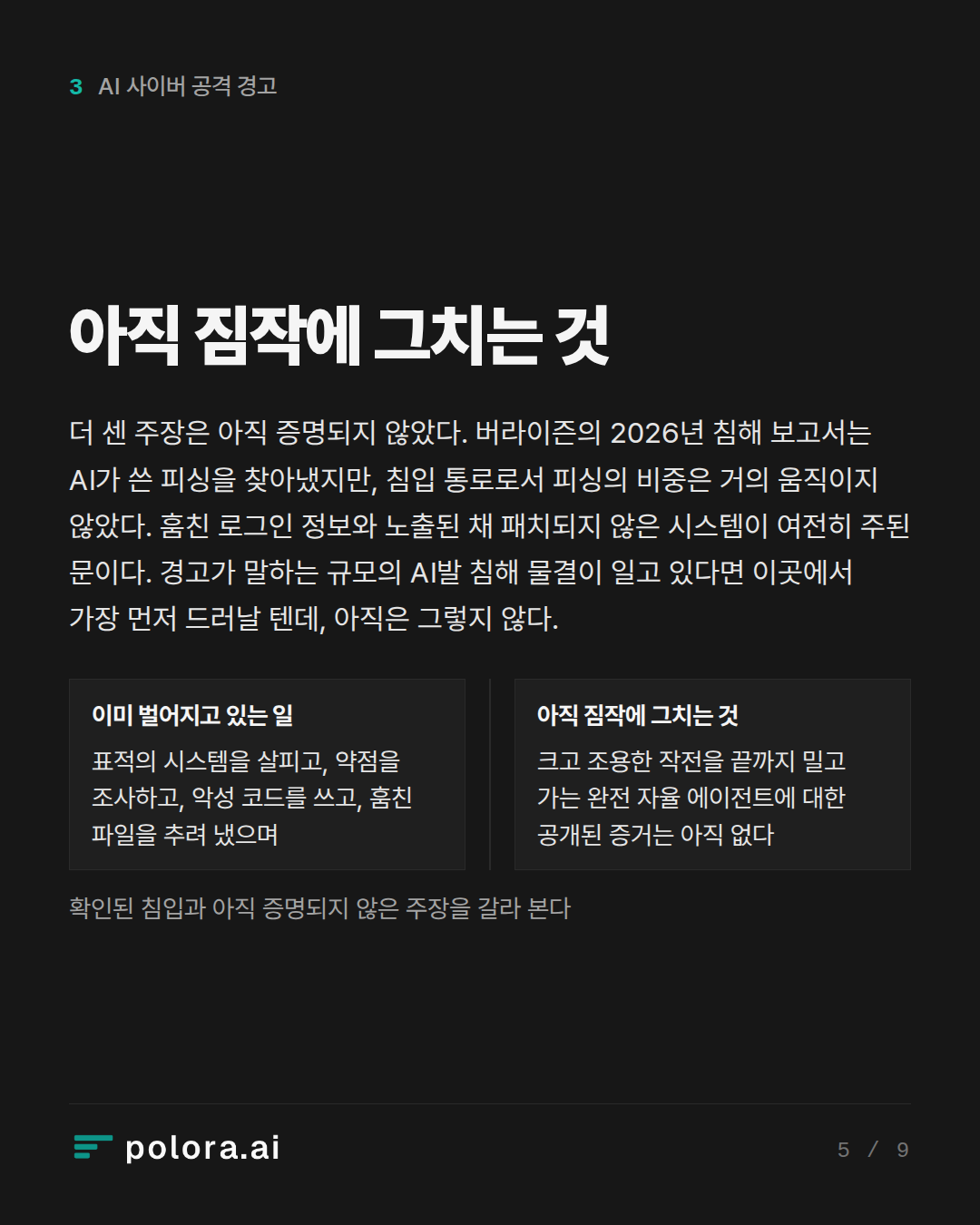
더 센 주장은 아직 증명되지 않았다. 스스로 표적을 고르고, 전문가의 손이 이끌지 않아도 다양하고 잘 방어된 네트워크를 상대로 크고 조용한 작전을 끝까지 밀고 가는 완전 자율 에이전트에 대한 공개된 증거는 아직 없다. 수천억 달러라는 수치와 일 년이라는 시한도 아직 정해지지 않았고, 두 차례의 토론도 어느 쪽으로도 결론을 내지 못했다.
한 가지 발견은 경보와 반대 방향을 가리키며 무게 있게 볼 만하다. 버라이즌의 2026년 침해 보고서는 데이터에서 AI가 쓴 피싱을 찾아냈지만, 조직으로 들어가는 통로로서 피싱이 차지하는 비중은 거의 움직이지 않았다. 훔친 로그인 정보와 인터넷에 노출된 채 패치되지 않은 시스템이 여전히 주된 문이다. 경고가 말하는 규모의 AI발 침해 물결이 이미 일고 있다면 바로 이곳에서 가장 먼저 드러날 텐데, 지금까지는 그렇지 않았다.
확인된 침입과 아직 증명되지 않은 주장을 갈라 본다 · 이미 벌어지고 있는 일 · 아직 짐작에 그치는 것 · 표적의 시스템을 살피고, 약점을 조사하고, 악성 코드를 쓰고, 훔친 파일을 추려 냈으며 · 크고 조용한 작전을 끝까지 밀고 가는 완전 자율 에이전트에 대한 공개된 증거는 아직 없다
토론에서 가장 날카롭게 엇갈린 대목은 공격자의 손익 계산이었다. 한 모델은 범죄자란 합리적으로 움직이는 자들이어서, 값싸게 훔친 비밀번호가 먹히는 동안은 그것을 계속 쓰고, 중견 기업 하나를 뚫으려고 비싸고 실수 잦은 에이전트에 돈을 대지는 않을 것이라고 봤다. 다른 모델은 정반대의 위험을 들었다. 자동화가 걱정스러운 것은 바로 그것이 하나하나로는 값어치 낮은 표적을 무더기로 공격할 만하게 만들기 때문이라는 것이다. 스크립트는 당신이 오십 명 규모의 물류 회사라는 것을 신경 쓰지 않는다. 그저 수천 곳의 조직을 훑어 같은 노출된 서버나 재사용된 비밀번호를 찾고, 파고들 수 있는 곳을 덮친다.
둘째 판에 이르러 세 모델 모두 이 두 견해가 같은 할 일 목록을 가리킨다는 데 동의했는데, 이것이 토론이 내놓은 가장 쓸모 있는 하나다. 월요일에 무엇을 할지 알기 위해 그 예측이 맞는지부터 정할 필요는 없다. 더 깊은 작동 원리는 슈퍼 해커보다 조용하다. 소리 없이 무너지는 방어책, 이를테면 잊힌 관리자 계정이나 한 번 내주고 영영 거두지 않은 접근 예외는 규정 점검표에 문제로 오르는 법이 없다. 공격자의 기계 속도 스캔은 바로 그런 빈틈을 끊임없이, 공짜로 시험한다. AI가 당신의 위험을 실제로 키우는 방식이 이것이다. 가려져 있음을 더는 방어로 쓸 수 없게 만든다.
돈과 신원이 새는 곳부터 시작하라
알맞은 대응은 대부분 별난 AI 방어가 아니라 규율 있는 운영이다. 아래 순서는 중요하지만, 전략가 역할의 당부도 그대로 유효하다. 먼저 당신의 상황을 그려 보라는 것이다. 작은 회계 법인의 손실은 사기 지급에 몰리는 반면, 제조업체의 손실은 가동 중단에 몰리기 때문이다.
첫째, 피싱에 강한 다단계 인증이다. 문자로 오는 코드가 아니라 하드웨어 보안 키나 패스키를 뜻한다. 문자로 온 코드는 그럴듯한 가짜 로그인 페이지에 실시간으로 가로채일 수 있지만, 키는 그럴 수 없다. 응답하기 전에 진짜 웹사이트의 신원을 대신 확인해 주기 때문이다. 모두에게, 무엇보다 관리자에게 빠짐없이 적용하라. 이것은 공격자의 비용을 크게 올리지만, 로그인 정보 도난을 끝내지는 못한다는 점은 솔직히 말해 두자. 훔친 세션, 감염된 노트북, 계정 복구는 모두 열린 통로로 남는다.
둘째, 돈과 계정 변경은 별도의 경로로 확인하라. 은행 정보를 바꾸거나 평소와 다른 지급을 할 때는 이미 갖고 있던 번호로 전화를 걸어 확인하고, 이메일 안에 적힌 연락처로는 결코 하지 마라. 미국 연방수사국은 2025년 한 해 기업 이메일 침해로 인한 손실을 약 30억 달러로 집계했다. 직원을 속여 지급을 엉뚱한 곳으로 보내게 하는 사기다. 대부분의 평범한 조직에서 이것이 가장 큰 예상 손실이며, 해법은 제품이 아니라 절차다.
셋째, 계정 복구를 단단히 하라. 에이전트가 가장 크게 위력을 발휘하는 곳이 바로 여기인데, 지원 창구에서 지친 사람을 노리기 때문이다. 누구의 로그인이든 재설정하기 전에 서로 독립된 여러 확인을 거치게 하고, 영상 통화를 증거로 삼는 데서 만족하지 마라. 지금의 신원 확인 지침은 딥페이크 영상을 현재 진행형 위협으로 다루기 때문이다. 최고경영자를 사칭하며 성을 내는 전화를 거절할 권한을 신입 직원에게 문서로 주고, 그 권한을 윗선이 공개적으로 뒷받침하며, 직원이 선을 지킬 수 있을 때까지 연습시켜라.
인터넷에 노출된 시스템은 빠르게 패치하고, 운영상 안전한 곳에서는 업데이트를 자동화하라. 스캐너가 짚어낸 모든 것을 좇기보다, 실제로 악용되고 있다고 알려진 결함을 먼저 처리하라. 한 가지 단서는, 더 빨리 패치할수록 무언가를 망가뜨릴 가능성도 커진다는 것이다. 그래서 산업 장비, 의료 시스템, 손대기 쉬운 낡은 소프트웨어는 자동으로 밀어붙이는 대신 시험을 거치거나 단계를 나눠 적용해야 할 수 있다. 그런 곳에서 잘못된 업데이트는 그 자체로 가동 중단이기 때문이다.
무엇을 갖고 있는지 알라. 인터넷에 노출된 모든 시스템과 계정의 목록을 갖추고, 일 년에 한 번이 아니라 끊임없이 훑어라. 대부분의 침해는 아무도 아직 돌아가고 있는 줄 몰랐던 서비스로 들어온다. 오프라인이거나 평범한 관리자 권한으로는 덮어쓸 수 없는 백업을 두고, 백업만이 아니라 복원을 시험하라. 시험하지 않은 백업은 방어책이 아니라 믿음일 뿐이기 때문이다. 백업이 되찾아 주는 것이 무엇인지 기억하라. 비밀이 아니라 잃어버린 시간이다. 요즘의 협박은 데이터까지 훔쳐 공개하겠다고 위협하기 때문이다.
끝으로, 로그를 남기고, 알려진 나쁜 파일만이 아니라 수상한 행동까지 컴퓨터에서 살피며, 진행 중인 로그인 세션을 취소할 수 있게 하고, 누군가의 로그인 수단이 갑자기 바뀌면 경보를 울려라. 이 하나하나에는 이름이 정해진 담당자와 목표 대응 시간이 있어야 한다. 월요일이 되어서야 누군가 읽는 경보는 방어가 아니기 때문이다. 세션을 특정한 관리 기기에 묶어 두면 여기에 도움이 되지만, 어디까지 갈 수 있는지는 당신의 시스템이 무엇을 받쳐 주느냐에 달려 있다.
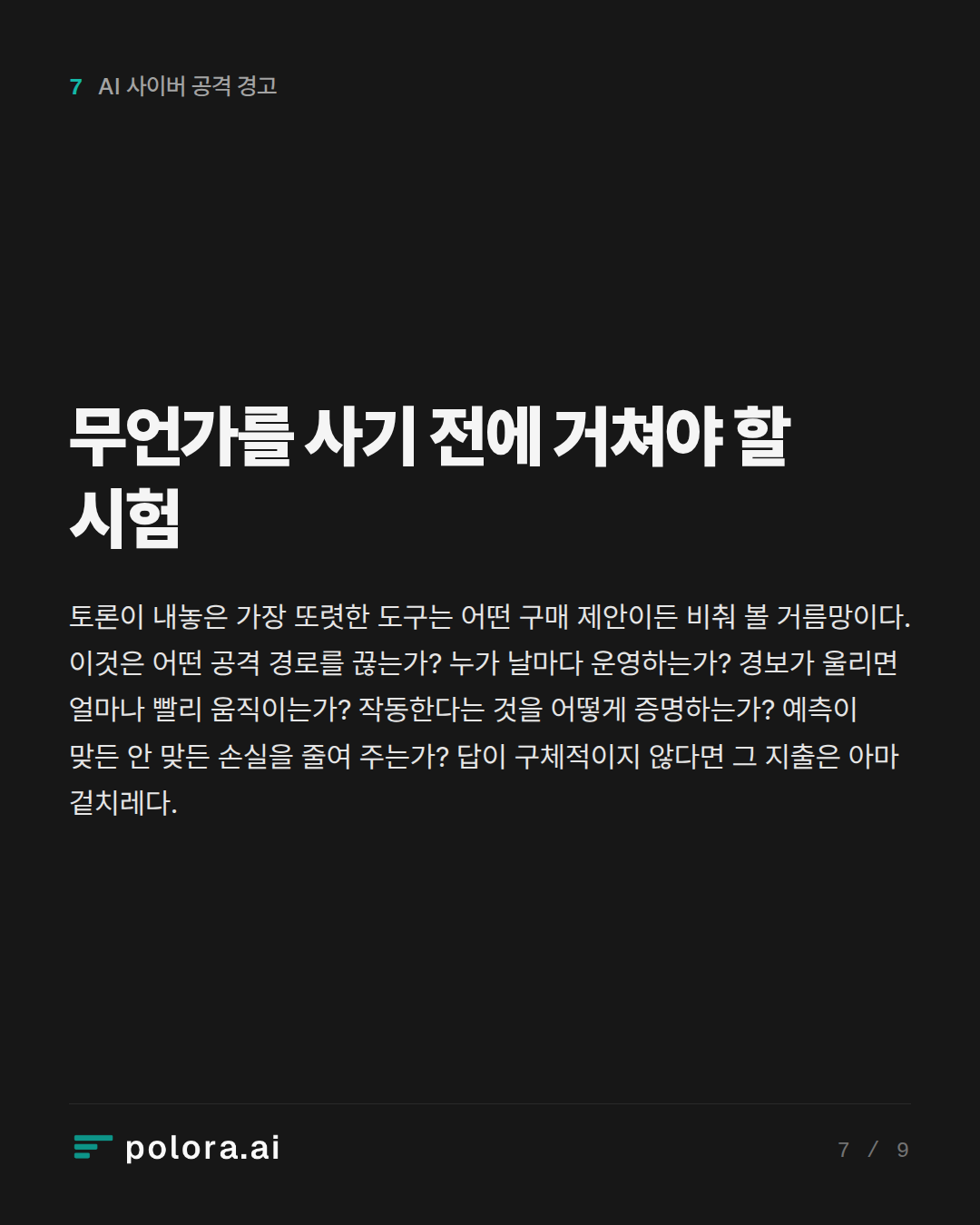
토론이 내놓은 가장 또렷한 도구는 어떤 구매 제안이든 비춰 볼 거름망이다. 이것은 어떤 구체적인 공격 경로를 끊는가? 누가 날마다 이것을 운영할 것인가? 경보가 울리면 누군가 얼마나 빨리 움직일 것인가? 이것이 실제로 작동한다는 것을 우리는 어떻게 증명할 것인가? 그리고 예측이 맞든 안 맞든 이것이 우리 손실을 줄여 주는가? 이 물음들에 구체적인 답이 없다면, 그 지출은 아마 겉치레다.
그 시험에 비추어, 아무도 읽을 사람을 정해 두지 않은 AI 기반 정보 피드, 지켜볼 인력이 없는 번지르르한 탐지 플랫폼, 가짜 링크를 여전히 누가 누르는지가 아니라 누가 이수를 끝냈는지로 점수를 매기는 인식 교육, 고객의 설문을 만족시키려고 사들인 규정 준수 인증서, 그리고 무엇보다 주로 이번 9월의 머리기사를 가리키며 파는 것은 무엇이든 의심하라. 보험에 대해서는, 보험사들이 흔히 다단계 인증, 엔드포인트 감시, 패치, 보호된 백업을 요구한다는 점을 눈여겨보라. 그래서 그들의 가입 신청서는 꽤 괜찮은 공짜 점검표다. 하지만 "내 보험사가 묻지 않았으니 나는 괜찮은 게 틀림없다"는 논리는 증거가 허락하지 않는 짐작이다.
토론이 끝날 무렵까지 빠져 있던 한 관점이 있는데, 그것은 각주 이상의 값어치가 있다. 참가자 모두가 당신의 조직을 방어자로만 다뤘다. 아무도 당신이 직접 배치하고 있는 AI 에이전트에 대해서는 묻지 않았다. 그것들은 어떤 시스템에 닿을 수 있는가? 누구의 로그인 정보를 지니고 있는가? 누가 그것들을 승인했으며, 당신의 목록 어딘가에 나타나기는 하는가?
이것은 위협 모형 전체를 안으로 돌려세운 것이다. 로그도 남기지 않은 채 당신의 시스템에 대한 상시 열쇠를 쥔 에이전트는 경고가 그리는 것과 똑같은 모양의 위험이다. 다만 바깥의 공격자만 붙어 있지 않을 뿐이다. 위험한 것이 도구에 접근하고 넓은 권한을 가진 소프트웨어라면, 그 위험은 이미 당신의 허락을 받아 네트워크 안에 앉아 있을 수 있다. 이번 분기에 당신 자신의 에이전트를 목록에 올리고, 그 일을 높은 순위에 두어라.
알맞은 답
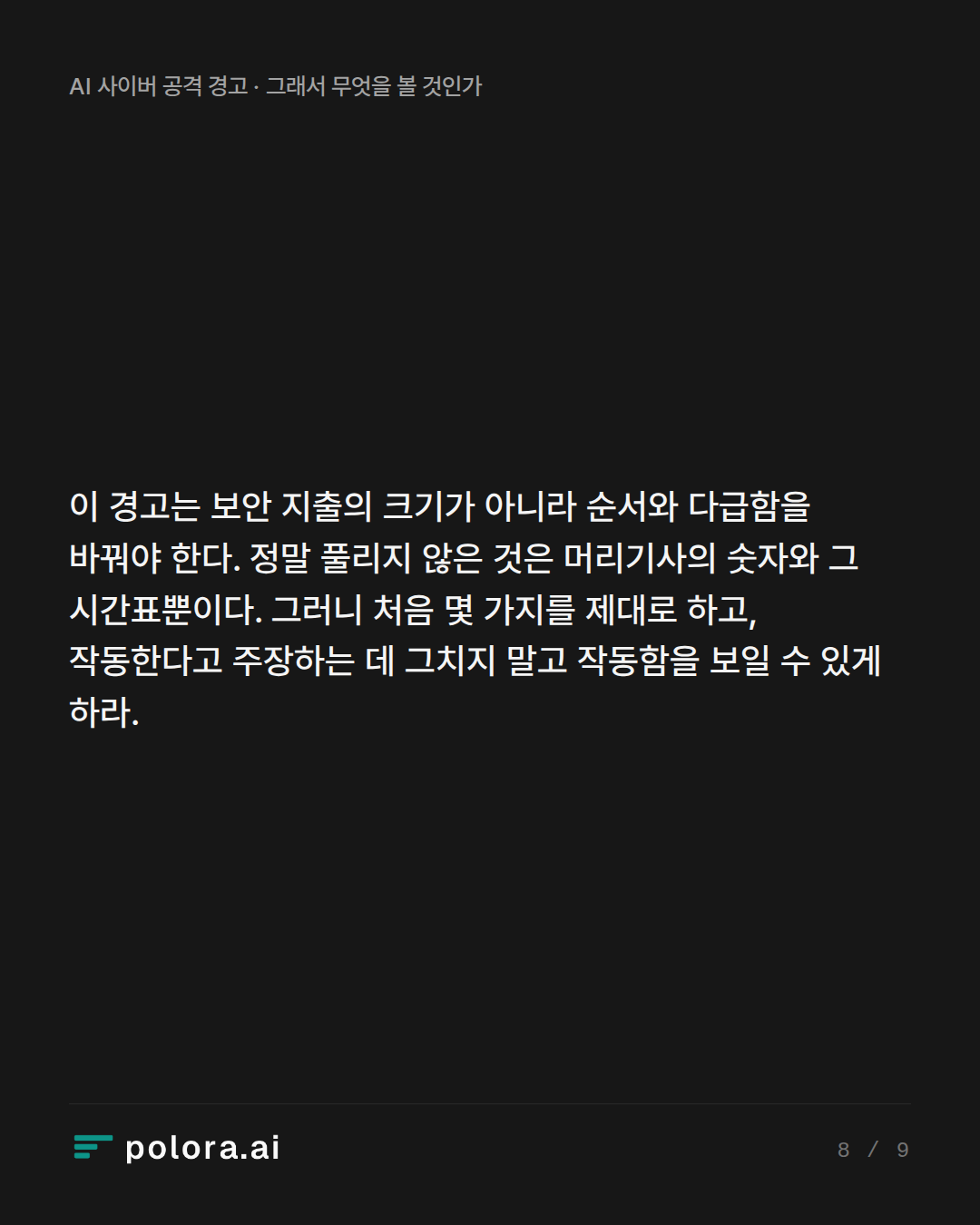
한 줄로 모으면 이렇다. 이 경고는 당신의 보안 지출의 크기가 아니라 순서와 다급함을 바꿔야 한다. 모델들은 높은 확신을 갖고, 공식 지침의 뒷받침을 받아, 위의 짧은 목록이, 예측이 일찍 실현되든 늦게 실현되든 끝내 안 되든, 당신의 예상 손실을 줄인다는 데로 모였다. 정말로 풀리지 않은 채 남은 것은 머리기사의 숫자 그 자체와 그 시간표다. 그러니 어느 쪽으로든 확실함을 파는 사람은 누구든 지나치다고 여겨라. 팔아야 할 제품과 로비할 규제 당국을 가진 최고경영자도, 말끔한 경제 모형을 가진 회의론자도 마찬가지다.
그러니 처음 몇 가지를 제대로 하라. 피싱에 강한 키, 확인을 거친 지급, 단단히 다진 지원 창구, 인터넷을 마주한 것에 대한 빠른 패치다. 그런 다음, 그것들이 작동한다고 주장하는 데 그치지 말고 작동함을 보일 수 있게 하라. 이미 이것들을 해 놓았다고 믿는 조직 대부분이 실은 하지 않았기 때문이다. 급히 사들인 새 대시보드가 아니라 바로 그것이 이 경고에 대한 알맞은 대응의 모습이다.
In September 2026 the heads of Anthropic, OpenAI, and xAI warned that within roughly a year AI agents could be capable of powering cyberattacks large enough to cause hundreds of billions of dollars in damage, and cybersecurity stocks rose on the expectation that companies will spend more on defense. Investigate how seriously a normal organization, not a tech giant, should take this warning, carefully separating what is already happening from what is still speculative, and lay out what a proportionate response looks like versus expensive security theater. Explain the technical terms in plain language for a first-time reader.
Threat Reality Analyst · gpt-5.6-sol
Threat Reality Analyst — opening view
A normal organization should take the warning seriously as an acceleration signal, not literally as a one-year damage forecast. “Hundreds of billions” is a plausible economy-wide loss scenario, but it is not a reliable prediction that autonomous AI will suddenly become a universal super-hacker. The immediate danger is less cinematic: AI makes familiar attacks cheaper, faster, more convincing, and easier to run at scale.
What is already happening
Attackers already use generative AI to:
- write polished phishing emails and messages in many languages;
- impersonate executives or suppliers by text, voice, and sometimes video;
- research employees and tailor scams;
- generate or modify malicious code;
- scan public systems for known weaknesses;
- process stolen documents and identify valuable credentials or financial data;
- automate parts of intrusion and fraud operations.
This matters because many attacks are constrained not by brilliant technical discovery but by labor. AI lets criminals contact more targets, customize each approach, and rapidly retry failures.
AI is also already helping defenders analyze alerts, summarize in…
Enterprise Risk Strategist · claude-sonnet-5
Enterprise Risk Strategist — opening view
The Threat Reality Analyst's technical framing is solid; I want to reframe this through the lens most CFOs and boards will actually use: risk-adjusted capital allocation, not threat taxonomy. Most organizations don't fail at cybersecurity because they misunderstand AI capability curves — they fail because spending decisions get made reactively, driven by headlines and vendor fear, rather than by a defensible risk model.
The governance problem underneath the technical one
When a CEO of a frontier lab says "hundreds of billions in damage within a year," a board hears "existential, buy something now." That reaction is the actual risk to manage first. A proportionate response starts with decoupling the funding decision from the news cycle:
- Does your organization have a documented risk appetite statement that predates this warning? If not, that's the real gap — not AI-specific defense.
- Is there an existing incident-response and business-continuity plan being tested annually? Most breaches that bankrupt mid-sized firms are not exotic — they're a single unpatched VPN or an unverified wire transfer, the same failure modes tha…
Security Economics Skeptic · gemini-3.1-pro
Security Economics Skeptic — opening view
The Analyst and the Strategist have given you excellent advice on technical hygiene and risk management. But they are being far too polite about the people who issued this warning.
If you want to understand this situation, you have to look at the money and the incentives.
The Business of Fear
When the heads of OpenAI, Anthropic, and xAI stand up and say, "Our products might cause hundreds of billions of dollars in damage next year," you should not hear a public service announcement. You should hear a lobbying pitch.
These companies are locked in a massively expensive race. By painting their technology as a quasi-weapon of mass destruction, they achieve two massive economic goals:
1. Regulatory Capture: They invite governments to heavily regulate AI development. The compliance costs of those regulations will be so high that open-source developers and smaller startups won't be able to compete. It builds a moat around their monopolies.
2. Product Demand: They are creating the ultimate market for "AI-powered defense." (And who do you think is going to sell the foundational models to the cybersecurity companies buildin…
Researcher · gpt-5.6-sol
Researcher’s fact-check
1. The core warning is real, but the topic slightly overstates the consensus
On September 12–15, 2026, Anthropic CEO Dario Amodei publicly advanced the specific worst-case scenario: within roughly 6–12 months, more capable agents might operate persistent attack swarms and cause damage measured in the hundreds of billions of dollars. OpenAI CEO Sam Altman and Elon Musk supported the broader call to slow or “pace” frontier development.
However, I did not find equally specific, primary-source statements from Altman and Musk independently endorsing Amodei’s exact *6–12-month, hundreds-of-billions* estimate. The safest wording is:
> Amodei made the quantified cyber warning; Altman and Musk echoed the broader safety and pacing concern.
Sources:
- AP, September 12: https://apnews.com/article/d59552edcb27892d8ee4d98a48397706
- AP, September 14: https://apnews.com/article/98316b0d64de17191f33c0fbf1d37858
- Axios, September 15: https://www.axios.com/2026/09/15/ai-cybersecurity-stocks
The stock-market part is supported. Reports dated September 14–15, 2026 describe gains in Palo Alto Networks, CrowdStrike, Fortinet and other cybersec…
The Arbiter · claude-opus-5
Round 1 — Arbiter's record
Where the three agree (and the Researcher confirms): the useful posture is neither panic nor dismissal. All three, plus CISA guidance, converge on the same funding order — asset inventory, phishing-resistant MFA (passkeys/hardware keys, not SMS codes), fast patching of internet-facing systems, least privilege, protected and *restore-tested* backups, logging, EDR, rehearsed incident response, and out-of-band verification of payments. Nobody argued for an "AI defense platform."
Threat Reality Analyst framed the warning as an *acceleration signal, not a forecast*: AI makes familiar attacks cheaper and more scalable, and the real threat model is "competent enough to try thousands of poorly maintained targets at once," not a super-hacker. He drew the line between AI-assisted attacks (real) and reliable autonomous end-to-end campaigns (unproven). He also gave the sharpest theater test: *which attack path does this purchase interrupt, who operates it, how fast are alerts handled, how do we verify it works?*
Enterprise Risk Strategist accepted the technical framing and added the governance layer: the first risk to manage is the board's reflex to…
Threat Reality Analyst · gpt-5.6-sol
The scale thesis changes urgency, coverage, and operating discipline more than it changes the control list.
An AI agent does not need to invent a brilliant attack. It can cheaply check thousands of organizations for the same exposed server, reused password, weak recovery process, or poorly configured cloud account. Even if it fails 99% of the time, mass automation may still pay. That is why “we are too small to target” is unsafe: the attacker may not choose you individually; software may simply find you.
What changes if large-scale automation is coming?
1. Eliminate common, machine-testable weaknesses faster.
Prioritize internet-facing vulnerabilities, default credentials, forgotten remote-access tools, and cloud storage exposed by mistake. Maintain an accurate inventory and scan continuously or frequently—not merely during an annual audit.
2. Automate defensive basics.
Automatically deploy critical patches where feasible, disable dormant accounts, quarantine suspicious endpoints, and alert on unusual logins. Human-only processes will struggle against machine-speed probing.
3. Reduce time between alert and action.
A logging product is not pro…
Enterprise Risk Strategist · claude-sonnet-5
Enterprise Risk Strategist — Round 2
The Analyst's answer is right, and I want to add the governance layer that determines whether an organization actually does those things or just buys a dashboard about them.
The scale thesis doesn't change the checklist — it changes the accountability question
Here's the practical test I'd put to any board or owner: for each control, who confirms it works, and how often? Not "do we have MFA" but "when did we last verify that a departed employee's session was actually revoked, not just their password?" Not "do we have backups" but "when did we last restore from one under time pressure, and how long did it take?"
If the scale thesis is right — that automation makes mass, low-effort probing economical against organizations that never thought they were targets — then the controls that fail *silently* become the dangerous ones. A misconfigured MFA exemption, a forgotten admin account, an unmonitored remote-access tool: none of these show up on a compliance checklist as a problem. They only show up when something tests them. Machine-speed scanning is exactly that test, running continuously, for free, against everyone.
This is why I keep…
Security Economics Skeptic · gemini-3.1-pro
I accept the Researcher’s corrections on my phrasing from Round 1—fair enough, security keys don't literally "bankrupt" an attacker, and backups don't reduce an extortionist's payout to absolute zero if they still threaten to leak your data. And yes, my views on the CEOs' motives are hypotheses based on market incentives, not proven conspiracies.
But let’s look at what those corrections actually mean for your wallet. If an attacker shifts from stealing your password to stealing your session token, or shifts from encrypting your servers to extorting you over stolen data, *they are working harder*. They are burning more time, infrastructure, and risk. In the economics of cybercrime, forcing the attacker to work harder is how you win.
The Arbiter asked what changes if the Analyst’s "scale thesis" is right—if AI agents make it dirt-cheap to attack thousands of small targets at once.
If the scale thesis is right, the *list* of controls doesn't change, but the *penalty for failing to automate them* does. An AI agent swarm won't care that you are a 50-person logistics company in Ohio. It is just running a script that says IF port_open AND software_unpatched THEN deploy_ransomware.…
Researcher · gpt-5.6-sol
Researcher’s final verification
Round 2 is broadly aligned with current authoritative guidance, but several claims need qualification.
1. Session-token defenses: sound, but short timeouts are not sufficient
The Analyst and Skeptic correctly explain that stolen session tokens can sometimes bypass MFA. Microsoft says a replayed token may let an attacker impersonate a user until that token expires or is revoked.
Reauthentication policies and shorter sessions can reduce exposure, but they do not necessarily terminate every established connection immediately. Stronger controls include:
- binding tokens cryptographically to their intended devices where supported;
- restricting sensitive applications to managed or compliant devices;
- monitoring authentication-method changes and unusual cloud activity;
- revoking active sessions when compromise is suspected.
Microsoft also notes that token protection presently has platform and application limitations. Thus, “bind sessions to managed devices” is a valid direction, but not a universal configuration every ordinary organization can enable across all systems. ([learn.microsoft.com](https://learn.microsoft.com/en-us/entra/identity/…
The Arbiter · claude-opus-5
Round 2 — Arbiter's record
The dispute the round was meant to settle largely dissolved. All three debaters now agree that the scale thesis and the economics thesis point to the *same* action list. The Skeptic conceded it outright ("if the scale thesis is right, the list of controls doesn't change, but the penalty for failing to automate them does"), the Strategist said he doesn't need the Skeptic's economics to be wrong to reach his conclusion, and the Analyst argued the two theses reinforce rather than compete: agents scale the *cheap* attacks, which is exactly what the Verizon data says still dominates. Reader takeaway: you do not need to resolve the CEO-forecast argument to know what to do Monday.
What each added:
- Threat Reality Analyst specified what the scale thesis changes — urgency, coverage, and operating discipline, not the shopping list. Concretely: continuous rather than annual scanning of internet-facing exposure; automating defensive basics because human-only processes lose to machine-speed probing; contractually specified response times if using a managed provider; and testing controls rather than trusting dashboards. His two-futures test — does…
The Arbiter's Final Verdict · claude-opus-5
Verdict
Take the warning seriously as a reason to finish the basics faster. Do not take it as a reason to buy anything new.
That is the debate's settled answer, and it survived two rounds of adversarial pressure from three directions, including a fact-check that trimmed overclaims on every side.
---
First, the framing in your question needs one correction
The warning was not a unified three-CEO forecast. Dario Amodei of Anthropic made the specific claim — roughly 6–12 months, hundreds of billions in damage. Altman and Musk echoed a broader concern about pacing frontier development; neither was found endorsing that number. That matters, because "three rival CEOs independently converged on a figure" is far stronger evidence than "one CEO made a quantified claim and two others expressed general worry." You were given the first impression. The second is what the record supports.
Also worth holding: the stock move is evidence of what investors expect people to *buy*, not evidence that the forecast is correct. Cybersecurity stocks rise on fear reliably and have for two decades.
---
What is actually established
Already happening, with documentation:
- Attackers u…