GPS 비용은 미국 납세자가 냅니다. 미국 법이 민간용 신호를 전 세계에 이용료 없이 제공하도록 정해 두었습니다. 갈릴레오는 EU 예산으로 운영되고, 지도와 와이파이 위치 데이터베이스는 기업이 가집니다.
정치와 정책 · 2026-11-15
스마트폰 GPS 비용은 누가 내나?
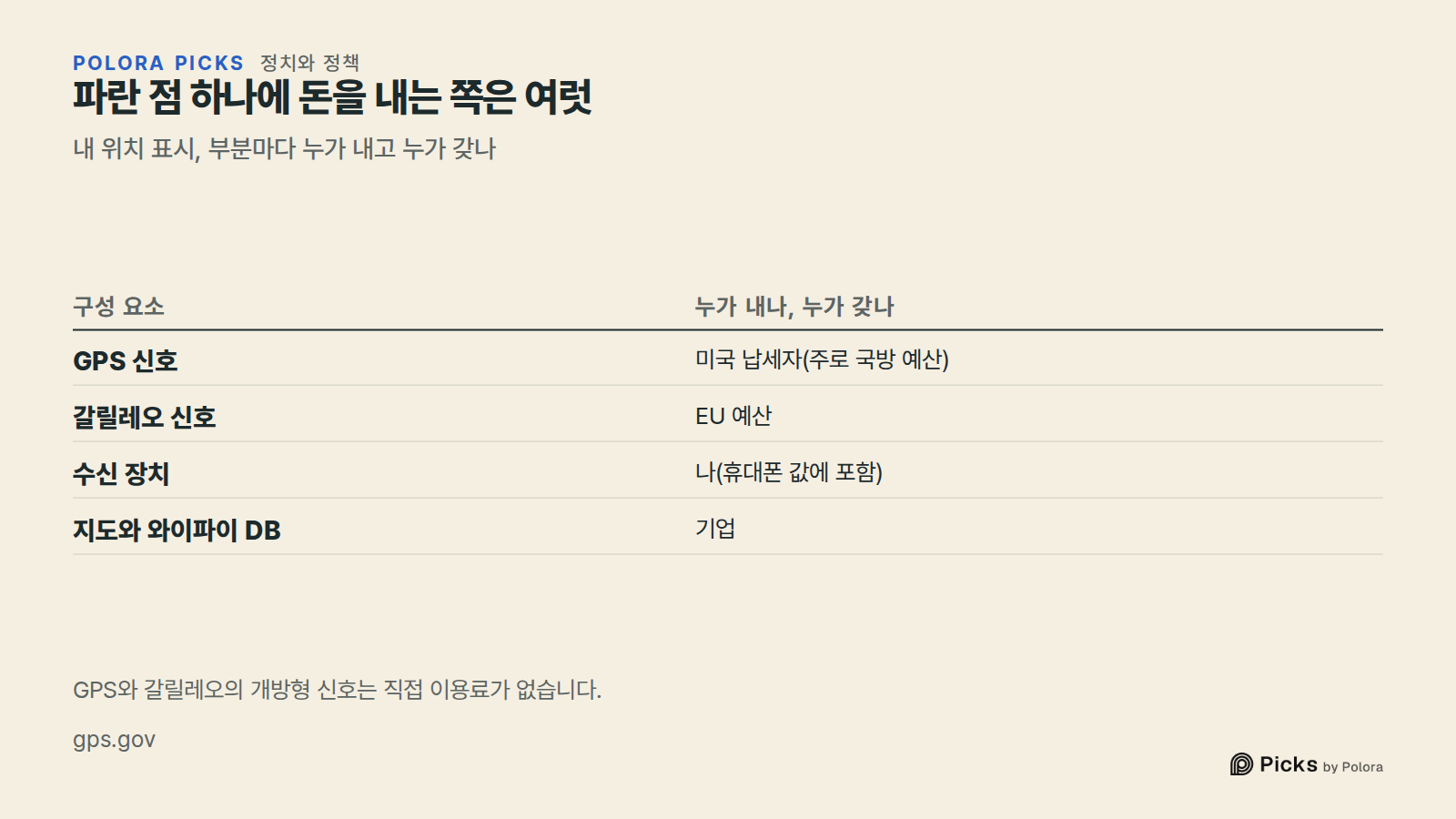
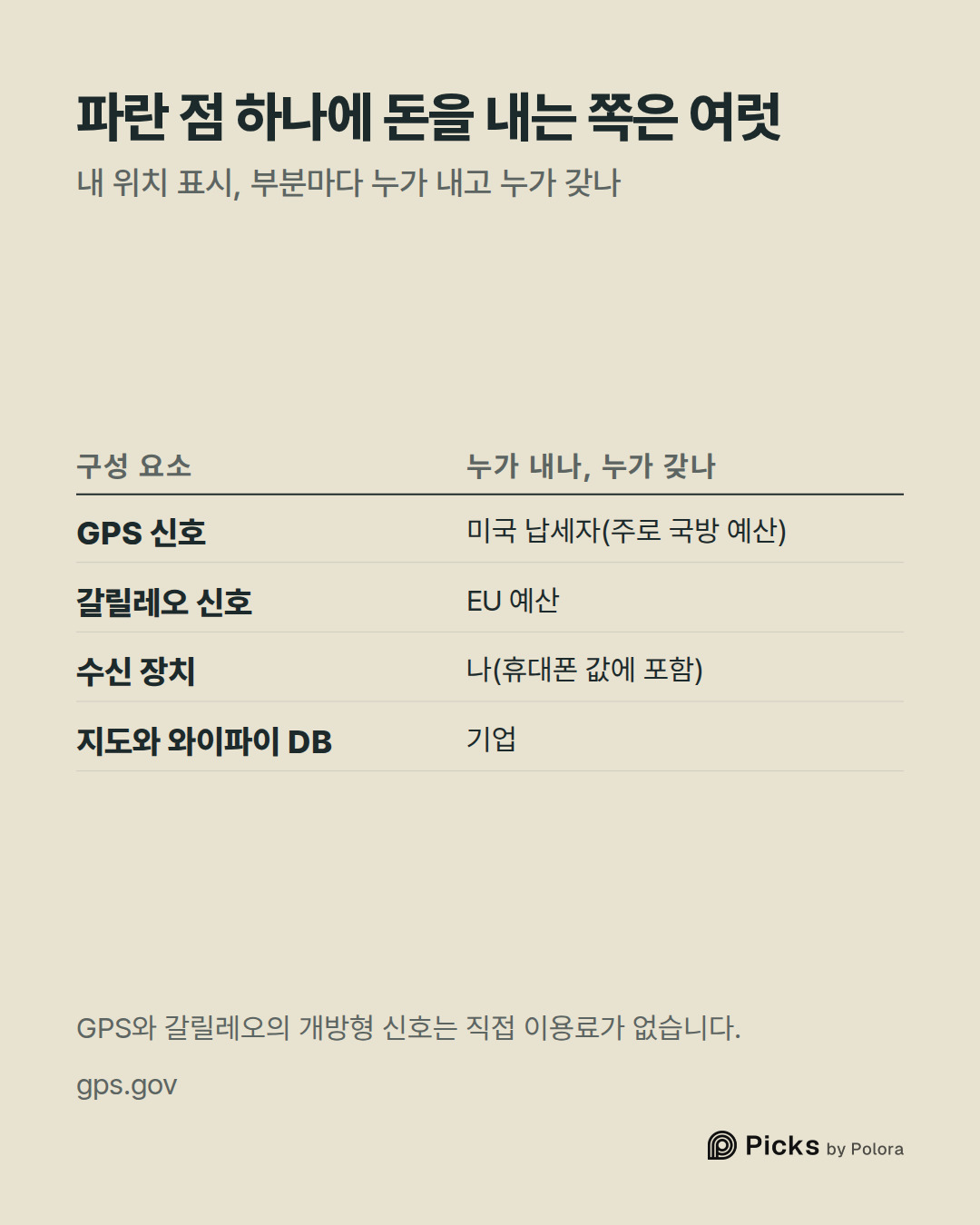
납세자가 냅니다. GPS는 미국 우주군이 운영하고, 그 돈은 미국의 일반 세수에서 나옵니다. 미국 법은 민간용 신호를 직접 이용료 없이 전 세계에 제공하도록 정해 두었습니다. 신호는 누구에게나 닿기 때문에, 미국 밖에 사는 사람도 미국에 세금 한 푼 내지 않고 이 신호를 씁니다. 유럽의 위성항법 시스템 갈릴레오는 EU 예산으로 운영됩니다. 우리가 돈을 내는 부분은 휴대폰 값에 포함된 수신 장치입니다. 신호 위에 얹힌 것들, 곧 지도와 위치 서비스, 그리고 휴대폰들이 함께 채우는 와이파이 위치 데이터베이스는 기업의 것입니다.
지도 앱을 열면 내가 서 있는 자리에 파란 점이 뜹니다. 돈을 받는 사람이 없으니, 그 점은 휴대폰에 딸려 오는 기능이거나 지도 앱이 지도와 함께 주는 것이라고 여기기 쉽습니다.
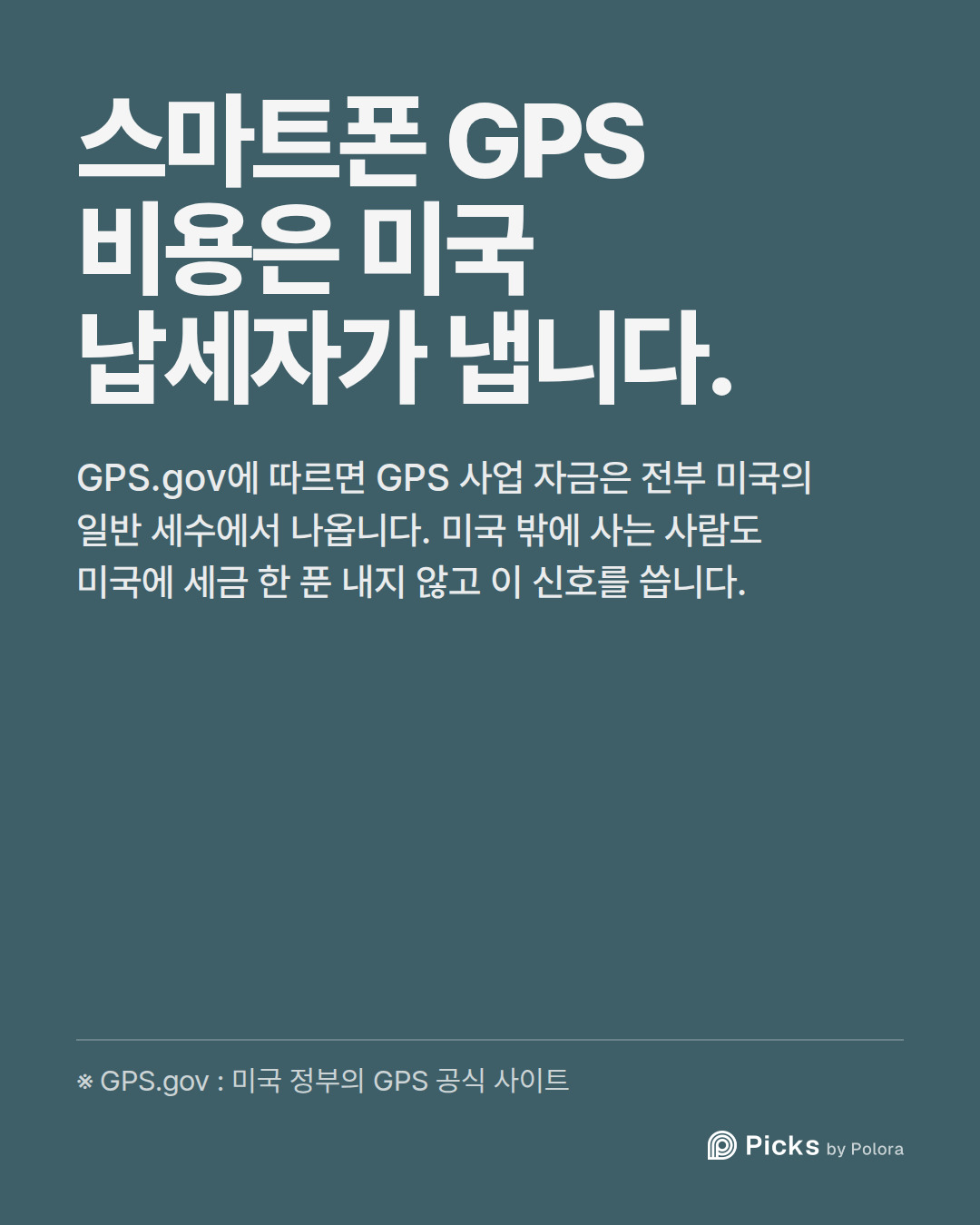
하지만 그 점의 일부는 휴대폰 제조사도, 지도 앱 회사도 갖고 있지 않은 위성에서 옵니다. 그중 가장 잘 알려진 것이 GPS이고, 미국 우주군이 운영하고 관리합니다. 미국 정부의 GPS 공식 사이트는 누가 돈을 내는지 분명하게 적어 둡니다 : "전 세계가 누리는 GPS 서비스의 비용은 미국 납세자가 냅니다. GPS 사업 자금은 전부 미국의 일반 세수에서 나옵니다."
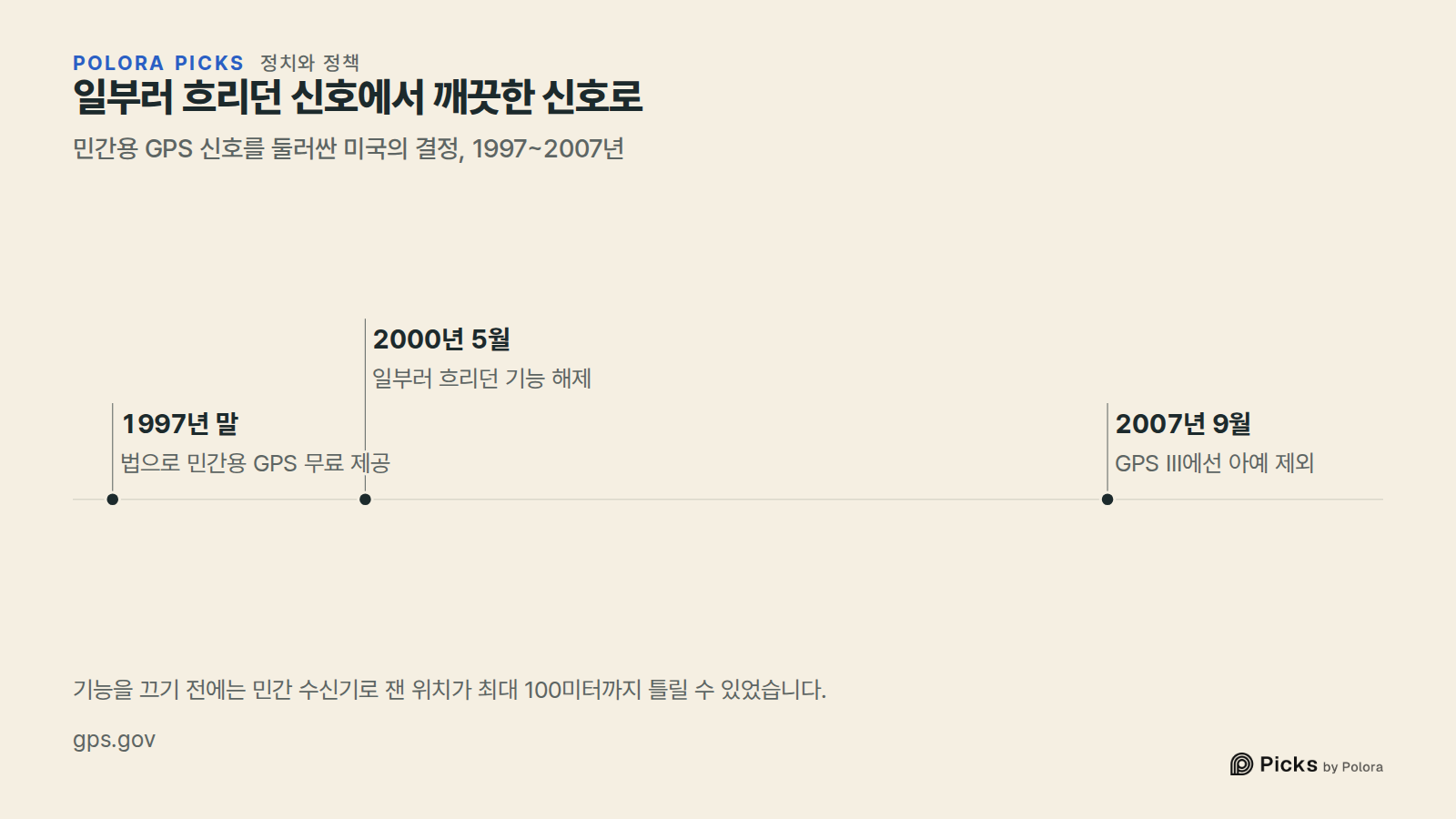
GPS가 공짜인 것은 언제든 슬그머니 거둬들일 수 있는 호의가 아닙니다. 미국 법에 적혀 있습니다. 미국 연방법전 제10편 제2281조는 국방부 장관에게 민간용 GPS 서비스를 "평화적인 민간, 상업, 과학 용도로 전 세계에 끊김 없이, 직접 이용료를 받지 않고" 제공하라고 지시합니다. 이 조항은 1997년 말에 제정된 1998 회계연도 국방수권법에서 나왔습니다. 다만 법이 막는 것은 요금을 물리는 일이지, 서비스가 절대 끊기지 않는다고 약속하는 것은 아닙니다.
여기서 '무료'는 쓰는 데 돈이 들지 않는다는 뜻이지, 만드는 데 돈이 들지 않는다는 뜻이 아닙니다. GPS 청구서를 받는 사람은 없지만, 위성과 로켓과 지상 기지국 비용은 미국 납세자가 댑니다. GPS 공식 사이트는 GPS를 민영화할 계획도 없다고 덧붙입니다.
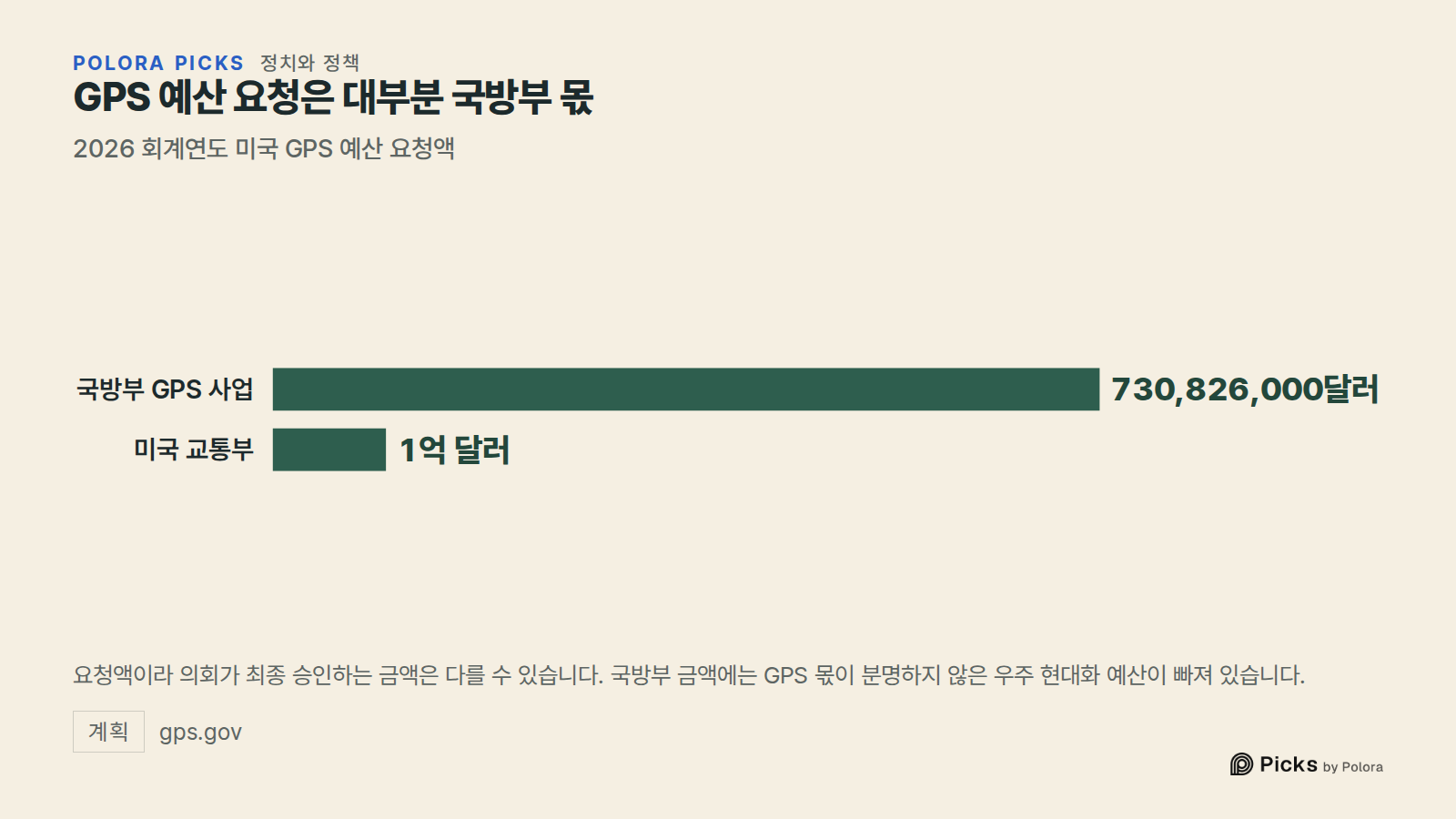
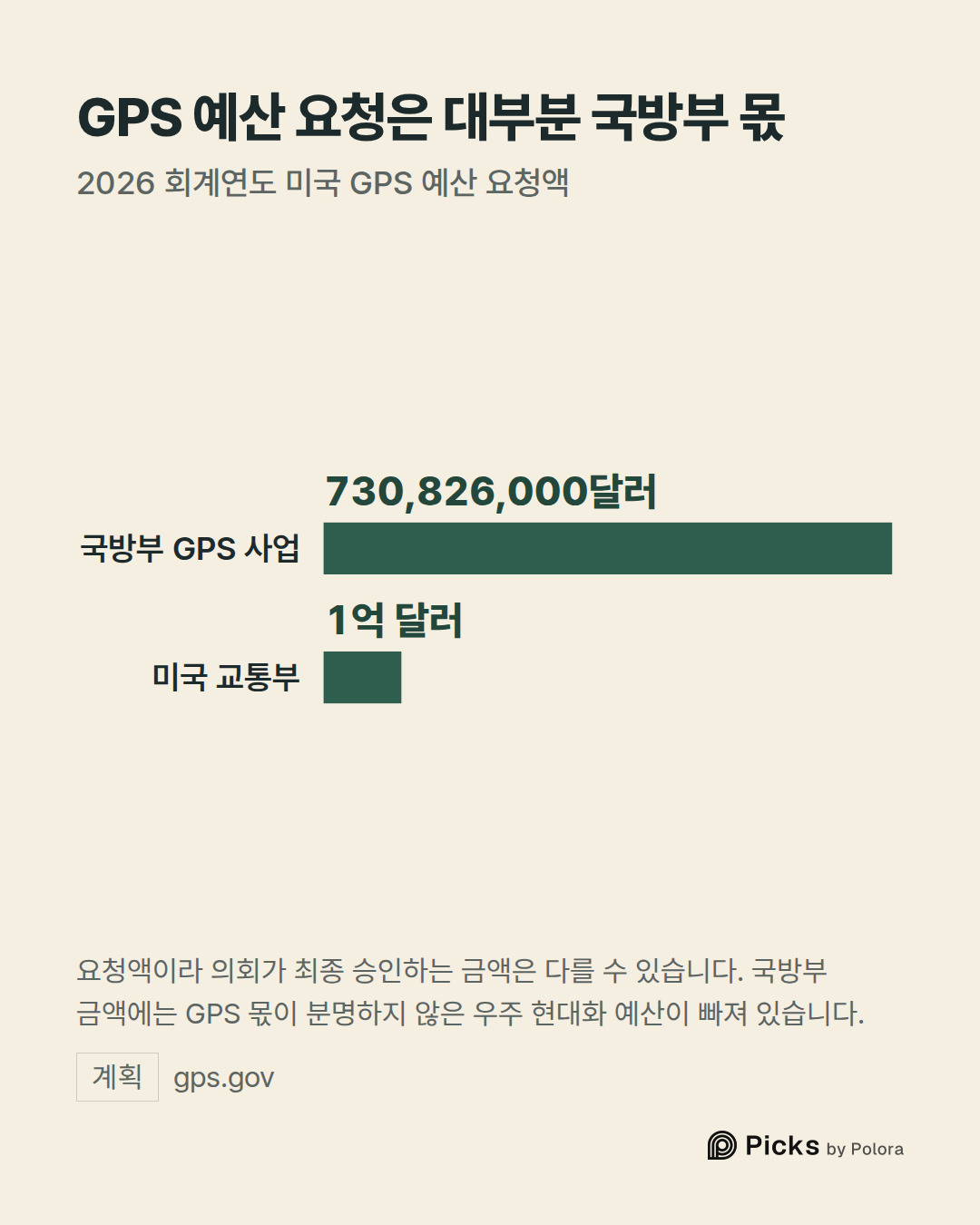
2026 회계연도 대통령 예산 요청서는 국방부 GPS 사업에 730,826,000달러를 잡아 두었습니다. 위성 구매와 연구개발에 드는 돈입니다. 어디까지나 요청액이라, 의회가 최종 승인하는 금액은 다를 수 있습니다. GPS 공식 사이트는 이와 별도로 우주 현대화 예산 항목이 있지만 그 가운데 GPS 몫이 얼마인지는 분명하지 않다고 밝힙니다. 그러니 이 숫자가 GPS에 드는 한 해 비용 전부는 아닙니다.
민간 쪽 예산은 훨씬 작습니다. 미국 교통부의 요청액은 1억 달러로, 항공기를 위해 GPS 오차를 보정하는 시스템인 WAAS에 9,200만 달러, 위치와 시각 측정 연구에 800만 달러입니다. GPS 공식 사이트에 따르면 GPS 예산은 대부분 국방부를 통해 편성됩니다. 내 휴대폰에 닿는 신호의 청구서가 대부분 군사 예산 안에 들어 있다는 뜻입니다.
이 무료 신호는 예전에는 일부러 정확도를 떨어뜨려 놓은 것이었습니다. '선택적 가용성(Selective Availability)'이라는 기능이 민간용 정확도를 고의로 낮췄고, 1990년대에는 민간 수신기로 잰 위치가 최대 100미터, 대략 축구장 하나 길이만큼 틀릴 수 있었습니다.
2000년 5월, 빌 클린턴 대통령이 국방부에 이 기능을 끄라고 지시했고, 민간용 정확도는 10배 좋아졌습니다. GPS 공식 사이트는 이 일을 계기로 상업용, 민간용 제품에 GPS가 널리 퍼졌다고 설명합니다. 2007년 9월에는 미국 정부가 차세대 위성 GPS III를 아예 이 기능 없이 만들겠다고 발표했습니다.
하늘에 있는 위성항법 시스템이 GPS만은 아닙니다. 유럽연합 집행위원회는 전 세계를 덮는 위성항법 시스템으로 넷을 꼽습니다. 미국의 GPS, 러시아의 글로나스(GLONASS), 중국의 베이더우(BeiDou), 유럽의 갈릴레오(Galileo)입니다. 요즘 휴대폰은 이 가운데 여러 개를 함께 받을 수 있습니다. 예를 들어 애플의 iPhone 17 사양표에는 GPS, GLONASS, Galileo, QZSS, BeiDou, NavIC가 올라 있습니다. 다만 사양표만 보고 모든 휴대폰이 늘 모든 시스템을 동시에 쓴다고 말할 수는 없습니다.
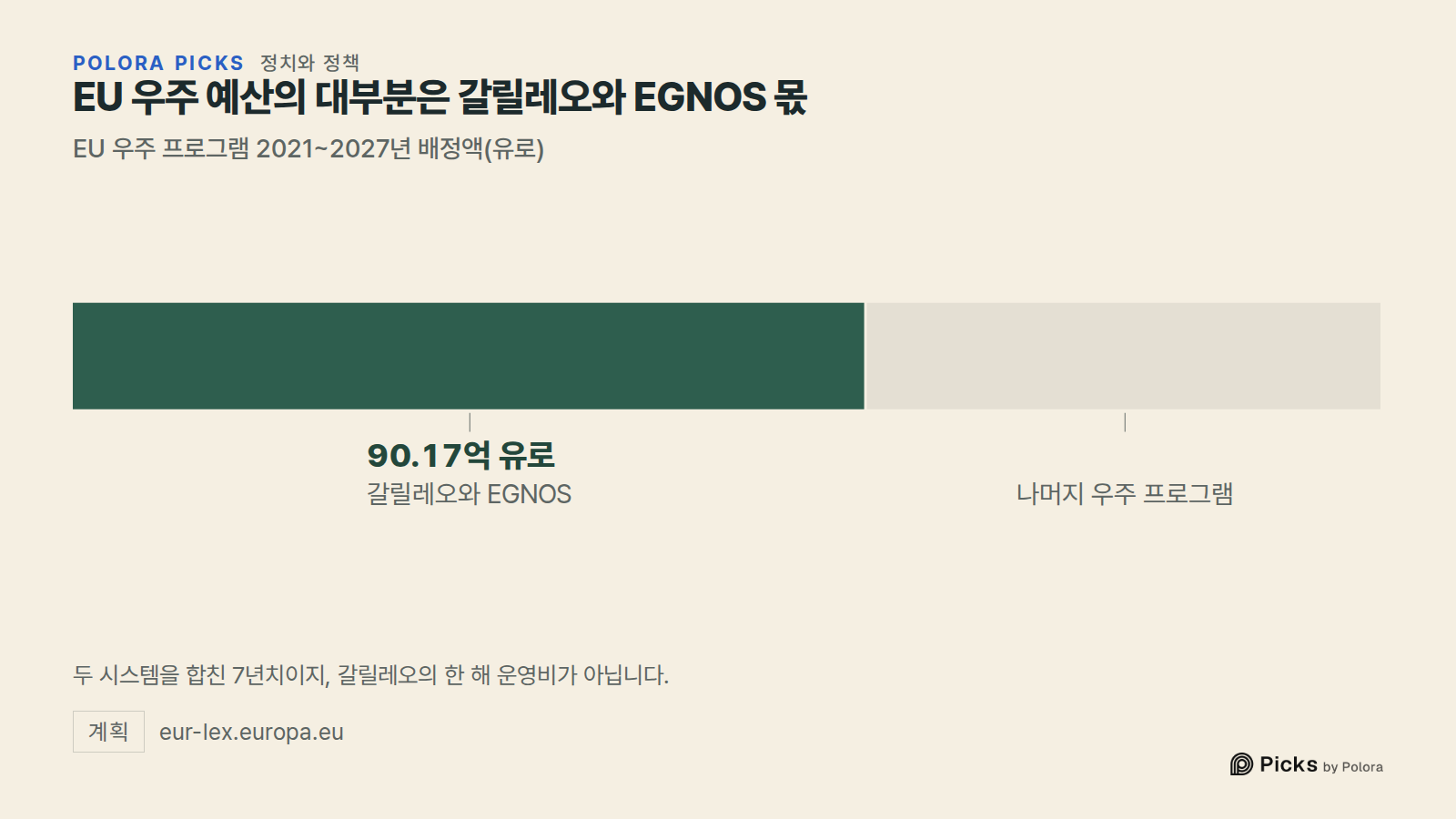
갈릴레오도 세금으로 운영되지만, 돈이 나오는 예산이 다릅니다. EU는 갈릴레오가 전액 유럽연합 자금으로 운영되고 민간이 통제하며, 허가받은 정부 사용자에게만 열린 서비스 하나를 빼면 모든 사용자에게 무료로 제공된다고 밝힙니다. EU의 2021~2027년 우주 프로그램은 전체 148.8억 유로 가운데 90.17억 유로를 갈릴레오와 그 지역 보조 시스템인 EGNOS에 배정했습니다. 이 금액은 두 시스템을 합친 7년치이지, 한 해 운영비가 아닙니다.
위성 신호는 건물 안이나 높은 빌딩 사이에서 약해지기 때문에, 휴대폰은 위성에만 기대지 않습니다. 애플은 자사 위치 서비스가 셀룰러, 와이파이, GPS, 블루투스 정보를 함께 써서 위치를 알아낸다고 설명합니다. 구글은 안드로이드의 '위치 정확도' 기능이 GPS, 와이파이, 이동통신망, 휴대폰 자체 센서를 결합한다고 설명합니다.
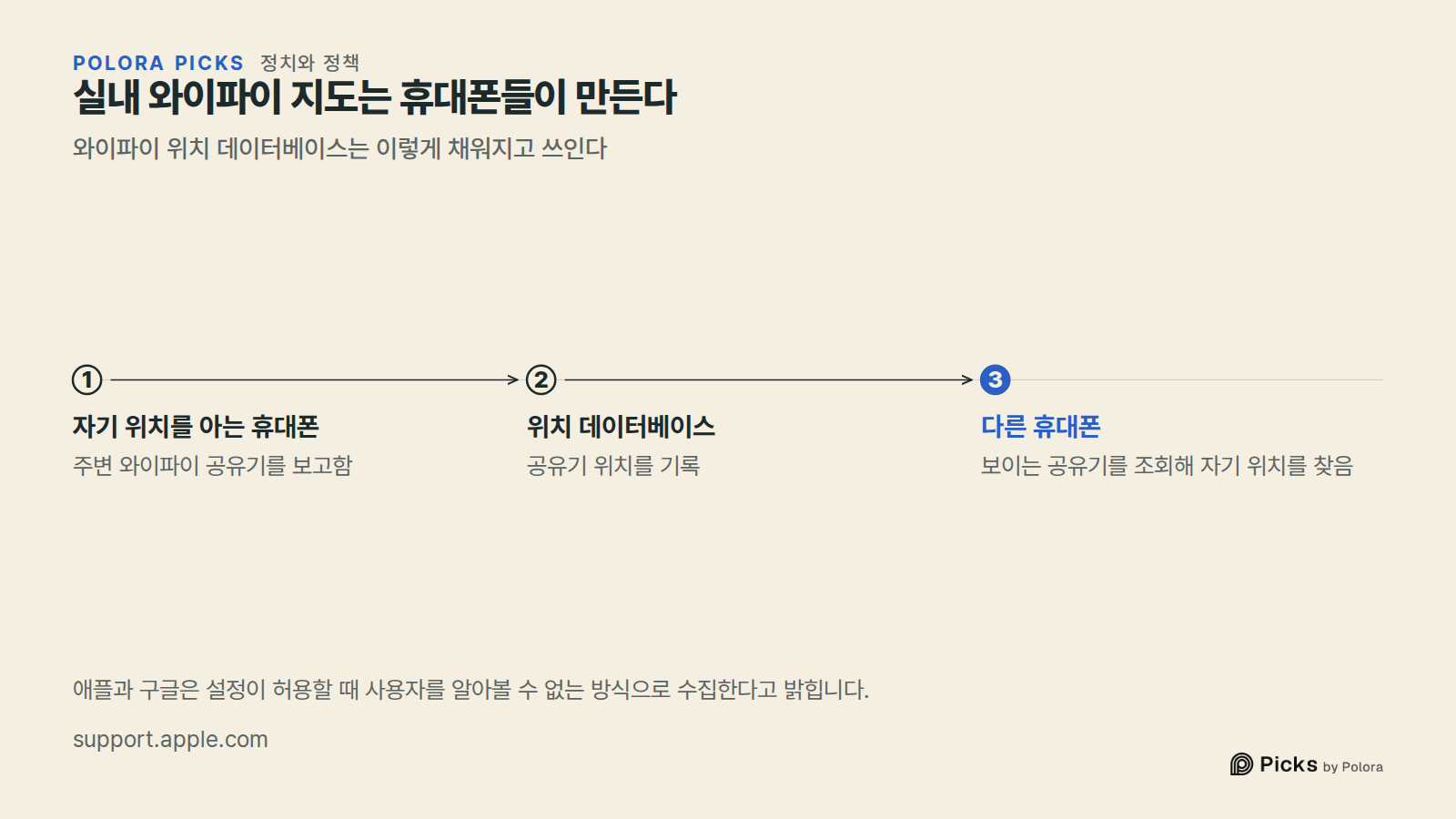
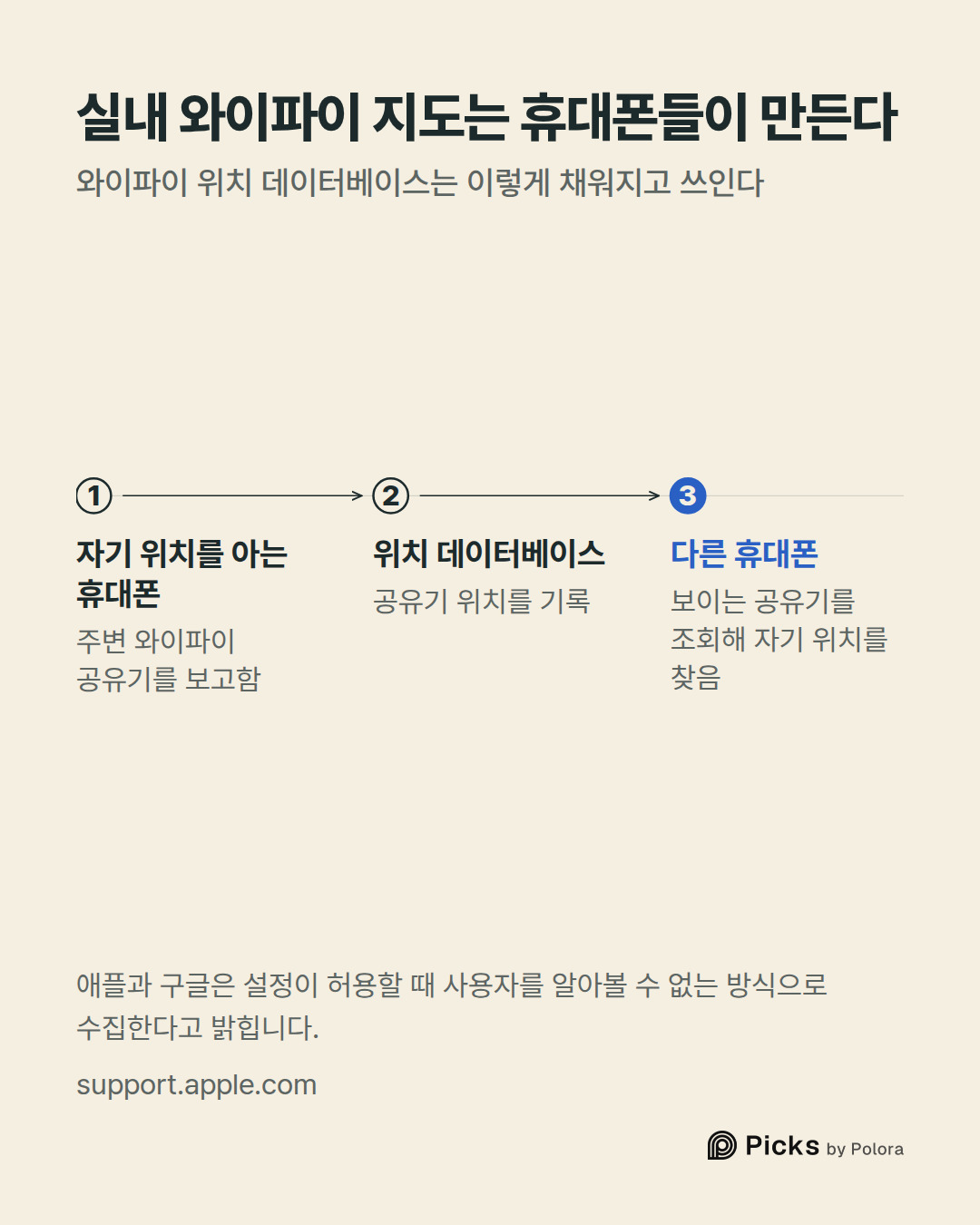
와이파이로 위치를 찾으려면 무선 공유기들이 어디에 있는지 담은 데이터베이스가 필요하고, 이 데이터베이스는 설정이 허용하는 한 휴대폰들이 채웁니다. 애플은 위치 서비스가 켜진 기기가 주변 와이파이 핫스폿과 기지국의 위치 정보를 주기적으로 보내며, 이 정보는 사용자를 알아볼 수 없는 방식으로 수집된다고 밝힙니다. 구글은 위치 정확도가 켜져 있으면 기기 주변의 무선 신호 정보를 주기적으로 수집하되, 특정인과 연결되지 않고 주기적으로 바뀌는 식별자를 쓴다고 밝힙니다. 미국 메릴랜드대학교 연구진의 2024년 연구도 같은 구조를 설명합니다. 자기 위치를 아는 휴대폰이 주변 공유기를 보고하면, 다른 기기들이 그 공유기를 조회해 자기 위치를 찾는다는 것입니다.
정리하면 파란 점 하나에 돈을 내는 쪽은 여럿입니다. 궤도에서 오는 신호는 공공 서비스로, GPS는 미국 납세자가, 갈릴레오는 EU 예산이 비용을 댑니다. 미국 법은 지구 어디에 있는 누구든 GPS를 직접 이용료 없이 쓰게 하고, EU도 갈릴레오의 개방형 서비스를 무료로 제공합니다. 수신 장치 값은 휴대폰 가격에 들어 있습니다. 기업이 가진 부분은 그 위에 얹혀 있습니다. 고객의 휴대폰들이 함께 만든 와이파이 위치 데이터베이스, 지도, 앱에 들어간 위치 서비스입니다.
그러니 지도 앱이 1초 만에 내 위치를 찾아낼 때, 그 뒤의 위성 신호는 이미 누군가 값을 치른 것입니다. 그 값은 대부분 청구서를 받아 본 적 없는 사람들, 곧 납세자들이 치렀습니다. GPS라면 그 돈은 주로 미국 국방 예산을 거쳐 나갔습니다.
The short answer: you are not sent a bill for the GPS signal, but you already paid for it — through taxes.
GPS is owned and operated by the U.S. government. The constellation is run by the U.S. Space Force, and its funding comes from general U.S. tax revenues through the defense budget. The U.S. government's own GPS materials put this plainly: the American taxpayer pays for the service, and there are no direct user fees.
Crucially, that “free” signal is not a favor that could quietly disappear. U.S. law, specifically 10 U.S.C. § 2281, directs the Secretary of Defense to provide the civil GPS signal worldwide on a continuous basis, free of direct user fees for peaceful civil, commercial, and scientific uses. So the satellite signal is closer to a public utility than a product.
But the full “blue dot” is more complicated than GPS alone. A modern phone listens to several satellite systems at once: the U.S. GPS, Europe’s Galileo, Russia’s GLONASS, China’s BeiDou, and sometimes regional systems like Japan’s QZSS or India’s NavIC. Each of those is paid for by its own government and, ultimately, its own taxpayers. Europe’s Galileo, for example, is funded through the EU budget.
What yo…
Beta · gpt-6-sol
U.S. taxpayers pay for the GPS satellites and ground system. The U.S. Space Force operates them, and the civilian signal is available worldwide without a direct user fee. That does not mean every person using GPS has paid U.S. taxes: someone anywhere with a compatible receiver can use the signal. (gps.gov)
Your phone’s *blue dot* is not necessarily GPS alone. A phone may also use Europe’s EU-funded Galileo, plus Wi-Fi and cell-tower information; you pay for the receiver as part of the phone. The map and location services are a separate layer, supplied by companies. So Alpha’s “you already paid through taxes” is apt for a U.S. taxpayer, but too broad as an answer for every user worldwide. (eu-space.europa.eu)
Manuscript verification notes:
- Funding and law — supported. GPS.gov says general U.S. tax revenues fund GPS, largely through Defense. The current text of 10 U.S.C. § 2281(b) requires continuous worldwide civil service free of *direct user fees*; its source credit traces the section to the FY1998 defense authorization act, enacted Novem…
Gamma · gemini-3.1-pro
Manuscript Verification and Requested Checks:
Beta has already laid out a solid foundation. I will confirm the specific elements the editor requested to be checked against the source documents.
* FY 2026 Funding: The manuscript correctly labels the $730.826 million (DOD) and $100 million (DOT) figures as the *President's budget request*. This distinction is vital to keep. My check of the enacted FY 2026 Defense Appropriations reveals that Congress altered the GPS procurement lines (for example, stepping in to fund GPS IIIF spacecraft that were omitted in the initial request to avoid a gap year). Therefore, these numbers must strictly remain attributed to the *request*, not final spending.
* 10 U.S.C. § 2281: The statute mandates that the civil GPS service be provided "free of direct user fees." The historical credit traces the addition of § 2281 to Public Law 105-85, section 1074, which was the National Defense Authorization Act for Fiscal Year 1998, enacted on November 18, 1997. The manuscript's claim is fully supported. (uscode.house.gov)
* Selective Ava…
Researcher · gpt-6-luna
What the sources support
- Who funds GPS: GPS.gov says the program is funded from general U.S. tax revenues, with most of the funding budgeted through the Defense Department. It also says the Space Force oversees GPS launches and operates the system on behalf of the department. The civil service is free of direct user fees, but users worldwide can receive it; that does not mean every user has paid U.S. taxes. GPS.gov, Program Funding; GPS.gov, GPS roles and responsibilities.
- The legal guarantee: 10 U.S.C. § 2281 requires continuous worldwide GPS Standard Positioning Service for peaceful civil, commercial and scientific uses, free of direct user fees. The code credits its addition to Public Law 105-85, § 1074, enacted November 18, 1997. That supports the manuscript’s claim about the law; it should not be read as a promise that service can never be interrupted. U.S. Code § 2281.
- FY 2026 figures: GPS.gov lists $730.826 million for Defense and $100 million for Transportation, including $92 million for WAAS. These are presented on the page as bu…
The Arbiter · gpt-6-sol
The voices agree on the central distinction: the GPS satellite signal is not billed to phone users, while the phone’s receiver, maps and other inputs to its location display are separate costs. The U.S. funding page describes GPS as taxpayer-funded; the statute requires its civil service to be provided worldwide free of *direct user fees*. (gps.gov)
Two qualifications matter for the verdict. Alpha’s “you already paid through taxes” does not apply to every user worldwide, and “the blue dot” is broader than GPS: Apple describes a location calculation that can also use Wi-Fi and cellular information. The manuscript’s $730.826 million Defense figure is a FY2026 budget-request total, not a complete or confirmed enacted annual cost; GPS.gov flags an additional line whose GPS share is unclear. (support.apple.com)
The remaining unsupported extension is Alpha’s claim about companies earning money from users’ location data. The sources discussed establish that companies provide location-related services, not that particular revenue claim. The verdict will address the…
The Arbiter's Final Verdict · gpt-6-sol
U.S. taxpayers pay for GPS; you are not charged to receive its civilian satellite signal. The U.S. Space Force operates the system, and U.S. law requires its civil service to be available worldwide free of *direct user fees*. A person using GPS outside the United States need not have paid U.S. taxes.
That answers the question about GPS, but not the entire blue dot on a map. You pay for a satellite receiver when you buy your phone. Its position may also draw on other satellite systems—including EU-funded Galileo—and on Wi-Fi, cellular information and company-provided maps and location services. Those are distinct from the free GPS signal.
Verdict on the manuscript: Its taxpayer-funded GPS premise stands, with that distinction kept clear. Its FY2026 $730.826 million Defense and $100 million Transportation figures are budget requests, not a verified complete or enacted annual GPS bill. The law does not guarantee that service can never be interrupted. The account of [Selective Availability](https://archive.gps.gov/systems/…