대개 하루 넘게 전에 먹은 여러 끼가 섞여 나옵니다. 건강한 성인을 조사한 연구에서 음식의 첫 흔적이 나오기까지 보통 하루가 넘게 걸렸습니다. 밥 먹고 화장실이 급한 것은 장에 이미 있던 것을 내보내는 반응입니다.
과학과 건강 · 2026-10-22
밥만 먹으면 화장실에 가고 싶은 이유
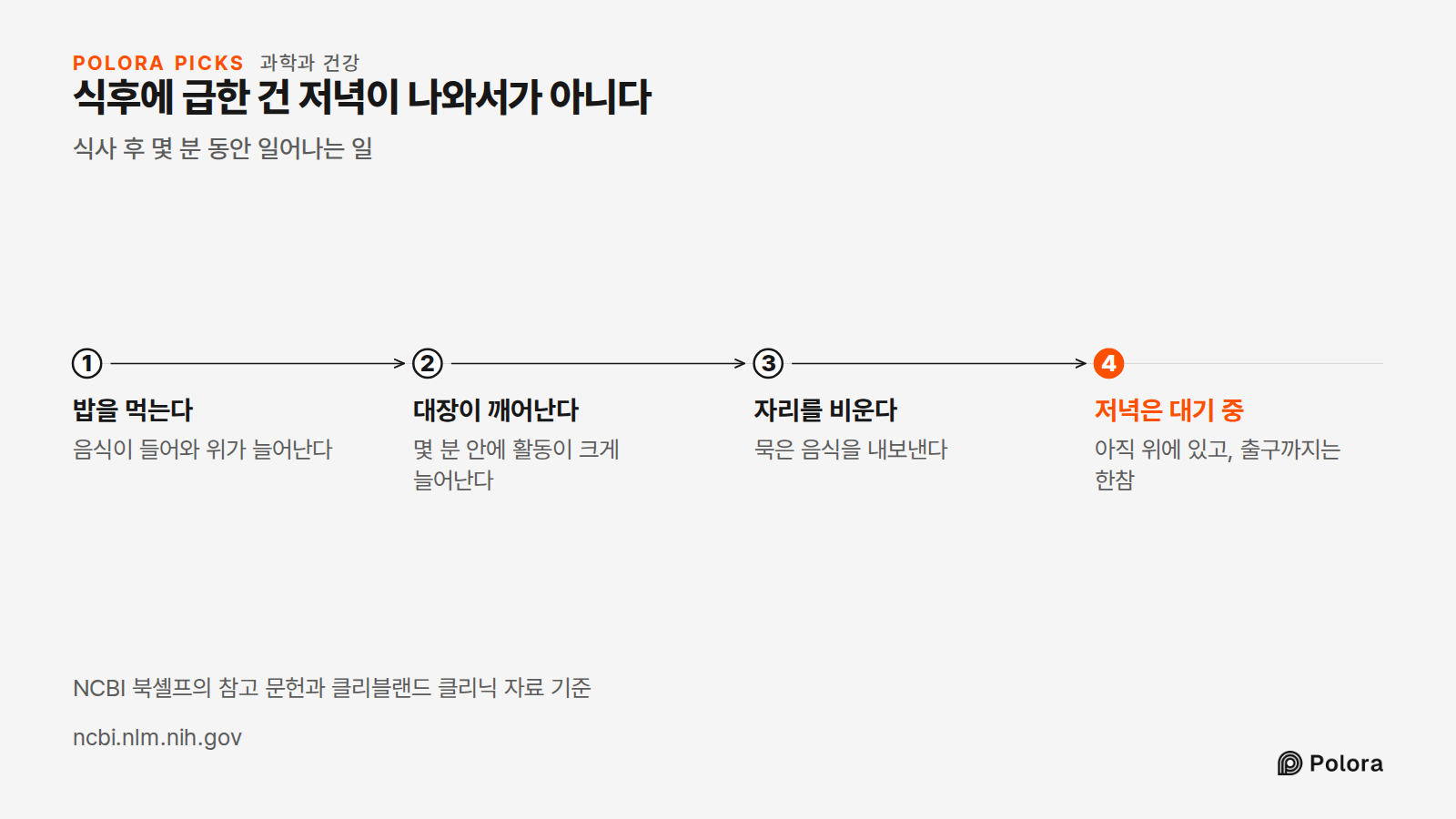
저녁을 다 먹고 얼마 안 가 화장실이 급해집니다. 방금 먹은 저녁이 나오려는 것이라고 생각하기 쉽지만 그렇지 않습니다. 식사 몇 분 뒤라면 그 음식은 아직 위에 머물러 있고, 앞으로 몇 미터나 되는 장을 지나가야 합니다.
이때 느끼는 것은 반사 작용입니다. 음식이 들어와 위가 늘어나면 대장이 더 활발하게 움직이기 시작합니다. 미국 국립의학도서관이 운영하는 온라인 자료실 NCBI 북셸프의 참고 문헌에 따르면, 대장의 전기 활동은 식사 후 몇 분 안에 크게 늘어납니다. 식후에 화장실에 가고 싶어지는 것이 바로 이 반사 때문입니다. 미국 병원 클리블랜드 클리닉의 설명은 더 간단합니다. 새 음식이 들어올 자리를 만들도록 묵은 음식을 내보내라고 장에 알리는 신호라는 것입니다.
그러니 밥 먹고 화장실이 급한 것은 자리를 비우는 일입니다. 나오는 것은 대장에서 기다리고 있던 것이고, 하루 넘게 전에 먹은 음식인 경우가 많습니다.
연구자들은 대변에 섞여 나오면 눈에 띄는 것을 먹게 해서 이 시간을 재 왔습니다. 가장 큰 연구 가운데 하나인 2021년 의학 학술지 Gut 논문에서는 영국과 미국의 건강한 성인 863명이 새파랗게 물들인 머핀을 두 개씩 먹고, 대변에 파란색이 처음 보인 때를 기록했습니다. 걸린 시간 순서로 사람들을 줄 세웠을 때 한가운데 오는 값은 28.7시간이었습니다. 이는 첫 흔적이 나온 때이지, 먹은 것이 다 빠져나간 때가 아닙니다.
사람마다 차이가 컸습니다. 약 11명 중 1명은 14시간이 안 되어 파란색을 보았고, 약 5명 중 1명은 59시간 이상 기다렸습니다. 그런데도 이들은 모두 건강한 사람으로 분류된 참여자였습니다.
다른 방법으로 재도 비슷합니다. 2023년에 나온 한 종합 분석은 건강한 지원자 1,885명이 장 속 위치를 알려 주는 작은 전자 캡슐을 삼킨 연구 22편을 모았습니다. 그중 음식이 지나가는 전체 시간을 보고한 연구는 11편뿐이었고, 보고된 값은 23.0시간에서 37.4시간 사이였습니다. 연구에 따라 평균을 낸 곳도, 중앙값을 낸 곳도 있습니다. 이 범위는 사람 사이가 아니라 연구와 연구 사이의 차이입니다. 밥을 먹고 나서 소화되지 않은 옥수수 알갱이가 나오는지 살펴보는 사람은 같은 실험을 집에서 대충 해 보는 셈입니다. 파란 머핀처럼 이 방법도 첫 조각이 나온 때만 알려 줍니다.
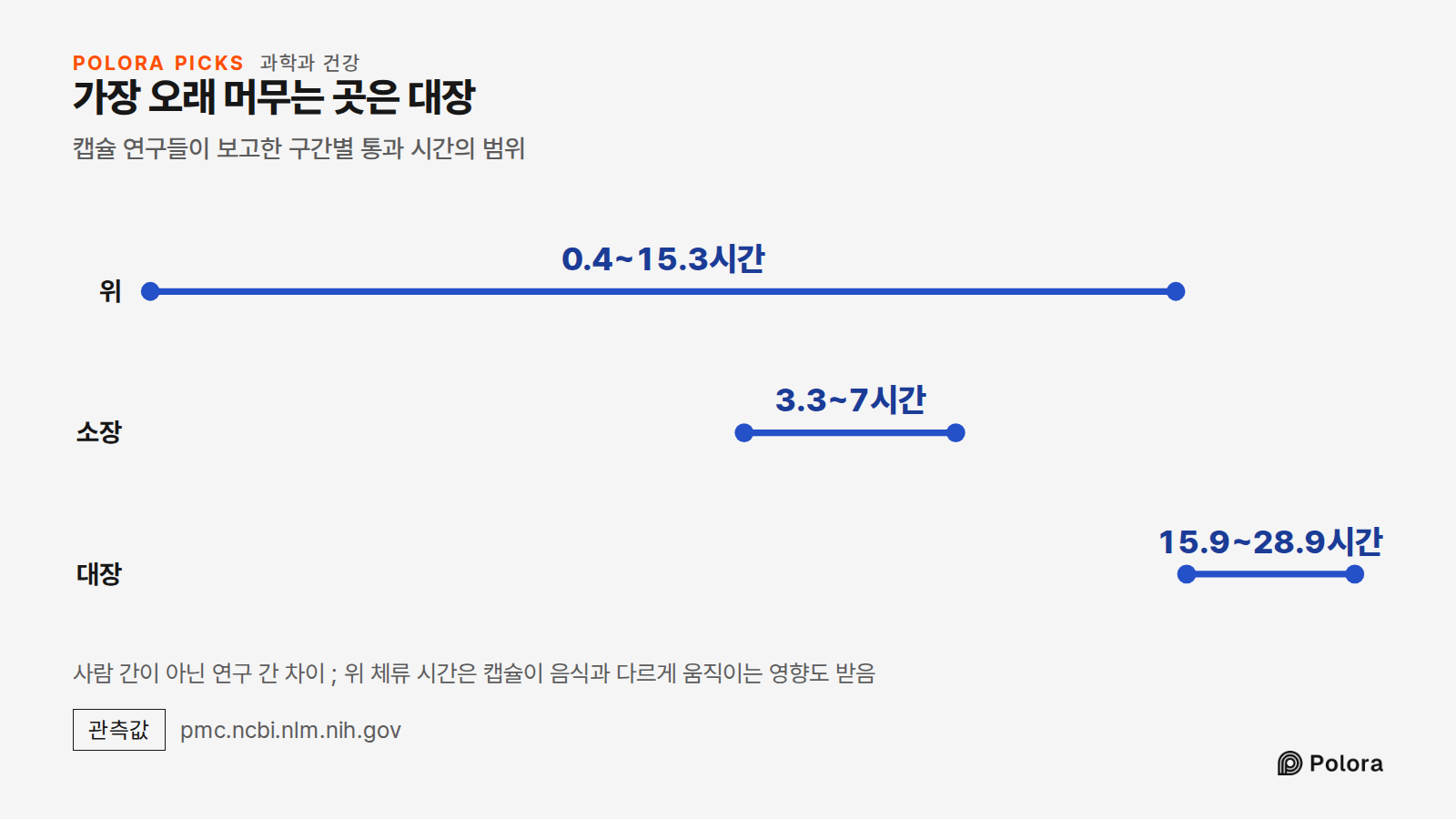
음식이 지나는 길은 크게 세 구간입니다. 위는 음식을 으깨고 뒤섞어 조금씩 내려보냅니다. 소장은 영양분 대부분을 흡수합니다. 대장은 물기를 다시 빨아들이고, 남은 것을 몸 밖으로 나갈 때까지 붙잡아 둡니다.
2023년 종합 분석이 다룬 캡슐 연구들에서 소장 통과 시간은 3.3시간에서 7시간, 대장 통과 시간은 15.9시간에서 28.9시간으로 보고됐습니다. 전체 시간과 마찬가지로 이 범위도 사람 사이가 아니라 연구 결과 사이의 차이입니다. 연구마다 가장 크게 달랐던 것은 위에 머무는 시간으로 0.4시간에서 15.3시간까지였는데, 캡슐이 음식과 다르게 움직이는 탓도 있습니다. 건강한 지원자 215명을 대상으로 한 캡슐 연구에서는 캡슐을 식사 전이 아니라 식사 후에 삼키기만 해도 측정된 위 체류 시간이 중앙값으로 52분 달라졌습니다.
음식이 오래 머무는 곳은 대장입니다. 소장은 몇 시간이면 지나가지만, 대장에서는 하루 안팎을 보냅니다.
한 끼는 한꺼번에 나오지 않습니다. 1969년에 발표돼 지금도 이런 검사의 기준이 되는 연구에서 건강한 사람 25명이 엑스레이에 보이는 작은 플라스틱 표지물을 삼켰고, 연구자들은 대변을 모아 엑스레이로 찍어 나온 표지물 수를 셌습니다. 모두 사흘 안에 첫 표지물이 나왔고, 대부분은 닷새 안에 표지물의 80퍼센트를 내보냈습니다. 한 끼 분량의 표지물이 며칠에 걸쳐 나온 것입니다.
이유 하나는 대장이 움직이는 방식에 있습니다. 대장은 대부분의 시간 동안 안에 든 것을 천천히 주무르듯 움직입니다. 그러다 하루 몇 번, 강한 수축의 물결이 큰 덩어리를 앞으로 밀어냅니다. 건강한 지원자 10명의 대장을 24시간 기록한 연구에서 이런 물결은 중앙값으로 하루 6번이었습니다. 다만 이 물결을 어떻게 정의하느냐에 따라 연구마다 세는 횟수가 다릅니다. 건강한 성인 25명을 조사한 다른 연구에서는 이 물결이 주로 잠에서 깬 뒤, 식사 뒤, 배변할 때 나타났습니다.
그래서 대장에는 여러 끼의 찌꺼기가 한데 뭉쳐 있고, 이를 몇 번에 나눠 내보냅니다. 한 번의 배변에는 하루치가 넘는 식사가 조금씩 섞여 있을 가능성이 큽니다. 표지물은 한 끼가 시간에 따라 어떻게 흩어져 나오는지를 보여 줄 뿐, 대변 한 번의 얼마가 어느 끼니에서 왔는지를 재지는 않습니다.
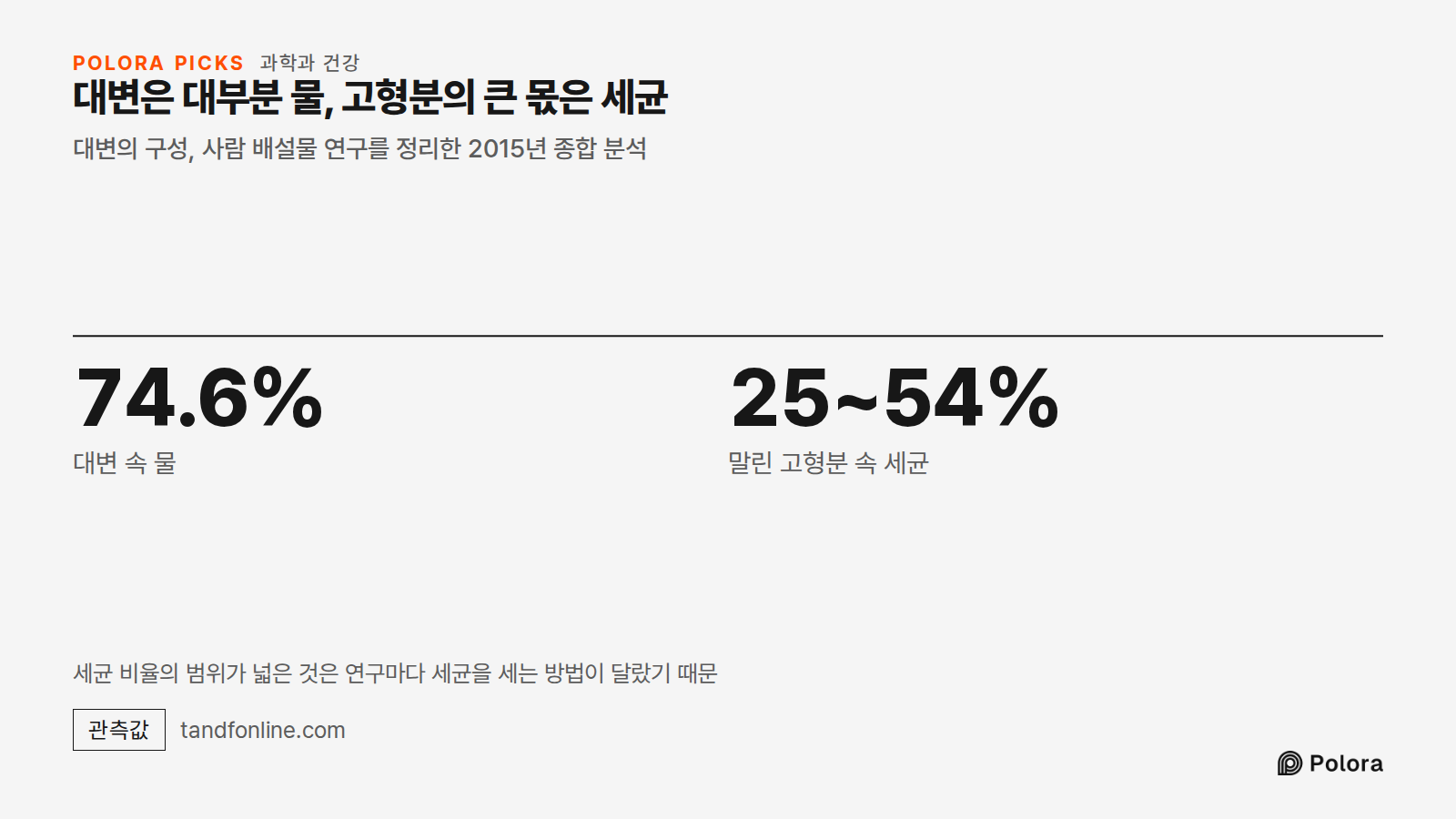
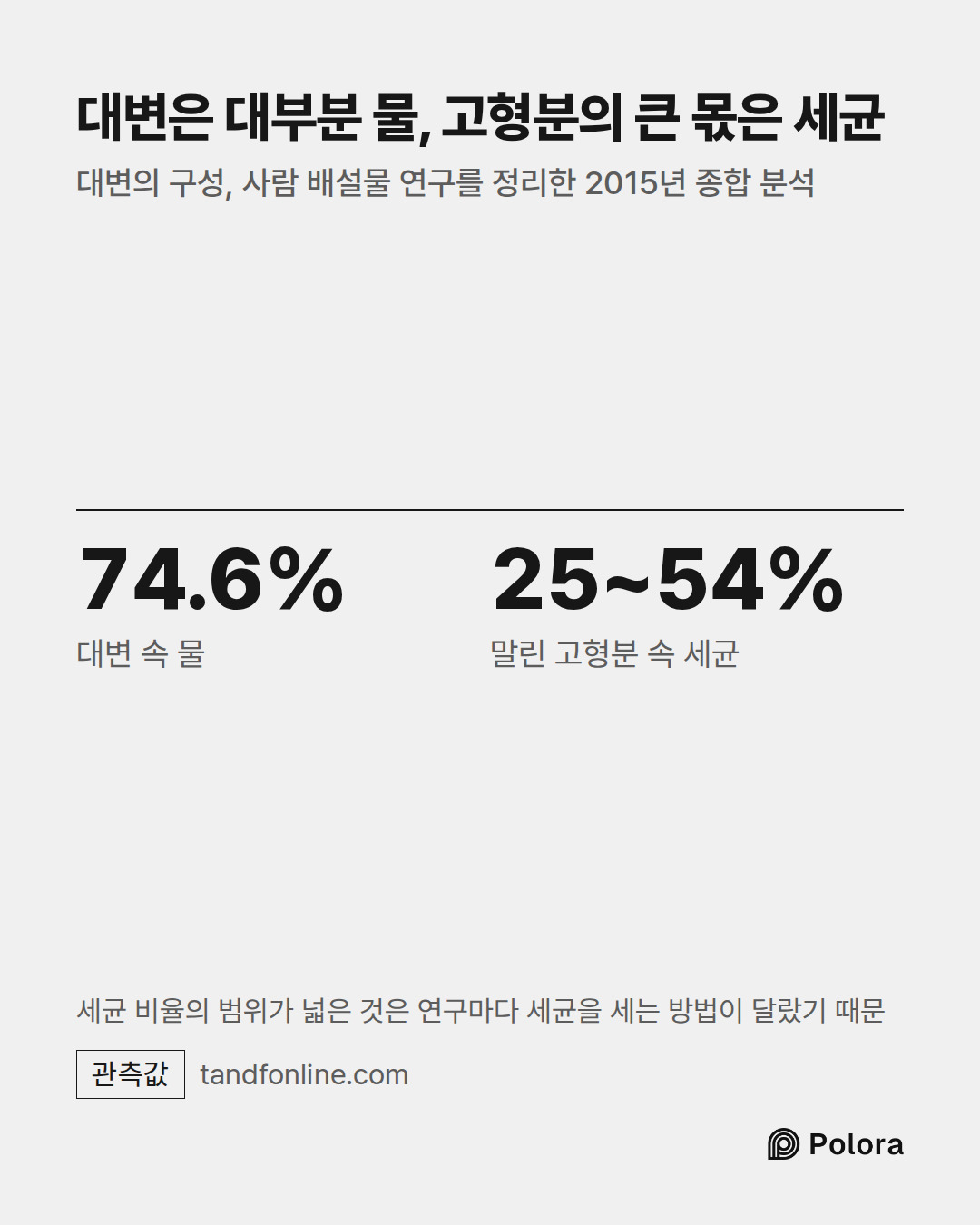
그 끼니들의 찌꺼기조차 대변의 일부일 뿐입니다. 사람 배설물에 관한 연구를 정리한 2015년 종합 분석에 따르면 대변은 약 74.6퍼센트가 물입니다. 물기를 빼고 남은 고형분에서 세균은 살아 있는 것과 죽은 것을 합쳐 25에서 54퍼센트를 차지했습니다. 이 분석이 모은 이전 연구들의 값이고, 범위가 넓은 것은 연구마다 세균을 세는 방법이 달랐기 때문입니다.
고형분의 나머지는 소화되지 않은 탄수화물, 식이섬유, 단백질, 지방이고, 그 양은 무엇을 먹느냐에 따라 달라집니다. 같은 분석에서 한 사람이 하루에 보는 대변은 중앙값 128그램, 말리면 29그램이었고, 식이섬유를 더 많이 먹는 저소득 국가에서는 그 무게가 두 배쯤 됐습니다.
그러니 대변은 대부분 물이고, 고형분의 큰 몫은 장내 세균입니다. 먹은 음식의 찌꺼기는 그 안에 든 것의 일부에 지나지 않습니다.
여기 나온 수치는 모두 특정한 방법으로 잰 사람들의 집단을 설명합니다. 어느 것도 내 몸에서는 얼마나 걸리는지 말해 주지 않습니다. 파란 머핀과 옥수수 방법은 먹은 것의 첫 흔적을 잴 뿐 마지막까지 다 빠져나간 때를 재지 않고, 엑스레이 표지물은 나머지가 더 오래 걸린다는 것을 보여 줍니다. 대변 한 번의 얼마가 어느 끼니에서 왔는지를 재는 방법은 이 중에 없습니다.
시간 기록도 보기만큼 정확하지 않습니다. 파란 머핀 연구와 215명 캡슐 연구 모두에서 측정된 시간이 대략 24시간 간격으로 몰려 있었습니다. 논문들은 이렇게 몰리는 현상을 보고하면서도 원인을 확정하지는 않았습니다. 그럴듯한 이유 하나는 많은 사람이 하루 한 번 비슷한 시각에 화장실에 가기 때문에, 음식이 나온 것을 다음 번 배변 때에야 확인할 수 있다는 것입니다. 캡슐 연구에서 여성의 전체 통과 시간은 남성보다 중앙값으로 263분 길었습니다. 이는 두 집단 사이의 차이이지, 한 사람 한 사람에게 들어맞는 규칙이 아닙니다.
그래도 이 연구들이 한결같이 가리키는 답의 윤곽은 있습니다. 오늘 본 대변에는 하루 넘게 전에 먹은 음식이 다른 끼니의 찌꺼기, 그리고 상당량의 장내 세균과 섞여 들어 있을 가능성이 크고, 정확한 구성은 사람마다 다릅니다. 저녁 먹고 화장실이 급한 것은 저녁이 나오는 것이 아닙니다. 저녁은 자리를 만들었을 뿐입니다.
Is the poop you pass today from last night's dinner, or from something you ate days ago?
Alpha · deepseek-v4-pro
Short answer: for most people, what you pass today is not last night’s dinner. It is mostly made from food eaten a day or more ago, mixed together — so “something you ate days ago” is much closer to the truth. Last night’s dinner is probably still inside you.
The clearest evidence is the blue-muffin study of 863 healthy adults: the median time from eating a dyed meal to seeing blue in the stool was 28.7 hours. That is roughly a day and a quarter. But the spread matters: about 1 in 11 people saw the marker in under 14 hours, while about 1 in 5 waited 59 hours or more. So a little of last night’s dinner *can* leave within a day in some fast-transit people — but for most people, yesterday evening’s meal is not coming out the next morning.
The capsule studies point the same way. Across 22 studies, average whole-gut transit time ranged from about 23 to 37 hours. Most of that time is spent in the colon — roughly 16 to 29 hours on average — while the stomach and small intestine pass food onward in a few hours. That is why the meal you ate last night is unlikely to have made the whole trip by this morning.
There is also a trap in the question: one stool is not one…
Beta · gpt-6-sol
Alex, what you pass today is generally older material, not the dinner you just ate. Eating can trigger the *gastrocolic reflex*: your colon moves contents already there, sometimes giving you the urge to go within minutes. That urge does not mean the new meal has travelled through you. (my.clevelandclinic.org)
The manuscript’s main answer holds, but its precision needs care. In a study of 863 adults, the median time until blue dye from a muffin *first appeared* in stool was 28.7 hours; 79 participants saw it in under 14 hours, while 174 waited at least 59 hours. First appearance is not the time when all of that meal has left. (gut.bmj.com)
Two corrections matter before publication:
- The capsule review’s 23.0–37.4-hour whole-gut range is a range of *reported study results*, not a range for individual people or simply a range of averages: six results were means and eleven were medians. Only 11 of its 22 studies reported whole-gut times. Capsules are also not identical to digesti…
Gamma · gemini-3.1-pro
Alex, the premise of the manuscript stands: the stool you pass today is a mixture of older material, and your dinner from last night is likely still making its way through your digestive tract.
Alpha and Beta have already highlighted the most significant adjustments needed for the manuscript, particularly regarding how transit times are measured and what those averages actually represent. I will address the specific checks the editor requested to ensure the piece is rock-solid before publication.
Here is what the sources confirm on the remaining editorial checks:
1. The Sweetcorn Test
Your reasoned description is accurate and supported by wider gastroenterology literature. Sweetcorn works as a home test because its outer shell is made of insoluble fiber that the body cannot digest, making it a visible marker. Health platforms and clinics describe it exactly as you do: it is a rough, untimed home marker that only indicates the *first appearance* of a meal, not the completion of its transit. You can safely keep this sentence.
2. Asnicar et al. 2021 (Blue Muffin Study)
The group cutoffs you used are exactly those defined by the study's authors: they categorized "fast" tra…
Researcher · gpt-6-luna
Verification findings
- Blue-muffin study: The paper reports 863 healthy participants, a median of 28.7 hours to the *first visible blue stool*, and the counts quoted in the manuscript—79 under 14 hours and 174 at 59 hours or more. The rounded fractions are accurate. This measures a marker’s first appearance, not when the whole meal has passed.
Source: https://pmc.ncbi.nlm.nih.gov/articles/PMC8349893/ (pmc.ncbi.nlm.nih.gov)
- Capsule review: The figures of 23.0–37.4 hours for whole-gut transit, 3.3–7 hours for small-intestinal transit, 15.9–28.9 hours for colonic transit, and 0.4–15.3 hours for gastric emptying are ranges across the reported study results—not a range describing individual people. The review says whole-gut transit was reported by 11 of its 22 studies; the values presented mix means and medians. The manuscript should call these “ranges across studies,” not imply they describe every healthy person.
Source: https://pmc.ncbi.nlm.nih.gov/articles/PMC10455695/ (pmc.ncbi.nlm.nih.gov)
- Wa…
The Arbiter · gpt-6-sol
The voices agree on the key distinction: an urge to go soon after eating does not mean that meal has already passed through you. The gastrocolic reflex moves contents already in the colon. (pmc.ncbi.nlm.nih.gov)
The publication question is how confidently to describe *which earlier meals* make up today’s stool. Beta and the Researcher caution that the cited studies time the first appearance of dye or the passage of capsules and markers; they do not measure the share of a particular bowel movement attributable to last night’s dinner. That makes “mostly from meals a day or more ago” a stronger claim than the measurements directly establish. Alpha and Gamma accept the broader explanation but speak more confidently about an individual’s stool.
Two checks remain unsettled in the record: the Researcher did not verify the manuscript’s specific counts of strong colonic contractions from the original studies, and found support for sweetcorn as a *first-appearance* marker but not for the phrase “nobody times it.” Gamma’s suggestion to combine the contraction counts into a single range should therefore not be treate…
The Arbiter's Final Verdict · gpt-6-sol
Verdict
Usually, the stool you pass today contains older material, not simply last night’s dinner. Eating can trigger the gastrocolic reflex, which moves contents already in the colon; an urge to go right after a meal does not mean that meal has travelled all the way through. A bowel movement is not a one-to-one record of a single meal. (Cleveland Clinic)
The qualification matters: the studies track the first appearance of dye or the passage of capsules and markers, not what percentage of *your* stool came from each dinner. In 863 healthy adults, the median time until blue dye first appeared was 28.7 hours, but individual results varied widely. That supports “older material is more likely” much better than “today’s stool is definitely mostly from meals eaten days ago.” (Asnicar et al.)
Publication check
- Reflex and timing: The manuscript’s central explanation stands. The blue-muffin study confirms 79 of 863 participants saw blue in under 14 hours and 174 waited at least 59 hours. Those are *first-appearance* times, not completion times…