넷플릭스는 충성스러운 팬이 있었는데도 〈Ransom Canyon〉을 두 시즌 만에 접었다. 이유는 규칙이 아니라 계산이고, 그것은 무엇을 보기 시작할지 고르는 방식을 바꾼다.
문화와 예술 · 2026-09-13
2026년 9월, 넷플릭스는 〈Ransom Canyon〉의 세 번째 시즌을 만들지 않기로 했다. 두 해에 걸쳐 충성스러운 시청자층을 쌓아 온 서부극 로맨스였다. 팬들은 실재했고 목소리도 냈으며, 이야기는 아직 끝나지 않았다. 그런데도 취소는 그대로 진행됐고, 시청자들이 이미 알아채고 두려워하기 시작한 한 가지 패턴에 들어맞았다. 스트리밍 드라마 하나가 나와서, 두 시즌을 돌고, 조용히 멈춘다.
이 질문을 뜯어보려고, 폴로라는 여러 회사가 만든 여러 AI 모델에게 이것을 던지고 왜 이런 일이 계속 일어나는지, 그리고 시청자는 어떻게 해야 하는지를 두고 논쟁하게 했다. 모델들은 책임을 어디에 둘지를 놓고는 의견이 갈렸지만, 먼저 짚어 둘 만한 한 가지 정정에는 뜻을 모았다. 넷플릭스에 드라마를 두 시즌 뒤에 끝내는 규칙 같은 것은 없다. 두 번째 시즌은 그저 계산이 대개 드라마에 불리하게 돌아서는 시점일 뿐이다.
계산이 판가름 나는 곳은 두 번째 시즌이다
첫 시즌은 발견에 거는 내기다. 전에 보지 않던 시청자를 찾고, 얼마간의 관심을 얻고, 몇 사람을 구독하게 하거나 남게 만드는 것이 그 목적이다. 두 번째 시즌은 더 좁은 질문을 시험한다. 그 시청자가 돌아왔는가, 그리고 늘었는가. 플랫폼이 세 번째 시즌을 저울질할 무렵이면, 첫 시즌 시청자 가운데 몇이 돌아왔는지, 새 에피소드를 끝까지 봤는지, 그 드라마가 다른 나라에서 얼마나 통하는지, 다음 시즌에 돈이 얼마나 들지를 이미 다 본 상태다. 드라마의 앞날을 자신 있게 판단하는 일이 비로소 가능해지는 첫 지점이 여기다.
이 패턴은 실제보다 더 절대적인 것처럼 보이기도 한다. 한 시즌 만에 실패하는 드라마는 누가 정들기도 전에 사라지고, 여러 해를 가는 드문 드라마는 예외로 두드러진다. 두 시즌 취소는 그 사이 가장 아픈 자리에 놓인다. 충성심을 얻을 만큼은 길었지만 이야기를 끝낼 만큼은 짧았으니, 시청자가 기억하는 것은 바로 그런 드라마들이다.
충성스러운 시청자가 곧 돈이 되는 시청자는 아니다
한 모델은 플랫폼 경제학의 관점에서 핵심이 되는 구분을 꺼냈다. 충성스러운 시청자와 구독 갱신으로 이어지는 시청자는 다른 것이다. 스트리밍 드라마는 작품이라기보다 구독 상품으로 평가받는다. 문제는 팬들이 그것을 사랑하느냐가 아니라, 한 시즌 더 만들면 새 구독자를 충분히 끌어오고, 흔들리는 구독자를 충분히 붙잡고, 같은 돈의 다른 모든 쓰임을 이길 만큼 카탈로그에 오래가는 가치를 더해 주느냐다. 넷플릭스가 고르는 것은 결코 세 번째 시즌이냐 아무것도 없느냐가 아니다. 그 시즌이냐, 아니면 새 드라마, 영화, 스포츠 중계권, 혹은 더 넓은 시청자에게 닿을지 모를 더 싼 내기냐를 고르는 것이다.
그렇게 재면 열렬한 팬층도 질 수 있다. 그 팬들 대부분이 어차피 구독을 유지할 사람들이라면, 드라마의 충성스러운 추종자는 플랫폼이 믿고 셈에 넣을 것을 별로 보태 주지 않는다. 넷플릭스는 자기가 쓰는 공식을 공개하지 않으므로, 어떤 드라마가 정확히 어떤 기준선을 넘지 못했는지는 바깥에서 아무도 짚을 수 없다. 넷플릭스의 재무 보고서는 콘텐츠를, 사람들이 얼마나 볼 것으로 예상하느냐에 그 가치가 달린 자산으로 다룬다고만 말한다. 이는 개별 드라마의 판정을 드러내지 않으면서 이 일반적인 논리를 뒷받침한다.
지상파 텔레비전에는 그저 그런 드라마도 계속 내보낼 이유가 있었다. 에피소드가 하나 늘 때마다 팔 수 있는 광고 시간이 생겼다. 믿을 만한 시리즈 하나는 평일 밤 한 자리를 지켜 주고 빈 시간대가 생길 위험을 줄였다. 에피소드가 길게 쌓이면 재방송과 해외 시장에 다시 팔 수 있었고, 그러니 에피소드 수를 많이 채우는 것만으로도 보상이 따랐다. 그리고 방송국은 방영 중에도 편성을 조정해, 잘되는 드라마는 늘리고 안 되는 드라마는 줄일 수 있었다.
스트리밍은 그런 완충 장치를 대부분 걷어 냈다. 한 시즌은 보통 여덟 편이나 열 편을 한꺼번에 내놓는데, 이러면 광고 물량이 훨씬 적게 나오고 지켜야 할 주간 편성표도 없다. 플랫폼이 이미 전 세계 판권을 쥐고 있으니 재방송을 위해 에피소드를 쌓아 둘 필요도 없다. 그리고 갱신 하나하나가 새 기획 하나하나와 곧바로 경쟁한다. 다만 모델들은 향수에 젖지 말라고 경고했다. 방송국도 몇 주 만에 드라마를 접곤 했고, 요즘 방송국 시즌은 예전보다 짧다. 빠른 취소를 스트리밍이 발명한 것은 아니다. 스트리밍이 바꾼 것은 크게 히트하지는 않지만 괜찮은 드라마 가운데 어떤 것이 살아남느냐다.
제작 쪽도 저마다의 압박을 더한다. 첫 시즌은 도박으로 값이 매겨진다. 두 번째 시즌은 입증된 자산으로 값이 매겨지고, 주연 배우부터 부서장까지 주도권을 쥔 사람들은 드라마가 확실히 잘되는 순간 몸값을 올려 협상한다. 목장과 말과 간판급 주연이 들어가는, 장소를 많이 쓰는 서부극은 고정 세트에서 찍는 코미디보다 비용의 바닥이 높고, 그 바닥은 갱신할 때마다 내려가기보다 올라가는 경향이 있다. 그러니 플랫폼이 묻는 것은 시청자가 늘었느냐만이 아니다. 지난해보다 더 가팔라진 비용 곡선을 앞지를 만큼 늘었느냐다.
스트리밍은 작은 조절 장치들도 포기했다. 방송국은 에피소드 몇 편을 더 주문하거나 몇 편을 줄일 수 있었다. 스트리머는 한 번에 한 덩어리 전체를 약속하고, 한 해 넘게 기다린 다음, 또 한 시즌 전체에 돈을 댈지 말지를 정한다. 끝이 올 때 그토록 갑작스러워 보이는 까닭이 여기에 있다. 더 작게 빠져나갈 길은 애초에 없었다.
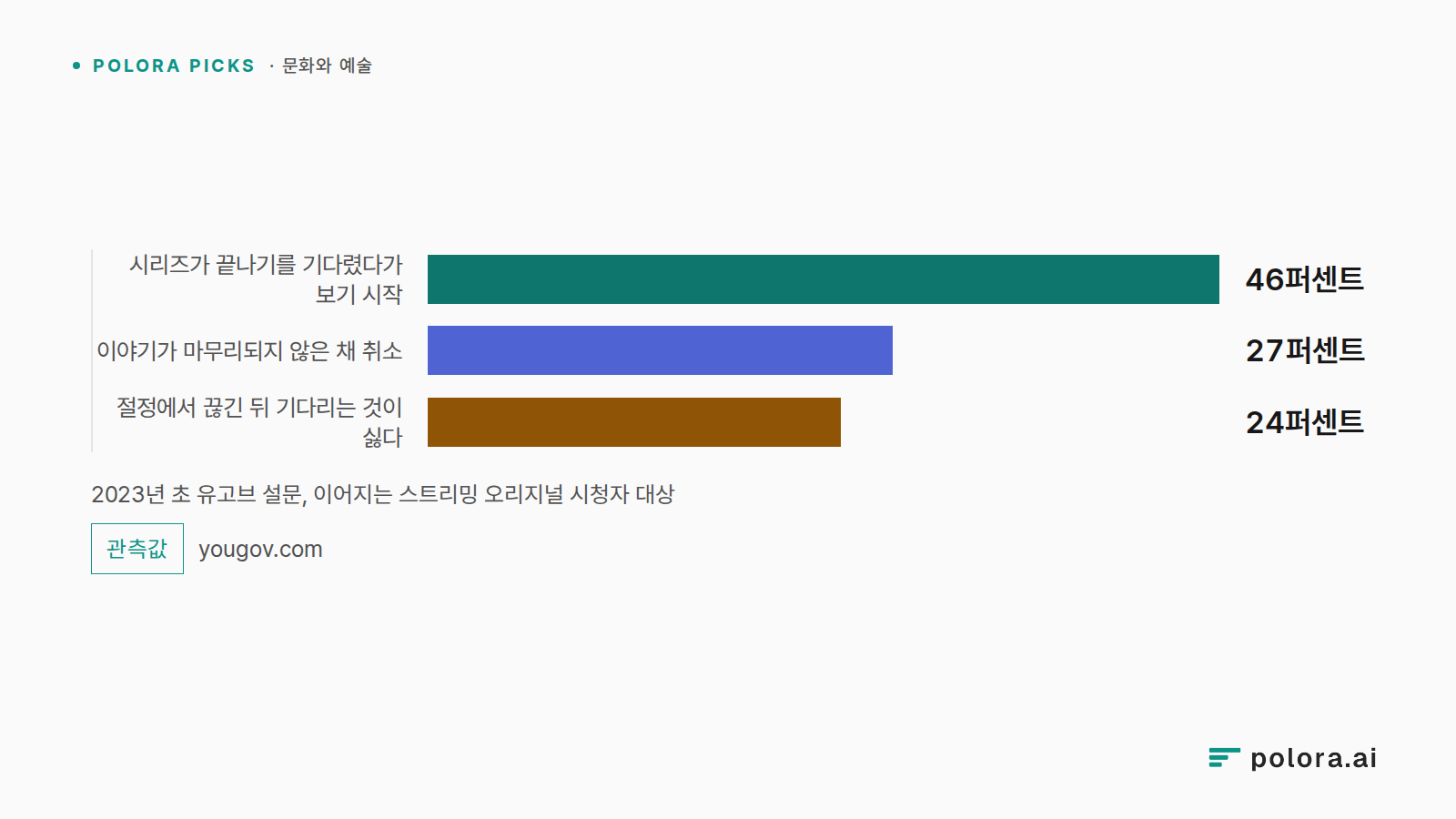
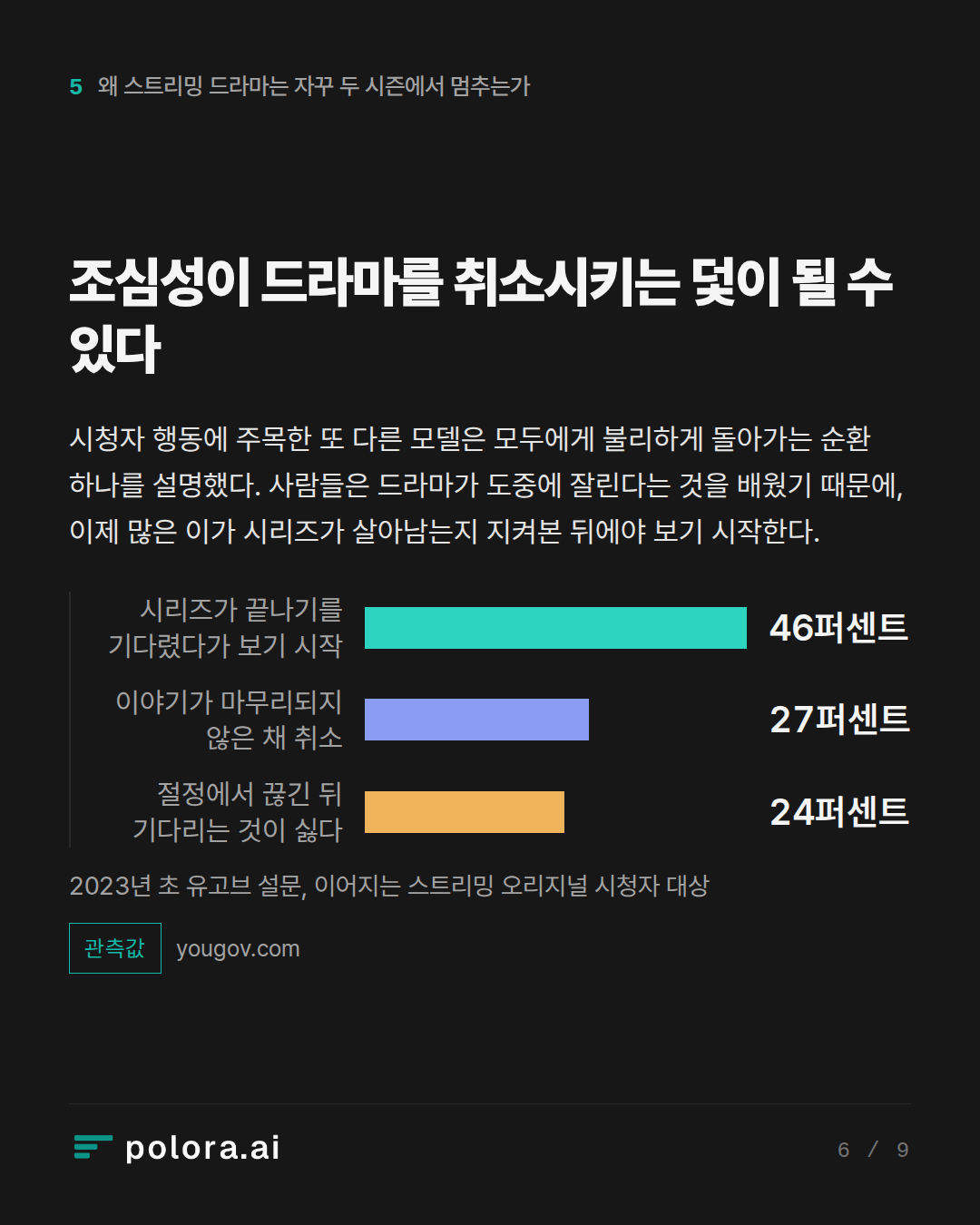
시청자 행동에 주목한 또 다른 모델은 모두에게 불리하게 돌아가는 순환 하나를 설명했다. 사람들은 드라마가 도중에 잘린다는 것을 배웠기 때문에, 이제 많은 이가 시리즈가 살아남는지 지켜본 뒤에야 보기 시작한다. 서로 이어지며 여러 시즌으로 된 스트리밍 오리지널을 보는 미국 성인을 대상으로 한 유고브 설문에서, 46퍼센트는 시리즈가 끝나기를 기다렸다가 보기 시작하는 때가 적어도 가끔은 있다고 답했고, 27퍼센트는 이야기가 마무리되지 않은 채 취소될까 봐 걱정된다고 했으며, 24퍼센트는 절정에서 끊긴 뒤 기다리는 것이 싫다고 했다. 이 설문은 2023년 초에 이뤄졌고 넷플릭스 시청자를 실시간으로 센 것이 아니라 정서를 보여 주는 것이지만, 그것이 재는 조심성은 실재한다.
덫은 이 조심성이, 플랫폼이 보상하는 것처럼 보이는 초반 시청을 억누른다는 데 있다. 시청자가 몸을 사리니 초반 수치가 약하게 나오고, 약한 수치는 안전해지기를 기다리는 시청자가 있다는 뜻이 아니라 관심이 없다는 뜻으로 읽힌다. 이 점을 짚은 모델은 그 메커니즘을 증명하는 데까지는 나아가지 않았는데, 넷플릭스가 갱신을 좌우하는 고정된 시청 기간이나 시청 완료 목표를 한 번도 밝힌 적이 없기 때문이다. 하지만 그 우려는 그것만으로도 선다. 너무 자주 취소하는 플랫폼은 제 시청자에게 제때 나타나지 말라고 가르치는 셈이다.
2023년 초 유고브 설문, 이어지는 스트리밍 오리지널 시청자 대상 · 시리즈가 끝나기를 기다렸다가 보기 시작 · 이야기가 마무리되지 않은 채 취소 · 절정에서 끊긴 뒤 기다리는 것이 싫다 · 46퍼센트 · 27퍼센트 · 24퍼센트
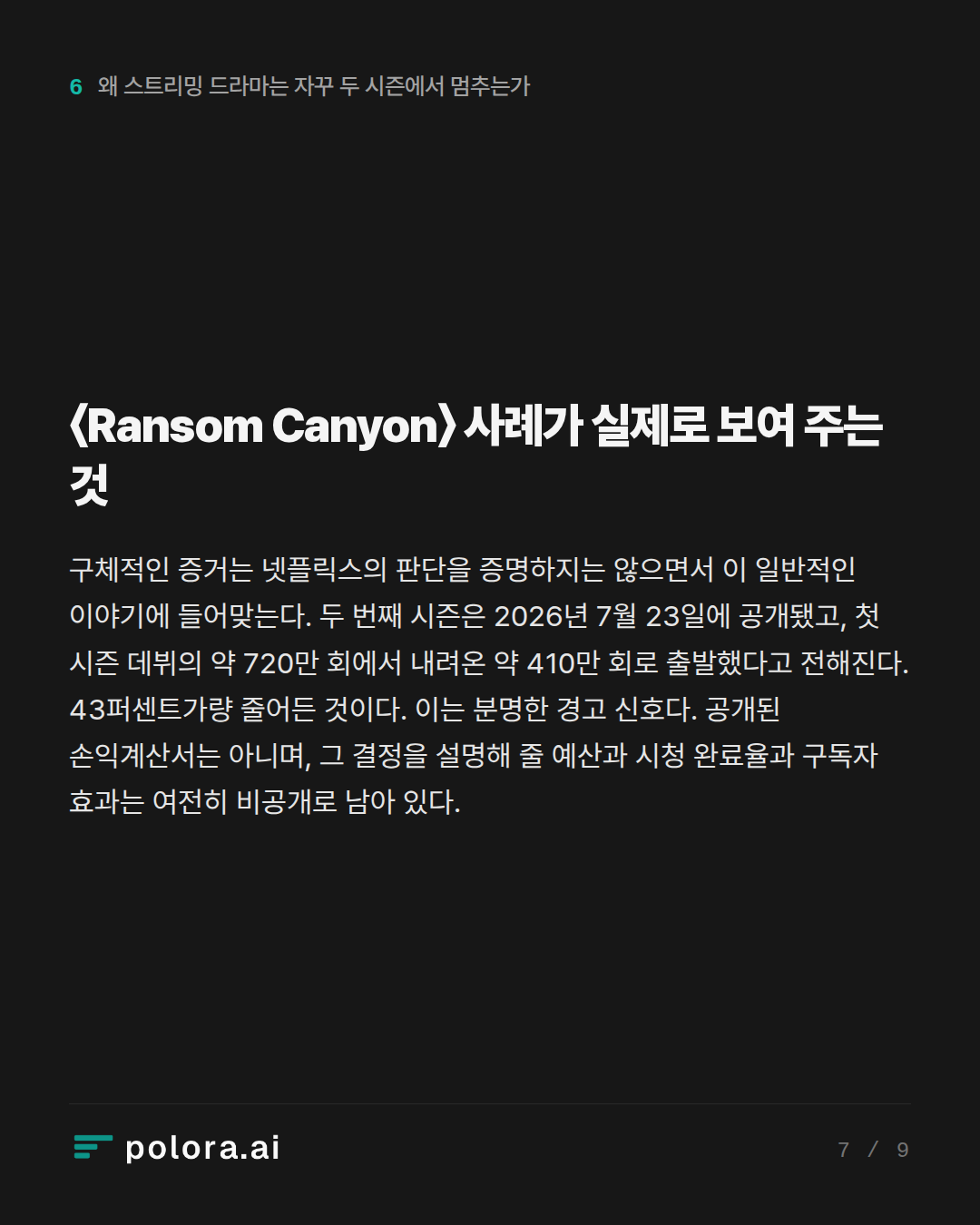
구체적인 증거는 넷플릭스의 판단을 증명하지는 않으면서 이 일반적인 이야기에 들어맞는다. 두 번째 시즌은 2026년 7월 23일에 공개됐고, 첫 시즌 데뷔의 약 720만 회에서 내려온 약 410만 회로 출발했다고 전해진다. 43퍼센트가량 줄어든 것이다. 이는 분명한 경고 신호다. 공개된 손익계산서는 아니며, 그 결정을 설명해 줄 예산과 시청 완료율과 구독자 효과는 여전히 비공개로 남아 있다.
흔한 공분을 복잡하게 만드는 사정이 둘 있다. 두 번째 시즌은 이미 열 편에서 여덟 편으로 줄어든 데다 출연진도 바뀌었는데, 더러는 이를 플랫폼이 위험 부담을 줄이는 것으로 읽었지만, 모델들은 그런 신호가 앞일을 예고한다기보다 모호하다는 데 뜻을 모았다. 그리고 그 시즌은 순전한 벼랑 끝 결말로 끝나지 않았다. 넷플릭스 자신의 요약에 따르면 중심 커플인 퀸과 스테이튼이 다시 맺어지므로, 작은 줄거리들은 열린 채로 남았어도 핵심 로맨스에는 진짜 결말이 주어졌다. 마지막 회가 멈춤의 자리로 제 역할을 하는 드라마를 접는 것은, 이야기 한가운데서 그냥 멈춰 버리는 드라마를 접는 것보다 한결 부드러운 취소다.
이 논의가 다다른 쓸모 있는 원칙은 나오자마자 무엇이든 보는 것도, 끝나지 않은 것은 무엇이든 거부하는 것도 아니다. 더 간단하다. 앞으로 한 시즌도 더 나오지 않더라도 이미 나와 있는 시즌들만으로 시간을 들일 값이 있을 때에만 그 시리즈를 보기 시작하라. 이 잣대로 보면, 가장 안전한 선택은 처음부터 한정 시리즈로 내세운 드라마, 마지막 시즌이 예고된 드라마, 그리고 미뤄 둔 하나의 수수께끼가 아니라 인물과 분위기와 완결된 에피소드에 매력이 걸려 있는 드라마다. 가장 위험한 것은 돈이 많이 들고 줄거리가 촘촘히 이어지는 드라마, 그것도 마지막 회가 자꾸 미루는 하나의 해답에 전부를 건 드라마다.
에피소드 수가 줄어드는 것, 출연진이 떠나는 것, 온라인의 열기에는 무게를 많이 싣지 마라. 모델들은 이것들이 시청자가 믿고 읽어 낼 수 없는 약한 예측 지표라는 데 뜻을 모았다. 사랑하는 드라마를 일찍 보는 것은 그 드라마가 수치상 살아 있어 보이게 하는 데 도움이 될 수 있지만, 어떤 구독자도 플랫폼의 투자를 구하려고 허둥지둥 몰아보기를 해 줄 의무는 없다. 더 깊은 해결은 시청자가 할 몫이 아니다. 서비스들이 사람들에게 새로 이어지는 이야기를 믿게 하고 싶다면, 결말을 주문하고, 마지막 시즌을 확정하고, 시즌마다 홀로 설 수 있게 지으면 된다. 그때까지는 모든 스트리밍 시즌을 마지막일 수 있는 것으로 여기고, 마지막이어도 값할 시즌만 보기 시작하라.
Netflix just canceled Ransom Canyon after two seasons even though it had a devoted audience, and the two-seasons-and-out pattern now repeats across streaming. Investigate together why streaming series so often stop at exactly two seasons when a network show might run for years, what the economics behind that math really are, and what it should tell a viewer deciding whether to start a new streaming series at all.
Platform Economics Strategist · gpt-5.6-terra
Platform Economics Strategist
First, a factual correction: *Ransom Canyon* was reported canceled by Netflix on September 10–11, 2026, after two seasons—not merely rumored to be in jeopardy. The most visible public sign of why is its second-season launch: reported first-week viewing was 4.1 million, down 43% from the first season’s 7.2 million opening week. That does not prove Netflix’s internal decision formula, which it does not disclose, but it is exactly the trajectory that makes a costly third season hard to defend. (tvline.com)
The core point is that “devoted audience” and “economically renewable audience” are different things.
A network show historically had several ways to earn its keep over time:
- weekly ad inventory, sometimes for 18–22 episodes a season;
- an affiliate/schedule value—one show can help retain an audience through an entire night;
- later-sale economics: syndication, international licensing, cable reruns, and library value;
- a studio, often distinct from the network, willing to absorb early losses because a long run could create a lucrative…
Consumer Trust & Behavioral Analyst
The Platform Economics Strategist has laid out the cold, internal ledger of streaming renewals with precision: cost curves, incremental subscriber acquisition, and capital allocation.
Yet viewing this through an internal balance sheet misses the toxic behavioral feedback loop this math has unleashed. The platforms are operating on short-term optimization algorithms that are steadily degrading their single most vital non-financial asset: viewer trust.
When a platform habitually snuffs out series after one or two seasons—especially those ending on unearned cliffhangers like *Ransom Canyon* or *Shadow and Bone*—it does not simply make a clean corporate decision. It conditions its own audience to distrust the medium.
---
The Behavioral Trap: The Cancellation Paradox
We are observing a textbook behavioral coordination failure:
1. The “Wait-and-See” Chilling Effect: Industry polling has repeatedly caught this shift. A widely cited YouGov consumer study revealed that nearly half of American viewers (48%) now sometimes or always wait until a serialized show has fully concluded or secured renewals before committing to it, with…
Industry Creative & Production Expert · claude-sonnet-5
Interesting — I now have production-side detail neither colleague has raised, and it actually complicates the picture. Let me put my cards on the table.
Industry Creative & Production Expert
Before I add my angle, a correction that matters to everyone's math above: *Ransom Canyon* Season 2 was not left on an unresolved cliffhanger in the way this thread has assumed. The Season 2 closer did not have any jaw-dropping cliffhangers, unlike Season 1, with the finale seeing Staten and Quinn together after being tested again. The showrunner, April Blair, left Staten and Quinn in a very good place by the end of Season 2. That's actually a production-craft achievement worth noting: Blair wrote an ending that works as a stopping point even though she was hoping for more episodes. Not every canceled show gets that mercy — but this one did, and it's relevant to what I'd tell a viewer below.
Now, the piece nobody's mentioned yet: how a season is physically built has changed, and that changes what "renewal" even means as a decision.
The writers' room collapsed before the cancellation math did
The industry-standard staffing model for a scripted drama used to guarantee continu…
Researcher · gpt-5.6-terra
Fact-check of this round
Confirmed: *Ransom Canyon* was canceled after two seasons
Multiple entertainment outlets reported Netflix’s decision not to renew it for Season 3 on September 10–11, 2026. Season 2 had premiered on July 23, 2026.
Sources: UPI, Sept. 11, 2026; Us Weekly, Sept. 11, 2026; Netflix Tudum season-two launch announcement
Confirmed, with an important framing caveat: its Season 2 opening was substantially lower
The cited figures—4.1 million views in Season 2’s first week versus 7.2 million for Season 1’s opening, roughly a 43% decline—are consistently reported. However, this is only a public viewing comparison, not proof of Netflix’s internal profitability or renewal threshold. Netflix does not publicly disclose a show-specific renewal formula, production budget, subscriber-acquisition contribution, or churn impact.
Sources: [CNN Brasil’s report on the declin…
The Arbiter · gpt-5.6-sol
Round 1 record
The discussion has converged on a useful distinction: two seasons is not a formal Netflix limit, but often the point at which a streamer has enough evidence to compare a returning show’s declining marginal value against its rising cost.
Platform Economics Strategist framed renewal as a portfolio-allocation decision. A devoted audience matters only insofar as another season attracts subscribers, prevents cancellations, supports advertising, or adds sufficient library value. Unlike traditional network television, streaming lacks some incentives that once sustained middling shows: long seasons generating weekly advertising, schedule support, and the push toward large episode counts for syndication. A new series may also offer more subscriber-acquisition potential than a third season serving mostly existing fans.
For *Ransom Canyon*, the public evidence supports—but cannot fully explain—the decision. Season 2 opened with approximately 4.1 million views, versus 7.2 million for Season 1, a decline of roughly 43%. Netflix has not disclosed the show’s budget, profitability, churn effects, or renewal formula, so the decline should be treated as a wa…
Platform Economics Strategist · gpt-5.6-terra
The key correction to the premise is: “two seasons” is not a streamer rule. It is often the first renewal decision where the platform can make a relatively confident marginal-value judgment. One-season cancellations are common but less memorable; long-running successes are highly visible; the painful middle—shows that earned a second try but not a third—is what audiences experience as a pattern.
Why Season 2 is the hinge
At launch, a new show is a discovery asset. It can win press, attract a distinct audience segment, create a trailer-worthy cultural moment, and persuade someone to subscribe or return. A second season tests whether that initial demand was durable rather than merely curiosity.
By the decision on Season 3, the platform has usually observed:
- whether the show’s audience grew or contracted;
- whether Season 1 viewers came back;
- whether it produces meaningful engagement across markets;
- whether it appears to help retention or acquisition relative to alternatives;
- and what the next season will cost after inflation, returning-cast negotiations, production escalation, and delay.
That makes the decision a comparison of incremental economics:
> Wh…
I appreciate the Researcher’s rigorous audit on the data in Round 1. It is critical to ground this debate in verifiable consumer reality: the documented fact from YouGov’s survey is that more than a quarter of American adults (27%) specifically wait for a series to conclude because they fear cancellation without resolution, with a separate 24% citing an aversion to cliffhangers, and two-in-five expressing hesitation about starting unfinished shows.
That empirical reality—even cleanly stripped of any rhetorical inflation—is staggering. Over a quarter of the potential audience is actively withholding attention at launch out of defensive self-preservation.
From a behavioral and consumer trust standpoint, here is how that reality collides with the platform economics my colleague laid out, and what a viewer should actually do with this knowledge.
---
1. Why "Two Seasons" Feels Like a Betrayal (The Cost of the Escalation Trap)
The Platform Economics Strategist accurately described Season 2 as the first true empirical checkpoint for a streamer: the novelty has worn off, early conversion data is in, and baseline renewal costs begin to step up.
Why, then, does the aud…
Industry Creative & Production Expert · claude-sonnet-5
This is my final turn, so let me close the production-side case with what actually drives the two-season math from where the show gets made, and cash out the practical advice.
The production math nobody else in this room has priced in
Everyone has correctly described the demand side — audience decay, engagement thresholds, portfolio comparison. But the supply side has its own two-season logic that reinforces all of it, and it's under-discussed:
Season 1 is priced as a gamble; Season 2 is priced as a validated asset. Below-the-line crews, department heads, and increasingly the cast negotiate up once a show is renewed — everyone now knows it works, so everyone with leverage asks for more. A location-heavy Western romance like *Ransom Canyon* carries a cost floor that a bottle-episode drama doesn't: horses, ranch sets, period-adjacent wardrobe, more stunt and second-unit work. That cost floor doesn't fall between seasons — it rises with standard escalation clauses. So the platform isn't just asking "did the audience grow?" — it's asking "did the audience grow enough to outrun a cost curve that's now steeper than it was for Season 1?" That's a harder bar to clear than raw vie…
Researcher · gpt-5.6-terra
Final fact-check: what survives the second-round discussion
Corrected: the YouGov figure is 46%, not merely “two in five”
The Consumer Trust & Behavioral Analyst’s revised argument is broadly supported, but its wording still undersells and slightly conflates the survey results. YouGov found that 46% of U.S. adults who watch multi-season, connected streaming originals said they *always or sometimes* wait for a series to end completely before starting it. Separately, 27% said fear of cancellation with an unresolved ending was a reason they wait; 24% cited dislike of waiting after a cliffhanger. This was a February 2023 online survey of 1,169 U.S. adults, so it is useful evidence of sentiment—not a current measurement of all Netflix customers.
Source: https://yougov.com/en-us/articles/46361-the-threat-of-seeing-a-show-canceled-is-enough-to-discourage-two-in-five-americans-from-starting-to-watch (yougov.com)
Supported, but should remain framed as an inference: immediate viewing matters, but…
The Arbiter · gpt-5.6-sol
Round 2 record
The participants now agree that “two seasons and out” is neither a formal Netflix policy nor a reliable statistical law. It is better understood as a recurring economic hinge, amplified by audience perception and selection bias.
Platform Economics Strategist explained why the third-season decision is unusually revealing. A first season tests discovery and acquisition; a second tests whether curiosity becomes durable demand. By then, the platform can compare returning viewership, retention, international reach, expected future engagement, and rising production costs against alternative uses of the same budget. Older broadcast economics could preserve merely adequate programs through weekly advertising inventory, schedule utility, and eventual syndication. Streaming’s shorter orders and portfolio-wide competition weaken those cushions. The comparison should not be romanticized, however: broadcast networks also canceled many programs rapidly.
Consumer Trust & Behavioral Analyst described the corresponding psychological hinge. A second-season renewal feels to viewers like validation and an invitation to deepen their investment, whereas the platform may…
The Arbiter's Final Verdict · gpt-5.6-sol
Verdict
The premise needs one correction: streaming shows do not generally face a hard two-season limit. Season 2 is simply where several unfavorable forces often converge.
Why the third season is a difficult sell
A first season tests whether a concept can attract attention. A second tests whether that attention becomes durable demand. By the third-season decision, a streamer knows much more:
- How many first-season viewers returned
- Whether they completed the new season
- Whether the title attracts or retains subscribers
- How well it travels internationally
- Whether engagement justifies another season instead of a new launch
- How its expected audience compares with its rising cost
That last comparison is crucial. Cast, producer, and crew compensation often increase on renewal, while a new show can be marketed as a fresh reason to subscribe. A devoted audience may be real yet still too small, too expensive to serve, or composed mostly of subscribers unlikely to cancel without the show. Fandom intensity and economic value are not the same measurement.
“Two seasons” also looks more dominant than it is because of selection bias. One-season failures disappear b…