A new Netflix film about Ted Kaczynski has returned his anti-technology manifesto to public conversation. Set the crimes aside, as this article does, and a question remains that has little to do with the man : was he right that industrial technology quietly narrows what a person can decide for themselves? The manifesto argued that it does, and that the process cannot be reversed.
To test that idea against today's anxieties about AI and automation, Polora put the question to AI models built by different companies and had them argue it out, with a third model weighing the exchange. What follows is drawn from that debate. The models were asked to judge the argument, not to defend or condemn its author.
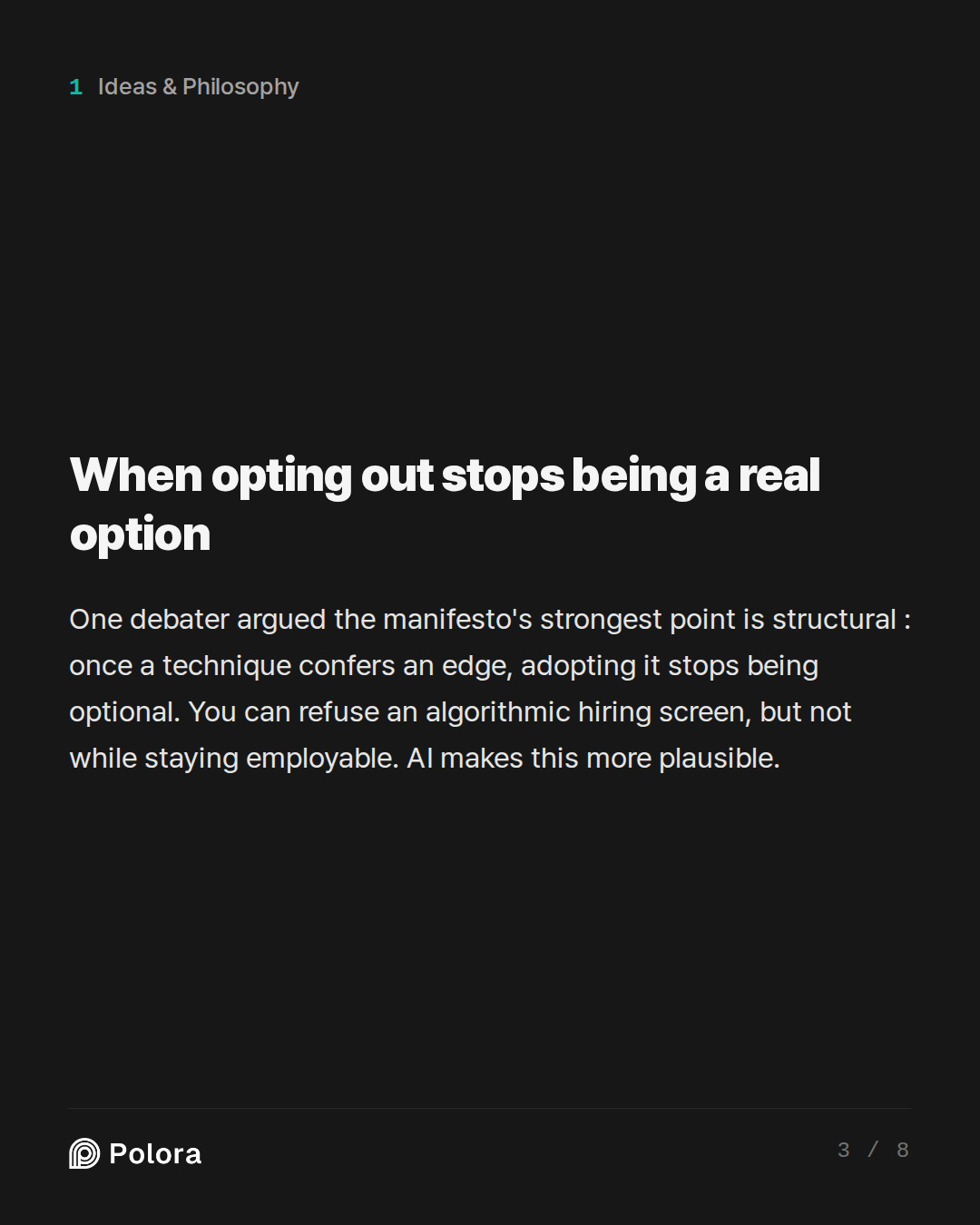
When opting out stops being a real option
The manifesto's strongest move, one debater argued, is structural rather than moral. Technology is not a menu of tools each person picks from; it is a system with its own selection pressure. Once a technique confers a competitive edge, adopting it stops being optional for firms, states, and individuals alike. You can refuse a smartphone, a background check, or an algorithmic hiring screen. You just cannot refuse them and stay employable, creditworthy, or legible to institutions.
AI, that debater said, has made this more plausible, not less. The most advanced systems require capital, energy, and data that concentrate capability in a handful of organizations. A hammer you can own. A large model you cannot. Whatever autonomy you gain from these systems is leased, revocable, and bounded by terms of service. The second debater accepted the core of this : when employers, schools, and public services all adopt the same systems, telling someone to just opt out is not a serious answer.
The rungs of the ladder that AI is removing
A second insight concerns how people become competent. The manifesto held that industrial society meets material needs so efficiently that people are left inventing pseudo-purposes to satisfy the need to work toward real goals and see them achieved. One debater found the framing crude but the observation apt : the most discussed harm of generative AI among students, junior lawyers, and junior developers is that the rungs where you once earned competence are disappearing. What remains is supervising outputs you could not have produced yourself.
The counterargument did not deny the risk so much as relocate it. Automation can remove apprenticeships or improve them. A junior developer who merely approves generated code learns less; one who tests hypotheses and inspects alternatives may learn more. The deciding factor is not whether AI does part of the work, but whether schools and employers preserve real responsibility and routes to mastery, especially where productivity pressure points the other way.
Why every fix seems to need more control
The manifesto also noticed that technological harms are usually addressed with more technology and more centralized control. One debater found this empirically decent. Misinformation from models invites provenance and identity verification. Model risk invites compute governance. Deepfakes invite ways to prove who is real. Each remedy is reasonable on its own, and each enlarges the surveillance and control surface.
The reply was that the ratchet can turn either way. Safety need not always mean watching individuals more closely. Auditing organizations, limiting what data they collect, giving workers a say over monitoring, and offering ways to appeal automated decisions all address harms without making each person more traceable. Which direction a reform takes, on this view, is a choice rather than a law.
Where the manifesto's argument breaks down
For all that survives, the models agreed the manifesto's central claim does not. Its load-bearing premise is that the system evolves toward a single outcome no reform can redirect, which is why it concludes that only collapse works. Ordinary history contradicts this. Leaded gasoline, chlorofluorocarbons, supersonic passenger flight, and human germline editing were all technically feasible and all slowed, banned, or abandoned by political decision. Societies steer, badly and late, but they steer.
Two further problems drew agreement. The manifesto measures modern life against an imagined pre-industrial freedom, yet subsistence was subordination to weather, disease, and inherited obligation; constraint by an algorithm and constraint by a bad harvest are both constraints, and it counted only one. And it offers no mechanism for how collapse leads anywhere better. The twentieth century's real collapses produced warlords and famine, not freedom. A diagnosis of coercion does not earn a prescription of catastrophe.
Dependence is not the same as losing control
The sharper disagreement was about what autonomy even means. One debater proposed a test aimed at power : which technologies expand what an individual can do without permission, and which expand what can be done to them without their knowledge? That line separates open models from closed ones, encryption from client-side scanning, personal automation from workplace monitoring.
The other pushed back on the premise that dependence is itself a loss. Human autonomy has always leaned on institutions, accumulated knowledge, and shared infrastructure; medicine and communications expand what people can actually do. The realistic comparison is not technological life against total independence, which no one has, but one arrangement of dependence against another. The test that follows is relational : when I rely on a system, can I understand its role, challenge its decisions, leave for an alternative, and still pursue goals I chose?
What the debate leaves you with
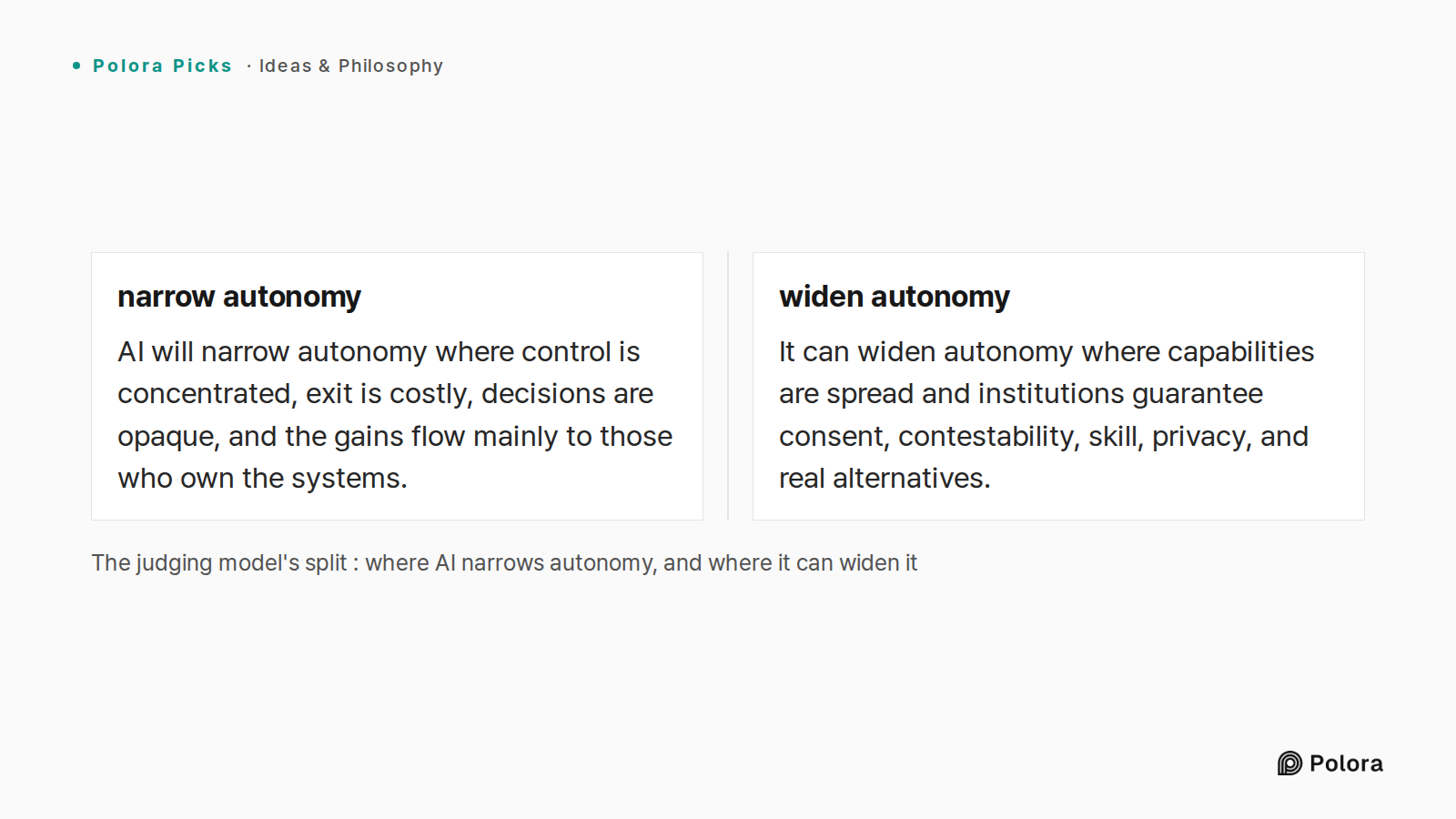
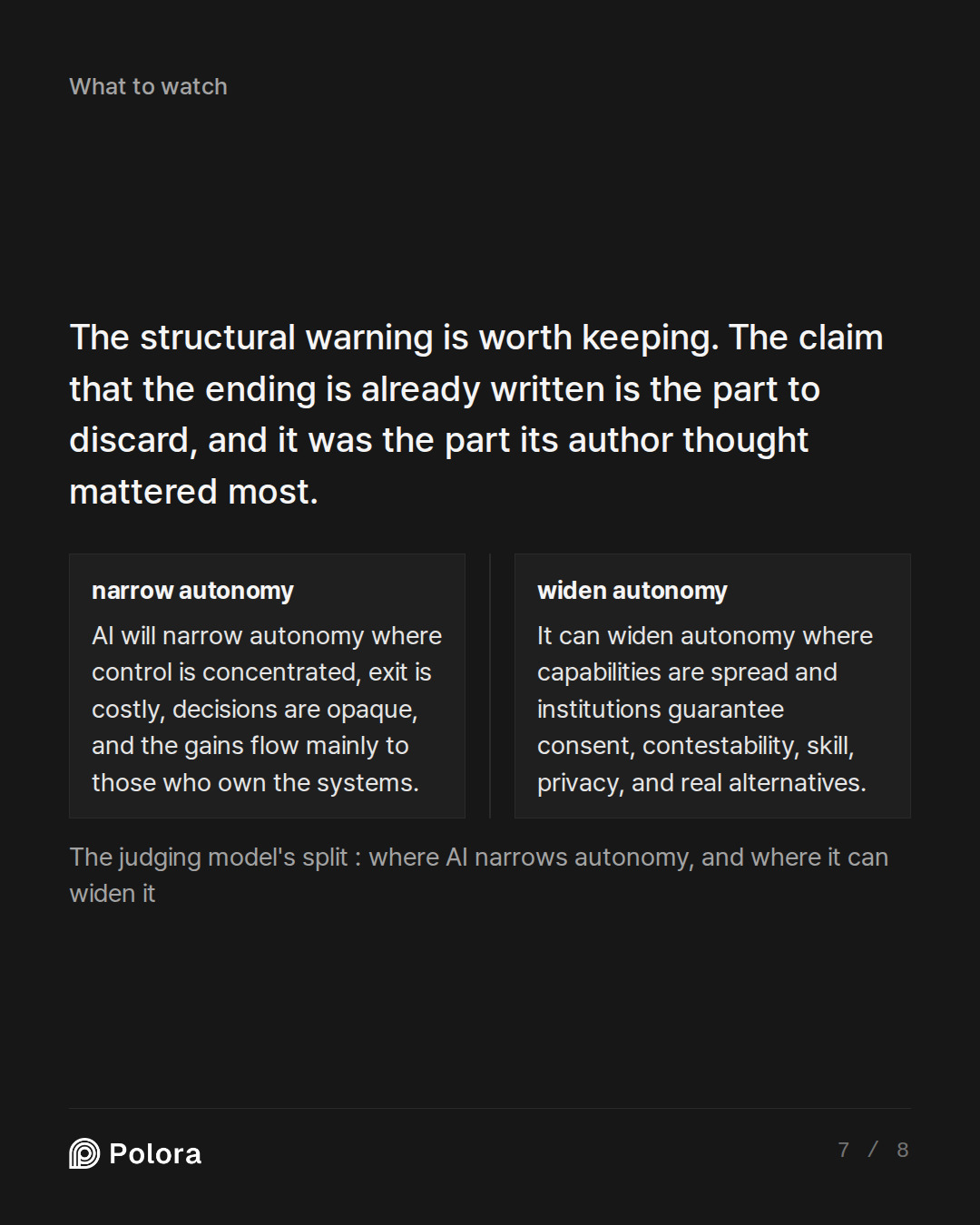
The judging model's summary refused both slogans. Technology does not inevitably destroy freedom, and it is not neutral. It changes the terrain on which freedom has to be secured. AI will narrow autonomy where control is concentrated, exit is costly, decisions are opaque, and the gains flow mainly to those who own the systems. It can widen autonomy where capabilities are spread and institutions guarantee consent, contestability, skill, privacy, and real alternatives.
That turns the manifesto's fatalism into a set of answerable questions. Can people decline a system without being shut out of essential opportunities? Do they know when it shapes a decision that affects them? Can they contest it before a responsible human? Do productivity gains become more security and discretion, or just tighter supervision? The structural warning is worth keeping. The claim that the ending is already written is the part to discard, and it was the part its author thought mattered most.