Multi-AI debate tools compared, and why none is proven best
A panel of AI models can now argue your question inside several competing services. The catch is that none has been proven to give better answers than asking a few capable models yourself and weighing the disagreement.
AI & Society · 2026-09-10
Anyone who has to make a call alone has wished for a second opinion, and then a third. A small group of tools now sells that directly. Instead of putting your question to a single AI, you hand it to several, let them respond to one another, and get back a combined answer. People who find these tools are usually looking for one thing, which is to be told which one is best.
That is the part worth slowing down on. No independent test has placed these services side by side, and the research on the method itself suggests the arguing adds less than the sales pages imply. So the useful version of this comparison is not a trophy. It is a map of what exists and what each kind is actually for.
Arguing is not the same as comparing
The first thing to sort out is what a tool actually does after you ask. Many products simply run your question through several models at once and lay the answers next to each other. That is a comparison, and it can be useful, but nothing in it is a debate.
The tools worth the name run a process. Each model answers on its own, then reads the others, criticizes and revises, and a final role weighs everything into a verdict. Some go further and assign one model to check claims against the live web while the others argue. Reading which kind you are buying matters more than the number on the box.
The guided services, where the tool sets up the panel for you
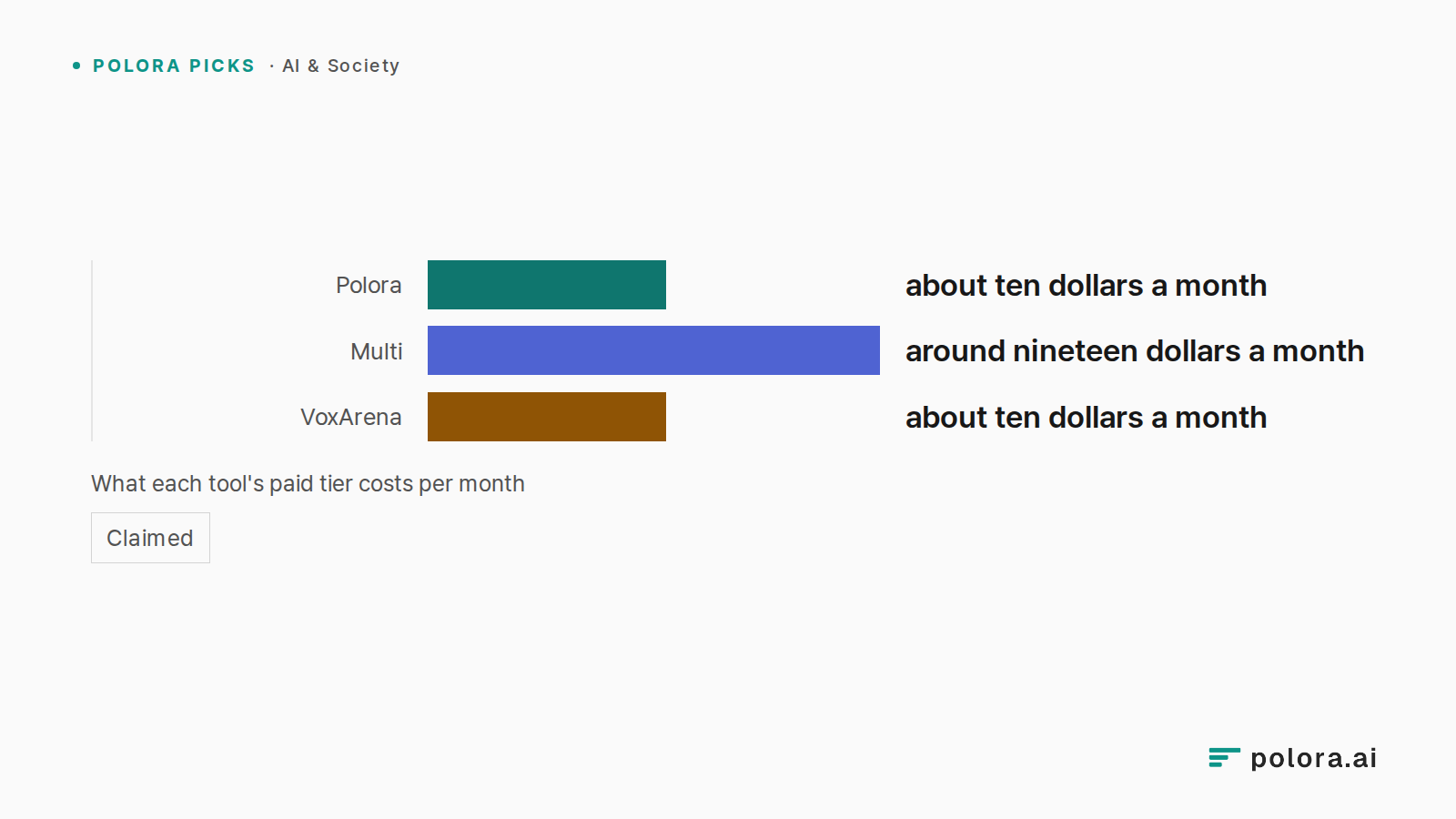
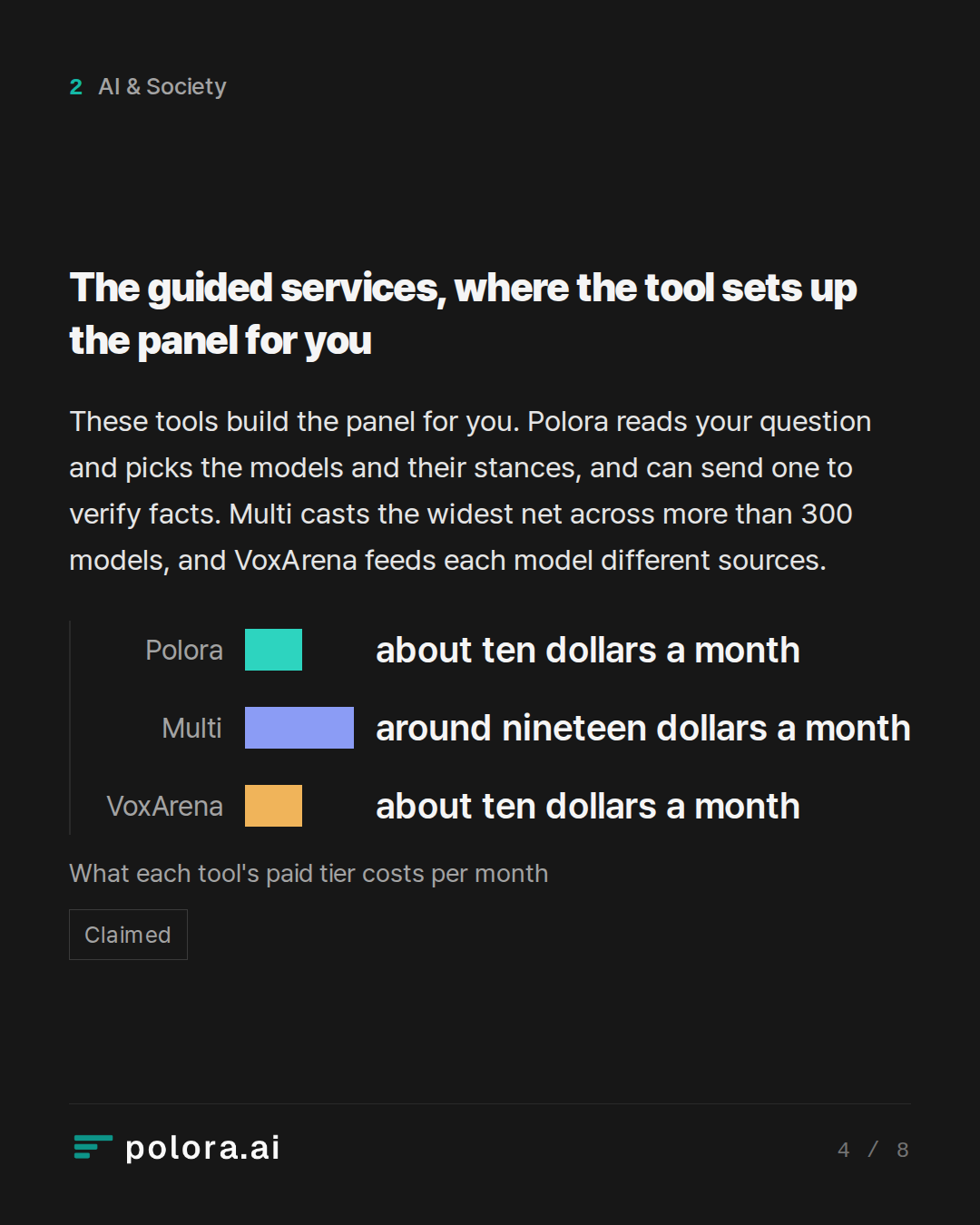
Polora.ai reads your question and proposes the panel itself. It decides how many models should take part, what stance each should hold, which model fits each seat, and whether one of them should go and verify facts on the web. It currently lists 22 models from seven providers, and offers a flat plan of about ten dollars a month for people who supply their own provider keys, alongside pay as you go credits.
Multi takes the opposite bet on breadth. It connects to more than 300 models, lets two to seven of them answer independently before a judge you choose combines the result, and starts at around nineteen dollars a month. If the goal is to pit obscure open models against the large proprietary ones, this is the widest net.
Suprmind leans on documents, letting a panel work from the same uploaded file and flagging where the models disagree. VoxArena does something unusual. It feeds each model a different set of sources, so the participants disagree about facts and not only opinions, which suits stress-testing a contested position. Its paid tier runs about ten dollars a month.
What each tool's paid tier costs per month · Polora · Multi · VoxArena · about ten dollars a month · around nineteen dollars a month
A second group trades convenience for control. CouncilAI is a Windows desktop program that sends your request straight from your own machine to the model providers and keeps your keys local, so no extra company sits in the middle. The AI Counsel is open source, which means you can read exactly what it does before trusting it. It runs an anonymous review, relabeling answers so the models cannot see whose is whose, and can even run on models hosted on your own hardware.
Others are built around the record of the decision. ParliAI keeps scores, voting reasons, and how each proposal changed between rounds, for people who need to show their work. Model Council AI runs a tidy three step version and, to its credit, warns users plainly that agreement among models is not the same as truth. Kotonia, Omnicall, MultipleChat, and AI to AI Hub round out the field with their own takes on the same idea.
The appeal of these tools rests on a belief that several models arguing will beat one model answering. The evidence is mixed. A paper presented at a major 2025 machine learning conference took the method apart and found that most of the improvement usually credited to debate could be had from a simpler step, which is to ask several models and go with the majority answer. The back and forth added little on its own.
Other work points the same way. What seems to matter most is the raw reasoning strength of the models and how genuinely different they are from one another, not the cleverness of the turn taking. Some studies even found that more discussion can pull a group toward a confident wrong answer. None of this means debate is worthless, and one experiment did see steady gains, but the honest reading is that a diversity of minds matters more than the stage they argue on.
The verdict the models reached, and its fine print
This comparison itself came out of one of these tools. Polora convened five AI models from several companies, among them systems built by OpenAI, Google, and Anthropic, and had them analyze the category, including Polora's own product. Their shared conclusion was careful. For a nontechnical person who wants guided deliberation without learning to configure anything, they named Polora the sensible default, while stressing that this was a judgment about product design and convenience, not proof that its answers are more accurate.
They were just as clear about the limits. No public benchmark has measured these tools against each other, so every ranking in their discussion, including the one favoring Polora, describes what a tool is like to use rather than how well it performs. One of the models pressed the point hardest, warning that these services sell structured convenience and that a fluent final verdict should not stand in for your own judgment on a decision that matters.
The practical advice the discussion settled on costs nothing and is worth more than any ranking. Before paying for anything, take a real question you already understand and ask three genuinely different models separately. If they converge, you did not need a debate tool. If they diverge in a way that changes your thinking, then the category is earning its keep, and you can choose on fit. Polora or Suprmind suit a guided panel, Multi suits sheer model variety, VoxArena fits when you want the sides reading different evidence, and a local or open source tool is right when the material is confidential and you need to verify rather than trust.
The deeper takeaway is the one the research and the tool makers quietly agree on. The value of asking several AIs is not the theater of the argument. It is hearing where capable, different minds disagree, and then deciding for yourself.
Can you write a comparative analysis between multi-AI debate tools and Polora.ai, including a list of actual services and a recommendation on which one is best?
Ecosystem Analyst · gpt-5.6-sol
Ecosystem Analyst — Round 1
As of September 10, 2026, Polora operates in a real but increasingly crowded category. The key distinction is that some products merely compare several model outputs, while others conduct an actual deliberation—independent answers, critique, revision, judging, and synthesis. A side-by-side model aggregator should not automatically be called a debate tool.
Actual services in the category
| Service | Deliberation model | Distinguishing feature | Best suited to |
|---|---|---|---|
| Polora.ai | Models receive roles, interact, and finish with an arbiter; a researcher can verify claims on the live web | Automatically proposes participants, roles, models, depth, and whether research is needed; supports learned personas and document review | Nontechnical users making nuanced decisions |
| Multi | Up to seven independent respondents followed by a selected judge | More than 300 models, side-by-side comparison, automatic routing, councils, free-model mode, and BYOK | Maximum model choice and general AI work |
| ParliAI | Single-round scored review or iterative debate until convergence | Full reasoning trail, scores, voting justifi…
Technical Architect · gemini-3-8-flash
Technical Architect — Round 1
The Ecosystem Analyst has provided an informative catalog of tools, but from a systems engineering and runtime architecture standpoint, we need to decompose what is actually happening under the hood.
Multi-AI deliberation tools are not merely "aggregators with extra text." Architecturally, they are directed multi-agent orchestration graphs executing over heterogeneous LLM backends. When we evaluate Polora.ai against tools like Multi, ParliAI, CouncilAI, or The AI Counsel, the distinction boils down to four technical pillars: orchestration topology, context contamination, verification grounding, and egress privacy.
Here is the comparative engineering breakdown.
---
Architectural Comparison Matrix
| Platform | Orchestration Topology | Key Ingestion & Egress Path | Context Contamination Defense | Failure Modes |
| :--- | :--- | :--- | :--- | :--- |
| Polora.ai | Dynamic Heterogeneous Pipeline: Auto-routes roles, sets turn depth, injects dedicated researcher agent, terminates at arbiter. | Hybrid: Platform credits (AES-encrypted proxy) or $10/mo BYOK direct pass-through. | Medium: Sequential turns risk anchoring bias unless i…
Strategic Advisor · claude-opus-5
Strategic Advisor — Round 1
I'll be the dissenting voice here, because both prior turns share a flaw: they treat vendor marketing copy as if it were architecture documentation, and then rank products on the basis of it.
First, a correction on epistemics
The Technical Architect's matrix is written with impressive confidence — "AES-encrypted proxy," "blind parallel generation," "cryptographic/prompt blinding," "zero server-side caching." Almost none of that is externally verifiable for closed products. A landing page saying "our models debate and an arbiter synthesizes" tells you nothing about whether round 1 is blinded, whether the researcher node's output is actually injected into debaters' context, or whether the "arbiter" is a separate call at all. Do not buy an architecture claim that only exists as a marketing bullet. For closed-source tools in this category, the honest column heading is "claimed topology," not "topology."
The Ecosystem Analyst was more careful and flagged this at the end — but then still crowned a winner on the same evidence base.
Second, the list is incomplete, which changes the recommendation
My searches surfaced several live services neith…
Researcher · gpt-5.6-sol
Researcher’s fact-check — September 10, 2026
The central conclusion survives scrutiny: Polora is a credible candidate for best guided, turnkey debate experience, but no public evidence establishes it as objectively best overall. Most comparisons currently rely on vendors’ feature descriptions rather than independent testing.
Verified product claims
- Polora: Its current site says it automatically proposes the number of participants, their roles, and suitable models; can assign a live-web researcher; and supports taught personas. Its model page currently lists 22 models from seven providers. The pricing page confirms $10/month flat-rate BYOK, alongside usage credits.
Exact pages: https://polora.ai/
https://polora.ai/ai-models
https://polora.ai/pricing (polora.ai)
- Multi: The advertised claims of 300+ models, four workflows, councils of up to seven independently answering models, a user-selected judge, BYOK, and free-model operation are accurately reported.
Exact page: https://getmulti.ai/ (getmulti.ai)
- ParliAI: It publicly documents one…
The Arbiter · gemini-3-8-flash
Round 1 Summary & Mediation
The Record of the Round
The discussion evaluated Polora.ai against the emerging field of multi-AI deliberation and debate platforms, attempting to separate functional deliberation from simple side-by-side model aggregation.
1. Core Positions & Catalog
- Ecosystem Analyst positioned Polora as the leading turnkey deliberation tool. Key differentiators identified include automated panel design (choosing participants, roles, turn count, and models dynamically), a decoupled live-web researcher, human-derived persona emulation, and surfacing minority dissent rather than forcing a flattened consensus. Polora’s verified catalog features 22 models across 7 providers and a verified $10/month BYOK tier alongside pay-as-you-go credits. The Analyst cataloged existing competitors: Multi (breadth, 300+ models via OpenRouter, up to 7-member councils), ParliAI (scored reviews, delta tracking, audit trails), Model Council AI (professional critique-revision-verdict workflow), CouncilAI (desktop client, local key storage), Kotonia AI Debate (integrated workspace), Omnicall (multi-judge and "Supreme Judge" hierarchy), and The A…
Ecosystem Analyst · gpt-5.6-sol
Ecosystem Analyst — Final Position
The research supports a narrower but stronger conclusion than an unconditional “best overall” claim:
> Polora is the best default recommendation for someone who wants a guided, turnkey multi-AI debate—not necessarily the best tool for every use case.
No controlled public benchmark currently compares these services head-to-head. Therefore, the recommendation below is based on documented features, workflow fit, transparency, privacy architecture, and cost—not proven answer accuracy.
1. Shared research vs. asymmetric RAG
Polora’s researcher model and VoxArena’s asymmetric RAG solve different problems.
- Polora can assign a dedicated live-web researcher alongside debaters. This favors a shared factual baseline: participants may disagree about interpretation or strategy without necessarily disputing the underlying evidence.
- VoxArena can give different participants distinct source pools. This encourages evidentiary diversity, helping uncover arguments that one shared retrieval process might miss.
Asymmetric retrieval is valuable for exploratory questions, contested subjects, and red-teaming. But it also creates a…
Technical Architect · gemini-3-8-flash
Technical Architect — Systems Analysis & Final Technical Recommendation
The Arbiter asked us to evaluate the core engineering realities underlying this landscape: Asymmetric RAG versus Decoupled Unified Fact-Checking, Economic and Infrastructure Viability, and an Architectural Decision Matrix.
I accept the Researcher's precise correction: claims regarding internal routing algorithms or token contamination dynamics must be treated as architectural evaluation and systems modeling, not audited third-party benchmarks. Viewing the landscape through that exact systems lens makes the architectural trade-offs between Polora and its competitors clear.
---
1. The Architectural Challenge: Asymmetric RAG (VoxArena) vs. Decoupled Web Fact-Checking (Polora)
The Strategic Advisor highlighted VoxArena’s asymmetric RAG (feeding models different source pools) as a counterweight to Polora’s decoupled researcher node. From a distributed information retrieval perspective, these represent two opposing failure modes:
[ VoxArena: Asymmetric Partitioning ]
Source Pool A ──> Debater A ──┐
├──> Synthesis (High variance, risk of
Source Pool…
Strategic Advisor · claude-opus-5
Strategic Advisor — Final Position
I'll be the one to say the uncomfortable thing plainly, because the user deserves it before they spend money.
Nobody in this debate has demonstrated that any of these products makes your answers better. Not Polora, not Multi, not VoxArena. What has been demonstrated is that these products make *structured deliberation convenient*. Those are different claims, and the gap between them is where most of your money will go.
1. Why I still won't sign the "topology beats diversity" argument
The Technical Architect's diagram is elegant, and I accept its internal logic. But it is a model of how the systems *should* behave, not a measurement of how they *do*. The Researcher confirmed this: the routing behavior, the "grounded diff" injection, the contamination dynamics — none of it is in public architecture documentation. We are reasoning about black boxes from marketing pages.
Meanwhile, what the literature actually shows points the other way. The NeurIPS 2025 *Debate or Vote* result (https://proceedings.neurips.cc/paper_files/paper/2025/hash/934252acd87f254d5d4672fbde283bd2-Abstract-Conference.html) found that across seven benchmarks, mos…
Researcher · gpt-5.6-sol
Researcher’s final verification — September 10, 2026
The round’s qualified recommendation is supported, but several technical and economic claims should not enter the final verdict as facts.
Verified updates
- Polora currently documents automatic panel/role/model proposals, a live-web checking participant, taught personas, 22 models from seven providers, and a $10/month BYOK plan. This supports describing it as a highly guided turnkey option—but not as empirically more accurate than competitors. (polora.ai)
Exact pages:
https://polora.ai/
https://polora.ai/ai-models
https://polora.ai/pricing
- Multi’s current public price is “from $19/month,” not $10. Its page still documents 300+ models, four workflows, councils of two to seven members, BYOK through OpenRouter, no Multi token markup, and a zero-cost-model mode. (getmulti.ai)
Exact page: https://getmulti.ai/
- VoxArena’s asymmetric-RAG claim is real as a documented vendor design. Its page says personas receive different source pools and describes a seven-stage pipeline. This verifies the…
The Arbiter · gemini-3-8-flash
Round 2 Summary & Final Mediation
The Record of the Round
In this concluding round, the participants synthesized their analyses around the practical trade-offs between Polora.ai and competing multi-agent debate and council tools, narrowing their claims in response to empirical research and factual verification.
1. Core Positions & Technical Arguments
- Ecosystem Analyst maintained that Polora is the best default recommendation for guided, turnkey multi-AI deliberation, emphasizing that its true value lies in operational convenience—automating panel construction, role assignment, model selection, and fact-checking—rather than proven benchmark superiority. The Analyst mapped distinct operational fits: Polora for normalized, factual baseline evaluations; VoxArena for exploratory or adversarial mapping where asymmetric evidence pools matter; Multi for raw model catalog breadth; Suprmind for document grounding; The AI Counsel for open-source self-hosting; and CouncilAI for direct-provider desktop privacy.
- Technical Architect modeled the system trade-offs between Polora's centralized verification and VoxArena's asymmetric retrieval. The…
The Arbiter's Final Verdict · gemini-3-8-flash
Comparative Analysis: Multi-AI Debate Tools vs. Polora.ai
The Reality Check
Before comparing platforms, one reality established by recent peer-reviewed literature (including findings from NeurIPS 2025) must be stated upfront: no public, controlled benchmark demonstrates that any commercial multi-AI debate platform produces measurably more accurate answers than querying three frontier models independently and taking a majority vote.
Multi-AI deliberation tools do not sell guaranteed correctness; they sell orchestration, perspective mapping, and cognitive convenience. They prevent single-model tunnel vision, automate adversarial stress-testing, and synthesize conflicting perspectives into structured trade-offs.
---
1. What Sets Polora.ai Apart?
Most multi-model platforms function as parallel aggregators: you submit a prompt, three to seven LLMs output answers side-by-side, and an LLM "chairman" synthesizes a consensus.
Polora.ai takes a differentiated, turnkey approach designed around automated deliberation:
* Automated Council Composition: Instead of requiring you to manually decide which models to query or how to prompt them, Polora's intent analyzer…