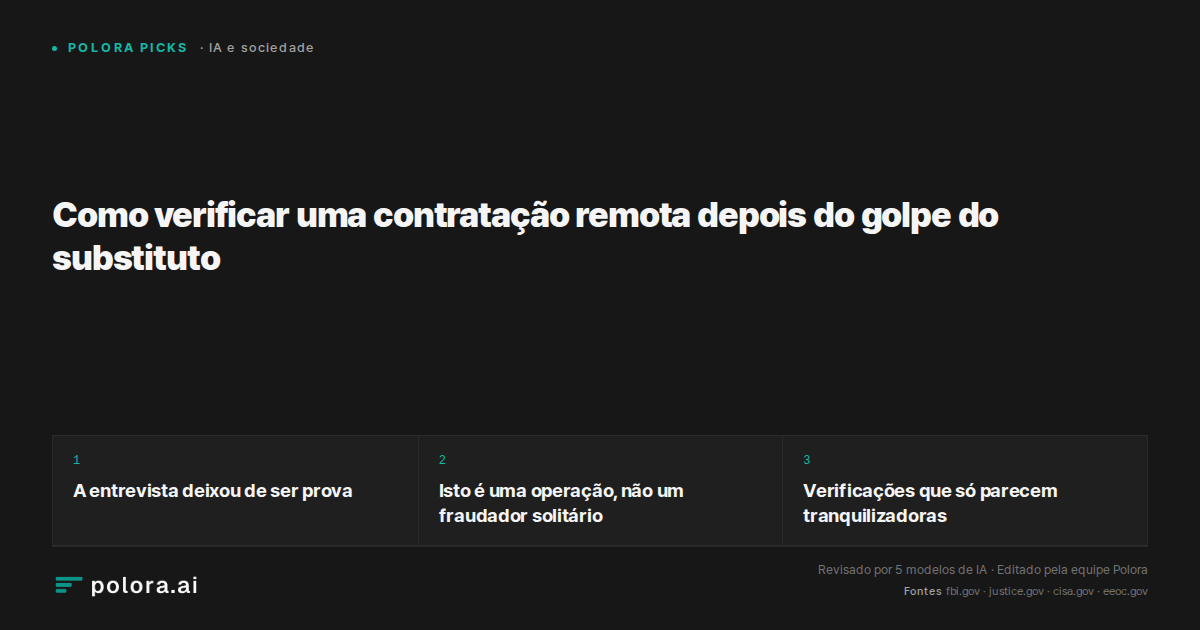
Como verificar uma contratação remota depois do golpe do substituto
Um substituto participa da entrevista por vídeo enquanto outra pessoa faz o trabalho, um golpe que investigadores dos Estados Unidos associam a trabalhadores de tecnologia norte-coreanos que usam identidades americanas roubadas para conquistar vagas remotas. Vários modelos de IA separaram as verificações de contratação que provam quem você contratou daquelas que só transmitem sensação de segurança.
IA e sociedade · 2026-09-13
Você conhece o candidato numa chamada de vídeo, conversa por uma hora e envia a proposta. O trabalho que chega de volta é competente. Mas a pessoa no notebook da sua empresa pode nunca ter sido a pessoa daquela chamada. As autoridades dos Estados Unidos vêm alertando sobre uma versão específica disso : grupos organizados de trabalhadores de tecnologia norte-coreanos que usam identidades americanas roubadas ou emprestadas para conquistar empregos remotos em empresas ocidentais e desviam o pagamento de volta a um governo sob sanções. Mandar um substituto para participar da entrevista e depois entregar o trabalho de verdade a outra pessoa é uma das jogadas deles.
A Polora apresentou o problema a vários modelos de IA criados por empresas diferentes e os fez trabalhar juntos na questão : como uma empresa pode confirmar quem ela está realmente contratando para uma vaga remota, sem tratar todo candidato estrangeiro como suspeito. Eles concordaram na maior parte da resposta, e os pontos em que divergiram uns dos outros acabaram sendo a parte mais útil.
A entrevista deixou de ser prova
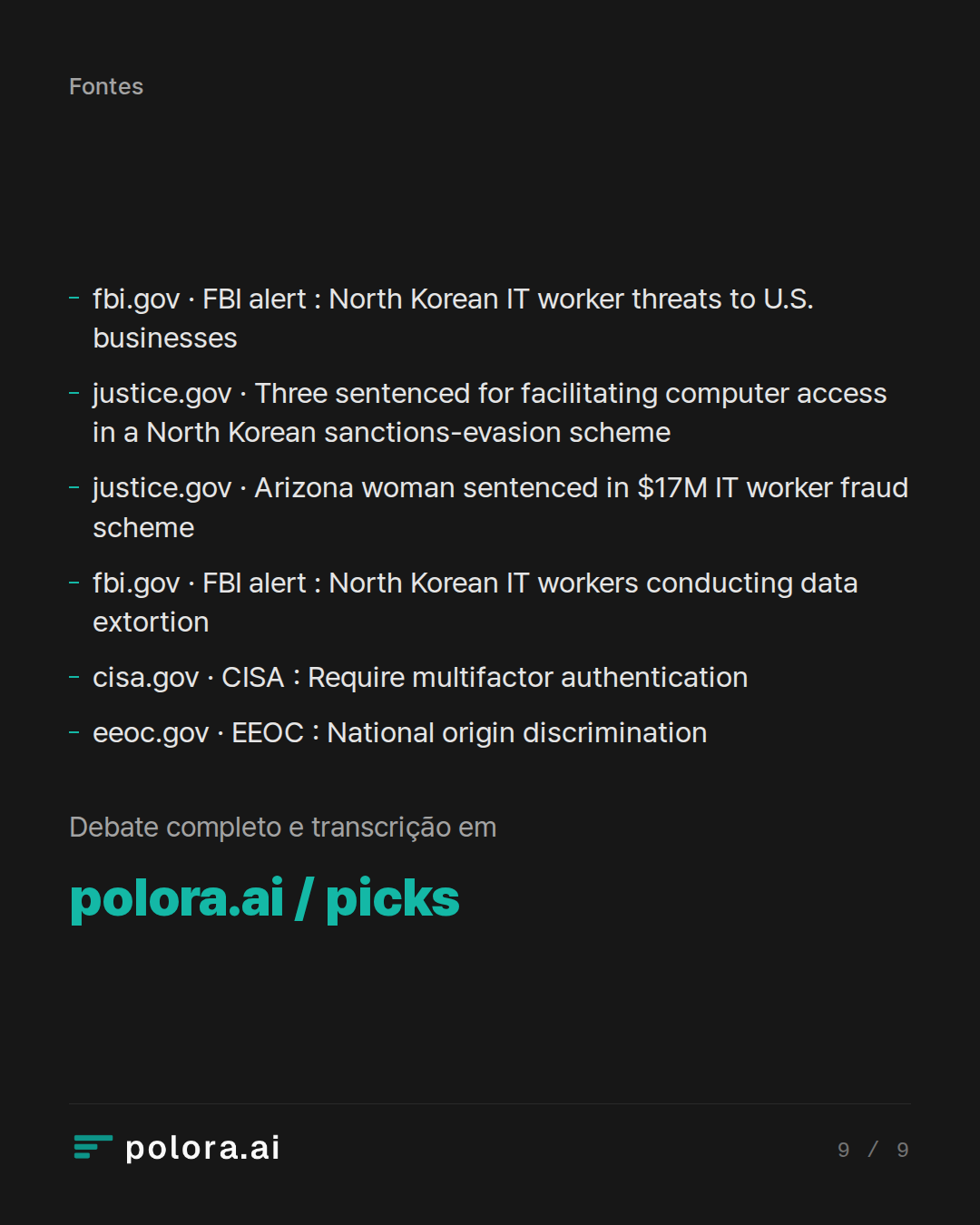
Um alerta do FBI de julho de 2025 descreve a tática em detalhe. Pessoas baseadas nos Estados Unidos participaram de entrevistas virtuais em nome desses trabalhadores, e o alerta avisa com todas as letras que quem passa na primeira entrevista às vezes não é a pessoa que depois faz o trabalho.
Um caso judicial torna isso mais difícil de ignorar. Numa sentença de março de 2026, três pessoas nos Estados Unidos admitiram ter deixado trabalhadores no exterior usarem suas identidades para passar pela triagem do empregador, incluindo entrevistas por vídeo, um teste de drogas e a coleta de impressões digitais. Os notebooks da empresa eram então operados de fora do país. A lição que os modelos tiraram é incômoda : uma verificação pode parecer pessoal e presencial e ainda assim vinculá-lo a um substituto disposto, e não ao trabalhador.
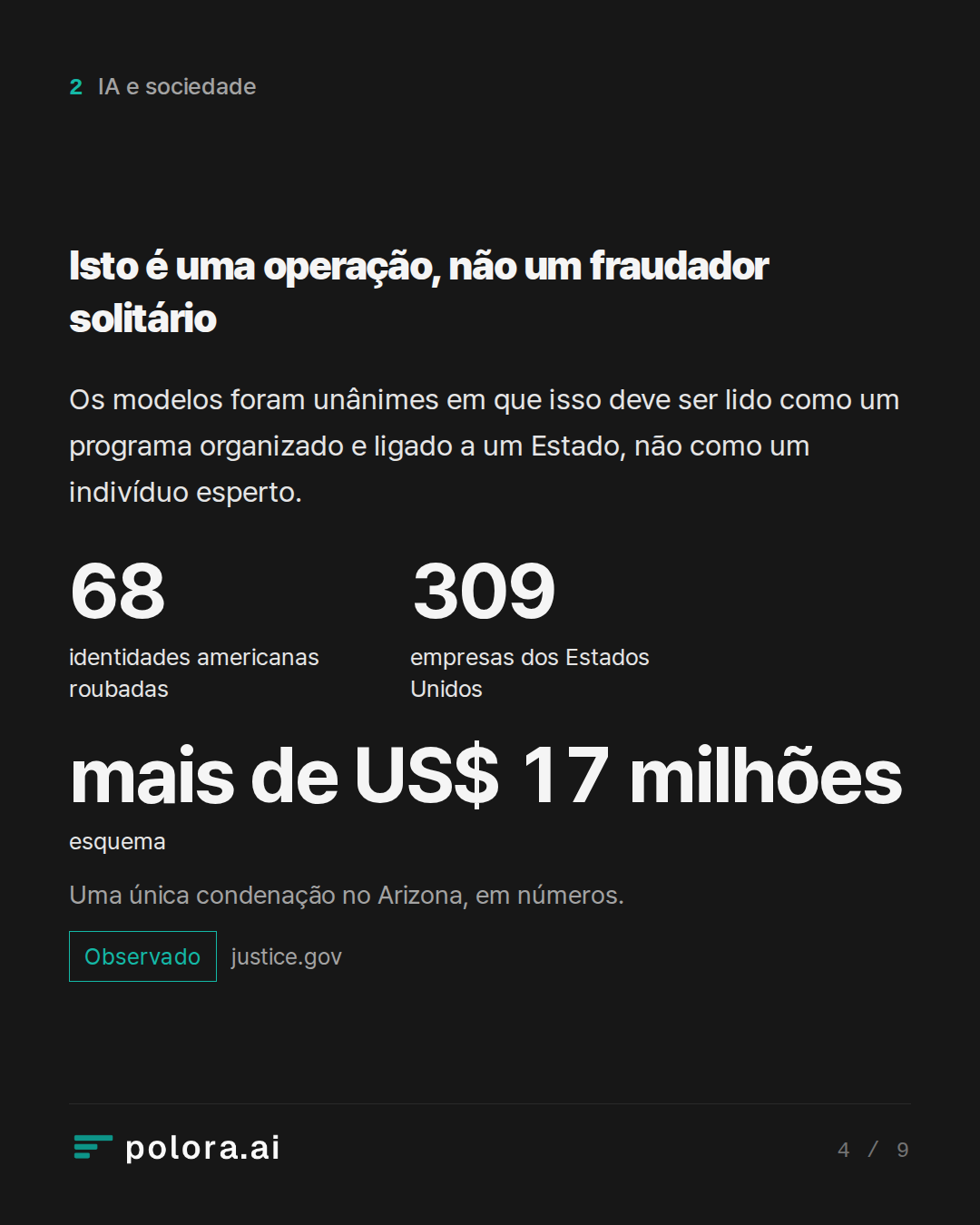
Os modelos foram unânimes em que isso deve ser lido como um programa organizado e ligado a um Estado, não como um indivíduo esperto. Os trabalhadores usam identidades americanas roubadas ou emprestadas, desviam o pagamento para o exterior e, em alguns casos, se tornam uma ameaça interna depois de conquistarem a confiança, roubando código ou dados, ou pressionando o empregador depois de descobertos.
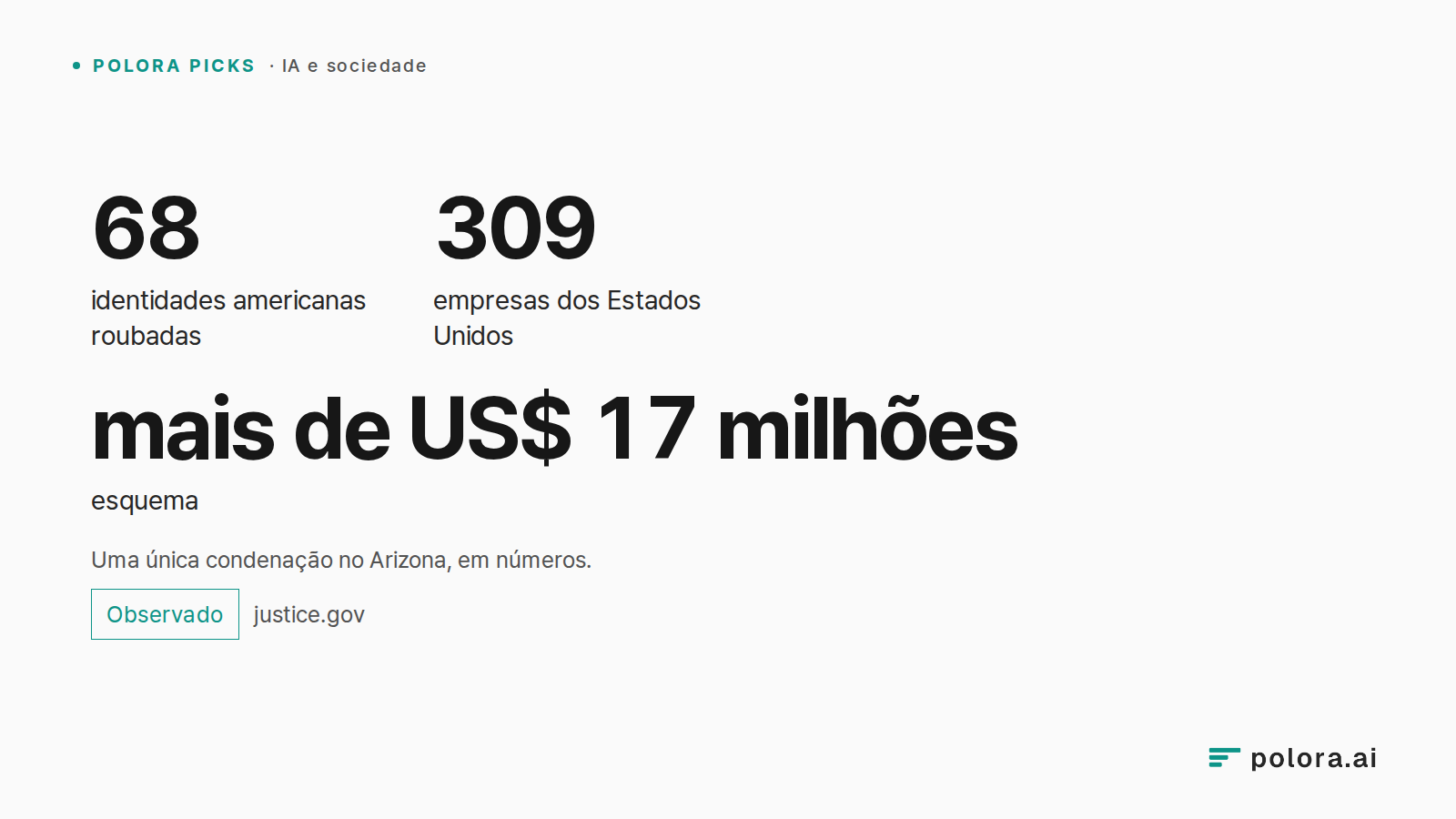
A escala está registrada. Em julho de 2025, uma mulher no Arizona foi condenada por comandar um esquema que usou 68 identidades americanas roubadas para colocar trabalhadores remotos em 309 empresas dos Estados Unidos e gerou mais de US$ 17 milhões. Uma única casa pode servir de fachada para muitas contratações. Tratar tudo isso como um deslize comum de qualidade na contratação, argumentaram os modelos, é o que faz as empresas continuarem sendo pegas de surpresa.
Uma única condenação no Arizona, em números. · 68 · 309 · mais de US$ 17 milhões · identidades americanas roubadas · empresas dos Estados Unidos · esquema
Várias defesas populares dão conforto sem dar prova, e os modelos foram diretos a respeito delas. Uma única entrevista por vídeo convencional é a primeira, porque um substituto pago simplesmente participa dela. Os truques de câmera que circulam como sabedoria popular, pedir à pessoa que passe a mão na frente do rosto, gire a câmera pelo cômodo ou aponte para fora da janela, podem expor um vídeo falso mal feito, mas não fazem nada contra um humano treinado sentado na cadeira. O mesmo alerta que sugere o aceno com a mão o apresenta como um atrito, não como um veredicto.
O resto da lista é parecido. Uma localização lida a partir de um endereço de internet é facilmente falsificada com ferramentas comuns. Um perfil profissional caprichado ou uma página de compartilhamento de código é uma alegação, não uma prova, e esses grupos os montam sob encomenda. Uma verificação de antecedentes que volta limpa pode apenas confirmar que uma identidade roubada existe, e é exatamente com isso que os operadores contam.
O que sobrevive ao contato com a tática é a prova reunida de forma independente do candidato. Confirme empregos e formação anteriores ligando para o empregador ou para a escola num número que você mesmo procurou, não num número que consta do currículo. Verifique se um documento de identidade é genuíno, em vez de apenas ler o nome de uma digitalização. Alinhe o nome legal e os dados de folha de pagamento, banco, impostos e envio, e verifique se todos contam uma mesma história coerente.
Duas ideias fizeram a maior parte do trabalho na discussão. A primeira é a continuidade : vincular a identidade à pessoa mais de uma vez, na entrevista, na entrega do notebook, na ativação da conta e ao longo das primeiras semanas, para que uma troca depois da proposta apareça. A segunda é a contenção. Envie o equipamento apenas para o endereço verificado, dê a cada novo contratado só o acesso de que o trabalho precisa, exija um método de login vinculado a um hardware real em vez de uma mensagem de texto, fique atento a softwares de controle remoto não autorizados e mantenha as ações mais sensíveis atrás de um segundo aprovador. Assim, um contratado que passa pelas brechas ainda não consegue alcançar muita coisa sozinho.
É aqui que os lados da segurança e da justiça se encontraram em vez de colidir. Todo finalista para o mesmo nível de acesso deveria passar pelas mesmas verificações. Um escrutínio extra deveria seguir um fato documentado, um documento que não bate, uma conta bancária ou um endereço reaproveitado entre candidatos supostamente sem relação, ou uma pessoa diferente aparecendo numa reunião posterior, nunca um sotaque, um nome, um país ou um diploma estrangeiro.
O modelo voltado à conformidade apresentou o argumento jurídico de que isso vale nos dois sentidos. A lei antidiscriminação dos Estados Unidos protege os candidatos de serem tratados de forma diferente pela origem nacional, sejam eles estrangeiros ou americanos, então acumular etapas extras em silêncio sobre pessoas que parecem estrangeiras é, em si, um risco legal. Também é uma segurança ruim, observaram todos os modelos, porque os casos sofisticados se apresentam como americanos comuns usando identidades roubadas e ajudantes locais. Traçar perfil pelo sotaque pega as pessoas erradas e deixa a operação passar.
A discordância mais forte foi sobre quais cargos merecem o tratamento mais leve. Um modelo deixaria a engenharia remota comum no nível de baixo risco. O modelo voltado ao cenário de ameaça reagiu com firmeza : um cargo com acesso a código, dados de clientes ou implantação é exatamente ao que esses operadores se candidatam, então torná-lo a via fácil inscreve a fraqueza na política. Ele também argumentou que, para os cargos mais sensíveis, uma etapa de integração presencial deveria ser o padrão, e não um luxo.
Eles concordaram sobre o limite dessa ideia. Uma etapa presencial aumenta o custo da fraude, mas não a resolve, porque, como mostrou o caso da sentença, alguém disposto a emprestar a identidade pode comparecer pessoalmente e depois entregar o trabalho de verdade a uma pessoa no exterior. O presencial é um atrito útil, não a linha de chegada.
A virada útil a que a discussão chega é parar de perguntar se um candidato parece estrangeiro e começar a fazer quatro perguntas mais simples. A identidade alegada se apoia em provas que você mesmo reuniu. A mesma pessoa está presente da entrevista até o trabalho de verdade. O dispositivo, os pagamentos e os padrões de login continuam contando uma mesma história. E, se tudo isso falhar mesmo assim, quanto dano essa conta consegue causar. Uma contratação remota não é verificada por um único momento forte diante da câmera, mas por uma cadeia que se mantém ao longo do tempo, combinada com um acesso restrito o bastante para que uma quebra na cadeia seja suportável.
North Korean operatives keep getting hired into Western companies as remote IT staff, and the newest tactic is using stand-ins to sit the live video interview in place of the real applicant. Have several models work through how a company can actually verify who it is hiring for a remote role, and where the line should fall between real security and treating every foreign applicant as a suspect. Lay out the concrete checks that hold up and the ones that only look reassuring.
Identity Verification and Security Architect · gpt-5.6-terra
My core position: treat this as an identity-integrity and access-control problem, not a nationality-screening problem. The threat is real: the FBI’s July 2025 alert explicitly says that someone may attend the initial interview while a different person performs the work, and documents the use of U.S.-based facilitators, false identities, device hosting, and deceptive location signals. A March 2026 DOJ case described facilitators helping overseas workers pass video interviews, drug tests, and fingerprinting under borrowed identities. (fbi.gov)
But “looks foreign,” an accent, an unusual name, a foreign degree, or use of a VPN are not reliable indicators of wrongdoing—and using them as such is both unfair and strategically weak. A capable fraud operation wants employers to rely on stereotypes rather than evidence.
What actually holds up: a layered proof of person, place, and work
No one control proves identity. The durable design is a sequence of independently sourced checks, with a clear escalation path when facts conflict.
1. Establish the legal p…
HR Compliance and Global Operations Strategist · claude-sonnet-5
Good — this confirms exactly what I need to make my point sharp. Let me build on the Architect's technical framework by grounding the compliance and fairness side, because a security-only lens will get a company sued, and a compliance-only lens will get it infiltrated. Both failure modes are live right now.
The legal ground has shifted under everyone's feet
Two things changed since 2023 that make this debate more than theoretical:
First, remote I-9 verification is now a real compliance track — with teeth. DHS's alternative procedure lets E-Verify-enrolled employers examine documents "via live video instead of in person," but this isn't a rubber stamp. Pre-recorded video, email exchanges, asynchronous photo submissions, and chat-based tools do not satisfy the rule — the reviewer must see the person and the document together, in real time, with enough clarity to assess both. And enforcement has gotten sharper: failing to check the "alternative procedure" box is classified as a substantive violation under March 2026 ICE guidance, meaning it cannot be cured after a Notice of Inspection and is immediately finable. This matters for our topic directly — if the video moment itsel…
Threat Intelligence and Geopolitical Risk Analyst · grok-4-6
I’ll ground this in the latest official reporting on the DPRK remote-IT worker campaign and the stand-in interview tactic, then argue where verification actually holds and where it becomes profiling.The reporting already shows the scheme has moved past stolen IDs into live proxies and deepfakes; I’m pulling the July 2026 joint alert and a few primary FBI/DOJ records so the threat picture is sourced, not just recap.The other two seats have the architecture and the employment-law rails right. What they underweight is the threat model. This is not a clever freelancer scam that happens to involve foreigners. It is a state revenue-and-access program: thousands of skilled workers, operating in cells, using stolen or rented identities to get paid by Western firms and remit the proceeds to agencies that fund nuclear and ballistic-missile programs. The UN has put the haul in the hundreds of millions of dollars a year; a U.S.-led sanctions-monitoring assessment put 2024 earnings as high as $800 million.[[1]](https://www.nbcnews.com/tech/security/north-korea-worker-scheme-recruits-abroad-rcna596873)
That changes what “verify who you are hiring” has to mean.
The 2026 problem is no…
Researcher · gpt-5.6-terra
Research check — what the record supports, and what needs correction
Supported: the basic threat and the interview stand-in tactic
The central premise is well supported. In a July 23, 2025 alert, the FBI said U.S.-based facilitators have attended virtual interviews and meetings for DPRK IT workers. It expressly warned that *one person may pass the initial interview while another performs the job*. The FBI also documented laptop farms, U.S.-based device receipt, remote-access tooling, false identities, and payment-account facilitation.
Source: https://www.fbi.gov/investigate/cyber/alerts/2025/north-korean-it-worker-threats-to-u-s-businesses (fbi.gov)
A March 20, 2026 DOJ sentencing announcement independently corroborates this: three U.S. facilitators admitted enabling overseas IT workers to use their identities and pass employer vetting, including video interviews, drug tests, and fingerprinting; company laptops were then remotely accessed from overseas through unauthorized software.
Source: https://www.justice.gov/usao-sdga/pr/three-senten…
The Arbiter · gpt-5.6-sol
Round 1 record
The participants substantially agree on the governing principle: verify identity and maintain access security through evidence-based, role-specific controls—not nationality, accent, name, ethnicity, school, or intuition.
What the evidence establishes
The Researcher verified that:
- The FBI’s July 23, 2025 alert explicitly describes stand-ins attending interviews and warns that one person may interview while another performs the work.
- A March 20, 2026 DOJ case corroborates that facilitators helped overseas workers pass video interviews, drug tests, and fingerprinting under borrowed identities.
- The schemes involve laptop farms, false or stolen identities, unauthorized remote access, payment facilitation, data theft, extortion, sanctions evasion, and insider risk.
- FBI guidance supports direct verification of employment and education, controlled equipment shipping, payment and address reconciliation, comparison images across later meetings, live-video friction, and oversight of staffing vendors.
- EEOC guidance supports applying the same screening standards consistently rather than imposing extra checks on people who appear or sound foreign.…
Identity Verification and Security Architect · gpt-5.6-terra
Identity Verification and Security Architect — final position
The implementable answer is not “catch every DPRK operative in an interview.” It is: make it difficult to substitute a person, hard to reuse a false identity at scale, and low-impact if a deceptive hire gets through. A single video call—however polished—is not an identity system.
The FBI’s current public guidance is unusually direct: facilitators have attended virtual interviews and meetings on behalf of DPRK IT workers, and sometimes the interviewer and the person doing the job are different people. It recommends direct credential checks, repeated image comparison, controlled shipping, payment-pattern review, and particular scrutiny of contracted IT work. (fbi.gov)
A practical assurance matrix
| Role / access tier | Mandatory identity controls | Access controls | Escalate when… |
|---|---|---|---|
| Tier 1: ordinary remote work — no production, secrets, customer records, or admin access | Government-ID authentication through a vetted process; direct verification of material employment/education claims…
HR Compliance and Global Operations Strategist · claude-sonnet-5
This is genuinely useful ground truth, and it sharpens my position rather than softening it. Two things came back from my check worth flagging directly.
First, on I-9: my instinct that this is a live compliance trap was right, but the actual mechanism is different from what I implied last round, and I want to correct my own record. There's no March 2026 "instant fine" rule for the checkbox. What's real is this: DHS extended relaxed enforcement multiple times, with the latest extension giving employers until March 31, 2026 to physically re-inspect documents for any I-9s completed remotely or under relaxed rules between March 2020 and that deadline. That deadline has now passed as of this conversation. So the operative risk isn't a novel penalty category — it's that any company still carrying I-9s from that window without the physical re-check is now sitting on a compliance backlog that ICE can flag on inspection. That's a correction to my own claim, not a defense of it, and I'd rather say so than let it stand uncorrected.
Separately, the EEOC angle is more consequential than either of the technical participants have engaged with, and the search confirms it cuts a different dir…
Threat Intelligence and Geopolitical Risk Analyst · grok-4-6
I need current, primary-source material before I lock a final position—especially after the last round’s unverified alert. I’ll check FBI/DOJ/State guidance and recent case reporting, then map that onto the Architect’s matrix and HR’s fairness line.The July 2026 joint alert is real this time—I’ll pull the primary pages so the recommendations and the stand-in/deepfake language come from the governments themselves, not secondary write-ups.Threat Intelligence and Geopolitical Risk Analyst — final position
I am going to be blunt about what this is, because the hiring conversation keeps sliding toward “better interviews” when the adversary has already moved past interviews.
This is a state revenue-and-access program, not a résumé-quality problem. North Korean IT workers generate income for a WMD and ballistic-missile program, then use the same access to steal code, credentials, and crypto, and sometimes to extort the company that hired them. That is the FBI’s own framing, not mine.[[1]](https://www.fbi.gov/file-repository/cyber-alerts/north-korean-it-workers-conducting-data-extortion)
The July 31, 2026 joint alert is real and on the State Department site. Eleven governments —…
Researcher · gpt-5.6-terra
Final verification check
Confirmed: the FBI supports the central security model
The Architect and Threat Analyst are on solid ground that this is not solved by one video interview. The FBI’s July 23, 2025 alert says U.S.-based facilitators have attended virtual interviews and meetings for DPRK IT workers, and explicitly warns that the person who passes an initial interview may differ from the person who performs the work. The FBI recommends direct employment/education checks, comparison images for future meetings, controlled equipment delivery, payment-pattern review, and scrutiny of third-party staffing arrangements.
Source: https://www.fbi.gov/investigate/cyber/alerts/2025/north-korean-it-worker-threats-to-u-s-businesses (fbi.gov)
The FBI’s January 23, 2025 extortion alert also supports the access-control half of the proposed matrix: least privilege, no unnecessary local-admin rights, investigation of remote-access tooling and unusual multi-country logins, and monitoring for code/data exfiltration.
Source: https://www.fbi.gov/investigate/cyber/alerts/2025/north-ko…
The Arbiter · gpt-5.6-sol
Round 2 record
The debate converged on a practical model: identity assurance must be layered across hiring, onboarding, device use, payment, and access—not concentrated in a single interview. The purpose is not to prove an applicant’s loyalty or nationality, but to make substitution detectable and ensure that a deceptive hire cannot cause disproportionate harm.
Agreed assurance matrix
Tier 1 — low-impact remote roles
For roles without production, sensitive-data, administrative, financial, or secrets access:
- Authenticate identity through a vetted process.
- Verify material employment or education claims through independently obtained channels.
- Reconcile legal identity, payroll, and equipment-delivery details.
- Repeat the identity check before account activation.
- Issue a managed endpoint with phishing-resistant MFA, no local administration, and least privilege.
Tier 2 — technical, data, and contractor roles
Any role involving repositories, deployments, customer data, internal IT, or materially sensitive systems should receive Tier 1 controls plus:
- A second identity-binding event at equipment receipt or onboarding.
- Reconciliation among HR, payroll…
The Arbiter's Final Verdict · gpt-5.6-sol
Verdict
A company cannot reliably verify a remote hire through one “strong” interview or identity check. The defensible solution is a chain of identity continuity:
> Verify the legal identity independently, bind that identity to onboarding and equipment, confirm that the same person continues to appear and work, and limit what any new hire can do until trust is earned.
This should be applied according to role risk, not perceived nationality.
Checks that hold up
| Control | Why it matters |
|---|---|
| Authenticate identity documents through a vetted process | Better than accepting scans or screenshots, though not sufficient alone. |
| Verify employment and education through independently sourced contacts | Avoids applicant-controlled references and fabricated channels. |
| Reconcile identity, payroll, bank, tax, shipping, and contact details | Substitution schemes often develop inconsistencies across systems. |
| Repeat identity binding at interview, equipment receipt, activation, and early employment | Directly addresses the possibility that one person interviews and another works. |
| Ship managed equipment only to a verified address, with revi…