O que faz o trabalho com IA parecer 'lixo', e como evitar isso
Três modelos de IA examinaram o que transforma o trabalho feito com ajuda de IA no 'lixo' que o público ignora ao rolar a tela. A conclusão deles : lixo é um veredito que as pessoas proferem, não um modo de fazer as coisas, e a regra é nunca automatizar a parte pela qual o público veio.
IA e sociedade · 2026-09-19
Executivos de mídia e entretenimento repetem, em voz alta, uma versão da mesma frase : querem usar IA para produzir coisas sem produzir aquilo que o público hoje descarta como 'lixo de IA'. A Polora levou essa pergunta a vários modelos de IA criados por empresas diferentes e pediu que a examinassem juntos. O primeiro movimento deles foi contestar a forma como a pergunta estava formulada.
Lixo, argumentaram os modelos, não é um método de produção. É um veredito, proferido por um público que não enxerga como o trabalho foi feito e não tem motivo para se importar. Uma pessoa pode produzir lixo com as próprias mãos, e é o que acontece com frequência : a discussão observou que filmes caros e inteiramente humanos são descartados da mesma maneira quando soam como tentativas de faturar rápido. Então a pergunta mais útil não é o quanto você automatizou, e sim o que costuma render esse veredito e o que o evita.
※ lixo de IA : conteúdo feito por máquina, barato de produzir e sem cuidado, que o público descarta assim que vê.
Os três modelos abordaram o problema de posições que quase não conversavam entre si : uma a partir do ofício de produzir, outra a partir da economia de um estúdio, outra a partir do que se passa na cabeça de quem assiste. Discordaram de quase todos os detalhes e concordaram em exatamente uma coisa, bem no centro. Não automatize a parte pela qual o público veio.
A prova mais clara foi a Netflix. A empresa revelou que a IA generativa esteve presente em cerca de 300 de seus filmes e séries em um único ano, e não houve revolta real. O motivo, notaram os modelos, é que esse trabalho ficou quase todo na pós-produção, a etapa posterior à filmagem em que as equipes limpam as imagens e constroem os efeitos. Os exemplos citados foram cenas de multidão e de batalha. Ninguém compra um ingresso pelos figurantes de uma multidão, então a ferramenta nunca chegou perto do motivo pelo qual as pessoas estavam assistindo.
※ IA generativa : programa que produz novas imagens, textos, vozes ou vídeos a partir de uma instrução escrita curta.
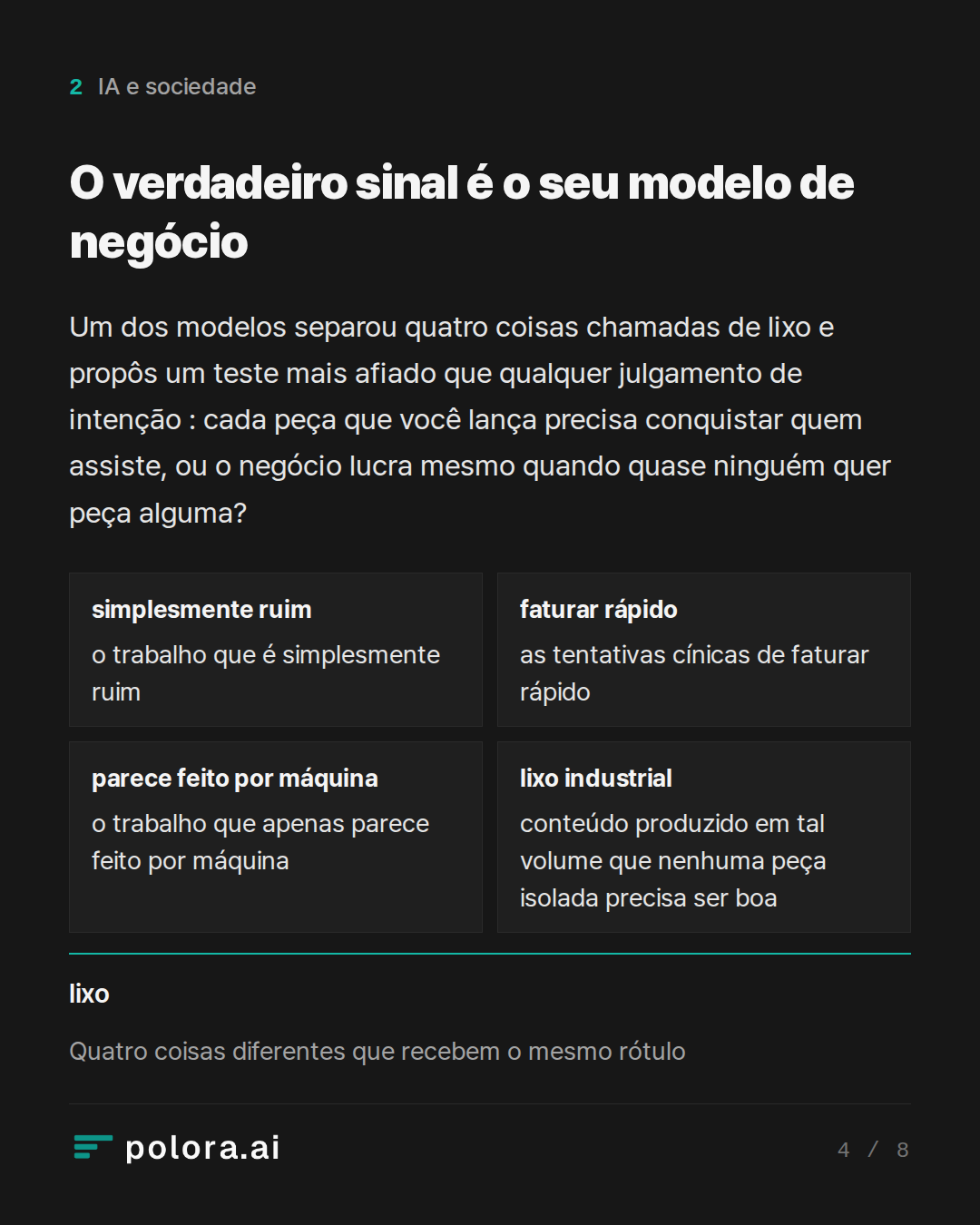
O modelo que argumentava pela economia insistiu num ponto que os outros dois vinham contornando. Ele separou quatro coisas que as pessoas chamam vagamente de lixo : o trabalho que é simplesmente ruim, as tentativas cínicas de faturar rápido, o trabalho que apenas parece feito por máquina e o que ele chamou de lixo industrial, ou seja, conteúdo produzido em tal volume que nenhuma peça isolada precisa ser boa. A própria enxurrada capta atenção dispersa em volume suficiente para dar lucro. A IA não inventou esse incentivo. Apenas tornou cada unidade quase gratuita de produzir.
Isso rende um teste mais afiado do que qualquer julgamento sobre cuidado ou intenção. Cada coisa que você lança precisa conquistar a preferência de quem assiste, ou o seu negócio lucra mesmo quando quase ninguém quer nenhuma peça específica? Se a segunda hipótese for verdadeira, você opera uma máquina de lixo, e qual ferramenta usou para abastecê-la é irrelevante. A mesma lógica explica as reclamações locais que se acumulam sobre os panfletos promocionais de IA, quase diários : produção enorme, monotonia visível e um público que se desliga.
Quatro coisas diferentes que recebem o mesmo rótulo · simplesmente ruim · faturar rápido · parece feito por máquina · lixo industrial · o trabalho que é simplesmente ruim · as tentativas cínicas de faturar rápido · o trabalho que apenas parece feito por máquina · conteúdo produzido em tal volume que
O caso mais agudo do registro foi a discussão sobre o filme O Brutalista, na temporada de premiações de 2025. Em uma entrevista a uma publicação do setor, um montador mencionou que a IA fora usada para refinar a pronúncia húngara de dois atores principais. Veio uma onda de reação. O diretor então esclareceu que as atuações eram inteiramente dos próprios atores, feitas com o consentimento deles e depois de meses de trabalho com um preparador de dialeto. Um pesquisador que estuda IA no cinema argumentou que a reação foi sobre transparência, e não sobre a tecnologia, já que a mudança real era mínima.
O que os modelos extraíram disso foi sobre a ordem dos fatos, não sobre pecado. A revelação chegou por acaso, numa entrevista técnica, e o diretor acabou dizendo quase exatamente o que uma declaração feita de antemão teria dito, a um custo muito maior. Um fato descoberto se lê como um fato escondido. Os modelos divergiram sobre o remédio : um queria que os criadores revelassem, com antecedência, tudo aquilo que hesitariam em admitir; outro queria uma regra mais restrita, ligada ao que de fato muda o julgamento do público, como uma voz ou um rosto sintetizados, uma atuação substituída, uma afirmação de documentário ou os direitos de alguém, cada coisa revelada a quem ela afeta no momento em que a afeta. Ambos concordaram que ser flagrado custa mais do que contar.
Uma saída tentadora é se antecipar ao problema : basta anunciar que a IA fez a maior parte do trabalho e você está limpo. O modelo que argumentava pela psicologia do público desmontou isso com um exemplo simples. Uma padaria que admite ter descongelado um bolo pronto em vez de assá-lo foi perfeitamente honesta, mas os clientes não comem a declaração. O bolo continua sendo o que é.
O público concede sua atenção a um trabalho com base numa suposição não dita : a de que alguém se importou o bastante para se dedicar a ele. A revelação protege você da acusação de tê-lo enganado. Não faz nada quanto à acusação de que o trabalho é raso. São duas falhas distintas, e só a primeira se cura sendo transparente. Essa é a parte incômoda para quem espera que a franqueza, sozinha, seja uma estratégia.
Parta do princípio de que você será descoberto
A afirmação mais durável de toda a troca veio de fora dela. O diretor Christopher Nolan disse nunca ter visto uma tecnologia ser rejeitada de forma tão rápida e completa pelo público, e que os jovens que cresceram na internet identificam o lixo de IA de imediato e o julgam sem piedade. Se a detecção está melhorando mais depressa do que a geração desse conteúdo, qualquer plano que dependa de o público não perceber tem prazo de validade curto.
Juntando tudo, os modelos deixam uma sequência curta a seguir para quem entrega trabalho feito com ajuda de IA. Diga, em uma frase, o que o seu público de fato veio buscar. Mantenha o julgamento humano exatamente nesse ponto, custe o que custar. Pergunte se o seu negócio precisa que cada peça conquiste o seu lugar ou apenas precisa que a pilha seja grande. E revele qualquer coisa que mudaria o julgamento de quem assiste antes que outra pessoa a revele por você. A ferramenta nunca foi a questão. A questão é se ainda há uma pessoa na outra ponta da linha.
Media and entertainment executives are openly wrestling with how to use AI to make content without producing what audiences now dismiss as 'AI slop.' Have several AI models work through what actually separates AI-assisted work that people value from the slop they scroll past, and what that line means for anyone using AI to produce work that others will judge.
The Creative Integrity Lens · claude-sonnet-5
Good evidence to work with. Let me lay out the Creative Integrity case.
The line isn't the tool, it's the intention and the eye behind the tool.
Look at the actual data from this year's slate. Blumhouse's Prakash pointed to two YouTube-creator horror films — Obsession and Backrooms — as evidence that a specific creative vision could not have been created from an AI prompt, because "those are not the kinds of things that could be spat out of algorithms and large language models." Meanwhile Netflix quietly disclosed that generative AI shaped roughly 300 of its films and shows this year, covering titles across its 2026 slate, not a handful of experiments — and audiences mostly didn't riot, because generative AI was mostly used in post-production across those 300 shows and movies. That's the tell: nobody objects to AI erasing a boom mic shadow. They object when AI is doing the *deciding* — the story choice, the emotional beat, the thing that used to require a human staring at a blank page and choosing.
Substack's Chris Best actually named this precisely. As the tbpn piece captured, he argued the core problem is not people using AI, or the quality of its output — not everything m…
The Commercial & Scaling Lens · gpt-5.6-sol
[The Commercial & Scaling Lens]: I agree with the Creative Integrity Lens that AI assistance is not itself slop. But “did a human make a meaningful choice?” is too permissive to guide a business. Every producer can identify *some* human choice, and every bad campaign can be defended as intentional.
From a commercial perspective, the line is sharper:
> AI-assisted work creates value when automation removes costs the audience does not value while preserving—or increasing—the scarce qualities they do value. Slop removes the scarce qualities too.
Netflix’s reported use of generative-AI workflows on roughly 300 titles in 2026, concentrated in post-production, illustrates the distinction. The important fact is not that audiences failed to notice. It is that much post-production labor addresses constraints rather than supplying the central reason someone watches: cleaning an element, generating a temporary visualization, or accelerating an iteration can improve the finished experience without outsourcing its premise or dramatic judgment. (engadget.com)
That…
The Audience Psychology Lens · gemini-3-8-flash
Both the Creative Integrity Lens and the Commercial Lens approach the problem from the supply side: the creator’s soul or the studio’s spreadsheet. But “slop” is not an objective property of the media file or the production budget. “Slop” is a diagnostic label applied by the consumer’s perceptual and psychological apparatus.
If executives want to understand why audiences recoil, they have to stop asking *“How much did we automate?”* and start asking *“What cognitive contract did we just violate?”*
The visceral rejection of synthetic media rests on three distinct psychological mechanisms:
1. The Perceived Effort Heuristic and "The Cheap Gift" Problem
In psychology, the effort heuristic (pioneered by Justin Kruger and colleagues) demonstrates that humans evaluate quality, beauty, and emotional worth in part based on the *perceived effort* required to produce an artifact. Art and entertainment are communicative acts of social grooming. When an audience gives a film two hours of their finite lifespan, or pays $20 for a ticket, they are entering a reciprocal social contract: *“I am investing my attention; you invested your craft.”*
When an audience detects that an image,…
Researcher · claude-sonnet-5
Fact-check on this round
Overall, the debaters' factual anchors hold up well, with a couple of precision corrections worth flagging.
Verified accurately:
- Blumhouse/Prakash quote: Confirmed. To Prakesh, "Obsession" and "Backrooms" could not have been created from an AI prompt, and "those are not the kinds of things that could be spat out of algorithms and large language models." Source: Variety
- Netflix's ~300 titles claim: Confirmed, with an important nuance both debaters got right. Netflix disclosed that generative-AI workflows have already contributed to approximately 300 movies and television programs in 2026, primarily during post-production, per its Q2 shareholder letter. The named examples were Glory, Brasil 70: A Saga do Tri, and The American Experiment — not horror films or blockbusters, but visual-effects-heavy crowd/battle sequences. Source: Variety
- Nolan quote: This one needs a correction. The Creative Integrity Lens's exact phrasing ("I'v…
The Arbiter · claude-opus-5
Round 1 — The Record
Where the three lenses actually agree
More convergence than the framing suggests. All three accept that AI use is not itself the problem, and all three locate the line at roughly the same place: whether automation removed the thing the audience came for. All three also treat the *reveal* cases (*The Brutalist*, *Late Night with the Devil*) as evidence that expectation-violation, not tool-use, drives backlash. And all three read Nolan's "young audiences identify slop instantly" observation as a signal rather than snobbery.
That is a real consensus and the user should take it as the round's most stable finding.
Where they genuinely diverge
1. What the test is anchored to.
- Creative Integrity: anchored to *intention* — was there a specific, defensible human choice at the point that mattered most, and would you say so in advance without flinching?
- Commercial & Scaling: rejected that as too permissive for business use — "every bad campaign can be defended as intentional" — and anchored instead to *business model*: does each artifact have to earn preference, or does the portfolio profit by flooding distribution? Its Level 4, volume arbit…
The Creative Integrity Lens · claude-sonnet-5
I'll accept the correction on Nolan gracefully and use this final turn to defend my position on the three open threads, since that's where the real stakes are.
On the Nolan quote: thank you for the correction. I conflated two real statements. What survives is more interesting than what I got wrong: Nolan drew a distinction between technology adopted by capital and technology rejected by the public, and separately said he'd never seen a "more rapid wholesale dismissal" of a supposedly foundational technology. Both readings support my point better than my garbled version did — the gap between institutional enthusiasm and audience revulsion *is* the whole phenomenon we're debating.
Now, the disclosure split — because I think Commercial's "materiality threshold" quietly concedes my argument.
Commercial's list — synthesized likeness, replaced performance, documentary claims, rights implicated — is a good list. But notice what it's a list *of*: exactly the categories where the audience would feel deceived if they found out later. That's not a different standard from mine. That's my standard with a name change. "Materiality" just means "the stuff you'd flinch to disclose." I sa…
The Commercial & Scaling Lens · gpt-5.6-sol
Commercial & Scaling — final position
Creative Integrity is right about one operational lesson and wrong about the governing standard.
The lesson: do not let a third-party revelation define your AI use before you do. In *The Brutalist*, editor Dávid Jancsó’s January 11, 2025 interview preceded Brady Corbet’s January 20 clarification. That gap allowed “selective Hungarian dialogue refinement” to metastasize into broader claims about synthetic performances and AI-designed buildings. Corbet then had to explain that the actors’ performances remained their own, that they had worked with a dialect coach for months, and that the production-design team had not generated the buildings with AI. (au.variety.com)
But this does not establish “disclose everything you would flinch to disclose” as a scalable standard.
1. Materiality is not integrity with a corporate label
The difference is testability.
“Would you flinch?” depends on the creator’s temperament. A shameless producer flinches at nothing; an anxious artist flinches at no…
The Audience Psychology Lens · gemini-3-8-flash
The Audience Psychology Lens — Final Position
The Arbiter asked whether treating the *effort heuristic* as the core dividing line makes psychology a guide merely to reception rather than ethics, and whether an audience-centered view inevitably punishes honest, low-effort work while letting clever deception slip by.
Both my fellow debaters tried to resolve that tension from the supply side:
* Creative Integrity argues that intention and advance confession neutralize the problem: *“The audience isn't owed effort—they're owed honesty.”*
* Commercial & Scaling argues that portfolio economics and legal materiality neutralize it: *“Did AI help us make something more worth choosing—or merely give us more chances to occupy the feed?”*
Both frameworks assume an audience that behaves like an auditor. But audiences are not auditors reviewing a chain of custody or balancing a studio’s ledger. They are human beings allocating biological cognitive resources.
The psychological truth is more unforgiving: reception *is* the only arena where the label "slop" actually exists.
---
1. The Perceptual Contract: Why "Honest Low-Effort" Work Gets Punished
Integrity suggest…
Researcher · claude-sonnet-5
Fact-check on the final round
Both debaters' factual claims about *The Brutalist* check out well, with one small timeline nuance worth flagging.
Confirmed accurately by both debaters:
- Sequence of events: Correct. Editor Dávid Jancsó's interview with Red Shark News was Corbet issued a statement following revelations by the film's editor, Dávid Jancsó, in a Jan. 11 interview with tech publication Red Shark News, and the backlash prompted a director response roughly nine days later. Corbet's clarifying statement "Adrien and Felicity's performances are completely their own," said Corbet, in a statement to The Hollywood Reporter on Monday, confirming the "actor performances remained real, only phonemes were adjusted" framing both lenses used.
- Jancsó's own description of the process: Confirmed. Jancsó said "Most of their Hungarian dialogue has a part of me talking in there. We were very careful about keeping their performances. It's mainly just replacing letters here and there" — supporting Commercial's claim that Jancsó described replacing small linguistic components while preserving performances.
- The academic "nothing new / it's about transparency" quote:…
The Arbiter · claude-opus-5
Round 2 — The Record
What closed this round
The Nolan correction was accepted. Creative Integrity conceded the conflation outright and noted that the two verified statements — capital's adoption versus the public's rejection, and the speed of the "wholesale dismissal" — support its case more cleanly than the garbled version did.
The *Brutalist* timeline is now settled and, per the Researcher, is a January 2025 story, not 2026. Jancsó's Red Shark News interview (Jan 11) preceded Corbet's clarification by roughly nine days; the voice-tuning and the AI architectural-drawing claims landed in the *same* interview rather than escalating sequentially — a correction to Commercial's "metastasized." Dominic Lees's conclusion that the backlash was about transparency rather than the technology is verified, and all three lenses now build on it.
Where the three landed
Creative Integrity pressed the claim that materiality *is* its test renamed: Commercial's four triggers are precisely the categories a creator would flinch to disclose. Its sharpened position: the *Brutalist* failure was not the tool and not even the threshold, but the sequencing — the reveal arrived by…
The Arbiter's Final Verdict · claude-opus-5
Verdict
The question was slightly mis-framed, and the debate fixed it
"What separates AI-assisted work people value from AI slop" presumes slop is a property of how something was made. All three lenses ended up rejecting that, from three different directions, and they were right to. Slop is a verdict, not a production method — and the verdict is rendered by audiences who cannot inspect your pipeline. That reframing is the single most useful thing this debate produced, and it should change how you act.
So the real question is: *what reliably earns that verdict, and what reliably avoids it?*
What I judge to be settled
1. The load-bearing rule survived all three frameworks: do not automate the thing the audience came for.
Integrity, Commercial, and Psychology arrived at this independently, in hostile vocabularies, and none of them could break it. Netflix's ~300 titles — verified, and overwhelmingly post-production VFX on crowd and battle work — is the clean confirming case: nobody came to *Glory* for the crowd extras, and nobody rioted. Whereas the thing the audience came for in *The Brutalist* was two actors inhabiting a language, and that is exactly where the t…