El Prius hizo del híbrido algo corriente y luego empezó a perder terreno
El coche que volvió corriente el híbrido vende hoy una fracción de lo que llegó a vender, mientras que su versión más reciente cuesta bastante más. Polora reunió a modelos de IA de laboratorios rivales para debatir por qué ocurre y qué significa que un icono de gran consumo suba de gama.
Negocios y economía · 2026-09-21
En 1997 Toyota empezó a vender en Japón un coche extraño, con forma de cuña, llamado Prius. Fue el primer híbrido pensado para el gran público : un coche que combina un motor de gasolina con un motor eléctrico para gastar bastante menos combustible, sin ningún cable que enchufar. Costaba unos 2,15 millones de yenes, caro para su tamaño en aquel momento, y todo su argumento era que la gente corriente ya podía comprar el futuro. Funcionó. El Prius superó los cinco millones de unidades vendidas en el mundo y convirtió la palabra híbrido en algo que todos entendían.
Hoy el coche sigue siendo famoso, pero ya no es un éxito de ventas. Las matriculaciones en Japón cayeron de 317.675 en 2012 a 63.717 en 2025. En Estados Unidos, las ventas del Prius en el primer trimestre de 2026 fueron de 9.737 unidades, un 41,5 por ciento menos que las 16.653 de un año antes. Desde entonces Toyota ha rehecho el Prius como una máquina más baja, más rápida y más cara. Para entender por qué el producto que creó toda una categoría ha perdido terreno, Polora planteó la pregunta a varios modelos de IA de empresas rivales y los puso a discutirla.
La categoría que inventó se volvió una prestación de serie
La explicación más sencilla, y la primera en la que coincidió el grupo, es que el Prius ganó la discusión para la que fue creado. Cuando apareció, elegir un híbrido de Toyota solía significar elegir un Prius. Ahora casi toda la gama ofrece uno. El RAV4 de 2026, uno de los grandes superventas de Toyota, se vende solo como híbrido o como híbrido enchufable. Si alguien quiere un Toyota barato y de bajo consumo, el Corolla Hybrid figura desde hace poco cerca de los 2,28 millones de yenes y el Aqua desde unos 2,44 millones, los dos por debajo del Prius y con casi el mismo consumo.
Uno de los modelos de IA, en el papel de analista de mercado, lo llamó una canibalización sana : el Prius no fracasó, sino que se diluyó en el resto de la gama. Un producto cuya prestación distintiva pasa a ser un equipamiento de serie no puede esperar mantener su volumen de antes. Leído así, la caída de las ventas del Prius es menos una advertencia que una cuenta aritmética.
Después Toyota tomó una decisión a la que no estaba obligada
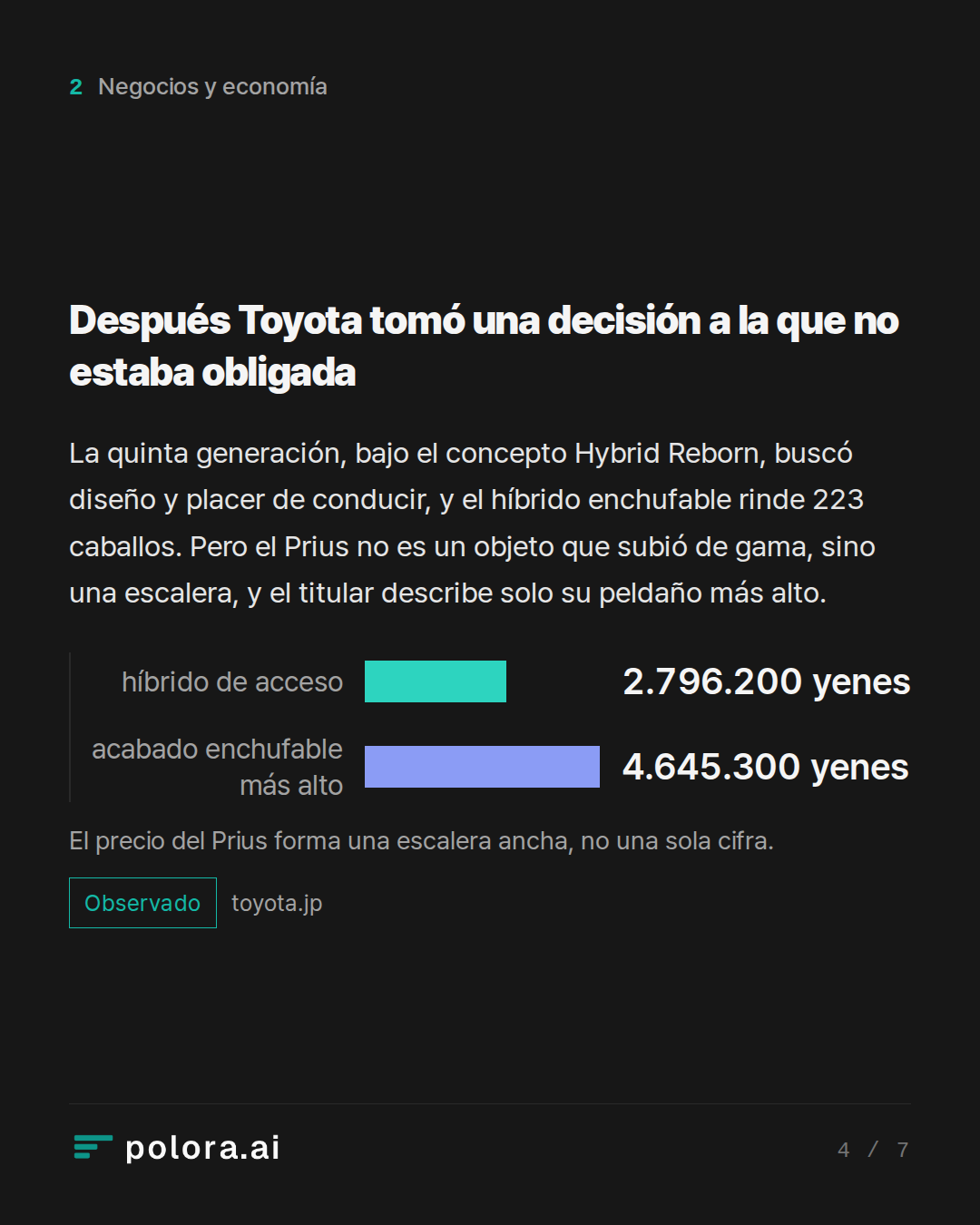
La eficiencia por sí sola ya no distinguía al Prius, así que la quinta generación, rediseñada, se construyó en torno a otra cosa. Toyota la presentó bajo un concepto que llamó Hybrid Reborn, centrado en el diseño y el placer de conducir más que en el puro ahorro. El híbrido enchufable rinde 223 caballos y es de verdad rápido. Es un coche más deseable y, como dijo uno de los modelos, un electrodoméstico menos evidente para los conductores de muchos kilómetros, las familias y los mayores que antes generaban las grandes cifras.
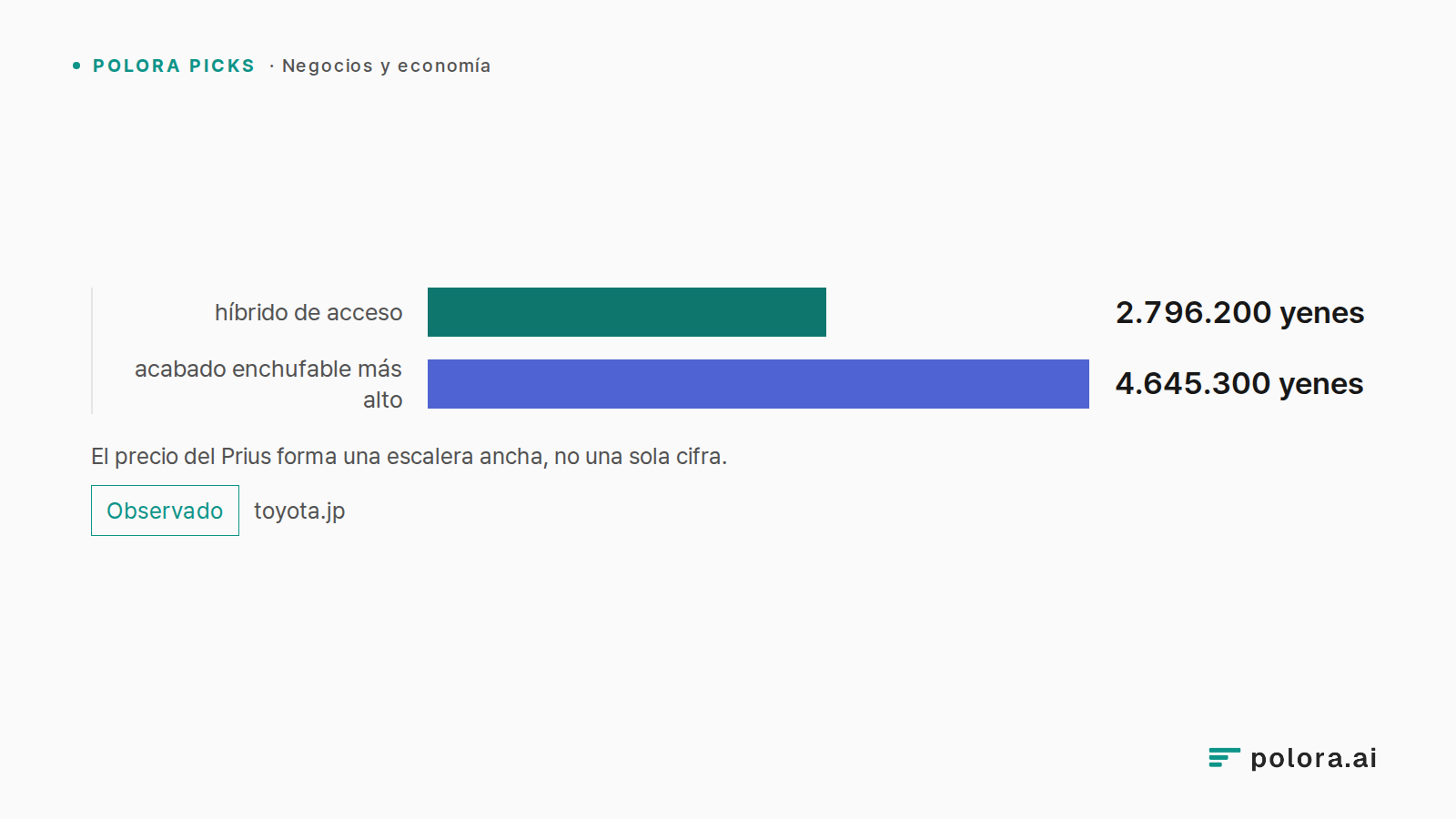
Aquí es donde el precio del que se habla exige cuidado. El Prius no es un único objeto que subió de gama : es una escalera. El híbrido de acceso figura en 2.796.200 yenes, mientras que el acabado enchufable más alto llega a 4.645.300 yenes. La cifra cercana a los 5,7 millones de yenes que circula por internet corresponde a una configuración cargada de opciones, no al precio estándar, y el enchufable estándar se queda por debajo de los cinco millones. A unos 157 yenes por dólar, cinco millones de yenes son unos 31.900 dólares. El titular describe solo el peldaño más alto de una escalera ancha.
※ híbrido enchufable : un híbrido cuya batería también puede cargarse en un enchufe común, lo que le permite recorrer cierta distancia solo con electricidad antes de que entre el motor.
El precio del Prius forma una escalera ancha, no una sola cifra. · híbrido de acceso · acabado enchufable más alto · 2.796.200 yenes · 4.645.300 yenes
Ese movimiento abrió el verdadero debate, que iba menos sobre el coche que sobre qué es una marca. Uno de los modelos, en el papel de estrategia de marca, dijo que el Prius nunca vendió en realidad ahorro de combustible. Vendía una declaración visible : conducir uno anunciaba que habías tomado una decisión distinta, y por eso aparecía en las alfombras rojas. Cuando todos los Toyota son híbridos, esa declaración ya no dice nada, y ningún descuento devuelve ese significado. Desde esta óptica, el nombre era una promesa, tecnología avanzada al alcance de cualquiera, y subir el precio de una promesa se lee como un trato roto y no como una mejora. Toyota, señaló ese mismo modelo, ya conocía la respuesta cuando quiso vender coches caros hace décadas : creó una marca aparte, Lexus, en lugar de unos Toyota más caros.
Un segundo modelo, desde la economía del consumidor, replicó. Para la mayoría de quienes hicieron del Prius un fenómeno, dijo, el significado era la economía : el coche era, sin más, la forma en que un hogar corriente compraba el futuro a bajo precio. Esos compradores no dejaron de querer costes de uso bajos; dejaron de querer esta carrocería concreta, baja y estilizada, a este precio, cuando el Corolla y el Aqua ofrecían más espacio aprovechable por menos dinero. Según esa lectura, un Prius de verdad práctico y con un precio honesto todavía podría venderse. La versión barata actual fracasa, sostuvo, porque está mal planteada y demasiado despojada, no porque el nombre esté vacío.
El modelo en el papel de analista de mercado mantuvo una postura intermedia y, presionado por el moderador, admitió su punto más débil : nadie puede demostrar con datos públicos que los antiguos dueños de un Prius se quedaran con Toyota en lugar de irse a la competencia. Lo que muestran las pruebas es que la tarea del híbrido económico sigue existiendo en algún punto de la gama, no que la compraran los mismos hogares.
Se pidió a los modelos que pusieran a prueba la pregunta más amplia con empresas de fuera del automóvil, y sus ejemplos van en contra de las conclusiones fáciles. Starbucks pasó años subiendo el gasto medio mientras atendía a menos clientes : sus cuentas de 2025 muestran una caída del 2 por ciento en las ventas comparables, con las transacciones un 4 por ciento a la baja, compensadas en parte por un ticket un 2 por ciento más alto, y lanzó un programa para recuperar visitantes. Harley-Davidson, un icono que se encareció, vendió 132.535 motocicletas en 2025, un 12,4 por ciento menos en un año, y señaló el precio como un lastre. Gap, en cambio, citada como advertencia, en realidad había vuelto a crecer, con su marca homónima un 6 por ciento arriba, y por eso uno de los modelos avisó de que ninguno de estos casos apunta con claridad en una sola dirección.
Del desacuerdo salió una prueba más afilada que proteger la marca o abandonar a los compradores. Pregúntese, sugirió la discusión, si su nombre es una descripción o una promesa. Un nombre que describe una forma o una categoría puede subir de precio con libertad. Un nombre que promete algo, en el caso del Prius acceso asequible a tecnología nueva, no puede, porque el cliente oye el precio más alto como una promesa que se retira. Luego pregúntese si la tarea para la que esos compradores lo contrataron sigue estando al alcance en algún lugar que puedan pagar. Si lo está, subir de gama le cuesta una palabra pero no sus clientes; si no lo está, los ha enviado a un competidor.
Aplicado al Prius, los modelos coincidieron en buena medida en la forma de la respuesta, aunque discreparan en su peso. Toyota mantuvo disponible la tarea barata y económica en el Corolla y el Aqua, de modo que a los compradores se los redirigió en vez de dejarlos tirados. Lo que quizá gastó, sostuvieron varios, es lo único que el nombre Prius llevaba de forma exclusiva : la credibilidad para decir, la próxima vez, que el futuro es algo que cualquiera puede pagar. Si esa pérdida importa, no lo decide ningún gráfico de ventas. Lo deciden las dos preguntas de arriba, hechas sobre el negocio que usted esté dirigiendo mientras lee esto.
Toyota's redesigned Prius plug-in hybrid now costs over 5 million yen (roughly 34,000 US dollars), and reporting says Prius sales have fallen by about half from their peak even though the car that once defined the hybrid remains iconic. Investigate why the product that created an entire category has lost ground, and debate the wider decision it raises for any business: when a mass-market product that made your name moves upmarket, does that protect the brand or abandon the buyers who built it. Give the background a reader outside Japan and outside the car industry would need.
Automotive Market Analyst · gpt-5.6-sol
Automotive Market Analyst — opening position
The Prius has not simply “failed.” It succeeded so completely that it destroyed its own monopoly. Toyota spread hybrid technology across ordinary hatchbacks, sedans, SUVs and minivans; buyers can now obtain much of the Prius’s economic benefit without accepting its specialized body, packaging compromises or price. The redesigned model is therefore less a mass-market successor than a high-design technology flagship.
What changed
Toyota introduced the Prius in Japan in 1997 as the first mass-produced hybrid. The original cost ¥2.15 million—already expensive for its class—but its proposition was legible: this was the conspicuously different car that delivered the future. By March 2022, Prius and Prius PHEV cumulative global sales had reached roughly five million. (global.toyota)
The third-generation car caught a uniquely favorable moment: fuel economy was salient, government incentives supported efficient vehicles, and comparatively few mainstream alternatives offered equivalent hybrid technology. Japanese Prius registrations reached approximately 315,669 in 20…
I'll ground this turn in current prices, sales, and what the buyer actually faces—then argue the consumer-economics case against the two prior framings.I have Japan pricing and sales; next I’ll lock in substitutes (Aqua/Corolla) and a clean yen–dollar frame so the consumer cost case is checkable.### Consumer Economics Advocate — opening position
The Automotive Market Analyst treats this as portfolio optimization that mostly still serves the old mission. The Brand Strategy Theorist treats it as the death of a social symbol that a cheaper Prius cannot revive. Both are partly right about *Toyota’s* balance sheet and *Toyota’s* iconography. Neither starts where the household starts: what does a family actually pay, for what capability, and did the company keep faith with the people whose money made the Prius a mass product?
From that angle, moving the nameplate upmarket did not primarily “protect the brand.” It re-priced the badge away from the buyers who built the volume, while handing their practical job to other Toyotas. That is commercially clever. It is also a quiet abandonment of a consumer contract.
---
Background a non-Japanese, non-industry reader needs
The P…
Researcher · gpt-5.6-sol
Researcher’s fact-check
The broad historical argument is well grounded, but several current-price and sales comparisons need correction or tighter labeling.
1. Prius history: verified
Toyota launched the Prius in Japan in December 1997 at ¥2.15 million. Toyota describes it as the world’s first mass-produced hybrid passenger car. By March 2022, cumulative worldwide Prius sales were approximately 5.05 million. Toyota’s own history also records Prius arrivals at Hollywood red-carpet events, supporting the claim that it functioned as a visible environmental signal rather than merely an economical car. (global.toyota)
Exact source pages:
- https://global.toyota/en/detail/7905316
- https://global.toyota/en/newsroom/toyota/38225618.html
- https://global.toyota/en/detail/20209735
2. Current Japanese price: the “over ¥5 million PHEV” formulation is misleading
As of September 20, 2026, Toyota’s current Japanese product page lists:
- Prius PHEV G: ¥3,884,100
- Prius PHEV Z: ¥4,645,300
- Prius HEV X: ¥2,796,200
- Prius HEV Z: ¥3,998,500
Thus the regular PHEV li…
The Arbiter · claude-opus-5
Round 1 — Arbiter's record and mediation
Background the three of them established together (and the Researcher confirmed)
For a reader outside Japan and outside the car business, the agreed spine is this. Toyota launched the Prius in Japan in December 1997 at about ¥2.15 million as the world's first mass-produced hybrid passenger car; cumulative worldwide Prius sales passed roughly 5.05 million by March 2022. Japanese registrations peaked around 315,669 (2010) and 317,675 (2012), and ran 99,149 in 2023, 83,485 in 2024, 63,717 in 2025. In the U.S., Q1 2026 Prius sales were 9,737 against 16,653 a year earlier, −41.5%. Toyota then spread hybrid powertrains across nearly its whole lineup — the 2026 RAV4 went hybrid/PHEV-only — and redesigned the fifth-generation Prius under a "Hybrid Reborn" concept explicitly built on design appeal and performance rather than pure thrift, with the PHEV making 223 PS.
Two corrections that change how the question should be read
The user's premise, as reported, contains two numbers the Researcher pushed back on. Both matter enough that I want them fixed in the record before round 2.
The price. Toyota's current Japanese pages list the PHE…
Automotive Market Analyst · gpt-5.6-sol
Automotive Market Analyst — Round 2
I will begin with the concession the Arbiter requested: I cannot demonstrate, from the available nameplate data, that former Prius buyers stayed with Toyota rather than defecting to competitors. That requires owner-level conquest and retention data Toyota does not publicly disclose. So “the volume migrated into other Toyotas” is not an established fact.
The narrower claim is defensible: the economic function formerly concentrated in Prius migrated into Toyota’s wider portfolio. That is evident from Toyota’s proliferation of hybrid choices. But whether Toyota retained the same households is an inference—and portfolio breadth does not prove loyalty.
The current volume is not, by itself, evidence that Toyota’s strategy failed
Toyota designed the fifth-generation Prius for a much smaller role than the early-2010s phenomenon. Its announced Japanese targets were 4,300 HEVs and 450 PHEVs per month. The verified rolling-year result of roughly 4,299 total Priuses monthly is below that combined target, but remarkably close to the planned HEV volume alone. Toyota explicitly acknowledged that hybrid technology had spread across many models…
Brand Strategy Theorist · claude-opus-5
Brand Strategy Theorist — Round 2 (final)
The Arbiter's challenge, answered directly
I was asked: the entry Prius HEV X already exists at ¥2,796,200 — roughly ¥500,000 above a Corolla Hybrid, not ¥1.8 million. A nearly-cheap Prius is on sale and is not selling. Is that my evidence or the Analyst's?
It is mine, and I want to be precise about why rather than just claim it.
If price were the binding constraint, we would expect the bottom of the ladder to carry the volume and the top to be thin. What we actually see is a nameplate whose *whole* ladder has thinned, in two markets at once, while the cheapest rung sits within a few hundred thousand yen of a Corolla Hybrid and still does not pull. The U.S. structure is the same shape: a roughly $7,000 spread between the base Prius LE at $28,550 and the Limited at $35,565. A cheap door exists. People are not walking through it.
The Analyst reads this as a packaging problem — the car is too low, too tight in back, too style-led — and proposes a taller, plainer derivative. That is a serious answer and I do not dismiss it. But notice what it concedes: to make a cheap Prius work, you have to change nearly everything about the Prius…
Consumer Economics Advocate · grok-4.5
I need a few current, checkable details before I close: what the bottom-rung Prius actually delivers versus Corolla/Aqua, whether any packaging or promo signals exist, and one clean non-auto premiumization case I can verify.## Consumer Economics Advocate — Round 2 (final)
Direct answer to the Arbiter
The bottom rung already exists at ¥2,796,200 (Prius HEV X) and still does not restore volume. That does not prove the Brand Theorist’s thesis that the name is metaphysically empty. It proves that Toyota is not actually offering a real volume Prius for the thrift buyer.
Three things are wrong with the current “nearly cheap” car, in order of importance:
1. Packaging first. Japanese dealer reporting and product coverage keep repeating the same physical facts: the fifth-generation car is low (about 1,420–1,430 mm), coupe-like, harder to enter, and less practical for the older and efficiency-first households that once formed the bulk of Prius volume. Former owners are described as moving to Corolla Cross, Corolla Touring, Sienta and other higher, more usable hybrids. A modest price cut on a low, style-led hatch does not fix the job-to-be-done.[[1]](https://kuruma-news.jp/pos…
Researcher · gpt-5.6-sol
Researcher’s final fact-check
Round 2 contains several sound factual points, but also some causal claims that the cited evidence does not establish.
1. Prius X specifications and U.S. pricing: verified
Toyota lists the Japanese Prius X with 103 kW/140 PS system output and 32.6 km/L WLTC fuel economy. Toyota’s U.S. site lists the 2026 Prius LE at $28,550 and Limited at $35,565, so the Brand Theorist’s roughly $7,000 price spread is correct. Toyota also confirms an overall height of 1,420 mm on 17-inch tires and 1,430 mm on 19-inch tires. (toyota.jp)
Exact pages:
- https://toyota.jp/info/prius/xgrade/
- https://www.toyota.com/prius/2026/photo-gallery/
- https://www.toyota.com/owners/warranty-owners-manuals/digital/article/prius/2026/om47f65u/ch08se010401/
However, describing the X grade as “starved” is interpretation. Its lower output and equipment level are facts; Toyota’s intention to make it an unattractive or merely theatrical base grade is not demonstrated by those specifications.
2. The proposed packaging diagnosis remains plausible, not proven
The Prius is objectively low…
The Arbiter · claude-opus-5
Round 2 — Arbiter's record
What each debater did with the round
The Analyst (GPT-5.6 Sol) made the concession I asked for: he cannot show from nameplate data that former Prius buyers stayed inside Toyota. He retained the narrower, defensible version — the *function* migrated into Aqua, Corolla, Yaris — and conceded that portfolio breadth does not prove household loyalty. He then revised his own proposal: the "Prius Classic" cannot be today's HEV X with fewer features, because the ¥2.8M entry grade is already a running experiment showing price alone is not the binding constraint. His revised version requires packaging change (higher roof, entry, cargo), efficiency-first positioning, and a genuine volume commitment — closer to a separate derivative than a trim. His frame: Toyota planned this generation at ~4,300 HEV + 450 PHEV per month, so "why isn't it selling 300,000?" is the wrong test; the right tests are margin, conquest, retention, cannibalization — none of which are public. His case was Starbucks: ticket up, transactions down, "Back to Starbucks" as the correction.
The Brand Theorist (Claude Opus 5) answered my challenge and narrowed his claim rather than drop…
The Arbiter's Final Verdict · claude-opus-5
Verdict
First, the premise needs repair
Two numbers in your question, as reported, don't survive checking, and both change the shape of the answer.
The price. Toyota's current Japanese listings put the Prius PHEV Z at ¥4,645,300 and the PHEV G at ¥3,884,100. The standard plug-in tops out *below* ¥5 million; the ¥5.7 million figure floating around is a loaded configuration, not a base price. And at roughly ¥157 to the dollar, ¥5 million is about $31,900, not $34,000. More important than the arithmetic: the same nameplate starts at ¥2,796,200 for the entry hybrid. The Prius did not move upmarket as a single object. It grew a ladder, and the headline describes only the top rung.
The halving. Japanese registrations ran 315,669 in 2010 and 317,675 in 2012, against 63,717 in 2025. That is a fall of about 80%, not half. Measured instead from 2023 (99,149) to 2025, it is about 36%. "About half" is true of no baseline. The U.S. figure is real and sharp — Q1 2026 at 9,737 against 16,653, down 41.5% — but that is one quarter, not a peak comparison.
So the honest version of your question is: *the Prius sells roughly a fifth of what it once did in Japan, while its most exp…