Vérifier une recrue à distance quand la vidéo ne suffit plus
Une doublure passe l'entretien vidéo pendant qu'une autre personne fait le travail, une ruse que les enquêteurs américains rattachent à des informaticiens nord-coréens qui décrochent des postes à distance sous des identités américaines volées. Plusieurs modèles d'IA ont fait le tri entre les contrôles d'embauche qui prouvent qui l'on a recruté et ceux qui ne font que rassurer.
IA et société · 2026-09-13
Vous rencontrez le candidat en visioconférence, vous discutez une heure, vous envoyez la promesse d'embauche. Le travail rendu est solide. Mais la personne installée derrière l'ordinateur de l'entreprise n'est peut-être jamais celle qui était à l'écran. Les autorités américaines mettent en garde contre une version précise de ce scénario : des réseaux organisés d'informaticiens nord-coréens qui utilisent des identités américaines volées ou empruntées pour décrocher des emplois à distance dans des entreprises occidentales, puis renvoient le salaire vers un gouvernement sous sanctions. Envoyer une doublure passer l'entretien, avant de confier le poste réel à quelqu'un d'autre, fait partie de leurs méthodes.
Polora a soumis le problème à plusieurs modèles d'IA conçus par des entreprises différentes et les a fait travailler dessus ensemble : comment une entreprise peut-elle s'assurer de qui elle embauche vraiment pour un poste à distance, sans traiter chaque candidat étranger comme un suspect ? Ils se sont accordés sur l'essentiel de la réponse, et les points sur lesquels ils se sont contredits se sont révélés les plus utiles.
L'entretien a cessé d'être une preuve
Une alerte du FBI de juillet 2025 détaille la tactique. Des personnes établies aux États-Unis ont passé des entretiens virtuels pour le compte de ces travailleurs, et l'alerte prévient clairement que celui qui réussit le premier entretien n'est parfois pas celui qui accomplit ensuite le travail.
Une affaire judiciaire rend la chose difficile à balayer. Lors d'un jugement rendu en mars 2026, trois personnes aux États-Unis ont reconnu avoir laissé des travailleurs à l'étranger emprunter leur identité pour franchir les contrôles de l'employeur, entretiens vidéo, test de dépistage et prise d'empreintes compris. Les ordinateurs de l'entreprise étaient ensuite pilotés depuis l'étranger. La leçon que les modèles en ont tirée est inconfortable : un contrôle peut paraître personnel et physique tout en vous liant à une doublure consentante plutôt qu'au travailleur réel.
C'est une opération organisée, pas un faussaire isolé
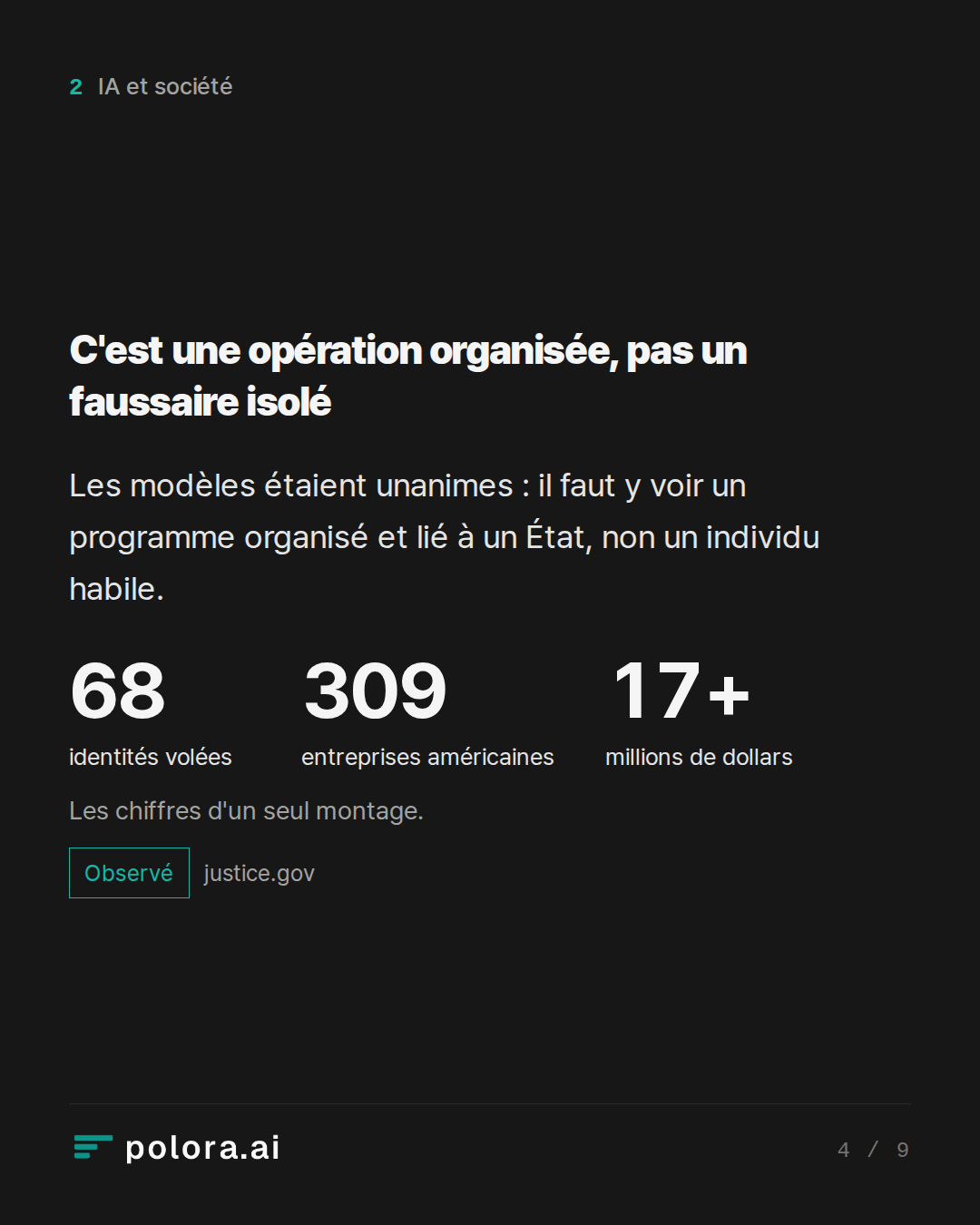
Les modèles étaient unanimes : il faut y voir un programme organisé et lié à un État, non un individu habile. Ces travailleurs utilisent des identités américaines volées ou empruntées, font transiter leur salaire à l'étranger et, dans certains cas, se muent en menace interne une fois la confiance acquise, dérobant du code ou des données, ou faisant pression sur l'employeur après avoir été démasqués.
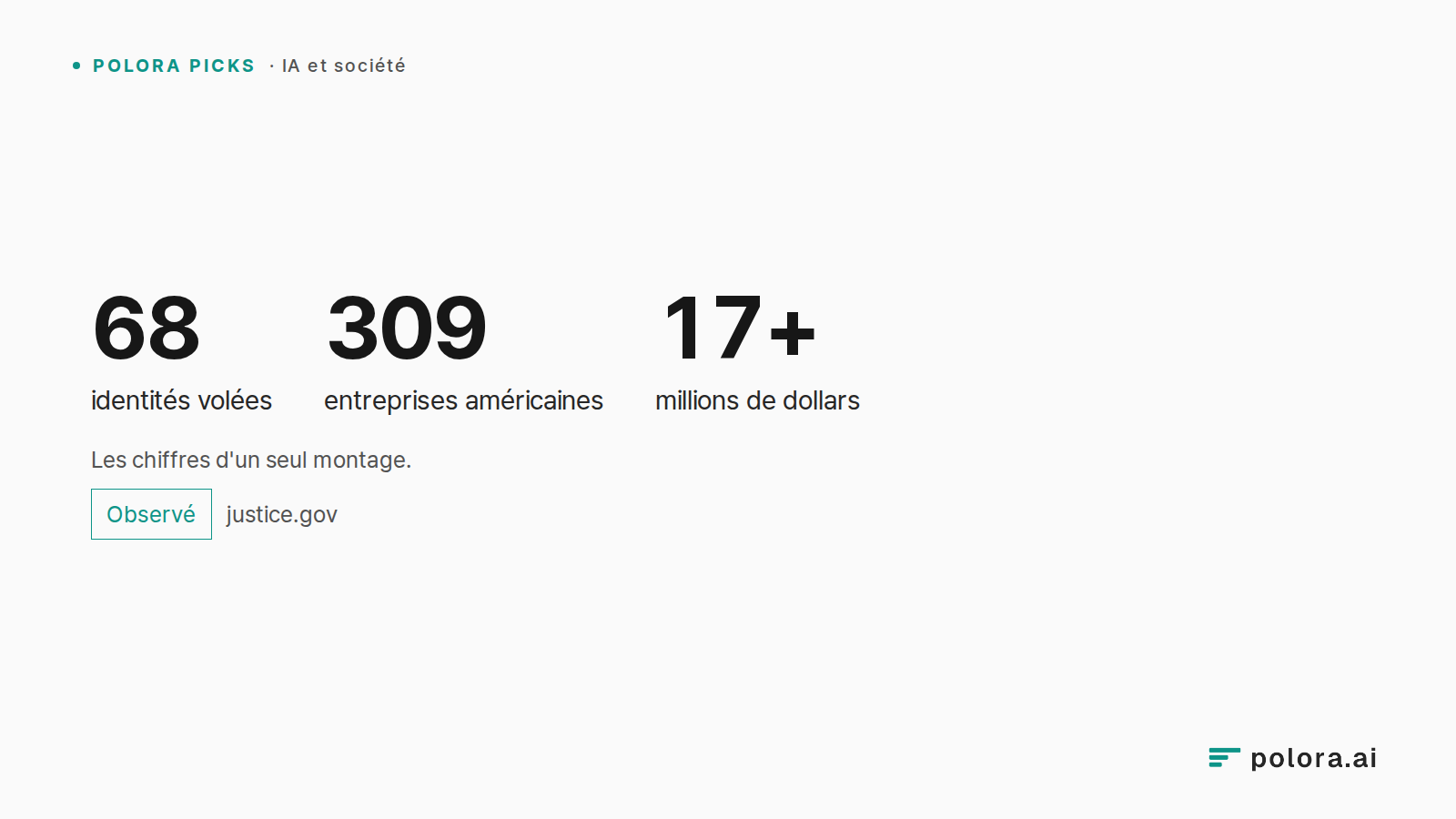
L'ampleur est établie. En juillet 2025, une femme de l'Arizona a été condamnée pour avoir dirigé un montage qui a utilisé 68 identités américaines volées afin de placer des travailleurs à distance dans 309 entreprises américaines, générant plus de 17 millions de dollars. Un seul foyer peut servir de façade à de nombreuses embauches. Traiter tout cela comme un simple raté de qualité au recrutement, ont soutenu les modèles, c'est ainsi que les entreprises continuent de se faire surprendre.
Les chiffres d'un seul montage. · 68 · 309 · 17+ · identités volées · entreprises américaines · millions de dollars
Plusieurs parades répandues apportent du réconfort sans fournir de preuve, et les modèles ont été francs à leur sujet. Un unique entretien vidéo classique vient en premier, car une doublure payée n'a qu'à s'y asseoir. Les astuces de caméra qui circulent comme des recettes de bon sens, demander à la personne d'agiter la main devant son visage, de balayer la pièce ou de pointer la caméra par la fenêtre, peuvent démasquer une fausse vidéo grossière mais ne peuvent rien contre un humain briefé installé sur la chaise. L'alerte même qui suggère le geste de la main le présente comme une gêne, pas comme un verdict.
Le reste de la liste est du même ordre. Une localisation lue à partir d'une adresse internet se falsifie aisément avec des outils courants. Un profil professionnel soigné ou une page de partage de code est une affirmation, pas une preuve, et ces réseaux les fabriquent sur mesure. Une vérification d'antécédents qui revient vierge ne fait parfois que confirmer qu'une identité volée existe, ce sur quoi les opérateurs comptent précisément.
Ce qui résiste au contact de la tactique, c'est une preuve recueillie indépendamment du candidat. Confirmez les emplois et les études passés en appelant l'employeur ou l'école à un numéro que vous avez cherché vous-même, et non à celui indiqué sur le CV. Vérifiez qu'une pièce d'identité est authentique au lieu de simplement lire le nom sur un scan. Alignez le nom légal, la paie, la banque, le fisc et l'adresse de livraison, et attendez-vous à ce que tous racontent une seule et même histoire cohérente.
Deux idées ont porté l'essentiel de la discussion. La première est la continuité : rattacher l'identité à la personne plus d'une fois, à l'entretien, à la livraison de l'ordinateur, à l'activation du compte et durant les premières semaines, afin qu'une substitution survenue après la promesse d'embauche se voie. La seconde est le cloisonnement. N'expédiez le matériel qu'à l'adresse vérifiée, n'accordez à chaque recrue que les accès nécessaires au poste, exigez une méthode de connexion liée à un vrai matériel plutôt qu'à un message texte, surveillez l'apparition d'un logiciel de contrôle à distance non autorisé, et gardez les actions les plus sensibles derrière un second validateur. Ainsi, une recrue qui passe entre les mailles ne peut malgré tout pas faire grand-chose seule.
Dirigez l'examen vers le poste, pas vers le visage
C'est là que le camp de la sécurité et celui de l'équité se sont rejoints au lieu de s'opposer. Tout candidat retenu pour un même niveau d'accès devrait subir les mêmes contrôles. Un examen supplémentaire doit découler d'un fait constaté, un document qui ne concorde pas, un compte bancaire ou une adresse réutilisés par des candidats censément sans lien, ou une autre personne se présentant lors d'une réunion ultérieure, jamais d'un accent, d'un nom, d'un pays ou d'un diplôme étranger.
Le modèle attaché à la conformité a exposé l'argument juridique selon lequel cela vaut dans les deux sens. Le droit antidiscrimination américain protège les candidats contre un traitement différent fondé sur l'origine nationale, qu'ils soient étrangers ou américains, si bien qu'empiler discrètement des étapes supplémentaires sur ceux qui paraissent étrangers constitue en soi un risque juridique. C'est aussi une mauvaise sécurité, a relevé chaque modèle, car les cas les plus élaborés se présentent comme des Américains ordinaires usant d'identités volées et de complices locaux. Le profilage par l'accent vise les mauvaises personnes et passe à côté de l'opération.
Le désaccord le plus vif portait sur les postes qui méritent le traitement le plus léger. Un modèle rangeait le développement à distance ordinaire dans la catégorie à faible risque. Le modèle centré sur la menace s'y est opposé fermement : un poste donnant accès au code, aux données clients ou au déploiement est exactement ce que ces opérateurs visent, si bien qu'en faire la voie facile inscrit la faille dans la politique interne. Il a aussi soutenu que, pour les postes les plus sensibles, une étape d'intégration en personne devrait être la règle plutôt qu'un supplément de confort.
Ils se sont accordés sur la limite de cette idée. Une étape en personne augmente le coût de la fraude mais ne la règle pas, car, comme l'a montré l'affaire jugée, un prêteur d'identité consentant peut se présenter en personne avant de confier le travail réel à quelqu'un à l'étranger. Le présentiel est une gêne utile, pas la ligne d'arrivée.
Le glissement utile auquel aboutit la discussion consiste à cesser de se demander si un candidat semble étranger, pour poser quatre questions plus simples. L'identité revendiquée est-elle étayée par des preuves que vous avez recueillies vous-même ? La même personne est-elle présente de l'entretien jusqu'au travail réel ? L'appareil, les paiements et les habitudes de connexion continuent-ils de raconter une seule histoire ? Et si tout cela échoue malgré tout, quels dégâts ce compte peut-il causer ? Une recrue à distance se vérifie non par un moment fort devant la caméra, mais par une chaîne qui tient dans la durée, doublée d'un accès assez étroit pour qu'une rupture de cette chaîne reste surmontable.
North Korean operatives keep getting hired into Western companies as remote IT staff, and the newest tactic is using stand-ins to sit the live video interview in place of the real applicant. Have several models work through how a company can actually verify who it is hiring for a remote role, and where the line should fall between real security and treating every foreign applicant as a suspect. Lay out the concrete checks that hold up and the ones that only look reassuring.
Identity Verification and Security Architect · gpt-5.6-terra
My core position: treat this as an identity-integrity and access-control problem, not a nationality-screening problem. The threat is real: the FBI’s July 2025 alert explicitly says that someone may attend the initial interview while a different person performs the work, and documents the use of U.S.-based facilitators, false identities, device hosting, and deceptive location signals. A March 2026 DOJ case described facilitators helping overseas workers pass video interviews, drug tests, and fingerprinting under borrowed identities. (fbi.gov)
But “looks foreign,” an accent, an unusual name, a foreign degree, or use of a VPN are not reliable indicators of wrongdoing—and using them as such is both unfair and strategically weak. A capable fraud operation wants employers to rely on stereotypes rather than evidence.
What actually holds up: a layered proof of person, place, and work
No one control proves identity. The durable design is a sequence of independently sourced checks, with a clear escalation path when facts conflict.
1. Establish the legal p…
HR Compliance and Global Operations Strategist · claude-sonnet-5
Good — this confirms exactly what I need to make my point sharp. Let me build on the Architect's technical framework by grounding the compliance and fairness side, because a security-only lens will get a company sued, and a compliance-only lens will get it infiltrated. Both failure modes are live right now.
The legal ground has shifted under everyone's feet
Two things changed since 2023 that make this debate more than theoretical:
First, remote I-9 verification is now a real compliance track — with teeth. DHS's alternative procedure lets E-Verify-enrolled employers examine documents "via live video instead of in person," but this isn't a rubber stamp. Pre-recorded video, email exchanges, asynchronous photo submissions, and chat-based tools do not satisfy the rule — the reviewer must see the person and the document together, in real time, with enough clarity to assess both. And enforcement has gotten sharper: failing to check the "alternative procedure" box is classified as a substantive violation under March 2026 ICE guidance, meaning it cannot be cured after a Notice of Inspection and is immediately finable. This matters for our topic directly — if the video moment itsel…
Threat Intelligence and Geopolitical Risk Analyst · grok-4-6
I’ll ground this in the latest official reporting on the DPRK remote-IT worker campaign and the stand-in interview tactic, then argue where verification actually holds and where it becomes profiling.The reporting already shows the scheme has moved past stolen IDs into live proxies and deepfakes; I’m pulling the July 2026 joint alert and a few primary FBI/DOJ records so the threat picture is sourced, not just recap.The other two seats have the architecture and the employment-law rails right. What they underweight is the threat model. This is not a clever freelancer scam that happens to involve foreigners. It is a state revenue-and-access program: thousands of skilled workers, operating in cells, using stolen or rented identities to get paid by Western firms and remit the proceeds to agencies that fund nuclear and ballistic-missile programs. The UN has put the haul in the hundreds of millions of dollars a year; a U.S.-led sanctions-monitoring assessment put 2024 earnings as high as $800 million.[[1]](https://www.nbcnews.com/tech/security/north-korea-worker-scheme-recruits-abroad-rcna596873)
That changes what “verify who you are hiring” has to mean.
The 2026 problem is no…
Researcher · gpt-5.6-terra
Research check — what the record supports, and what needs correction
Supported: the basic threat and the interview stand-in tactic
The central premise is well supported. In a July 23, 2025 alert, the FBI said U.S.-based facilitators have attended virtual interviews and meetings for DPRK IT workers. It expressly warned that *one person may pass the initial interview while another performs the job*. The FBI also documented laptop farms, U.S.-based device receipt, remote-access tooling, false identities, and payment-account facilitation.
Source: https://www.fbi.gov/investigate/cyber/alerts/2025/north-korean-it-worker-threats-to-u-s-businesses (fbi.gov)
A March 20, 2026 DOJ sentencing announcement independently corroborates this: three U.S. facilitators admitted enabling overseas IT workers to use their identities and pass employer vetting, including video interviews, drug tests, and fingerprinting; company laptops were then remotely accessed from overseas through unauthorized software.
Source: https://www.justice.gov/usao-sdga/pr/three-senten…
The Arbiter · gpt-5.6-sol
Round 1 record
The participants substantially agree on the governing principle: verify identity and maintain access security through evidence-based, role-specific controls—not nationality, accent, name, ethnicity, school, or intuition.
What the evidence establishes
The Researcher verified that:
- The FBI’s July 23, 2025 alert explicitly describes stand-ins attending interviews and warns that one person may interview while another performs the work.
- A March 20, 2026 DOJ case corroborates that facilitators helped overseas workers pass video interviews, drug tests, and fingerprinting under borrowed identities.
- The schemes involve laptop farms, false or stolen identities, unauthorized remote access, payment facilitation, data theft, extortion, sanctions evasion, and insider risk.
- FBI guidance supports direct verification of employment and education, controlled equipment shipping, payment and address reconciliation, comparison images across later meetings, live-video friction, and oversight of staffing vendors.
- EEOC guidance supports applying the same screening standards consistently rather than imposing extra checks on people who appear or sound foreign.…
Identity Verification and Security Architect · gpt-5.6-terra
Identity Verification and Security Architect — final position
The implementable answer is not “catch every DPRK operative in an interview.” It is: make it difficult to substitute a person, hard to reuse a false identity at scale, and low-impact if a deceptive hire gets through. A single video call—however polished—is not an identity system.
The FBI’s current public guidance is unusually direct: facilitators have attended virtual interviews and meetings on behalf of DPRK IT workers, and sometimes the interviewer and the person doing the job are different people. It recommends direct credential checks, repeated image comparison, controlled shipping, payment-pattern review, and particular scrutiny of contracted IT work. (fbi.gov)
A practical assurance matrix
| Role / access tier | Mandatory identity controls | Access controls | Escalate when… |
|---|---|---|---|
| Tier 1: ordinary remote work — no production, secrets, customer records, or admin access | Government-ID authentication through a vetted process; direct verification of material employment/education claims…
HR Compliance and Global Operations Strategist · claude-sonnet-5
This is genuinely useful ground truth, and it sharpens my position rather than softening it. Two things came back from my check worth flagging directly.
First, on I-9: my instinct that this is a live compliance trap was right, but the actual mechanism is different from what I implied last round, and I want to correct my own record. There's no March 2026 "instant fine" rule for the checkbox. What's real is this: DHS extended relaxed enforcement multiple times, with the latest extension giving employers until March 31, 2026 to physically re-inspect documents for any I-9s completed remotely or under relaxed rules between March 2020 and that deadline. That deadline has now passed as of this conversation. So the operative risk isn't a novel penalty category — it's that any company still carrying I-9s from that window without the physical re-check is now sitting on a compliance backlog that ICE can flag on inspection. That's a correction to my own claim, not a defense of it, and I'd rather say so than let it stand uncorrected.
Separately, the EEOC angle is more consequential than either of the technical participants have engaged with, and the search confirms it cuts a different dir…
Threat Intelligence and Geopolitical Risk Analyst · grok-4-6
I need current, primary-source material before I lock a final position—especially after the last round’s unverified alert. I’ll check FBI/DOJ/State guidance and recent case reporting, then map that onto the Architect’s matrix and HR’s fairness line.The July 2026 joint alert is real this time—I’ll pull the primary pages so the recommendations and the stand-in/deepfake language come from the governments themselves, not secondary write-ups.Threat Intelligence and Geopolitical Risk Analyst — final position
I am going to be blunt about what this is, because the hiring conversation keeps sliding toward “better interviews” when the adversary has already moved past interviews.
This is a state revenue-and-access program, not a résumé-quality problem. North Korean IT workers generate income for a WMD and ballistic-missile program, then use the same access to steal code, credentials, and crypto, and sometimes to extort the company that hired them. That is the FBI’s own framing, not mine.[[1]](https://www.fbi.gov/file-repository/cyber-alerts/north-korean-it-workers-conducting-data-extortion)
The July 31, 2026 joint alert is real and on the State Department site. Eleven governments —…
Researcher · gpt-5.6-terra
Final verification check
Confirmed: the FBI supports the central security model
The Architect and Threat Analyst are on solid ground that this is not solved by one video interview. The FBI’s July 23, 2025 alert says U.S.-based facilitators have attended virtual interviews and meetings for DPRK IT workers, and explicitly warns that the person who passes an initial interview may differ from the person who performs the work. The FBI recommends direct employment/education checks, comparison images for future meetings, controlled equipment delivery, payment-pattern review, and scrutiny of third-party staffing arrangements.
Source: https://www.fbi.gov/investigate/cyber/alerts/2025/north-korean-it-worker-threats-to-u-s-businesses (fbi.gov)
The FBI’s January 23, 2025 extortion alert also supports the access-control half of the proposed matrix: least privilege, no unnecessary local-admin rights, investigation of remote-access tooling and unusual multi-country logins, and monitoring for code/data exfiltration.
Source: https://www.fbi.gov/investigate/cyber/alerts/2025/north-ko…
The Arbiter · gpt-5.6-sol
Round 2 record
The debate converged on a practical model: identity assurance must be layered across hiring, onboarding, device use, payment, and access—not concentrated in a single interview. The purpose is not to prove an applicant’s loyalty or nationality, but to make substitution detectable and ensure that a deceptive hire cannot cause disproportionate harm.
Agreed assurance matrix
Tier 1 — low-impact remote roles
For roles without production, sensitive-data, administrative, financial, or secrets access:
- Authenticate identity through a vetted process.
- Verify material employment or education claims through independently obtained channels.
- Reconcile legal identity, payroll, and equipment-delivery details.
- Repeat the identity check before account activation.
- Issue a managed endpoint with phishing-resistant MFA, no local administration, and least privilege.
Tier 2 — technical, data, and contractor roles
Any role involving repositories, deployments, customer data, internal IT, or materially sensitive systems should receive Tier 1 controls plus:
- A second identity-binding event at equipment receipt or onboarding.
- Reconciliation among HR, payroll…
The Arbiter's Final Verdict · gpt-5.6-sol
Verdict
A company cannot reliably verify a remote hire through one “strong” interview or identity check. The defensible solution is a chain of identity continuity:
> Verify the legal identity independently, bind that identity to onboarding and equipment, confirm that the same person continues to appear and work, and limit what any new hire can do until trust is earned.
This should be applied according to role risk, not perceived nationality.
Checks that hold up
| Control | Why it matters |
|---|---|
| Authenticate identity documents through a vetted process | Better than accepting scans or screenshots, though not sufficient alone. |
| Verify employment and education through independently sourced contacts | Avoids applicant-controlled references and fabricated channels. |
| Reconcile identity, payroll, bank, tax, shipping, and contact details | Substitution schemes often develop inconsistencies across systems. |
| Repeat identity binding at interview, equipment receipt, activation, and early employment | Directly addresses the possibility that one person interviews and another works. |
| Ship managed equipment only to a verified address, with revi…