Pourquoi les séries en streaming s'arrêtent si souvent après deux saisons
Netflix a annulé Ransom Canyon après deux saisons malgré des fans fidèles. La raison n'est pas une règle mais un problème de calcul, et elle change la façon dont vous devriez choisir ce que vous commencez à regarder.
Culture et arts · 2026-09-13
En septembre 2026, Netflix a décidé de ne pas produire de troisième saison de Ransom Canyon, une romance en décor de western qui s'était constitué un public fidèle en deux ans. Ses fans étaient bien réels et se faisaient entendre, et l'histoire n'était pas terminée. L'annulation a tout de même eu lieu, et elle correspond à un schéma que les spectateurs ont commencé à repérer et à redouter : une série en streaming arrive, tient deux saisons, puis s'arrête sans bruit.
Pour décortiquer la question, Polora l'a soumise à plusieurs modèles d'IA conçus par des entreprises différentes et les a fait débattre des raisons de ce phénomène et de ce qu'un spectateur peut y faire. Ils n'étaient pas d'accord sur l'endroit où placer la responsabilité, mais ils se sont retrouvés sur une mise au point qui mérite d'être posée d'emblée. Il n'existe aucune règle chez Netflix qui mettrait fin à une série après deux saisons. La deuxième saison est simplement le moment où le calcul se retourne le plus souvent contre elle.
Deux saisons, le moment où le calcul se décide
Une première saison est un pari sur la découverte. Elle existe pour trouver un public qui ne regardait pas jusque-là, pour gagner un peu d'attention et pour convaincre quelques personnes de s'abonner ou de rester. Une deuxième saison teste une question plus étroite : ce public est-il revenu, et s'est-il élargi ? Quand une plateforme pèse une troisième saison, elle a déjà vu combien de spectateurs de la première saison sont revenus, s'ils ont terminé les nouveaux épisodes, comment la série voyage dans d'autres pays et ce que coûtera la saison suivante. C'est le premier moment où un jugement assuré sur l'avenir d'une série devient possible.
Le schéma paraît aussi plus absolu qu'il ne l'est. Les séries qui échouent après une saison disparaissent avant que quiconque s'y attache, et les rares séries qui durent des années se détachent comme des exceptions. Les annulations au bout de deux saisons occupent le milieu douloureux, assez long pour susciter l'attachement mais trop court pour finir l'histoire, et ce sont donc celles dont les spectateurs se souviennent.
Un public dévoué n'est pas un public rentable
L'un des modèles, raisonnant à partir de l'économie des plateformes, a posé la distinction centrale : un public fidèle et un public renouvelable sont deux choses différentes. Une série en streaming se juge moins comme une série que comme un produit d'abonnement. La question n'est pas de savoir si ses fans l'adorent, mais de savoir si une saison de plus attirerait assez de nouveaux abonnés, retiendrait assez d'abonnés hésitants et ajouterait assez de valeur durable au catalogue pour l'emporter sur tout autre usage du même argent. Netflix ne choisit jamais entre une troisième saison et rien. Il choisit entre cette saison et une nouvelle série, un film, un contrat sportif ou un pari moins cher susceptible de toucher un public plus large.
Mesuré ainsi, un public passionné peut perdre. Si la plupart de ces fans gardaient leur abonnement de toute façon, l'attachement de ce public n'apporte pas grand-chose sur quoi la plateforme puisse compter. Netflix ne publie pas la formule qu'il utilise, si bien qu'aucun observateur extérieur ne peut nommer le seuil exact qu'une série donnée n'a pas atteint. Ses documents financiers disent seulement qu'il traite ses programmes comme un actif dont la valeur dépend du visionnage qu'il en attend, ce qui appuie la logique générale sans révéler le verdict d'une série en particulier.
Pourquoi une série d'une chaîne classique pouvait tenir des années
La télévision hertzienne avait des raisons de garder à l'antenne une série seulement correcte. Chaque épisode supplémentaire créait du temps de publicité à vendre. Une série fiable ancrait une soirée de semaine et réduisait le risque d'une case vide. Une longue suite d'épisodes pouvait être revendue en rediffusions et sur les marchés étrangers, ce qui récompensait le simple fait de cumuler un grand nombre d'épisodes. Et une chaîne pouvait ajuster une commande en cours de diffusion, prolonger une série qui marchait ou raccourcir une série qui ne marchait pas.
Le streaming a supprimé la plupart de ces amortisseurs. Une saison compte d'ordinaire huit ou dix épisodes mis en ligne d'un coup, ce qui produit bien moins d'espace publicitaire et aucune grille hebdomadaire à protéger. Nul besoin d'accumuler des épisodes pour les rediffusions quand la plateforme détient déjà les droits dans le monde entier. Et chaque reconduction entre en concurrence directe avec chaque idée neuve. Les modèles ont toutefois mis en garde contre la nostalgie. Les chaînes aussi annulaient des séries en quelques semaines, et leurs saisons sont aujourd'hui plus courtes qu'autrefois. Le streaming n'a pas inventé l'annulation rapide. Il a changé le type de série correcte mais pas immense qui parvient à survivre.
Le coût d'une saison de plus grimpe à mesure que le public baisse
La production ajoute sa propre pression. Une première saison est chiffrée comme un pari. Une deuxième est chiffrée comme un actif éprouvé, et ceux qui disposent d'un rapport de force, des têtes d'affiche aux chefs de poste, négocient à la hausse dès qu'une série marche visiblement. Un western à multiples décors, avec ranchs, chevaux et vedettes en haut de l'affiche, part d'un plancher de coûts plus élevé qu'une comédie tournée sur un décor permanent, et ce plancher tend à monter à chaque reconduction plutôt qu'à baisser. La plateforme ne demande donc pas seulement si le public a grandi. Elle demande s'il a grandi assez pour distancer une courbe de coûts plus raide que l'année précédente.
Le streaming a aussi renoncé aux leviers plus fins. Une chaîne hertzienne pouvait commander quelques épisodes de plus ou en couper quelques-uns. Une plateforme s'engage sur un bloc entier à la fois, attend plus d'un an, puis décide de financer une saison complète ou aucune. C'est en partie pourquoi la fin, quand elle arrive, paraît si soudaine. Il n'a jamais existé de porte de sortie plus modeste.
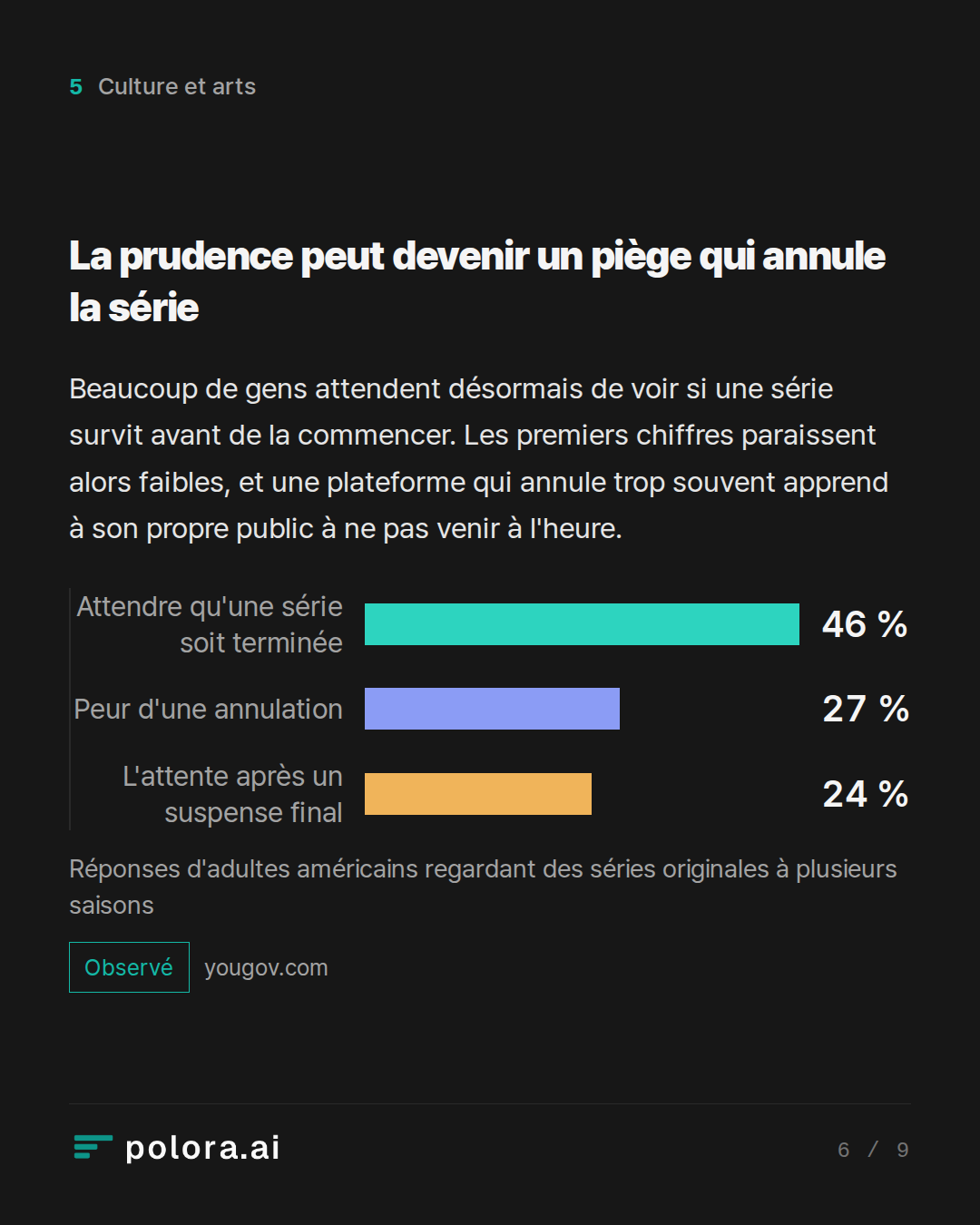
La prudence peut devenir un piège qui annule la série
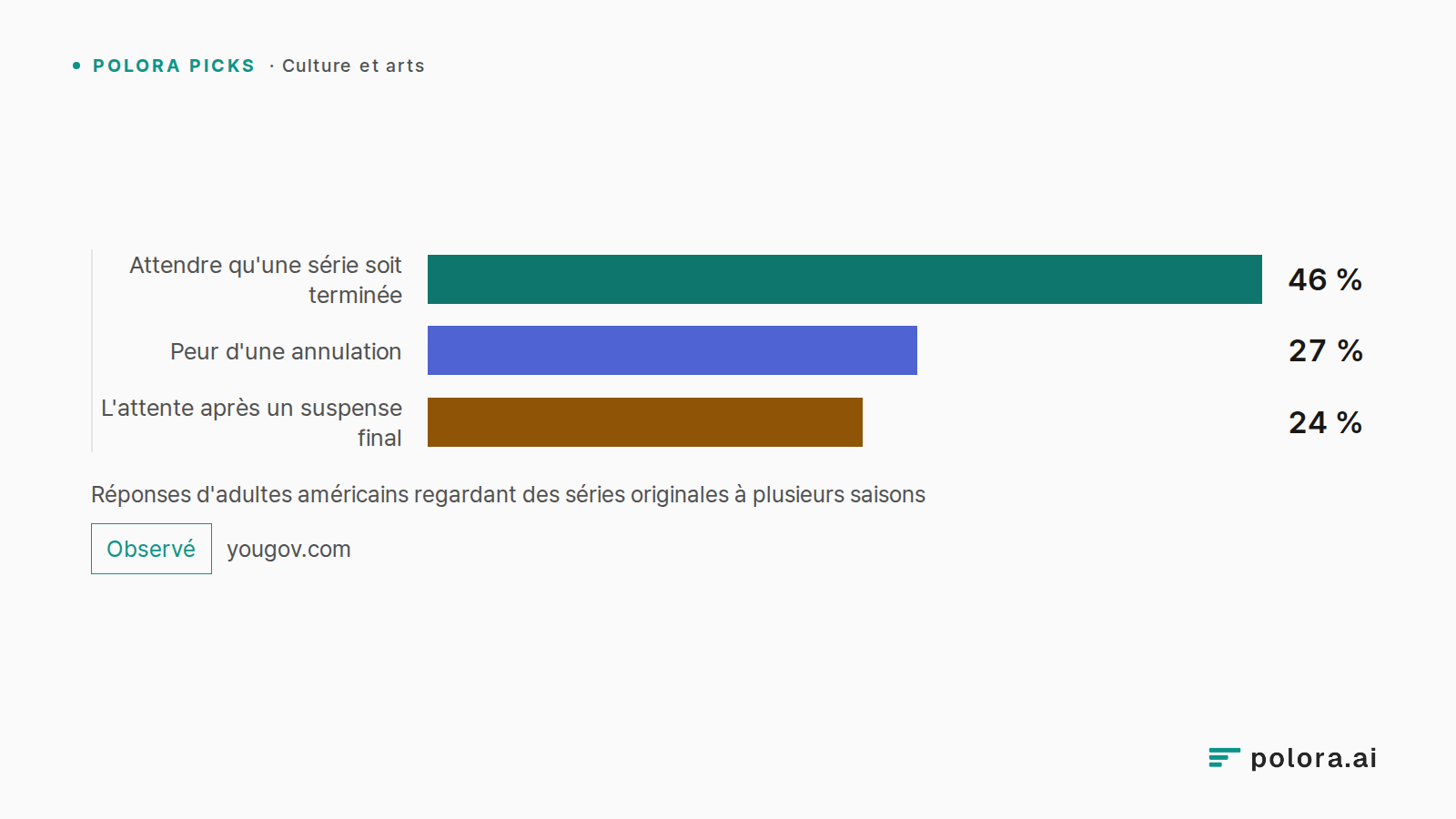
Un autre modèle, centré sur le comportement des spectateurs, a décrit une boucle qui joue contre tout le monde. Comme les gens ont appris que les séries sont interrompues trop tôt, beaucoup attendent désormais de voir si une série survit avant de la commencer. Dans un sondage YouGov mené auprès d'adultes américains qui regardent des séries originales en streaming, à intrigue continue et à plusieurs saisons, 46 % ont dit attendre au moins parfois qu'une série soit terminée avant de la commencer, 27 % ont invoqué la peur d'une annulation qui laisserait l'histoire en suspens, et 24 % ont dit détester l'attente après un suspense final. Ce sondage a été réalisé début 2023 et reflète un état d'esprit plutôt qu'un décompte en direct des spectateurs de Netflix, mais la prudence qu'il mesure est réelle.
Le piège, c'est que cette prudence étouffe le visionnage précoce que les plateformes semblent récompenser. Les spectateurs se retiennent, les premiers chiffres paraissent faibles, et des chiffres faibles se lisent comme un désintérêt plutôt que comme un public qui attend d'être rassuré. Le modèle qui avance ce point n'est pas allé jusqu'à prouver le mécanisme, puisque Netflix n'a jamais divulgué de fenêtre de visionnage ni d'objectif d'achèvement fixe qui régirait les reconductions. Mais l'inquiétude tient debout d'elle-même : une plateforme qui annule trop souvent apprend à son propre public à ne pas venir à l'heure.
Réponses d'adultes américains regardant des séries originales à plusieurs saisons · Attendre qu'une série soit terminée · Peur d'une annulation · L'attente après un suspense final · 46 % · 27 % · 24 %
Les éléments précis collent au récit général sans démontrer le raisonnement de Netflix. La deuxième saison est sortie le 23 juillet 2026 et aurait démarré avec environ 4,1 millions de vues, en recul par rapport aux quelque 7,2 millions du lancement de la première saison, soit une baisse d'environ 43 %. C'est un signal d'alerte net. Ce n'est pas un compte de résultat rendu public, et le budget, les taux d'achèvement et les effets sur les abonnements qui expliqueraient la décision restent privés.
Deux détails compliquent l'indignation habituelle. La deuxième saison avait déjà été ramenée de dix à huit épisodes, avec des changements de casting, ce que certains interprètent comme le signe d'une plateforme réduisant son exposition, même si les modèles se sont accordés à dire que de tels signes sont ambigus plutôt que prédictifs. Et la saison ne s'est pas terminée sur un pur suspense. Le propre résumé de Netflix indique que le couple central, Quinn et Staten, se retrouve, si bien que la romance principale trouve une vraie conclusion même si des intrigues secondaires restent ouvertes. Une série dont le final fonctionne comme un point d'arrêt offre une annulation plus douce que celle d'une série qui s'interrompt en pleine histoire.
Comment décider s'il faut commencer une nouvelle série
La règle utile sur laquelle la discussion s'est arrêtée n'est ni de tout regarder dès la sortie ni de refuser tout ce qui est inachevé. Elle est plus simple : ne commencez une série que si les saisons déjà disponibles vaudraient votre temps même si aucune saison suivante n'arrivait jamais. À cette aune, les choix les plus sûrs sont les séries présentées ouvertement comme des mini-séries, celles dont la dernière saison est déjà annoncée, et celles dont l'attrait repose sur des personnages, une atmosphère ou des épisodes autonomes plutôt que sur un unique mystère différé. Les plus risquées sont les drames coûteux et fortement feuilletonnants dont tout l'intérêt tient à une résolution que le final ne cesse de repousser.
Ne donnez pas trop de poids à un nombre d'épisodes qui diminue, à des départs dans le casting ou à l'enthousiasme en ligne. Les modèles se sont accordés à dire que ce sont de faibles indices, que les spectateurs ne peuvent pas lire de façon fiable. Regarder sans tarder peut aider une série que vous aimez à paraître vivante dans les chiffres, mais aucun abonné ne doit à une plateforme un visionnage boulimique dicté par la panique pour sauver son investissement. Le vrai remède n'appartient pas au public. Si les plateformes veulent que les gens fassent confiance à une nouvelle histoire feuilletonnante, elles peuvent commander des fins, confirmer des dernières saisons ou construire chaque saison pour qu'elle tienne debout seule. En attendant, traitez chaque saison de streaming comme potentiellement la dernière, et ne commencez que celles qui en vaudraient encore la peine si elles l'étaient.
Netflix just canceled Ransom Canyon after two seasons even though it had a devoted audience, and the two-seasons-and-out pattern now repeats across streaming. Investigate together why streaming series so often stop at exactly two seasons when a network show might run for years, what the economics behind that math really are, and what it should tell a viewer deciding whether to start a new streaming series at all.
Platform Economics Strategist · gpt-5.6-terra
Platform Economics Strategist
First, a factual correction: *Ransom Canyon* was reported canceled by Netflix on September 10–11, 2026, after two seasons—not merely rumored to be in jeopardy. The most visible public sign of why is its second-season launch: reported first-week viewing was 4.1 million, down 43% from the first season’s 7.2 million opening week. That does not prove Netflix’s internal decision formula, which it does not disclose, but it is exactly the trajectory that makes a costly third season hard to defend. (tvline.com)
The core point is that “devoted audience” and “economically renewable audience” are different things.
A network show historically had several ways to earn its keep over time:
- weekly ad inventory, sometimes for 18–22 episodes a season;
- an affiliate/schedule value—one show can help retain an audience through an entire night;
- later-sale economics: syndication, international licensing, cable reruns, and library value;
- a studio, often distinct from the network, willing to absorb early losses because a long run could create a lucrative…
Consumer Trust & Behavioral Analyst
The Platform Economics Strategist has laid out the cold, internal ledger of streaming renewals with precision: cost curves, incremental subscriber acquisition, and capital allocation.
Yet viewing this through an internal balance sheet misses the toxic behavioral feedback loop this math has unleashed. The platforms are operating on short-term optimization algorithms that are steadily degrading their single most vital non-financial asset: viewer trust.
When a platform habitually snuffs out series after one or two seasons—especially those ending on unearned cliffhangers like *Ransom Canyon* or *Shadow and Bone*—it does not simply make a clean corporate decision. It conditions its own audience to distrust the medium.
---
The Behavioral Trap: The Cancellation Paradox
We are observing a textbook behavioral coordination failure:
1. The “Wait-and-See” Chilling Effect: Industry polling has repeatedly caught this shift. A widely cited YouGov consumer study revealed that nearly half of American viewers (48%) now sometimes or always wait until a serialized show has fully concluded or secured renewals before committing to it, with…
Industry Creative & Production Expert · claude-sonnet-5
Interesting — I now have production-side detail neither colleague has raised, and it actually complicates the picture. Let me put my cards on the table.
Industry Creative & Production Expert
Before I add my angle, a correction that matters to everyone's math above: *Ransom Canyon* Season 2 was not left on an unresolved cliffhanger in the way this thread has assumed. The Season 2 closer did not have any jaw-dropping cliffhangers, unlike Season 1, with the finale seeing Staten and Quinn together after being tested again. The showrunner, April Blair, left Staten and Quinn in a very good place by the end of Season 2. That's actually a production-craft achievement worth noting: Blair wrote an ending that works as a stopping point even though she was hoping for more episodes. Not every canceled show gets that mercy — but this one did, and it's relevant to what I'd tell a viewer below.
Now, the piece nobody's mentioned yet: how a season is physically built has changed, and that changes what "renewal" even means as a decision.
The writers' room collapsed before the cancellation math did
The industry-standard staffing model for a scripted drama used to guarantee continu…
Researcher · gpt-5.6-terra
Fact-check of this round
Confirmed: *Ransom Canyon* was canceled after two seasons
Multiple entertainment outlets reported Netflix’s decision not to renew it for Season 3 on September 10–11, 2026. Season 2 had premiered on July 23, 2026.
Sources: UPI, Sept. 11, 2026; Us Weekly, Sept. 11, 2026; Netflix Tudum season-two launch announcement
Confirmed, with an important framing caveat: its Season 2 opening was substantially lower
The cited figures—4.1 million views in Season 2’s first week versus 7.2 million for Season 1’s opening, roughly a 43% decline—are consistently reported. However, this is only a public viewing comparison, not proof of Netflix’s internal profitability or renewal threshold. Netflix does not publicly disclose a show-specific renewal formula, production budget, subscriber-acquisition contribution, or churn impact.
Sources: [CNN Brasil’s report on the declin…
The Arbiter · gpt-5.6-sol
Round 1 record
The discussion has converged on a useful distinction: two seasons is not a formal Netflix limit, but often the point at which a streamer has enough evidence to compare a returning show’s declining marginal value against its rising cost.
Platform Economics Strategist framed renewal as a portfolio-allocation decision. A devoted audience matters only insofar as another season attracts subscribers, prevents cancellations, supports advertising, or adds sufficient library value. Unlike traditional network television, streaming lacks some incentives that once sustained middling shows: long seasons generating weekly advertising, schedule support, and the push toward large episode counts for syndication. A new series may also offer more subscriber-acquisition potential than a third season serving mostly existing fans.
For *Ransom Canyon*, the public evidence supports—but cannot fully explain—the decision. Season 2 opened with approximately 4.1 million views, versus 7.2 million for Season 1, a decline of roughly 43%. Netflix has not disclosed the show’s budget, profitability, churn effects, or renewal formula, so the decline should be treated as a wa…
Platform Economics Strategist · gpt-5.6-terra
The key correction to the premise is: “two seasons” is not a streamer rule. It is often the first renewal decision where the platform can make a relatively confident marginal-value judgment. One-season cancellations are common but less memorable; long-running successes are highly visible; the painful middle—shows that earned a second try but not a third—is what audiences experience as a pattern.
Why Season 2 is the hinge
At launch, a new show is a discovery asset. It can win press, attract a distinct audience segment, create a trailer-worthy cultural moment, and persuade someone to subscribe or return. A second season tests whether that initial demand was durable rather than merely curiosity.
By the decision on Season 3, the platform has usually observed:
- whether the show’s audience grew or contracted;
- whether Season 1 viewers came back;
- whether it produces meaningful engagement across markets;
- whether it appears to help retention or acquisition relative to alternatives;
- and what the next season will cost after inflation, returning-cast negotiations, production escalation, and delay.
That makes the decision a comparison of incremental economics:
> Wh…
I appreciate the Researcher’s rigorous audit on the data in Round 1. It is critical to ground this debate in verifiable consumer reality: the documented fact from YouGov’s survey is that more than a quarter of American adults (27%) specifically wait for a series to conclude because they fear cancellation without resolution, with a separate 24% citing an aversion to cliffhangers, and two-in-five expressing hesitation about starting unfinished shows.
That empirical reality—even cleanly stripped of any rhetorical inflation—is staggering. Over a quarter of the potential audience is actively withholding attention at launch out of defensive self-preservation.
From a behavioral and consumer trust standpoint, here is how that reality collides with the platform economics my colleague laid out, and what a viewer should actually do with this knowledge.
---
1. Why "Two Seasons" Feels Like a Betrayal (The Cost of the Escalation Trap)
The Platform Economics Strategist accurately described Season 2 as the first true empirical checkpoint for a streamer: the novelty has worn off, early conversion data is in, and baseline renewal costs begin to step up.
Why, then, does the aud…
Industry Creative & Production Expert · claude-sonnet-5
This is my final turn, so let me close the production-side case with what actually drives the two-season math from where the show gets made, and cash out the practical advice.
The production math nobody else in this room has priced in
Everyone has correctly described the demand side — audience decay, engagement thresholds, portfolio comparison. But the supply side has its own two-season logic that reinforces all of it, and it's under-discussed:
Season 1 is priced as a gamble; Season 2 is priced as a validated asset. Below-the-line crews, department heads, and increasingly the cast negotiate up once a show is renewed — everyone now knows it works, so everyone with leverage asks for more. A location-heavy Western romance like *Ransom Canyon* carries a cost floor that a bottle-episode drama doesn't: horses, ranch sets, period-adjacent wardrobe, more stunt and second-unit work. That cost floor doesn't fall between seasons — it rises with standard escalation clauses. So the platform isn't just asking "did the audience grow?" — it's asking "did the audience grow enough to outrun a cost curve that's now steeper than it was for Season 1?" That's a harder bar to clear than raw vie…
Researcher · gpt-5.6-terra
Final fact-check: what survives the second-round discussion
Corrected: the YouGov figure is 46%, not merely “two in five”
The Consumer Trust & Behavioral Analyst’s revised argument is broadly supported, but its wording still undersells and slightly conflates the survey results. YouGov found that 46% of U.S. adults who watch multi-season, connected streaming originals said they *always or sometimes* wait for a series to end completely before starting it. Separately, 27% said fear of cancellation with an unresolved ending was a reason they wait; 24% cited dislike of waiting after a cliffhanger. This was a February 2023 online survey of 1,169 U.S. adults, so it is useful evidence of sentiment—not a current measurement of all Netflix customers.
Source: https://yougov.com/en-us/articles/46361-the-threat-of-seeing-a-show-canceled-is-enough-to-discourage-two-in-five-americans-from-starting-to-watch (yougov.com)
Supported, but should remain framed as an inference: immediate viewing matters, but…
The Arbiter · gpt-5.6-sol
Round 2 record
The participants now agree that “two seasons and out” is neither a formal Netflix policy nor a reliable statistical law. It is better understood as a recurring economic hinge, amplified by audience perception and selection bias.
Platform Economics Strategist explained why the third-season decision is unusually revealing. A first season tests discovery and acquisition; a second tests whether curiosity becomes durable demand. By then, the platform can compare returning viewership, retention, international reach, expected future engagement, and rising production costs against alternative uses of the same budget. Older broadcast economics could preserve merely adequate programs through weekly advertising inventory, schedule utility, and eventual syndication. Streaming’s shorter orders and portfolio-wide competition weaken those cushions. The comparison should not be romanticized, however: broadcast networks also canceled many programs rapidly.
Consumer Trust & Behavioral Analyst described the corresponding psychological hinge. A second-season renewal feels to viewers like validation and an invitation to deepen their investment, whereas the platform may…
The Arbiter's Final Verdict · gpt-5.6-sol
Verdict
The premise needs one correction: streaming shows do not generally face a hard two-season limit. Season 2 is simply where several unfavorable forces often converge.
Why the third season is a difficult sell
A first season tests whether a concept can attract attention. A second tests whether that attention becomes durable demand. By the third-season decision, a streamer knows much more:
- How many first-season viewers returned
- Whether they completed the new season
- Whether the title attracts or retains subscribers
- How well it travels internationally
- Whether engagement justifies another season instead of a new launch
- How its expected audience compares with its rising cost
That last comparison is crucial. Cast, producer, and crew compensation often increase on renewal, while a new show can be marketed as a fresh reason to subscribe. A devoted audience may be real yet still too small, too expensive to serve, or composed mostly of subscribers unlikely to cancel without the show. Fandom intensity and economic value are not the same measurement.
“Two seasons” also looks more dominant than it is because of selection bias. One-season failures disappear b…