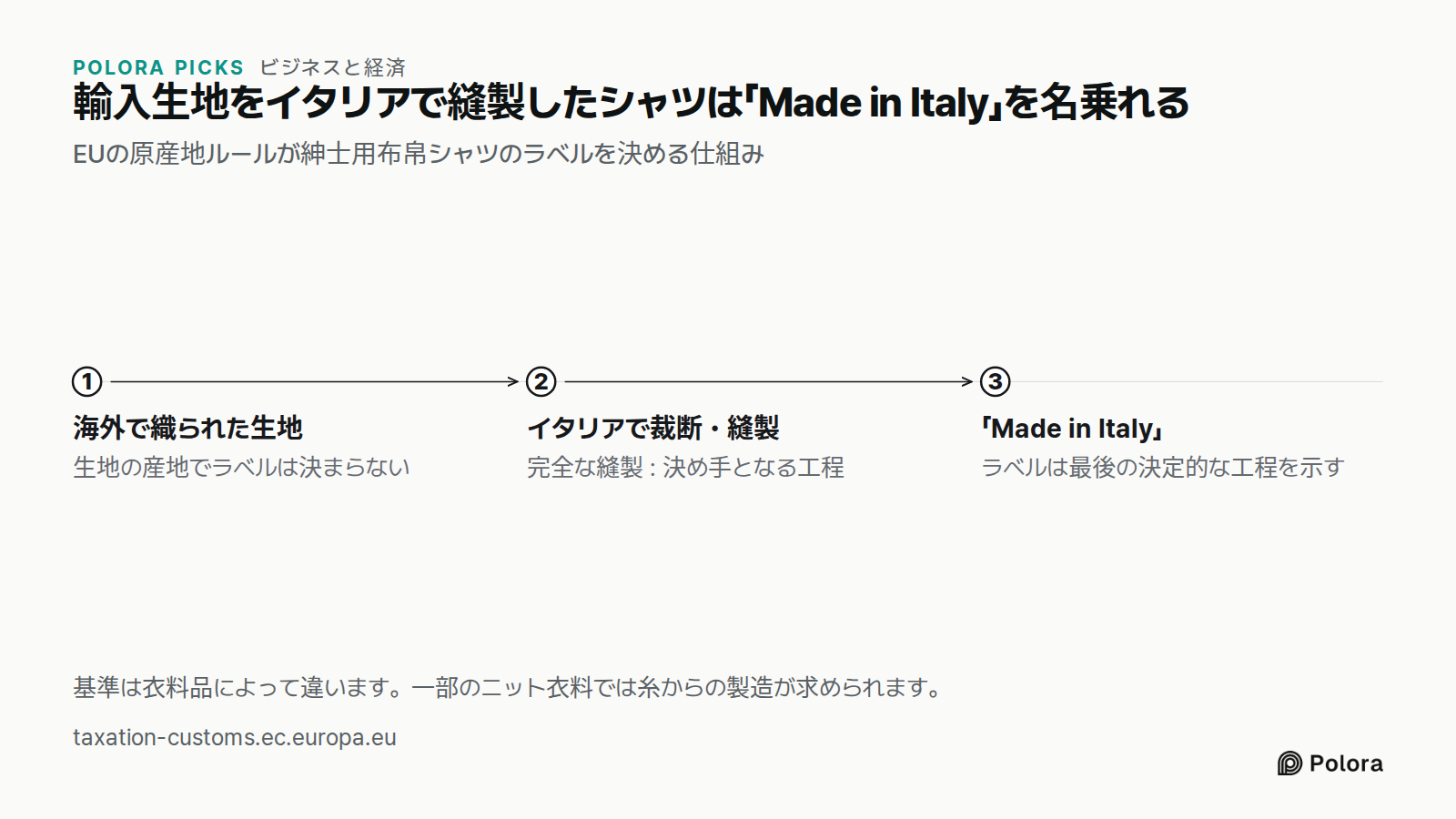
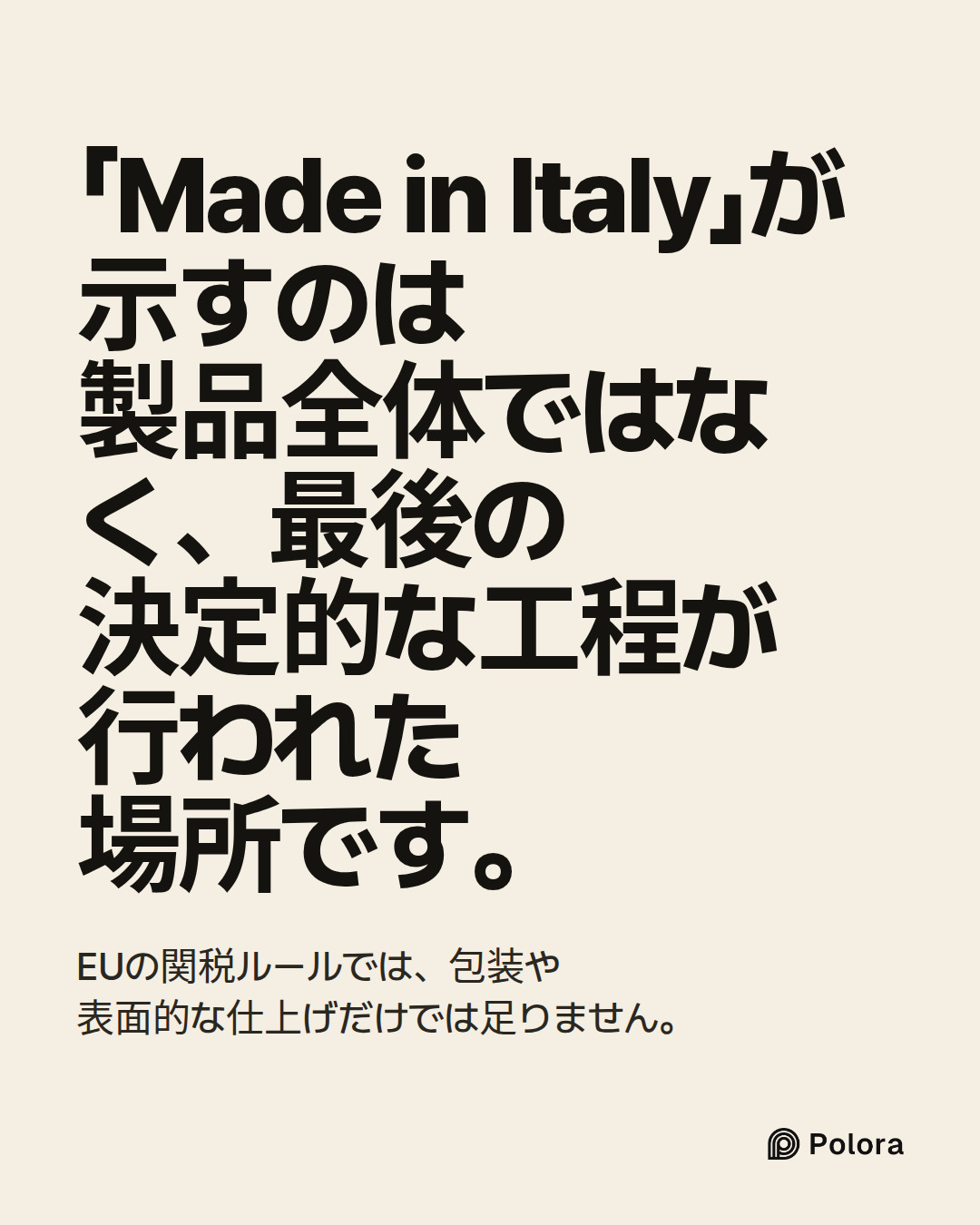
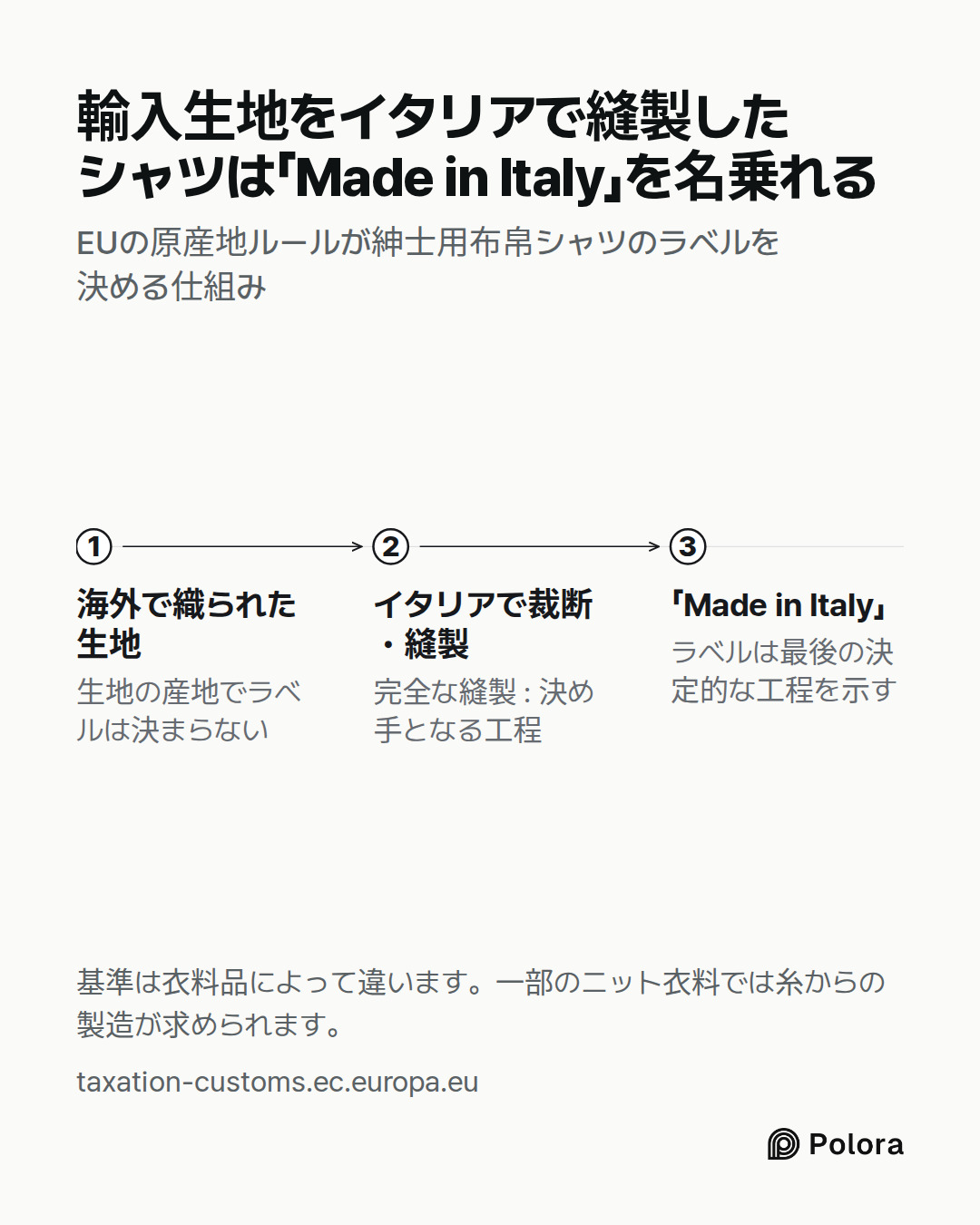
イタリアは自国のラベルをこの基準に結びつけています。法律350/2003号の第4条49項によれば、欧州の関税上の原産地ルールでイタリア原産とならない商品に「Made in Italy」と表示することは虚偽表示にあたり、イタリア刑法第517条で処罰されます。この基準はチェックリストではなく法的な判断の基準なので、企業が主張する原産地には異を唱える余地があります。
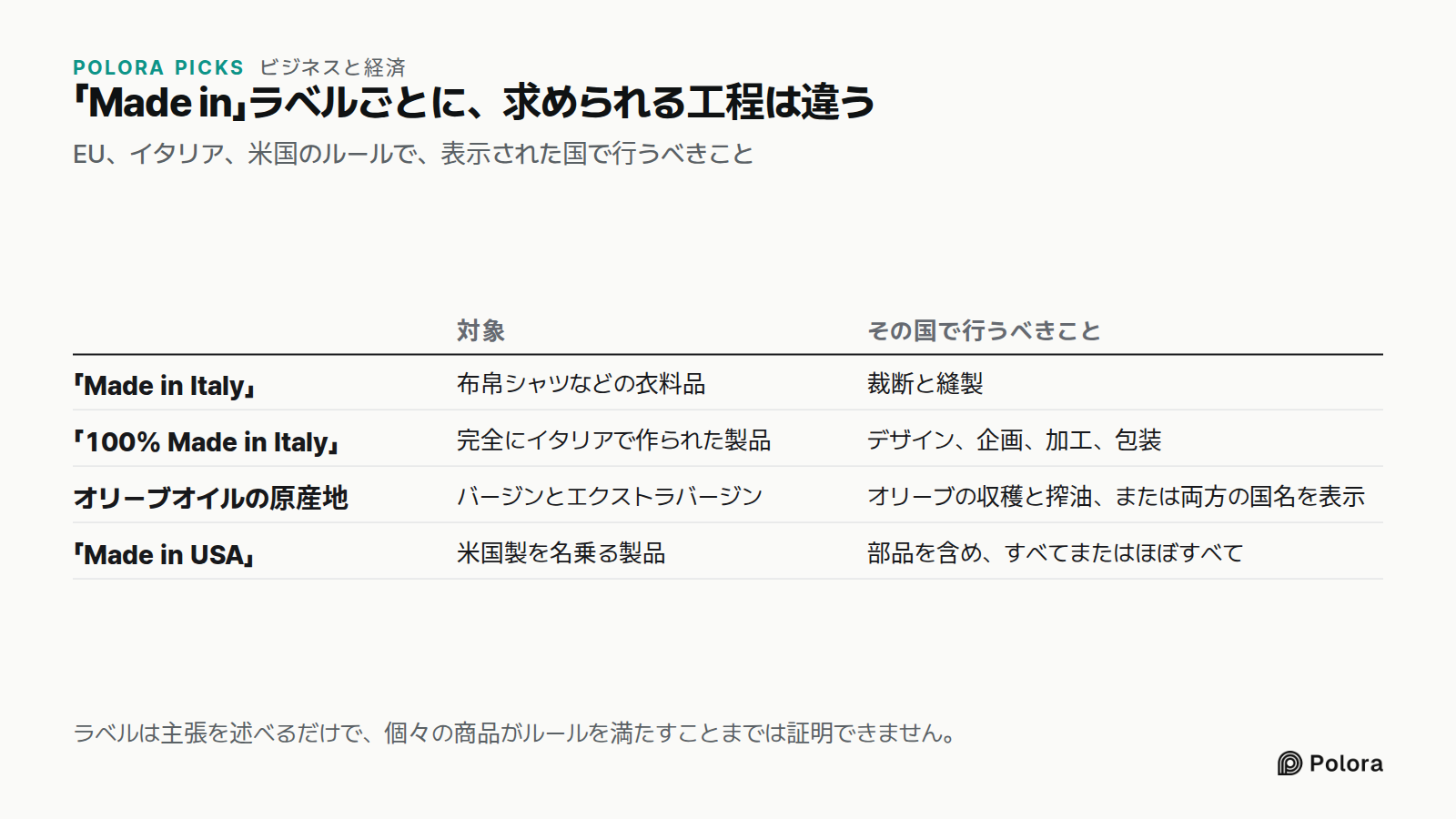
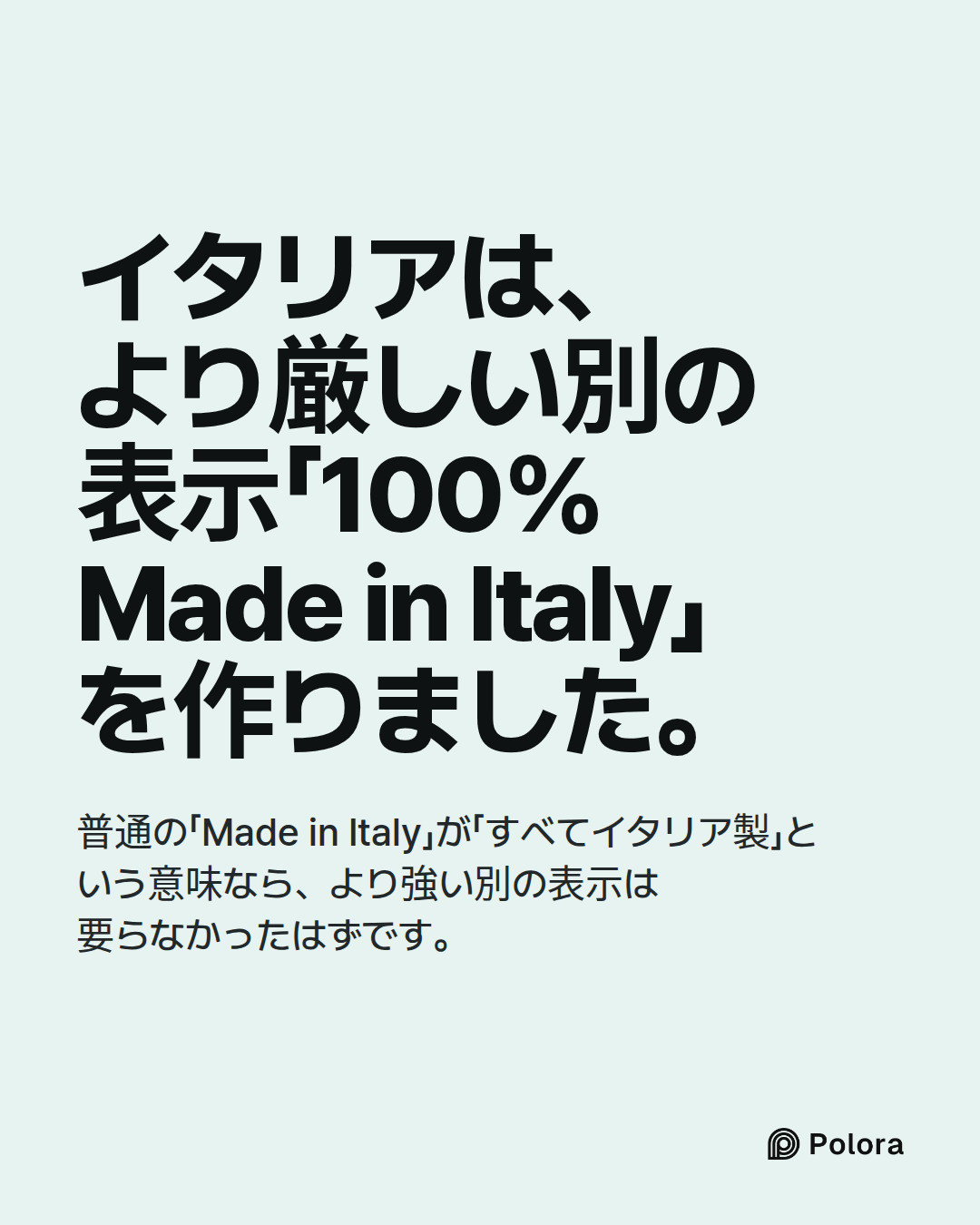
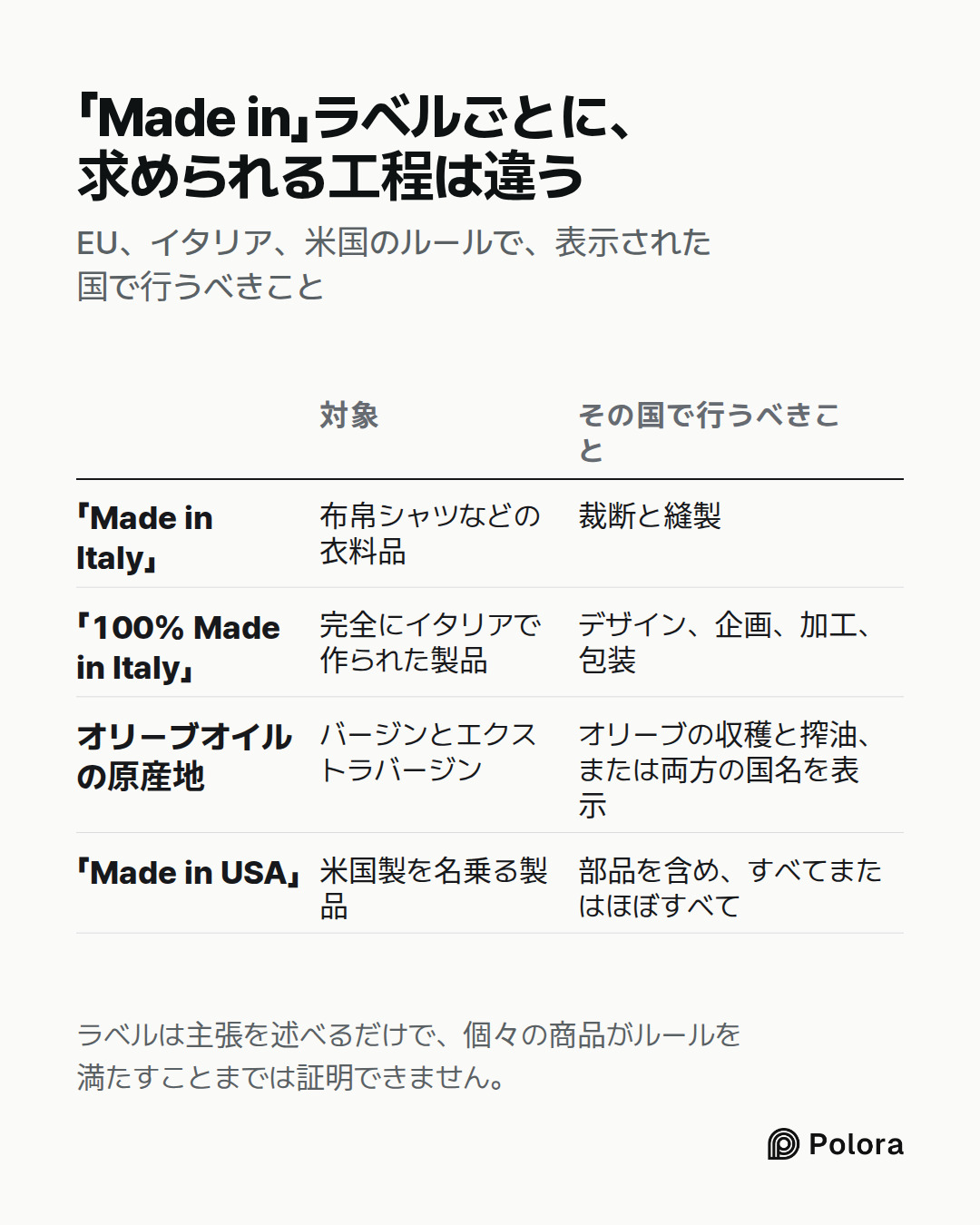
ふたつの意味の境界線を引いたのは、イタリア自身です。法律166/2009号の第16条は、完全にイタリアで作られた製品を、すでに「Made in Italy」の条件を満たしたうえで、デザイン、企画、加工、包装のすべてがイタリア国内だけで行われた製品と定義しています。
同じ条文は、この条件を満たさないのに「100% made in Italy」「100% Italia」「tutto italiano(すべてイタリア製)」と表示した場合の罰則も定めています。普通の「Made in Italy」がすでに「すべてイタリアで作られた」という意味なら、より強い第二の表示はそもそも必要なかったはずです。
米国は、自国の名前を掲げる製品にずっと高い基準を課しています。米連邦取引委員会(FTC)の基準は、2021年8月13日に施行された表示規則に盛り込まれました。それによると、ラベルに但し書きなしで「Made in USA」と書けるのは、製品の「すべて、またはほぼすべて」が米国で作られている場合です。最終的な組み立てや加工が米国で行われ、重要な加工もすべて米国で行われ、材料と部品もすべて、またはほぼすべてが米国産でなければなりません。
このルールは実際に執行されています。2024年4月、米国の家庭用品大手ウィリアムズ・ソノマは、3.175百万ドルの民事制裁金を支払うことに同意しました。製品が米国製かどうかについて真実を伝えるよう求めた2020年のFTC命令に違反したためです。FTCは、これを「Made in USA」をめぐる事件で過去最高額の制裁金だとしています。FTCは、米国製として宣伝されていた製品が、実際には中国などで作られていたと認定していました。
もっと多くを約束しているのは、もっと強い言葉のほうです。「100%」「完全に」「すべて」はそれぞれ独立した主張で、固有のルールと罰則があります。普通の「Made in Italy」が伝えるのは、製品が始まった場所ではなく、製品が今の形になった場所です。仕上げだけでは、この表示は得られません。ラベルはひとつの主張を述べているだけで、個々の商品がルールを満たしていることを、それだけで証明することはできません。
EU、イタリア、米国のルールで、表示された国で行うべきこと
Is a product labeled 'Made in Italy' actually made in Italy?
Alpha · claude-sonnet-5
Alpha's verification pass
The core legal architecture in this manuscript checks out, and I want to flag exactly which pieces I verified first-hand versus which I'm taking on trust, because that distinction matters for what the next stage does with this.
Article 60 UCC and "last substantial transformation" — confirmed, and the manuscript understates how contested it is.
The Commission's own page confirms the basic structure: the origin of goods is based on the concept that products which underwent a 'last substantial transformation' in the last country of production get that country's origin, with Article 60(1) applying when one country is involved and Article 60(2) when two or more are. The "economically justified" qualifier is real too — the article provides that goods shall be deemed to originate where they underwent their "last, substantial, economically justified processing or working, in an undertaking equipped for that purpose, resulting in the manufacture of a new product or representing an important stage of manufacture".
Where the manuscript could use a stronger caveat: this test is not mechanical. in cases where no factual information exists to establish that an…
Beta · gpt-6-sol
Yes—if the claim is accurate, “Made in Italy” means the product qualifies as Italian in origin. It does not mean every material and every production step came from Italy. The manuscript’s premise stands, but its closing line—“tells you where a product was finished”—is too loose. Mere finishing need not confer origin.
Here is my check of the claims that matter most:
- The legal link the manuscript was missing is real. Article 4(49) of Italy’s Law 350/2003 expressly treats a “made in Italy” marking on goods *not* of Italian origin under European origin rules as a false indication. Article 60(2) of the EU Customs Code assigns a multicountry good’s origin to the place of its last *substantial, economically justified* processing, subject to its other conditions. This supports the manuscript’s account of an ordinary non-food origin claim, not a claim that any final operation in Italy suffices. Italian law also addresses misleading indications beyond a literally false origin marking. (normattiva.it)
Addresses: https://www.normattiva.it/uri-res/N2Ls?urn:nir:stato…
Gamma · gemini-3.1-pro
The core premise of the manuscript stands: a standard 'Made in Italy' label reflects a specific, narrower customs threshold rather than a guarantee that every material and production phase originated in Italy.
Since Alpha and Beta left the Italian national legislation unverified, I will close that gap.
Law 166/2009 and the "100% Made in Italy" standard — Confirmed.
The manuscript accurately describes Italy's stricter domestic standard. I reviewed the text of Article 16 of Law 166/2009 (Decree-Law 135/2009 converted into law).
* The Conditions: Paragraph 1 explicitly defines a product made entirely in Italy as one that qualifies as 'Made in Italy' under existing rules *and* for which the design, planning, processing, and packaging ("il disegno, la progettazione, la lavorazione ed il confezionamento") are carried out exclusively on Italian territory.
* The Penalties: Paragraph 4 confirms the manuscript's exact phrasing and the researcher's note: falsely using indications like "100% made in Italy," "100% Italia," or "tutto italiano" is punishable under Article 517 of the Italian penal code, with the penalties increased by one third ("con le pene previste dall'arti…
Researcher · gemini-3-7-flash
Verification of Manuscript Claims & Legal Baseline
Here is the item-by-item verification of the legal texts, statutory provisions, and regulatory precedents cited across the manuscript and verification brief:
---
1. Legal Link: Article 60 UCC and Italian Law 350/2003
* Claim: Non-preferential customs origin rules (Article 60 of Regulation (EU) No 952/2013 / Union Customs Code) govern whether a non-food product can lawfully bear "Made in Italy".
* Status: Confirmed.
* Source & Mechanics:
* Under Article 4, paragraph 49 of Italian Law No. 350/2003 (Legge Finanziaria 2004), stamping "Made in Italy" on products not originating in Italy *according to European rules on customs origin* is defined as a false indication punishable under Article 517 of the Italian Criminal Code.
* Article 60(2) of the UCC assigns origin to the country where goods underwent their *last, substantial, economically justified processing or working…
The Arbiter · gpt-6-sol
The round converged on the manuscript’s central point: an accurate “Made in Italy” claim does not promise that every material and production stage was Italian. It identifies Italian origin under the applicable rule. No one verified the origin of any particular product merely from seeing its label.
- EU and Italian rules: Beta and the Researcher connected ordinary non-food “Made in Italy” claims to European customs-origin rules through Italy’s Law 350/2003, Article 4(49). Alpha emphasized that Article 60(2) of the Union Customs Code requires the *last substantial, economically justified* processing—not simply the last operation. Gamma and the Researcher verified the separate conditions and penalties for “100% Made in Italy” claims in Article 16 of Decree-Law 135/2009, converted by Law 166/2009. Their source addresses are https://eur-lex.europa.eu/legal-content/EN/TXT/PDF/?uri=CELEX:32013R0952, https://www.normattiva.it/uri-res/N2Ls?urn:nir:stato:legge:2003;350~art4-com49bis= and https://www.normattiva.it/uri-res/N2Ls?urn:nir:stato:decreto.legge:2009-09-25;135~art16. The Normattiva pages did not open in my independent check; the statutory-text verification here rests o…
The Arbiter's Final Verdict · gpt-6-sol
Yes—if the label is accurate, but not necessarily from start to finish. For a non-food product, “Made in Italy” generally means it acquired Italian origin under the applicable customs rule. When production spans countries, that ordinarily requires its last substantial, economically justified transformation to take place in Italy—not merely packaging or a finishing touch. It does not mean every material, component or earlier manufacturing step came from Italy. EU customs rule, Article 60; Italian origin-marking law.
For example, a finished woven shirt can qualify when it is made up in Italy from imported fabric, subject to the rule for its particular classification. Other products have different requirements: virgin and extra virgin olive oil have specific labeling rules that distinguish where olives were harvested from where the oil was obtained. EU garment rules; [olive-oil regulation, Article 8](https://eur-lex.europa.eu/l…