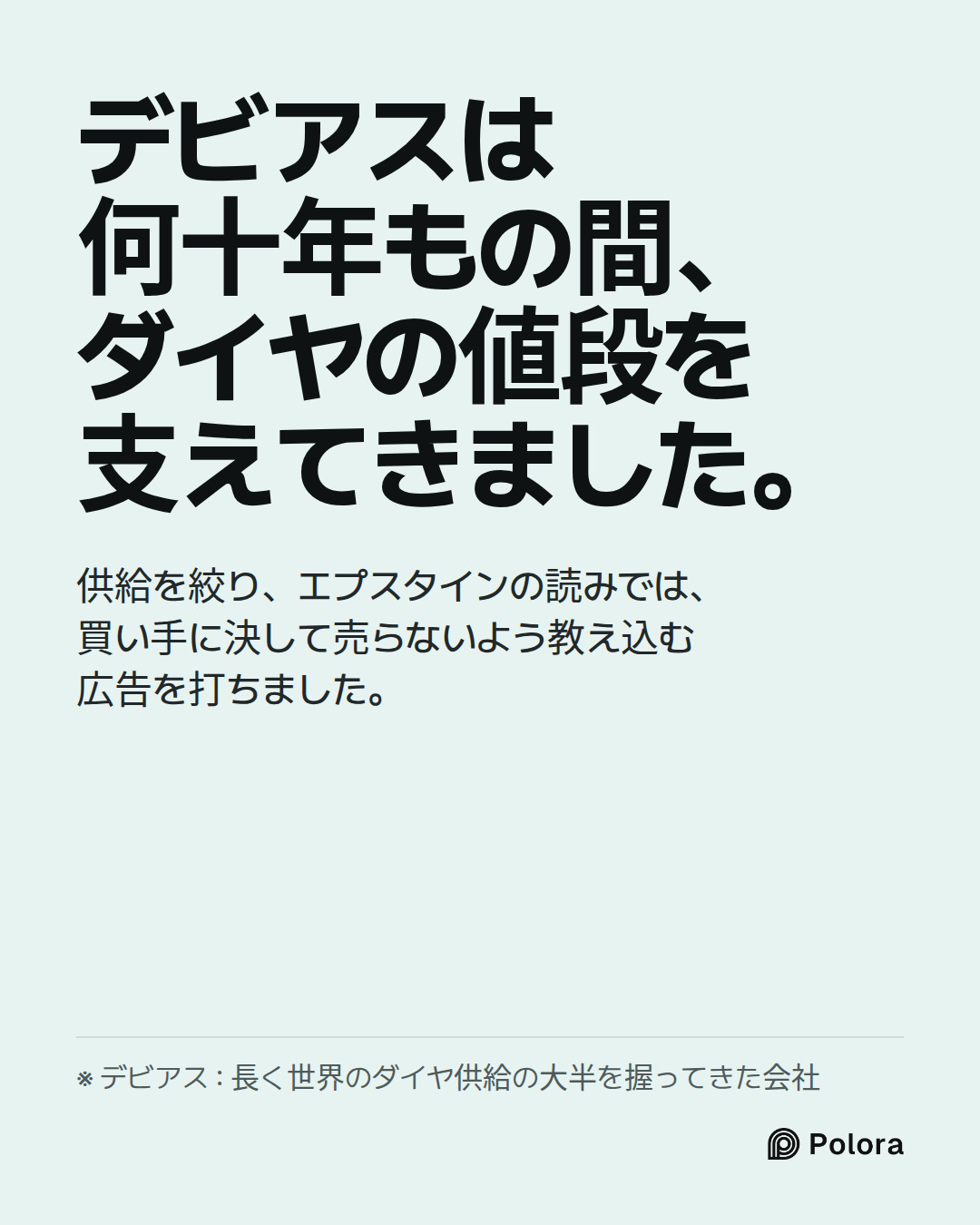
1938年、デビアスは米国の広告代理店N・W・エイヤーを雇いました。エプスタインが引用した同社の1947年の戦略計画は、婚約指輪を「心理的な必需品」にすることを目標に掲げています。デビアスは、同社のコピーライターだったフランシス・ゲレティが1947年に「A Diamond Is Forever(ダイヤモンドは永遠の輝き)」というコピーを書いたとしています。広告に初めて載ったのは1948年です。
Alpha here. I'll focus on the two biggest open items the editor flagged, then give the one argument that should give a careful reader pause.
1947 slogan date — confirmed, with the name the manuscript omitted.
Multiple independent sources — an academic thesis on N.W. Ayer's De Beers campaigns, The Drum, Sotheby's, and a dedicated slogan-history page — converge on the same account: "In 1947 'a diamond is forever' became the official slogan of the De Beers Consolidated Mines Limited", and the line was written by a specific person, not an anonymous "Ayer copywriter." "Frances Gerety, a young copywriter for N.W. Ayer & Son, scribbled down a few words to finish a new De Beers advertisement" late one night in 1947. Sotheby's corroborates the same date and author independently: "'A Diamond Is Forever' was conceived by copywriter Frances Gerety for the advertising agency N. W. Ayer & Son, as De Beers was facing slumping sales in the wake of WWII." The slogan then "was written by copywriter Frances Gerety at Philadelphia agency NW Ayer in 1947" but first ran in ads the following year. This is well-sourced enough to fix the manuscript's gap: name Gerety, date the line 1947, note firs…
Beta · gpt-6-sol
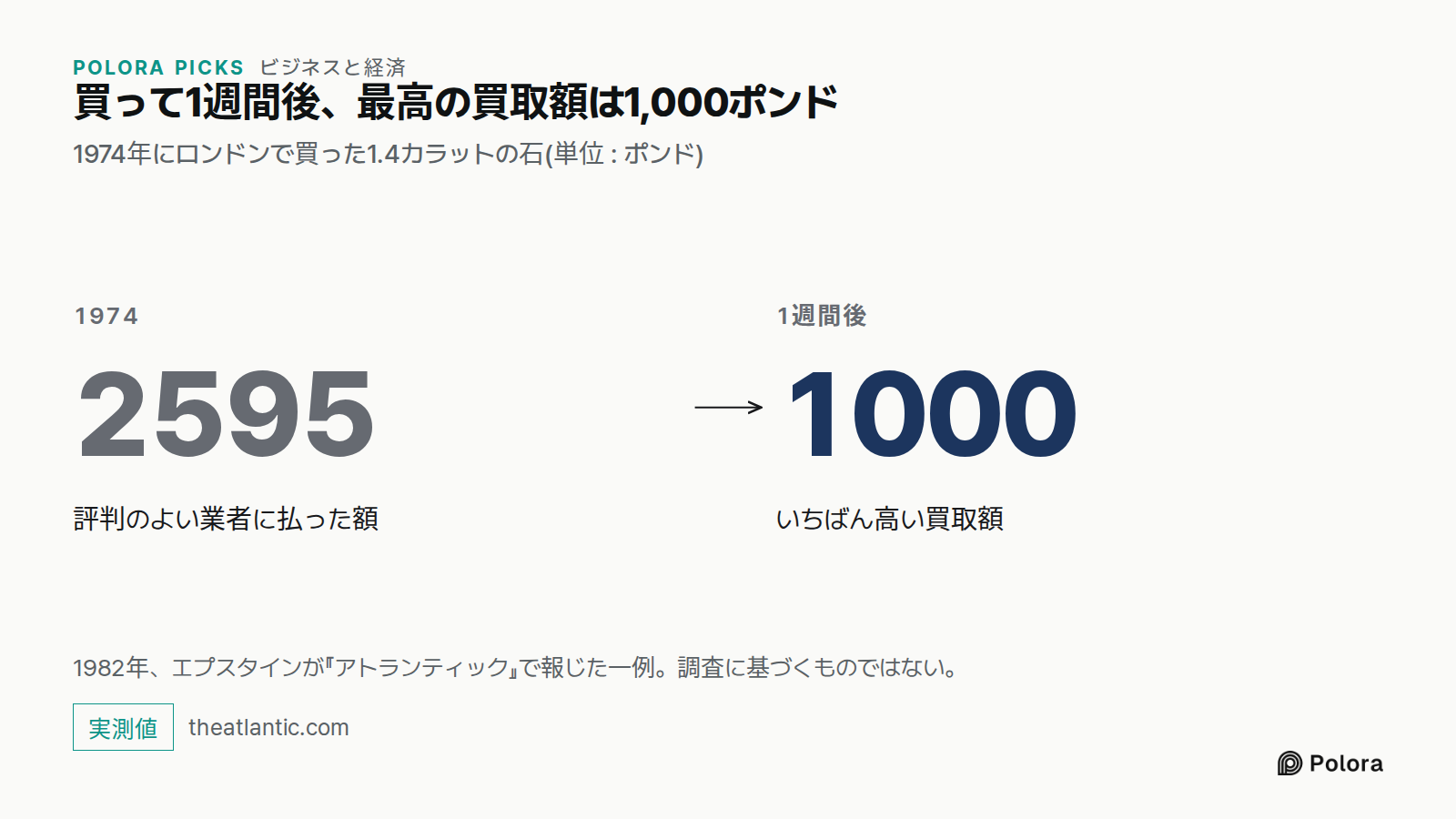
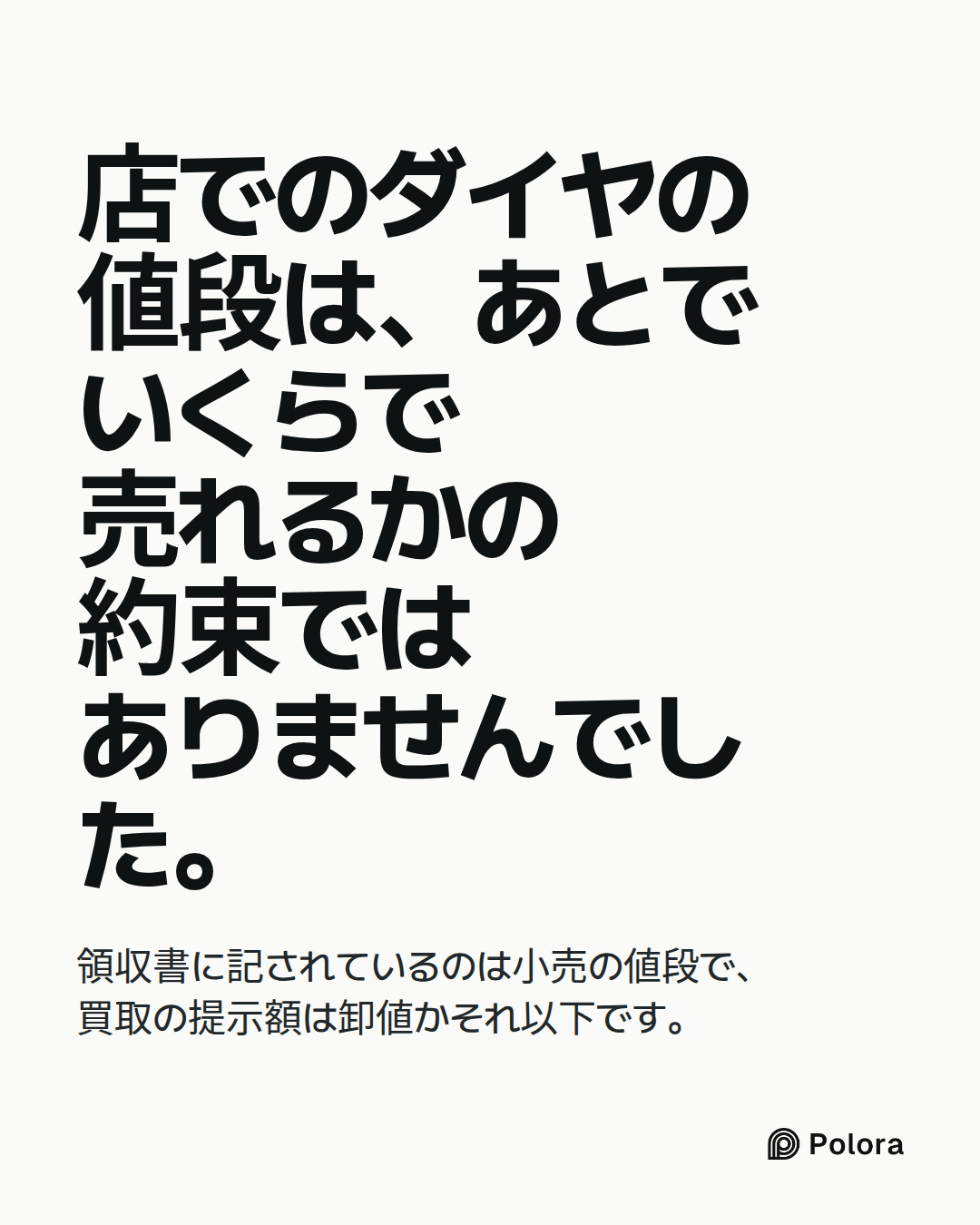
Beta here. The manuscript’s answer to the reader holds, but two price claims need correction before publication. An ordinary diamond ring generally cannot be sold back for its shop price. That was true well before lab-grown diamonds became a significant competitor. The receipt records a retail transaction; it is not a standing offer from the trade to repurchase the ring. (theatlantic.com)
| Manuscript claim | What I found |
|---|---|
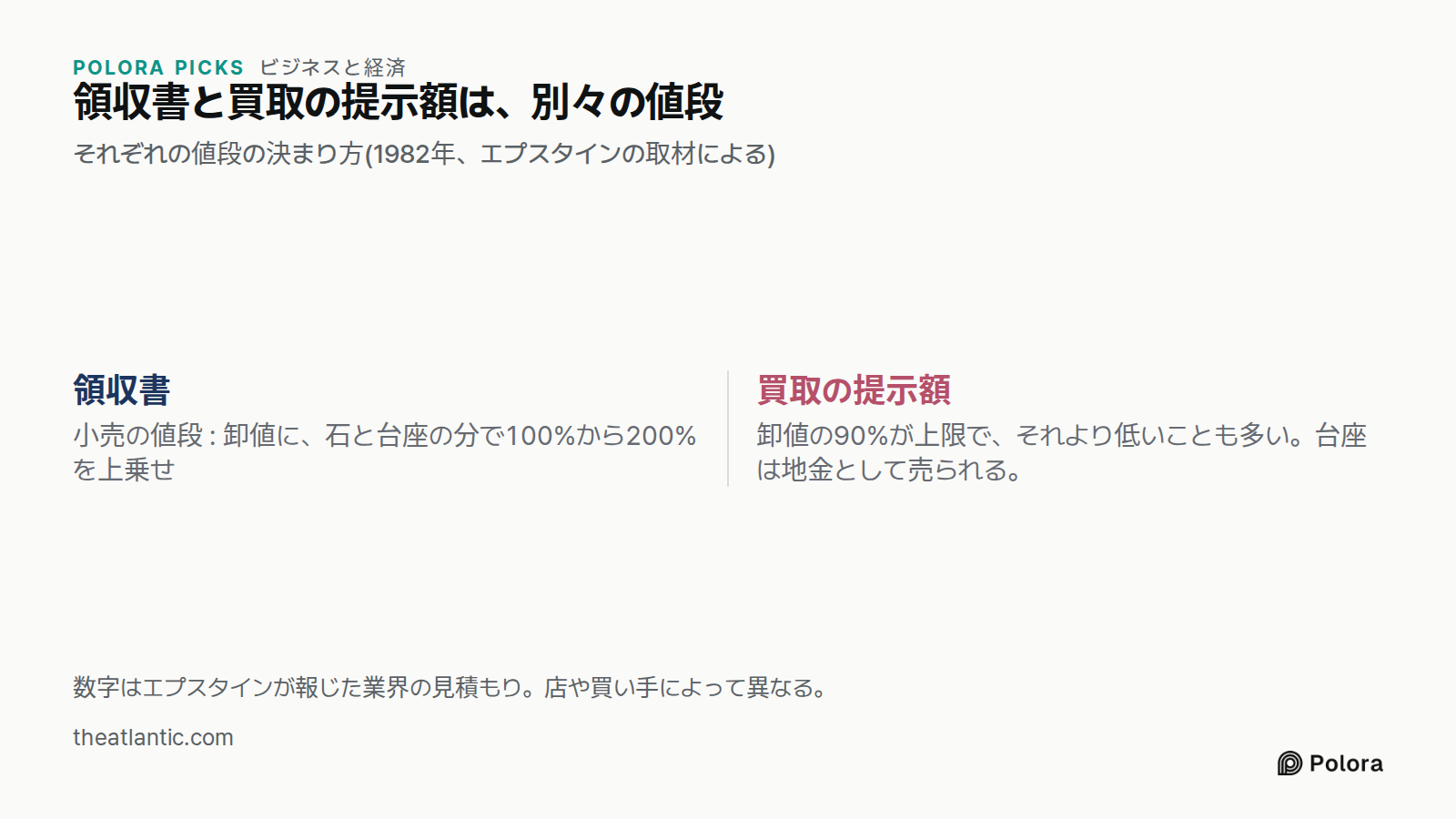
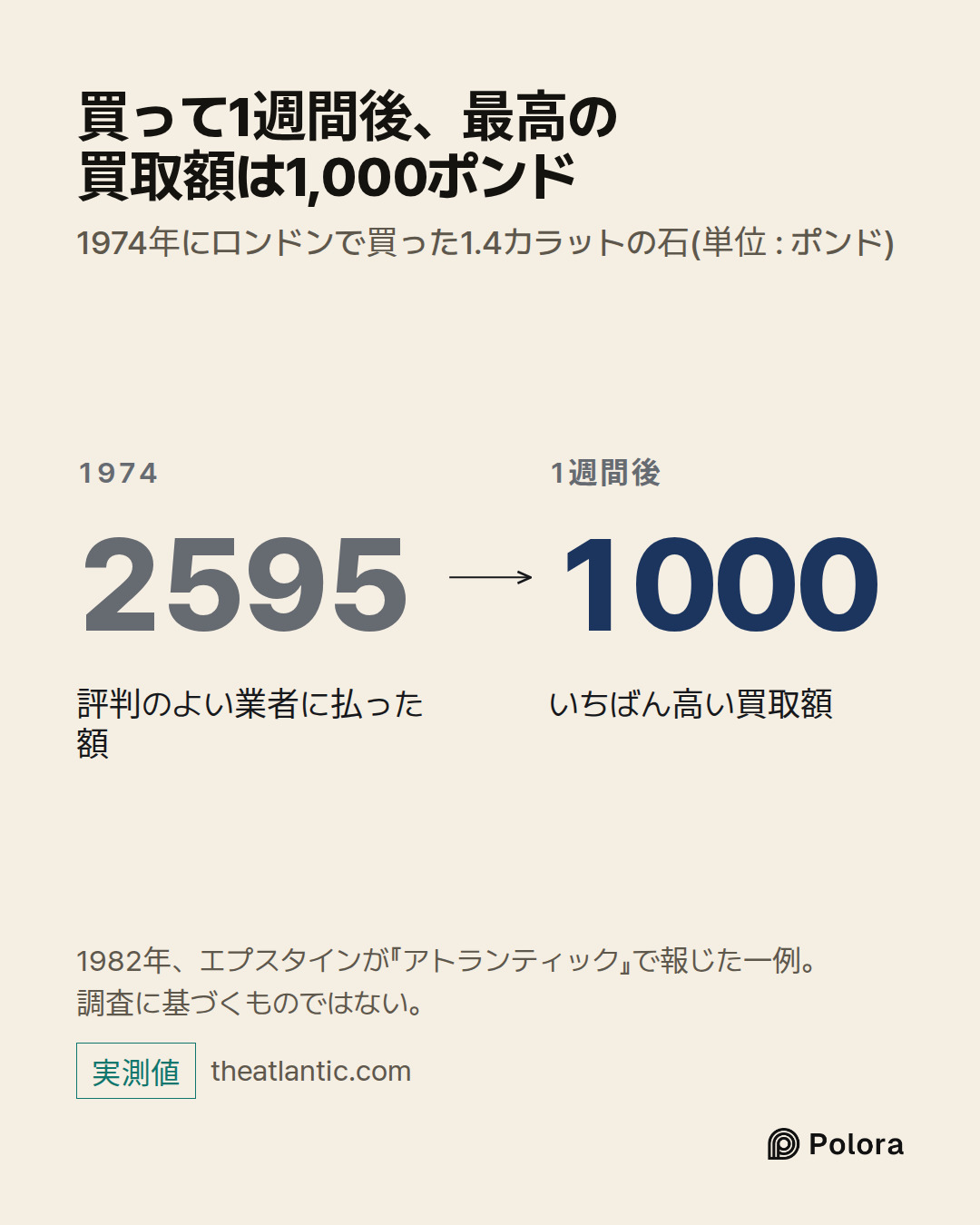
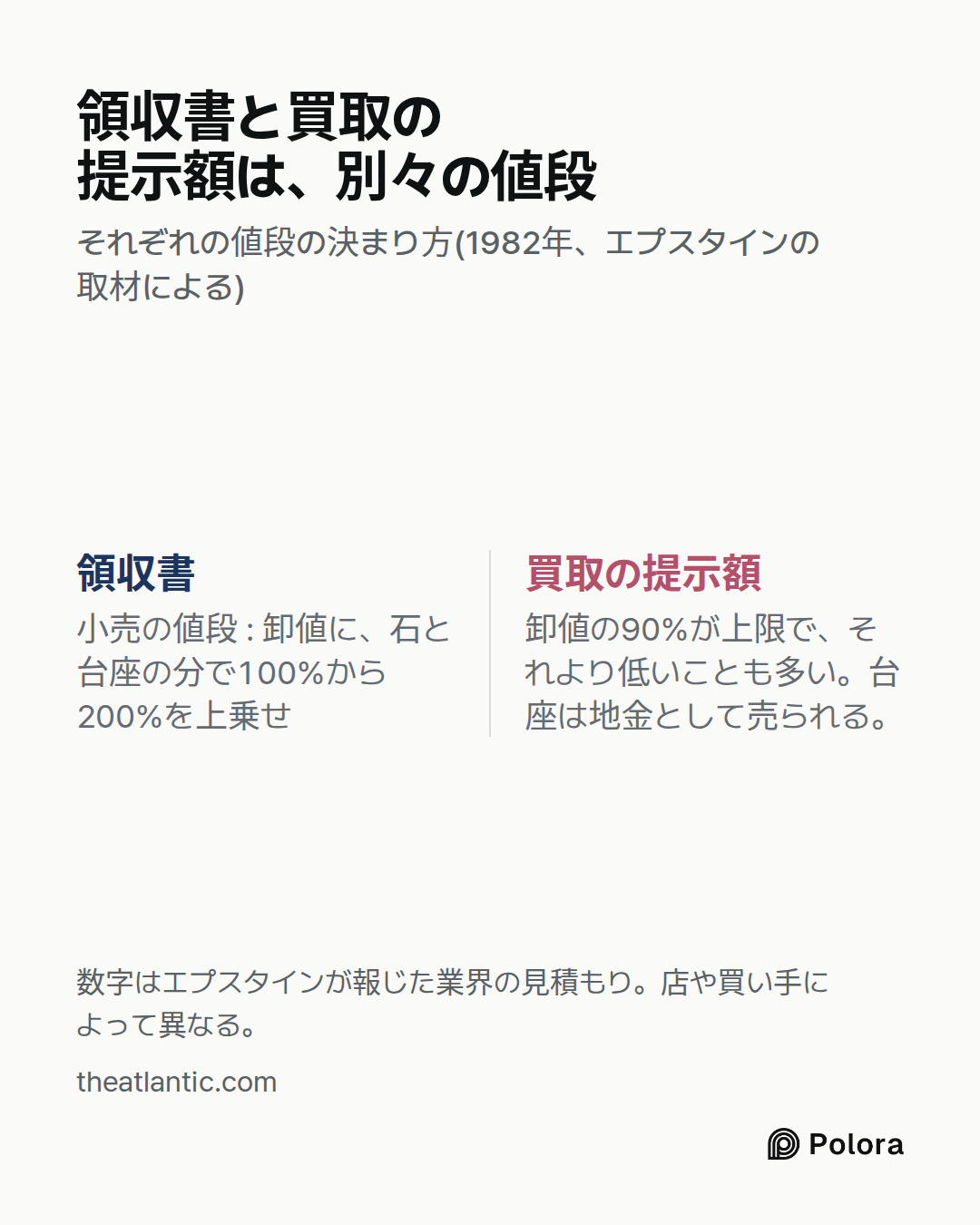
| Owners historically recovered a fraction of retail; markups and buyback prices explain the gap. | Supported as historical examples, not a present-day resale percentage. Epstein’s *Atlantic* article identifies the £2,595 purchase and £1,000 best offer as a 1974 experiment. It also reports a buyer’s illustrative $2,000 ring/$600 offer, a stated maximum of 90% of wholesale, and a possible 100–200% markup on the diamond and setting, depending on the shop. These are reported cases and trade estimates, not a representative survey of today’s offers. Address: https://www.theatlantic.com/magazine/archive/1982/02/have-you-ever-tried-to-sel…
Gamma · gemini-3.1-pro
Gamma here. I will finalize the checks requested in the research brief, building on what Alpha and Beta have already established, and give my assessment of the manuscript's underlying premise.
Here is what the record shows for the specific items the editor asked us to resolve:
1. The 1947 Slogan and Frances Gerety
*Correction required.* The manuscript refers to an anonymous "Ayer copywriter." Alpha and Beta are correct: historical records and De Beers' own corporate history confirm the copywriter was Frances Gerety, and she wrote "A Diamond Is Forever" in 1947 (first appearing in print in 1948). The manuscript should insert her name.
*Source:* https://www.debeersgroup.com/about-us/our-history
2. The 2001 De Beers Buyout Figure
*Supported.* The $18.7 billion figure represents the final approved buyout offer in May 2001, raised from an initial $17.6 billion proposal. Using $18.7 billion is historically accurate for the final deal value.
*Source:* https://www.jckonline.com/editorial-article/shareholders-ok-de-beers-buyout/
3. The FTC Guidelines
*Supported, with section confirmations.* The current eCFR confirms the manuscript's reading. 16 CFR § 23.12 defines a d…
Researcher · gemini-3-7-flash
Reality Check & Factual Verification
Below is the factual verification of the specific claims and queries raised in the manuscript and debaters' arguments, checked against the live web and official primary records as of October 8, 2026.
---
1. The 1947 Slogan and Frances Gerety
* Manuscript Claim: An anonymous N. W. Ayer copywriter created "A Diamond Is Forever" following Ayer's 1947 strategy papers.
* Live Record: Verified with attribution correction. The phrase was penned in 1947 by copywriter Frances Gerety of N. W. Ayer & Son, and the campaign officially launched in print in 1948. De Beers' corporate history explicitly credits Gerety with the 1947 creation.
* Source: De Beers Group Corporate History
---
2. The 2001 De Beers Buyout Figure ($18.7B vs. $17.6B)
* Manuscript Claim: The May 2001 buyout of De Beers was worth $18.7 billion.
* Live Record: Verified. The initial proposal from DB Investments (Anglo American, the Oppenheimer family/Central Holdings, and Debswana) was $17.6 billion, but the consortium raised its offer in May 2001 to secure shareholder approval, valuing the…
The Arbiter · gpt-6-sol
Round record for the verdict: Alpha, Beta and Gamma agree that the manuscript’s central answer is supported: a retail diamond receipt has historically been a poor guide to what an owner can recover on resale. Beta dates Epstein’s £2,595 purchase and £1,000 best offer to a 1974 example, not a present-day resale rate. No participant established a representative current resale percentage.
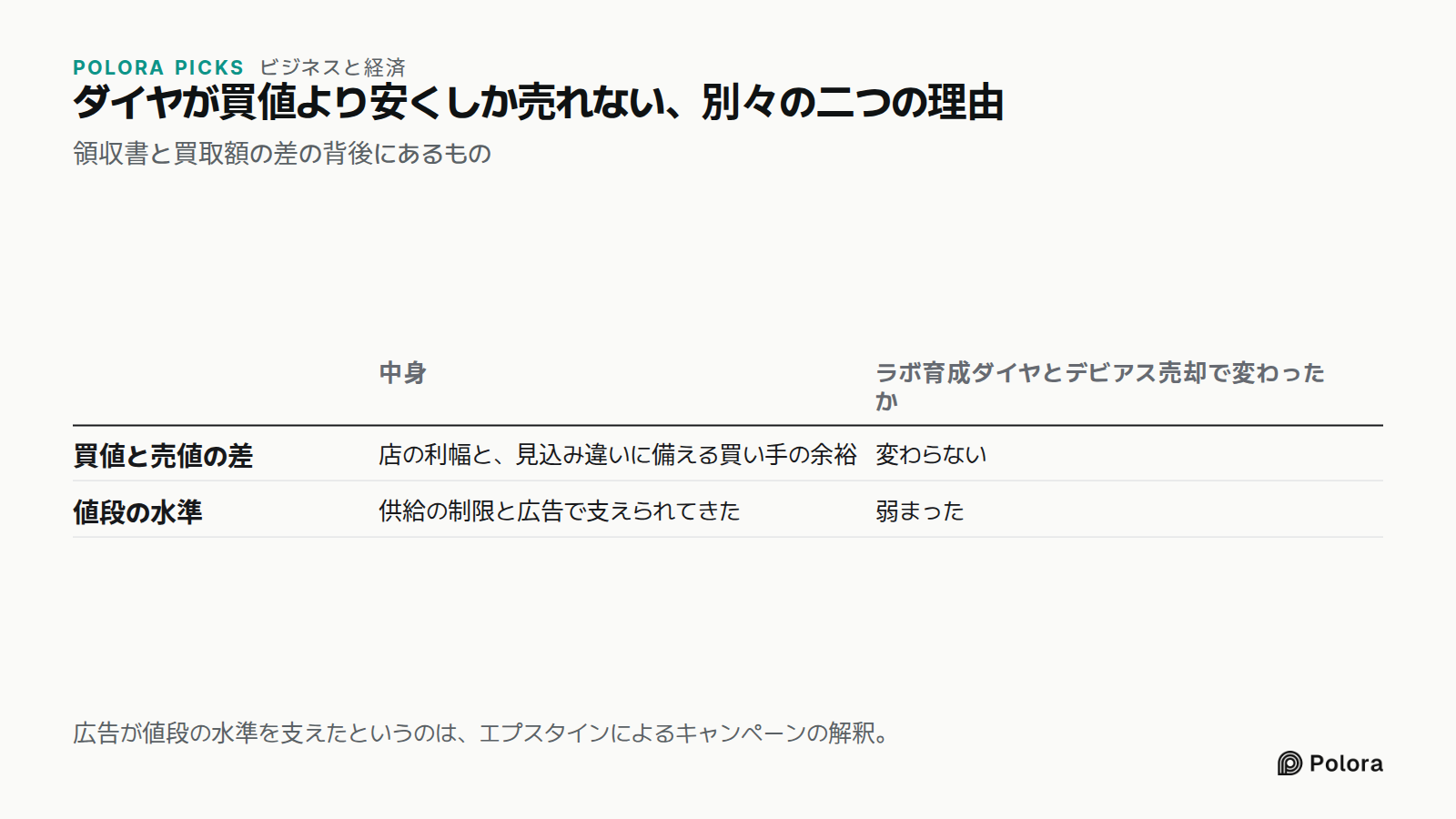
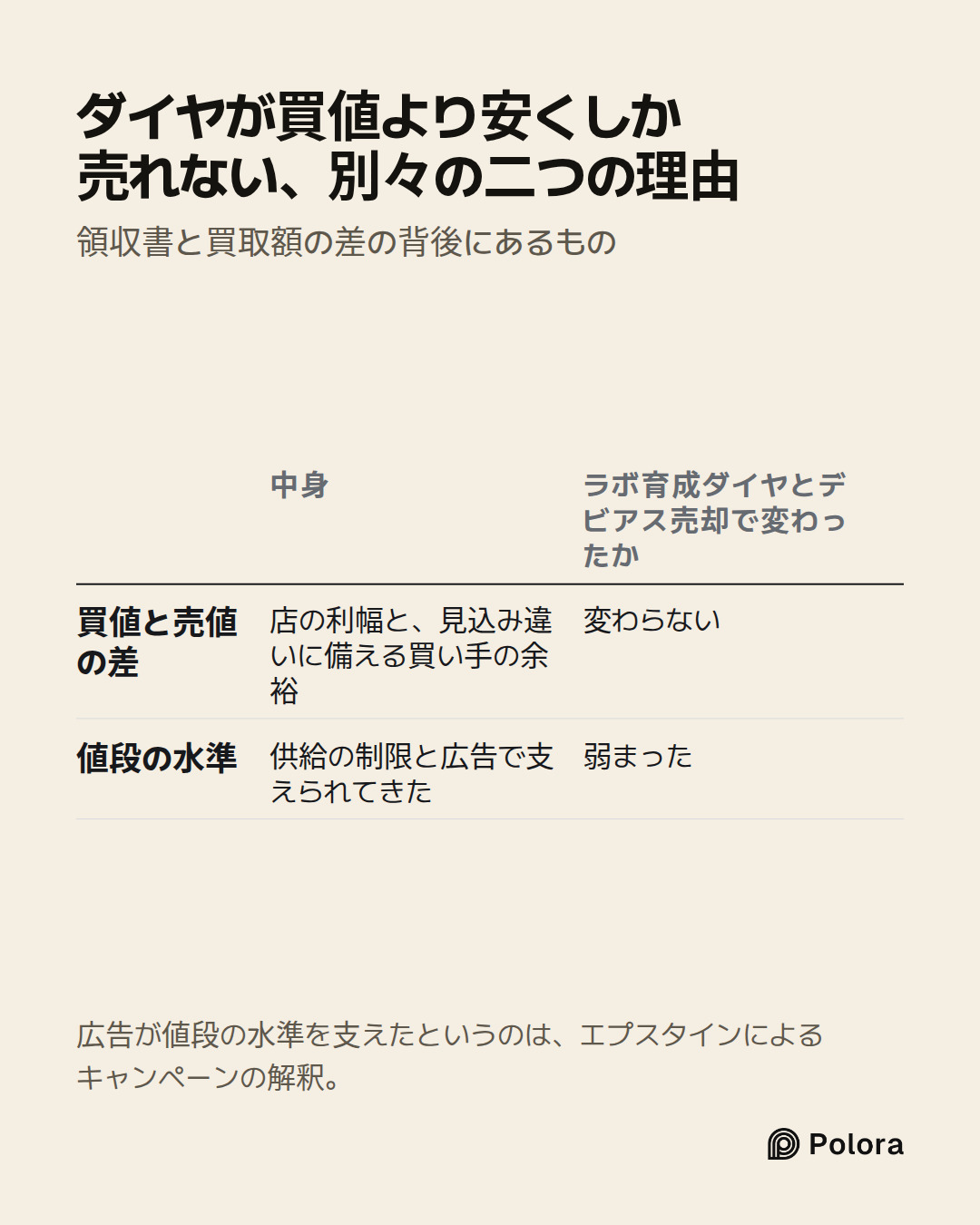
The agreement comes with an important distinction. Alpha identified it, and Beta and Gamma endorsed it: the retail-to-resale gap and the level of diamond prices are different questions. Shop margins and a buyer’s resale risk help explain a low offer even without De Beers. Historic supply control, advertising and lab-grown competition bear on broader prices; they do not, by themselves, establish what a particular ring will fetch. Epstein’s claim that “forever” discouraged resale should remain attributed to *his interpretation*, not stated as the copywriter’s documented intent.
The checks yielded these publication-relevant points:
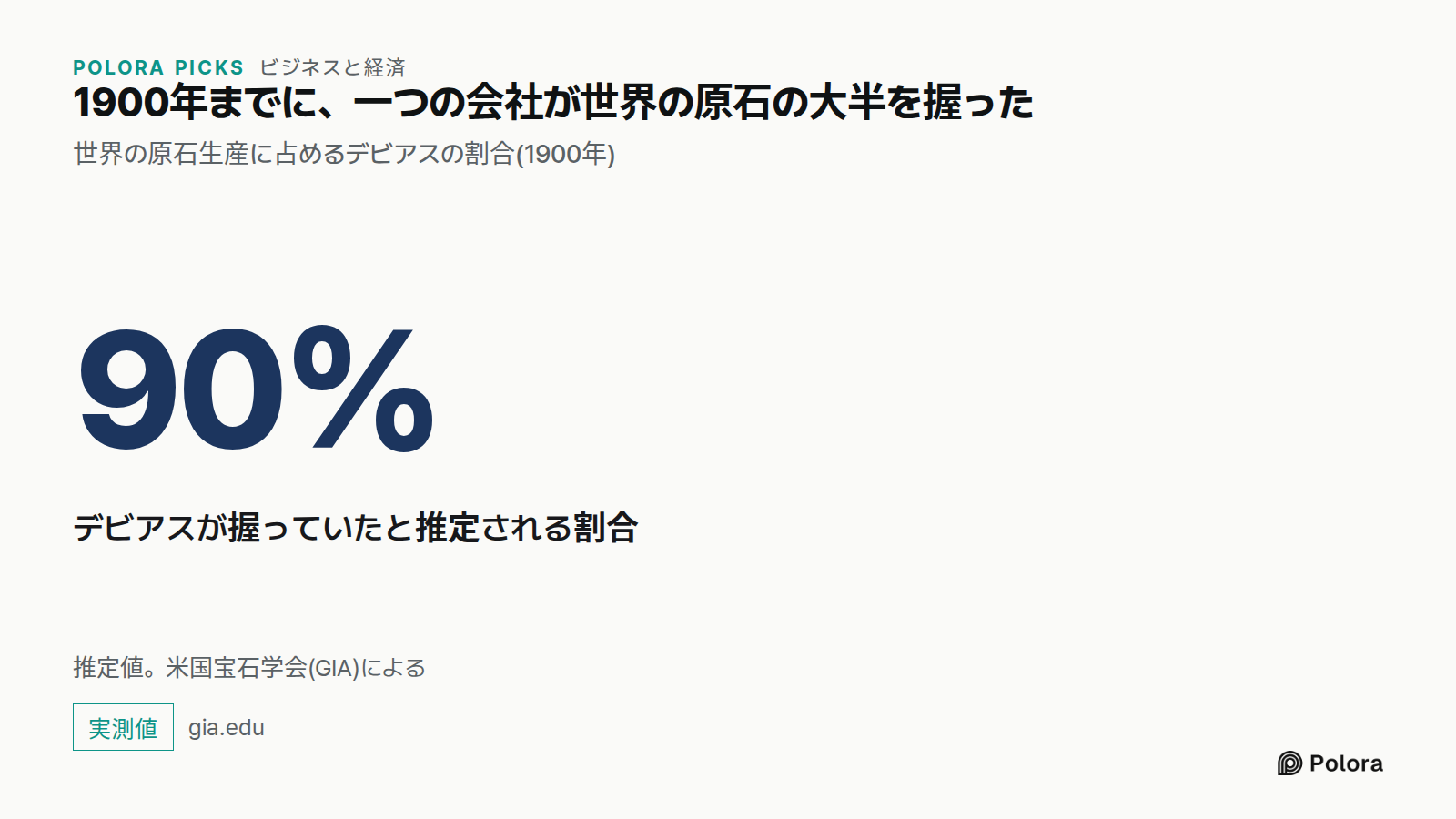
- History and attribution: GIA’s estimate of De Beers’ roughly 90% control of rough production by 1900 stands in the record. De Beers credits Frances Ger…
The Arbiter's Final Verdict · gpt-6-sol
Usually not if “worth” means what you could sell it for. A shop’s receipt records a retail price; a resale buyer generally offers a wholesale-based price or less. That gap existed long before lab-grown diamonds. Edward Jay Epstein documented striking examples in *The Atlantic* in 1982, but those examples are historical—not a reliable percentage for a sale today.
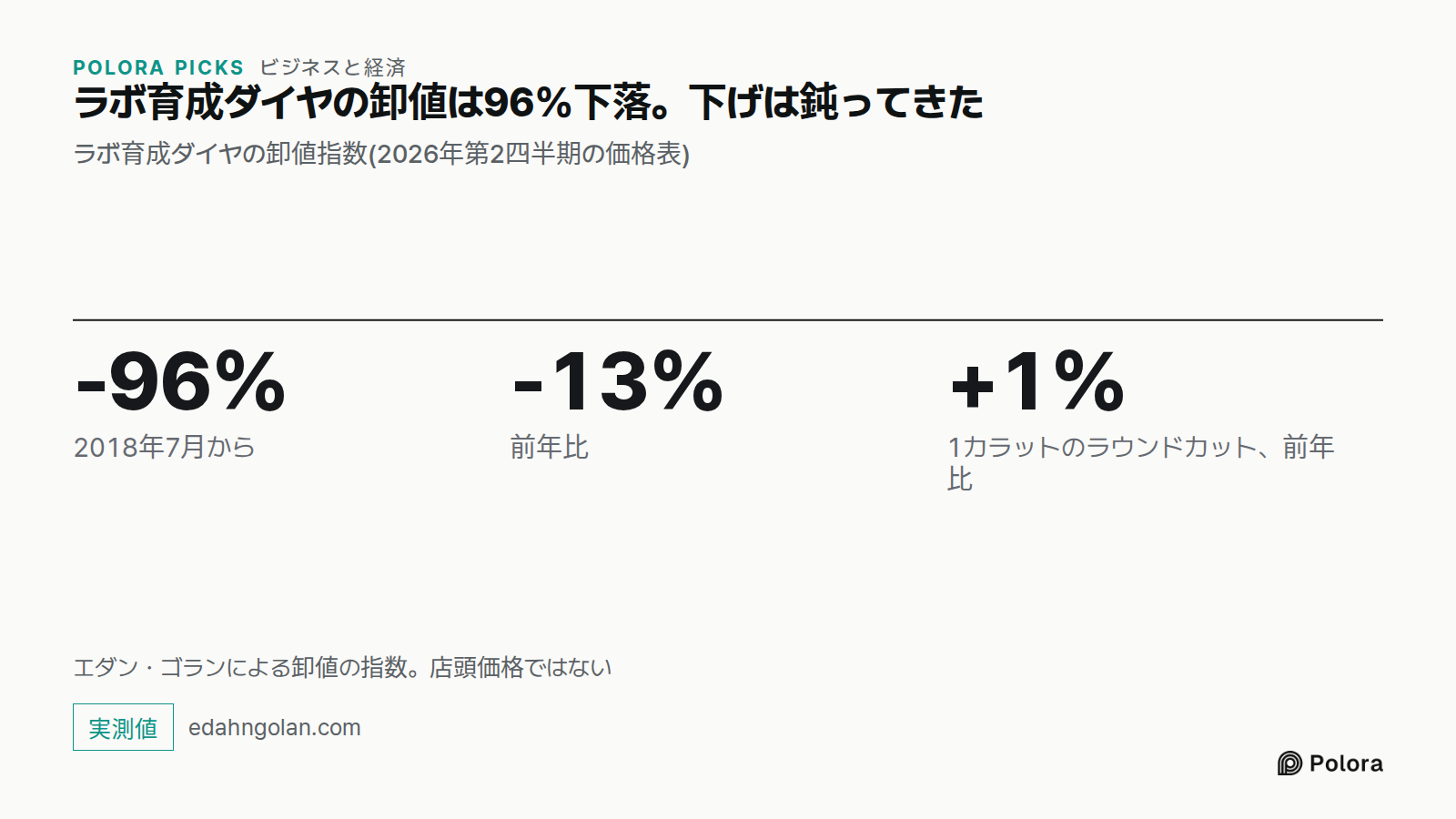
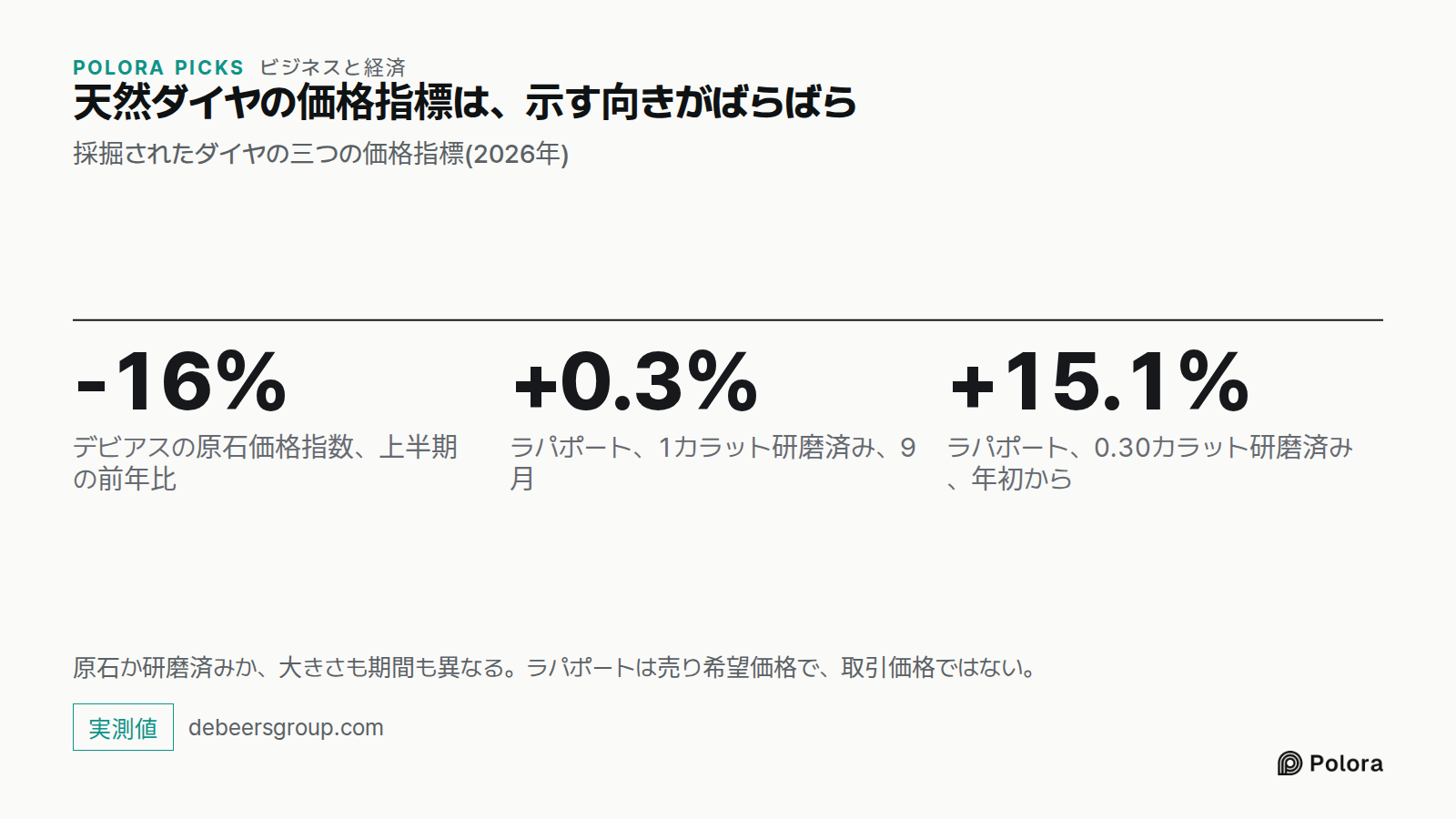
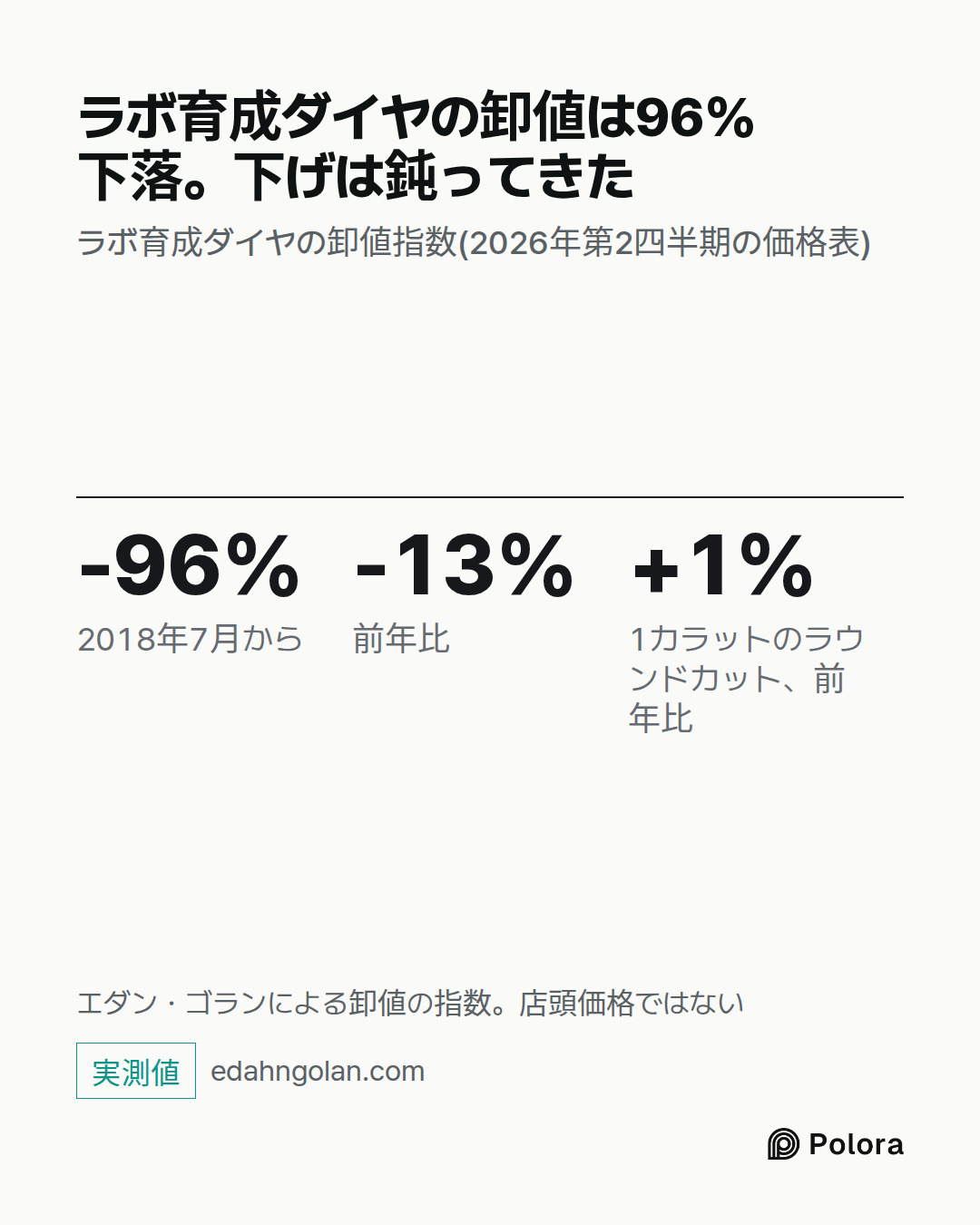
Market prices are a separate question. De Beers reported a 90% fall in *wholesale lab-grown* prices since Lightbox launched in 2018. Natural-diamond measures have also weakened, though some selected polished-stone indexes rose in September 2026; those indexes do not tell you what someone would offer for your ring. (De Beers, July 2026; Rapaport, October 2026)
So the man…