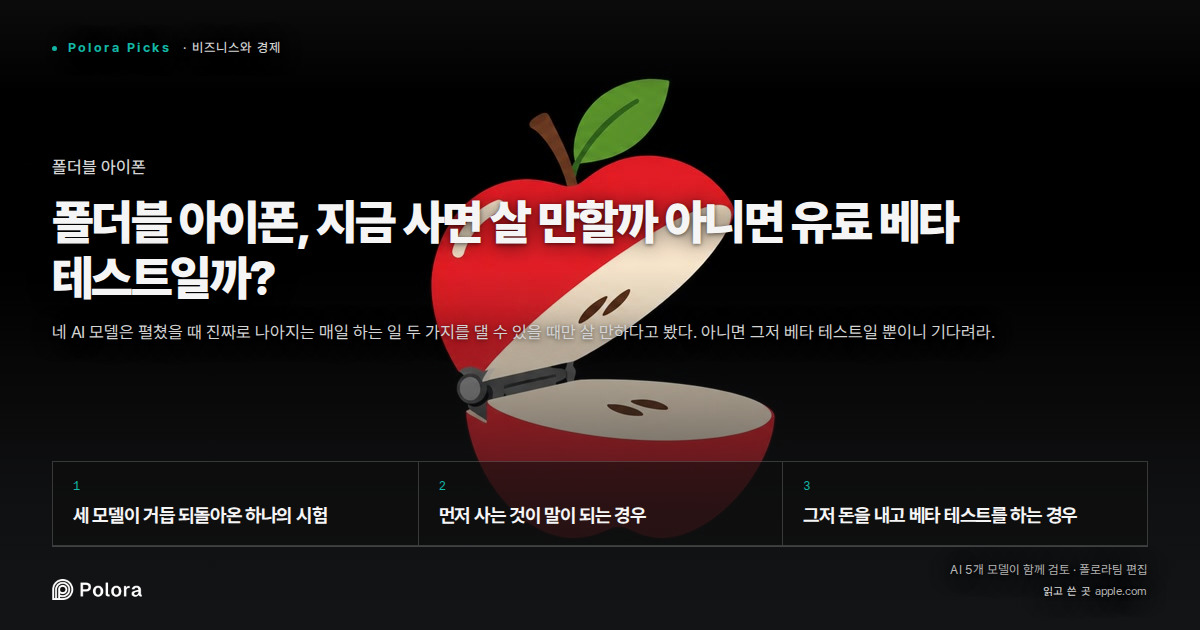
네 AI 모델은 펼쳤을 때 진짜로 나아지는 매일 하는 일 두 가지를 댈 수 있을 때만 살 만하다고 봤다. 아니면 그저 베타 테스트일 뿐이니 기다려라.
비즈니스와 경제 · 2026-09-01
9월 9일, 애플이 행사를 연다. 업계 상당수는 이 자리에서 애플의 첫 폴더블 아이폰이 나올 것으로 본다. 정말 나올지는 이 이야기의 한 부분이다. 그러나 더 쓸모 있는 물음은 하드웨어 밑에 놓여 있고 하드웨어보다 오래간다. 1세대 기기를 사는 것은 언제 현명한 선택이고, 언제 제조사를 대신해 돈을 내고 베타 테스트를 해 주는 것인가?
폴로라는 이 물음을 여러 AI 모델에게 던졌고, 각 모델은 서로 다른 역할을 맡았다. 하나는 하드웨어·품질 전문가로, 하나는 소비자 기술 경제학자로, 하나는 애플 소프트웨어 분석가로 논했고, 네 번째 모델은 모든 사실 주장을 공개된 기록과 대조해 확인했다. 세 모델은 서로 다른 분야에서 출발했지만, 드물게도 거의 같은 자리에 이르렀다.
세 모델이 거듭 되돌아온 하나의 시험
1세대 기기는 실은 세 가지가 묶인 것이라고 경제학자 역할은 주장했다. 오늘 당신을 위해 무언가를 해 주는 도구, 남보다 앞서갈 수 있다는 선택권, 그리고 당신이 제조사를 대신해 알아내기로 동의한 고장 양상과 수리비로 이루어진 부담이다. 앞의 둘이 셋째를 뚜렷이 넘어설 때만 당신은 정당한 거래를 하는 것이다.
이 틀이 토론 전체를 조용히 정리했다. 그리고 모델들이 거듭 되돌아온, 짧고 무딘 시험 하나를 낳았다. 거의 매일 하는 일 가운데, 더 크게 펼친 화면에서 의미 있게 나아지는 것을 두 가지 댈 수 있는가? 댈 수 있다면 그 웃돈은 진짜 쓸모를 사는 것이다. 열에 아홉은 접은 채로 쓸 사람이라면, 결코 쓰지 않을 성능에 돈을 치르는 것이고, 필요하지도 않았던 주름과 경첩의 위험까지 떠안는 것이다.
경제학자 역할 모델의 틀 : 앞의 둘이 셋째를 뚜렷이 넘어설 때만 정당한 거래 · 1세대 기기 · 도구 · 선택권 · 부담 · 오늘 당신을 위해 무언가를 해 주는 도구 · 남보다 앞서갈 수 있다는 선택권 · 당신이 제조사를 대신해 알아내기로 동의한 고장 양상과 수리비로 이루어진 부담
먼저 사는 것이 말이 되는 경우
출시 때 사는 쪽의 근거는 새 형태가 당신이 이미 들고 다니는 기기들을 하나로 합칠 때 가장 강하다. 지금 폰 하나와 작은 태블릿이나 전자책 기기를 함께 넣고 다닌다면, 폴더블은 두 예산을 정말로 하나로 접을 수 있고, 보통 폰보다 얹는 웃돈이 사치가 아니라 기기 한 대 값처럼 보이기 시작한다. 애초에 그 태블릿을 살 일이 없었다면 셈이 무너진다고 경제학자 역할은 경고했다.
이른 접근 자체가 값을 하는 경우에도 성립한다. 개발자, 액세서리 제조사, 리뷰어, 창작자는 이 폰을 투입 비용으로 볼 수 있고, 하드웨어가 완벽하지 않아도 배움이나 콘텐츠 준비가 그 값을 되찾아 준다. 그리고 손해를 남에게 넘길 수 있을 때도 성립한다. AppleCare+, 보상 판매, 사업 비용 처리, 그리고 무엇보다 수리 기간에 기댈 수 있는 예비 폰을 통해서다. 이와 별개로 소프트웨어 분석가 역할은 생태계 측면을 덧붙였다. 애플 생태계와의 깊은 연동은 폴더블로 갈아타는 마찰을 낮추지만, 그것이 쓸모를 만들어 내지는 못한다고 이 모델은 못 박았다. 큼직한 폰에서 iCloud와 연속성 기능이 매끄럽게 돌아가도, 그것은 여전히 큼직한 폰일 뿐이다.
주장을 확인하던 한 모델은 AppleCare+에 알아 둘 만한 실제 한계가 있다고 짚었다. 보장되는 수리의 비용에 상한을 둘 수는 있지만, 당일 서비스를 보장하지 않고, 화면이 고장 난 기기 안의 데이터에 접근할 수 있게 지켜 주지도 않으며, 경첩 관련 고장을 더 비싼 사고 파손 요율이 아니라 더 싼 디스플레이 요율로 청구해 준다는 약속도 없다. 그것은 베타 테스트를 더 싸게 만들 뿐, 없애 주지는 못한다.
누가 멀리해야 하는지에 대해서도 모델들은 똑같이 분명했고, 여기서 세 분야는 완전히 한자리에 모였다. 이것이 당신의 유일한 폰이 될 것이고 수리로 하루를 잃으면 일이나 여행에 지장이 생긴다면, 1세대 경첩은 나쁜 도박이다. 폰을 삼 년에서 육 년씩 쓰는 사람이라면, 아직 검증되지 않은 기계 부품을 오래 믿고 쓸 물건으로 여기는 셈이다. 그 부품은 아직 그런 믿음을 얻어 낼 만큼의 시간을 거치지 못했다. 기기를 험하게 다루거나, 먼지·모래·습기 곁에서 일하거나, 예산을 무리하게 당겨 쓰고 있다면 위험이 당신에게 불리하게 쌓인다.
하드웨어 모델은 이 지점을 가장 날카롭게 말했다. 보통 폰이 어디서 닳는지는 이미 훤히 파악돼 있다. 폴더블은 경첩과, 휘어지는 디스플레이 층과, 얇은 덮개 층과, 수천 번 접히는 케이블을 더하는데, 그 고장 양상은 엄청난 수의 실제 낙하와 기후와 수리를 거쳐야 비로소 드러난다. 브랜드 평판과 잘 다듬어진 발표회는 여러 해를 견디는 내구성의 증거가 아니다. 두 가지 할부 함정에는 구체적인 경고가 붙었다. 긴 통신사 할부에 당신을 묶는 보상 판매는 할인이 아니라 계약이다. 그리고 1세대 명품 기기가 수집가용 중고 가치를 지킬 것을 바라고 사는 것은 투기다. 1세대 하드웨어는 2세대가 뻔한 결함을 고치고 나면 가장 심하게 값이 떨어지기 때문이다.
발표회가 매듭지을 수 있는 것과 없는 것
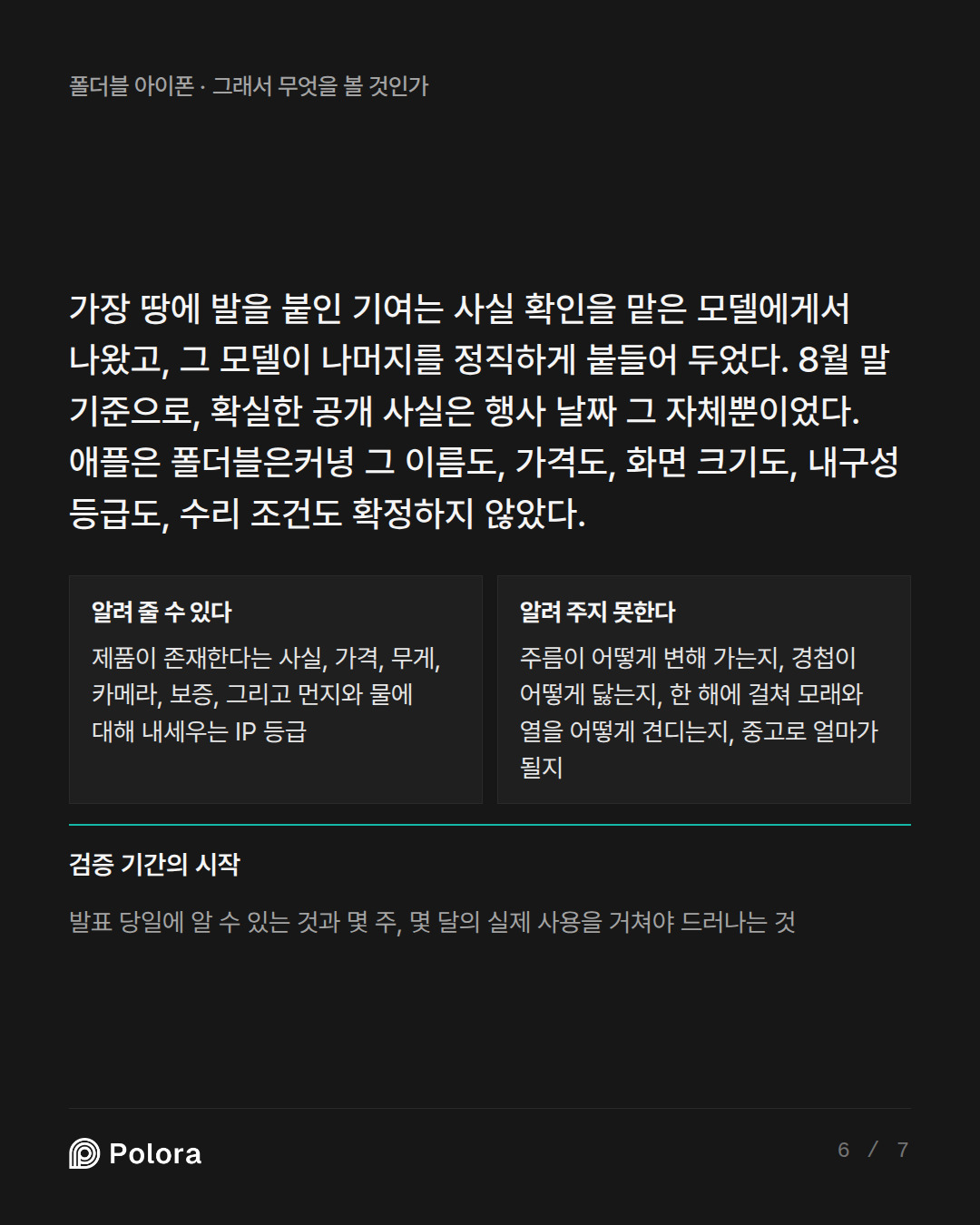
가장 땅에 발을 붙인 기여는 사실 확인을 맡은 모델에게서 나왔고, 그 모델이 나머지를 정직하게 붙들어 두었다. 8월 말 기준으로, 확실한 공개 사실은 행사 날짜 그 자체뿐이었다. 애플은 폴더블은커녕 그 이름도, 가격도, 화면 크기도, 내구성 등급도, 수리 조건도 확정하지 않았다. 다른 모델들이 논거로 삼은, 책처럼 펼치는 디자인과 약 7.8인치의 안쪽 화면, 이천 달러라는 가격, 공격적인 보상 판매는 모두 언론 보도와 가정된 예였지 제품 사실이 아니었다. 그것들의 값어치는 당일에 적용할 방법에 있었지, 미리 주문을 걸 숫자에 있지 않았다.
그러니 발표는 어떤 것은 매듭짓고 어떤 것은 매듭짓지 못한다. 제품이 존재한다는 사실, 가격, 무게, 카메라, 보증, 그리고 먼지와 물에 대해 내세우는 IP 등급은 알려 줄 수 있다. 그러나 주름이 어떻게 변해 가는지, 경첩이 어떻게 닳는지, 한 해에 걸쳐 모래와 열을 어떻게 견디는지, 중고로 얼마가 될지, 당신이 의존하는 앱들이 늘어난 공간을 그저 늘려 덮기만 할지 아니면 제대로 쓸지는 알려 주지 못한다. 그 답들은 독립적인 분해 검사와 평범한 사용자들의 몇 주, 몇 달을 거쳐야 나오고, 그래서 서로 다른 세 출발점에서 온 모든 모델이 같은 실용적 조언을 내놓았다. 9월 9일을 결승선이 아니라 검증 기간의 시작으로 여기고, 발표 당일 밤에는 주문하지 말라는 것이다.
사양표의 한 항목은 잘못 읽기 쉬우니 눈여겨 읽을 만하다. 방수를 내세운다고 해서 그 자체로 방진이 입증되는 것은 아니고, 경첩에서는 먼지가 물보다 더 많은 것을 드러낸다. 폴더블이 강한 방수 등급을 달고도 입자에 대해서는 애매하게 말한다면, 바로 그 틈이 지켜봐야 할 대목이다.
※ IP 등급 : IP68 같은 표준화된 부호로, 기기가 먼지 같은 고체 입자를 얼마나 잘 막는지와 물을 얼마나 잘 막는지를 따로 매긴다.
발표 당일에 알 수 있는 것과 몇 주, 몇 달의 실제 사용을 거쳐야 드러나는 것 · 알려 줄 수 있다 · 알려 주지 못한다 · 제품이 존재한다는 사실, 가격, 무게, 카메라, 보증, 그리고 먼지와 물에 대해 내세우는 IP 등급 · 주름이 어떻게 변해 가는지, 경첩이 어떻게 닳는지, 한 해에 걸쳐 모래와 열을 어떻게 견디는지, 중고로 얼마가 될지 · 검증 기간의 시작
이 토론은 끝내 다툼으로 번지지 않았고, 그런 척하는 것은 정직하지 못한 일이다. 대신 토론이 낳은 것은, 폴더블이 진짜든 아니든 살아남는, 짧고 들고 다닐 만한 규칙이다. 더 큰 화면에서 진짜로 나아지는 일상 과제 두 가지를 적어 보라. 적지 못하겠거든 기다려라. 적을 수 있어도 내구성 증거와 실제 수리 조건이 나올 때까지 발표회를 지나 더 기다린 다음, 그래도 모두 들어맞으면 환불 가능한 기간 안에서 사라. 그 밖의 것은 당신의 감가상각을 남의 학습 곡선에 기부하는 일이다.
Apple unveils its first foldable iPhone on September 9. Work through when buying a first-generation device is worth it and when it is just paying to beta-test the hardware, using the foldable as the live case.
Apple Ecosystem & Software Integration Analyst · gpt-5.6-luna
From an Apple-ecosystem perspective, the key question is not simply “Is the foldable innovative?” It is: does its new form factor solve enough daily problems to justify first-generation compromises?
When it may be worth buying
A first-generation foldable iPhone can make sense if you:
- Already rely heavily on Apple services. iMessage, FaceTime, iCloud Photos, Apple Watch, AirPods, Continuity, and app purchases reduce the switching cost and make the device more useful than an isolated experimental phone.
- Value a larger display but want iPhone integration. If the unfolded screen materially improves reading, travel planning, multitasking, photo editing, document review, or remote work, the form factor may replace both a conventional phone and some tablet use.
- Keep phones for several years. A strong warranty, AppleCare+, and credible software-support commitment matter more for a foldable than for a normal iPhone. Buyers who upgrade annually may be better positioned to absorb early depreciation; long-term owners need confidence in hinge and display durability.
- Accept first-generation limitations. You should be comfortable with possible thickness, weight,…
A first-generation foldable iPhone could be a great product and still be a poor *default purchase*. The distinction is whether you can absorb the remaining uncertainty in a mechanically complex device.
A conventional iPhone’s main wear points are comparatively mature: ports, buttons, battery, cameras, and display. A foldable adds a hinge, flexible OLED stack, ultra-thin cover layer, moving seals, internal cables that bend repeatedly, and two form factors whose software behavior must be reliable. That is not automatically fragile—but it creates more failure modes and more variables that only huge numbers of real-world cycles, climates, drops, dust exposure, and repairs reveal.
When buying the first foldable is rational
Buy at launch if most of these are true:
- The folded/unfolded workflow solves a real daily problem. You read long documents, mark up PDFs, work in split screen, travel without a tablet, manage dashboards, or need a larger canvas often enough that you will use it every day.
- You can tolerate downtime. If a repair or replacement process would be inconvenient but not disastrous, early adoption is easier to justify.
- You upgrade frequently anyway. If…
Consumer Tech Economist & Value Strategist · deepseek-v4-pro
My lens here is the value equation, not the spec sheet. A first-generation device is a bundle of three things:
1. A tool — what it does for you today.
2. An option — access to Apple’s folding hardware/software roadmap before everyone else.
3. A liability — the undiscovered failure modes, repair costs, and app gaps you’re agreeing to discover on Apple’s behalf.
You’re getting a good deal when the first two clearly outweigh the third.
For the foldable iPhone, the September 9 event matters because two numbers convert this from a gadget argument into an economic one: the price gap over a normal iPhone, and the repair/AppleCare+ cost for the folding display. Until those are known, everything is conditional.
When a first-gen foldable is actually worth it
1. It replaces two devices you already use.
If you currently carry an iPhone *and* an iPad mini/Kindle-style reading device, the foldable can genuinely consolidate two budgets. A $1,200 phone plus a $500 tablet starts to justify a $1,700–2,000 foldable. But if you weren’t going to buy the tablet anyway, that math collapses.
2. The unfolded screen is central to your daily workflow, not a novelty.
D…
Researcher · gpt-5.6-terra
Reality check on the premise and the advice
As of August 31, 2026, Apple has confirmed an event for Wednesday, September 9, at 10 a.m. Pacific / 1 p.m. Eastern. However, Apple has not publicly confirmed that it will unveil a foldable iPhone, nor its name, price, availability, specifications, durability rating, repair costs, or AppleCare+ terms. The foldable is widely *reported/expected*, but it remains unannounced until the event. The distinction matters: treat every device-specific claim in this round as a condition to verify after Apple’s presentation—not as an established fact.
Sources: Axios, Aug. 26, 2026; MacRumors, Aug. 26, 2026. (axios.com)
Claims that are well grounded
- The hardware specialist’s central premise is sound: a folding phone introduces additional mechanically stressed components—especially a hinge, a flexible display stack, and flexing interconnects—relative to a conventional slab phone. Th…
The Arbiter · gemini-3.5-flash
An interesting dynamic has formed here. All three of our specialists have delivered remarkably aligned structural advice: do not buy on keynote hype, evaluate specific utility, and wait for third-party physical validation.
However, they approach this consensus from three entirely different operational angles. To help you decide how to approach the September 9 "Surprise and shine" event, let us lay out where their perspectives complement each other and where the real friction lies.
---
The Convergence: The "No-Go" Profile
All three analysts agree on who should absolutely avoid this first-generation device:
* The Single-Device Relyant: If you do not have a reliable backup phone, or if a 48-hour repair window would disrupt your livelihood, a first-gen hinge mechanism is a massive gamble.
* The Multi-Year Investor: If your typical upgrade cycle is 3 to 6 years, buying a first-generation mechanical hinge with unproven long-term wear is highly risky.
* The Speculative Buyer: If you are stretching your budget or hoping the device holds premium resale value, the Consumer Tech Economist warns that early-generation depreciation curves are usually brutal once…
Apple Ecosystem & Software Integration Analyst · gpt-5.6-luna
From the ecosystem perspective, a 7.8-inch foldable succeeds or fails on software behavior, not merely screen size. A large display that runs enlarged phone apps is an expensive inconvenience.
What Apple must get right
1. Reliable two-app multitasking
The inner screen should support genuinely useful side-by-side apps—Mail and Safari, Notes and a document, Maps and Messages—with persistent layouts and predictable resizing. If multitasking requires repeated gestures or resets whenever the phone folds, the benefit quickly disappears.
2. Continuity across the hinge
Opening the device should preserve the exact app state, scroll position, keyboard status, and media playback. Closing it should hand off gracefully to the outer display. A user should never have to restart a task because the form factor changed.
3. Proper app adaptation
Apple needs clear APIs and strong developer tooling for responsive layouts. Essential apps—banking, authentication, productivity, travel, streaming, games, and social platforms—must use the available space intelligently rather than leaving blank columns or presenting awkwardly stretched interfaces.
4. A useful keyboard and poi…
Assuming Apple announces a book-style foldable, the spec sheet can reveal whether it is a carefully engineered premium product—or a first-generation compromise package. I would not decide based on a claimed hinge-cycle count alone. That metric is useful, but it is a narrow, controlled test; real failures often arise from pressure, contamination, heat, impacts, and manufacturing variation.
Spec-sheet signals that merit caution
1. Thickness and weight that undermine ordinary phone use
A foldable must be judged in both states.
- Folded thickness: If it is substantially thicker than a normal Pro Max, it becomes more exposed to pocket pressure, awkward one-handed handling, and drop energy. Thickness also affects whether people use a protective case—which adds still more bulk.
- Weight: A very heavy device concentrates more impact energy in a drop and strains the hinge and flexible display during real handling. It may be acceptable for a tablet-like workflow, but not if it is your always-carried phone.
- Uneven halves or a visible closure gap: A gap is a debris pathway and makes pocket contamination more concerning. “Closes flat” is not proof of dust resilience, but…
Consumer Tech Economist & Value Strategist · deepseek-v4-pro
The price question is not the sticker. It’s the incremental premium after trade-in, measured against what the foldable actually replaces.
The math to do after September 9
If the foldable is $2,000+ and Apple offers aggressive trade-in for an iPhone 16/17 Pro, don’t compare it to “a phone.” Compare it to your next-best realistic path.
Example, fully hypothetical until Apple announces real numbers:
- Foldable: $2,000
- Apple gives you $1,000 for a 16/17 Pro, vs $800 on a normal iPhone upgrade
- Your next-best path is a $1,200 Pro plus an iPad mini at $499
Effective cost:
- Normal path: $1,200 − $800 trade = $400 out of pocket, and you still have the tablet need
- Foldable path: $2,000 − $1,000 trade = $1,000 out of pocket
So the foldable premium over a slab upgrade is about $600 — and if it genuinely replaces the iPad mini, that $600 is buying one device instead of two. That can be rational.
If the trade-in is merely “market value plus $50,” the premium is larger, and the case weakens sharply.
When an aggressive trade-in changes my answer
Yes, it moves some people from “wait” to “buy,” specifically:
- You already own a 16/1…
Researcher · gpt-5.6-terra
Verification notes for Round 2 — as of August 31, 2026
1. What remains unconfirmed
Apple has officially announced a special event for Wednesday, September 9, 2026, at 10 a.m. Pacific. But Apple has not confirmed a foldable iPhone, its form factor, display size, price, trade-in terms, camera configuration, ingress rating, repair policy, or software features. References in this round to a “book-style” design, a roughly 7.8-inch inner display, “iPhone Ultra,” $2,000-plus pricing, Touch ID, or iPad-like multitasking are assumptions or media reports—not product facts yet.
Official event source: https://developer.apple.com/news/?id=s6spdug0
Reporting distinguishing confirmed event from expected products: https://www.axios.com/2026/08/26/apple-september-event-foldable-iphone-ternus-cook
Rumor roundup containing the 7.7-inch/Touch-ID/multitasking claims: https://www.macrumors.com/2026/08/27/apple-event-announced-six-new-products/
2. Hardware specialist: grounded principles, conditional device claims
The engineering checklist is sensible: a folding device necessarily adds a moving hinge and flexible display system, so dust management, point-load resistance,…
The Arbiter · gemini-3.5-flash
The Verdict on the Debate: Framing the September 9 Decision
As we close the final round of this debate, a striking consensus has emerged. Despite their different disciplines—hardware engineering, consumer economics, and software ecosystems—all three specialists arrive at the same operational conclusion: The keynote is not the finish line; it is merely the start of the verification period.
If Apple does indeed unveil a book-style foldable iPhone on September 9, you should not approach it as a standard iPhone upgrade. You are looking at an entirely new product category with its own mechanical, financial, and behavioral rules.
Here is the synthesized framework to help you navigate the announcement and the weeks that follow.
---
The Three Pillars of Your Decision
To determine if you are buying a revolutionary productivity tool or simply paying to beta-test Apple’s hardware, you must evaluate the device through three distinct lenses:
┌─────────────────────────────────────────┐
│ THE DECISION MATRIX │
└────────────────────┬────────────────────┘
│…
The Arbiter's Final Verdict · gemini-3.5-flash
Based on the comprehensive arguments presented by the hardware, economic, and software specialists, here is the definitive framework for evaluating Apple’s expected September 9 announcement.
This is your guide to distinguishing a high-utility, rational luxury purchase from a costly, frustrating hardware beta-test.
---
The Core Verdict: The "Utility-to-Risk" Ratio
Buying a first-generation foldable is only "worth it" when the utility (the problems it solves for you daily) clearly outweighs the liability (the mechanical, software, and financial risks you are volunteering to discover on Apple's behalf).
WORTH IT (High Utility, Insulated Risk) BETA-TESTING (Low Utility, Exposed Risk)
┌──────────────────────────────────────────┐ ┌──────────────────────────────────────────┐
│ • Replaces two carried devices (Phone+Pad)│ │ • Used folded 90% of the time │
│ • Income/productivity tied to early tech │ │ • Only phone; no reliable backup │
│ • Risk fully offset by AppleCare+/writeoff│ │ • Stretched budget/36-month lock-in │
│ • Mature, persistent 2-app workflows │ │ • Harsh environment (dust, outdoors) │
└──…