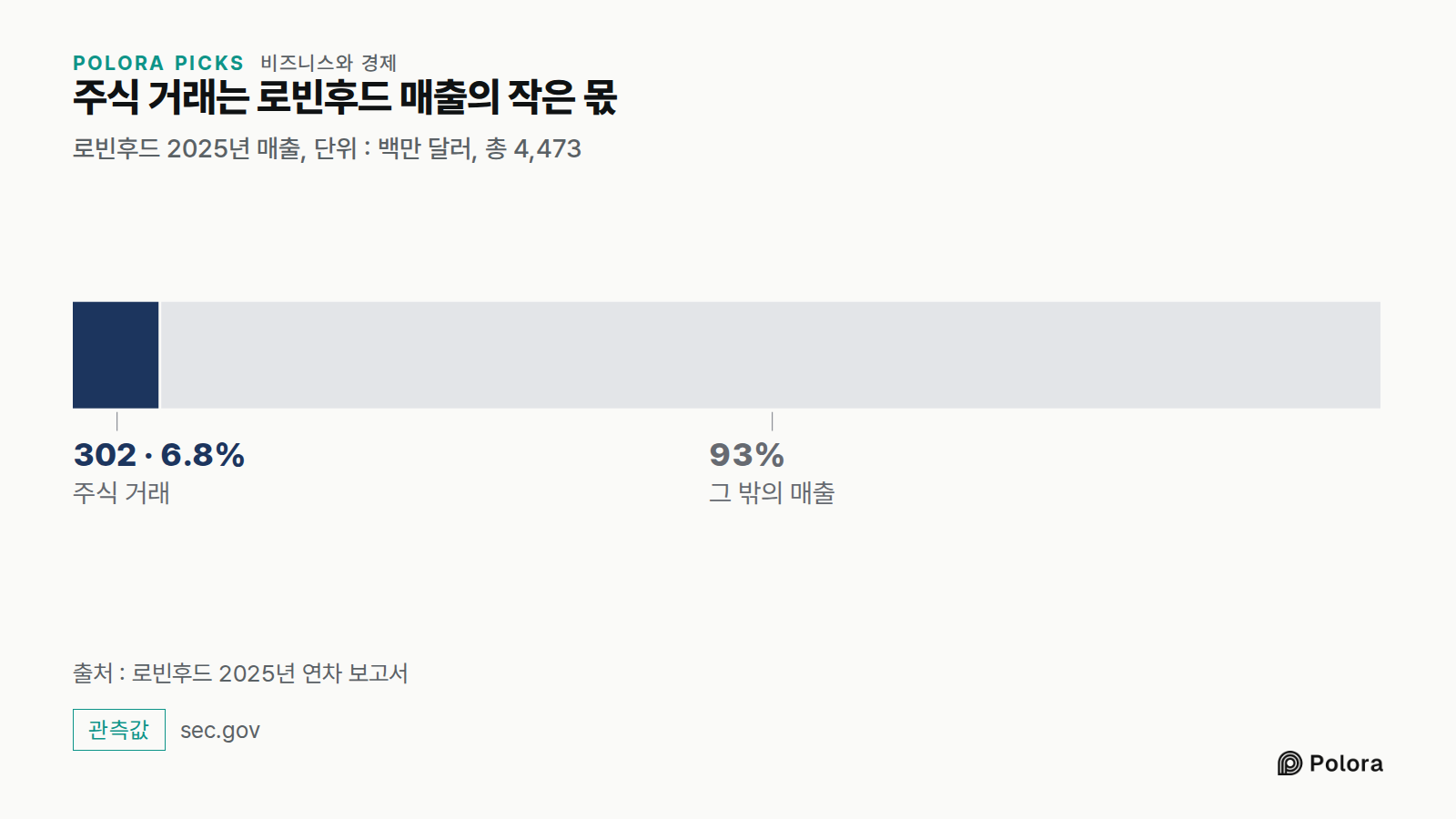
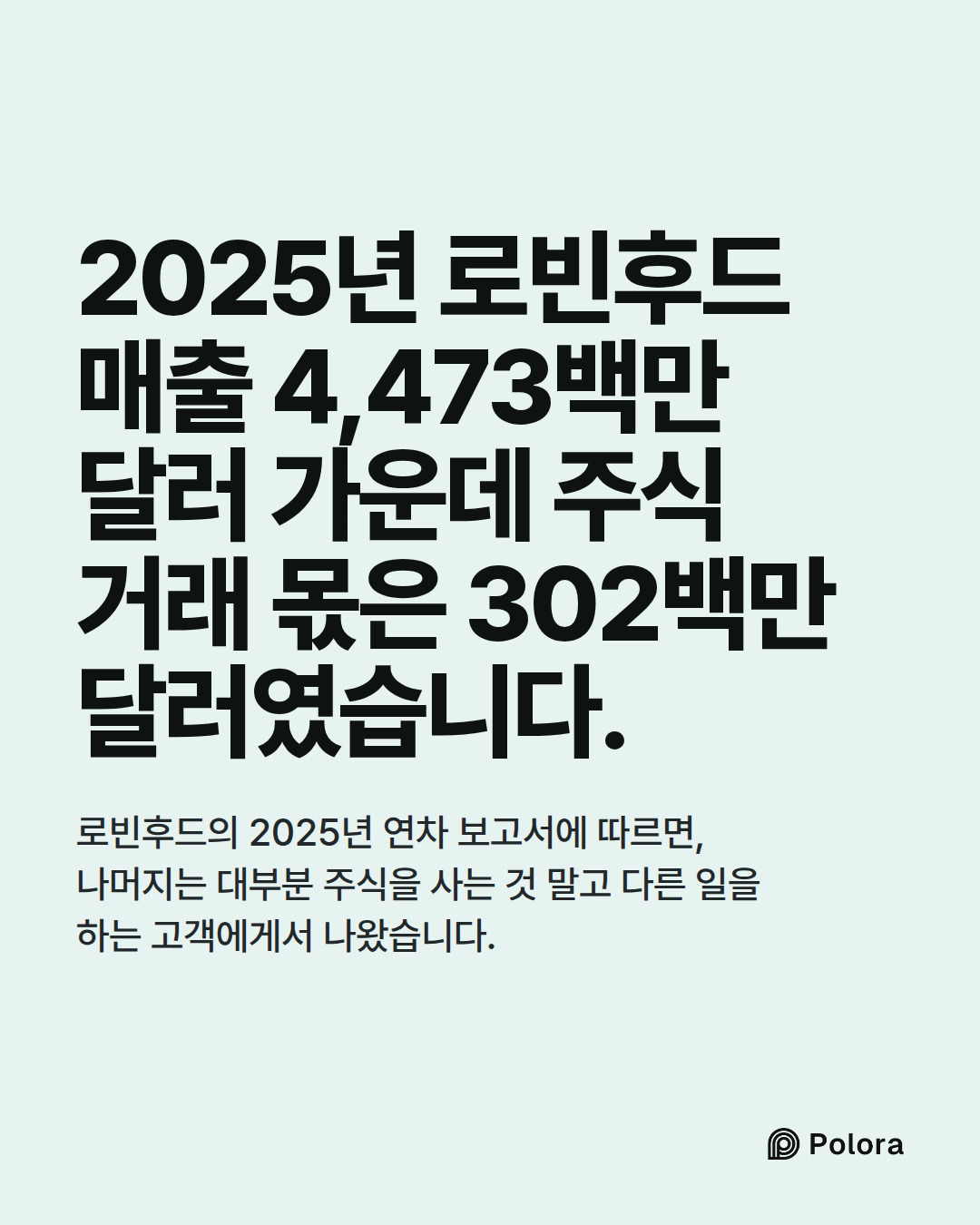
대부분 주식 거래 밖에서 법니다. 2025년 로빈후드 매출 4,473백만 달러 가운데 주식 거래 몫은 302백만 달러였고, 옵션과 암호화폐, 이자 수입이 훨씬 컸습니다.
비즈니스와 경제 · 2026-10-04
무료 주식 거래는 매출에서 가장 작은 몫입니다
거래 수수료를 받지 않는 앱이 어떻게 돈을 버느냐고 물으면, 대부분은 돈을 못 번다거나 거래 한 건마다 조금씩 남긴다고 답합니다. 미국의 대표적인 무료 주식 앱 로빈후드의 2025년 연차 보고서는 다른 답을 내놓습니다. 그해 회사 매출은 4,473백만 달러였습니다. 그중 이 앱 하면 떠오르는 일, 곧 주식을 사고파는 거래에서 나온 돈은 302백만 달러였습니다.
나머지는 대부분 주식을 사는 것 말고 다른 일을 하는 고객에게서 나왔습니다. 옵션이나 암호화폐를 거래하는 고객, 돈을 빌려 투자하는 고객, 계좌에 현금을 그냥 넣어 두는 고객, 월 구독료를 내는 고객입니다. 이들 대부분이 주식을 사는 고객보다 회사에 더 많은 돈을 벌어 주고, 구독료조차 주식 거래 매출에 크게 뒤지지 않습니다. 이 목록을 보고 나면 '무료'는 선물이 아니라 누가 돈을 낼지 가르는 장치로 보입니다.
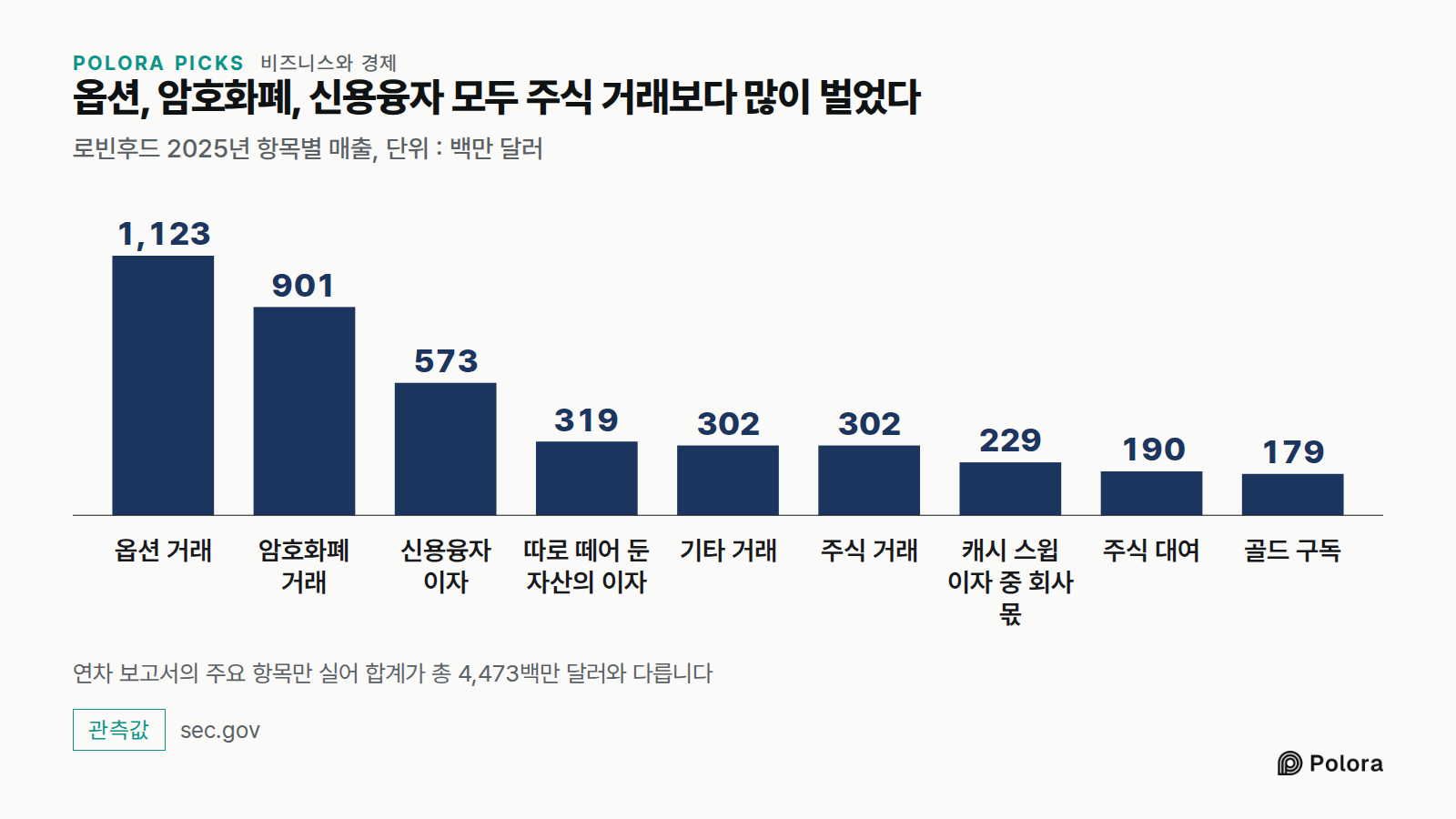
로빈후드의 2025년 연차 보고서에 따르면 매출은 대략 다음과 같이 나뉩니다. 옵션 거래 : 1,123백만 달러. 암호화폐 거래 : 901백만 달러. 예측시장 계약과 즉시 출금 수수료가 대부분인 기타 거래 : 302백만 달러. 돈을 빌려 투자하는 고객에게 내준 대출(신용융자)의 이자 : 573백만 달러. 고객 보호 규정에 따라 따로 떼어 둔 현금, 증권, 예치금에서 나온 이자 : 319백만 달러. 고객이 놀려 둔 현금을 제휴 은행에 맡기고 받은 이자 가운데 회사 몫 : 229백만 달러. 고객 주식을 다른 투자자에게 빌려주고, 고객 몫을 떼어 준 뒤 남은 수입 : 190백만 달러. 골드 구독 : 179백만 달러. 주식 거래 : 302백만 달러.
모든 종류의 이자를 합치면 1,514백만 달러로 전체의 약 삼분의 일입니다. 주식 거래를 뺀 거의 모든 항목이, 고객이 주식을 사는 것 이상의 무언가를 해야 생기는 돈입니다.
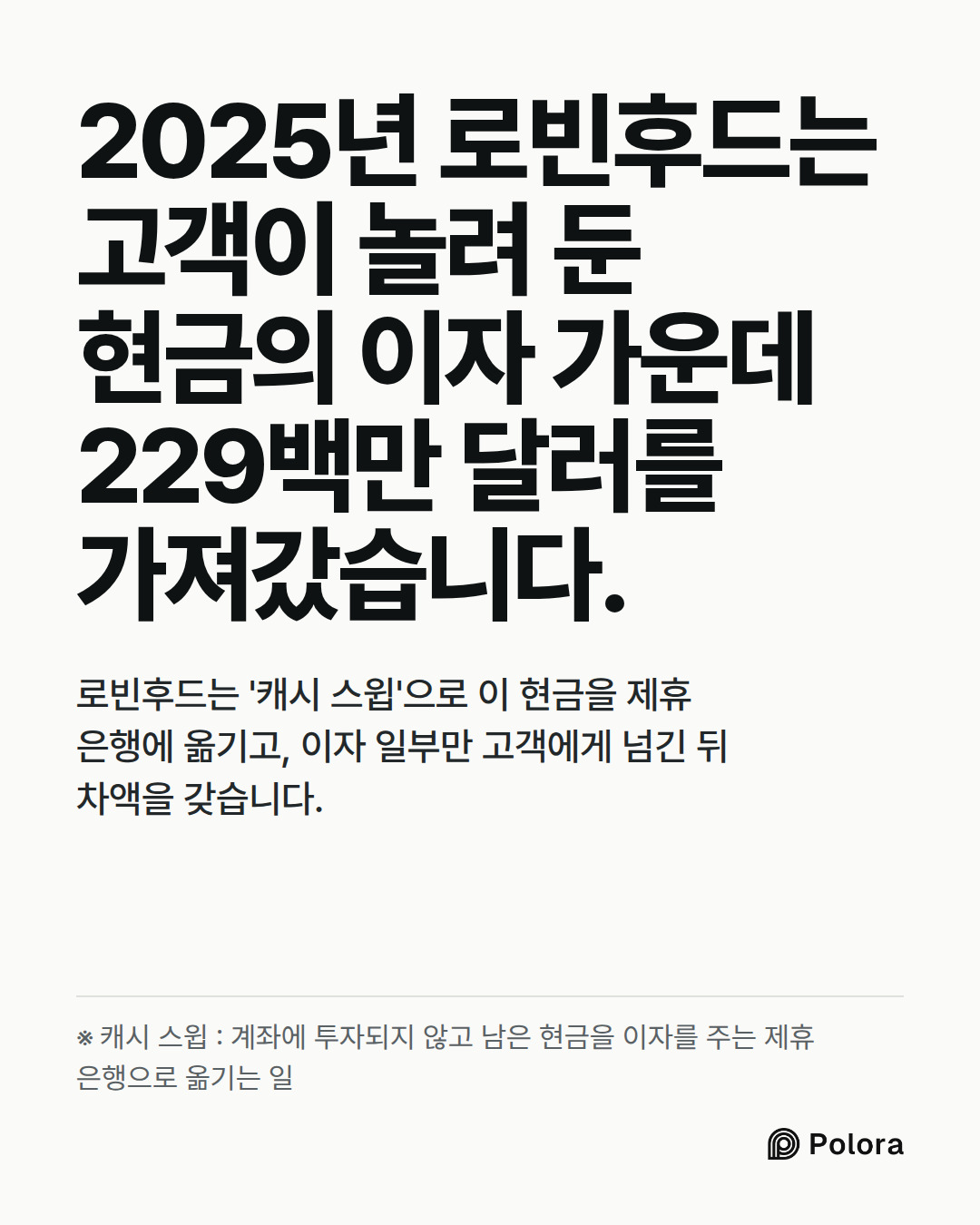
증권 계좌에 투자되지 않고 남아 있는 돈은 증권사 입장에서는 놀고 있는 돈이 아닙니다. 로빈후드는 이 돈의 상당 부분을 여러 제휴 은행으로 옮기는데, 회사는 이를 '캐시 스윕'이라고 부릅니다. 은행은 이 돈에 이자를 줍니다. 로빈후드는 그 이자의 일부를 고객에게 넘기고 차액을 갖습니다. 2025년에는 평균 약 309억 달러의 예치 현금에서 이 차액이 229백만 달러 나왔습니다. 회사는 이를 연 0.74%의 수익률로 보고합니다.
로빈후드는 고객 자금 규정에 따라 따로 떼어 둬야 하는 현금, 증권, 예치금에서도 이자를 버는데, 2025년에 319백만 달러였습니다. 다만 이 자산에는 청산기관에 맡긴 예치금도 들어 있어서, 전부가 고객이 놀려 둔 돈에서 나온 것은 아닙니다. 전통적인 증권사에서는 놀고 있는 현금이 더 큰 몫을 합니다. 미국 대형 증권사 찰스 슈왑은 2025년 연차 보고서에서 투자되지 않은 고객 현금을 이자 수익을 내는 자산의 '주된 자금원'이라고 부릅니다.
미국 주식 앱에서 '매수'를 누르면 주문은 대개 증권거래소로 가지 않습니다. 시장조성자 또는 도매 체결업체라고 불리는 대형 트레이딩 회사로 가고, 이 회사가 직접 주식을 팔아 줍니다. 이 회사는 사는 값과 파는 값 사이의 작은 차이인 스프레드로 돈을 법니다. 그리고 주문을 보내 준 대가로 그 차이의 일부를 앱에 줍니다. 이를 주문흐름 대가 지급(PFOF)이라고 합니다.
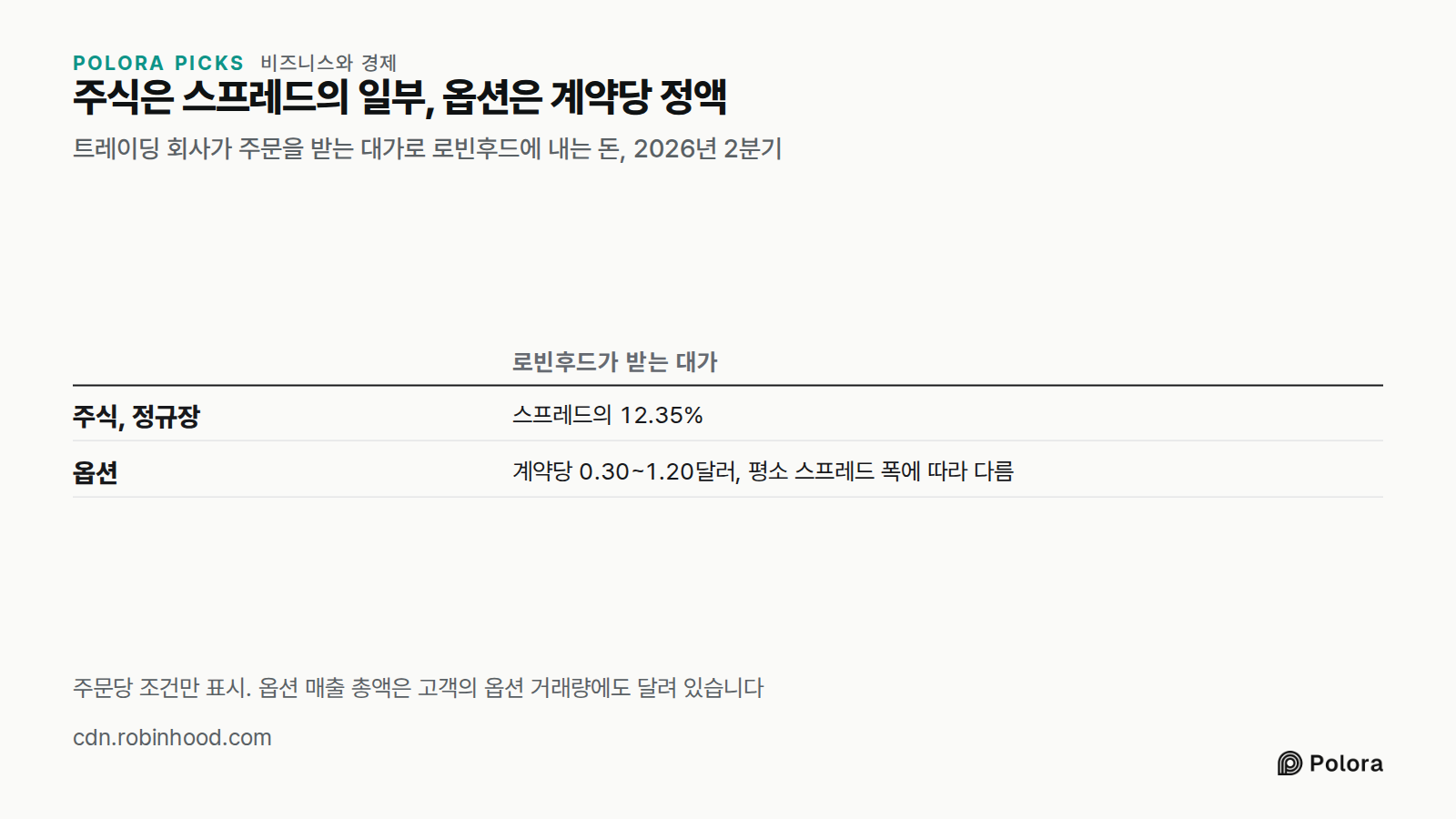
조건은 로빈후드가 2026년 두 번째 분기에 대해 낸 공시에 나와 있습니다. 정규장 시간의 주식 주문에 대해서는 스프레드의 12.35%를 받습니다. 옵션은 계약 하나당 0.30달러에서 1.20달러 사이의 고정 금액을 받는데, 금액은 그 옵션의 스프레드가 평소 얼마나 넓은지에 따라 달라집니다. 옵션은 로빈후드 매출에서 가장 큰 단일 항목입니다. 이 공시는 주문 하나하나에 대가가 어떻게 매겨지는지를 설명할 뿐, 옵션이 전체적으로 왜 더 많이 버는지는 설명하지 않습니다. 옵션 매출의 크기는 고객이 옵션을 얼마나 많이 거래하느냐에도 달려 있고, 보고서는 이 둘을 나눠 보여 주지 않습니다.
가진 현금보다 더 많이 사려고 앱에서 돈을 빌리는 고객은 대출 이자를 냅니다. 로빈후드에서 이런 신용융자는 2025년 평균 약 114억 달러였습니다. 회사는 여기서 573백만 달러를 벌었고, 보고된 수익률은 5.01%였습니다. 돈을 빌린 고객이 낸 이자가 주식 거래 전체보다 큰 수입원인 셈입니다.
증권사는 고객의 주식을 주가 하락에 베팅하려는 투자자에게 빌려주고 수수료를 받을 수도 있습니다. 로빈후드는 2025년 이렇게 해서, 고객 몫을 떼어 주고도 190백만 달러를 벌었습니다.
로빈후드는 골드라는 월 구독 상품도 파는데, 2025년에 이것으로 179백만 달러를 벌었습니다. 암호화폐는 그 자체로 901백만 달러짜리 큰 항목입니다. 이 돈은 대부분 주식이나 옵션 주문에서 받는 대가와는 다른 방식으로 들어오고, 로빈후드 보고서에도 '거래 리베이트'라는 별도 이름으로 잡힙니다. 회사는 일부 암호화폐 주문에 대해 고객이 직접 수수료를 내는 방식도 도입하기 시작했습니다. 어느 쪽이든 이 돈은 주식을 사는 사람이 아니라 암호화폐를 거래하는 사람에게서 나옵니다. 기타 거래에서 나온 302백만 달러도 주식을 사는 사람의 돈이 아닙니다. 대부분 예측시장 베팅과 즉시 출금 수수료입니다.
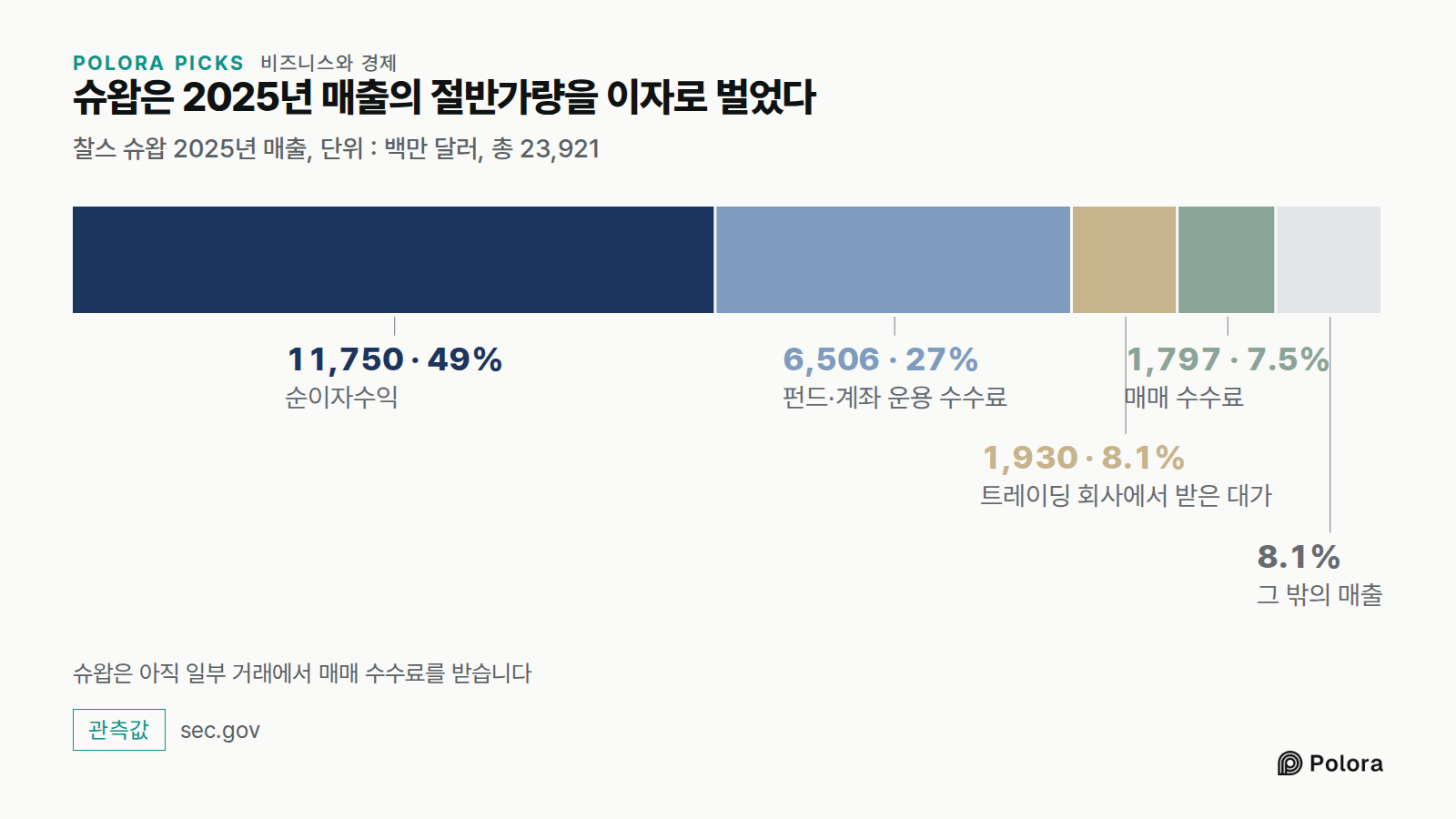
모든 앱이 로빈후드처럼 버는 것은 아닙니다. 미국 최대 증권사 가운데 하나인 찰스 슈왑은 2025년 매출 23,921백만 달러 가운데 순이자수익이 11,750백만 달러로 절반가량이었습니다. 트레이딩 회사에서 받은 대가는 1,930백만 달러로 약 8%였습니다. 펀드와 계좌 운용 수수료는 6,506백만 달러였습니다. 슈왑이 아직 일부 거래에서 받는 매매 수수료는 1,797백만 달러였습니다.
그래도 두 회사에 공통된 점이 하나 있습니다. 옵션 주문이 주식 주문보다 더 많은 돈을 가져온다는 것입니다. 슈왑이 트레이딩 회사에서 받은 대가 가운데 1,167백만 달러는 옵션 주문, 763백만 달러는 주식 주문에서 나왔습니다.
이 문제는 아직 논쟁 중이고, 양쪽 다 근거가 있습니다. 로빈후드는 공시에서 이런 대가를 받는 것이 고객에게 최선의 가격을 찾아 주는 일을 '방해하지 않는다'고 말합니다. 같은 문서에는, 미국 규제 당국의 검사 부서가 증권사가 받는 대가와 고객이 받는 가격 사이에 '잠재적인 상충 관계가 있다는 점을 관찰했다'는 내용도 적혀 있습니다.
2022년 미국 증권거래위원회(SEC)는 개인 투자자 주문의 90% 이상이 소수의 도매 체결업체로 간다고 밝혔습니다. SEC 실무진은 주문마다 경매를 거치게 하는 규칙을 제안하면서, 이 투자자들이 공개 경쟁에서라면 받았을 가격에 비해 해마다 약 15억 달러를 놓치고 있다고 추정했습니다. 이는 측정된 손실이 아니라 추정치였고, 업계는 반박했습니다. SEC는 이 제안을 채택하지 않고 2025년 6월 12일 철회했으며, 철회는 6월 17일부터 효력이 생겼습니다. 영국 사례도 있습니다. CFA 협회가 인용한 연구에 따르면, 영국에서 소액 거래 가운데 호가상 최선의 가격으로 체결된 비율이 2010년 약 65%에서 2014년 90% 이상으로 올랐습니다. 그 사이인 2012년에 영국 규제 당국은 이 관행을 사실상 금지하는 결정을 내렸습니다.
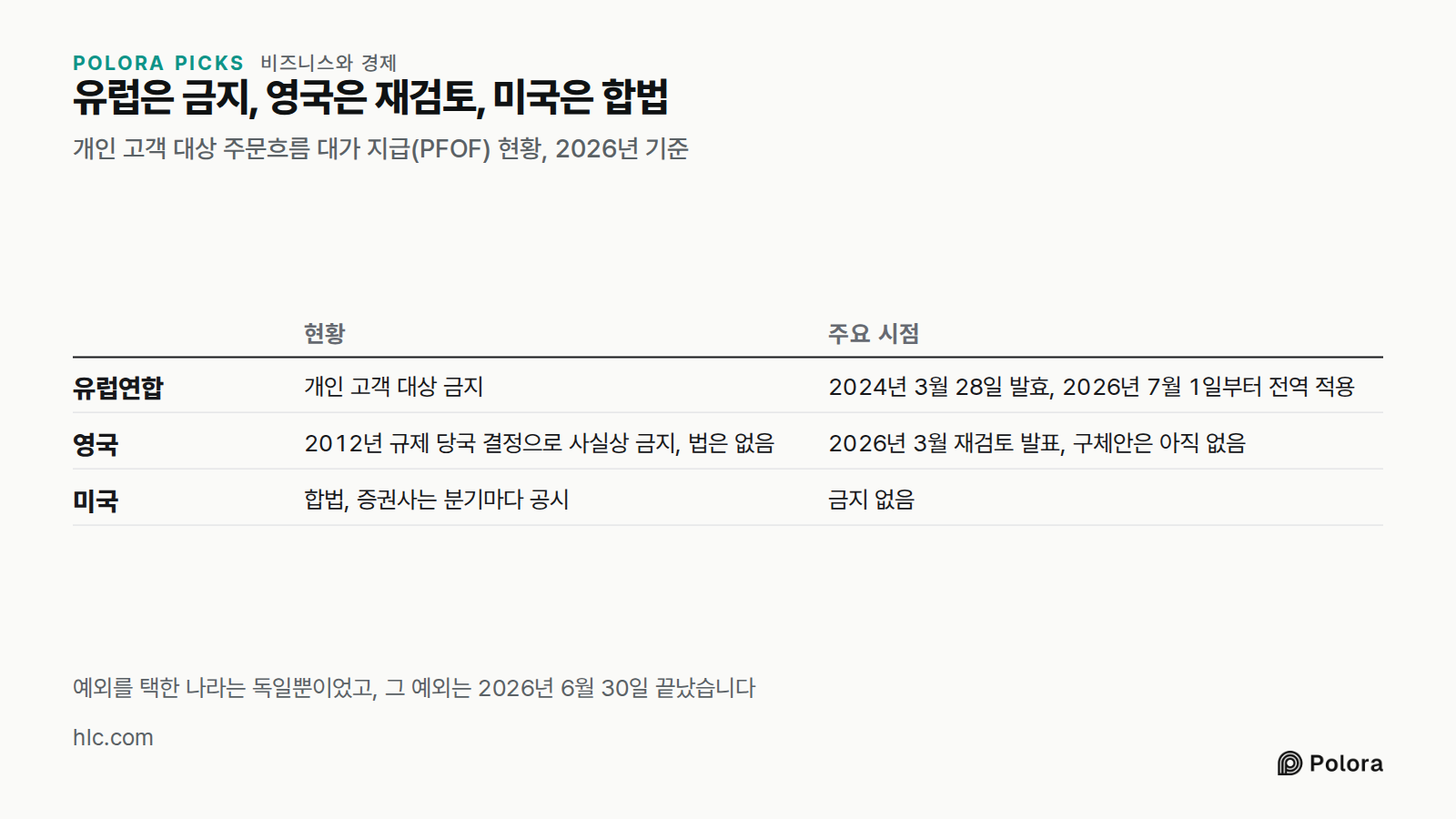
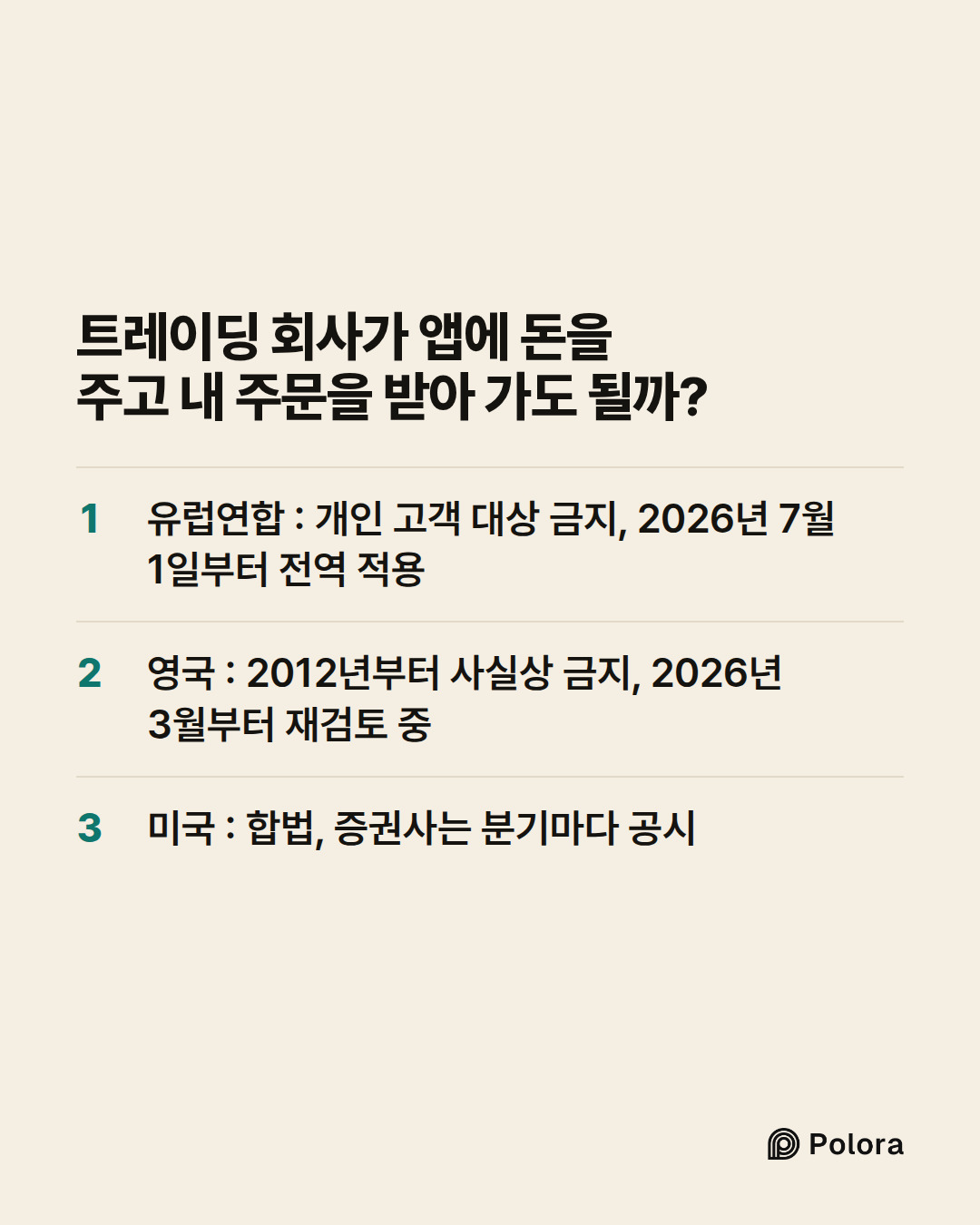
유럽연합은 시장 규정 개정을 통해 개인 고객에 대한 주문흐름 대가 지급을 금지했고, 이 개정은 2024년 3월 28일 발효됐습니다. 각국은 자국 증권사의 국내 고객에 한해 2026년 6월 30일까지 예외를 둘 수 있었는데, 이를 택한 나라는 독일뿐이었습니다. 2026년 7월 1일부터 금지는 유럽연합 전역에 적용되고 있습니다. 독일 금융감독청(BaFin)은 2026년 7월 22일 어떤 사업 방식을 계속 허용하는지 밝혔습니다.
영국은 이 관행을 금지하는 법을 만든 적이 없습니다. 2012년 당시 규제 당국이, 이런 대가를 받으면 그 돈을 챙기는 일과 고객 각자에게 최선의 가격을 찾아 주는 일이 서로 부딪힌다고 결론 내렸고, 이것이 사실상 금지로 작용했습니다. 2026년 3월 영국 금융행위감독청(FCA)은 이 입장을 재검토하겠다고 밝혔습니다. 2026년 5월에 낸 규제 업무 계획에도 여전히 재검토라고만 적혀 있고, 무엇을 제안할지는 아직 밝히지 않았습니다. 미국에서는 이 관행이 여전히 합법입니다. 다만 증권사는 위에서 인용한 것과 같은 분기 보고서로 이를 공시해야 합니다.
주식을 사는 사람에게 수수료 무료는 말 그대로 무료입니다. 하지만 앱은 자선 단체가 아니고, 돈은 어딘가에서 나옵니다. 일부는 주식 주문 자체에서, 곧 트레이딩 회사가 주문을 받아 체결하며 내는 대가에서 나옵니다. 훨씬 많은 돈은 옵션 거래자, 돈을 빌려 투자하는 고객, 암호화폐 거래자에게서, 그리고 계좌에 머물며 주인보다 앱에 더 많은 돈을 벌어 주는 현금에서 나옵니다. 보고서가 보여 주는 것은 매출이 어디서 오는지까지입니다. 한 고객이 낸 돈이 다른 고객의 무료 거래를 메운다거나, 어떤 주문이 더 나쁜 가격을 받았다는 것까지 보여 주지는 않습니다. 2025년 로빈후드에서 주식 거래는 4,473백만 달러 가운데 302백만 달러였습니다. 값의 대부분은 다른 곳에서 치러졌습니다.
How do stock apps make money if trading is commission-free?
Alpha · claude-sonnet-5
This is a solid manuscript, and my search confirms its core architecture while flagging one real discrepancy worth flagging to readers.
What checks out cleanly:
The SEC withdrawal is accurate and well-dated. The SEC formally withdrew certain notices of proposed rulemaking issued between March 2022 and November 2023, and does not intend to issue final rules with respect to these proposals, with the Federal Register date of June 17, 2025, and the underlying Commission action on June 12, 2025. This matches the manuscript's "withdrew... on 12 June 2025" line exactly, confirmed independently via Schwab's own 10-K: On June 12, 2025, the SEC withdrew certain notices of proposed rulemaking issued between March 2022 and November 2023, which the Company had been evaluating. The withdrawn proposals included the December 2022 equity market structure rule proposals, "Order Competition Rule" and "Regulation Best Execution". Good, traceable, two independent filers confirm it.
One real number mismatch I found — worth flagging to the editor:
Robinhood's own 10-K table (SEC filing) gives different equities and "other" revenue figures than the manuscript states. Per the filing itself: Opt…
Beta · gpt-6-sol
The manuscript’s central answer holds: a zero commission on a stock trade does not mean the brokerage has no revenue. It can receive payment for routing orders, earn interest from margin lending and cash balances, lend securities, and sell subscriptions. But the manuscript sometimes turns *broker revenue* into an asserted *cost to a particular customer* without evidence that supports that allocation.
The 2025 figures are substantially right. Robinhood reports $4,473 million in total net revenue, including $1,123 million from options transactions, $901 million from crypto, $302 million from equities, $573 million in margin interest, $229 million from cash sweep, $190 million in net securities-lending revenue, and $179 million from Gold subscriptions. Net interest revenue was $1,514 million. Its reported average margin book was $11,431 million at a 5.01% annual yield; average swept cash was $30,912 million at 0.74%. The filing also has a separate “other” transaction line of $302 million—identical to the equities figure, not a discrepancy in it. That other line grew largely with prediction-market activity and instant withdrawals, and should not disappear into “the res…
Gamma · gemini-3.1-pro
This manuscript is in very good shape for the editor, but Alpha and Beta left a few loose threads on the regulatory front that I have now pulled and verified.
What I checked and can confirm:
1. The UK CFA Institute Statistic: The manuscript states that in Britain, research cited by the CFA Institute found that execution at the best quoted price rose from around 65% to more than 90% between 2010 and 2014 following the 2012 rule clarification. This is accurate. The CFA Institute released a 2016 study specifically analyzing the UK Financial Services Authority's (now FCA) 2012 guidance that effectively banned PFOF. The study explicitly states that the proportion of retail-sized trades executing at the best quoted price increased from "around 65% to more than 90%" over the 2010–2014 period.
*(Source: CFA Institute, 2016 study on UK ban on PFOF / https://www.cfainstitute.org)*
2. The Germany / BaFin Timeline: The manuscript's dates for the European rollout are correct. Germany utilized the temporary exemption under Article 39a(2) MiFIR for domestic business until June 30, 2026. Following that expiry, the ban applied fully to German investment firms starting July 1, 2…
Researcher · gemini-3-7-flash
Fact-Check and Verification Report
This report evaluates the checkable claims raised in the editor’s manuscript and the debaters’ assessments.
---
1. Verification of Manuscript Claims & Regulatory References
A. Robinhood (FY2025 10-K) Revenue & Balance Sheet Metrics
* Total Net Revenue & Disaggregated Lines:
* Total Net Revenue: $4,473 million
* Options: $1,123 million
* Cryptocurrencies: $901 million
* Equities: $302 million
* Margin Interest: $573 million (reported average margin book of ~$11.4 billion at a 5.01% yield)
* Cash Sweep: $229 million (reported average swept cash of ~$30.9 billion at a 0.74% yield)
* Net Securities Lending: $190 million
* Gold Subscriptions: $179 million
* Net Interest Revenue: $1,514 million
* The "Other" Line Overlap: Robinhood’s 10-K contains a separate "Other transaction-based revenues" line of $302 million (driven by event contracts/prediction markets and instant withdrawal fees) alongside the $302 million equities line. The manuscript correctly transcribed the equities figure, but treating the remainder exclusively as non-transaction revenue omits this distinct ca…
The Arbiter · gpt-6-sol
Round record: Alpha, Beta, Gamma and the Researcher agree on the central answer: a stock app can charge no commission on a share trade while earning revenue from order-routing payments, options trading, interest on margin loans and cash balances, securities lending, subscriptions, and—in Robinhood’s case—crypto and other transactions. The manuscript’s premise stands, but its claim about *who pays for whose trade* needs more care.
- The headline numbers check out. Robinhood’s 2025 filing reports $4,473 million in total net revenue, including $302 million from equities, $1,123 million from options, $901 million from crypto and $1,514 million in net interest revenue. As Alpha noticed and Beta clarified, a separate “other” transaction line also happens to be $302 million; that is not a mismatch in the equities figure. The filing additionally supports $573 million in margin interest, $229 million from cash sweep, $190 million in *net* securities-lending revenue and $179 million from Gold subscriptions. Address: https://www.sec.gov/Archives/edgar/data/1783879/000178387926000023/hood-20251231.htm. ([sec.gov](https://www.sec.gov/Archives/edgar/data/1783879/000178387926000023…
The Arbiter's Final Verdict · gpt-6-sol
Commission-free means the app does not charge you a commission for a stock trade—not that the app earns nothing. Its revenue can come from several places:
- Order routing: Some US brokers receive payment from trading firms that execute customers’ stock and options orders. This is called *payment for order flow*.
- Interest: Brokers earn revenue from customers who borrow to invest (margin loans), and from certain cash balances and cash-sweep arrangements.
- Securities lending: They may earn fees when customers’ eligible shares are lent out.
- Subscriptions and other products: Paid memberships, crypto trading, and other transactions can add revenue.
The mix differs by broker. In Robinhood’s 2025 filing, equities generated $302 million of $4,473 million in total net revenue; options generated $1,123 million, and net interest revenue was $1,514 million. Schwab’s 2025 filing shows a different mix, with net interest revenue accounting for roughly half its total.
That does not…