길게 보면 TV 화면을 만드는 비용이 크게 내려갔기 때문입니다. 일부 브랜드는 TV를 판 뒤에도 홈 화면 광고와 시청 데이터로 돈을 법니다. 미국 브랜드 비지오는 2024년 TV와 사운드바를 팔아서는 원가도 건지지 못했고, 이익은 이 두 번째 사업에서 나왔습니다.
비즈니스와 경제 · 2026-10-04
비지오는 TV와 사운드바에서 손해를 보고, 화면에서 번 돈으로 메웠다
TV 회사가 어떻게 돈을 버느냐고 물으면 대부분 TV를 팔아서 번다고 답할 겁니다. 그런데 미국 가정에 가장 많이 놓여 있는 TV 브랜드 가운데 하나인 비지오(Vizio)가 독립 회사로서 마지막으로 내놓은 실적을 보면 꼭 그렇지도 않습니다.
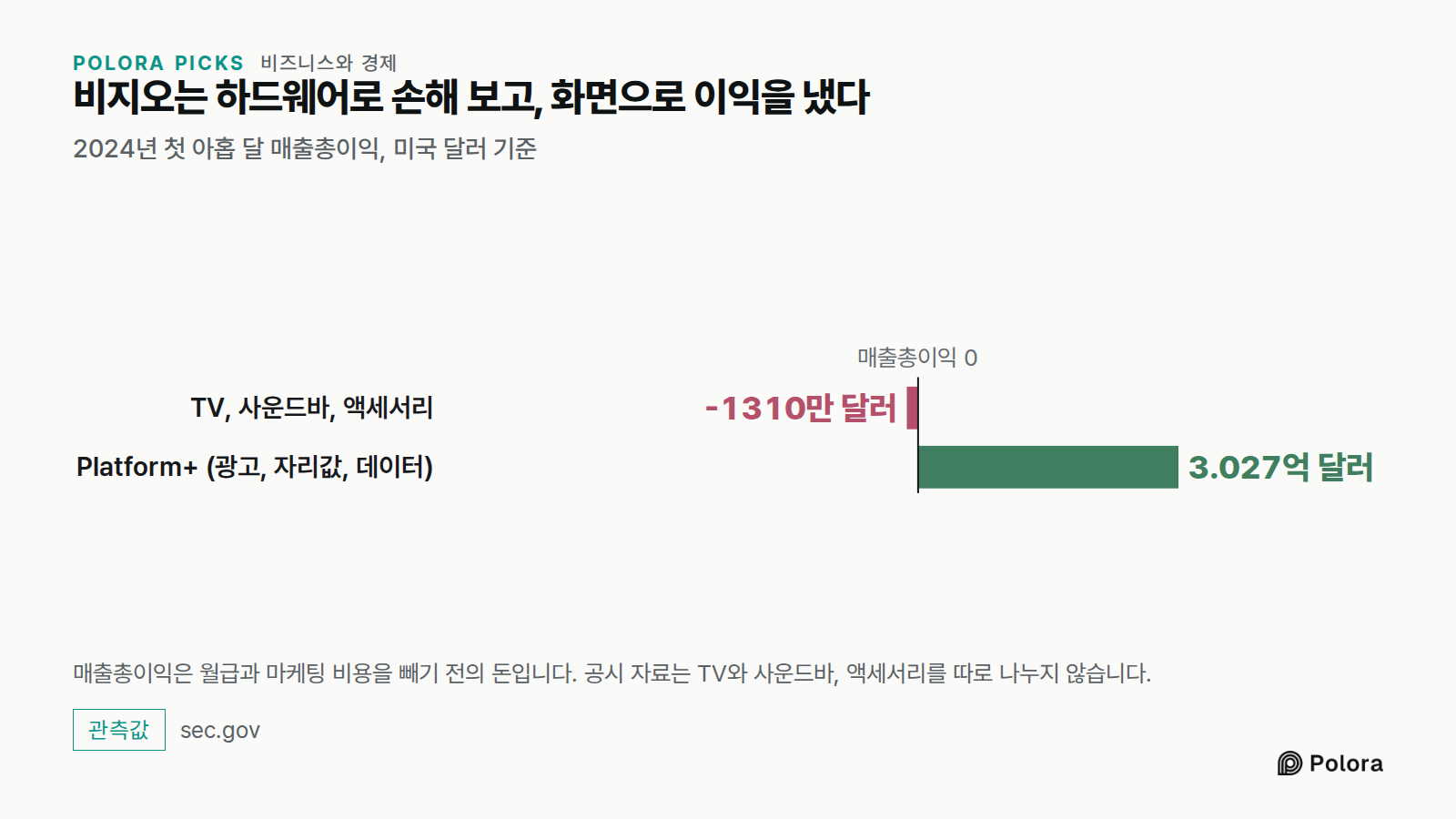
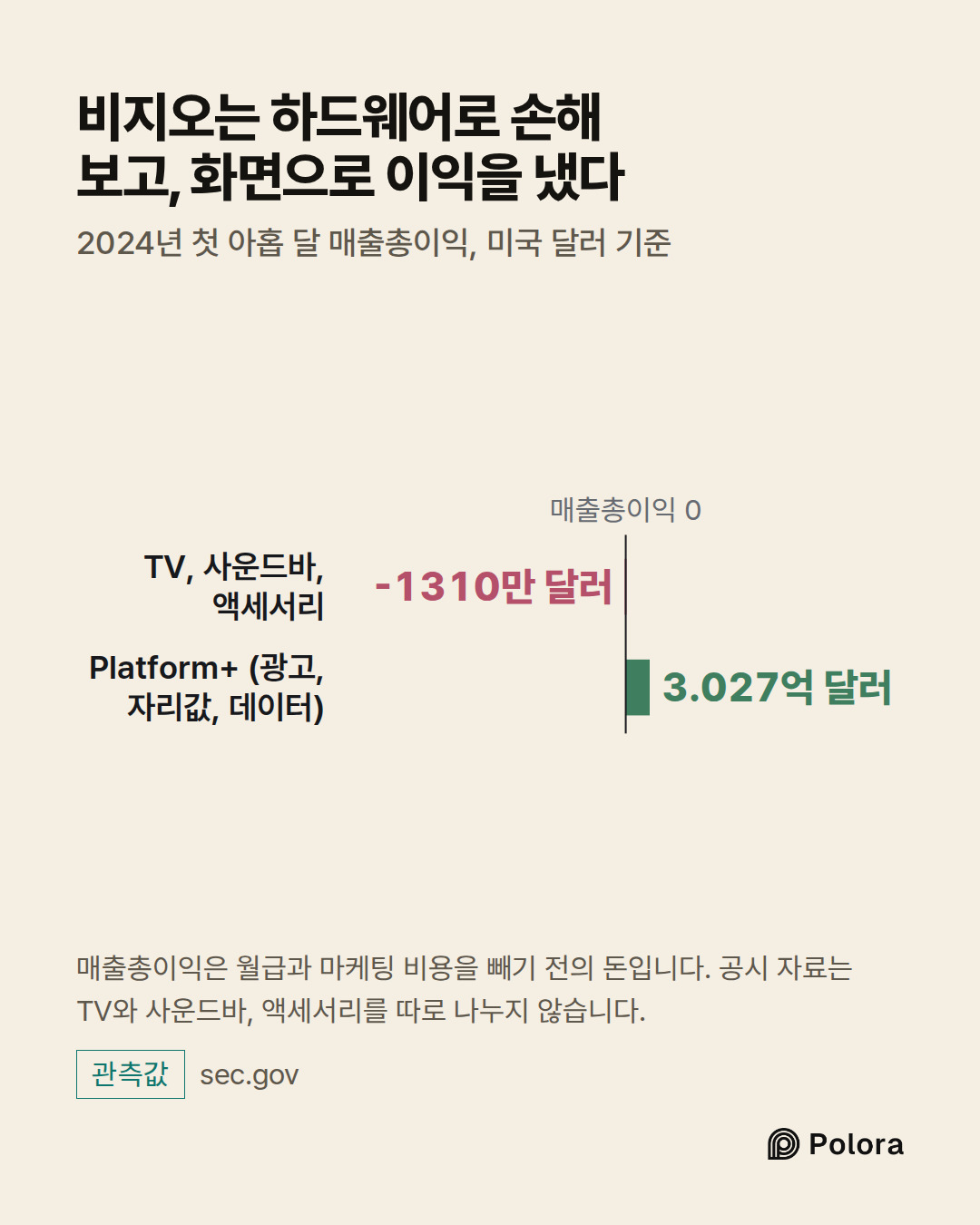
2024년 첫 아홉 달 동안 비지오의 기기 사업은 TV, 사운드바, 액세서리를 7.099억 달러어치 팔았고, 이것을 만들고 배송하는 데 7.23억 달러를 썼습니다. 1310만 달러의 매출총손실이 난 셈입니다. 매출총이익은 매출에서 제품 자체의 원가만 뺀 돈으로, 월급이나 마케팅 같은 다른 비용은 아직 빼기 전입니다. 같은 기간 비지오의 다른 사업인 Platform+는 5.26억 달러의 매출을 올렸고, 매출총이익 3.027억 달러를 남겼습니다.
Platform+는 TV에 들어간 소프트웨어, 그리고 그 소프트웨어로 파는 것들을 묶은 사업입니다. 홈 화면 광고, 비지오가 직접 운영하는 무료 채널의 광고, 스트리밍 서비스가 돈을 내고 사는 노출 자리, 제휴사가 돈을 내고 붙이는 리모컨 버튼, 그리고 TV 사용자가 무엇을 보는지에 관한 데이터 이용권입니다. 두 사업을 합쳐 보면 비지오의 하드웨어는 매출총이익에 아무것도 보태지 않았습니다. 매출총이익은 전부 TV가 팔린 뒤 그 화면에서 나왔습니다. 다만 공시 자료는 TV를 사운드바나 액세서리와 따로 나누어 보고하지 않습니다. 그래서 이 숫자가 보여 주는 것은 비지오 하드웨어 전체의 손실이지, TV 한 대 한 대의 손실이 아닙니다.
그렇다고 모든 TV가 광고 덕분에 싼 것은 아닙니다. 더 큰 이유는 패널, 곧 TV 앞면의 평평한 화면입니다. 디스플레이 산업을 추적하는 시장조사업체 트렌드포스(TrendForce)는 패널이 TV 한 대를 만드는 비용의 40~50퍼센트쯤을 차지한다고 봅니다.
지난 십 년 동안 중국의 패널 공장은 세계 LCD TV 화면의 대부분을 만들 만큼 커졌습니다. 트렌드포스는 2023년 LCD TV 패널 공급에서 중국 업체의 몫이 70.4퍼센트에 이를 것으로 내다봤고, 상위 세 곳은 차례로 BOE, CSOT, HKC였습니다. 생산 능력이 이렇게 넘치다 보니 공급 과잉이 길게 이어졌습니다. 2022년 말 트렌드포스는 65인치 TV 패널 가격이 부품 원가 가까이까지 떨어졌고, 공장 가동률이 십 년 만에 가장 낮은 60퍼센트에 그칠 수 있다고 전했습니다.
다만 이것은 긴 흐름의 이야기이고, 해마다 그렇다는 뜻은 아닙니다. 2026년 1월 트렌드포스는 패널 가격과 다른 부품 비용이 다시 오르고 있다고 전했습니다.
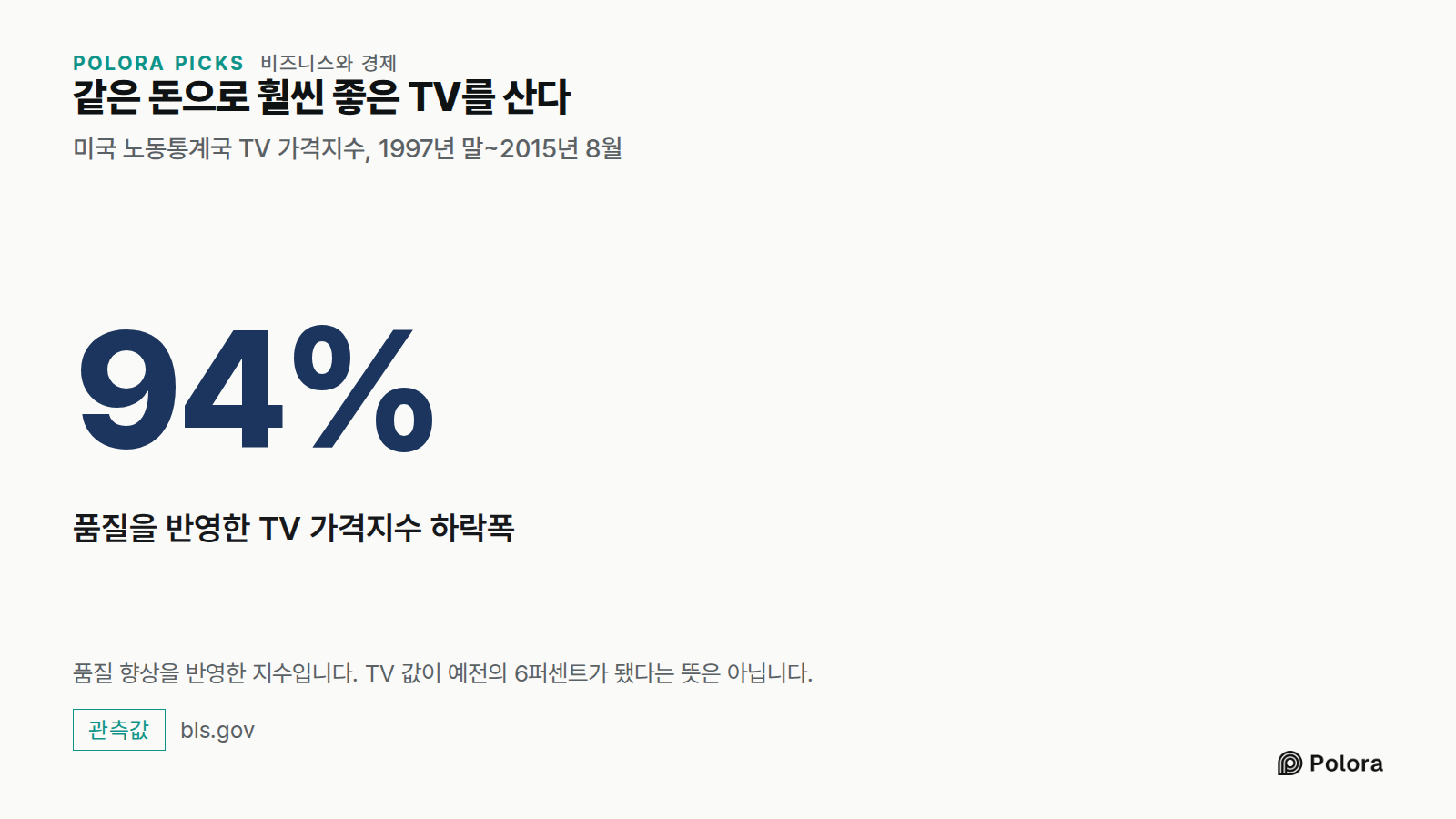
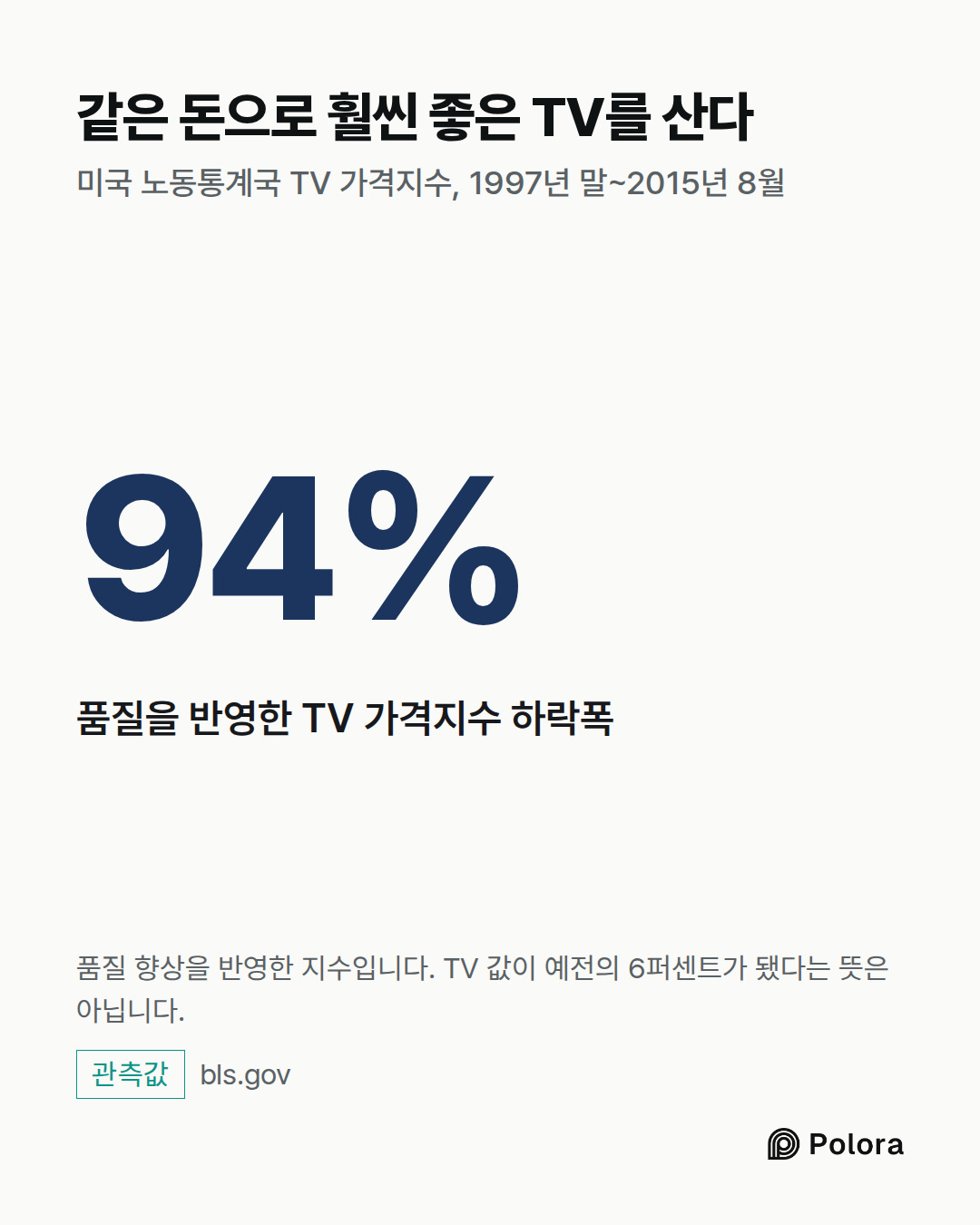
화면이 싸지면서 광고를 팔든 안 팔든 모든 브랜드의 TV 값이 내려갔습니다. 미국 노동통계국이 집계한 TV 가격지수는 1997년 말부터 2015년 8월까지 94퍼센트 떨어졌습니다. 이 지수는 품질 향상을 반영해 조정한 값입니다. 그러니 TV 값이 예전의 6퍼센트가 됐다는 뜻이 아니라, 같은 돈으로 예전보다 훨씬 좋은 TV를 살 수 있게 됐다는 뜻입니다. 광고 사업은 이 흐름 위에 얹혀 있습니다. 일부 브랜드에 TV 값을 낮게 매길 여유를 조금 더 줄 수는 있지만, 그것이 특정 TV의 가격을 얼마나 깎아 주는지 보여 주는 공개 수치는 없습니다.
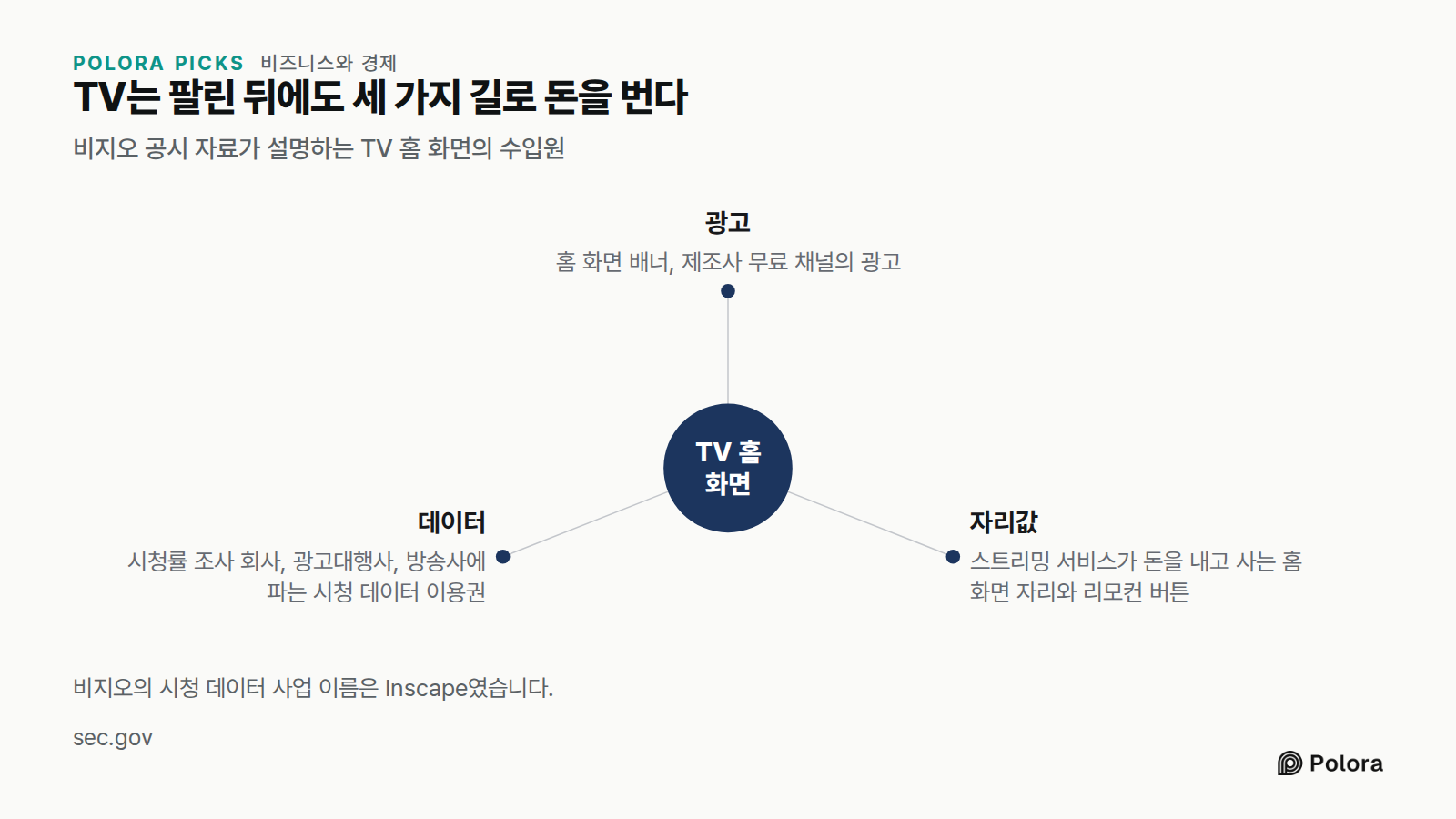
스마트 TV는 인터넷에 연결된 컴퓨터이고, 그 홈 화면은 제조사가 쥐고 있습니다. 비지오의 공시 자료는 이 화면이 돈을 버는 길을 세 가지로 설명합니다.
첫째는 광고입니다. 제조사는 홈 화면의 배너 자리를 스트리밍 서비스, 영화사, 그 밖의 브랜드에 팝니다. 제조사가 운영하는 무료 채널은 지상파 방송처럼 중간광고를 넣어 프로그램을 내보내는데, 이 광고도 제조사가 직접 팝니다. 둘째는 자리값입니다. 스트리밍 서비스는 돈을 내고 홈 화면에 자리를 잡거나 리모컨에 자기 버튼을 달 수 있습니다.
셋째는 데이터입니다. 많은 스마트 TV에는 자동 콘텐츠 인식(ACR)이라는 기능이 있습니다. 화면에 나오는 것이 앱에서 오든, 케이블 셋톱박스에서 오든, 게임기에서 오든 그것이 무엇인지 알아보는 기능입니다. 비지오의 이 기능은 Inscape라는 이름이었습니다. 비지오는 여기서 모은 데이터의 이용권을 시청률 조사 회사, 광고대행사, 방송사에 팔았고, 이들은 그것으로 누가 무엇을 보는지 추적했습니다.
2024년 9월 말 기준 비지오의 활성 계정, 곧 인터넷에 연결돼 실제로 쓰이는 TV는 1910만 개였습니다. 그 전 네 분기 동안 Platform+ 매출은 활성 계정 하나당 평균 37.17달러였습니다. 이것은 이익이 아니라 매출이고, 한 달이 아니라 한 해 기준입니다. 거의 남기지 않고 판 TV도 전원이 꽂혀 있는 한 계속 돈을 벌어다 줄 수 있다는 얘기입니다.
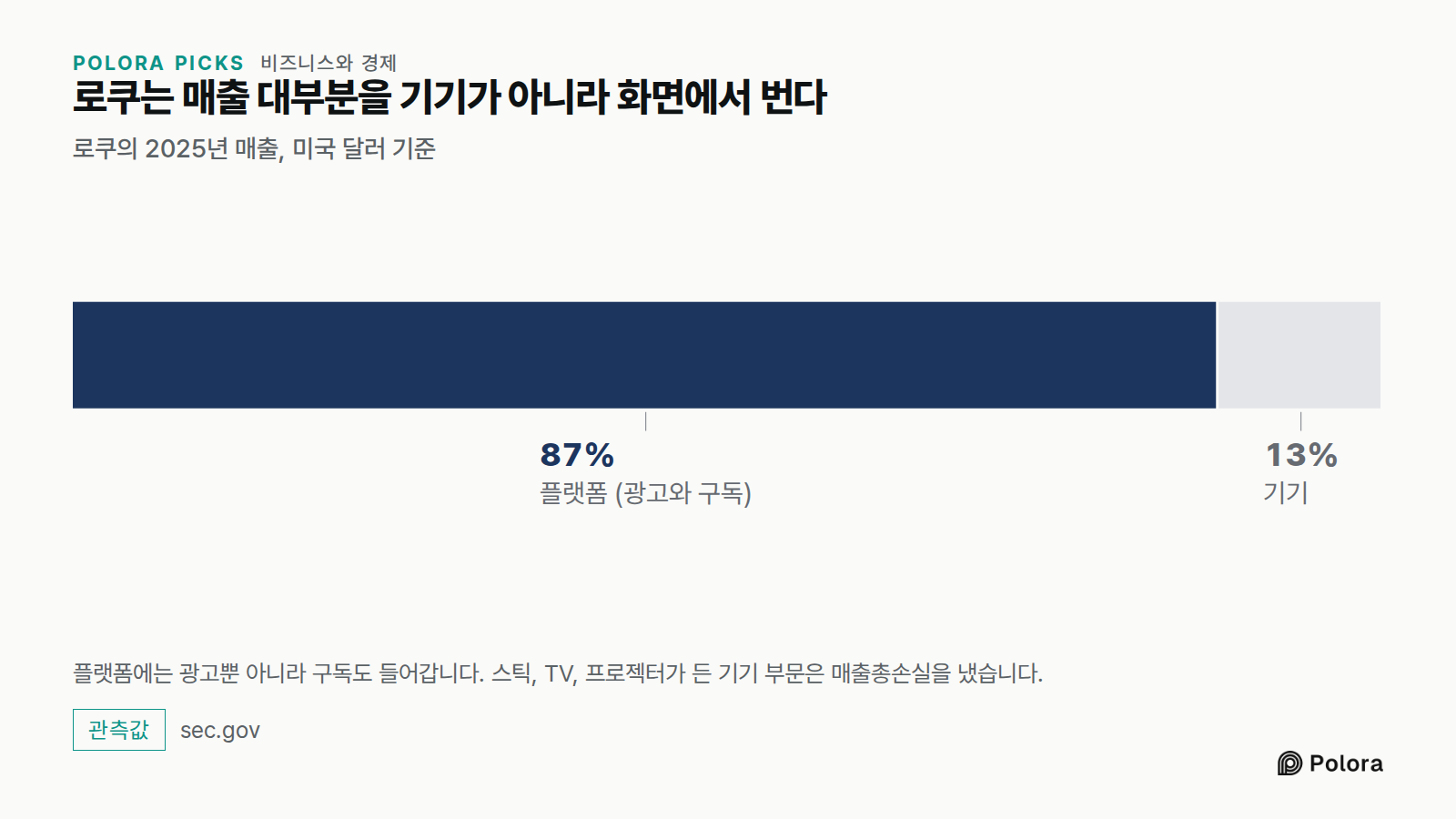
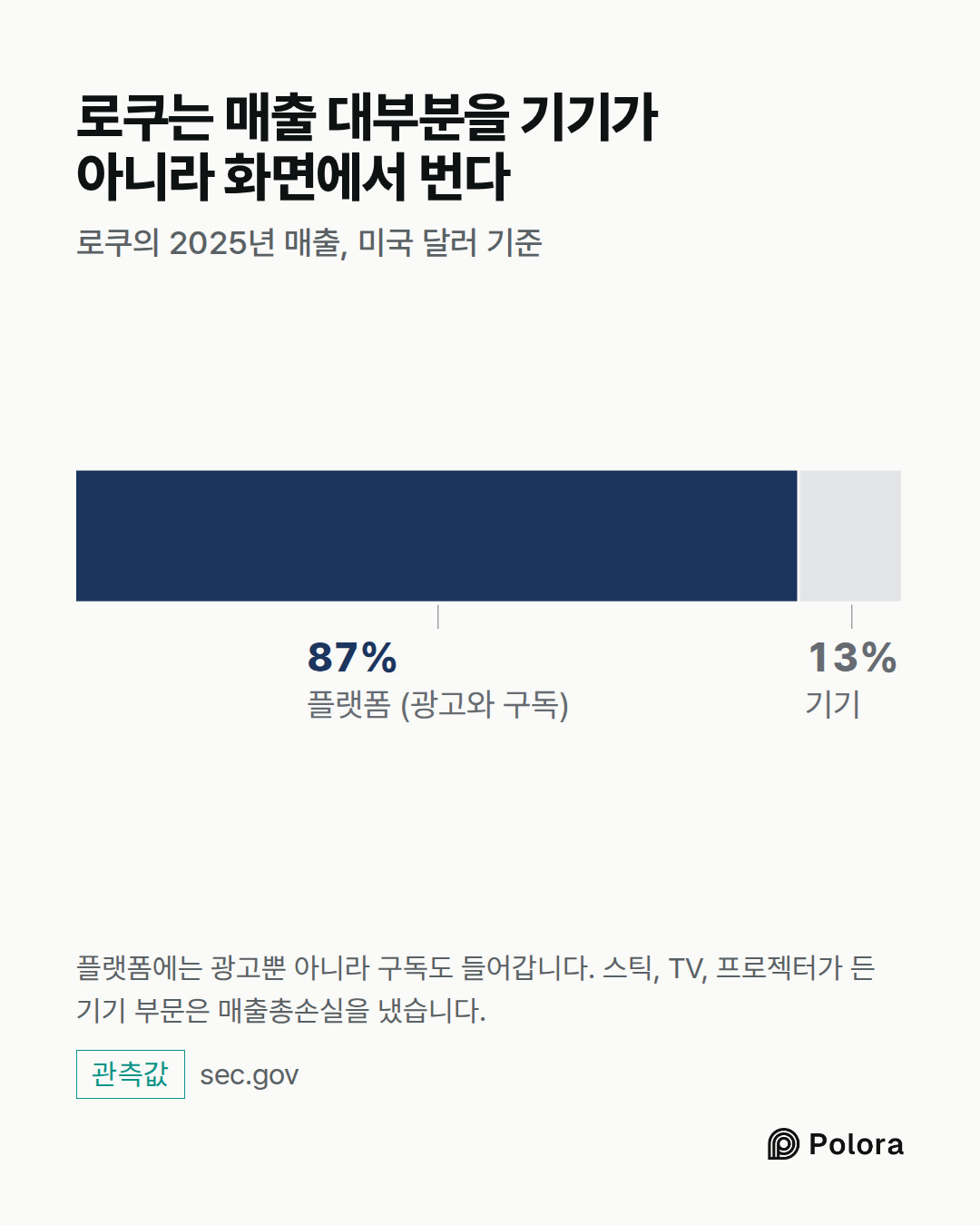
로쿠(Roku)는 스트리밍 기기와 TV를 만들고, 자사 TV 소프트웨어를 다른 브랜드에 라이선스로 내줍니다. 로쿠도 같은 두 부문을 따로 보고합니다. 2025년 로쿠의 기기 부문은 8200만 달러의 매출총손실을 냈는데, 기기를 1달러어치 팔 때마다 약 14센트를 잃은 셈입니다. 광고, 그리고 스트리밍 서비스 구독을 대신 팔아 주는 일로 이루어진 플랫폼 부문은 매출 41.45억 달러를 올렸습니다. 로쿠 전체 매출 47.4억 달러의 약 87퍼센트이고, 매출총이익은 약 21.6억 달러였습니다.
로쿠의 기기 부문에는 스트리밍 스틱, 로쿠가 직접 만든 TV, 스마트 프로젝터가 섞여 있어서 이 손실이 TV만의 것은 아닙니다. 다른 브랜드가 로쿠 소프트웨어를 넣어 만든 TV는 여기에 들어가지 않습니다. 플랫폼 수치에도 광고뿐 아니라 구독이 포함됩니다. 그래도 구조는 비지오와 같습니다. 하드웨어 전체로는 손해를 보고, 돈은 화면에서 나옵니다.
데이터 사업은 TV 사용자 대부분이 처음 설정할 때 한 번 하고 마는 선택에 기대고 있습니다. 2017년 비지오는 미국 연방거래위원회(FTC)와 뉴저지주가 제기한 혐의를 합의로 마무리하며 220만 달러를 냈습니다. 혐의는 비지오가 해당 기능을 기본으로 켜 둔 채 TV 1100만 대에서 사용자 모르게, 동의 없이 시청 데이터를 모았다는 것이었습니다. 비지오는 잘못을 인정하지 않았습니다. 합의 명령에 따라 비지오는 데이터 수집을 분명하게 설명하고 사용자에게서 명시적 동의를 먼저 받아야 했습니다.
2025년 말 텍사스주 법무장관은 삼성전자, LG전자, 소니, 하이센스, TCL을 상대로 소송을 냈습니다. 소장은 이 회사들이 사용자가 자동 콘텐츠 인식을 켜도록 유도하고, 그 의미를 빽빽한 법률 문구 속에 묻어 두었으며, 이 기능이 화면에 나오는 것을 반 초마다 잡아낼 수 있다고 주장합니다. 이것은 주 정부의 주장이지, 특정 TV에 대해 내려진 판단이 아닙니다. 삼성전자는 2026년 2월, LG전자는 2026년 5월에 합의했고, 두 회사 모두 텍사스의 TV 사용자에게 시청 데이터를 모으기 전에 충분한 설명을 거친 동의를 받기로 했습니다. 5월에 LG전자 합의가 발표됐을 때 소니, 하이센스, TCL에 대한 소송은 아직 진행 중이었습니다. 그 뒤 상황은 이 글에서 확인하지 못했습니다.
텍사스주 법무장관실은 이 기능을 끄는 방법을 안내하는 자료를 냈습니다. 기능은 설정 메뉴 안에 브랜드마다 다른 이름으로 들어 있습니다. 삼성전자에서는 Viewing Information Services, LG전자에서는 Live Plus 같은 이름이고, 처음 설정 화면에서 늘 이 이름이 나오는 것도 아닙니다.
이렇게 깔끔하게 나뉜 숫자는 비지오와 로쿠 두 곳에서만 나옵니다. 매출 기준 세계 최대 TV 판매사인 삼성전자는 광고로 얼마를 버는지 공개하지 않습니다. LG전자는 숫자 하나를 내놓았습니다. 자사 TV에 들어가는 소프트웨어인 webOS의 광고와 콘텐츠 사업 매출이 2024년 1조 원을 넘었다는 것입니다. 2025년 LG전자에서 TV와 그 밖의 디스플레이 제품을 맡은 사업본부는 7509억 원의 영업손실을 냈고, 회사는 webOS가 계속 성장했다고 밝혔습니다. LG전자는 webOS의 이익을 이 사업본부의 실적과 따로 나누지 않기 때문에, 비지오처럼 두 숫자를 나란히 놓고 볼 수는 없습니다.
비지오의 자체 구분도 2024년에서 끝납니다. 월마트가 그해 말 비지오를 인수했고, 지금은 비지오를 자사 글로벌 광고 사업 안에 넣어 집계합니다. 이 광고 사업의 2026 회계연도 매출은 64억 달러에 가까웠지만, 비지오를 따로 떼어 낸 항목은 없습니다.
그러니 근거를 갖고 말할 수 있는 것은 이렇습니다. 대형 TV가 싼 것은 무엇보다 긴 세월에 걸쳐 그 화면을 만드는 비용이 크게 내려갔기 때문입니다. 여기에 더해, 비지오와 로쿠에서는 하드웨어 전체가 매출총이익을 내지 못했고 돈은 화면 위의 광고와 데이터에서 나왔습니다. 그 수입이 특정 TV의 값을 얼마나 깎아 주는지는 공개된 숫자가 말해 주지 않습니다. 다른 브랜드에도 같은 구조가 있다는 것은 그 회사들이 밝힌 내용을 합리적으로 읽은 해석이지, 측정된 사실은 아닙니다.
Alpha here. I ran the two most load-bearing checks myself — Vizio's and Roku's own filings — since those numbers carry the whole piece.
Vizio's Q3 2024 figures check out almost exactly, with one correction. The manuscript's nine-month aggregate figures aren't the ones I pulled directly, but the underlying quarterly filing confirms the pattern precisely: Platform+ net revenue was $197.0 million with $115.8 million gross profit, while Device revenue was $247.7 million, and Device gross profit showed a loss of $6.7 million for the quarter (sec.gov exhibit 99.1, Q3 2024). SmartCast ARPU of $37.17 is confirmed, and Vizio's own definition states SmartCast ARPU as total Platform+ net revenue, less revenue attributable to legacy VIZIO V.I.A. Plus units, during the preceding four quarters — so the researcher's flagged uncertainty resolves cleanly: yes, it's a trailing-twelve-month figure, not a single-quarter number. The manuscript should say that explicitly. Account count of 19.1 million also checks out.
Roku's numbers are correct, but one sentence in the manuscript blends two different metrics in a way a careful reader will trip over. The 10-K confirms Platform gross profit…
Beta · gpt-6-sol
Beta: The manuscript has a sound explanation of *two forces*, but its last sentence claims more than its evidence can measure. Cheaper panels help explain the long-run fall in TV prices; advertising and other platform income give *some* companies another way to earn from a TV. The filings do not establish how much either force reduces the price of a big TV today.
- Vizio’s split is real, but it is not a TV-only loss. For the first nine months of 2024, its Device segment had $709.9 million in revenue, $723.0 million in costs and a $13.1 million gross loss. Platform+ had $526.0 million in revenue and $302.7 million in gross profit. Device includes sound bars and accessories, so “Vizio lost money on its TVs” is stronger than the filing permits. The manuscript’s “TVs added nothing to gross profit” needs the same qualification. Vizio defines the $37.17 SmartCast ARPU over the preceding four quarters, divided by an average active-account count—not as earnings from each of the 19.1 million accounts in September alone. (sec.gov)
Address: https://www.sec.gov/Archives/edgar/data/1…
Gamma · gemini-3.1-pro
Gamma: I can close the loop on the legal and privacy claims Beta rightly flagged as unverified. I ran searches to check the Texas Attorney General’s actions and the technical claims about disabling ACR, and the manuscript’s account is highly accurate, with sources confirming the specifics.
Here is what the record shows on the remaining checks:
* The Texas lawsuits and 500-millisecond claim: In December 2025, Texas Attorney General Ken Paxton did indeed sue Samsung, LG, Sony, Hisense, and TCL. The state's December 15, 2025 press release explicitly alleges that ACR "can capture screenshots of a user’s television display every 500 milliseconds." (texasattorneygeneral.gov)
* The settlements and informed consent: Samsung settled earlier in 2026, and LG settled on May 11, 2026. According to the state's announcements and subsequent reporting, both agreements require the companies to stop collecting viewing data without informed consent and mandate clear pop-up disclosures and opt-out mechanisms. ([texasattorneygeneral.gov](https://www.texasatto…
Researcher · gemini-3-7-flash
Claim-by-Claim Verification & Fact-Check
1. Vizio’s U.S. Market Position & ARPU Definition
* Claim: Vizio is one of the best-selling TV brands in the United States. SmartCast ARPU was $37.17 for 19.1 million active accounts in September 2024.
* Finding: Supported with nuance. Market research data ranks Vizio consistently among the top 3–4 TV brands in U.S. household penetration alongside Samsung, LG, and TCL.
* ARPU Clarification: Per Vizio’s Q3 2024 Form 10-Q and Exhibit 99.1, SmartCast ARPU ($37.17) is defined as trailing-twelve-month (TTM) Platform+ net revenue (excluding legacy VIA Plus) divided by the average number of active accounts over that four-quarter period—it is not earnings generated solely within a single quarter or month.
* Hardware vs. TVs: Vizio’s "Device" segment reported a gross loss of $13.1 million on $709.9 million net revenue for the first 9 months of 2024. However, "Device" includes soundbars and accessories alongside televisions, so stating "Vizio lost money on its TVs" represents a segment-level aggregation rather than an isolated television unit margin.
* Source: [U.S. SEC EDGAR – Vizio Q3 2024 10-Q](https://www.sec.…
The Arbiter · gpt-6-sol
Round record
Alpha and Beta agree on the financial pattern, but corrected its wording. Vizio reported a $13.1 million gross loss in its Device segment and $302.7 million gross profit in Platform+ for the first nine months of 2024. “Vizio lost money on its TVs” is not established: Device also includes sound bars and accessories. Its $37.17 SmartCast ARPU measures revenue over the preceding four quarters, divided by an average account count; it is not profit from each of the 19.1 million accounts active in September. (sec.gov)
Address: https://www.sec.gov/Archives/edgar/data/1835591/000183559124000089/vzio-20240930.htm
Alpha and Beta likewise agree on Roku’s figures and their limit. In 2025, Roku reported $2.156 billion Platform gross profit and an $82.0 million Devices gross loss. The manuscript’s 87% is Platform’s share of *revenue*, not a gross-profit margin. Devices combines types of hardware, so its loss does not establish that Roku-made TVs individually sold at a loss. ([sec.gov](https://www.sec.gov/Archives/edgar/data/1428439/000162828026008114/roku-20251…
The Arbiter's Final Verdict · gpt-6-sol
A big smart TV is cheap mainly because large LCD screens became much cheaper to produce over the long run. Manufacturing scale and periods of excess panel supply reduced a major part of the cost of making a set. That is the broad explanation; it does not mean panel costs fall every year. TrendForce reported rising panel and other component costs in early 2026. TrendForce on panel supply · TrendForce on 2026 costs
Some smart-TV businesses also make money after the purchase. They can sell home-screen and free-channel ads, paid placement, subscriptions, and—in some cases—licences for viewing data. That income may give a company more room to compete on the set’s price, but the accounts examined do not measure how many dollars it takes off a particular TV.
Vizio is the clearest example, with an important correction to the manuscript: in the first nine months of 2024, its Device segment had a $13.1 million gross loss while Platform+ had $302.7 million gross profit. Device includes sound bars and accessories, so this does not prove that Vi…