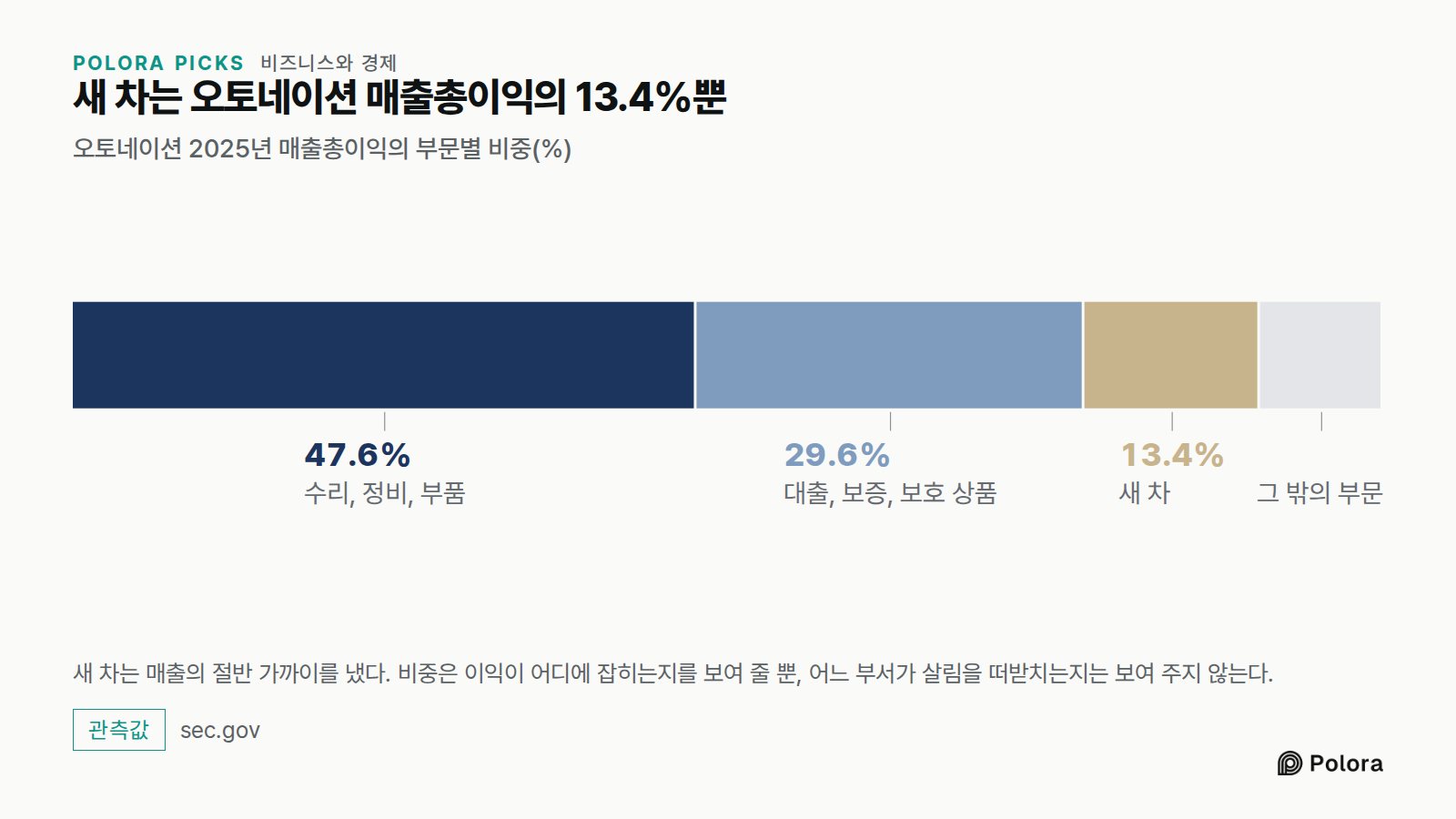
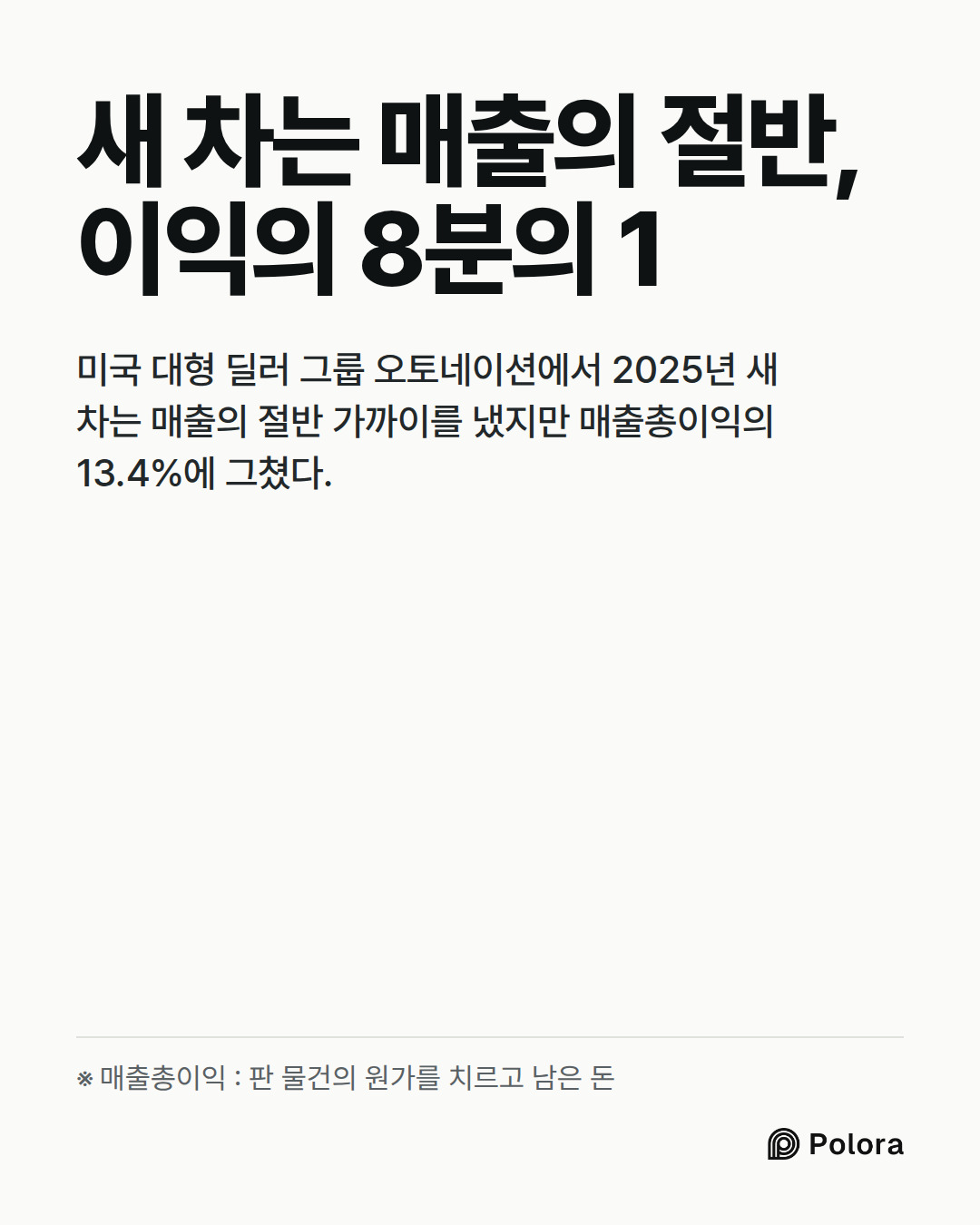
벌기는 하지만 이익에서 차지하는 몫은 작다. 미국 대형 딜러 그룹 오토네이션에서 2025년 새 차는 매출의 절반 가까이를 냈지만 매출총이익의 13.4%에 그쳤다. 수리와 정비가 47.6%, 차와 함께 파는 대출과 보증 상품이 나머지 대부분을 벌었다.
비즈니스와 경제 · 2026-10-04
새 차는 매출의 절반, 이익의 8분의 1
자동차 딜러가 어디서 돈을 버느냐고 물으면 대부분은 전시장을 가리킨다. 차 유리에 붙은 가격표가 곧 사업처럼 보이기 때문이다. 그런데 미국에서 손꼽히는 대형 딜러 그룹 한 곳은 자사 공시 서류에서 다른 이야기를 한다.
오토네이션은 미국 전역에서 약 245곳의 대리점을 운영한다. 2025년 이 회사가 판 새 차는 135억 달러어치로, 전체 매출 276억 달러의 절반 가까이였다. 하지만 새 차가 낸 매출총이익, 즉 판 물건의 원가를 치르고 남은 돈은 전체의 13.4%에 불과했다. 수리, 정비, 부품이 47.6%를 냈다. 차와 함께 파는 대출, 연장 보증, 각종 보호 상품이 29.6%를 냈다.
평균 52,075달러에 팔린 새 차 한 대에서 회사가 차 원가를 빼고 남긴 돈은 2,564달러, 마진율로 치면 4.9%였다. 새 차로 돈을 벌긴 벌지만 많지는 않다는 얘기다. 게다가 이것은 급여, 임대료, 광고비를 내기 전의 금액인데, 그해 이런 비용이 전체 매출총이익의 3분의 2 정도를 가져갔다. 2025년에는 새 차의 매출총이익이 14% 줄어든 반면, 정비와 금융 쪽은 모두 늘었다.
이 숫자들은 어느 부서의 장부에 이익이 잡히는지를 보여 준다. 어느 부서가 대리점의 살림을 떠받치는지까지 보여 주지는 않는다. 부서들은 직원과 건물을 함께 쓴다. 대출과 타던 차의 보상 판매, 이후의 정비 일감을 끌고 오는 것도 흔히 새 차 판매다. 숫자가 말해 주는 것은 이익이 어디에 찍히느냐이지, 딜러가 새 차 판매를 그만두면 얼마를 벌지가 아니다.
구매자가 가격에 합의하면 서류 작업은 보통 별도의 창구에서 이뤄진다. 업계에서는 이곳을 금융·보험 창구라고 부른다. 여기서 딜러는 은행이나 자동차 회사 계열 금융사의 대출이나 리스를 연결해 주고, 흔히 연장 보증이라고 부르는 서비스 계약과 그 밖의 보호 상품을 권한다.
이 창구에서 딜러는 대개 직접 돈을 빌려주거나 보험을 책임지는 당사자가 아니다. 오토네이션은 오토네이션 파이낸스라는 자체 대출 사업도 운영하지만, 이 창구의 수입은 대부분 수수료라고 설명한다. 은행은 대출을 연결해 준 대가로, 외부 회사는 자기네 서비스 계약과 보호 상품을 팔아 준 대가로 딜러에게 돈을 낸다. 일부 상품에서는 나중에 청구가 적게 들어오면 상품을 만든 회사가 남긴 이익을 나눠 받기도 한다.
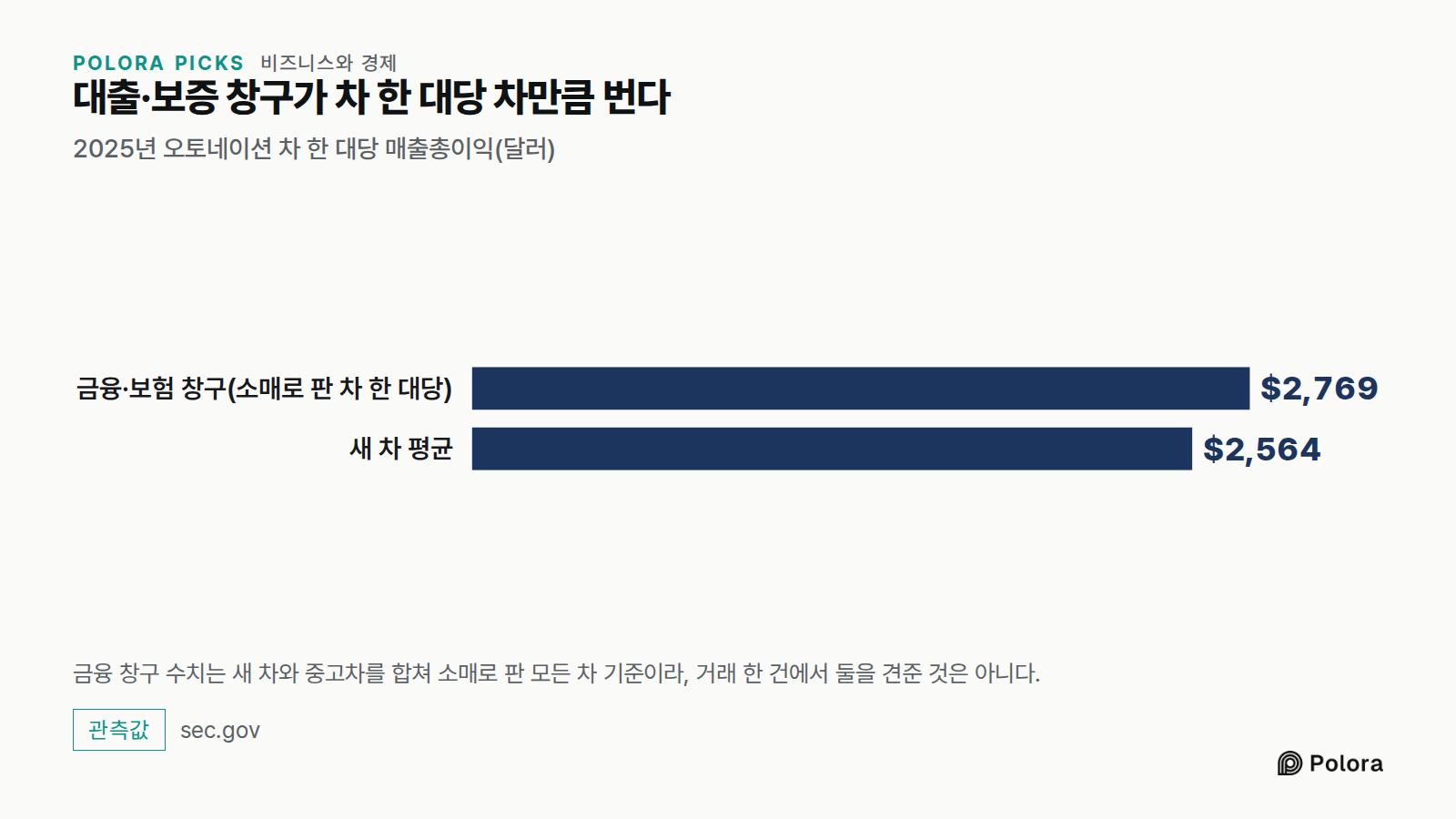
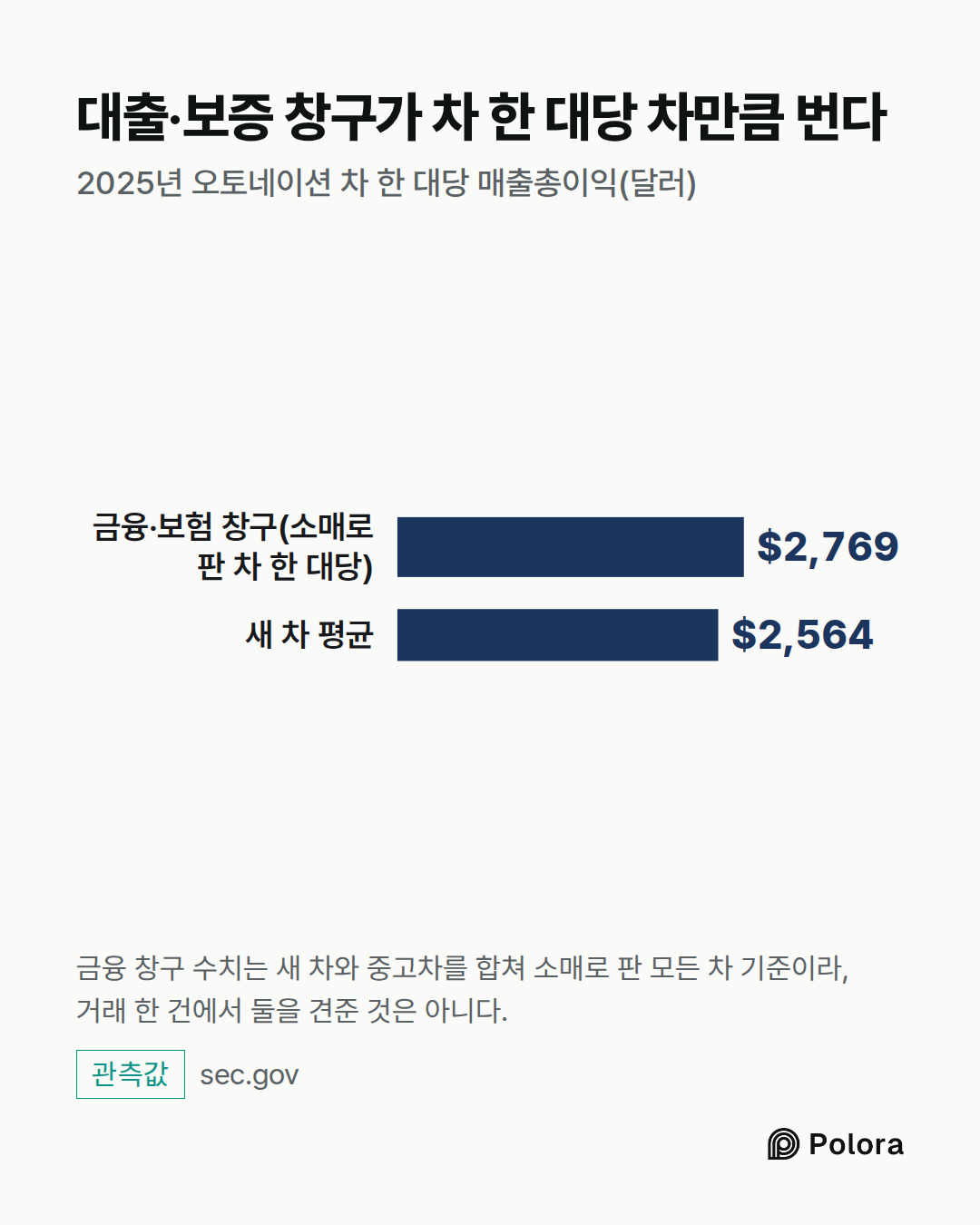
2025년 이 창구는 오토네이션에 1,464.4백만 달러를 벌어 주었다. 새 차와 중고차를 합쳐 소매로 판 차 한 대당 2,769달러다. 새 차 한 대의 평균 이익은 2,564달러였다. 두 숫자는 세는 차의 범위가 달라서, 어느 한 건의 거래에서 창구가 차보다 더 벌었다는 뜻은 아니다. 다만 서류 작업이 차 자체와 맞먹는 규모의 사업이라는 것은 보여 준다. 회사는 그해 이 수입이 늘어난 주된 이유로 서비스 계약의 마진이 높아진 것을 꼽았다.
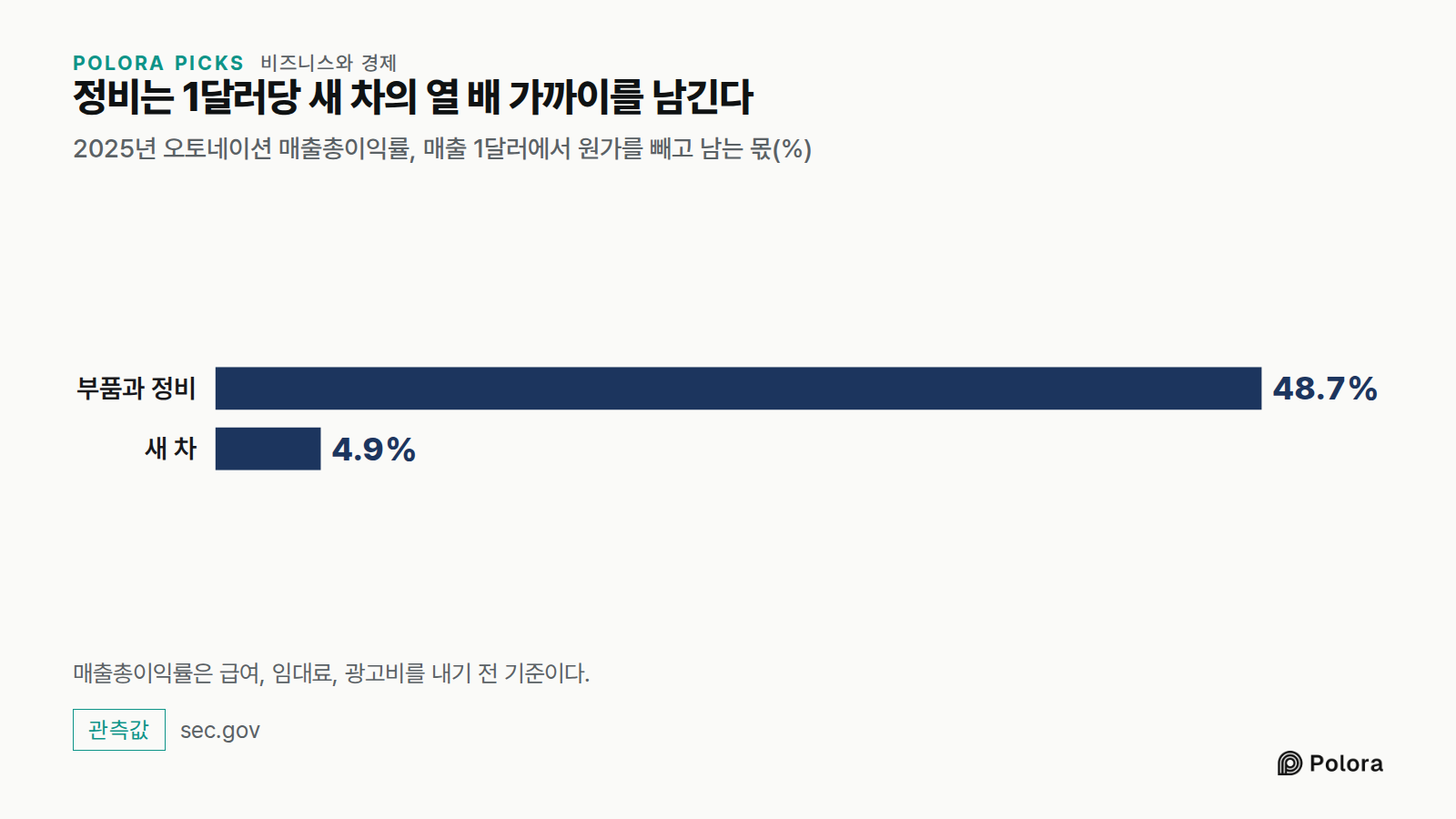
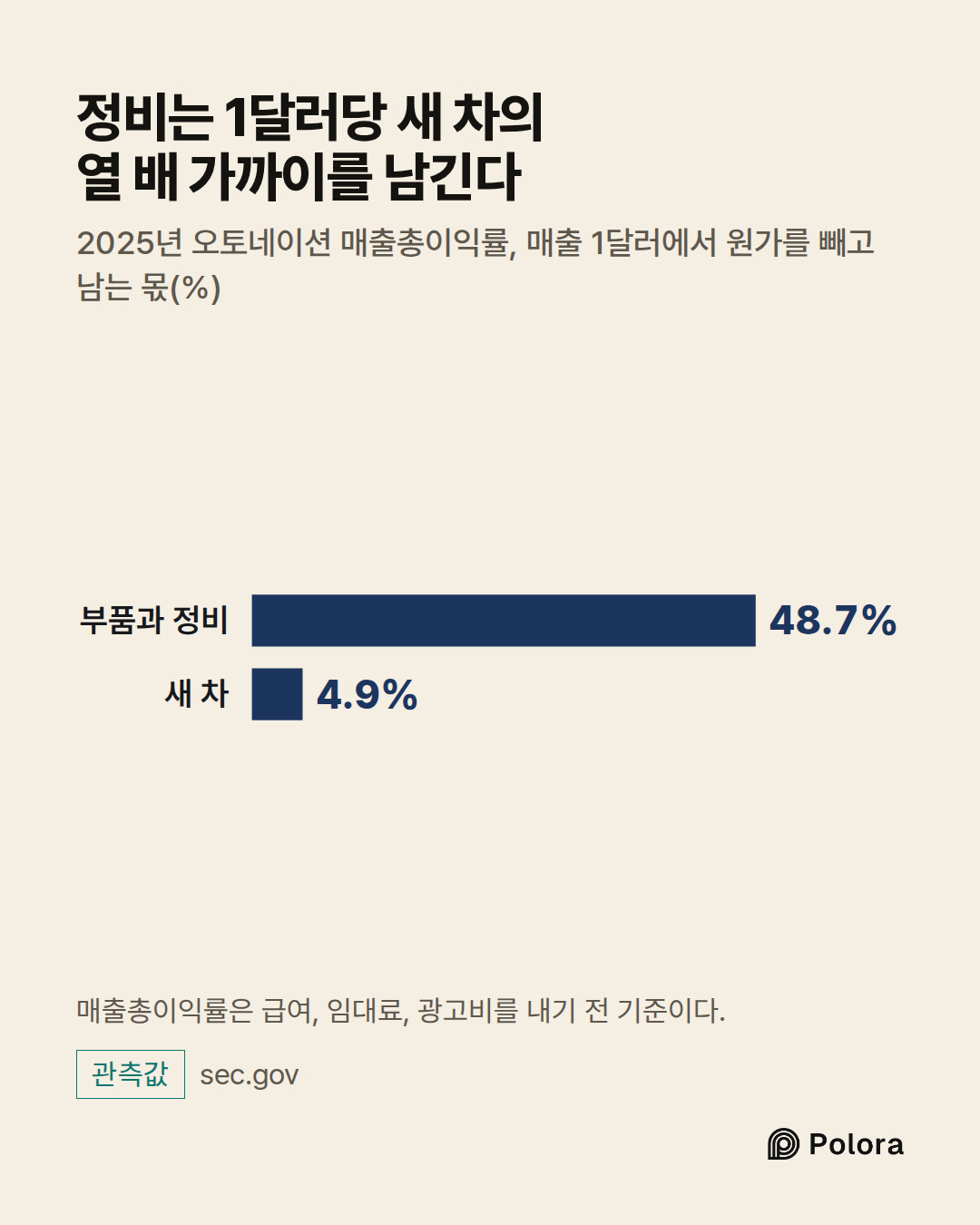
수리와 부품은 매출로 보면 작은 사업이고 이익으로 보면 큰 사업이다. 오토네이션에서 부품과 정비는 매출의 5분의 1이 채 안 됐지만, 1달러를 팔면 그중 48.7%가 매출총이익으로 남았다. 새 차는 4.9%였다.
엔진오일 교환, 브레이크 정비, 수리 같은 일감은 고객이 값을 치른다. 자동차 회사가 값을 치르는 일감도 있다. 제조사 보증 기간이 남은 차를 고쳐야 하면 딜러가 수리하고 비용을 제조사에 청구한다. 오토네이션은 2025년에 두 가지가 모두 늘었다고 밝히면서, 이 사업은 예로부터 차 판매보다 경기를 덜 탔다고 설명한다.
미국 딜러들의 업계 단체인 미국자동차딜러협회(NADA)에 따르면, 미국의 새 차 공식 딜러 16,990곳 전체에서 2025년 수리 접수는 276백만 건이 넘었고 정비와 부품 매출은 1,646억 달러였다. 기계 정비 공임은 시간당 평균 186달러였다. 오늘 팔린 차 한 대는 몇 년 동안 주인을 이런 정비소로 다시 불러들일 수 있다. 다만 이 합계만으로는 그중 얼마나 많은 사람이 차를 산 바로 그 딜러에게 돌아오는지 알 수 없다.
새 차에서 남는 작은 이익이 전부 구매자에게서 나오는 것은 아니다. 자동차 회사는 여러 방식으로 딜러에게 돈을 준다. 판매 뒤에 차 가격의 일정 비율을 딜러에게 되돌려 주는 홀드백, 현금 인센티브, 딜러가 매장에 차를 채워 두려고 빌리는 대출의 이자 지원, 판매 목표를 달성하면 주는 보너스가 있다. 오토네이션은 이 돈을 새 차 원가에서 빼는 식으로 처리하므로, 앞에서 본 얇은 마진에는 이 돈이 이미 들어 있다.
딜러에게는 이런 목표가 차 한 대 가격보다 더 중요할 수 있다. 업계 언론이 보도한 NADA의 수치에 따르면, 2018년 미국 대리점은 평균적으로 영업에서 13,338달러 손실을 냈지만 세전 이익은 약 136만 달러였다. NADA의 이코노미스트 패트릭 만지는 업계지 오토모티브 뉴스에, 딜러들이 인센티브 목표를 채우려고 손실을 감수하며 영업한다고 말했다. 영업에서 손실이 났다는 것은 이익의 거의 전부가 자동차 회사에서 나왔다는 뜻이라고 했다. 다만 매장 영업에서 손실이 났다고 차를 한 대 팔 때마다 손해를 봤다는 뜻은 아니다. 또 이 수치는 NADA가 직접 낸 보고서가 아니라 NADA를 인용한 보도에서 나왔다.
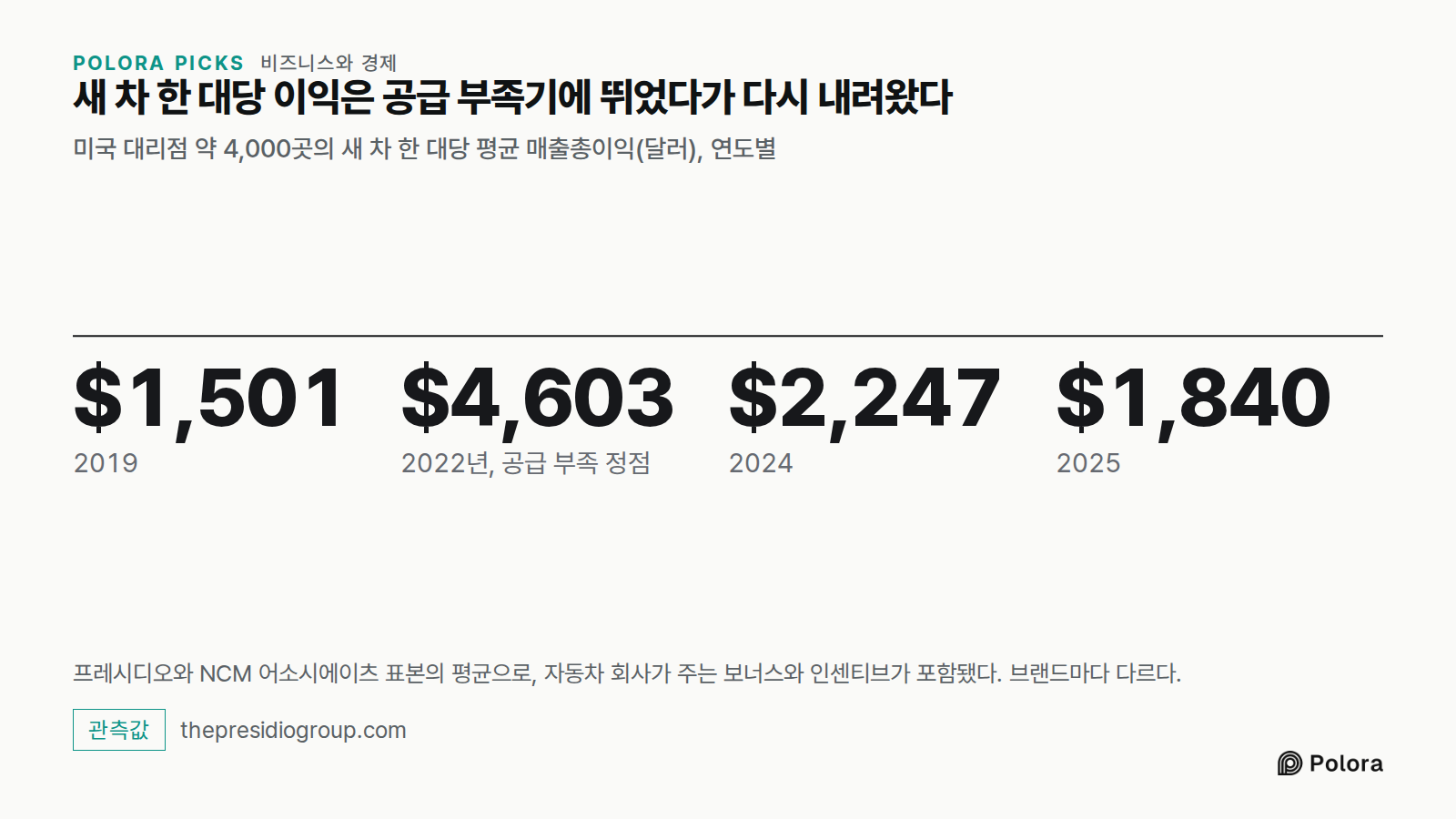
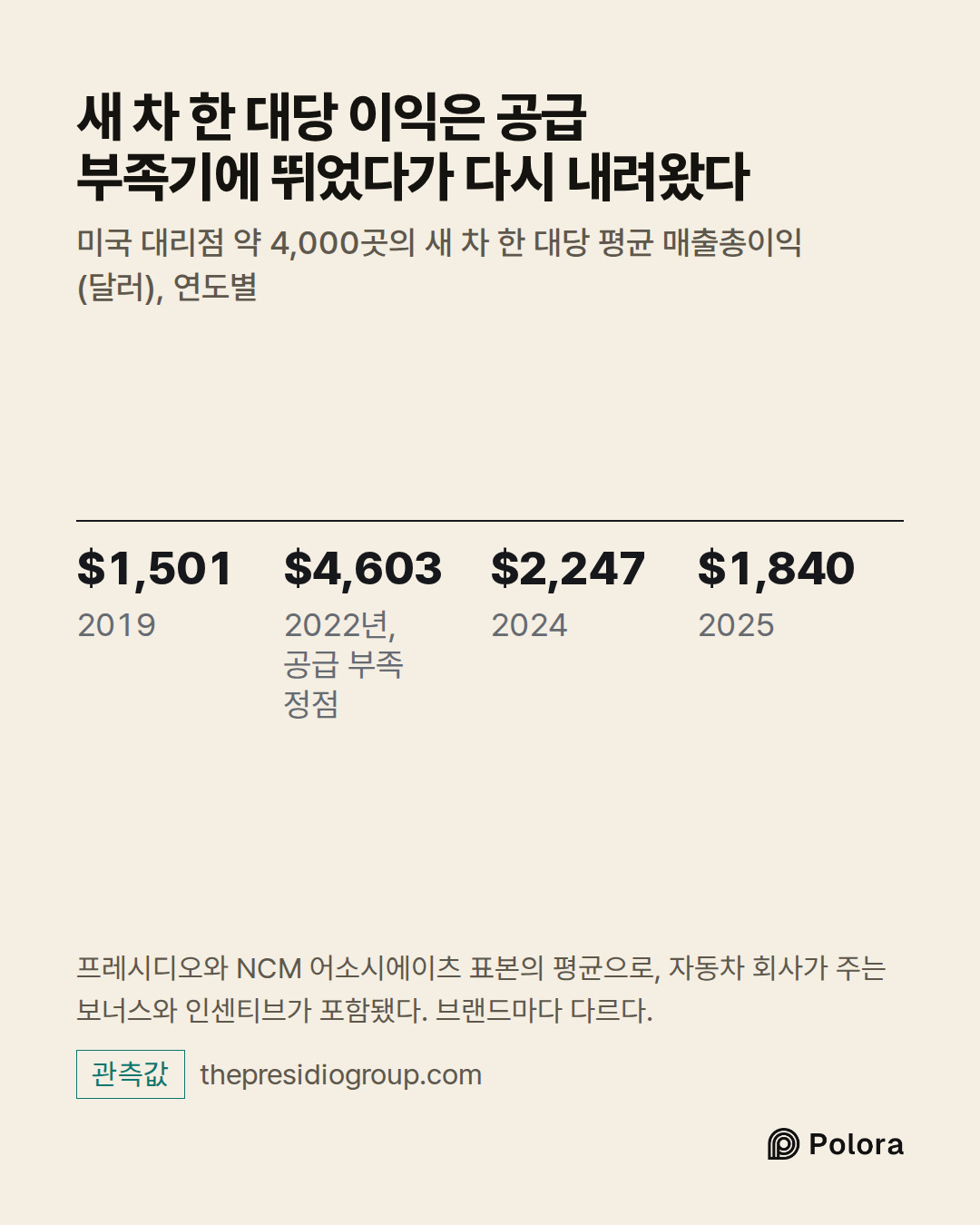
몇 년 동안은 새 차가 정말로 돈이 됐다. 반도체 부족으로 대리점 매장이 텅 비자 새 차 한 대당 이익이 크게 뛰었다. 프레시디오와 NCM 어소시에이츠는 미국 대리점 약 4,000곳의 실적을 추적하는 업계 회사다. 이들이 집계한 새 차 한 대당 평균 매출총이익은 2019년 1,501달러에서 2022년 4,603달러로 뛰었다.
그 뒤 이익은 다시 내려왔다. 2024년 2,247달러, 2025년에 이어 2026년 2분기에도 1,840달러였다. 해마다 줄어든 것이 아니라 공급 부족기의 정점에서 제자리로 돌아온 것이다. 이들이 추적하는 평균적인 매장에서 지금 금융·보험 창구가 차 한 대당 버는 돈은 1,769달러로 새 차와 거의 같고, 수리와 부품은 전체 매출총이익의 52.8%를 낸다. 이 수치에서 자동차 회사가 주는 보너스와 인센티브는 각 부서의 이익에 포함돼 있다.
물론 이것은 표본에 든 매장의 평균이고, 브랜드마다 사정이 다르다. 어떤 새 차는 여전히 넉넉한 마진에 팔리고 어떤 차는 손해를 보고 팔리며, 가족이 꾸리는 작은 대리점은 오토네이션과 같지 않다. 그래도 오토네이션의 공시와 이 표본의 평균 매장은 같은 방향을 가리킨다.
전시장에서 버는 돈이 이렇게 적다면 왜 굳이 딜러를 둘까? 미국에서는 법이 답의 일부다. 많은 주가 자동차 회사가 구매자에게 직접 차를 파는 것을 제한하거나 금지하는 법을 두고 있다. 차를 대 주는 제조사로부터 독립 딜러를 보호하려고 만든 법이다.
이런 법은 자동차 회사가 정당한 이유 없이 딜러와의 계약을 끊거나, 가까운 곳에 같은 브랜드의 경쟁 매장을 내는 것도 어렵게 만든다. 오토네이션은 파산이 아니고서는 딜러의 뜻에 반해 가맹 계약이 끝나는 일은 드물다고 적고 있다.
눈에 띄는 예외는 테슬라다. 테슬라는 처음부터 가맹 딜러를 두지 않고 웹사이트와 직영 매장으로 차를 팔며, 딜러와의 관계를 전제로 만든 법은 자사에 해당하지 않는다며 주마다 다퉈 왔다. 규칙은 주마다 다르다. 어떤 주는 테슬라의 주장을 받아들였고, 어떤 주는 좁은 예외를 두었으며, 어떤 주는 지금도 직접 판매를 아예 금지한다. 델라웨어주 대법원은 2023년 이 주의 딜러법이 테슬라에 어떻게 적용되는지 판결했다.
그렇게 딜러는 남았고, 차는 입장권이 됐다. 차 자체로도 얼마간은 번다. 하지만 사업을 굴러가게 하는 돈은 상당 부분 차와 함께, 그리고 차를 판 뒤에 들어온다. 대출과 보증, 그리고 몇 년씩 이어지는 정비소 방문에서다.
Do car dealerships actually make money selling new cars?
Alpha · claude-sonnet-5
Opening assessment: the manuscript's core numbers check out, with small rounding quirks worth flagging.
I verified the central AutoNation claim directly against the 10-K text. The filing states plainly: "For the year ended December 31, 2025, new vehicle sales accounted for 49% of our total revenue and 13% of our total gross profit. Used vehicle sales accounted for 28% of our total revenue and 9% of our total gross profit. Our parts and service operations, while comprising 17% of our total revenue, contributed 48% of our total gross profit. Our finance and insurance sales, while comprising 5% of our total revenue, contributed 30% of our total gross profit." That matches the manuscript's 13.4%/47.6%/29.6% breakdown almost exactly (the 10-K's rounded headline percentages are 13/48/30, the annual report table gives the more precise 13.4/47.6/29.5–29.6 depending on which year-over-year table you read). So the "almost half the revenue, an eighth of the profit" framing is sound and traceable to https://www.sec.gov/Archives/edgar/data/350698/000162828026007800/an-20251231.htm.
I also confirmed the 2025 gross-profit decline direction: "Our total gross profit increased 3% during 2025,…
Beta · gpt-6-sol
Yes. Dealers generally make gross profit selling new cars; the mistake is to confuse a small share of the dealership’s *total* profit with a loss on each sale. AutoNation reported $2,564 in new-vehicle gross profit per vehicle in 2025, before dealership-wide expenses. New vehicles supplied 13.4% of its gross profit, compared with 9.3% from used vehicles, 29.6% from finance and insurance (F&I), and 47.6% from parts and service. Its 245 *stores* held 323 new-vehicle franchises, so “about 245 dealerships” is a reasonable shorthand if “stores” is meant. (sec.gov)
Address: https://www.sec.gov/Archives/edgar/data/350698/000162828026007800/an-20251231.htm
I would make three corrections to the manuscript’s interpretation:
- “A little, and less each year” overstates the trend. AutoNation’s new-vehicle gross profit fell in 2025, but “less each year” is not established. Presidio–NCM’s chart shows $1,501 per new vehicle in 2019, $4,603 in 2022, $2,247 in 2024 and $1,840 for the second quarter of 2026. It also shows $1,840 for *full-year 2025*: those identical figures refer to different periods.…
Gamma · gemini-3.1-pro
Both Alpha and Beta have thoroughly dismantled the manuscript's overreliance on AutoNation's specific numbers to represent the entire industry, and Beta correctly caught the denominator mismatch in the F&I comparison. I will focus on the remaining unverified claims and the broader economic reality of the dealership model.
The Shortage Years and Sticker Price Claim
The manuscript claims that during the chip shortage, "buyers paid close to sticker or above it." This is accurate and widely documented by automotive analysts. In 2022, Kelley Blue Book and Edmunds consistently reported that the Average Transaction Price (ATP) for new vehicles was frequently hundreds or even thousands of dollars above the Manufacturer's Suggested Retail Price (MSRP). This was a historical anomaly driven by supply chain constraints, supporting the manuscript's assertion that the 2021-2023 margins were the exception, not the rule.
Franchise Laws and Direct Sales
The manuscript's summary of franchise laws ("Every state has laws limiting or banning carmakers from selling directly to buyers") is functionally correct but lacks nuance. While the foundation of these laws dates back to the 1930s to prot…
Researcher · gemini-3-7-flash
Verification of Manuscript Claims Against Current Sources
1. AutoNation Financial Breakdown (2025)
* Claims: $13.5B new-car revenue out of $27.6B total; gross profit shares: new 13.4%, used 9.3%, F&I 29.6%, parts & service 47.6%; new GP per vehicle $2,564 on $52,075 ASP (4.9% margin); F&I total $1,464.4M ($2,769/retail vehicle); parts/service margin 48.7%; new-car gross profit fell 14% while service and F&I grew; store count ~245 (with 323 franchises).
* Status: Verified.
* Source: AutoNation Form 10-K (FY 2025).
* Nuance/Correction:
* As Beta pointed out, the denominator for the F&I comparison is per retail vehicle (new and used combined) ($2,769), whereas $2,564 is per new vehicle. Comparing them side-by-side to show that the F&I desk makes more per sale requires explicitly noting this blended base.
* In the broader public peer group (e.g., Lithia Motors and Penske Automotive Group), new and used vehicle sales similarly generate ~80–85% of total retail revenue but only ~30–35% of total gross profit, while service/parts and F&I produce ~65–70%.
---
####…
The Arbiter · gpt-6-sol
The round has converged on the central distinction: a dealership can make money on a new car without the new-car department being its largest source of gross profit. The remaining work is to keep that distinction intact in the manuscript, rather than turn it into a claim that new cars are generally sold at a loss.
- AutoNation: Alpha verified the filing’s broad revenue and profit mix; Beta and the Researcher confirmed the detailed figures. The 2025 filing reports $13.5 billion in new-vehicle revenue—48.9% of total revenue—but 13.4% of gross profit. Used vehicles supplied 9.3% of gross profit, parts and service 47.6%, and F&I 29.6%. New vehicles earned $2,564 in gross profit per new vehicle, at a 4.9% margin, before shared expenses. The filing identifies 245 stores with 323 new-vehicle franchises, making “about 245 dealerships” shorthand for stores, not franchises. AutoNation’s new-vehicle gross profit fell 14% in 2025 while parts/service and F&I grew; that supports a 2025 decline, not the headline’s “less each year.” (sec.gov)
Address: https://www.sec.gov/Archives/edgar/dat…
The Arbiter's Final Verdict · gpt-6-sol
Yes. Selling a new car generally produces *gross profit* for a dealership, but new cars often account for a much smaller share of its gross profit than their share of sales revenue suggests.
AutoNation’s 2025 filing is a concrete example: new vehicles brought in 48.9% of revenue but 13.4% of gross profit. It reported $2,564 gross profit per new vehicle, a 4.9% margin. Parts and service contributed 47.6% of total gross profit, and finance and insurance contributed 29.6%.
That does not mean the $2,564 was net profit after salaries, rent and advertising, or that dealerships routinely sell new cars at a loss. Nor can the new-car sale be cleanly separated from the financing, trade-in and future service business it may bring. The defensible answer is: dealers do make money selling new cars, but much of the dealership’s gross profit is recorded in the businesses alongside and after the sale.