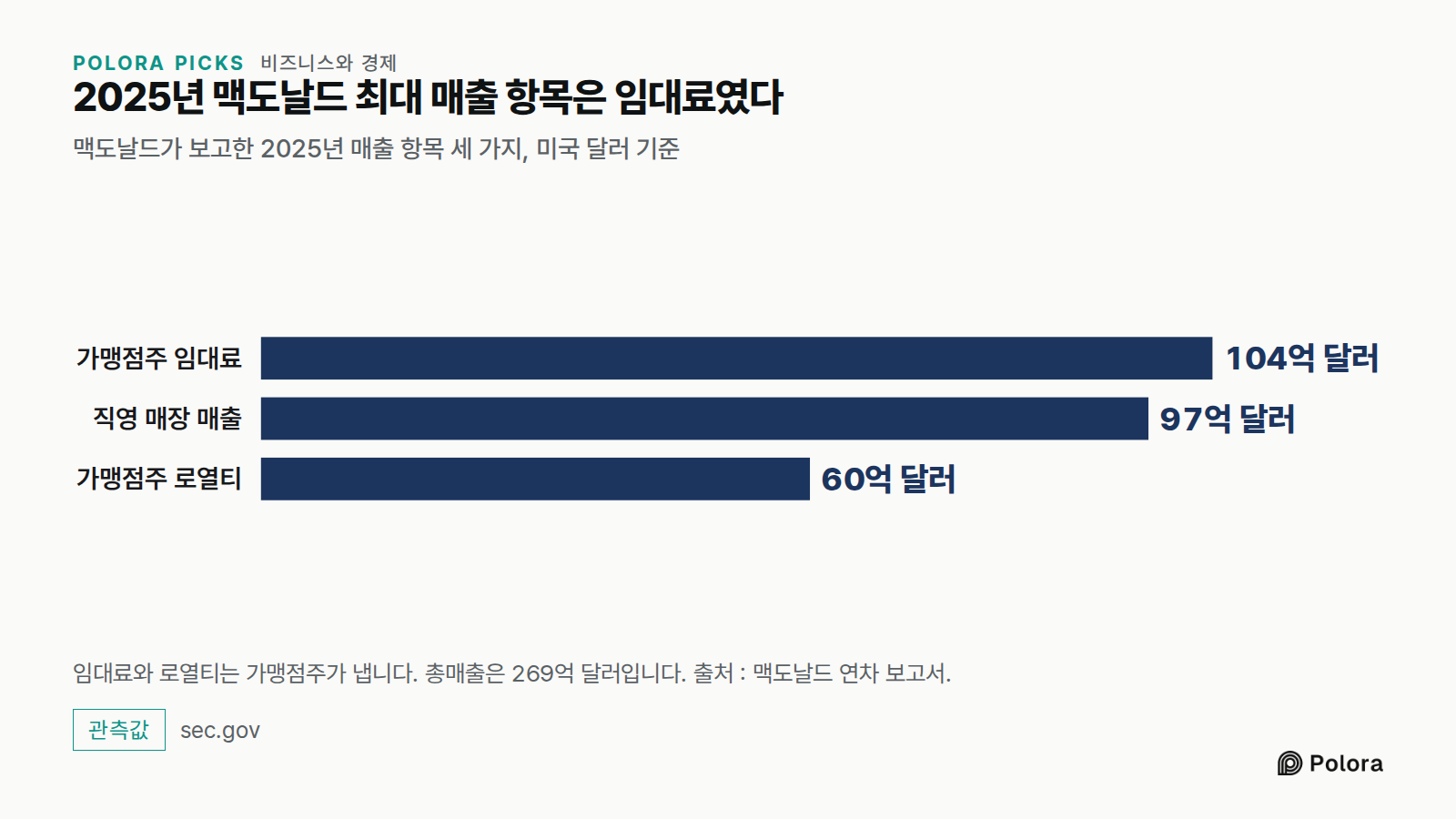
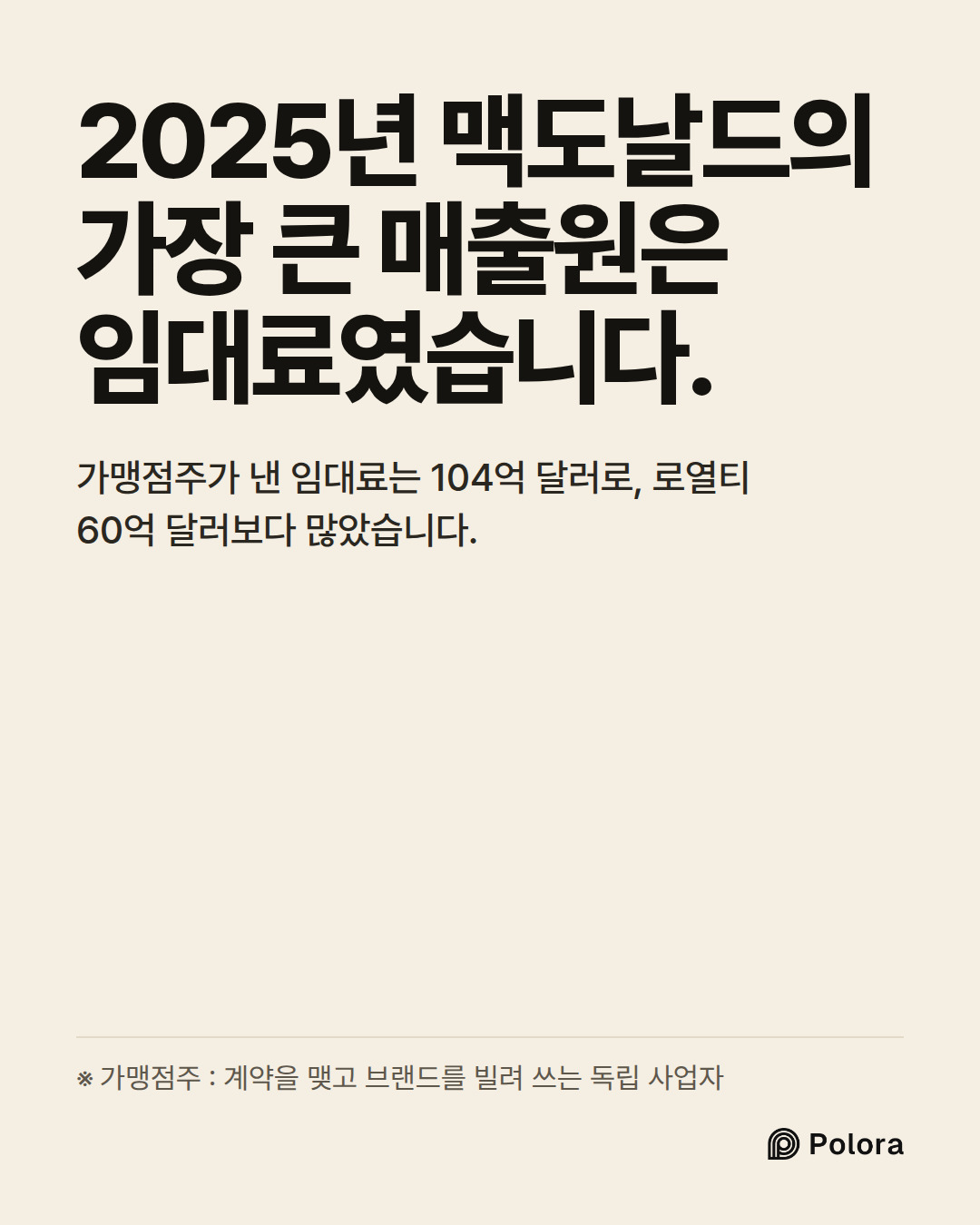
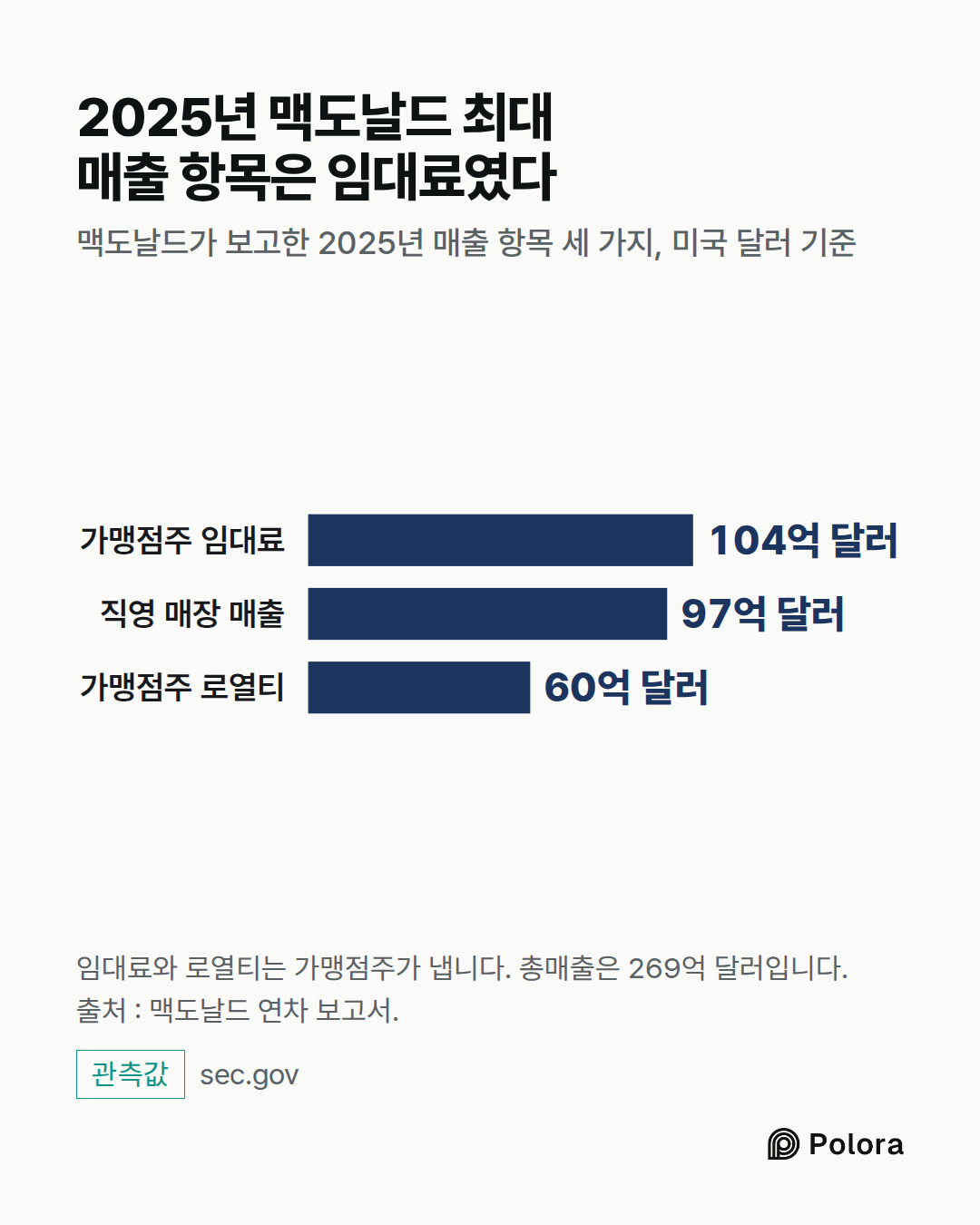
둘 다입니다. 2025년 맥도날드가 가맹점주에게 받은 임대료는 104억 달러로 로열티 60억 달러보다 많았습니다. 다만 이 임대료는 매장의 햄버거 매출에 따라 오르내립니다.
비즈니스와 경제 · 2026-10-08
맥도날드가 버는 돈은 대부분 햄버거 값이 아니다
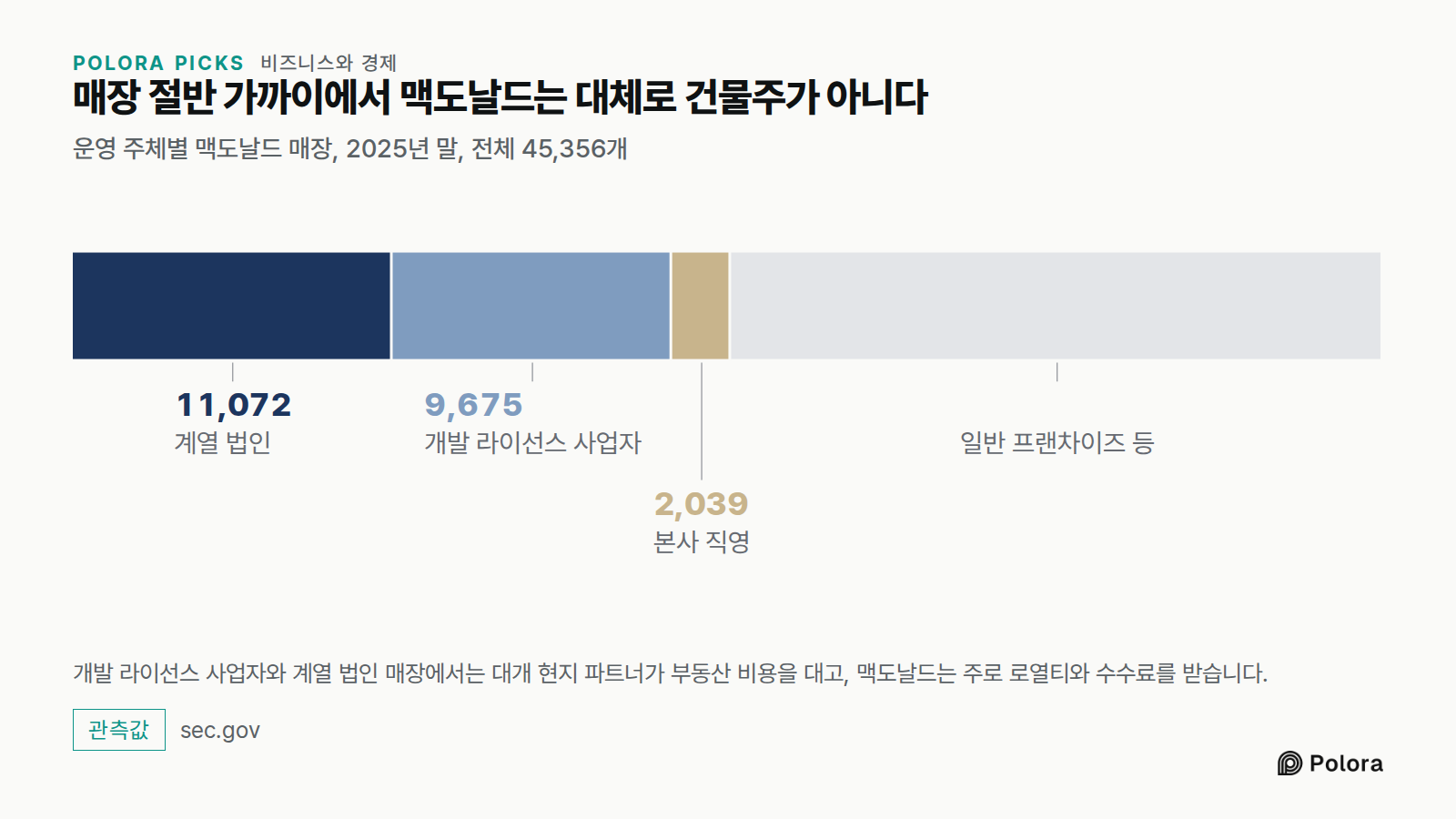
빅맥 값을 내면 그 돈은 대개 맥도날드 본사가 아니라 그 동네 사업자에게 갑니다. 2025년 말 맥도날드 매장의 약 95%는 가맹점주가 운영했습니다. 가맹점주는 계약을 맺고 브랜드를 빌려 쓰는 독립 사업자입니다. 전체 45,356개 매장 가운데 본사가 직접 운영한 곳은 2,039개였습니다.
본사가 얼마를 벌었는지는 맥도날드가 미국 증권 당국에 낸 2025년 연차 보고서에 나옵니다. 총매출은 269억 달러였습니다. 이 가운데 본사가 직접 운영하는 매장에서 판 금액이 97억 달러였습니다. 더 큰 몫인 165억 달러는 가맹점주가 낸 각종 수수료였습니다.
사람들이 흔히 떠올리는 수수료는 로열티입니다. 브랜드와 매장 운영 방식을 쓰는 대가로 매출의 일부를 떼어 내는 돈입니다. 이것이 60억 달러였습니다. 그런데 가장 큰 항목은 따로 있었습니다. 바로 임대료로, 104억 달러였습니다. 2023년(98억 달러)과 2024년(100억 달러)에도 임대료가 가장 큰 항목이었으니 2025년만의 일이 아닙니다. 모두 회사가 보고서에 매출로 직접 적은 항목입니다. 동네에서 흔히 보는 맥도날드 매장의 점주는 맥도날드의 세입자이기도 합니다.
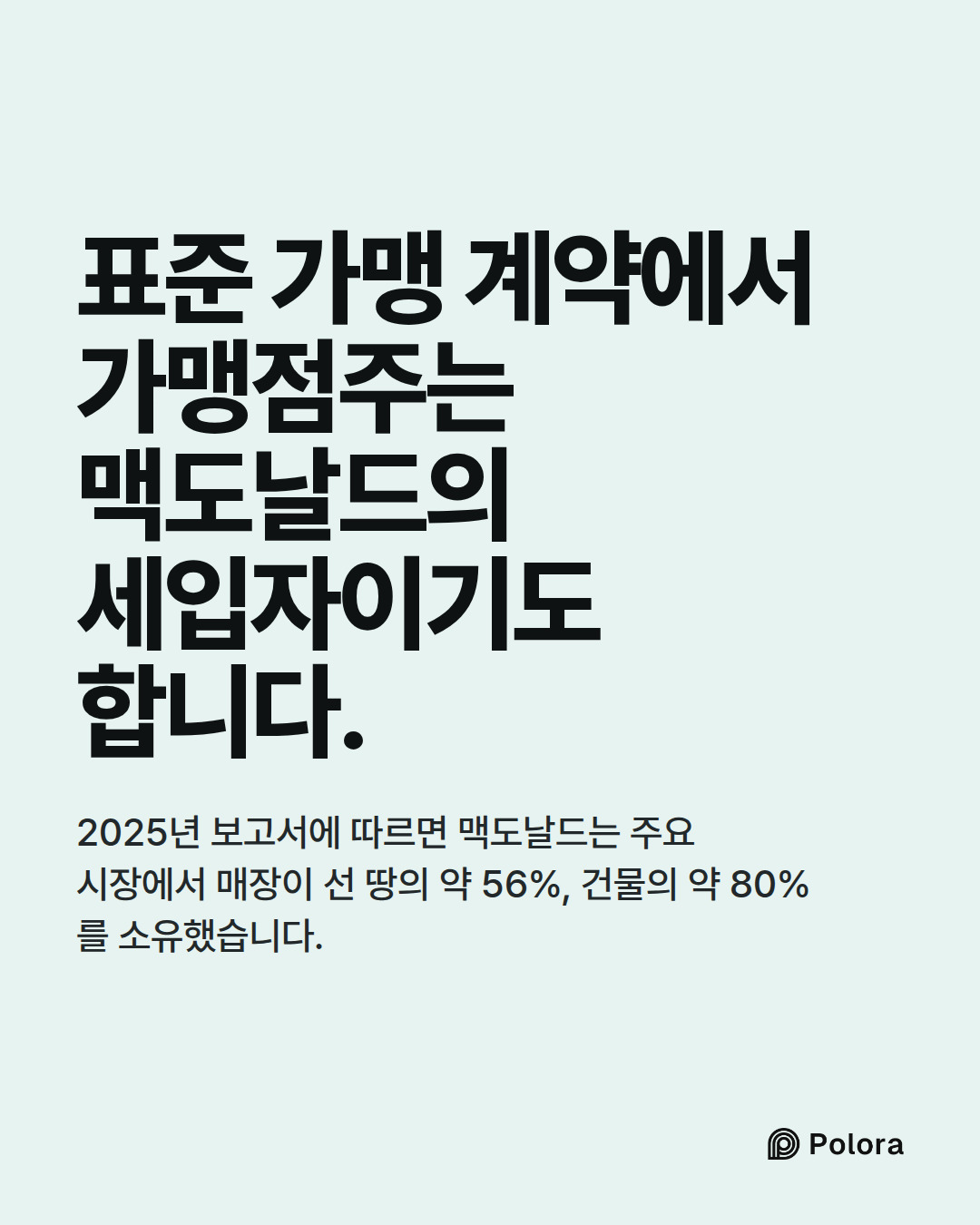
맥도날드가 '일반 프랜차이즈'라고 부르는 표준 가맹 계약에서는 대개 본사가 땅과 건물을 소유하거나 장기로 빌려 둡니다. 가맹점주는 그 안을 채우는 주방 설비, 간판, 좌석, 인테리어에 돈을 댑니다. 이 계약은 브랜드 사용 허가이면서 동시에 그 자리에 대한 임대차 계약입니다. 가맹점주는 맥도날드가 쥐고 있는 부동산에서 장사를 하니, 맥도날드에 임대료를 냅니다.
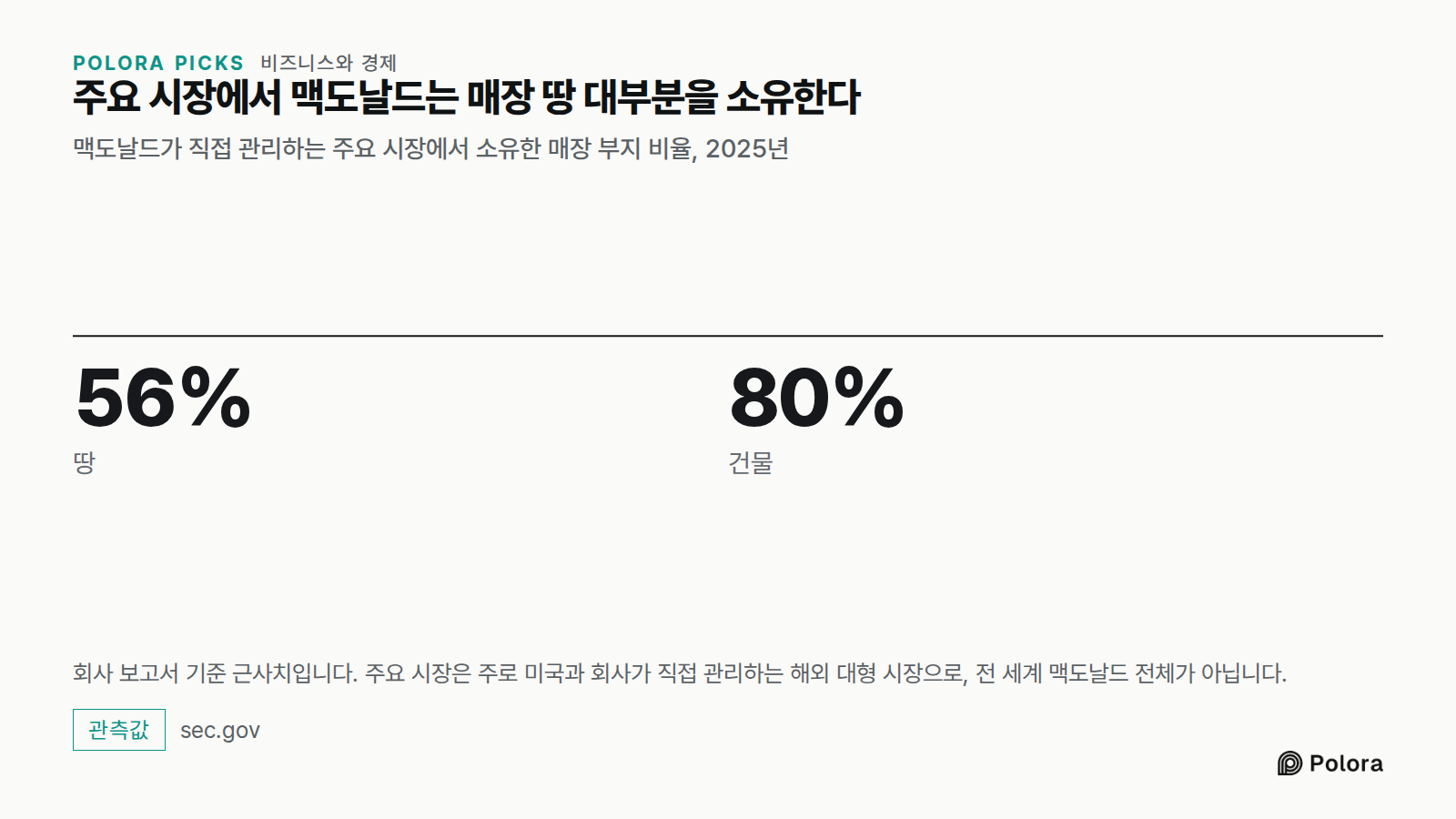
그 부동산이 적지 않습니다. 2025년 보고서에 따르면 맥도날드는 미국과 해외 대형 시장 등 회사가 직접 관리하는 주요 시장에서 매장이 선 땅의 약 56%, 건물의 약 80%를 소유했습니다. 전 세계 모든 맥도날드를 아우르는 비율은 아닙니다. 직접 소유하지 않은 곳은 다른 소유주에게서 빌려 가맹점주에게 다시 빌려줍니다. 2025년 말 가맹 계약에 묶인 맥도날드의 부동산과 설비는 감가상각을 뺀 장부가로 228억 달러였고, 그중 땅이 71억 달러였습니다.
그 자리를 유지하는 비용은 상당 부분 가맹점주 몫입니다. 회사에 따르면 재산세, 보험료, 유지보수비는 대체로 가맹점주가 냅니다.
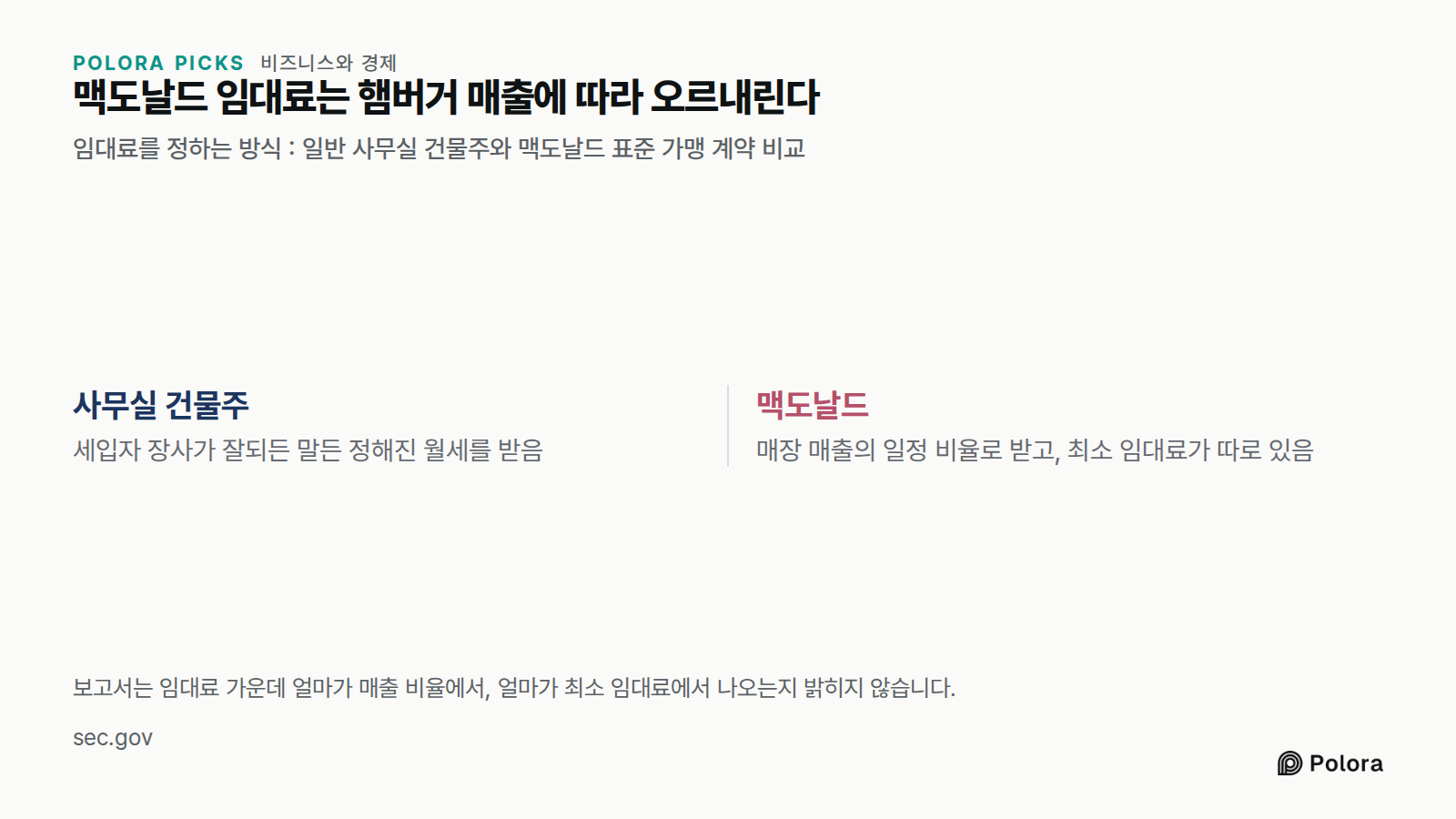
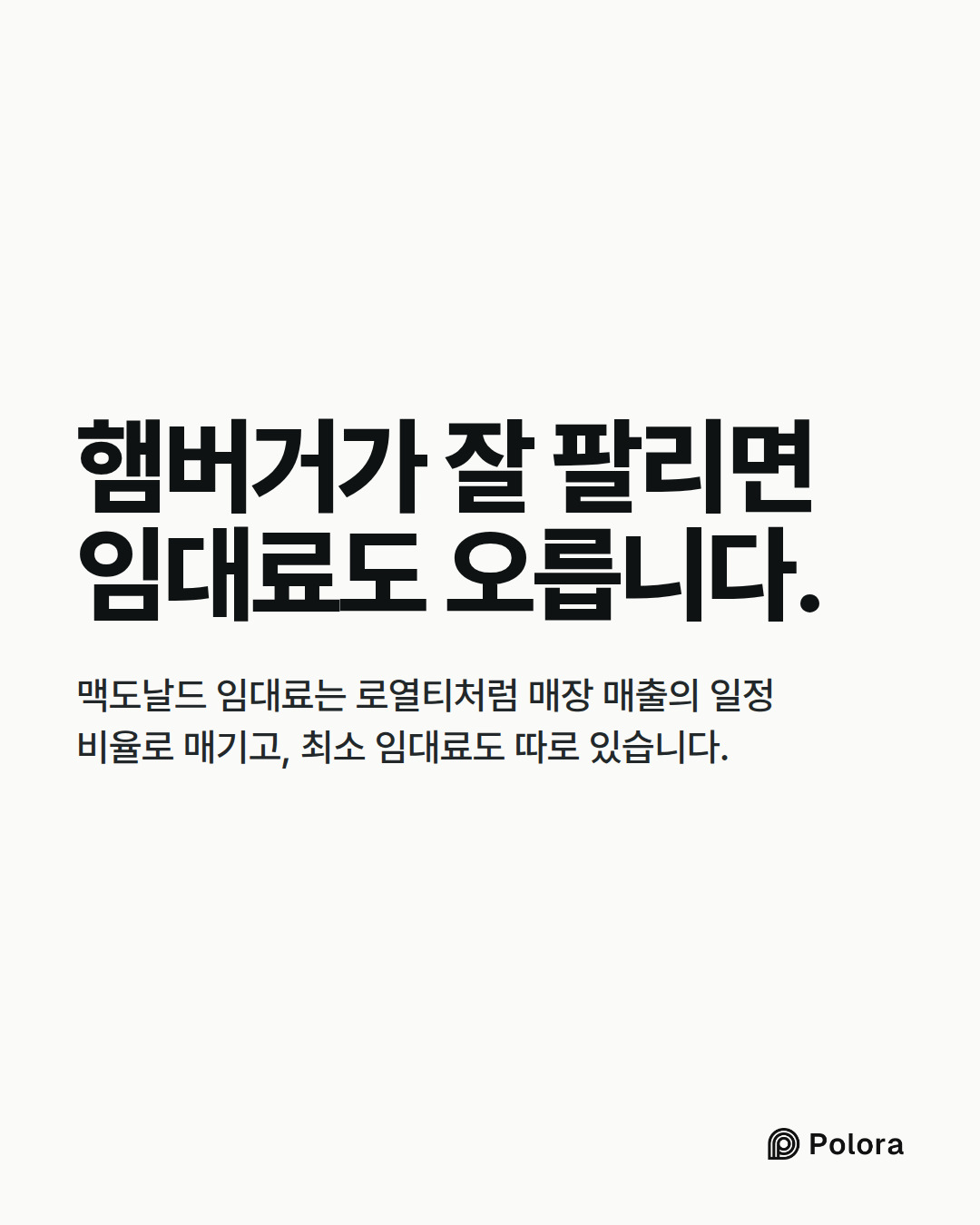
여기서 맥도날드는 평범한 건물주와 달라집니다. 사무실 건물주는 세입자 장사가 잘되든 말든 정해진 월세를 받습니다. 맥도날드의 임대료는 로열티처럼 매장 매출의 일정 비율로 정해집니다. 여기에 최소 임대료가 따로 정해져 있습니다. 회사가 소유한 자리라면 최소 임대료는 맥도날드가 그 자리에 투자한 금액을 기준으로 하고, 빌린 자리라면 맥도날드가 원래 소유주에게 내는 임차료를 따라갑니다.
보고서는 임대료 가운데 얼마가 매출 비율에서 나오고 얼마가 최소 임대료에서 나오는지 밝히지 않습니다. 견주어 볼 숫자는 하나 있습니다. 2025년 말 기준 계약으로 가맹점주들이 2026년에 내야 할 최소 임대료는 30억 달러로, 맥도날드가 2025년에 보고한 임대료 104억 달러에 한참 못 미칩니다. 두 숫자는 연도도 다르고 재는 대상도 다르며, 최소 임대료에는 그 뒤에 맺은 계약이 빠져 있습니다. 그래서 임대료 중 얼마만큼이 매출에 따라 움직이는지는 이 숫자로 알 수 없습니다. 다만 보장된 최저선이 맥도날드가 보고해 온 임대료보다 훨씬 낮다는 것은 보여 줍니다.
이 구조는 시간이 갈수록 회사에 힘을 실어 줍니다. 가맹 계약은 대개 20년입니다. 계약이 끝나도 땅과 건물은 맥도날드 손에 남습니다. 같은 점주와 다시 20년 계약을 맺을 수도, 자리를 다른 점주에게 넘길 수도, 매장을 닫을 수도 있습니다.
임대료는 매출이지 이익이 아니니, 맥도날드가 실제로 얼마를 남기는지 따져 볼 만합니다. 회사는 가맹 매장과 직영 매장 각각의 마진을 보고합니다. 가맹 매장 쪽 마진은 가맹점주에게 받은 돈, 즉 임대료와 로열티를 합한 금액에서 그 자리들에 대한 회사의 임차료와 감가상각비를 뺀 것입니다. 직영 매장 쪽은 매출에서 식재료, 포장재, 인건비, 운영비를 뺀 것입니다.
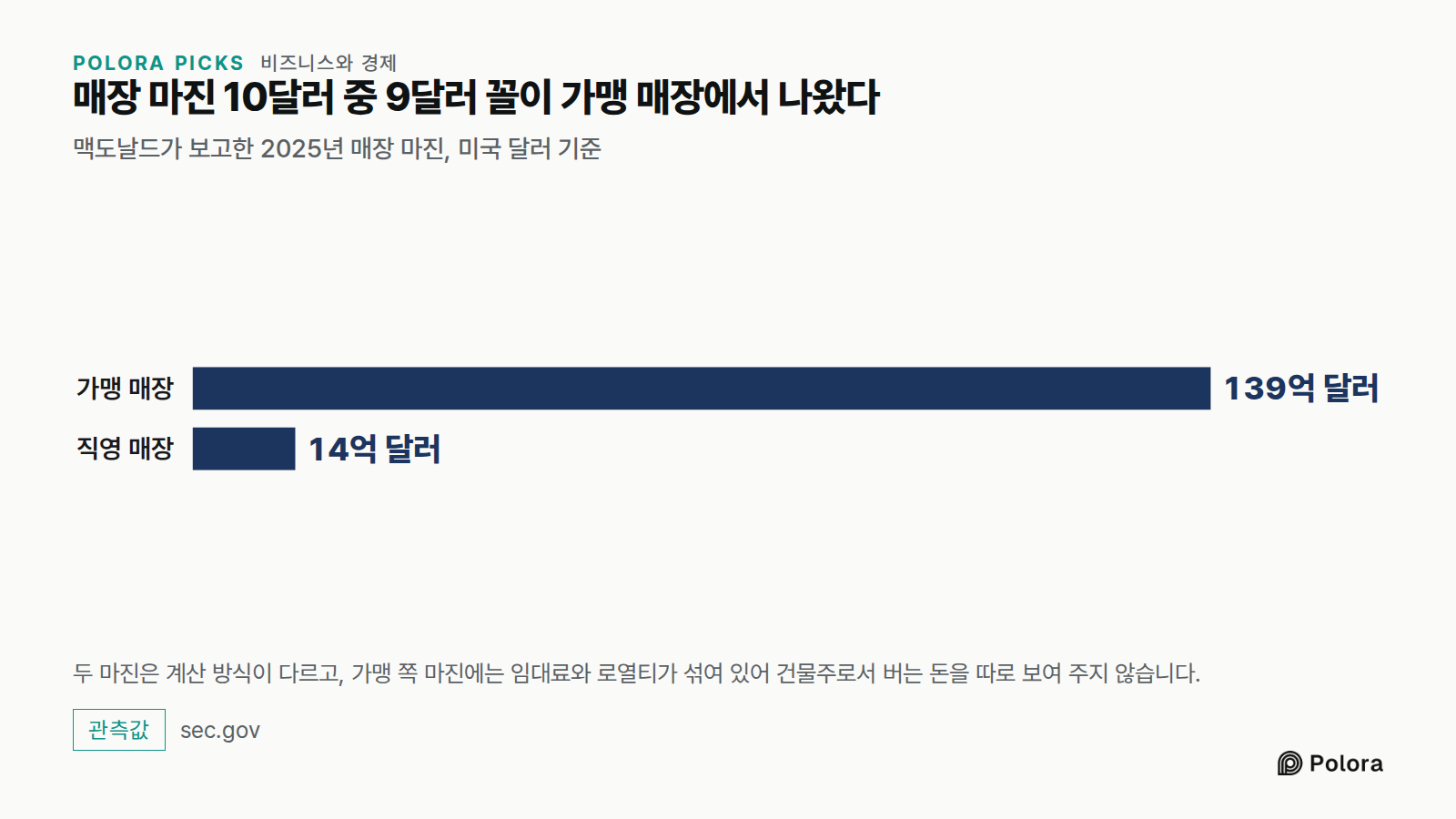
2025년 가맹 매장에서 맥도날드에 남은 마진은 139억 달러였습니다. 직영 매장에서는 14억 달러였습니다. 매장 단위 마진 10달러 가운데 9달러 꼴이 가맹 매장에서 나온 셈입니다. 매장을 직접 돌리려면 식재료와 직원에 돈을 써야 합니다. 가맹점주에게 건물과 브랜드를 빌려주는 데는 그런 비용이 대체로 들지 않습니다.
이 비교에는 한계가 있습니다. 두 마진은 계산 방식이 다르고, 가맹 쪽 마진에는 임대료와 로열티가 섞여 있어 맥도날드가 건물주로서 버는 돈을 따로 보여 주지 않습니다. 직영 매장을 줄이면 더 벌 수 있다는 뜻도 아닙니다. 회사는 일부 매장을 직접 운영하는 것이 매장 운영 방식을 개발하고 시험하는 데 도움이 된다고 말합니다.
맥도날드는 이 모델을 이렇게 설명합니다. 가맹 비중이 높은 자사 사업이 '안정적이고 예측 가능한 매출, 대체로 가맹점 매출에 따라 정해지는 매출'을 내도록 설계됐다고 합니다. 또 '부동산 소유와 가맹점주의 공동 투자가 결합된 구조' 덕분에 매장들이 '업계 최고 수준'의 성과를 낸다고 믿는다고 말합니다. 회사 스스로의 주장이고, 보고서는 다른 체인과 비교하지 않습니다.
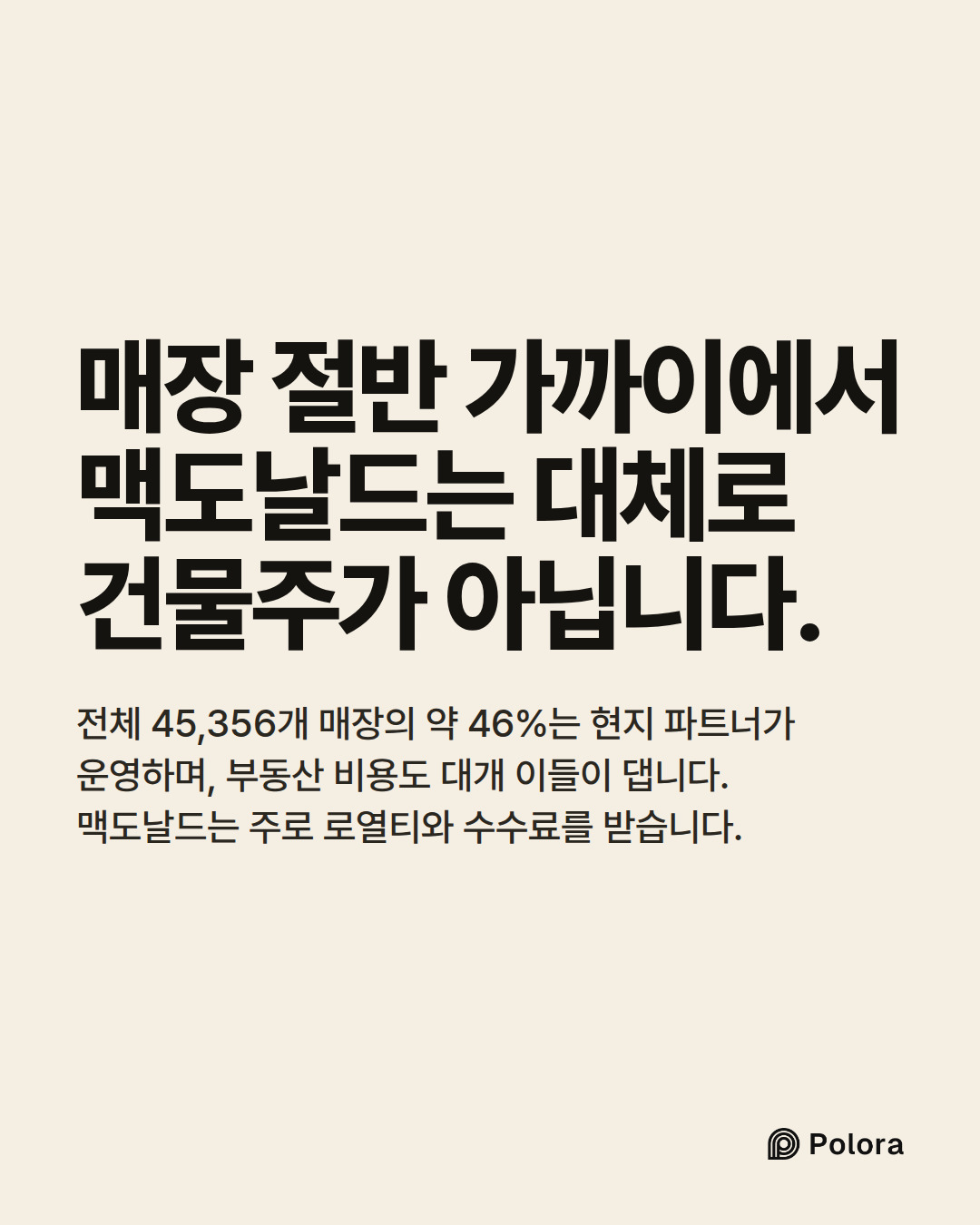
건물주라는 그림이 들어맞는 곳은 맥도날드가 표준 가맹 방식을 쓰는 곳, 주로 미국과 회사가 직접 관리하는 해외 대형 시장입니다. 다른 곳에서는 대개 방식이 다릅니다. '개발 라이선스 사업자'나 '계열 법인'이라 불리는 현지 파트너가 부동산을 포함해 매장에 드는 돈을 댑니다. 맥도날드는 그곳 매장에 대체로 자본을 넣지 않습니다. 매출에 따른 로열티와 대개 최초 가입비를 받고, 계열 법인에서는 이익의 일부를 받기도 합니다. 맥도날드는 이런 방식으로 운영되는 시장을 중심으로 75개국이 넘는 나라를 하나의 보고 부문으로 묶습니다. 다만 부문과 운영 방식이 정확히 일치하지는 않아서, 이런 방식의 매장 일부는 회사가 직접 관리하는 시장에도 있습니다.
이런 매장이 적지 않습니다. 2025년 말 개발 라이선스 사업자가 운영한 맥도날드 매장은 9,675개, 계열 법인이 운영한 매장은 11,072개였습니다. 합치면 전체 45,356개의 약 46%입니다. 회사 지분이 50% 이하인 중국과 일본의 맥도날드 사업도 여기에 속합니다. 맥도날드 매장의 절반 가까이에서 회사는 대체로 건물주가 아닙니다. 그곳에서는 사람들이 흔히 떠올리는 프랜차이즈 본사처럼, 브랜드 값으로 돈을 받습니다.
맥도날드가 보고한 숫자만 보면, 맥도날드는 브랜드 주인으로서보다 건물주로서 더 많은 매출을 올립니다. 2025년 가맹점주에게 받은 임대료는 로열티보다도, 직영 매장 매출보다도 많은 단일 최대 매출원이었습니다. 주요 시장에서는 땅과 건물을 쥐고 있고, 가맹 계약이 끝나도 그것을 지킵니다.
그렇다고 무슨 일이 있어도 돈을 받는 건물주는 아닙니다. 임대료가 매출의 일정 비율로 정해지기 때문에, 햄버거를 덜 판 매장은 최소 임대료는 내야 하지만 대체로 임대료를 덜 냅니다. 임대차와 브랜드 사용 허가는 한 계약으로 묶여 있고, 보고서는 맥도날드가 부동산으로 버는 몫과 브랜드로 버는 몫을 나누지 않습니다. 또 부동산을 갖지 않은 곳에서 맥도날드는 주로 로열티와 수수료, 곧 브랜드 값으로 돈을 받습니다.
결국 임대차 계약은 맥도날드가 자기 몫의 상당 부분을 떼어 가는 통로이고, 그 몫의 크기는 햄버거 매출이 정합니다. 맥도날드는 버는 돈의 상당 부분을 건물주로서 받는 햄버거 회사입니다.
Is McDonald's really a burger company, or a landlord that sells burgers?
Alpha · claude-sonnet-5
Good — I was able to confirm the core manuscript claims directly against the FY2025 10-K text. Here's my verification pass.
What checks out cleanly
The franchise arrangements language in the manuscript matches the filing almost word for word. The 10-K states: "Conventional franchise arrangements generally include a lease and a license and provide for payment of initial fees, as well as continuing rent and royalties to the Company based upon a percent of sales with minimum rent payments," and "Minimum rent payments are based on the Company's underlying investment in owned sites and parallel the Company's underlying leases and escalations on properties that are leased." This confirms the manuscript's structural claim without needing the famous "we are in the real estate business" quote — good that the brief avoided it, since I found no primary-source confirmation of that line in this filing.
The 20-year term and McDonald's retained control at expiry is also confirmed verbatim: "franchisees are granted the right to operate a restaurant using the McDonald's System and, in most cases, the use of a restaurant facility, generally for a period of 20 years. At the end of the 20-year…
Beta · gpt-6-sol
The manuscript’s premise stands, but “landlord” describes how McDonald’s earns much of its revenue—not the whole business. Its 2025 Form 10-K supports the central comparison: McDonald’s reported $10.442 billion in rent, $6.018 billion in royalties, and $9.690 billion in sales from company-operated restaurants. Rent was the largest of those revenue lines. These are *recognized revenues*, however; “took” or “collected” should not be read as a claim about cash received. The same filing reports rent of $10.017 billion in 2024 and $9.840 billion in 2023. (sec.gov)
Here is where I would draw the verification lines:
- Who sells the burgers: Confirmed. At December 31, 2025, franchisees operated 43,317 of 45,356 restaurants (about 95%); McDonald’s operated 2,039. Franchisees’ sales are not recorded as McDonald’s corporate revenue. The manuscript’s $26.9 billion total revenue and $16.5 billion franchised-revenue figures also match the filing. (sec.gov)
- Why it earns rent: Confirmed for *conventiona…
Gamma · gemini-3.1-pro
I have reviewed the manuscript against the provided 2025 Form 10-K. The foundational numbers and structural claims are accurate, but the manuscript makes a few analytical leaps that the filing does not support.
Here is what the record actually shows:
What is confirmed by the source:
* Revenue Split: The figures are exact. In 2025, McDonald's recognized $10.442 billion in rent, $6.018 billion in royalties, and $9.690 billion in company-operated sales out of $26.9 billion in total revenue.
* Restaurant Counts: Exactly 45,356 total restaurants at the end of 2025. Franchisees ran 43,317 (about 95%), while the company ran 2,039.
* Real Estate Ownership: The 56% land and 80% building ownership figures are accurate, but apply specifically to its "consolidated markets," not the entire global system. The $22.8 billion net property value (with $7.1 billion in land) is also confirmed.
* International Models: The count of 9,675 developmental licensee restaurants and 11,072 affiliate restaurants is accurate, confirming that at nearly half of its locations, McDonald's relies on local partners for capital and real estate.
* Control and Term: The standard 20-y…
Researcher · gemini-3-7-flash
Factual Verification & Evidence Report
Every empirical claim in the manuscript was cross-checked against primary regulatory filings—specifically McDonald’s Corporation Form 10-K for the Fiscal Year Ended December 31, 2025, accessible via the SEC EDGAR system at:
https://www.sec.gov/Archives/edgar/data/63908/000006390826000035/mcd-20251231.htm
---
1. Itemized Claim-by-Claim Verification
A. Revenue Breakdown & "Who Sells the Burgers"
* Manuscript Claim: Total revenue was $26.9B; company-operated restaurant sales were $9.7B; franchised fees were $16.5B (Rent: $10.4B, Royalties: $6.0B). Rent was also the largest line in 2023 ($9.8B) and 2024 ($10.0B).
* Status: Confirmed verbatim.
* Filing Reality: In the 2025 Consolidated Statement of Income, McDonald’s reported total revenues of $26.890B ($26.9B rounded), comprising $9.690B from company-operated sales and $16.546B from franchised restaurants. Within franchised revenues:
* Rent: $10,442M ($10.4B) in 2025, compared to $10,017M in 2024 and $9,840M in 2023.
* Royalties: $6,018M ($6.0B) in 2025.
* Restaurant Count Claim: 43,317 (~95%) run by franchisees out of 45,356 total re…
The Arbiter · gpt-6-sol
Round record
Alpha, Beta, Gamma, and the Researcher agree on the central finding: McDonald’s 2025 filing reports $10.442 billion in franchise rent, more than its $6.018 billion in royalties or $9.690 billion in company-operated restaurant sales. Rent was also the larger franchise-revenue line in 2023 and 2024. The filing describes a conventional franchise as both a lease and a license, with rent and royalties based on restaurant sales and a minimum rent payment. That supports the manuscript’s central angle, but not the idea that property income is independent of burger sales. These are *reported revenues*, not necessarily cash “collected.” (sec.gov)
The filing settles the operating and property claims, with geographic limits. Franchisees ran 43,317 of 45,356 restaurants at year-end 2025; McDonald’s ran 2,039. McDonald’s reports owning approximately 56% of land and 80% of buildings in its consolidated markets, not across its entire worldwide system. It reports $22.8 billion in net property and equipment under franchise arrangements, including $7.1 billion of land. Conve…
The Arbiter's Final Verdict · gpt-6-sol
Both—but “a burger business that gets paid partly as a landlord” is the more accurate description. McDonald’s franchises most of its restaurants, and its conventional franchise deal combines a brand license with a property lease. In 2025, it reported $10.442 billion in rent from franchisees, more than its $6.018 billion in royalties or $9.690 billion in sales at company-operated restaurants. That makes the landlord angle a real feature of its business, not just a clever line. (McDonald’s 2025 Form 10-K)
But rent revenue is not real-estate profit, and the filing does not show how much of 2025’s rent came from sales-based payments rather than contractual minimums. McDonald’s says conventional-franchise rent and royalties are based on restaurant sales, subject to minimum rent. Its property and brand therefore work together: strong burger sales help drive what the company earns.
The landlord label also does not fit every market. About 46% of its restaurants were operated under developmental-license or affiliate arrangements at the end of 2025, in which local partners generally…