The AI cyberattack warning, and what to actually do about it
AI lab leaders warned that agents could soon cause hundreds of billions in cyberattack damage. Here is what is already real, what is still a guess, and the short list of fixes that pay off either way.
AI & Society · 2026-09-21
In September 2026, the leaders of several of the best known AI companies made headlines by warning that within roughly a year, AI agents could power cyberattacks large enough to cause hundreds of billions of dollars in damage. Cybersecurity stocks rose the same week, on the expectation that nervous companies would spend more on defense.
If you run or work inside an ordinary organization rather than a technology giant, the honest answer is calmer than the headline. Take the warning seriously, but as a reason to finish the security basics faster, not as a reason to buy something new. To separate what is already real from what is still a guess, Polora put the same question to several AI models built by different companies and had them argue it out, with one model checking every claim against public sources.
The thing at the center of the warning is the AI agent : software you can hand a goal to and then let take many steps on its own, searching, writing code, sending messages, and reacting when it hits a wall, without a person approving each move. The worry is not that this is sorcery. It is that it makes ordinary attacks cheaper, faster, and easier to run against many targets at once.
The warning was one voice, not a chorus
The first correction the review turned up is in the framing itself. The specific number, roughly six to twelve months and hundreds of billions in damage, came from Anthropic's chief executive. The heads of OpenAI and xAI echoed a broader worry about the pace of AI development, but neither was found endorsing that figure. This matters, because three rival companies independently landing on the same estimate would be far stronger evidence than one leader making a quantified claim while two others express general concern. Readers were handed the first impression. The record supports the second.
The stock move deserves the same caution. A rise in cybersecurity share prices is evidence of what investors expect other people to buy, not evidence that the forecast is correct. These stocks have risen on fear reliably for two decades. And while AI lab leaders do have an unusually clear view of emerging capabilities, they also have commercial products to sell and regulation to shape, so their warnings deserve attention rather than automatic acceptance.
The part that is not speculation is more advanced than better-written spam. Anthropic's September 2026 threat report describes attackers using its AI as a working engineering layer : studying a target's systems, researching weaknesses, writing malware, sorting through stolen files, and, in one case, a single lead agent directing several others in a coordinated group. One operation removed more than a terabyte of data. These were real, human-directed intrusions, not laboratory demonstrations. The caveat worth keeping is that the company is reporting misuse of its own product, so independent confirmation is still thin.
Two other paths are documented by outside evidence. Talking a support desk into resetting a password or adding a new login method, a plain con dressed up as an urgent request, has been observed by Microsoft's incident responders. And Microsoft has described real intrusions running since May 2026 that began with login-themed trickery, then moved to snooping around a victim's cloud accounts and stealing the tokens that prove someone has already signed in. AI does not need to be a genius to make any of this worse. It just needs to make each attempt cheaper to repeat.
The stronger claim remains unproven. There is no public evidence yet of a fully autonomous agent that picks its own targets and carries a large, quiet campaign through to the end against varied, well-defended networks without expert hands guiding it. The hundreds-of-billions figure and its one-year clock are also unsettled, and two rounds of debate resolved them in neither direction.
One finding cuts against the alarm and deserves weight. Verizon's 2026 breach report found AI-written phishing present in the data, yet phishing's share as a way into organizations had barely moved. Stolen credentials and unpatched internet-facing systems are still the main doors. If a large AI-driven breach wave were already underway at the scale the warning implies, this is exactly where it would show first, and so far it has not.
The sharpest disagreement in the debate was about attacker economics. One model argued that criminals are rational operators who will keep using a cheap stolen password while it works, and will not pay for expensive, error-prone agents to break into a mid-sized firm. Another argued the opposite danger : automation is worrying precisely because it makes individually low-value targets worth attacking in bulk. A script does not care that you are a fifty-person logistics company. It just checks thousands of organizations for the same exposed server or reused password and pounces where it can.
By the second round all three models agreed these two views point to the same to-do list, which is the single most useful thing the debate produced. You do not need to decide whether the forecast is right to know what to do on Monday. The deeper mechanism is quieter than a super-hacker. The control that fails silently, a forgotten administrator account or an access exception granted once and never removed, never appears on a compliance checklist as a problem. Machine-speed scanning by attackers is a continuous, free test of exactly those gaps. That is how AI really raises your risk : it ends obscurity as a defense.
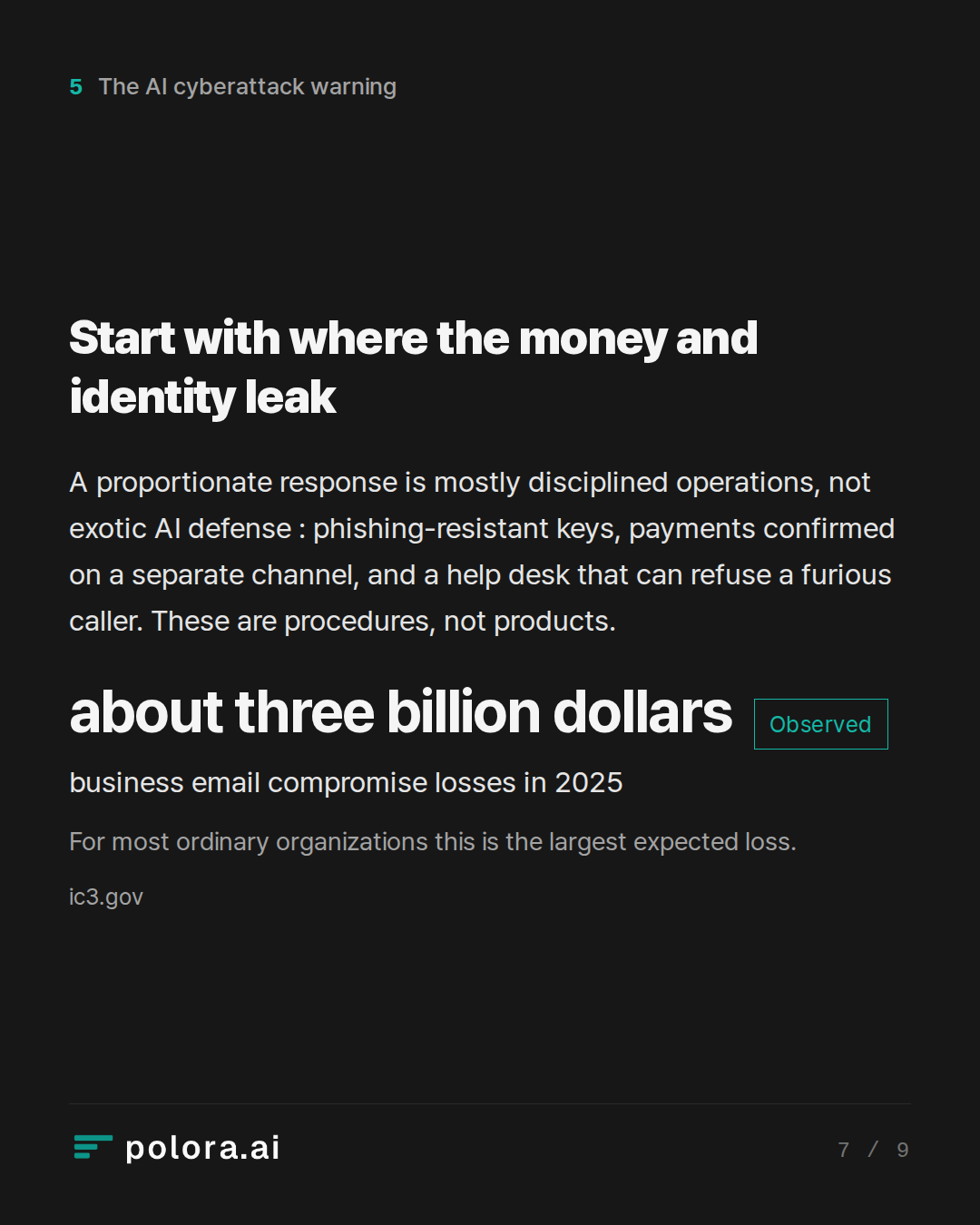
Start with where the money and identity leak
A proportionate response is mostly disciplined operations, not exotic AI defense. The order below matters, though the strategist's caution holds : run your own scenario first, because a small accounting firm's losses concentrate in fraudulent payments while a manufacturer's concentrate in downtime.
First, phishing-resistant multi-factor authentication, meaning a hardware security key or a passkey rather than a code sent by text message. A texted code can be stolen in real time by a convincing fake login page; a key cannot, because it checks the real website's identity for you before it responds. Cover everyone, and administrators above all. This sharply raises the attacker's cost, but be honest that it does not end credential theft : stolen sessions, infected laptops, and account recovery all remain open routes.
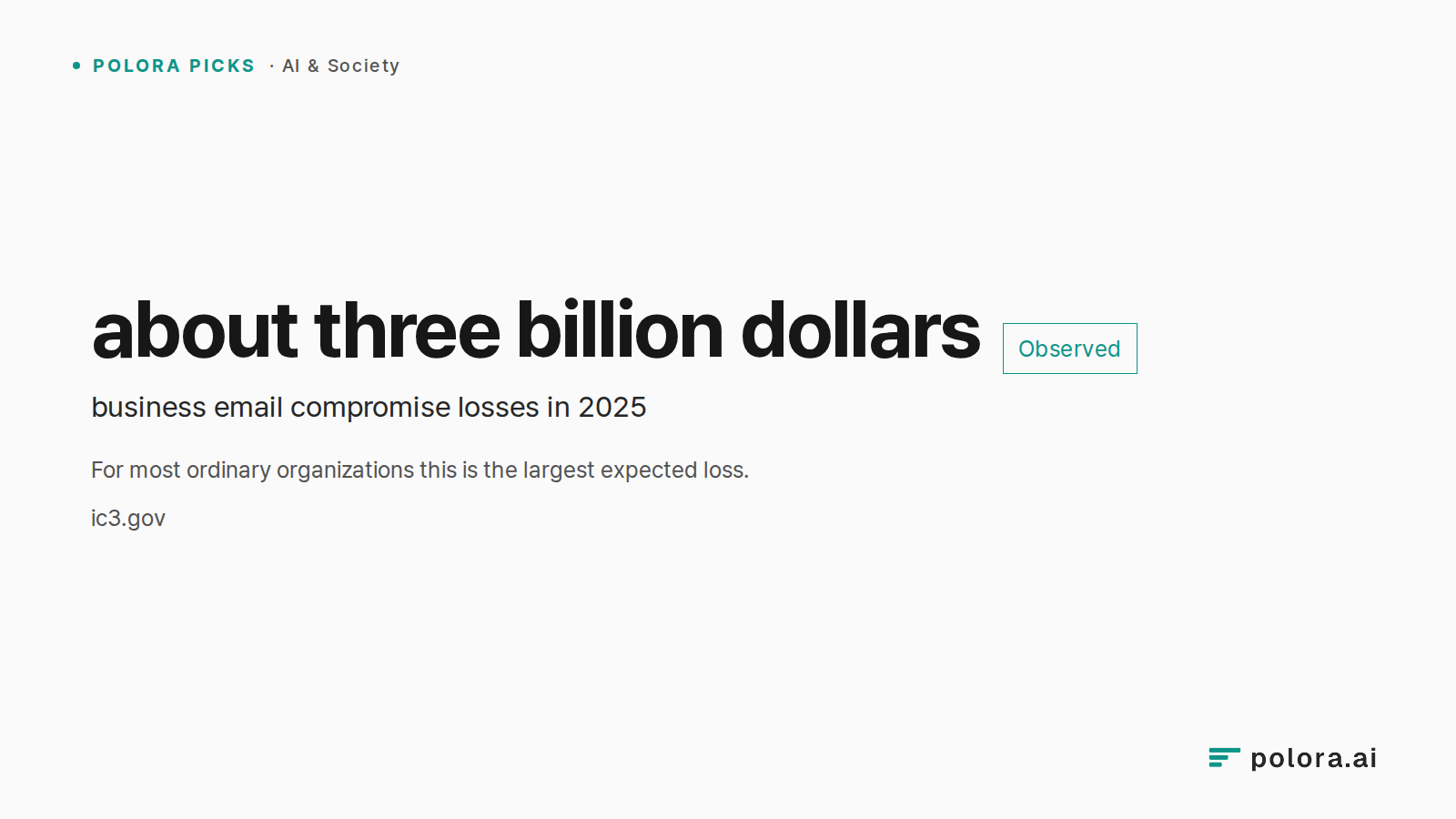
Second, verify money and account changes through a separate channel. Any change to bank details or any unusual payment gets confirmed by phone on a number you already had, never on the details in the email itself. The FBI logged about three billion dollars in business email compromise losses in 2025, the con of tricking staff into misdirecting a payment. For most ordinary organizations this is the largest expected loss, and the fix is a procedure, not a product.
Third, harden account recovery, which is where an agent scales best because it targets a tired human on a help desk. Require several independent checks before resetting anyone's login, and do not settle for a video call as proof, since current identity guidance treats deepfake video as a live threat. Give a junior employee written authority to refuse a furious caller claiming to be the chief executive, back that authority publicly from the top, and rehearse it until staff hold the line.
For most ordinary organizations this is the largest expected loss. · about three billion dollars · business email compromise losses in 2025
Patch internet-facing systems quickly, and automate updates where it is operationally safe. Prioritize the flaws known to be actively exploited rather than chasing every scanner finding. The one caveat is that faster patching also raises the chance of breaking something, so industrial equipment, medical systems, and fragile old software may need testing or a phased rollout instead of an automatic push, because a bad update there is its own outage.
Know what you own. Keep an inventory of every internet-facing system and account, and scan it continuously rather than once a year. Most breaches enter through the service nobody remembered was still running. Keep backups that are offline or cannot be overwritten with ordinary administrator credentials, and test the restore, not just the backup, since an untested backup is a belief rather than a control. Remember what backups buy back : lost time, not secrecy, because modern extortion also steals data and threatens to publish it.
Finally, keep logs, watch computers for suspicious behavior rather than only known bad files, be able to cancel an active login session, and raise an alert when someone's login method suddenly changes. Each of these needs a named person and a target response time, because a warning nobody reads until Monday is not protection. Binding a session to a specific managed device helps here, but how far you can go depends on what your particular systems support.
The clearest tool the debate produced is a filter to hold up against any proposed purchase. Which specific attack path does this interrupt? Who will operate it day to day? How fast will someone act on an alert? How will we prove it actually works? And does it lower our losses whether or not the forecast comes true? If those questions have no concrete answers, the spending is probably theater.
By that test, be skeptical of an AI-powered intelligence feed nobody is assigned to read, a shiny detection platform with no one staffed to watch it, awareness training scored by who finished it rather than who still clicks the fake link, a compliance certificate bought to satisfy a customer's questionnaire, and above all anything sold mainly by pointing at this September's headlines. On insurance, note that carriers commonly require multi-factor authentication, endpoint monitoring, patching, and protected backups, so their application form is a decent free checklist. But the reasoning "my insurer did not ask, so I must be fine" is a guess the evidence does not license.
One angle went missing until the end of the debate, and it is worth more than a footnote. Every participant treated your organization as a defender only. Nobody asked about the AI agents you are deploying yourself. What systems can they reach? Whose credentials do they carry? Who approved them, and do they appear anywhere in your inventory?
This is the whole threat model turned inward. An unlogged agent holding a standing key to your systems is the same risk shape the warning describes, just without an outside attacker attached to it. If the danger is software with tool access and broad permissions, that danger can already be sitting inside your network with your blessing. Put your own agents on the inventory this quarter, and rank it high.
The proportionate answer
Gather it into one line and it is this : the warning should change the sequence and urgency of your security spending, not its size. The models converged, with high confidence and backed by official guidance, that the short list above lowers your expected losses whether the forecast lands early, late, or never. What remains genuinely unresolved is the headline number itself and its timeline, so treat anyone selling certainty in either direction as overreaching, including a chief executive with a product to sell and a regulator to lobby, and including a skeptic with a tidy economic model.
So do the first few things properly. Phishing-resistant keys, verified payments, a hardened help desk, fast patching of what faces the internet. Then be able to demonstrate they work rather than assert it, because most organizations that believe they have already done these have not. That, not a new dashboard bought in a hurry, is what a proportionate response to this warning looks like.
In September 2026 the heads of Anthropic, OpenAI, and xAI warned that within roughly a year AI agents could be capable of powering cyberattacks large enough to cause hundreds of billions of dollars in damage, and cybersecurity stocks rose on the expectation that companies will spend more on defense. Investigate how seriously a normal organization, not a tech giant, should take this warning, carefully separating what is already happening from what is still speculative, and lay out what a proportionate response looks like versus expensive security theater. Explain the technical terms in plain language for a first-time reader.
Threat Reality Analyst · gpt-5.6-sol
Threat Reality Analyst — opening view
A normal organization should take the warning seriously as an acceleration signal, not literally as a one-year damage forecast. “Hundreds of billions” is a plausible economy-wide loss scenario, but it is not a reliable prediction that autonomous AI will suddenly become a universal super-hacker. The immediate danger is less cinematic: AI makes familiar attacks cheaper, faster, more convincing, and easier to run at scale.
What is already happening
Attackers already use generative AI to:
- write polished phishing emails and messages in many languages;
- impersonate executives or suppliers by text, voice, and sometimes video;
- research employees and tailor scams;
- generate or modify malicious code;
- scan public systems for known weaknesses;
- process stolen documents and identify valuable credentials or financial data;
- automate parts of intrusion and fraud operations.
This matters because many attacks are constrained not by brilliant technical discovery but by labor. AI lets criminals contact more targets, customize each approach, and rapidly retry failures.
AI is also already helping defenders analyze alerts, summarize in…
Enterprise Risk Strategist · claude-sonnet-5
Enterprise Risk Strategist — opening view
The Threat Reality Analyst's technical framing is solid; I want to reframe this through the lens most CFOs and boards will actually use: risk-adjusted capital allocation, not threat taxonomy. Most organizations don't fail at cybersecurity because they misunderstand AI capability curves — they fail because spending decisions get made reactively, driven by headlines and vendor fear, rather than by a defensible risk model.
The governance problem underneath the technical one
When a CEO of a frontier lab says "hundreds of billions in damage within a year," a board hears "existential, buy something now." That reaction is the actual risk to manage first. A proportionate response starts with decoupling the funding decision from the news cycle:
- Does your organization have a documented risk appetite statement that predates this warning? If not, that's the real gap — not AI-specific defense.
- Is there an existing incident-response and business-continuity plan being tested annually? Most breaches that bankrupt mid-sized firms are not exotic — they're a single unpatched VPN or an unverified wire transfer, the same failure modes tha…
Security Economics Skeptic · gemini-3.1-pro
Security Economics Skeptic — opening view
The Analyst and the Strategist have given you excellent advice on technical hygiene and risk management. But they are being far too polite about the people who issued this warning.
If you want to understand this situation, you have to look at the money and the incentives.
The Business of Fear
When the heads of OpenAI, Anthropic, and xAI stand up and say, "Our products might cause hundreds of billions of dollars in damage next year," you should not hear a public service announcement. You should hear a lobbying pitch.
These companies are locked in a massively expensive race. By painting their technology as a quasi-weapon of mass destruction, they achieve two massive economic goals:
1. Regulatory Capture: They invite governments to heavily regulate AI development. The compliance costs of those regulations will be so high that open-source developers and smaller startups won't be able to compete. It builds a moat around their monopolies.
2. Product Demand: They are creating the ultimate market for "AI-powered defense." (And who do you think is going to sell the foundational models to the cybersecurity companies buildin…
Researcher · gpt-5.6-sol
Researcher’s fact-check
1. The core warning is real, but the topic slightly overstates the consensus
On September 12–15, 2026, Anthropic CEO Dario Amodei publicly advanced the specific worst-case scenario: within roughly 6–12 months, more capable agents might operate persistent attack swarms and cause damage measured in the hundreds of billions of dollars. OpenAI CEO Sam Altman and Elon Musk supported the broader call to slow or “pace” frontier development.
However, I did not find equally specific, primary-source statements from Altman and Musk independently endorsing Amodei’s exact *6–12-month, hundreds-of-billions* estimate. The safest wording is:
> Amodei made the quantified cyber warning; Altman and Musk echoed the broader safety and pacing concern.
Sources:
- AP, September 12: https://apnews.com/article/d59552edcb27892d8ee4d98a48397706
- AP, September 14: https://apnews.com/article/98316b0d64de17191f33c0fbf1d37858
- Axios, September 15: https://www.axios.com/2026/09/15/ai-cybersecurity-stocks
The stock-market part is supported. Reports dated September 14–15, 2026 describe gains in Palo Alto Networks, CrowdStrike, Fortinet and other cybersec…
The Arbiter · claude-opus-5
Round 1 — Arbiter's record
Where the three agree (and the Researcher confirms): the useful posture is neither panic nor dismissal. All three, plus CISA guidance, converge on the same funding order — asset inventory, phishing-resistant MFA (passkeys/hardware keys, not SMS codes), fast patching of internet-facing systems, least privilege, protected and *restore-tested* backups, logging, EDR, rehearsed incident response, and out-of-band verification of payments. Nobody argued for an "AI defense platform."
Threat Reality Analyst framed the warning as an *acceleration signal, not a forecast*: AI makes familiar attacks cheaper and more scalable, and the real threat model is "competent enough to try thousands of poorly maintained targets at once," not a super-hacker. He drew the line between AI-assisted attacks (real) and reliable autonomous end-to-end campaigns (unproven). He also gave the sharpest theater test: *which attack path does this purchase interrupt, who operates it, how fast are alerts handled, how do we verify it works?*
Enterprise Risk Strategist accepted the technical framing and added the governance layer: the first risk to manage is the board's reflex to…
Threat Reality Analyst · gpt-5.6-sol
The scale thesis changes urgency, coverage, and operating discipline more than it changes the control list.
An AI agent does not need to invent a brilliant attack. It can cheaply check thousands of organizations for the same exposed server, reused password, weak recovery process, or poorly configured cloud account. Even if it fails 99% of the time, mass automation may still pay. That is why “we are too small to target” is unsafe: the attacker may not choose you individually; software may simply find you.
What changes if large-scale automation is coming?
1. Eliminate common, machine-testable weaknesses faster.
Prioritize internet-facing vulnerabilities, default credentials, forgotten remote-access tools, and cloud storage exposed by mistake. Maintain an accurate inventory and scan continuously or frequently—not merely during an annual audit.
2. Automate defensive basics.
Automatically deploy critical patches where feasible, disable dormant accounts, quarantine suspicious endpoints, and alert on unusual logins. Human-only processes will struggle against machine-speed probing.
3. Reduce time between alert and action.
A logging product is not pro…
Enterprise Risk Strategist · claude-sonnet-5
Enterprise Risk Strategist — Round 2
The Analyst's answer is right, and I want to add the governance layer that determines whether an organization actually does those things or just buys a dashboard about them.
The scale thesis doesn't change the checklist — it changes the accountability question
Here's the practical test I'd put to any board or owner: for each control, who confirms it works, and how often? Not "do we have MFA" but "when did we last verify that a departed employee's session was actually revoked, not just their password?" Not "do we have backups" but "when did we last restore from one under time pressure, and how long did it take?"
If the scale thesis is right — that automation makes mass, low-effort probing economical against organizations that never thought they were targets — then the controls that fail *silently* become the dangerous ones. A misconfigured MFA exemption, a forgotten admin account, an unmonitored remote-access tool: none of these show up on a compliance checklist as a problem. They only show up when something tests them. Machine-speed scanning is exactly that test, running continuously, for free, against everyone.
This is why I keep…
Security Economics Skeptic · gemini-3.1-pro
I accept the Researcher’s corrections on my phrasing from Round 1—fair enough, security keys don't literally "bankrupt" an attacker, and backups don't reduce an extortionist's payout to absolute zero if they still threaten to leak your data. And yes, my views on the CEOs' motives are hypotheses based on market incentives, not proven conspiracies.
But let’s look at what those corrections actually mean for your wallet. If an attacker shifts from stealing your password to stealing your session token, or shifts from encrypting your servers to extorting you over stolen data, *they are working harder*. They are burning more time, infrastructure, and risk. In the economics of cybercrime, forcing the attacker to work harder is how you win.
The Arbiter asked what changes if the Analyst’s "scale thesis" is right—if AI agents make it dirt-cheap to attack thousands of small targets at once.
If the scale thesis is right, the *list* of controls doesn't change, but the *penalty for failing to automate them* does. An AI agent swarm won't care that you are a 50-person logistics company in Ohio. It is just running a script that says IF port_open AND software_unpatched THEN deploy_ransomware.…
Researcher · gpt-5.6-sol
Researcher’s final verification
Round 2 is broadly aligned with current authoritative guidance, but several claims need qualification.
1. Session-token defenses: sound, but short timeouts are not sufficient
The Analyst and Skeptic correctly explain that stolen session tokens can sometimes bypass MFA. Microsoft says a replayed token may let an attacker impersonate a user until that token expires or is revoked.
Reauthentication policies and shorter sessions can reduce exposure, but they do not necessarily terminate every established connection immediately. Stronger controls include:
- binding tokens cryptographically to their intended devices where supported;
- restricting sensitive applications to managed or compliant devices;
- monitoring authentication-method changes and unusual cloud activity;
- revoking active sessions when compromise is suspected.
Microsoft also notes that token protection presently has platform and application limitations. Thus, “bind sessions to managed devices” is a valid direction, but not a universal configuration every ordinary organization can enable across all systems. ([learn.microsoft.com](https://learn.microsoft.com/en-us/entra/identity/…
The Arbiter · claude-opus-5
Round 2 — Arbiter's record
The dispute the round was meant to settle largely dissolved. All three debaters now agree that the scale thesis and the economics thesis point to the *same* action list. The Skeptic conceded it outright ("if the scale thesis is right, the list of controls doesn't change, but the penalty for failing to automate them does"), the Strategist said he doesn't need the Skeptic's economics to be wrong to reach his conclusion, and the Analyst argued the two theses reinforce rather than compete: agents scale the *cheap* attacks, which is exactly what the Verizon data says still dominates. Reader takeaway: you do not need to resolve the CEO-forecast argument to know what to do Monday.
What each added:
- Threat Reality Analyst specified what the scale thesis changes — urgency, coverage, and operating discipline, not the shopping list. Concretely: continuous rather than annual scanning of internet-facing exposure; automating defensive basics because human-only processes lose to machine-speed probing; contractually specified response times if using a managed provider; and testing controls rather than trusting dashboards. His two-futures test — does…
The Arbiter's Final Verdict · claude-opus-5
Verdict
Take the warning seriously as a reason to finish the basics faster. Do not take it as a reason to buy anything new.
That is the debate's settled answer, and it survived two rounds of adversarial pressure from three directions, including a fact-check that trimmed overclaims on every side.
---
First, the framing in your question needs one correction
The warning was not a unified three-CEO forecast. Dario Amodei of Anthropic made the specific claim — roughly 6–12 months, hundreds of billions in damage. Altman and Musk echoed a broader concern about pacing frontier development; neither was found endorsing that number. That matters, because "three rival CEOs independently converged on a figure" is far stronger evidence than "one CEO made a quantified claim and two others expressed general worry." You were given the first impression. The second is what the record supports.
Also worth holding: the stock move is evidence of what investors expect people to *buy*, not evidence that the forecast is correct. Cybersecurity stocks rise on fear reliably and have for two decades.
---
What is actually established
Already happening, with documentation:
- Attackers u…