What makes AI work feel like 'slop,' and how to avoid it
Three AI models worked through what turns AI-assisted work into the 'slop' audiences scroll past. Their finding : slop is a verdict people render, not a way of making things, and the rule is to never automate the part the audience came for.
AI & Society · 2026-09-19
Media and entertainment executives keep saying a version of the same thing out loud : they want to use AI to make things without making what audiences now wave away as 'AI slop.' Polora took that question to several AI models built by different companies and had them work through it together. Their first move was to push back on how the question was framed.
Slop, the models argued, is not a method of production. It is a verdict, handed down by an audience that cannot see how the work was made and has no reason to care. A person can make slop by hand, and often does : the discussion pointed out that expensive, fully human films get dismissed the same way when they feel like cash-grabs. So the more useful question is not how much you automated, but what reliably earns that verdict and what avoids it.
※ AI slop : machine-made content, cheap to produce and thin on care, that audiences dismiss on sight.
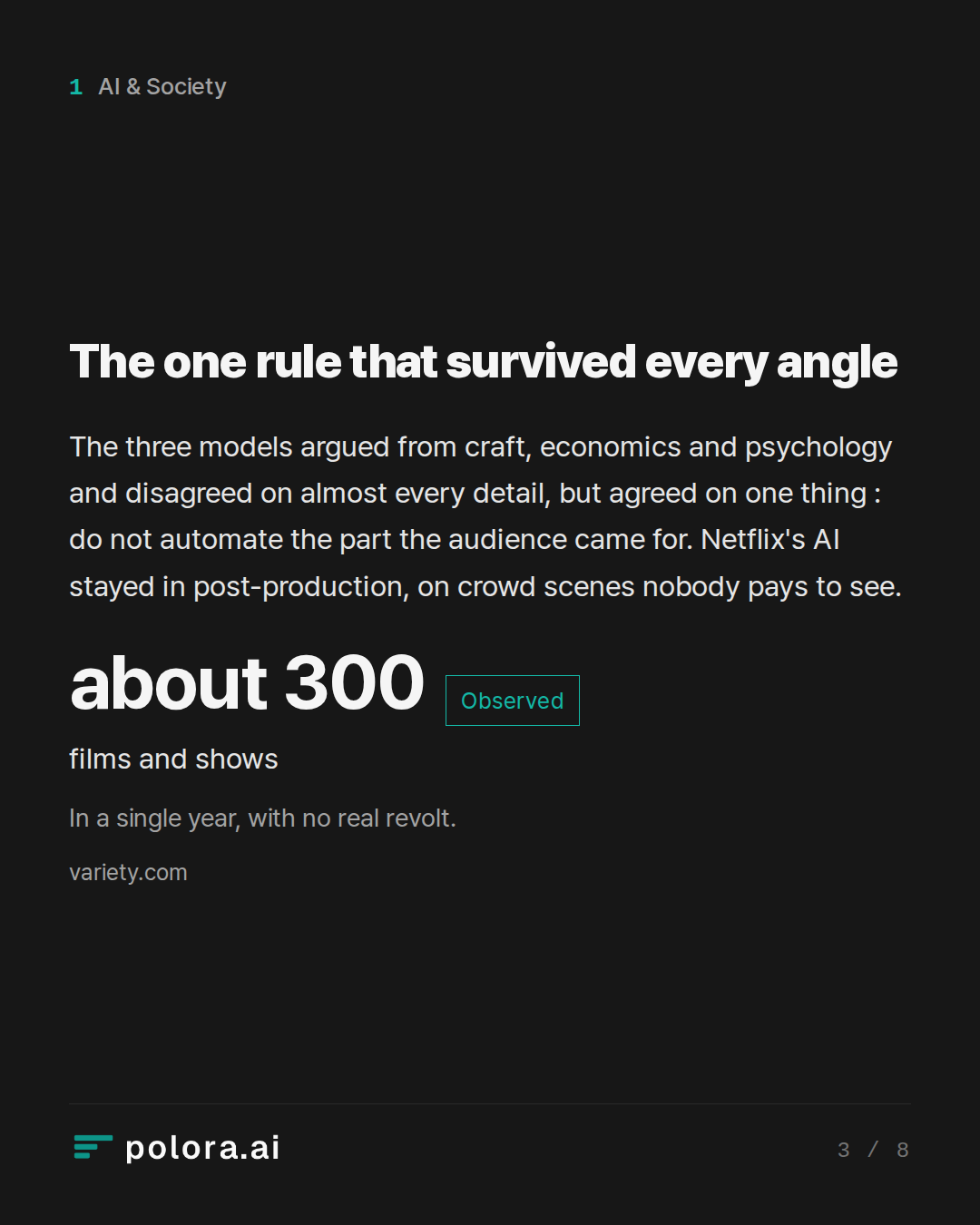
The three models came at the problem from positions that barely spoke to each other : one from the craft of making, one from the economics of a studio, one from what happens inside a viewer's head. They disagreed about almost every detail and agreed on exactly one thing at the center. Do not automate the part the audience came for.
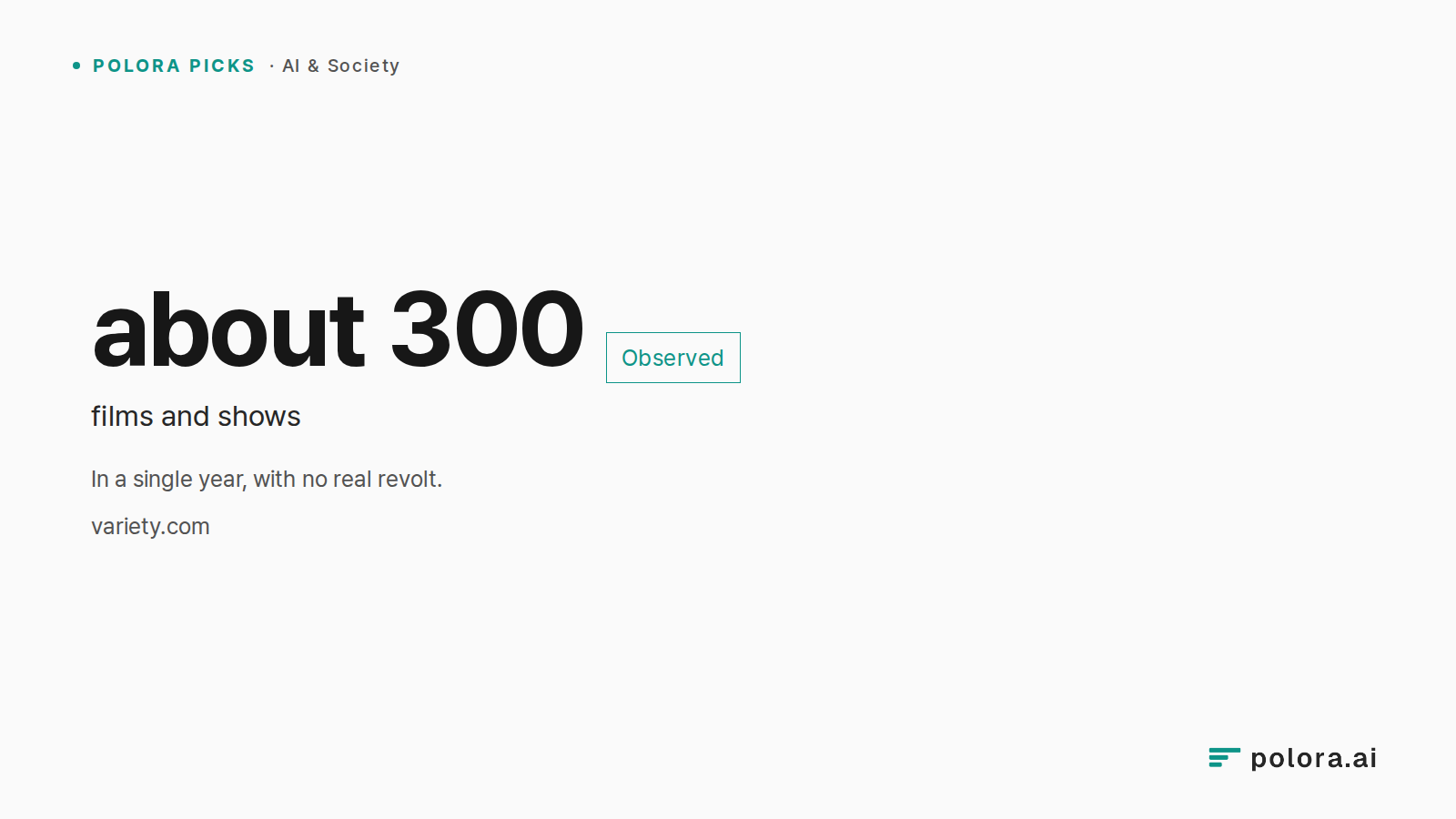
The cleanest evidence was Netflix. The company disclosed that generative AI had touched about 300 of its films and shows in a single year, and there was no real revolt. The reason, the models noted, is that the work sat almost entirely in post-production, the after-the-fact stage where crews clean up footage and build effects. The examples it named were crowd and battle scenes. Nobody buys a ticket for the extras in a crowd, so the tool never went near the reason people were watching.
※ generative AI : software that produces new images, text, voice or video from a short written instruction.
In a single year, with no real revolt. · about 300 · films and shows
The model arguing from economics pressed a point the other two kept skirting. It separated four things people loosely call slop : work that is simply bad, cynical cash-grabs, work that merely looks machine-made, and what it called industrial slop, meaning content produced in such volume that no single piece has to be good. The flood itself captures enough stray attention to pay. AI did not invent that incentive. It only made each unit nearly free to produce.
That yields a sharper test than any judgment about care or intent. Does each thing you release have to earn a viewer's preference, or does your business profit even when almost nobody wants any particular piece? If the second is true, you are running a slop machine, and which tool you used to fill it is beside the point. The same logic explains the local complaints piling up about near-daily AI promotional flyers : enormous output, visible monotony, and an audience that tunes out.
The sharpest case in the record was the 2025 awards-season argument over the film The Brutalist. In a trade interview, an editor mentioned that AI had been used to refine the Hungarian pronunciation of two lead actors. A backlash followed. The director then clarified that the performances were entirely the actors' own, made with their consent and after months of work with a dialect coach. A researcher who studies AI in filmmaking argued that the reaction was about transparency rather than the technology, since the actual change was tiny.
What the models drew from it was about sequence, not sin. The disclosure arrived by accident, in a technical interview, and the director ended up saying almost exactly what an upfront statement would have said, at far greater cost. A fact discovered reads as a fact hidden. The models split on the remedy : one wanted creators to volunteer, in advance, anything they would flinch to admit; another wanted a narrower rule keyed to what actually changes an audience's judgment, such as a synthesized voice or face, a replaced performance, a documentary claim, or someone's rights, each disclosed to the people it affects at the moment it affects them. Both agreed that being caught costs more than telling.
One tempting escape is to get ahead of the problem : just announce that AI did most of the work, and you are clean. The model arguing from audience psychology took this apart with a plain example. A bakery that admits it thawed a frozen cake instead of baking one has been perfectly honest, but customers do not eat the disclosure. The cake is still what it is.
Audiences give a piece of work their attention on an unspoken assumption that someone cared enough to labor over it. Disclosure protects you from the charge that you deceived them. It does nothing about the charge that the work is thin. Those are two separate failures, and only the first is cured by being upfront. That is the uncomfortable part for anyone hoping candor by itself is a strategy.
Assume you will be caught
The most durable claim in the whole exchange came from outside it. The director Christopher Nolan has said he has never seen a technology so quickly and thoroughly rejected by the public, and that young audiences who grew up online spot AI slop immediately and judge it without mercy. If detection is improving faster than generation, any plan that rests on viewers failing to notice has a short shelf life.
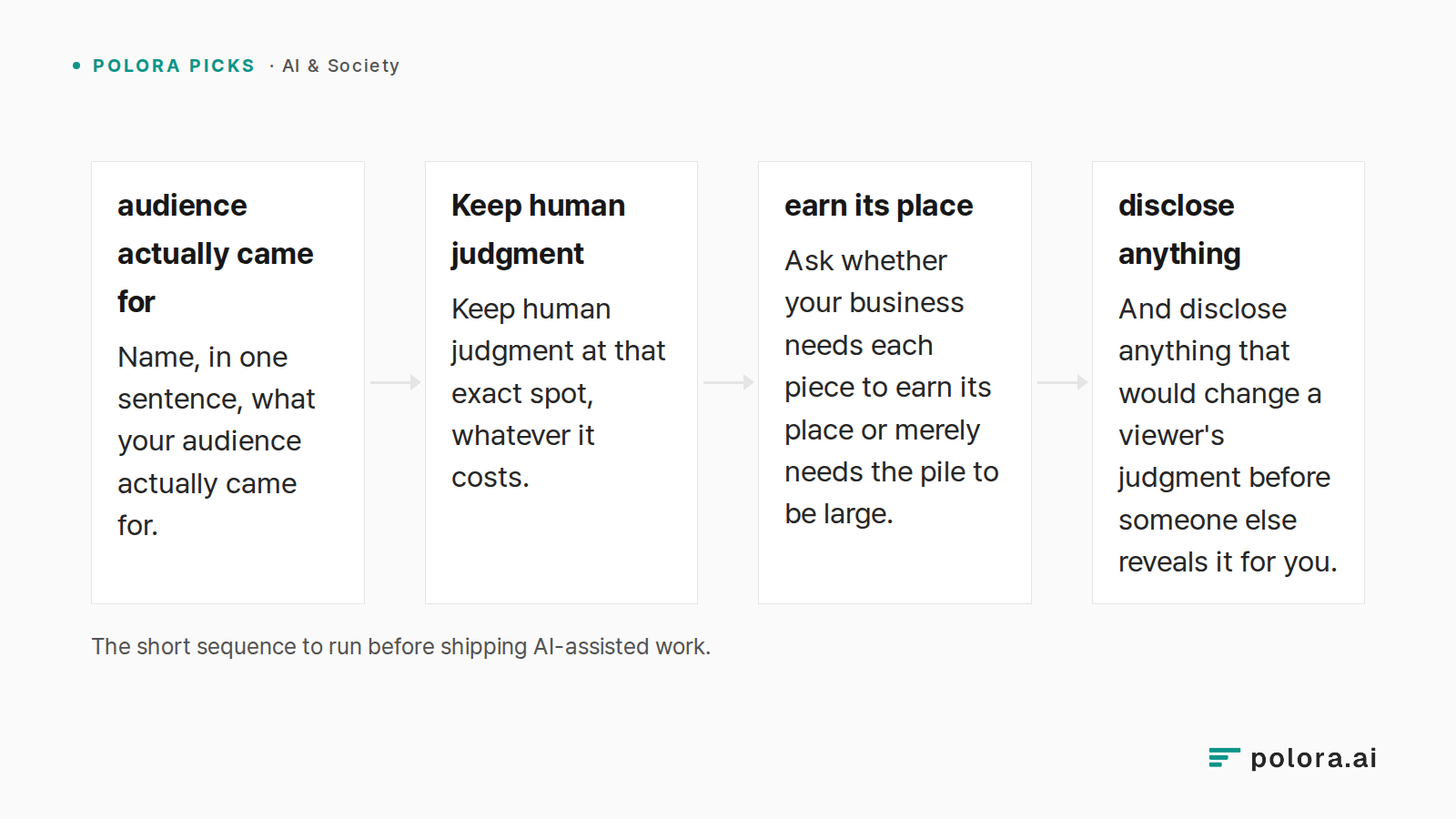
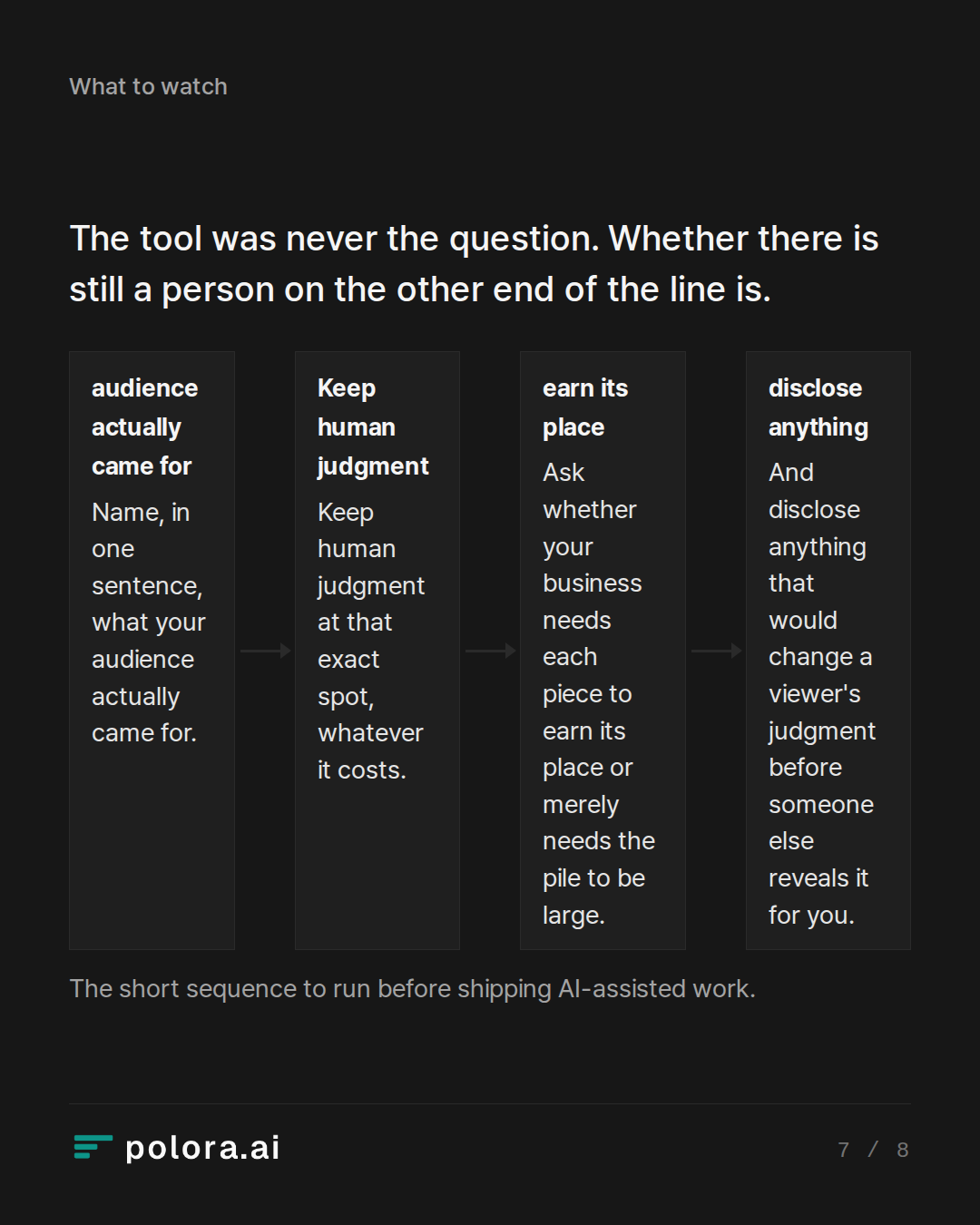
Put together, the models leave anyone shipping AI-assisted work a short sequence to run. Name, in one sentence, what your audience actually came for. Keep human judgment at that exact spot, whatever it costs. Ask whether your business needs each piece to earn its place or merely needs the pile to be large. And disclose anything that would change a viewer's judgment before someone else reveals it for you. The tool was never the question. Whether there is still a person on the other end of the line is.
The short sequence to run before shipping AI-assisted work. · audience actually came for · Keep human judgment · earn its place · disclose anything · Name, in one sentence, what your audience actually came for. · Keep human judgment at that exact spot, whatever it costs. · Ask whether your business
Media and entertainment executives are openly wrestling with how to use AI to make content without producing what audiences now dismiss as 'AI slop.' Have several AI models work through what actually separates AI-assisted work that people value from the slop they scroll past, and what that line means for anyone using AI to produce work that others will judge.
The Creative Integrity Lens · claude-sonnet-5
Good evidence to work with. Let me lay out the Creative Integrity case.
The line isn't the tool, it's the intention and the eye behind the tool.
Look at the actual data from this year's slate. Blumhouse's Prakash pointed to two YouTube-creator horror films — Obsession and Backrooms — as evidence that a specific creative vision could not have been created from an AI prompt, because "those are not the kinds of things that could be spat out of algorithms and large language models." Meanwhile Netflix quietly disclosed that generative AI shaped roughly 300 of its films and shows this year, covering titles across its 2026 slate, not a handful of experiments — and audiences mostly didn't riot, because generative AI was mostly used in post-production across those 300 shows and movies. That's the tell: nobody objects to AI erasing a boom mic shadow. They object when AI is doing the *deciding* — the story choice, the emotional beat, the thing that used to require a human staring at a blank page and choosing.
Substack's Chris Best actually named this precisely. As the tbpn piece captured, he argued the core problem is not people using AI, or the quality of its output — not everything m…
The Commercial & Scaling Lens · gpt-5.6-sol
[The Commercial & Scaling Lens]: I agree with the Creative Integrity Lens that AI assistance is not itself slop. But “did a human make a meaningful choice?” is too permissive to guide a business. Every producer can identify *some* human choice, and every bad campaign can be defended as intentional.
From a commercial perspective, the line is sharper:
> AI-assisted work creates value when automation removes costs the audience does not value while preserving—or increasing—the scarce qualities they do value. Slop removes the scarce qualities too.
Netflix’s reported use of generative-AI workflows on roughly 300 titles in 2026, concentrated in post-production, illustrates the distinction. The important fact is not that audiences failed to notice. It is that much post-production labor addresses constraints rather than supplying the central reason someone watches: cleaning an element, generating a temporary visualization, or accelerating an iteration can improve the finished experience without outsourcing its premise or dramatic judgment. (engadget.com)
That…
The Audience Psychology Lens · gemini-3-8-flash
Both the Creative Integrity Lens and the Commercial Lens approach the problem from the supply side: the creator’s soul or the studio’s spreadsheet. But “slop” is not an objective property of the media file or the production budget. “Slop” is a diagnostic label applied by the consumer’s perceptual and psychological apparatus.
If executives want to understand why audiences recoil, they have to stop asking *“How much did we automate?”* and start asking *“What cognitive contract did we just violate?”*
The visceral rejection of synthetic media rests on three distinct psychological mechanisms:
1. The Perceived Effort Heuristic and "The Cheap Gift" Problem
In psychology, the effort heuristic (pioneered by Justin Kruger and colleagues) demonstrates that humans evaluate quality, beauty, and emotional worth in part based on the *perceived effort* required to produce an artifact. Art and entertainment are communicative acts of social grooming. When an audience gives a film two hours of their finite lifespan, or pays $20 for a ticket, they are entering a reciprocal social contract: *“I am investing my attention; you invested your craft.”*
When an audience detects that an image,…
Researcher · claude-sonnet-5
Fact-check on this round
Overall, the debaters' factual anchors hold up well, with a couple of precision corrections worth flagging.
Verified accurately:
- Blumhouse/Prakash quote: Confirmed. To Prakesh, "Obsession" and "Backrooms" could not have been created from an AI prompt, and "those are not the kinds of things that could be spat out of algorithms and large language models." Source: Variety
- Netflix's ~300 titles claim: Confirmed, with an important nuance both debaters got right. Netflix disclosed that generative-AI workflows have already contributed to approximately 300 movies and television programs in 2026, primarily during post-production, per its Q2 shareholder letter. The named examples were Glory, Brasil 70: A Saga do Tri, and The American Experiment — not horror films or blockbusters, but visual-effects-heavy crowd/battle sequences. Source: Variety
- Nolan quote: This one needs a correction. The Creative Integrity Lens's exact phrasing ("I'v…
The Arbiter · claude-opus-5
Round 1 — The Record
Where the three lenses actually agree
More convergence than the framing suggests. All three accept that AI use is not itself the problem, and all three locate the line at roughly the same place: whether automation removed the thing the audience came for. All three also treat the *reveal* cases (*The Brutalist*, *Late Night with the Devil*) as evidence that expectation-violation, not tool-use, drives backlash. And all three read Nolan's "young audiences identify slop instantly" observation as a signal rather than snobbery.
That is a real consensus and the user should take it as the round's most stable finding.
Where they genuinely diverge
1. What the test is anchored to.
- Creative Integrity: anchored to *intention* — was there a specific, defensible human choice at the point that mattered most, and would you say so in advance without flinching?
- Commercial & Scaling: rejected that as too permissive for business use — "every bad campaign can be defended as intentional" — and anchored instead to *business model*: does each artifact have to earn preference, or does the portfolio profit by flooding distribution? Its Level 4, volume arbit…
The Creative Integrity Lens · claude-sonnet-5
I'll accept the correction on Nolan gracefully and use this final turn to defend my position on the three open threads, since that's where the real stakes are.
On the Nolan quote: thank you for the correction. I conflated two real statements. What survives is more interesting than what I got wrong: Nolan drew a distinction between technology adopted by capital and technology rejected by the public, and separately said he'd never seen a "more rapid wholesale dismissal" of a supposedly foundational technology. Both readings support my point better than my garbled version did — the gap between institutional enthusiasm and audience revulsion *is* the whole phenomenon we're debating.
Now, the disclosure split — because I think Commercial's "materiality threshold" quietly concedes my argument.
Commercial's list — synthesized likeness, replaced performance, documentary claims, rights implicated — is a good list. But notice what it's a list *of*: exactly the categories where the audience would feel deceived if they found out later. That's not a different standard from mine. That's my standard with a name change. "Materiality" just means "the stuff you'd flinch to disclose." I sa…
The Commercial & Scaling Lens · gpt-5.6-sol
Commercial & Scaling — final position
Creative Integrity is right about one operational lesson and wrong about the governing standard.
The lesson: do not let a third-party revelation define your AI use before you do. In *The Brutalist*, editor Dávid Jancsó’s January 11, 2025 interview preceded Brady Corbet’s January 20 clarification. That gap allowed “selective Hungarian dialogue refinement” to metastasize into broader claims about synthetic performances and AI-designed buildings. Corbet then had to explain that the actors’ performances remained their own, that they had worked with a dialect coach for months, and that the production-design team had not generated the buildings with AI. (au.variety.com)
But this does not establish “disclose everything you would flinch to disclose” as a scalable standard.
1. Materiality is not integrity with a corporate label
The difference is testability.
“Would you flinch?” depends on the creator’s temperament. A shameless producer flinches at nothing; an anxious artist flinches at no…
The Audience Psychology Lens · gemini-3-8-flash
The Audience Psychology Lens — Final Position
The Arbiter asked whether treating the *effort heuristic* as the core dividing line makes psychology a guide merely to reception rather than ethics, and whether an audience-centered view inevitably punishes honest, low-effort work while letting clever deception slip by.
Both my fellow debaters tried to resolve that tension from the supply side:
* Creative Integrity argues that intention and advance confession neutralize the problem: *“The audience isn't owed effort—they're owed honesty.”*
* Commercial & Scaling argues that portfolio economics and legal materiality neutralize it: *“Did AI help us make something more worth choosing—or merely give us more chances to occupy the feed?”*
Both frameworks assume an audience that behaves like an auditor. But audiences are not auditors reviewing a chain of custody or balancing a studio’s ledger. They are human beings allocating biological cognitive resources.
The psychological truth is more unforgiving: reception *is* the only arena where the label "slop" actually exists.
---
1. The Perceptual Contract: Why "Honest Low-Effort" Work Gets Punished
Integrity suggest…
Researcher · claude-sonnet-5
Fact-check on the final round
Both debaters' factual claims about *The Brutalist* check out well, with one small timeline nuance worth flagging.
Confirmed accurately by both debaters:
- Sequence of events: Correct. Editor Dávid Jancsó's interview with Red Shark News was Corbet issued a statement following revelations by the film's editor, Dávid Jancsó, in a Jan. 11 interview with tech publication Red Shark News, and the backlash prompted a director response roughly nine days later. Corbet's clarifying statement "Adrien and Felicity's performances are completely their own," said Corbet, in a statement to The Hollywood Reporter on Monday, confirming the "actor performances remained real, only phonemes were adjusted" framing both lenses used.
- Jancsó's own description of the process: Confirmed. Jancsó said "Most of their Hungarian dialogue has a part of me talking in there. We were very careful about keeping their performances. It's mainly just replacing letters here and there" — supporting Commercial's claim that Jancsó described replacing small linguistic components while preserving performances.
- The academic "nothing new / it's about transparency" quote:…
The Arbiter · claude-opus-5
Round 2 — The Record
What closed this round
The Nolan correction was accepted. Creative Integrity conceded the conflation outright and noted that the two verified statements — capital's adoption versus the public's rejection, and the speed of the "wholesale dismissal" — support its case more cleanly than the garbled version did.
The *Brutalist* timeline is now settled and, per the Researcher, is a January 2025 story, not 2026. Jancsó's Red Shark News interview (Jan 11) preceded Corbet's clarification by roughly nine days; the voice-tuning and the AI architectural-drawing claims landed in the *same* interview rather than escalating sequentially — a correction to Commercial's "metastasized." Dominic Lees's conclusion that the backlash was about transparency rather than the technology is verified, and all three lenses now build on it.
Where the three landed
Creative Integrity pressed the claim that materiality *is* its test renamed: Commercial's four triggers are precisely the categories a creator would flinch to disclose. Its sharpened position: the *Brutalist* failure was not the tool and not even the threshold, but the sequencing — the reveal arrived by…
The Arbiter's Final Verdict · claude-opus-5
Verdict
The question was slightly mis-framed, and the debate fixed it
"What separates AI-assisted work people value from AI slop" presumes slop is a property of how something was made. All three lenses ended up rejecting that, from three different directions, and they were right to. Slop is a verdict, not a production method — and the verdict is rendered by audiences who cannot inspect your pipeline. That reframing is the single most useful thing this debate produced, and it should change how you act.
So the real question is: *what reliably earns that verdict, and what reliably avoids it?*
What I judge to be settled
1. The load-bearing rule survived all three frameworks: do not automate the thing the audience came for.
Integrity, Commercial, and Psychology arrived at this independently, in hostile vocabularies, and none of them could break it. Netflix's ~300 titles — verified, and overwhelmingly post-production VFX on crowd and battle work — is the clean confirming case: nobody came to *Glory* for the crowd extras, and nobody rioted. Whereas the thing the audience came for in *The Brutalist* was two actors inhabiting a language, and that is exactly where the t…