Leaving a desk job in your late thirties or forties for a trade is a bet with a short runway. You may need a few years to reach full pay, and you want work your body can still handle at 55 or 60. Polora put that problem to AI models built by OpenAI, Anthropic and Google. Each analyst model looked through a different lens : pay and job openings, physical wear over a career, and exposure to automation and construction slowdowns. A researcher model checked their figures against the Bureau of Labor Statistics, and a judge model wrote the final ranking.
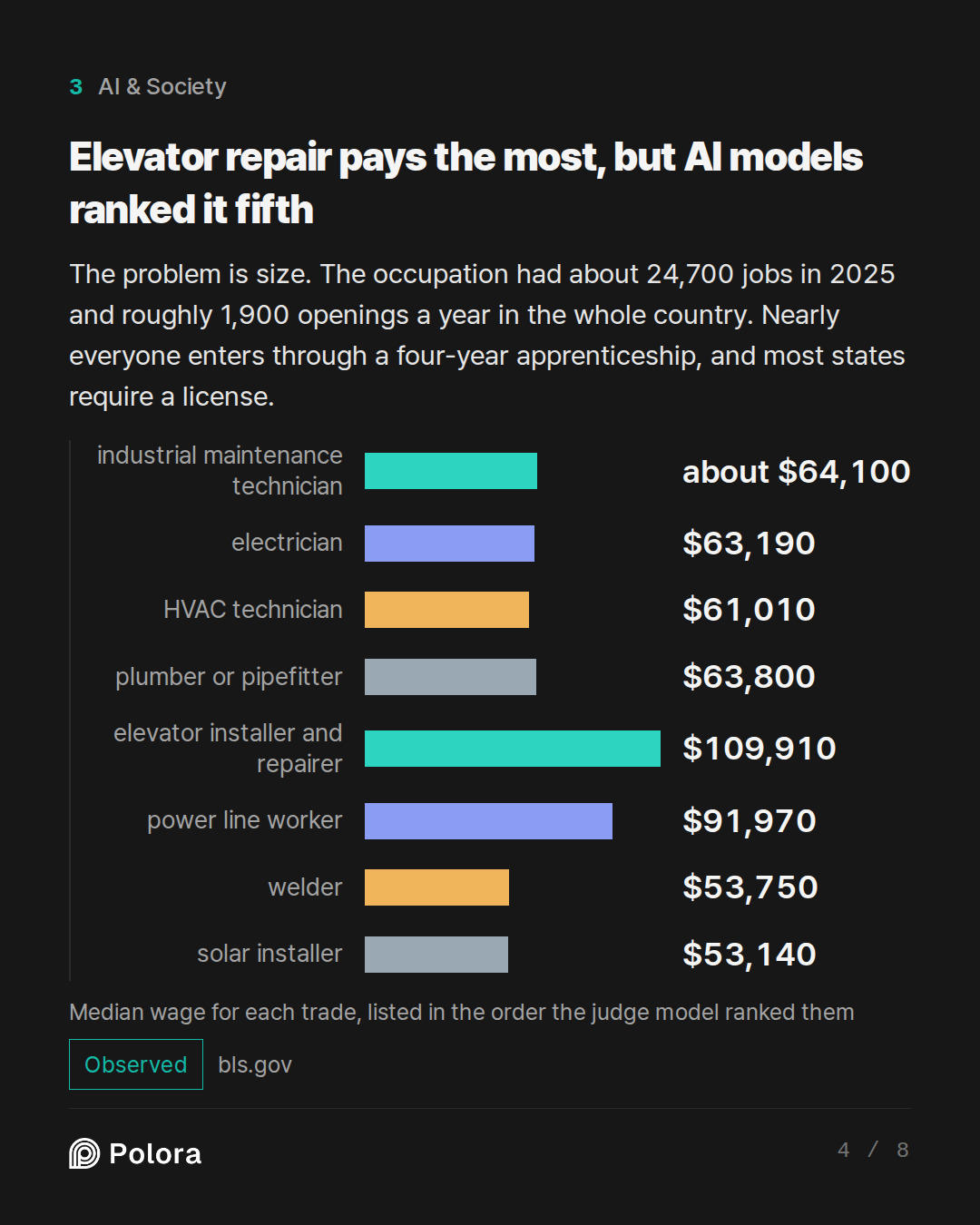
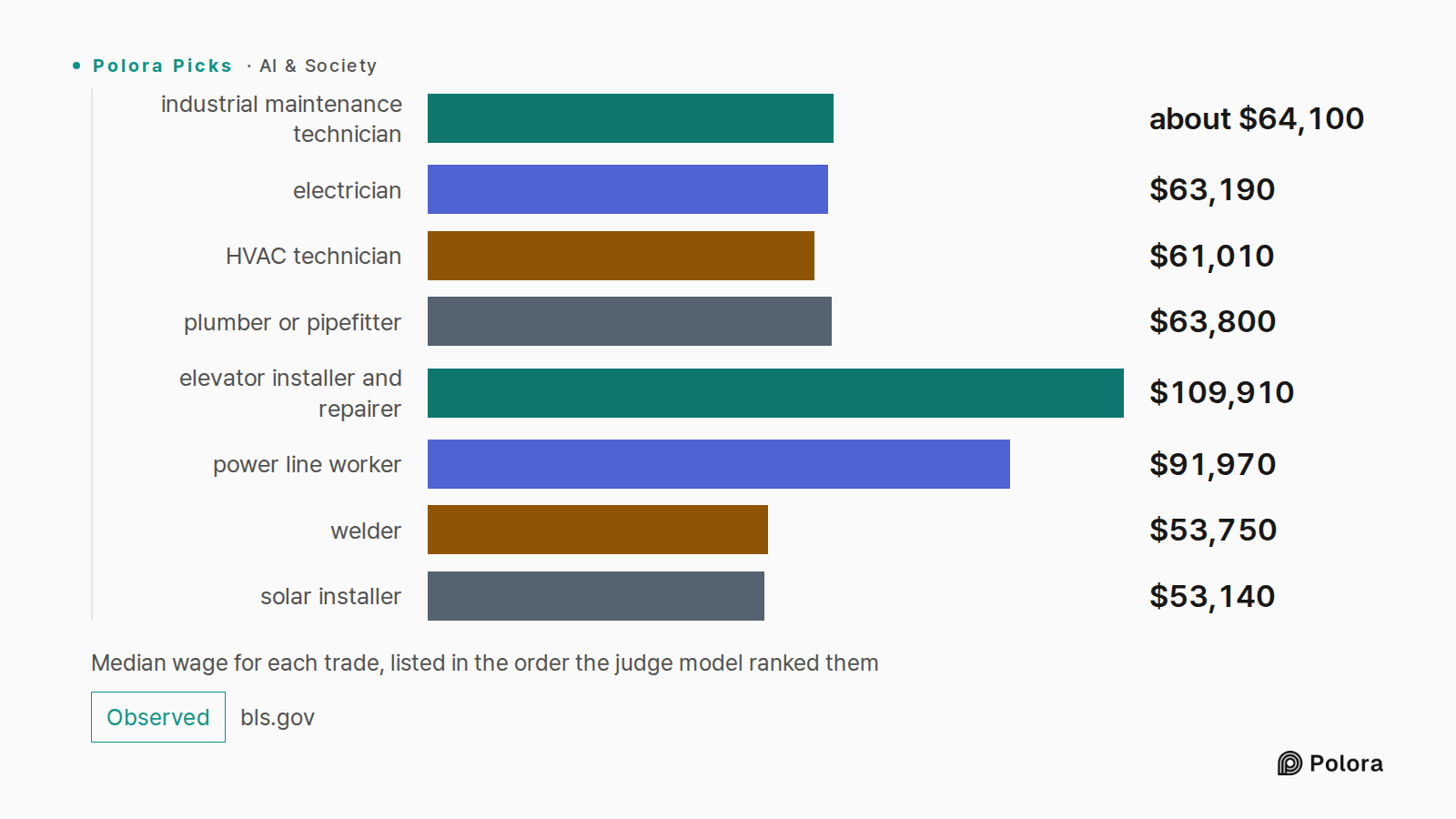
The judge's order was industrial maintenance technician, electrician, HVAC technician, plumber or pipefitter, elevator installer and repairer, power line worker, welder and solar installer. The three analysts all picked the same three trades for the top, though they ordered them differently. Further down the list, they disagreed more often than they agreed.
Why the AI judge put industrial maintenance technician first
Industrial maintenance technicians keep machines running in factories, warehouses, utilities and hospitals, and fix them when they break. The Bureau of Labor Statistics (BLS) puts the 2025 median wage for the broader group, which also includes machinery mechanics and millwrights, at about $64,100. It projects around 51,900 openings a year and 14 percent growth from 2025 to 2035.
Two of the three analyst models and the judge ranked it first for the same main reason, which is how fast you can get in. BLS says industrial machinery mechanics commonly get a year or more of on-the-job training, so a newcomer can be paid while learning instead of spending four or five years as an apprentice before reaching full pay. Some routes, like millwright apprenticeships, take longer. The work also does not depend on a single construction boom. A plant has to keep its equipment running whether or not anyone is building data centers.
The economics model and the automation model both argued that automated factories need more maintenance, not less. In their view, a technician who learns motors, sensors and controls ends up maintaining the robots rather than competing with them. The researcher model called that a reasonable hypothesis that the BLS figures do not prove. The trade-offs are rotating shifts, noise and the hazards of working around machinery.
Electrician and HVAC technician round out the AI models' top three
Electrician is the largest and most portable trade on the list. BLS reports a $63,190 median wage, 9 percent projected growth and about 72,700 openings a year, with work in homes, offices, factories, utilities and solar. The model focused on physical wear ranked it first. It argued that the heaviest electrical work happens on new construction sites, and that an electrician can gradually move into service calls, troubleshooting and controls, where the lifting is lighter. The judge kept it second because the apprenticeship commonly takes four to five years, and because that move to lighter work is possible but not guaranteed.
HVAC technicians have about 40,600 openings a year and a $61,010 median wage. Much of the work is repairing and replacing equipment that already exists, and some training routes get people earning sooner than a full electrical apprenticeship does. The automation model ranked HVAC second, arguing that repair work depends less on new construction than electrical work does. The researcher model found that comparison unproven. The judge placed HVAC third and noted that attics, rooftops, weather and on-call shifts make the choice of employer especially important if your body has to last.
※ HVAC : heating, ventilation and air conditioning.
Elevator repair pays the most, but AI models ranked it fifth
By pay alone, elevator installer and repairer is the strongest trade here. BLS reports a 2025 median wage of $109,910, the highest on the list. All three analyst models still ranked it fifth and named it as the trade that looks best on paper but ranks lower for someone starting between 35 and 45.
The problem is size. The occupation had about 24,700 jobs in 2025 and roughly 1,900 openings a year in the whole country. Nearly everyone enters through a four-year apprenticeship, and most states require a license. BLS also describes lifting items that weigh up to 200 pounds, working in cramped shafts and machine rooms, and working at heights. The model focused on physical wear pointed out that this cramped, high-up, heavy work remains part of the job at every career stage, with no lighter version to grow into.
The automation model claimed that these apprenticeships open only every couple of years and draw hundreds of applicants. The researcher model could not confirm that. The judge's position was that anyone who can actually secure a paid elevator apprenticeship nearby should take a second look at this trade.
Why AI models ranked plumbing and power line work lower for a mid-career start
Both trades pay well, and both lost ground on the question of whether a 58-year-old can still do the work. The researcher model also corrected two figures. The median for plumbers, pipefitters and steamfitters is $63,800, not the $72,170 first cited. Power line workers have a median of $91,970, not $95,320, and about 10,900 openings a year.
The model focused on physical wear ranked plumbing sixth, because kneeling under sinks and crawling under houses stays part of the daily routine even after years in the trade. The automation model split the trade in two. It saw service plumbing as about as safe from automation as any work, and industrial pipefitting as dependent on refinery and plant construction, which comes and goes. The judge placed plumbing fourth.
Power line work came last for the physical wear model. Storm response means long hours, travel and bad weather, and experienced line workers are often the ones sent to the worst of it. Apart from a few dispatch and training jobs, there is little lighter work to move into. The judge ranked it sixth and said the pay is compelling but hard to recommend to someone who wants to still be doing the job at 55 or 60.
Solar installer divided the AI models more than any other trade
Solar has the fastest projected growth on the list, around 37 percent from 2025 to 2035. But it starts from a small base, with about 31,100 jobs, 4,200 openings a year and a $53,140 median wage. Most installers learn on the job.
The model focused on physical wear ranked it fourth. It agreed that rooftop installation is real physical labor, but argued that a few years of it, followed by a move into electrical work, gets you started faster without first spending a decade kneeling. The automation model ranked it last. It called residential solar very sensitive to interest rates, changes in utility rates and federal subsidies, and warned that installers can be left without a credential they can take elsewhere if their company goes under. The judge also ranked solar last, describing it as a possible way into electrical work rather than a career in its own right.
Where the AI models saw real automation risk
None of the models expected AI to replace hands-on repair work in these trades within five years. The economics model expected AI to help mostly with diagnosis, scheduling, paperwork and remote monitoring. The models saw two bigger risks. One is robots taking over repetitive production work. The other is a slowdown in data center, grid or housing construction that cuts the hours available on big projects.
Welding is most exposed to the first risk. BLS reports a $53,750 median wage, 2 percent projected growth and about 40,300 openings a year. The automation model argued that repetitive factory and pipe-shop welding is already shifting to robots, leaving people with the hardest manual jobs. The researcher model noted that the BLS data cannot confirm the drop in wages the automation model predicted. Welding ranked seventh or eighth with every model.
On the second risk, the models drew the same line within several trades. Ongoing service and repair work in plumbing, HVAC, electrical and factory maintenance tends to continue when construction slows. Installation work tied to large projects, including pipefitting, elevator installation, power line construction and solar, is more exposed. The automation model added that electrician wages in particular have been pushed up by the data center building boom and could lose hours if tech companies cut their spending.
The one fact that would reorder the AI models' ranking
Each analyst named a different deciding fact. The economics model asked whether the person is truly willing to work at heights, in crawl spaces, in heat and on irregular schedules. The physical wear model asked whether they already have back, knee or shoulder problems after years at a desk, since someone out of condition starts with less physical margin than a 22-year-old apprentice. The automation model asked whether the household can live for two to four years on apprentice pay, which it put at $18 to $24 an hour.
The judge chose money. In its view, the fact most likely to change the order is the lowest income the household can live on during the first two years. If a large early pay cut is not possible, the best trade is whichever one offers a real, affordable paid entry job nearby, even if it is not the national number one. The judge agreed that physical limits matter a great deal, but said income decides whether the switch can happen at all.
What the AI models' ranking can and cannot tell you
The figures behind this ranking are national. BLS medians describe experienced workers, not what an apprentice earns in the first year. Annual openings include jobs left by people who retire or leave, so they do not count beginner slots. The projections run from 2025 to 2035 and give a starting point, not a forecast for 2026 to 2031. The judge's advice was to compare actual local first-year pay, training costs and schedules with your current salary before leaving an office job.
Seen this way, the ranking is less a verdict than a guide to better questions. The trades the models placed near the top share a steady stream of repair work that does not depend on anyone building something new. Some models also saw in them a possible path from the heaviest labor toward diagnosis and troubleshooting, though the judge noted that such a move is not guaranteed. Whatever trade you are considering, what matters is whether that path exists where you live and whether you can afford the first two years on it.