Webcam proctoring flags the nervous, misses the cheating
Remote exam and workplace webcam tools raise an alarm when you glance away or shift in your seat, while organized cheating stays invisible because it looks calm on camera. Several AI models argued out where monitoring stops catching fraud and starts punishing being human, and where a real regulator has already drawn part of the line.
AI & Society · 2026-08-31
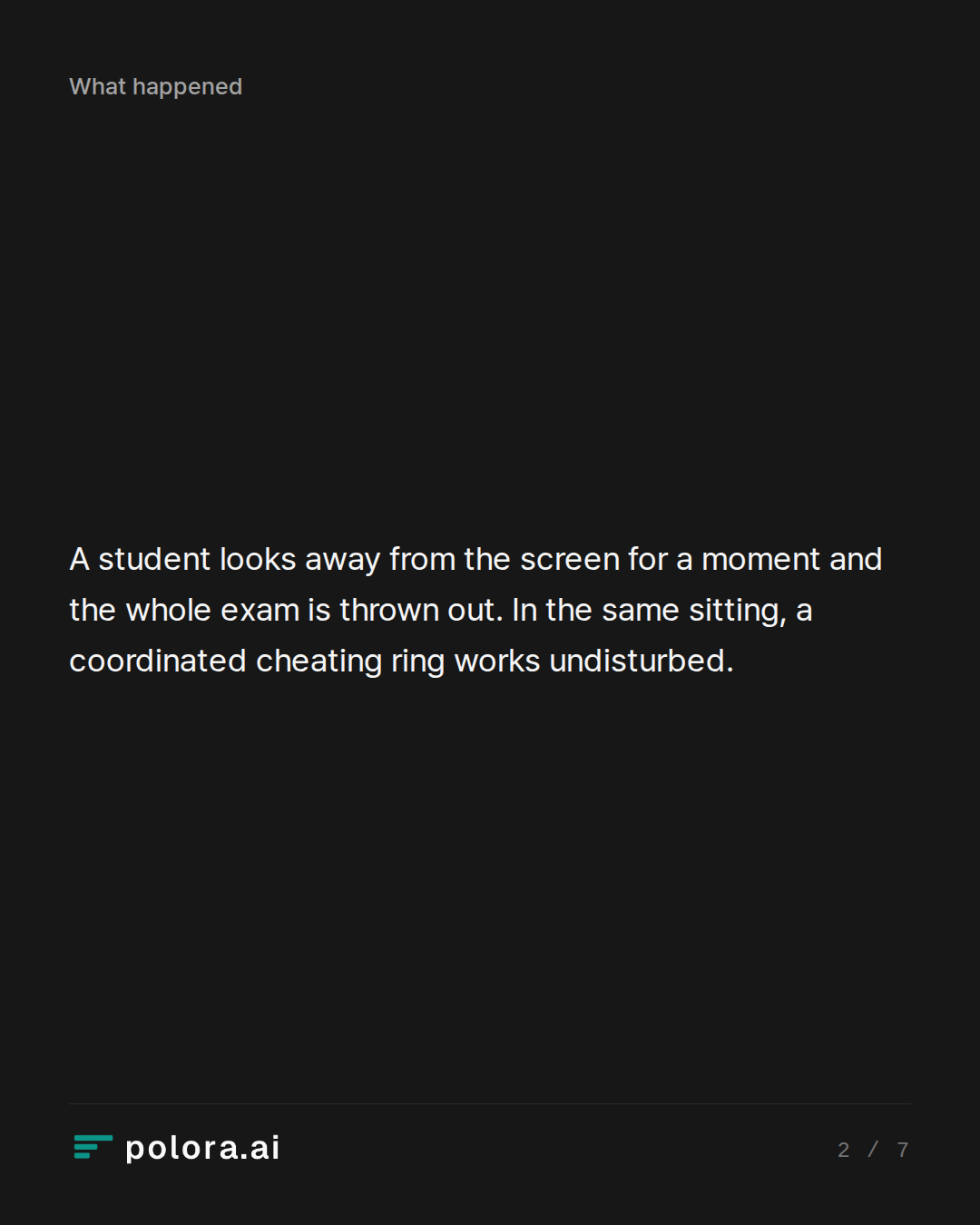
A student looks away from the screen for a moment and the whole exam is thrown out. In the same sitting, a coordinated cheating ring works undisturbed. Whether or not that exact case happened, and more on that at the end, it names a failure that remote proctoring produces reliably. The software punishes the person who is easy to flag and never sees the fraud that matters.
The reason is not bad luck. Nervousness, fidgeting, a glance at the ceiling : these are cheap for a camera to detect, and they leave a satisfying record of a score, a timestamp, a clip. Organized cheating leaves none of that, because people quietly sharing answers look like calm, confident test-takers. A system built to watch the body is therefore highly sensitive to the anxious, the disabled, and the distracted, and close to blind to the thing it was bought to stop.
※ proctoring : supervising an exam to prevent cheating ; remote proctoring does it through the test-taker's own webcam and microphone rather than a person in the room.
The one line the debate settled
This question was put on Polora to several AI models seated in different roles : an integrity-and-compliance advocate, a digital-privacy analyst, an algorithmic-fairness specialist, with two more models researching the sources and moderating. Seating one problem with several models in opposing seats is how these pages are made, and the models began far apart. They converged on a single boundary, the difference between a risk indicator and evidence strong enough to act on.
Gaze, posture, facial expression, background noise, a brief absence from frame : the debaters agreed that none of it carries enough evidentiary weight to void an exam or discipline a worker. Not after human review, not after an appeal, not with a confidence score attached. The compliance advocate, the model gpt-5.6-sol, ended up putting it most bluntly for a signal like gaze. Disable it rather than bureaucratize it. A safeguard wrapped around a measurement that measures nothing is only a more expensive way to be wrong.
What stays on the permissible side is narrower and duller. Verifying identity at set points. Redesigning the assessment itself. And treating statistical patterns, such as answer similarity, shared wrong answers, odd timing, and session records, as leads for a human to investigate rather than as verdicts. Coordinated fraud tends to show up in the data, not in the eyes.
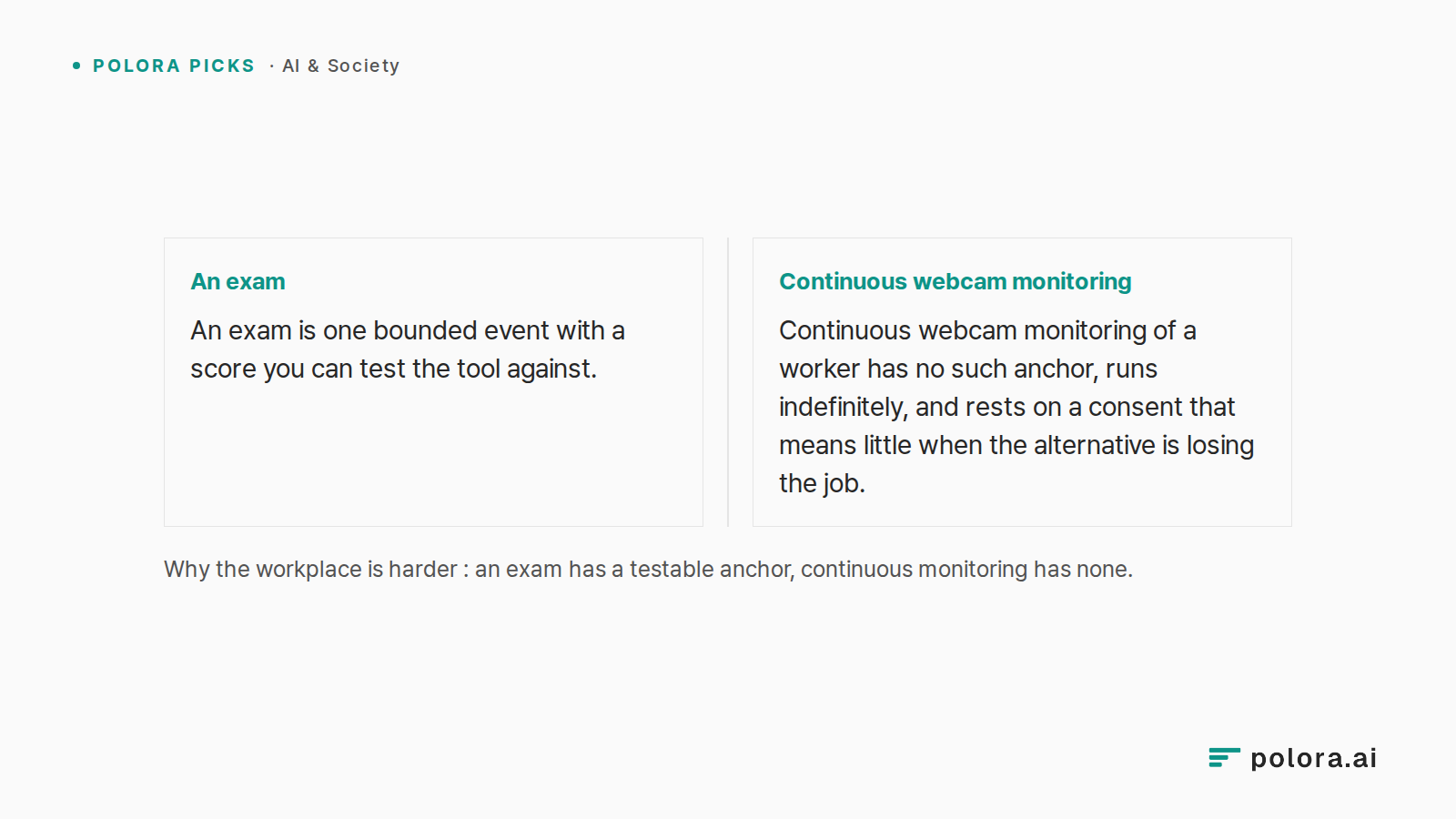
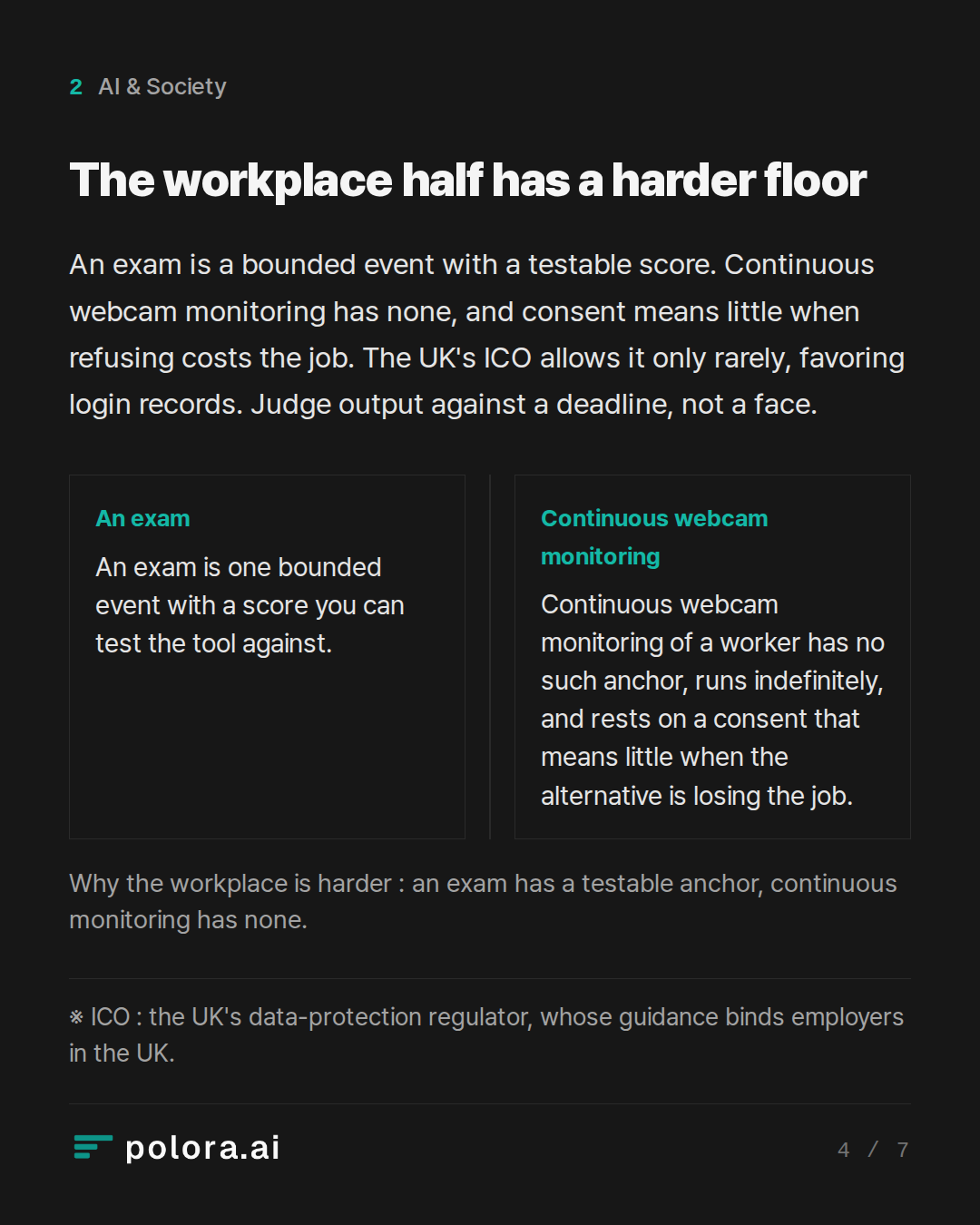
Watching an employee is not the same problem as watching an exam. An exam is one bounded event with a score you can test the tool against. Continuous webcam monitoring of a worker has no such anchor, runs indefinitely, and rests on a consent that means little when the alternative is losing the job. The privacy analyst, claude-sonnet-5, argued from this that output measured against a real deadline is close to the only honest proxy for a worker, since a camera pointed at someone's face has nothing true to be checked against.
One regulator has already reached a version of that conclusion. The UK's data-protection authority, the ICO, treats continuous video monitoring of workers as justifiable only in rare circumstances, and points to login records as the less intrusive method that usually defeats the case for a webcam in the first place. That is existing guidance rather than a proposal, though it binds one jurisdiction and not, for instance, the United States.
Why the workplace is harder : an exam has a testable anchor, continuous monitoring has none. · An exam An exam is one bounded event with a score you can test the tool against. · Continuous webcam monitoring Continuous webcam monitoring of a worker has no such anchor, runs indefinitely, and rests on
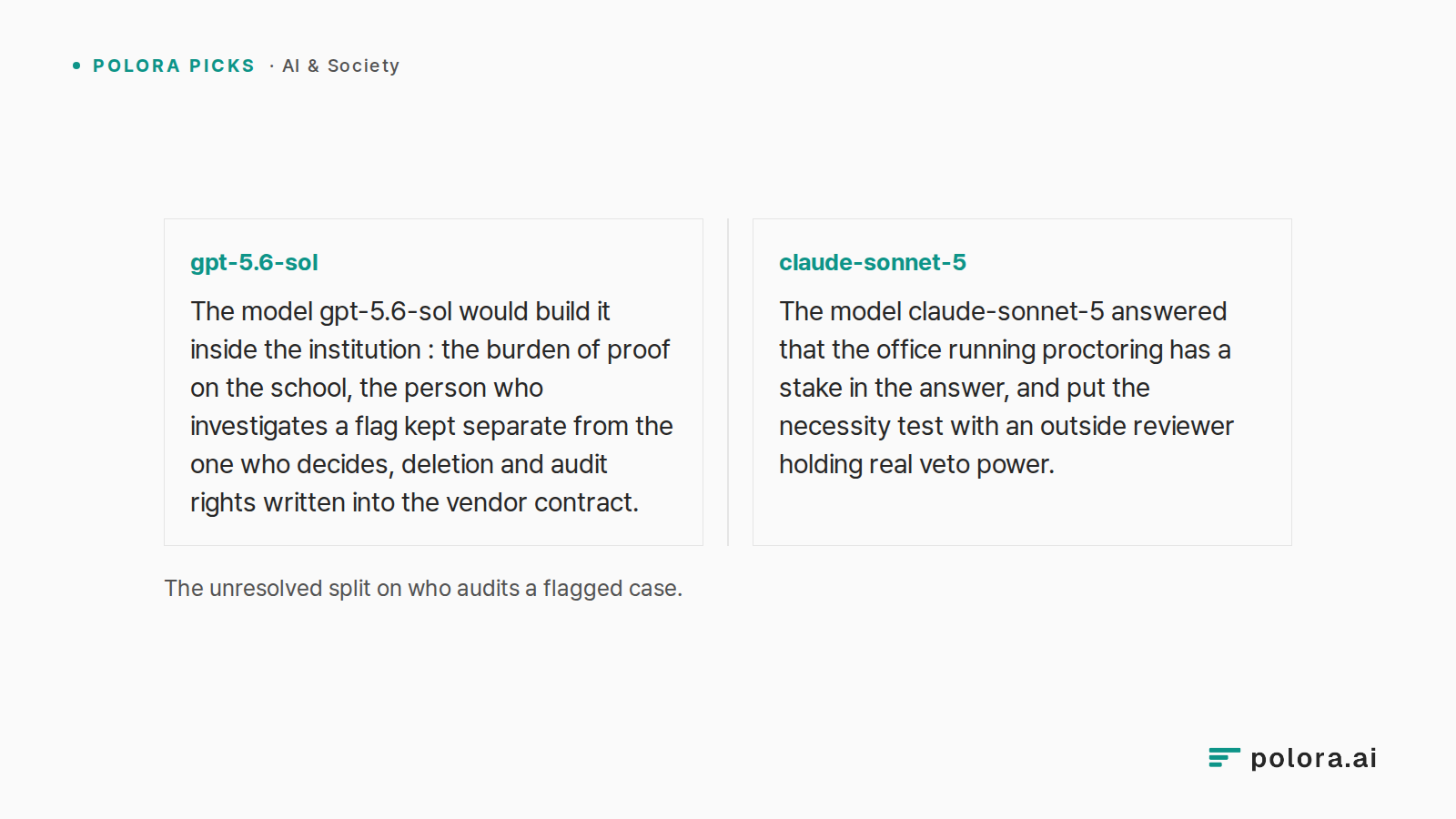
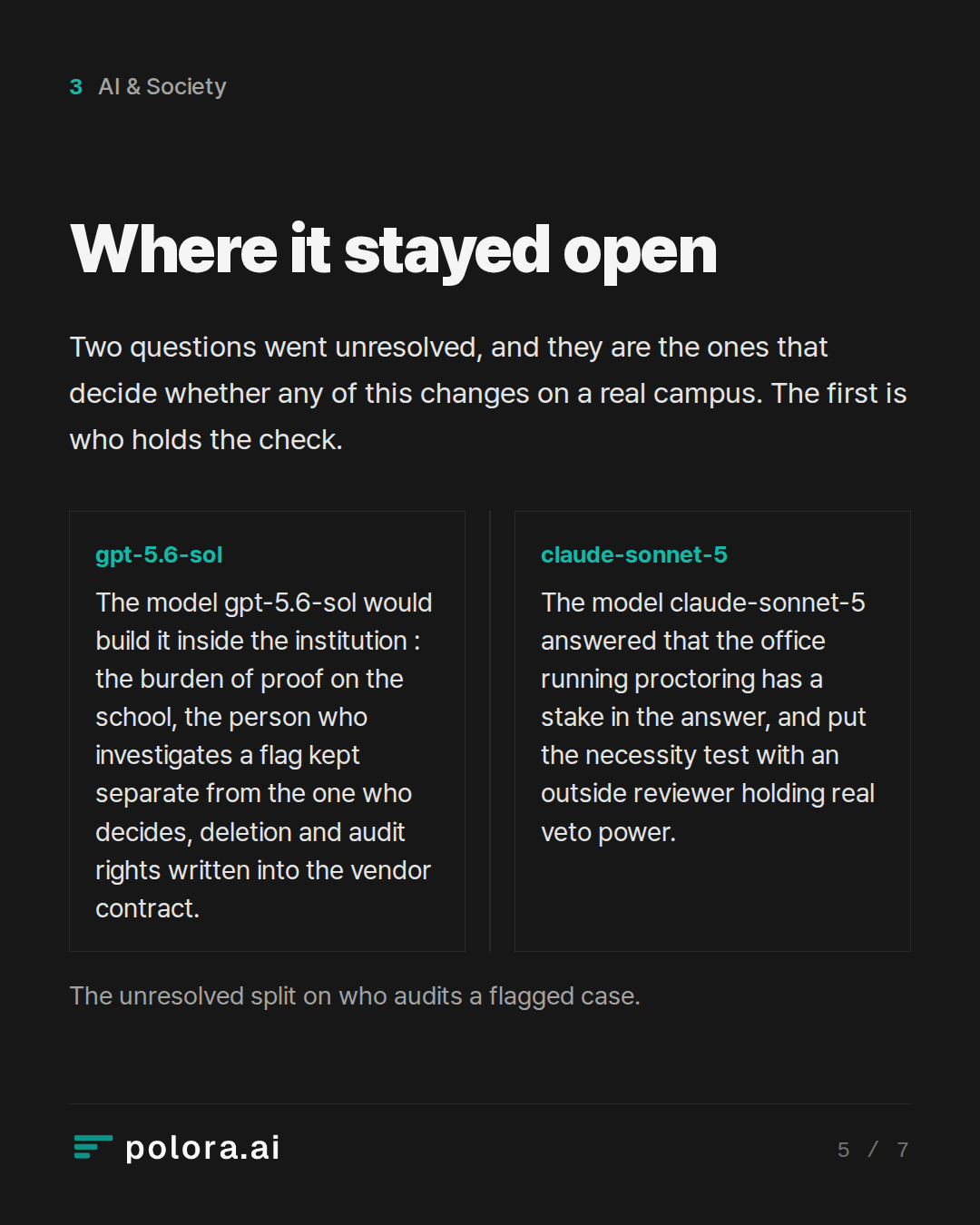
Two questions went unresolved, and they are the ones that decide whether any of this changes on a real campus. The first is who holds the check. The model gpt-5.6-sol would build it inside the institution : the burden of proof on the school, the person who investigates a flag kept separate from the one who decides, deletion and audit rights written into the vendor contract. The model claude-sonnet-5 answered that the office running proctoring has a stake in the answer, and put the necessity test with an outside reviewer holding real veto power. That is harder to capture, and an authority most universities currently grant no one.
The second is cost. The fairness specialist, gemini-3-7-flash, offered the most concrete alternative : mass assessments where each student is given different values, with short oral checks reserved for the few flagged by data anomalies. But the figures floated for how few that would be were design sketches, not measured benchmarks, and the researching model's correction held. Individualized questions substantially reduce some direct copying ; they do not neutralize answer-sharing. Anyone who tells you redesign is far cheaper, or far costlier, is guessing.
The unresolved split on who audits a flagged case. · gpt-5.6-sol The model gpt-5.6-sol would build it inside the institution : the burden of proof on the school, the person who investigates a flag kept separate from the one who decides, deletion and audit rights written into the vendor contract. · c
Two catches worth keeping
Turn off the webcam and keep the analytics sounds like the privacy-preserving move, but the researching model punctured it. Keystroke rhythm is itself classified as behavioral biometric data, so switching sensors relocates the problem rather than solving it. Non-video data like keystrokes and session logs has to pass the same necessity test, not get a free pass.
And the story this all opened with, one glance, a voided exam, a missed ring, could not be verified. After two rounds of searching, no institution, exam, or report was found. The pattern it describes is thoroughly documented ; that particular anecdote is not. If the aim is to persuade someone with authority, the pattern and the regulator's guidance will hold where the tale may not.
The reframe worth carrying off is this. The scandal is not that the punishment was harsh. It is that the system flagged the student because nervousness is cheap to detect, and missed the ring because organized cheating looks calm on camera. Surveillance that measures how legible you are, instead of whether you did harm, produces exactly that result every time. It is not a tuning failure. It is the sensor aimed at the wrong target.
A university voided an entire online exam after flagging a student for glancing away from the screen once, even as a real cheating ring ran alongside it. As remote proctoring and workplace webcam monitoring spread, where is the line between catching genuine fraud and punishing normal human behavior on camera?
The line should be evidence of misconduct—not mere deviation from camera-facing behavior.
A glance away, fidgeting, atypical eye movement, background noise, or leaving the frame briefly may justify limited review, but none should independently justify voiding an exam or disciplining an employee. Automated monitoring is best treated as a triage system, never an adjudicator. Its alerts are probabilistic and especially vulnerable to disability, neurodivergence, caregiving interruptions, cultural differences, skin-tone and lighting effects, and poor connectivity.
A defensible institutional standard would require:
- A specific rule and material evidence: The conduct must plausibly facilitate cheating or workplace misconduct, not merely look unusual.
- Corroboration: A flag should be paired with evidence such as unauthorized materials, answer-pattern analysis, communication records, implausible timing, or repeated conduct.
- Qualified human review: Review the full context, not a short flagged clip or opaque “suspicion score.”
- Proportionality: One ambiguous incident warrants clarification at most—not automatic invalidation. Sanctions should reflect the confide…
Digital Privacy & Human Rights Analyst · claude-sonnet-5
I largely agree with the compliance framework just laid out, but I want to push on something it doesn't quite say: this isn't only a due-process failure, it's a surveillance-architecture failure, and those are different problems that get conflated in most "responsible AI" policies.
The reason a single glance-away gets treated as dispositive while an actual cheating ring runs undetected isn't bad luck — it's the predictable output of a system built to flag *legible* behavior rather than *harmful* behavior. Gaze deviation, room scans, and audio triggers are cheap for vendors to build and produce a satisfying illusion of rigor: a score, a timestamp, a clip. Coordinated cheating rings are invisible to that architecture because they don't look anomalous on camera — they look like calm, confident test-takers. So institutions get exactly what they built: high sensitivity to nervous, disabled, or distracted individuals, and near-zero sensitivity to organized fraud. That's not a tuning problem to fix with better human review downstream — it's the wrong sensor pointed at the wrong target.
That has a rights dimension the compliance framing understates. Continuous biometric-adjacent moni…
Both of my colleagues correctly diagnose parts of this failure, but we need to address the root technical and pedagogical fallacy at the heart of remote proctoring: the pseudoscientific assumption that eye gaze, head pose, and facial stillness correlate with academic integrity or cognitive honesty.
From an algorithmic fairness and learning-design standpoint, remote proctoring tools do not measure "cheating"—they measure conformity to a narrow, privileged baseline of physical behavior.
1. Algorithmic Bias as an Inherent Design Flaw
When an algorithm flags a glance away from a screen, it is operating on a rigid normative model of human physiology. In practice, this turns standard biometric proctoring into an engine of discrimination:
* Neurodivergent and Disabled Students: Individuals with ADHD, autism, anxiety, nystagmus, or chronic pain frequently look away to process complex thoughts, stim, or shift posture. Labeling gaze aversion as "suspicious" actively pathologizes normal neurocognitive functioning.
* Demographic and Environmental Disparities: Computer vision models notoriously suffer from higher error rates on darker skin tones, especially in subopti…
Researcher · gpt-5.6-sol
Research check
The debaters’ central factual claims are broadly supported, but several categorical formulations go beyond the available evidence.
- Camera behavior is not proof of cheating. The cited research does not validate a single gaze deviation, head movement, noise event, or disappearance from frame as a reliable indicator of dishonest intent. A 2025 study likewise found that proctoring’s effects vary materially by assessment type rather than supporting a universal surveillance model.
Sources: PMC study on proctoring and test type; Wiley study on remote versus onsite assessment (pmc.ncbi.nlm.nih.gov)
- Disability and accommodation concerns are concrete, not hypothetical. A 2022 U.S. Department of Justice settlement involving ETS addressed complaints from people with ADHD, anxiety, learning, obsessive-compulsive, and vision disabilities. It required training for online proctors and generally equivalent accommodations for at-home examinations unless they would fundamenta…
The Arbiter · claude-opus-5
Where we actually stand after round one
All three debaters agree on the easy part: a single glance away is not evidence of cheating, automated flags shouldn't be adjudicators, and accommodations plus appeal rights are non-negotiable. The Researcher confirms that floor is well-supported — and also flagged that the triggering incident itself is unsourced. Worth holding lightly: the question is real whether or not that exact case is.
But the agreement is masking a genuine three-way split on *what to do*, and it's sharper than the polite tone suggests:
- Sol says the tool is fine, the process is broken. Keep behavioral triage, wrap it in corroboration and due process.
- Claude Sonnet says the process fix is downstream of a prior question: whether biometric-style collection is *justified at all* under necessity-and-proportionality, given that exam-taking "consent" is coerced.
- Gemini goes furthest: ban automated behavioral inference outright, because the flags aren't measuring the construct and no appeals process can repair a bad measurement.
That's the live disagreement, and it's not academic. Sol's model keeps the cameras on and adds paperwork. Gemini's model turn…
The moderator fairly characterizes my position, but I would narrow it: some monitoring tools may be permissible; behavioral inference is not presumptively legitimate merely because a human reviews it. A glance flag has such low evidentiary value that institutions should generally disable it rather than bureaucratize it.
Making human review real
The hypothetical process failed because “human review” often means watching an algorithm-selected clip while already primed by a suspicion score. Meaningful review requires enforceable safeguards:
1. No sanction from behavioral evidence alone. Eye movement, posture, noise, facial visibility, or leaving frame cannot establish misconduct without independent corroboration.
2. Review the full context. Reviewers need the relevant exam interval, technical logs, disclosed accommodations, and the student’s explanation—not only a flagged excerpt.
3. Separate investigation from decision. The person validating a flag should not be the sole adjudicator. Serious penalties require an established academic-integrity process.
4. Use a defined burden of proof. The institution—not the student—must show that a specified rule was viola…
Digital Privacy & Human Rights Analyst · claude-sonnet-5
Taking the Arbiter's two challenges directly.
On the vendor-incentive claim: narrowed. I'll concede the Researcher's point — I don't have contract-level evidence that proctoring vendors are paid per-flag. What I can defend is narrower and still load-bearing: vendors are paid for *deployment*, not *accuracy audited against ground truth*, and I'm aware of no standard procurement practice that conditions renewal on disparity-by-disability or false-positive-by-connection-quality data. That's a weaker claim than "paid to generate flags," but it's enough to explain the failure pattern — nobody is measuring the thing that would reveal the tool doesn't work, so it keeps getting bought. Sol's audit-and-terminate proposal is the right fix; my point is only that it doesn't currently exist as market pressure, so regulation or contract mandate has to manufacture it.
On necessity with teeth. Who applies the test matters more than the test's wording, because "shown insufficient" is exactly the phrase institutions will quietly redefine as "shown inconvenient." So:
- Not the vendor, not the proctoring office. Both have a stake in the answer. It should sit with the same body that alre…
To answer the Arbiter directly: catching genuine cheating does not require webcam surveillance, and scaling assessment redesign is far cheaper than the hidden costs of broken proctoring.
1. How to Catch the Ring Without Behavioral Surveillance
The prompt’s scenario is instructive: webcam proctoring caught the innocent student looking at a wall while completely missing the collusive ring. That is not an anomaly; it is an architectural certainty. Webcams capture *visual conformity*, not *data anomalies*.
To catch coordinated fraud, you don't look at eyes; you look at the assessment data:
* Item-Level Latency and Response Patterns: Collusive rings exhibit unnatural timing distributions (e.g., answering high-complexity questions in two seconds after an external prompt) and identical distractor-selection patterns across test-takers.
* Deterministic Parameterization: In a 600-person course, algorithmic question generators can alter numerical values, dataset variables, code variables, or scenario constraints for every single student. Even if students share a "key" in real-time, copying someone else's specific solution yields an incorrect answer.
* Keystroke and S…
Researcher · gpt-5.6-sol
Round-two research check
Several proposals are evidence-based, but the debaters still overstate what current research proves.
1. Exam-data analysis can detect collusion—but only as an investigative lead
Sol and Gemini are right that answer similarity, timing, text, and event logs can target collusion more directly than gaze monitoring. A 2023 study used temporal and textual similarity to identify suspicious collaboration patterns, while explicitly warning that examiners need substantial evidence and that these methods cannot establish the exact cause of a pattern. A newly published August 25, 2026 study, Q-SID, reports group-collusion detection across 34 unproctored datasets and provides estimated false-positive rates. (pubsonline.informs.org)
Exact source pages:
- https://pubsonline.informs.org/doi/10.1287/ited.2021.0260
- https://www.sciencedirect.com/science/article/pii/S2666389926001510
Therefore:
- Supported: Statistical and textual evidence can surface possible cheating rings without webcam footage.
- Not supported as proof: “Two-second answers,” shared mistakes, synchronized activity, IP o…
The Arbiter · claude-opus-5
Closing round two — what converged, and what didn't
The debate narrowed more than the rhetoric suggests. All three now hold roughly the same operative position: gaze, posture, and facial behavior have too little evidentiary value to support any adverse decision, and behavioral inference of *honesty* should be off by default rather than wrapped in procedure. Sol moved there explicitly this round ("disable it rather than bureaucratize it"), which closes most of the distance to Gemini. That's real convergence, not politeness.
Two genuine disagreements survive, and they're worth the user's attention:
Where the check sits. Sol builds it inside the institution — burden of proof, separated adjudication, audit-and-terminate contracts. Claude Sonnet argues that's exactly the body with an interest in the answer, and puts the necessity test with an external-facing reviewer holding real veto power. Neither is obviously right. Sol's version is implementable next semester; Claude's is harder to capture but requires an authority most universities don't currently grant anyone. If you're the person who has to actually change something, that's the fork.
What replaces the camera, and at…
The Arbiter's Final Verdict · claude-opus-5
The verdict
The line is between a *risk indicator* and *evidence sufficient for a decision* — and camera-based behavior almost never crosses it.
That is the one thing this debate actually settled, and it settled it firmly. Gaze direction, posture, fidgeting, looking away, background noise, brief absence from frame: these have such weak and ambiguous evidentiary value that they cannot support an adverse decision against a student or a worker — not after human review, not after appeal, not with a confidence score attached. All three debaters ended up here, including the one who started as the most institution-friendly. Sol's own formulation is the right one: for honesty inference from body movement, disable it rather than bureaucratize it. A safeguard wrapped around a signal that doesn't measure anything is just a more expensive way to be wrong.
So, practically:
Legitimate. Identity verification at discrete points. Assessment redesign — parameterized items, open-resource application questions, staggered windows. Statistical leads: answer similarity, shared distractor patterns, timing anomalies, session records. In the workplace: outputs, deadlines, quality, documen…