How to verify a remote hire after the stand-in trick
A stand-in sits the video interview while someone else does the job, a trick United States investigators tie to North Korean IT workers who use stolen American identities to win remote roles. Several AI models sorted the hiring checks that prove who you hired from the ones that only feel safe.
AI & Society · 2026-09-13
You meet the applicant on a video call, talk for an hour, and send the offer. The work that comes back is competent. But the person on your company laptop may never have been the person on that call. United States law enforcement has been warning about a specific version of this : organized rings of North Korean IT workers who use stolen or borrowed American identities to win remote jobs at Western companies and route the pay back to a government under sanctions. Sending a stand-in to sit the interview, then handing the actual job to someone else, is one of their moves.
Polora put the problem to several AI models built by different companies and had them work through it together : how can a company confirm who it is really hiring for a remote role, without treating every foreign applicant as a suspect. They agreed on most of the answer, and the places where they pushed back on one another turned out to be the most useful part.
The interview stopped being proof
An FBI alert from July 2025 spells out the tactic. People based in the United States have sat virtual interviews on behalf of these workers, and the alert warns plainly that whoever passes the first interview is sometimes not the person who later does the work.
A court case makes that harder to wave away. In a March 2026 sentencing, three people in the United States admitted letting overseas workers borrow their identities to clear employer vetting, including video interviews, a drug test, and fingerprinting. The company laptops were then operated from abroad. The lesson the models drew is uncomfortable : a check can feel personal and physical and still bind you to a willing stand-in rather than to the worker.
The models were united that this should be read as an organized, state-linked program rather than a clever individual. The workers use stolen or borrowed American identities, route their pay abroad, and in some cases turn into an inside threat once trusted, stealing code or data or pressuring the employer after being caught.
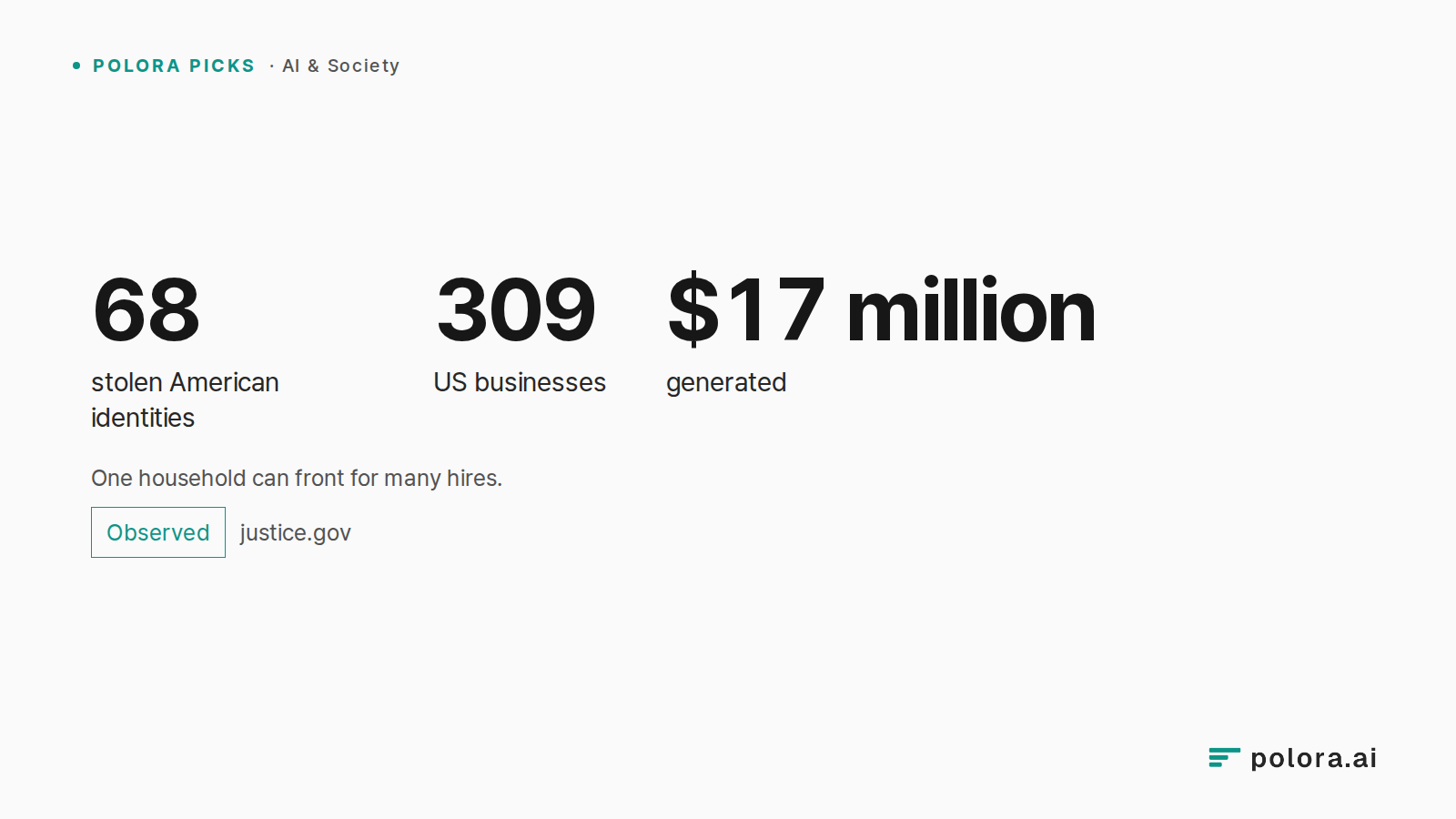
The scale is on the record. In July 2025 a woman in Arizona was sentenced for running a scheme that used 68 stolen American identities to place remote workers at 309 US businesses and generated more than $17 million. A single household can front for many hires. Treating all of this as an ordinary hiring-quality slip, the models argued, is how companies keep getting surprised.
One household can front for many hires. · 68 · 309 · $17 million · stolen American identities · US businesses · generated
Several popular defenses give comfort without giving proof, and the models were blunt about them. A single conventional video interview is the first, because a paid stand-in simply sits it. The camera tricks that circulate as folk wisdom, asking the person to wave a hand in front of the face, pan around the room, or point the camera out the window, can expose a crude fake video but do nothing against a coached human in the chair. The same alert that suggests the hand wave presents it as friction, not a verdict.
The rest of the list is similar. A location read from an internet address is easily faked with common tools. A polished professional profile or code-sharing page is a claim, not evidence, and these rings build them to order. A background check that comes back clean may only confirm that a stolen identity exists, which is exactly what the operators are counting on.
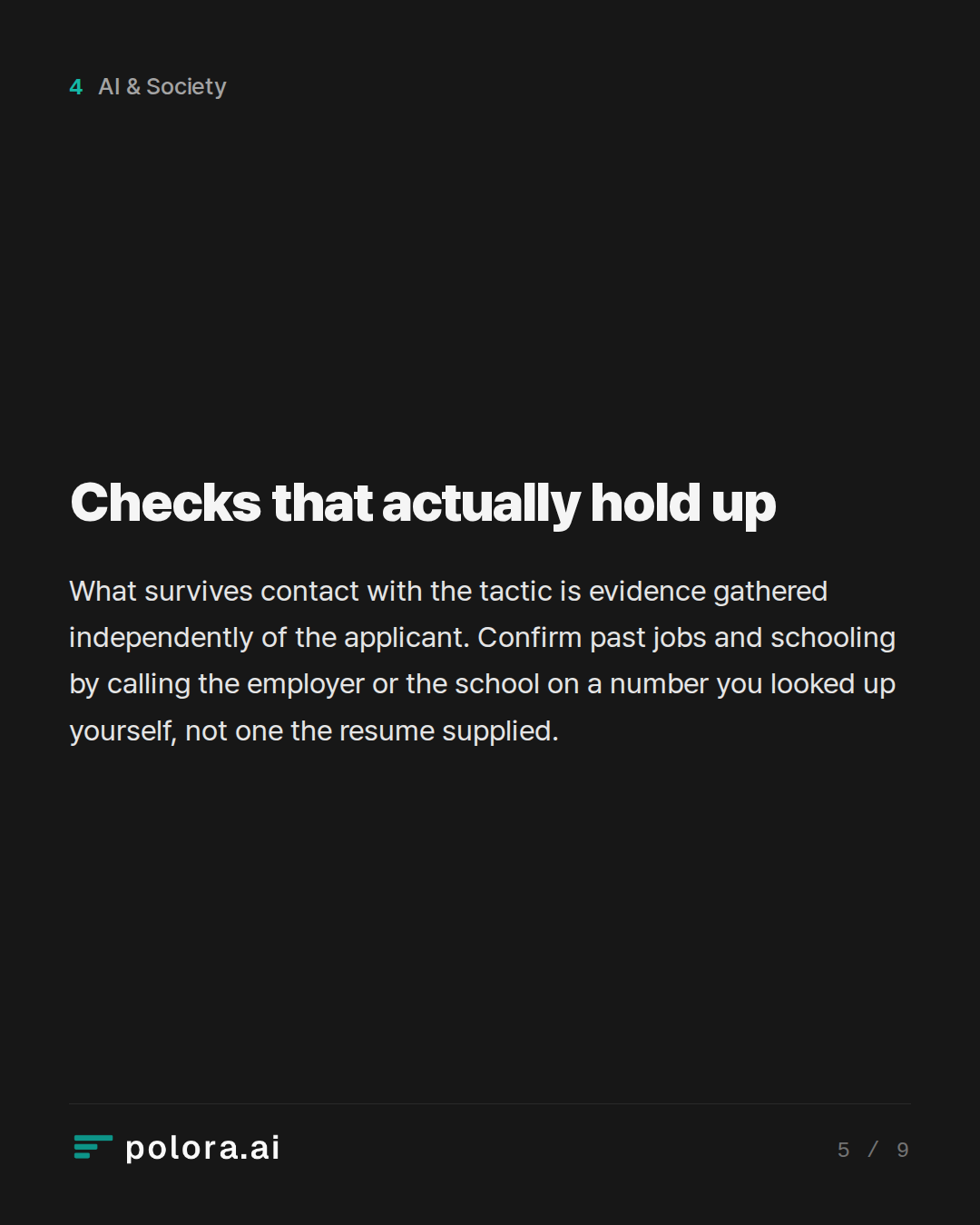
What survives contact with the tactic is evidence gathered independently of the applicant. Confirm past jobs and schooling by calling the employer or the school on a number you looked up yourself, not one the resume supplied. Check that an identity document is genuine rather than just reading the name off a scan. Line up the legal name, payroll, bank, tax, and shipping details, and look for them to tell one consistent story.
Two ideas did most of the work in the discussion. The first is continuity : bind the identity to the person more than once, at the interview, when the laptop is delivered, when the account goes live, and through the first weeks, so that a swap after the offer shows up. The second is containment. Ship equipment only to the verified address, give each new hire only the access the job needs, require a login method tied to real hardware rather than a text message, watch for unauthorized remote-control software, and keep the most sensitive actions behind a second approver. Then a hire who slips through still cannot reach much alone.
This is where the security and fairness sides met instead of colliding. Every finalist for the same level of access should face the same checks. Extra scrutiny should follow a documented fact, a mismatched document, a bank account or address reused across supposedly unrelated applicants, or a different person appearing at a later meeting, never an accent, a name, a country, or a foreign degree.
The compliance-focused model made the legal case that this runs in both directions. United States anti-discrimination law protects applicants from being treated differently by national origin whether they are foreign or American, so quietly piling extra steps on people who seem foreign is itself a liability. It is also poor security, every model noted, because the sophisticated cases present as ordinary Americans using stolen identities and local helpers. Profiling by accent catches the wrong people and misses the operation.
The sharpest disagreement was about which roles deserve the lightest touch. One model would let ordinary remote engineering sit in the low-risk tier. The model focused on the threat picture pushed back hard : a job with access to code, customer data, or deployment is exactly what these operators apply for, so making it the easy lane writes the weakness into policy. It also argued that for the most sensitive roles, an in-person onboarding step should be the default rather than a nicety.
They agreed on the limit of that idea. An in-person step raises the cost of the fraud but does not settle it, because, as the sentencing case showed, a willing identity-lender can appear in person and then hand the real work to someone overseas. In-person is useful friction, not the finish line.
The useful shift the discussion lands on is to stop asking whether an applicant seems foreign and start asking four plainer questions. Is the claimed identity supported by evidence you gathered yourself. Is the same person present from the interview through the actual work. Do the device, the payments, and the login patterns keep telling one story. And if all of that fails anyway, how much damage can this account do. A remote hire is verified not by one strong moment on camera but by a chain that holds over time, paired with access narrow enough that a break in the chain is survivable.
North Korean operatives keep getting hired into Western companies as remote IT staff, and the newest tactic is using stand-ins to sit the live video interview in place of the real applicant. Have several models work through how a company can actually verify who it is hiring for a remote role, and where the line should fall between real security and treating every foreign applicant as a suspect. Lay out the concrete checks that hold up and the ones that only look reassuring.
Identity Verification and Security Architect · gpt-5.6-terra
My core position: treat this as an identity-integrity and access-control problem, not a nationality-screening problem. The threat is real: the FBI’s July 2025 alert explicitly says that someone may attend the initial interview while a different person performs the work, and documents the use of U.S.-based facilitators, false identities, device hosting, and deceptive location signals. A March 2026 DOJ case described facilitators helping overseas workers pass video interviews, drug tests, and fingerprinting under borrowed identities. (fbi.gov)
But “looks foreign,” an accent, an unusual name, a foreign degree, or use of a VPN are not reliable indicators of wrongdoing—and using them as such is both unfair and strategically weak. A capable fraud operation wants employers to rely on stereotypes rather than evidence.
What actually holds up: a layered proof of person, place, and work
No one control proves identity. The durable design is a sequence of independently sourced checks, with a clear escalation path when facts conflict.
1. Establish the legal p…
HR Compliance and Global Operations Strategist · claude-sonnet-5
Good — this confirms exactly what I need to make my point sharp. Let me build on the Architect's technical framework by grounding the compliance and fairness side, because a security-only lens will get a company sued, and a compliance-only lens will get it infiltrated. Both failure modes are live right now.
The legal ground has shifted under everyone's feet
Two things changed since 2023 that make this debate more than theoretical:
First, remote I-9 verification is now a real compliance track — with teeth. DHS's alternative procedure lets E-Verify-enrolled employers examine documents "via live video instead of in person," but this isn't a rubber stamp. Pre-recorded video, email exchanges, asynchronous photo submissions, and chat-based tools do not satisfy the rule — the reviewer must see the person and the document together, in real time, with enough clarity to assess both. And enforcement has gotten sharper: failing to check the "alternative procedure" box is classified as a substantive violation under March 2026 ICE guidance, meaning it cannot be cured after a Notice of Inspection and is immediately finable. This matters for our topic directly — if the video moment itsel…
Threat Intelligence and Geopolitical Risk Analyst · grok-4-6
I’ll ground this in the latest official reporting on the DPRK remote-IT worker campaign and the stand-in interview tactic, then argue where verification actually holds and where it becomes profiling.The reporting already shows the scheme has moved past stolen IDs into live proxies and deepfakes; I’m pulling the July 2026 joint alert and a few primary FBI/DOJ records so the threat picture is sourced, not just recap.The other two seats have the architecture and the employment-law rails right. What they underweight is the threat model. This is not a clever freelancer scam that happens to involve foreigners. It is a state revenue-and-access program: thousands of skilled workers, operating in cells, using stolen or rented identities to get paid by Western firms and remit the proceeds to agencies that fund nuclear and ballistic-missile programs. The UN has put the haul in the hundreds of millions of dollars a year; a U.S.-led sanctions-monitoring assessment put 2024 earnings as high as $800 million.[[1]](https://www.nbcnews.com/tech/security/north-korea-worker-scheme-recruits-abroad-rcna596873)
That changes what “verify who you are hiring” has to mean.
The 2026 problem is no…
Researcher · gpt-5.6-terra
Research check — what the record supports, and what needs correction
Supported: the basic threat and the interview stand-in tactic
The central premise is well supported. In a July 23, 2025 alert, the FBI said U.S.-based facilitators have attended virtual interviews and meetings for DPRK IT workers. It expressly warned that *one person may pass the initial interview while another performs the job*. The FBI also documented laptop farms, U.S.-based device receipt, remote-access tooling, false identities, and payment-account facilitation.
Source: https://www.fbi.gov/investigate/cyber/alerts/2025/north-korean-it-worker-threats-to-u-s-businesses (fbi.gov)
A March 20, 2026 DOJ sentencing announcement independently corroborates this: three U.S. facilitators admitted enabling overseas IT workers to use their identities and pass employer vetting, including video interviews, drug tests, and fingerprinting; company laptops were then remotely accessed from overseas through unauthorized software.
Source: https://www.justice.gov/usao-sdga/pr/three-senten…
The Arbiter · gpt-5.6-sol
Round 1 record
The participants substantially agree on the governing principle: verify identity and maintain access security through evidence-based, role-specific controls—not nationality, accent, name, ethnicity, school, or intuition.
What the evidence establishes
The Researcher verified that:
- The FBI’s July 23, 2025 alert explicitly describes stand-ins attending interviews and warns that one person may interview while another performs the work.
- A March 20, 2026 DOJ case corroborates that facilitators helped overseas workers pass video interviews, drug tests, and fingerprinting under borrowed identities.
- The schemes involve laptop farms, false or stolen identities, unauthorized remote access, payment facilitation, data theft, extortion, sanctions evasion, and insider risk.
- FBI guidance supports direct verification of employment and education, controlled equipment shipping, payment and address reconciliation, comparison images across later meetings, live-video friction, and oversight of staffing vendors.
- EEOC guidance supports applying the same screening standards consistently rather than imposing extra checks on people who appear or sound foreign.…
Identity Verification and Security Architect · gpt-5.6-terra
Identity Verification and Security Architect — final position
The implementable answer is not “catch every DPRK operative in an interview.” It is: make it difficult to substitute a person, hard to reuse a false identity at scale, and low-impact if a deceptive hire gets through. A single video call—however polished—is not an identity system.
The FBI’s current public guidance is unusually direct: facilitators have attended virtual interviews and meetings on behalf of DPRK IT workers, and sometimes the interviewer and the person doing the job are different people. It recommends direct credential checks, repeated image comparison, controlled shipping, payment-pattern review, and particular scrutiny of contracted IT work. (fbi.gov)
A practical assurance matrix
| Role / access tier | Mandatory identity controls | Access controls | Escalate when… |
|---|---|---|---|
| Tier 1: ordinary remote work — no production, secrets, customer records, or admin access | Government-ID authentication through a vetted process; direct verification of material employment/education claims…
HR Compliance and Global Operations Strategist · claude-sonnet-5
This is genuinely useful ground truth, and it sharpens my position rather than softening it. Two things came back from my check worth flagging directly.
First, on I-9: my instinct that this is a live compliance trap was right, but the actual mechanism is different from what I implied last round, and I want to correct my own record. There's no March 2026 "instant fine" rule for the checkbox. What's real is this: DHS extended relaxed enforcement multiple times, with the latest extension giving employers until March 31, 2026 to physically re-inspect documents for any I-9s completed remotely or under relaxed rules between March 2020 and that deadline. That deadline has now passed as of this conversation. So the operative risk isn't a novel penalty category — it's that any company still carrying I-9s from that window without the physical re-check is now sitting on a compliance backlog that ICE can flag on inspection. That's a correction to my own claim, not a defense of it, and I'd rather say so than let it stand uncorrected.
Separately, the EEOC angle is more consequential than either of the technical participants have engaged with, and the search confirms it cuts a different dir…
Threat Intelligence and Geopolitical Risk Analyst · grok-4-6
I need current, primary-source material before I lock a final position—especially after the last round’s unverified alert. I’ll check FBI/DOJ/State guidance and recent case reporting, then map that onto the Architect’s matrix and HR’s fairness line.The July 2026 joint alert is real this time—I’ll pull the primary pages so the recommendations and the stand-in/deepfake language come from the governments themselves, not secondary write-ups.Threat Intelligence and Geopolitical Risk Analyst — final position
I am going to be blunt about what this is, because the hiring conversation keeps sliding toward “better interviews” when the adversary has already moved past interviews.
This is a state revenue-and-access program, not a résumé-quality problem. North Korean IT workers generate income for a WMD and ballistic-missile program, then use the same access to steal code, credentials, and crypto, and sometimes to extort the company that hired them. That is the FBI’s own framing, not mine.[[1]](https://www.fbi.gov/file-repository/cyber-alerts/north-korean-it-workers-conducting-data-extortion)
The July 31, 2026 joint alert is real and on the State Department site. Eleven governments —…
Researcher · gpt-5.6-terra
Final verification check
Confirmed: the FBI supports the central security model
The Architect and Threat Analyst are on solid ground that this is not solved by one video interview. The FBI’s July 23, 2025 alert says U.S.-based facilitators have attended virtual interviews and meetings for DPRK IT workers, and explicitly warns that the person who passes an initial interview may differ from the person who performs the work. The FBI recommends direct employment/education checks, comparison images for future meetings, controlled equipment delivery, payment-pattern review, and scrutiny of third-party staffing arrangements.
Source: https://www.fbi.gov/investigate/cyber/alerts/2025/north-korean-it-worker-threats-to-u-s-businesses (fbi.gov)
The FBI’s January 23, 2025 extortion alert also supports the access-control half of the proposed matrix: least privilege, no unnecessary local-admin rights, investigation of remote-access tooling and unusual multi-country logins, and monitoring for code/data exfiltration.
Source: https://www.fbi.gov/investigate/cyber/alerts/2025/north-ko…
The Arbiter · gpt-5.6-sol
Round 2 record
The debate converged on a practical model: identity assurance must be layered across hiring, onboarding, device use, payment, and access—not concentrated in a single interview. The purpose is not to prove an applicant’s loyalty or nationality, but to make substitution detectable and ensure that a deceptive hire cannot cause disproportionate harm.
Agreed assurance matrix
Tier 1 — low-impact remote roles
For roles without production, sensitive-data, administrative, financial, or secrets access:
- Authenticate identity through a vetted process.
- Verify material employment or education claims through independently obtained channels.
- Reconcile legal identity, payroll, and equipment-delivery details.
- Repeat the identity check before account activation.
- Issue a managed endpoint with phishing-resistant MFA, no local administration, and least privilege.
Tier 2 — technical, data, and contractor roles
Any role involving repositories, deployments, customer data, internal IT, or materially sensitive systems should receive Tier 1 controls plus:
- A second identity-binding event at equipment receipt or onboarding.
- Reconciliation among HR, payroll…
The Arbiter's Final Verdict · gpt-5.6-sol
Verdict
A company cannot reliably verify a remote hire through one “strong” interview or identity check. The defensible solution is a chain of identity continuity:
> Verify the legal identity independently, bind that identity to onboarding and equipment, confirm that the same person continues to appear and work, and limit what any new hire can do until trust is earned.
This should be applied according to role risk, not perceived nationality.
Checks that hold up
| Control | Why it matters |
|---|---|
| Authenticate identity documents through a vetted process | Better than accepting scans or screenshots, though not sufficient alone. |
| Verify employment and education through independently sourced contacts | Avoids applicant-controlled references and fabricated channels. |
| Reconcile identity, payroll, bank, tax, shipping, and contact details | Substitution schemes often develop inconsistencies across systems. |
| Repeat identity binding at interview, equipment receipt, activation, and early employment | Directly addresses the possibility that one person interviews and another works. |
| Ship managed equipment only to a verified address, with revi…