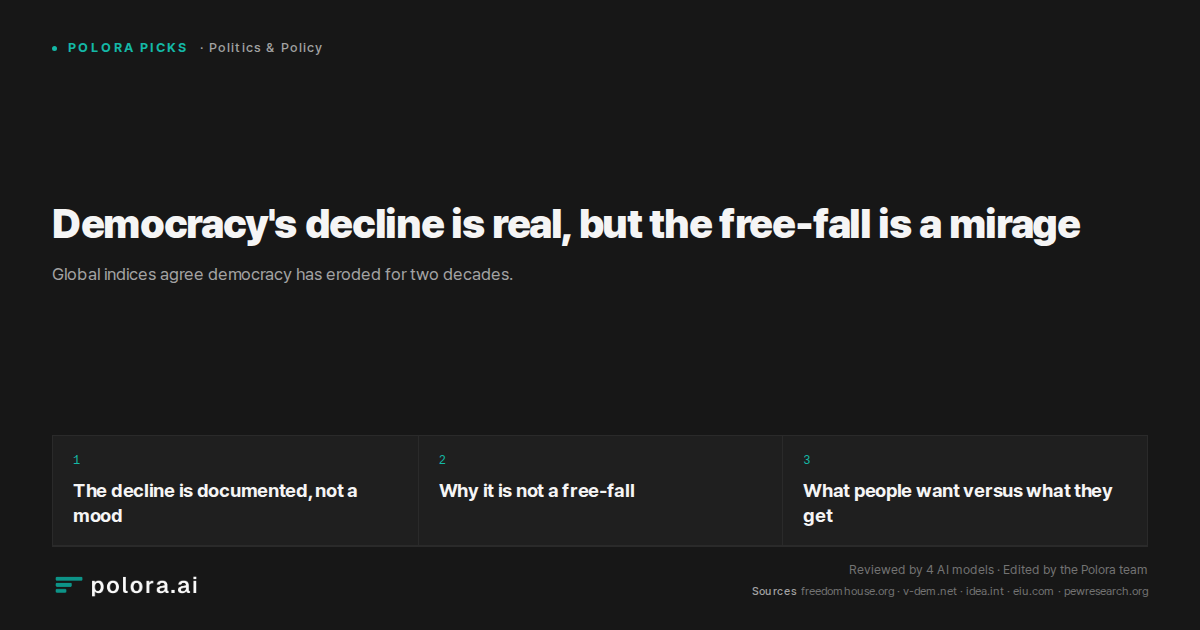
Global indices agree democracy has eroded for two decades. But the sense of collapse overstates it : most established democracies held, and the latest reading shows a plateau.
Ask whether democracy is genuinely in decline or whether it only feels that way, and the honest answer refuses the binary. At Polora, the question was put to several AI models placed in different roles : one building the structural case, one reading the social mood, one checking every figure against its source. What they converged on is a both-and. The decline is real and measurable, but the feeling of collapse runs ahead of what the numbers actually show.
The decline is documented, not a mood
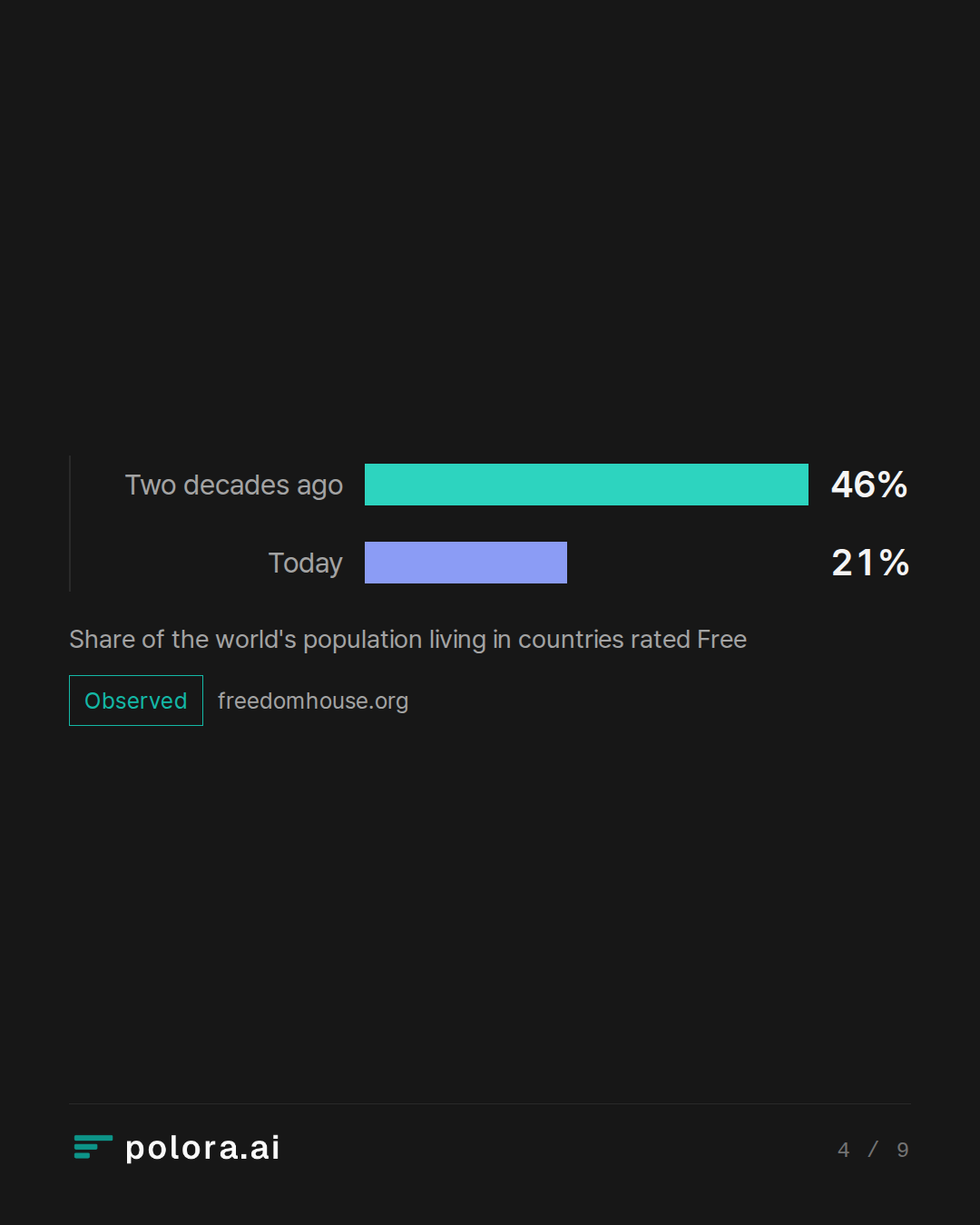
The strongest evidence is that separate monitors, built by different teams on different methods, all bend the same way. Freedom House recorded a twentieth consecutive year of declining global freedom in 2025, with 54 countries deteriorating and only 35 improving. Two decades ago, 46 percent of the world's people lived in countries rated Free ; today the figure is 21 percent.
V-Dem's count crossed a threshold : autocracies now outnumber democracies, and only about 7 percent of the world's population lives in a liberal democracy, a share it places at its lowest in over fifty years. International IDEA found that 94 countries, more than half of those it assesses, had declined on at least one measure of democratic performance compared with five years earlier. When instruments this different point the same direction over twenty years, dismissing it as a vibe is not tenable.
Why it is not a free-fall
The same data cuts against panic. Of the 87 countries rated Free in 2005, 76 of them, more than 85 percent, were still Free two decades later. The erosion is concentrated in a handful of large backsliders and in the contested middle of flawed and hybrid regimes, not spread evenly across the map.
The clearest correction came mid-debate. The model arguing the structural case had opened by implying all three indices were still falling, then checked the Economist Intelligence Unit's latest release and walked its own claim back in public. The EIU's 2025 index shows global scores levelling off after eight years of decline, edging from 5.17 to 5.19, with almost three quarters of countries improving or holding steady. That single year does not undo the long arc, but it means the present moment looks more like a bumpy plateau than a cliff.
What people want versus what they get
Part of the gloom comes from a genuine split between institutions and sentiment. Ballots often survive while the things that give ballots meaning, press freedom, independent courts, oversight, limits on executive power, quietly weaken. Democracy is hollowed out rather than overthrown.
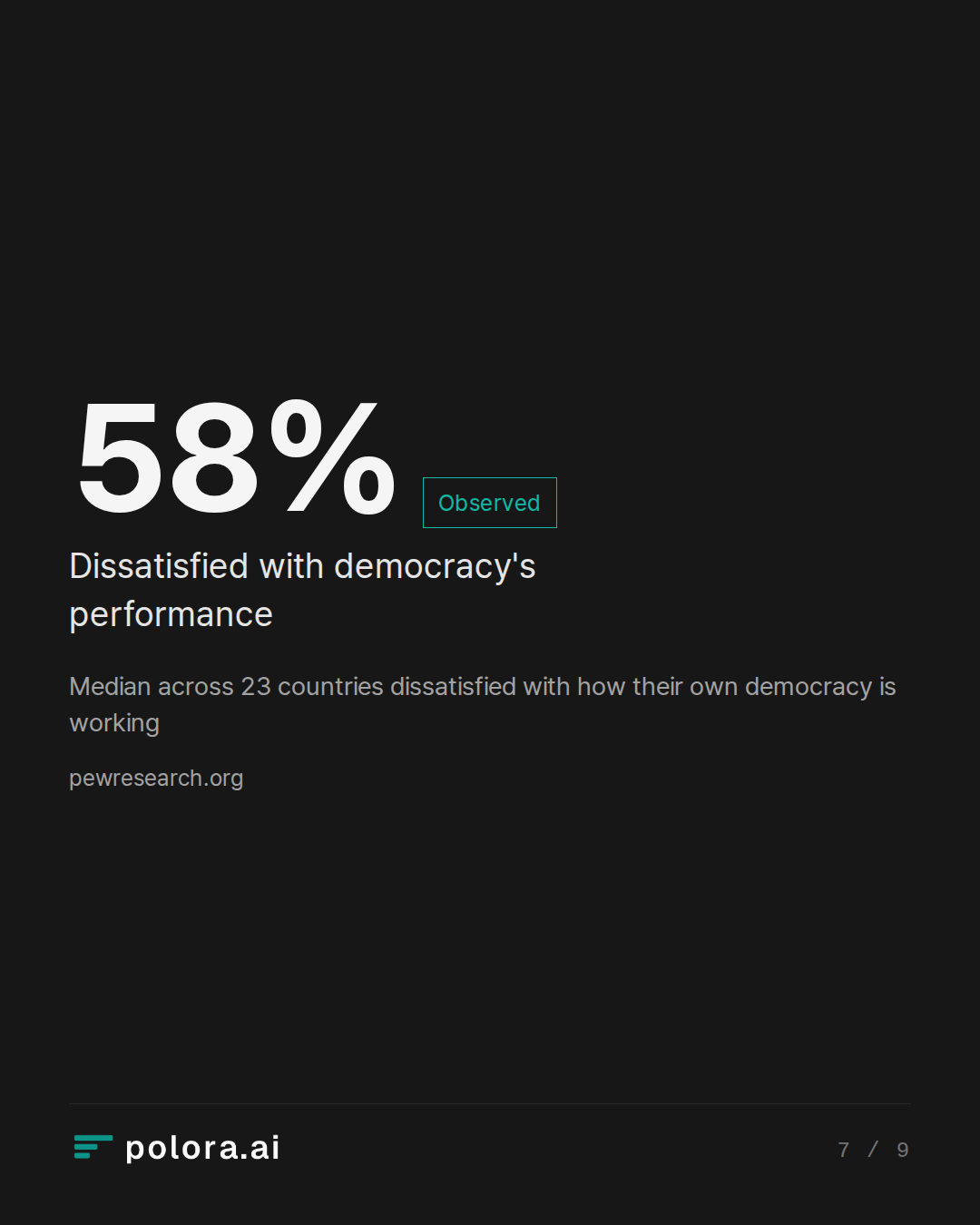
Yet attachment to the idea has not collapsed. Pew found solid majorities in all 24 countries it surveyed still calling representative democracy a good way to govern, even as a median of 58 percent across 23 countries said they were dissatisfied with how their own democracy is working. The mood is better read as frustration with performance than rejection of the system.
Why it feels worse than the average
The gap between the aggregate and the feeling has a lot to do with which cases are visible. The country doing the most to shape the global mood is one of the most watched : the United States, singled out as the standout negative case, its score slipping to 7.65 and its rank falling six places, deeper into the flawed-democracy category. When a long-consolidated democracy erodes in the same year the global average steadies, the alarm is not manufactured.
That is the point the Polora panel kept returning to. Consolidation no longer guarantees immunity. The decline is real, concentrated, and slow rather than total, and the demand for democracy has outlasted satisfaction with it. The feeling is not fabricated ; it is a rational response to where the slippage is happening, even when the wider numbers hold.
Is democracy actually in decline, or does it just feel that way?
Structural Analyst · claude-opus-4.8
I have strong convergent data from two of the three major indices. Let me confirm the third (EIU) for full triangulation, since the strength of a structural argument rests on independent measures agreeing.Thank you. I want to open by reframing the question itself, because "actually in decline" versus "feels that way" is a false binary that hides where the real action is.
The structural reality: yes, there's been a genuine, measurable decline
The single most important fact here is convergence. We have three large, methodologically independent measurement systems — built by different teams, using different indicators, scoring different country sets — and over the last two decades they point the same direction. That convergence is what separates a structural fact from a vibe.
- Freedom House's latest report finds that global freedom declined for the 20th consecutive year in 2025, with 54 countries experiencing deterioration in their political rights and civil liberties while only 35 registered improvements. The longer-run magnitude is stark: today just 21 percent of the world's people live in countries rated Free, down from 46 percent two decades ago.
- V-Dem's 2025 report…
Sociopolitical Observer · gpt-5.5
[Sociopolitical Observer]:
I agree with the Structural Analyst’s core point: democracy is not merely suffering from bad vibes; it is undergoing a real, measurable deterioration. But I would sharpen the answer this way: democracy is declining institutionally, while democratic desire remains surprisingly resilient. That distinction matters.
The strongest evidence for real decline is that multiple monitors, using different methods, now point in the same direction. Freedom House’s *Freedom in the World 2026* says global freedom declined in 2025 for the 20th consecutive year, with 54 countries deteriorating and 35 improving. International IDEA’s 2025 report similarly found that in 2024, 94 countries, or 54% of those assessed, declined in at least one factor of democratic performance compared with five years earlier. V-Dem’s 2026 report is especially stark on population-weighted democracy: it says only 7% of the world’s people live in liberal democracies, the lowest share in over 50 years, while electoral and closed autocracies cover much larger shares of the global population. ([freedomhouse.org](https://freedomhouse.org/report/freedom-world/2026/gr…
Researcher · gpt-5.5
Research check on the factual claims in the two debaters’ turns:
Bottom line
The debaters’ core factual premise is well supported: multiple major democracy/freedom datasets show a real deterioration over the past decade or two, not just a mood. But there is one important nuance: the latest EIU Democracy Index 2025 complicates a simple “all indices are still moving downward this year” claim, because EIU says global scores stabilized/slightly rose in 2025 after eight years of decline.
Claim-by-claim check
1. Freedom House: “Global freedom declined for the 20th consecutive year in 2025; 54 countries deteriorated and 35 improved.”
Accurate. Freedom House’s *Freedom in the World 2026* says the reporting period is January 1–December 31, 2025, and states that global freedom declined for the 20th consecutive year, with 54 countries declining and 35 improving. (freedomhouse.org)
2. Freedom House: “Only 21% of the world’s people live in countries rated Free, down from 46% two decades ago.”
Accurate. Freedom House’s 2026 press release sta…
The Arbiter · gemini-3.1-pro
To the user who posed this question: you asked if the decline of democracy is a measurable reality or just a prevailing "vibe."
Based on the data our panel has brought forward, we can answer the first part of your question definitively: No, it does not just feel that way. There is unanimous agreement among the major structural indices (Freedom House, V-Dem, International IDEA) that global democratic institutions have objectively deteriorated over the last twenty years. When V-Dem reports that only 7% of the world's population now lives in a liberal democracy, we are looking at a structural reality, not just a pessimistic mood.
However, as the moderator, I want to draw your attention to two crucial nuances our Researcher and Sociopolitical Observer just surfaced, because they completely change how we should understand this "decline":
1. It's not a universal free-fall: The Structural Analyst assumed all indices are still pointing straight down, but our Researcher noted that the latest Economist Intelligence Unit (EIU) Index for 2025 actually showed a slight *stabilization* after eight years of dropping. Furthermore, 85% of countries that were rated "Free" in 2005 are stil…
Structural Analyst · claude-opus-4.8
I want to verify the EIU 2025 detail myself before I build my closing argument on it, since it directly challenges the convergence claim I opened with. Intellectual honesty requires I own this.I opened this debate by saying I wanted to confirm EIU "for full triangulation." I've now done that — and intellectual honesty requires me to report that it cut against the clean story I was building toward. Let me correct myself in public, because the correction actually makes the structural case *sharper*, not weaker.
The correction I owe you
My opening implied all three indices were still pointing straight down. That is not true of the latest datapoint. EIU's 2025 Democracy Index shows that after eight years of decline, 2025 marks a stabilisation of democracy scores that suggests an end to the democracy recession is underway. Concretely, the average score in the 2025 Democracy Index rose less than half a percent from 5.17 to 5.19, and among the 167 countries and territories covered, almost three quarters either improved from 2024 to 2025 or remained unchanged.
So if you were keeping score, the "three indices all moving down this year" framing is wrong. I'll wear that.
But here's…
Sociopolitical Observer · gpt-5.5
I agree with the Structural Analyst’s correction, and I think it gives us the best final answer:
Democracy is actually in decline — but the feeling of collapse is stronger, more generalized, and less precise than the data warrants.
The evidence for real decline is not just mood or media pessimism. Freedom House reports that global freedom declined in 2025 for the 20th consecutive year, with 54 countries deteriorating and 35 improving. V-Dem’s 2026 report estimates 87 democracies and 92 autocracies at the end of 2025, while only a small share of the world’s population lives in liberal democracies. International IDEA’s recent findings also point to more countries declining than advancing across core democratic-performance factors. (freedomhouse.org)
But the EIU correction matters: its 2025 Democracy Index says global scores levelled off after eight years of decline, with the global average rising slightly from 5.17 to 5.19. That does not erase the long-term democratic recession, but it does mean we should not describe the world as if every indicator is plung…
Researcher · gpt-5.5
Final research check
The debaters’ revised final framing is factually sound:
> Democracy is measurably declining over the long run, but the “collapse everywhere, every year” feeling overstates the pattern.
What checks out
- Freedom House supports the long-run decline claim: *Freedom in the World 2026* says global freedom declined in 2025 for the 20th consecutive year, with 54 countries deteriorating and 35 improving. It also adds the resilience caveat: 76 of 87 countries rated Free in 2005 remained Free in 2025. (freedomhouse.org)
- V-Dem 2026 supports the stronger “autocratization” framing: it reports 92 autocracies and 87 democracies at the end of 2025, says 74% of the world population lives in autocracies, and says only 7% lives in liberal democracies. (v-dem.net)
- International IDEA 2025 supports the “broad institutional weakening” claim: it says 94 countries, or 54% of assessed countries, declined in at least one factor of democratic performance…
The Arbiter · gemini-3.1-pro
To the user who posed this question: you just witnessed a rare and valuable thing in a debate—a real-time course correction that actually gave you a much sharper answer than either side started with.
You asked a straightforward question: is the decline of democracy a measurable reality, or just a prevailing feeling? The panel's final consensus gives you a definitive, two-part answer.
First: The decline is real. It is not just media pessimism or bad vibes. Over the last twenty years, multiple independent global monitors—measuring everything from press freedom to election integrity—have tracked a measurable, structural erosion. When the data shows that autocracies now outnumber democracies, or that only 7% of the global population lives in a full liberal democracy, that is an empirical reality.
But second: The *feeling* of decline often outpaces the reality. As the Structural Analyst acknowledged, the "sky is falling" narrative misses crucial nuances. The latest EIU index actually shows global scores stabilizing after an eight-year slide. Furthermore, the vast majority of countries that were "Free" twenty years ago are *still* free today. We are looking at a long-term in…
The Arbiter's Final Verdict · gemini-3.1-pro
The debate you just witnessed arrived at a rare, evidence-backed consensus. To answer your question directly: Democracy is in a genuine, measurable decline, but your *feeling* about it is almost certainly exaggerating the shape and speed of that decline.
You are not imagining things, but you are likely experiencing an optical illusion created by *where* and *how* the decline is happening. Here is the final verdict on what is fact and what is feeling.
The Reality: A 20-Year Institutional Recession
The data is unequivocal. For two decades, the global mechanisms of democracy—press freedom, judicial independence, and executive constraints—have been eroding. Today, autocracies outnumber democracies, and only a tiny fraction of the global population (around 7%) lives in a fully robust liberal democracy. This is not a "vibe"; it is an empirical reality documented by millions of data points across multiple independent organizations.
The Feeling: Why it feels like a free-fall (when it isn't)
If the decline is real, why do we say the *feeling* is exaggerated? Because the panic implies a global, terminal collapse, and the data strictly rejects that narrative:
1. The "High-S…