Why are AI memory chip prices expected to double, and why do memory stocks still swing so hard?

TrendForce projects the average price of AI memory chips will more than double in 2027, as supply stays tight and buyers shift to pricier generations. Micron says this memory needs about three times the wafers of ordinary memory for the same amount of storage, and that most of its own 2027 supply is sold. The shares still swing because contracts say little about profits years ahead, and this business has a long boom-and-bust history.

2026-10-27

Prices forecast to double, then shares fell by a tenth in a day

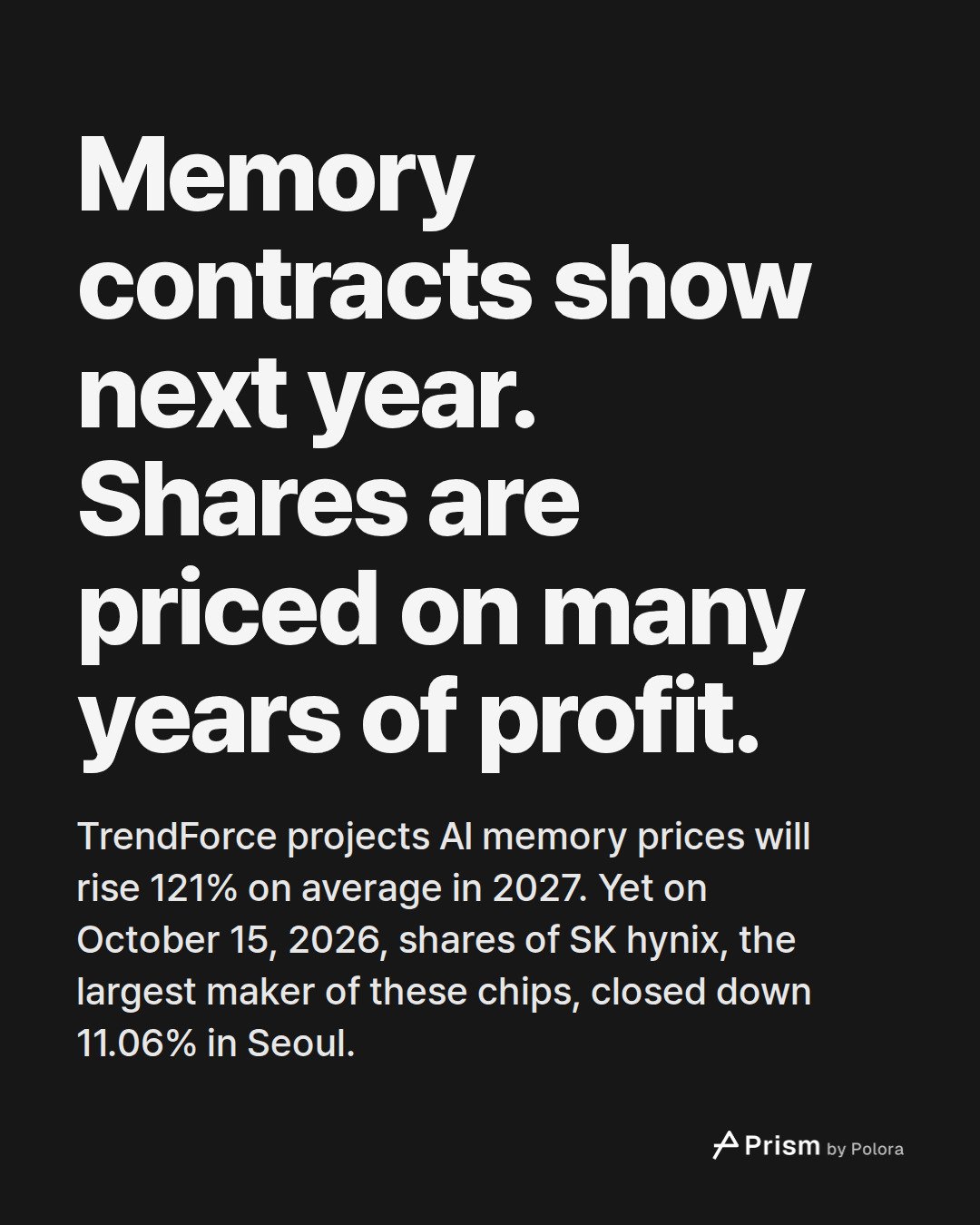
On September 29, 2026, the research firm TrendForce projected that the average selling price of AI memory chips, blended across products, would rise 121% in 2027, more than doubling in a single year. Two weeks later, on October 15, shares of SK hynix, the largest maker of those chips, closed down 11.06% in Seoul. Samsung Electronics fell 9.48%. The KOSPI, Korea's main stock index, closed 7.57% lower at 5,554.22, after a slide steep enough to halt all trading for 20 minutes.

Within the same few weeks, prices were expected to double and a share price fell by a tenth in a day. Both can be true at once, and seeing why is the clearest way to understand how this business works.
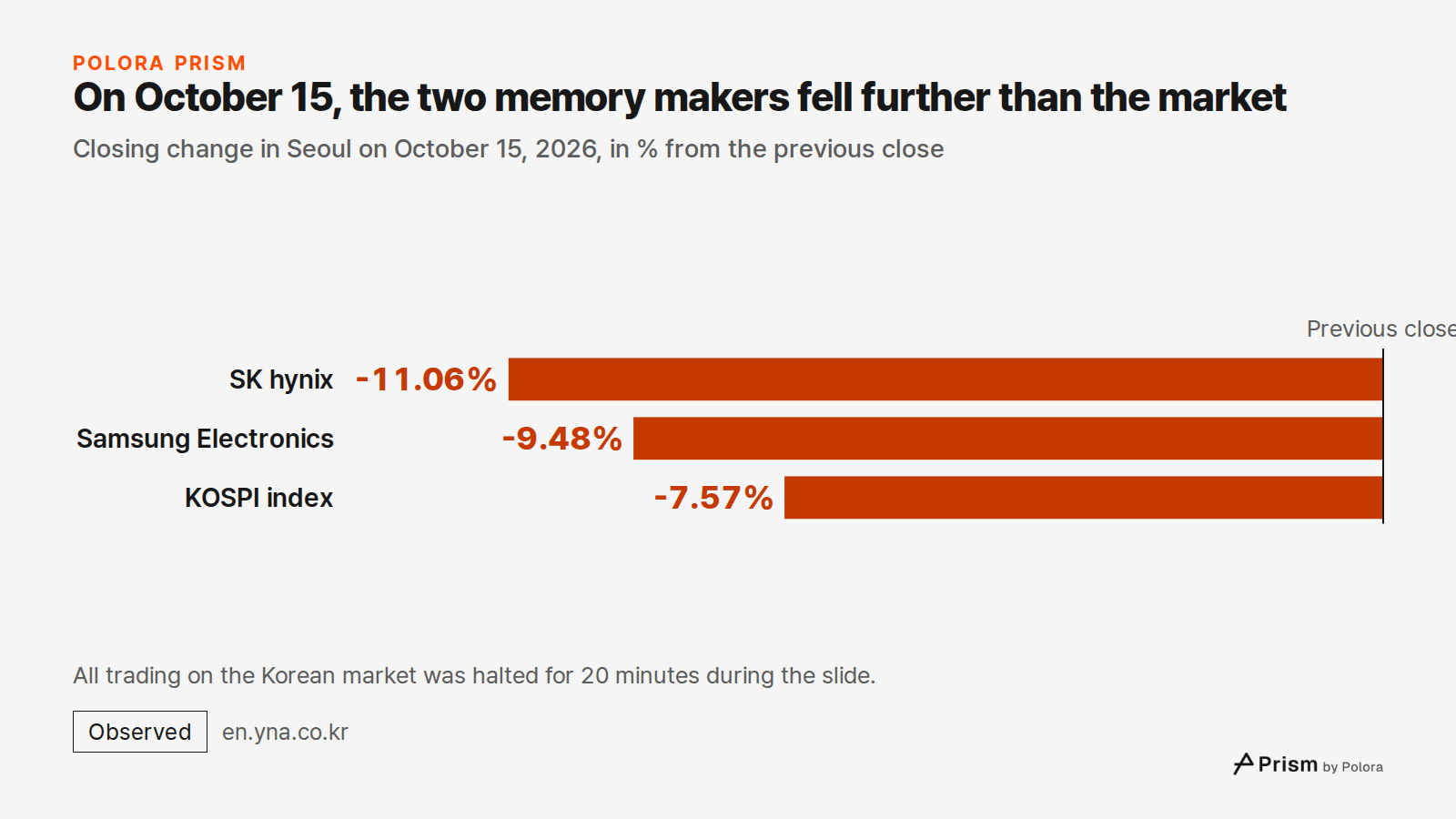
On October 15, the two memory makers fell further than the market · Closing change in Seoul on October 15, 2026, in % from the previous close · Previous close · SK hynix · Samsung Electronics · KOSPI index · -11.06% · -9.48% · -7.57% · All trading on the Korean market was halted for 20 minutes durin
Closing change in Seoul on October 15, 2026, in % from the previous close

What an AI memory chip actually is

The chip in question is called HBM, short for high-bandwidth memory. An AI processor can only work as fast as data reaches it. HBM stacks a dozen or so thin memory chips on top of one another and places the stack right beside the processor, linked by thousands of tiny vertical connections. Ordinary memory, the kind in a laptop or a regular server, sits farther away and moves data far more slowly.

Only three companies make HBM in volume : SK hynix and Samsung in Korea, and Micron in the United States.

AI memory uses about three times the silicon wafers for the same storage

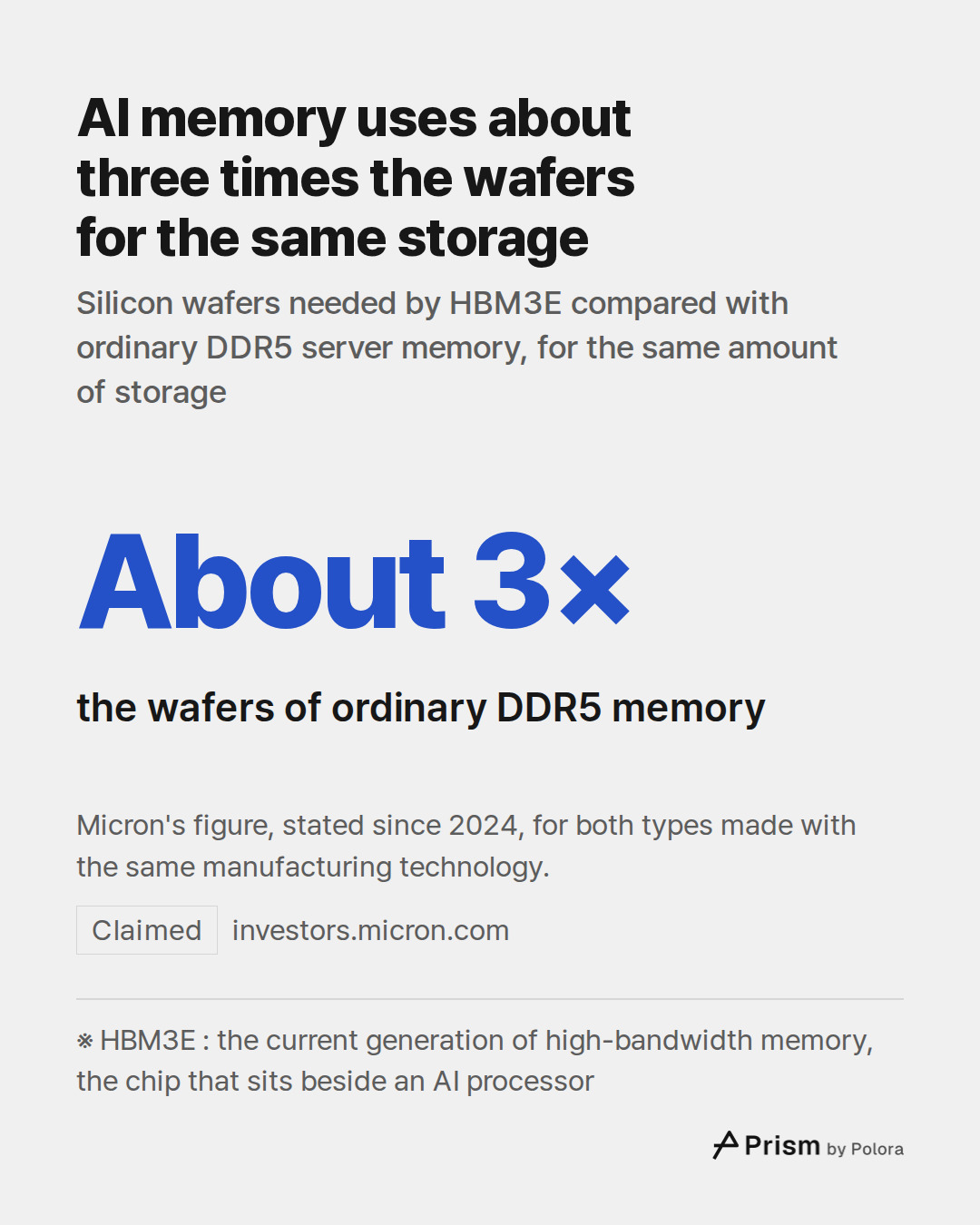
Memory is made on round silicon wafers in very expensive, ultra-clean factories. Micron has said since 2024 that HBM3E, the current generation, needs about three times as many wafers as ordinary DDR5 server memory to make the same amount of storage, when both are made with the same manufacturing technology. The chips are larger, more of each chip goes to the wiring that links the layers, and stacking adds losses. If one layer in a stack is faulty, the whole stack is worth less.

So every wafer turned into HBM is a wafer not turned into ordinary memory, and building new factory space takes years. TrendForce gives three reasons for its 2027 projection. Supply stays tight, a growing share of sales will be the newer and pricier HBM4, and the next generation, HBM4e, starts up in the second half of 2027.
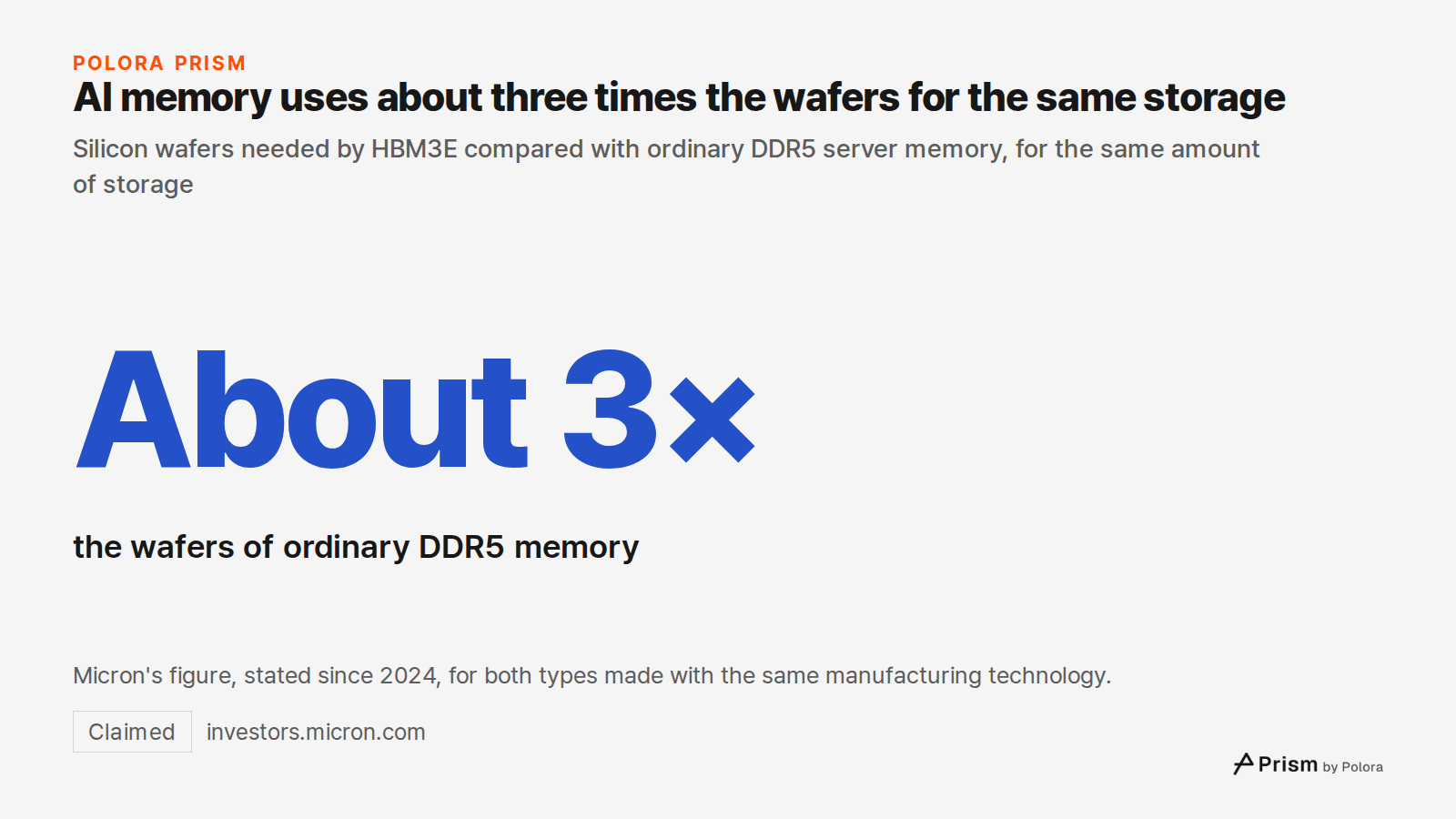
AI memory uses about three times the wafers for the same storage · Silicon wafers needed by HBM3E compared with ordinary DDR5 server memory, for the same amount of storage · About 3× · the wafers of ordinary DDR5 memory · Micron's figure, stated since 2024, for both types made with the same manufact
Silicon wafers needed by HBM3E compared with ordinary DDR5 server memory, for the same amount of storage

Micron says most of its 2027 AI memory is already sold

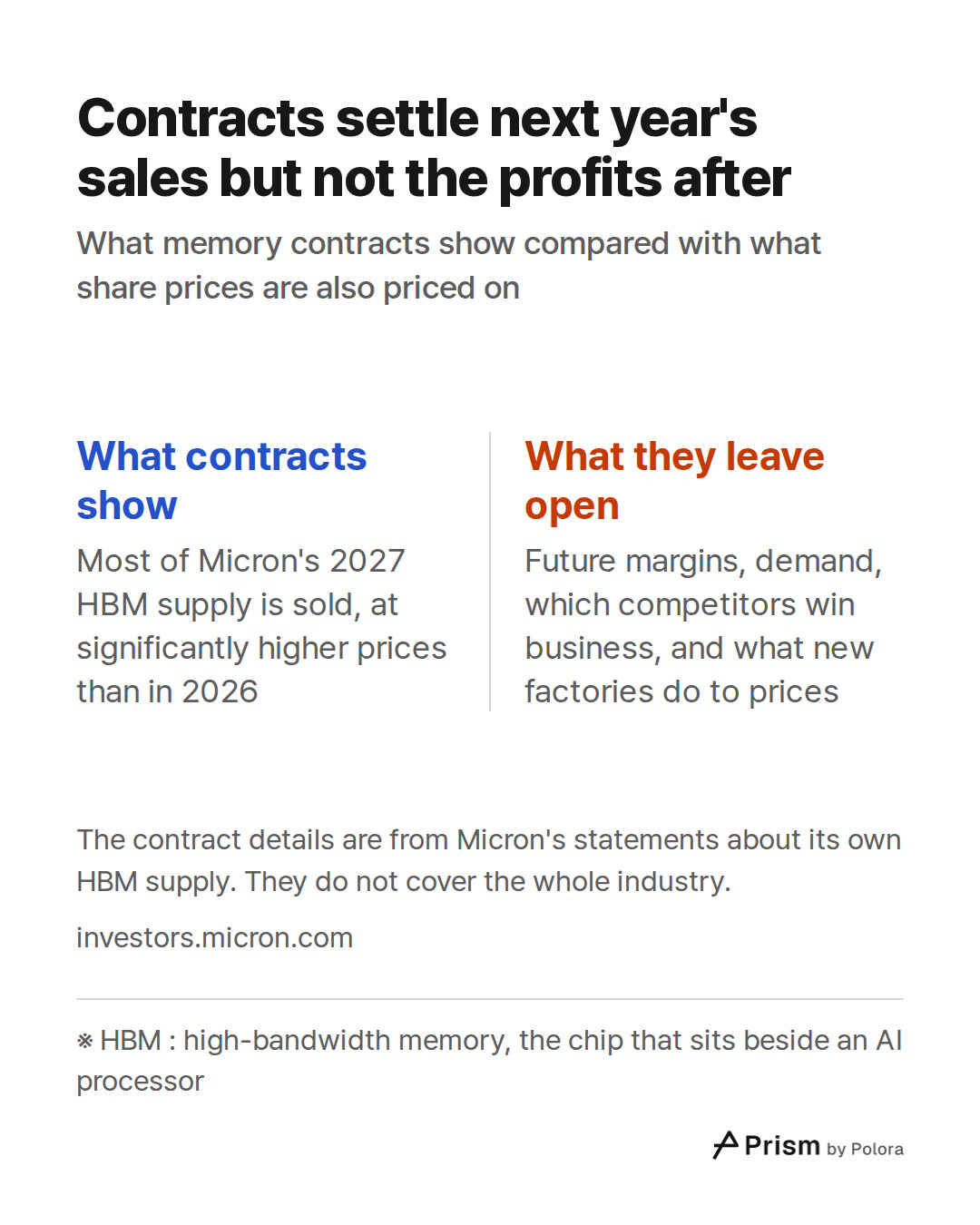
HBM is not bought off a shelf. Prices are set roughly once a year in negotiations between the three makers and their buyers, and much of the volume sits under long contracts. On September 30, 2026, Micron told investors it had completed agreements for "the vast majority" of its own calendar 2027 HBM supply, "with significant price increases year over year." That shows a tight market at one of the three makers. It does not show that most of the industry's 2027 supply is sold.

Micron also described 26 multi-year "take-or-pay" agreements, under which the buyer pays for the agreed volume whether or not it takes delivery. About three-quarters of the revenue Micron expects from these agreements has a defined pricing framework, and in a majority of that portion the price moves inside a band with a floor and a ceiling. The ceiling matters here, because it means part of the gain from higher prices has already been given up in exchange for certainty.

The 121% is one firm's projection of an average

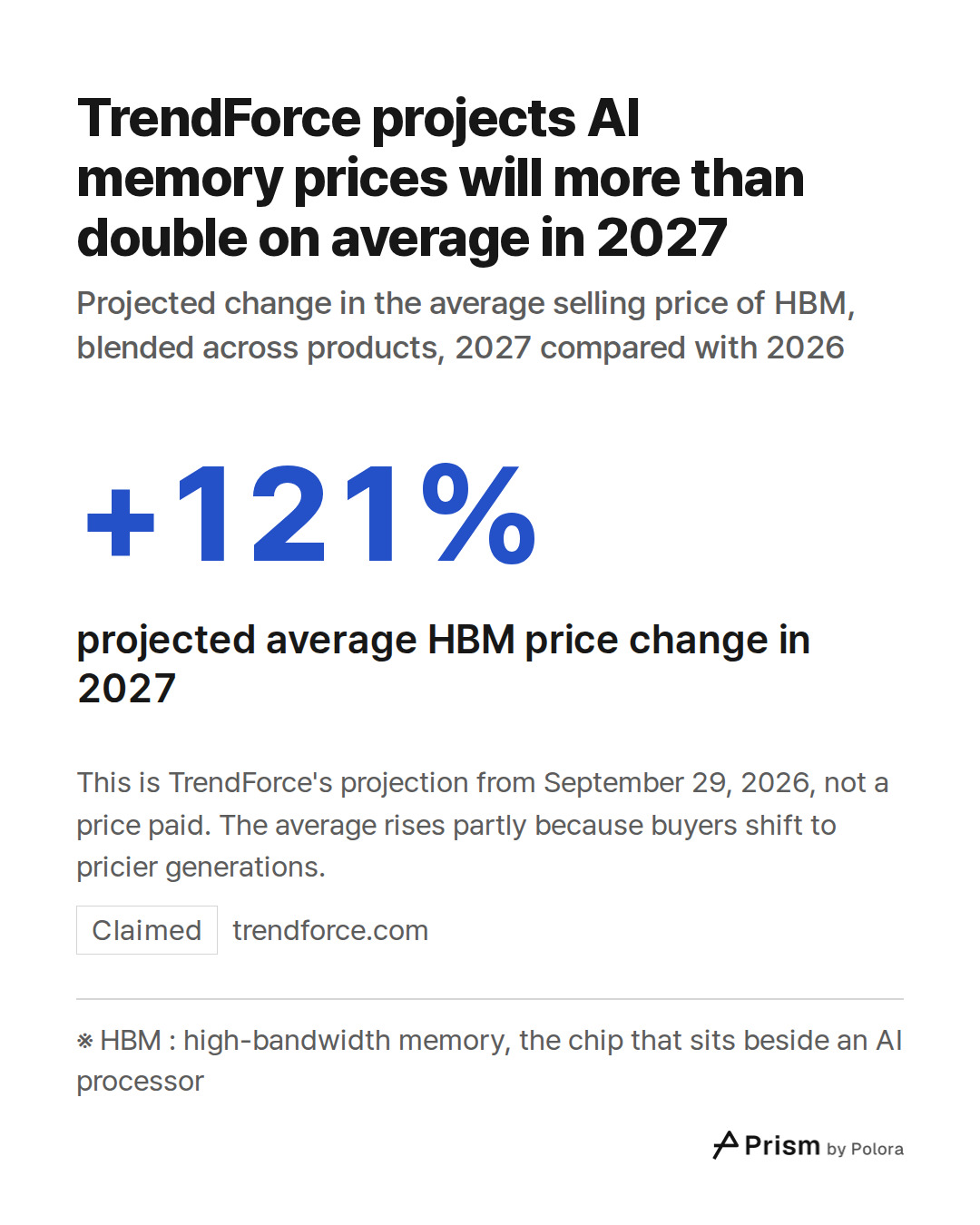
TrendForce's figure is a projection, not a price anyone has paid yet. It is also a blended average across products. When buyers shift toward newer, more expensive generations, the average rises even if no single product's price changes. So 121% does not mean every chip will cost 121% more.

Tight supply and booked contracts explain why TrendForce expects prices to rise, but they do not by themselves produce a figure of 121%. That number is TrendForce's own estimate, and the shift toward newer chips is part of it. The contracts give firmer evidence of the direction, at least for one maker : Micron says its 2027 HBM prices are significantly higher than its 2026 prices.
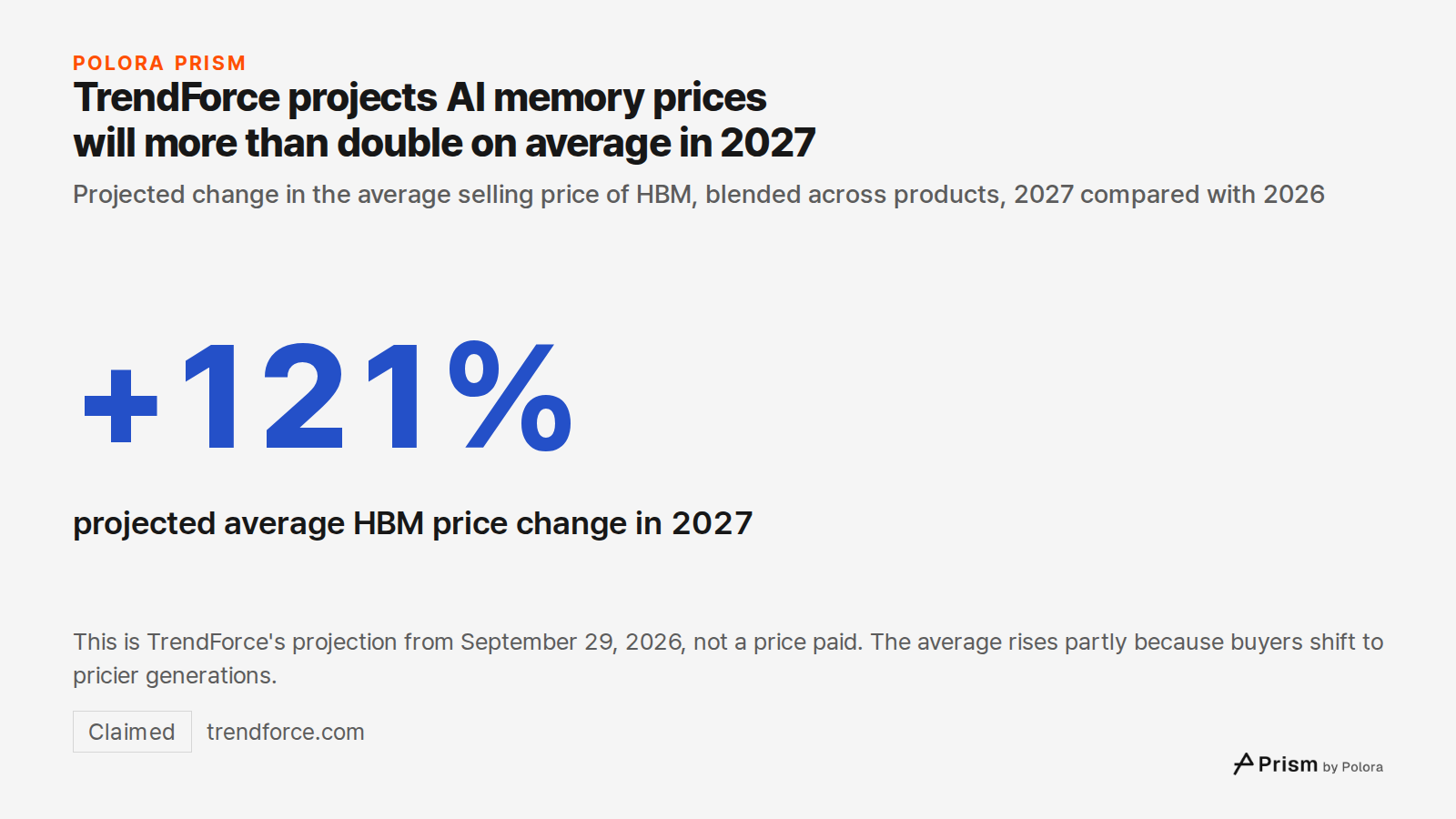
TrendForce projects AI memory prices will more than double on average in 2027 · Projected change in the average selling price of HBM, blended across products, 2027 compared with 2026 · +121% · projected average HBM price change in 2027 · This is TrendForce's projection from September 29, 2026, not a
Projected change in the average selling price of HBM, blended across products, 2027 compared with 2026

Why the shares swing anyway : they are priced beyond the contracts

Contracts make next year's sales easier to see, and some of Micron's run for several years. But they do not fix future profit margins, how much customers will want, how much business competitors win, or what new factories do to prices. A share price reflects what investors expect a company to earn for many years, and memory has a long record of booms that ended in gluts. In past cycles, when prices were high, every maker built new capacity at once. The new factories opened around the same time, supply overshot demand, and prices fell faster than costs.

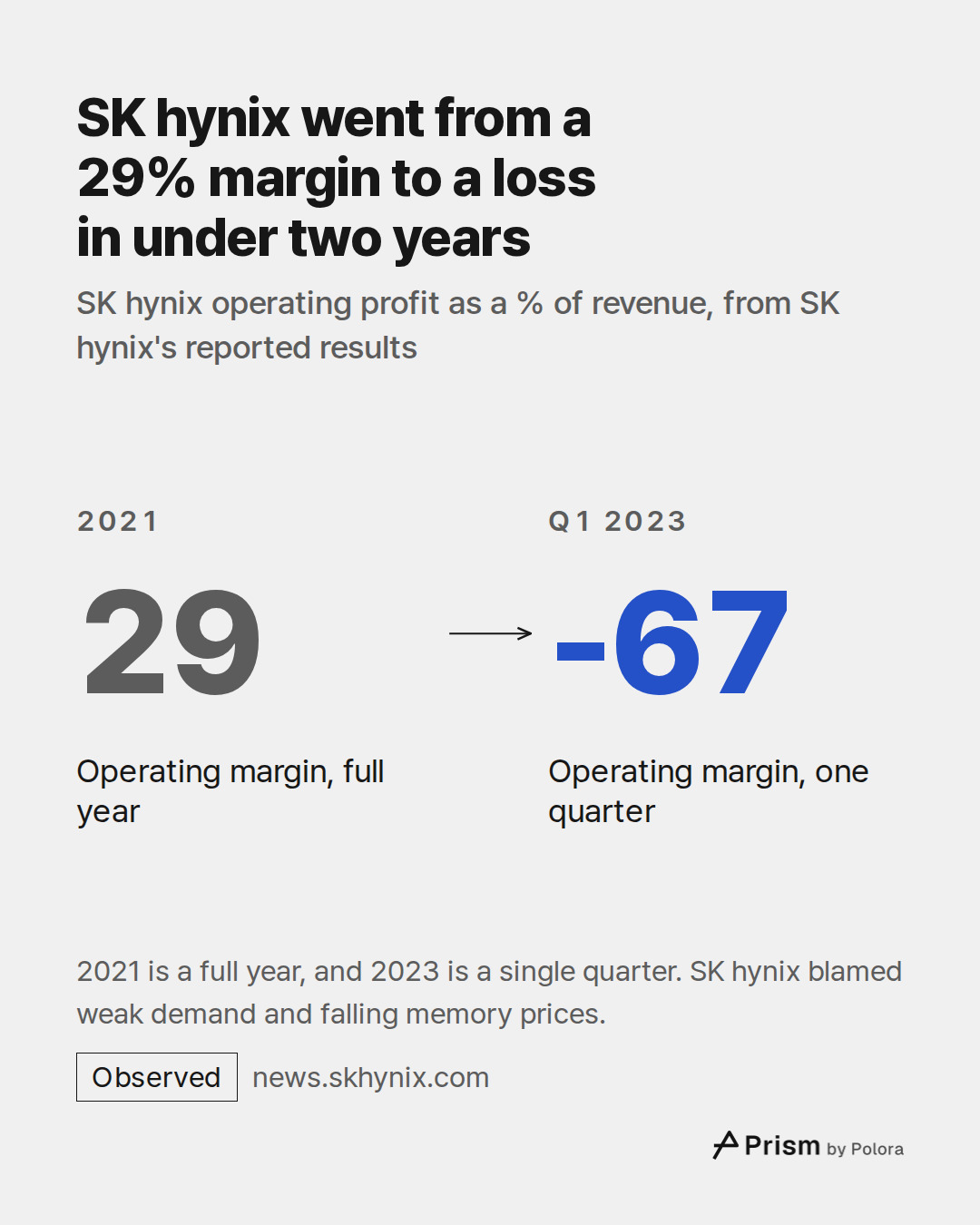
SK hynix's own results show how fast that can happen. In 2021 it made an operating profit of 12.41 trillion won, a 29% margin. By the first quarter of 2023 it was losing money : an operating loss of 3.402 trillion won on revenue of 5.088 trillion won, a margin of negative 67%. The company blamed weak demand and falling memory prices.

More capacity is on the way. Micron alone expects its Singapore HBM packaging plant to start output in early 2027, a new US factory to start in mid-2027, and more cleanroom space from late 2028. Micron's own view, and it is the company's outlook, is that supply will stay tight through 2028 and that it cannot yet see when supply and demand will balance.

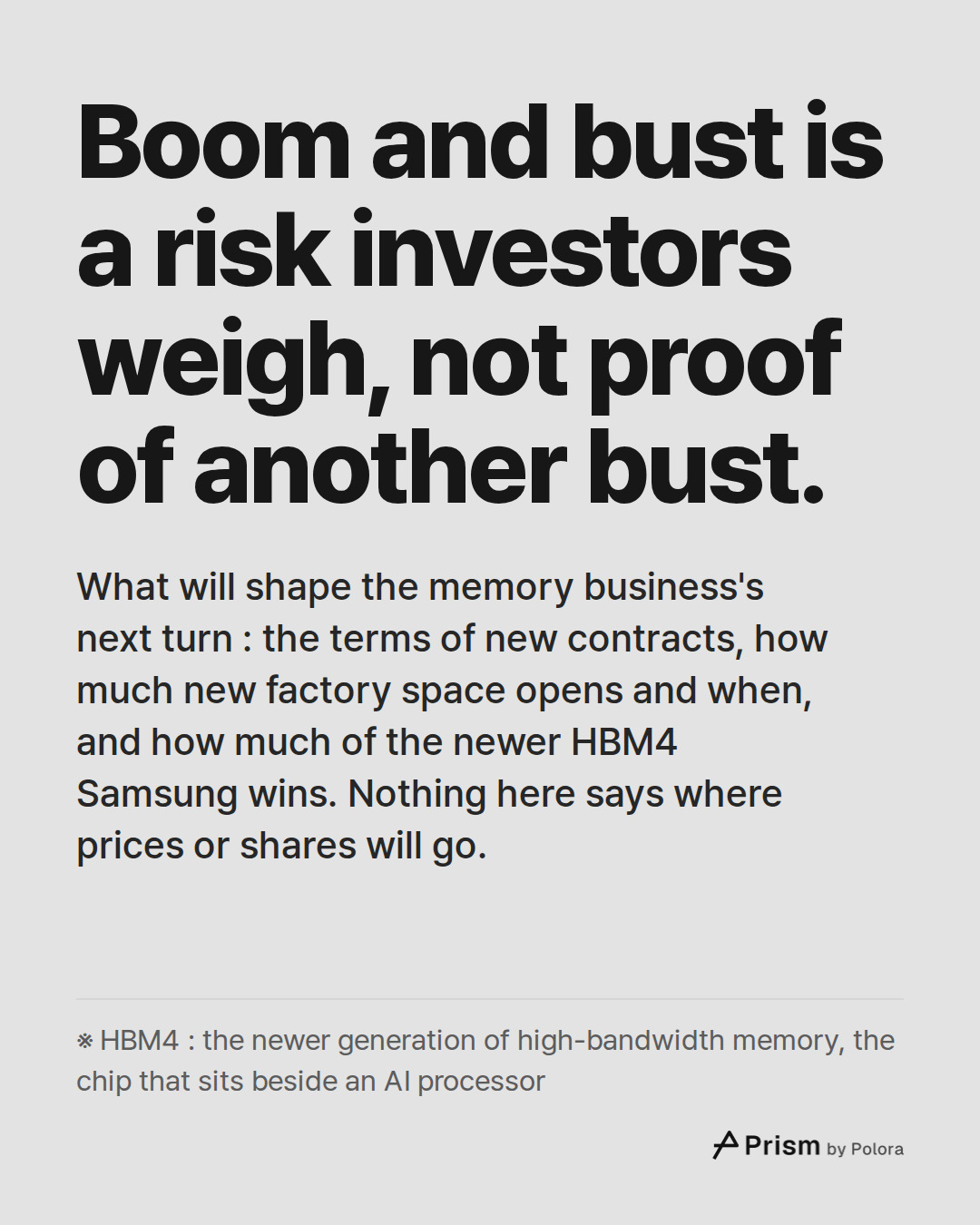
The boom-and-bust history is a risk investors weigh, not proof that another bust is coming. Multi-year take-or-pay contracts, in which buyers commit to volumes in advance, may make this cycle less like the busts of the past, though they cannot guarantee profits. Whether this cycle will differ from earlier ones is exactly what investors disagree about.
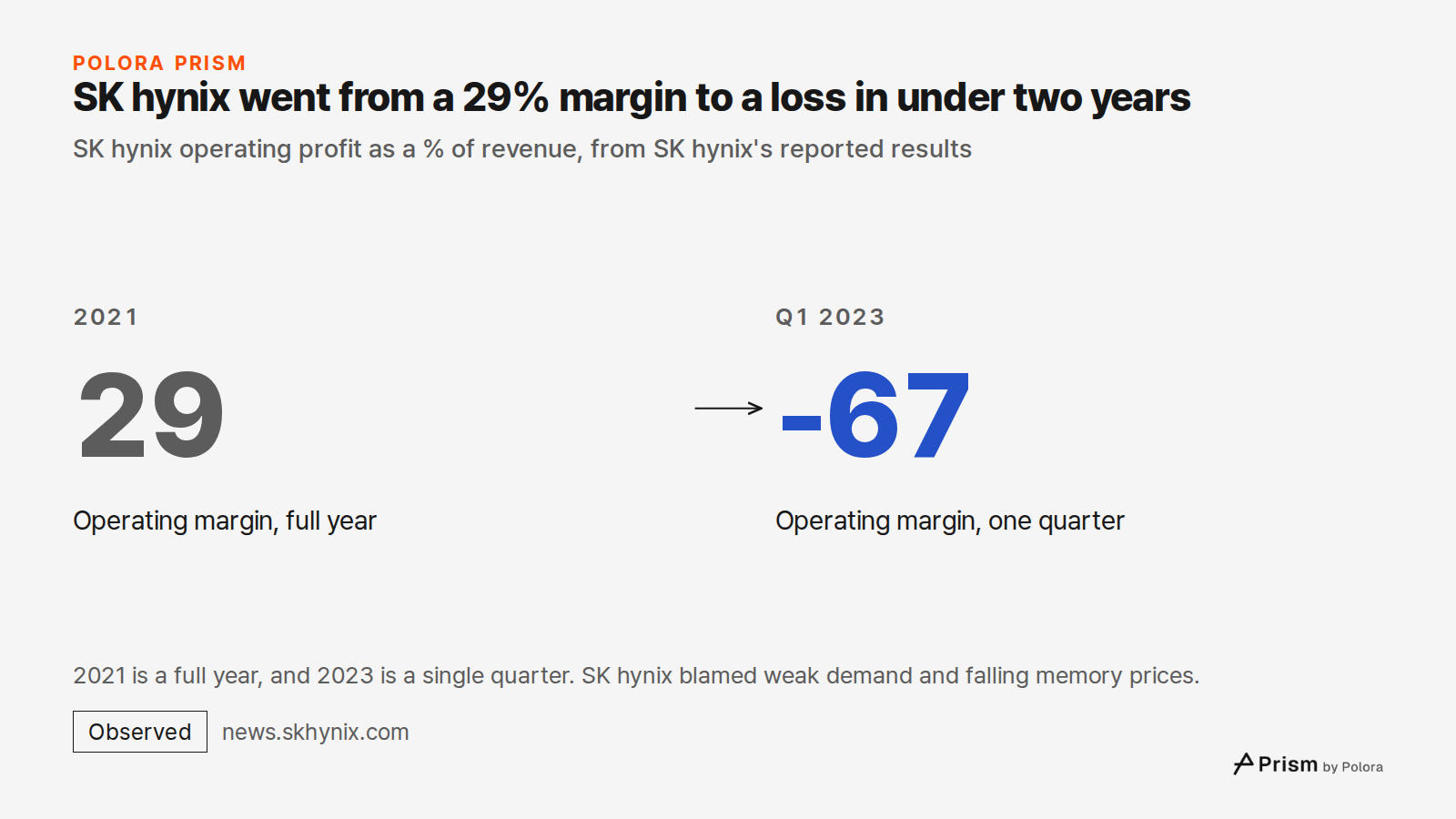
SK hynix went from a 29% margin to a loss in under two years · SK hynix operating profit as a % of revenue, from SK hynix's reported results · 2021 · 29 · Operating margin, full year · Q1 2023 · -67 · Operating margin, one quarter · 2021 is a full year, and 2023 is a single quarter. SK hynix blamed
SK hynix operating profit as a % of revenue, from SK hynix's reported results

Reports tied October 15 to interest rates and AI funding

Korean and international reports tied the drop that day to US inflation and to AI funding. US consumer prices rose 0.6% in September from August, according to the US Bureau of Labor Statistics, a hot reading that fed worries the Federal Reserve could raise interest rates. Reports also pointed to doubts about how AI projects will keep being funded. These are reporters' explanations of a market move, not a proven single cause.

Memory makers sell into AI spending, so doubts about that spending reach their shares directly.

SK hynix still leads AI memory, by a narrower margin

Share prices also move on who wins the next contracts. By Counterpoint Research's count of HBM revenue, SK hynix held 64% of the market in the second quarter of 2025. It held 56%, 57% and 58% over the next three quarters, and 50% in the second quarter of 2026. Over the same year, Samsung rose from 15% to 33%. These are shares of HBM revenue, not of all memory.

The latest drop is a single quarter, not a trend, and other research firms measure market share differently and get different numbers. What the figures do show is that the lead can change, which is one more thing a share price has to account for.
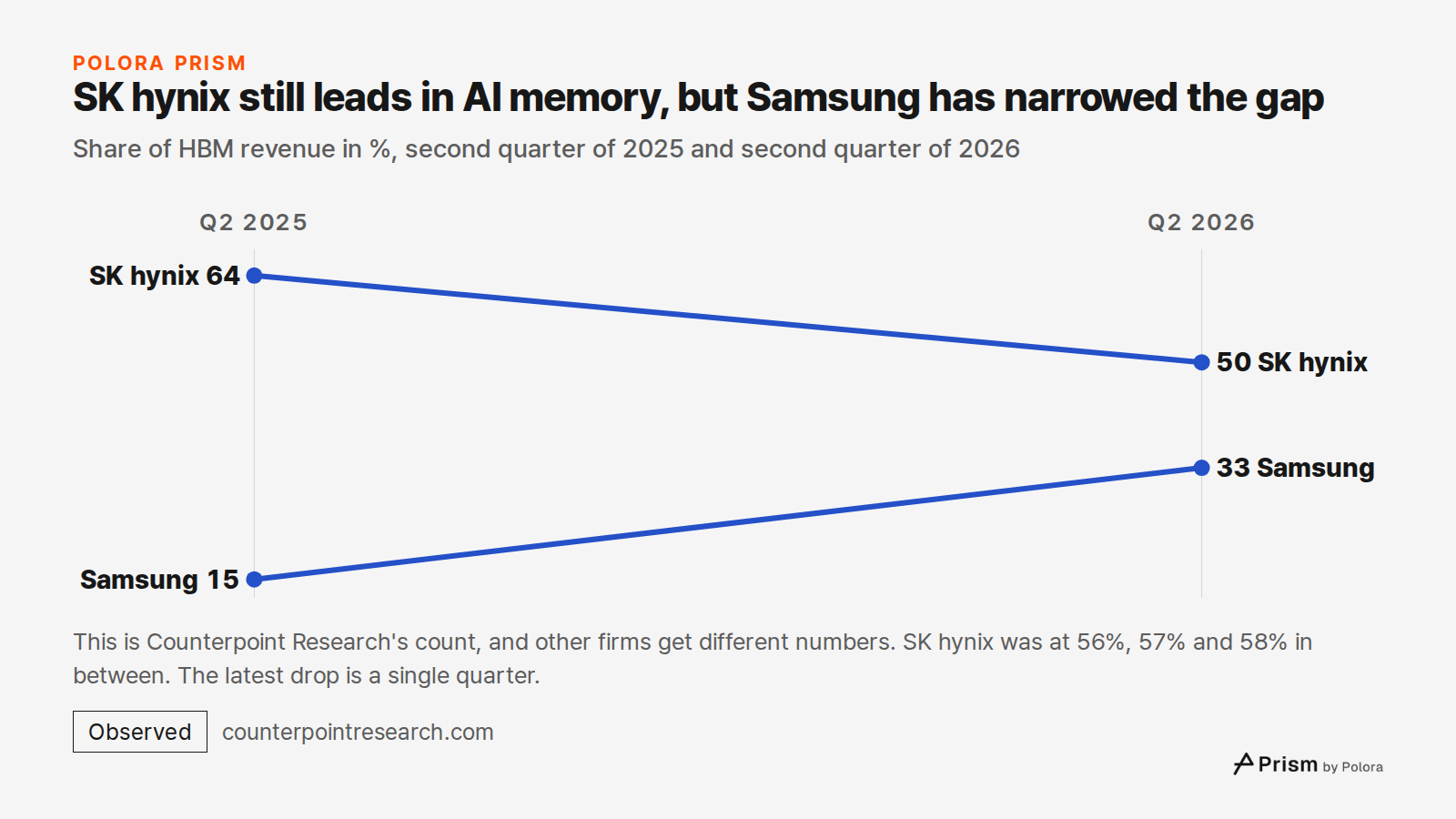
SK hynix still leads in AI memory, but Samsung has narrowed the gap · Share of HBM revenue in %, second quarter of 2025 and second quarter of 2026 · Q2 2025 · Q2 2026 · SK hynix · Samsung · 64 · 15 · 50 · 33 · This is Counterpoint Research's count, and other firms get different numbers. SK hynix was
Share of HBM revenue in %, second quarter of 2025 and second quarter of 2026

Contracts show next year more clearly than the years after

The thing to carry away is this. TrendForce expects AI memory to cost far more on average next year because supply stays tight and buyers are moving to pricier generations. Separately, Micron says this memory takes about three times the wafers of ordinary memory for the same amount of storage, and that it has already sold most of its own 2027 supply. The shares swing because they are priced on many years of profit that contracts do not settle, in a business that, not long ago, went from a large profit to a large loss within two years.

Nothing here says where prices or shares will go. What will shape the next turn is public : the terms of new contracts, how much new factory space opens and when, and how much of the newer HBM4 Samsung wins. The next quarterly results from SK hynix and Samsung, and what both say about 2027 supply, will be the next piece of evidence. The projections here belong to the firms named, and past results promise nothing about the future.
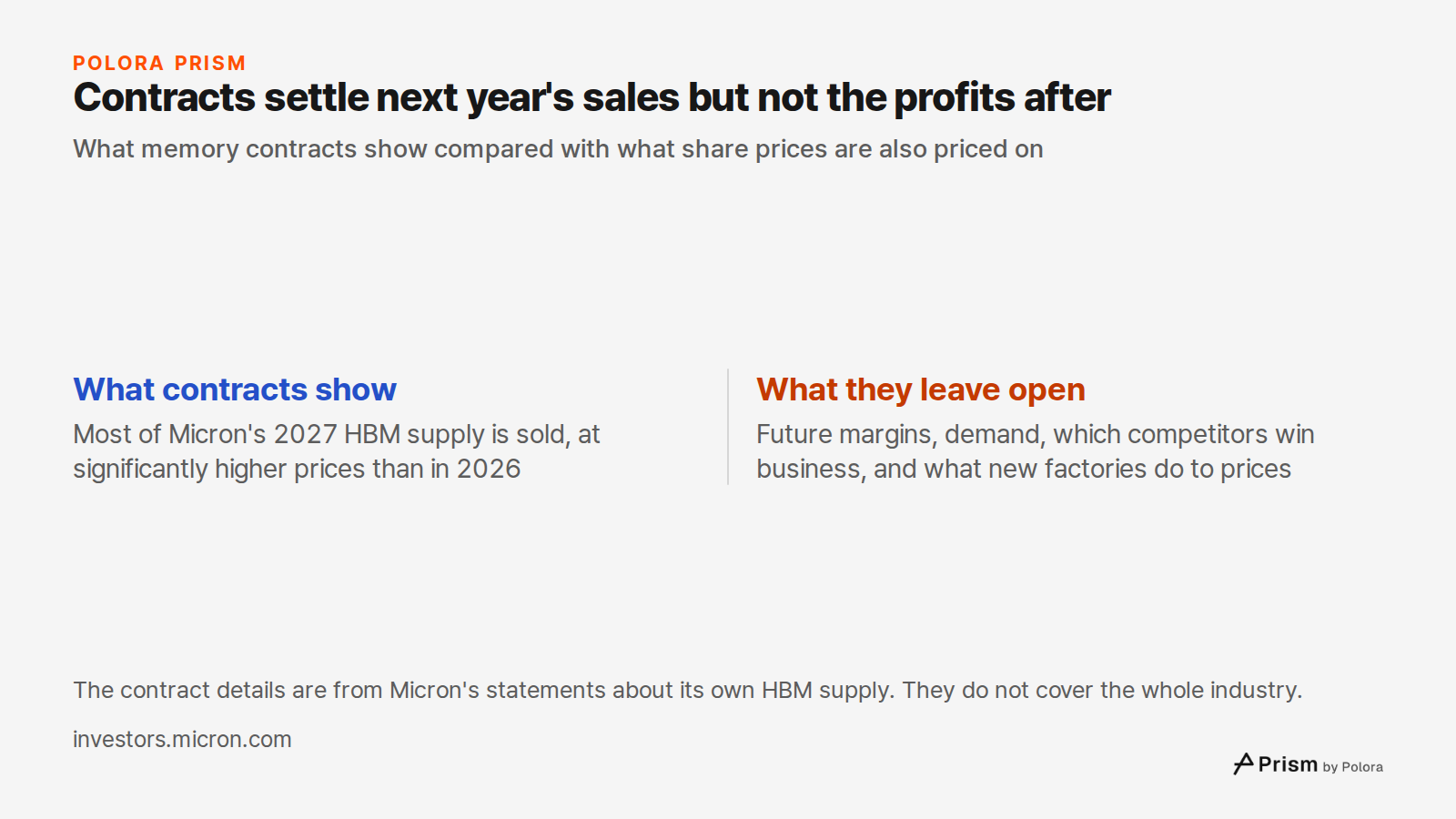
Contracts settle next year's sales but not the profits after · What memory contracts show compared with what share prices are also priced on · What contracts show · What they leave open · Most of Micron's 2027 HBM supply is sold, at significantly higher prices than in 2026 · Future margins, demand,
What memory contracts show compared with what share prices are also priced on
Why are AI memory chip prices expected to double, and why do memory stocks still swing so hard?Why are AI memory chip prices expected to double, and why do memory stocks still swing so hard?Memory contracts show next year. Shares are priced on many years of profit. · TrendForce projects AI memory prices will rise 121% on average in 2027. Yet on October 15, 2026, shares of SK hynix, the largest maker of these chips, closed down 11.06% in Seoul.※ HBM : high-bandwidth memory, the chip that sits beside an AI processor · +121% · projected average HBM price change in 2027 · TrendForce projects AI memory prices will more than double on average in 2027 · Projected change in the average selling price of HBM, blended across products, 2027 compared※ HBM3E : the current generation of high-bandwidth memory, the chip that sits beside an AI processor · About 3× · the wafers of ordinary DDR5 memory · AI memory uses about three times the wafers for the same storage · Silicon wafers needed by HBM3E compared with ordinary DDR5 server memory, for the※ HBM : high-bandwidth memory, the chip that sits beside an AI processor · What contracts show · What they leave open · Most of Micron's 2027 HBM supply is sold, at significantly higher prices than in 2026 · Future margins, demand, which competitors win business, and what new factories do to prices2021 · 29 · Operating margin, full year · Q1 2023 · -67 · Operating margin, one quarter · SK hynix went from a 29% margin to a loss in under two years · SK hynix operating profit as a % of revenue, from SK hynix's reported results · 2021 is a full year, and 2023 is a single quarter. SK hynix blamedBoom and bust is a risk investors weigh, not proof of another bust. · What will shape the memory business's next turn : the terms of new contracts, how much new factory space opens and when, and how much of the newer HBM4 Samsung wins. Nothing here says where prices or shares will go. · ※ HBM4 : theSources 14 : trendforce.com · TrendForce press release, September 29, 2026, eetasia.com · EE Times Asia : TrendForce raises 2027 HBM price forecast as supply constraints persist, koreaherald.com · The Korea Herald + 11Read the full story at · polora.ai

Why are AI memory chip prices expected to double, and why do memory stocks still swing so hard?

Alpha · deepseek-v4-pro

The short version is that two different things are being conflated: a forecast for one memory product's contract prices next year, and the stock market's guess about the whole industry many years out. They can move in opposite directions on the same day, and October 15, 2026 was a clean demonstration of why. Why the "double" is expected. The "AI memory chip" here is HBM, the stacked high-bandwidth memory that sits next to AI accelerators. The "prices will double" claim traces to a TrendForce projection that blended HBM average selling prices will rise 121% in 2027. That is a projection, not an observed transaction price. It is also an average across products, so a mix shift toward pricier HBM4 pushes the blended number up even if per-chip prices move less. The underlying economics are genuinely tight, though: - HBM uses roughly three times the wafer supply of ordinary DDR5 server memory for the same storage capacity. Every wafer made into HBM is a wafer not made into conventional memory. - Most of next year's volume is already locked up. Micron told investors in late September 2026 that it had contracted "the vast majority" of its calendar 2027 HBM supply, with sign…

Beta · gpt-6-sol

The manuscript’s central distinction holds: a forecast for HBM selling prices in 2027 is not a forecast for memory-company shares. But I would push back on Alpha’s phrasing that contracts describe *only next year*. Some of Micron’s agreements extend into 2031, so the better explanation is that contracts reduce some uncertainty without eliminating uncertainty about volumes, margins, competition and demand. (trendforce.com) Here is what I could check directly: - “Prices double” is a projection, not a measured price increase. TrendForce’s September 29, 2026 release projects a 121% year-on-year rise in blended HBM average selling prices in 2027. It attributes that forecast to constrained supply, a larger share of higher-priced HBM4, and an HBM4e ramp in the second half of 2027. A changing product mix means the figure does *not* say that every individual chip’s price will rise 121%. (trendforce.com) - The su…

Gamma · gemini-3.1-pro

The manuscript’s fundamental premise holds up well under scrutiny. It correctly identifies the tension at the heart of the user’s question: near-term memory prices are driven by tight supply and locked-in contracts, while memory stocks swing wildly because they are priced on the long-term, cyclical nature of the business and broader macroeconomic factors. Beta left a few specific claims unverified, which I was able to confirm via Live Search: * Micron's 75% contract coverage: The claim that "more than 75% of all its fiscal 2027 shipments, ordinary memory included, were already under contract or set aside for customers" is accurate. During Micron's fiscal Q4 2026 earnings call on September 30, 2026, President and COO Manish Bhatia stated that the company had committed more than 75% of its planned shipments for fiscal 2027. (Sources: MarketBeat, Trefis coverage of the Q4 call). * The "three times the wafer supply" claim: This is also accurate and comes directly from Micron. Raghu Sreeramaneni, Micron's HBM Design Architecture Fellow, presented at the Hot Chips conference on August 23, 2026, stating that for the same memory capacity, HBM3E requires approximately three t…

Researcher · gpt-6-luna

Research check - TrendForce’s 121% figure is verified as a projection. Its September 29, 2026 release says blended HBM average selling prices are projected to rise 121% year over year in 2027. It cites tight supply, a growing share of higher-priced HBM4, and HBM4e ramping in the second half of 2027. This is a forecast for a blended average, not a prediction that every HBM product’s price will rise by that amount. TrendForce release (trendforce.com) - The October 15 market figures are supported. Yonhap’s closing-data item gives the KOSPI at 5,554.22, down 454.59 points; that is a 7.57% decline. The Korea Herald’s report gives SK hynix down 11.06% and Samsung Electronics down 9.48%. A separate report citing Korea Exchange data says trading was halted for 20 minutes. These figures support the manuscript’s market-move description. Yonhap close · Korea Herald report · [News1/Chos…

The Arbiter · gpt-6-sol

The voices agree on the key distinction to test in the verdict: TrendForce’s 121% figure is a forecast for the blended average selling price of HBM in 2027, not an observed price rise or a forecast for memory stocks. TrendForce attributes it to tight supply and a shift toward newer HBM products. Micron’s older “three times” comparison concerns *wafer supply for the same number of bits*, not three times every kind of factory capacity. (investors.micron.com) The main disagreement is about how much certainty the contracts provide. Micron’s account of its own HBM commitments supports a tight near-term market, but it cannot establish that most *industry-wide* supply is sold. Beta also cautions that multiyear contracts make “stocks are priced on the years after contracts end” too stark: those agreements can extend visibility without settling future demand, margins or competition. Micron’s investor materials describe multiyear customer agreements and price bands, underscoring that distinction. ([investors.micron.com](https://investors.micron.com/static-files/631b1a32-5537-46ae-8f40-82e42fc…

The Arbiter's Final Verdict · gpt-6-sol

Verdict The manuscript’s central explanation stands, but its opening overstates what the evidence proves. The “doubling” is TrendForce’s projection that *blended* high-bandwidth memory (HBM) average selling prices will rise 121% in 2027. It is not a price increase already observed, and it does not mean every HBM chip will cost twice as much. HBM stacks memory beside an AI processor so data can reach it quickly. Making it strains supply: Micron’s original comparison says HBM3E needs approximately three times the wafer supply of DDR5 for the same number of bits at the same technology node—not three times every kind of “factory capacity.” Micron also says it has agreements covering the vast majority of its own calendar-2027 HBM bit supply at significantly higher year-on-year prices. That supports tightness, but does not establish that most HBM supply across all makers is sold. TrendForce’s forecast also reflects a shift towar…