¿Vale la pena el primer iPhone plegable o es pagar por hacer de betatester?
Solo vale la pena si puede nombrar dos tareas del día a día que mejoren de verdad con la pantalla desplegada, coincidieron cuatro modelos de IA. Si no, estará haciendo de betatester. Espere.
Negocios y economía · 2026-09-01
El 9 de septiembre Apple celebra un evento que buena parte del sector espera que traiga su primer iPhone plegable. Que de verdad lo haga es solo una parte del asunto. Pero la pregunta más útil está por debajo del hardware y lo sobrevive. ¿Cuándo comprar un dispositivo de primera generación es una compra inteligente y cuándo uno solo paga por hacerle de betatester al fabricante?
Polora planteó esa pregunta a varios modelos de IA, cada uno en un rol distinto. Uno argumentó como especialista en hardware y calidad, otro como economista de tecnología de consumo, otro como analista del software de Apple, y un cuarto contrastó cada afirmación factual con el registro público. Partieron de tres disciplinas distintas y, cosa poco habitual, llegaron casi al mismo lugar.
La única prueba a la que los tres volvían una y otra vez
Un dispositivo de primera generación, argumentó el economista, en realidad son tres cosas metidas en un mismo paquete. Una herramienta que hace algo por usted hoy, una opción de adelantarse a la curva, y un pasivo hecho de los fallos y las facturas de reparación que usted ha aceptado descubrir en nombre del fabricante. Solo obtiene un buen trato cuando las dos primeras superan con claridad a la tercera.
Ese marco organizó en silencio todo el debate. Y produjo una prueba única y contundente a la que los modelos volvían sin parar. ¿Puede nombrar dos cosas que hace casi a diario y que mejoran de forma apreciable en la pantalla más grande, ya desplegada? Si puede, el sobreprecio compra utilidad real. Si usaría el dispositivo plegado el noventa por ciento del tiempo, está pagando por una capacidad que nunca consumirá, más el riesgo de un pliegue y una bisagra que no necesitaba.
Cuándo comprar primero se justifica
Los argumentos para comprar en el lanzamiento son más fuertes cuando el nuevo formato consolida dispositivos que usted ya lleva encima. Si hoy carga con un teléfono y una tableta pequeña o un lector, un plegable puede de verdad fundir dos presupuestos en uno, y el sobreprecio frente a un teléfono normal empieza a parecer el precio de un solo dispositivo y no un lujo. Si nunca iba a comprar esa tableta, advirtió el economista, la cuenta se derrumba.
También se sostiene cuando el acceso temprano se paga solo. Desarrolladores, fabricantes de accesorios, reseñadores y creadores pueden tratar el teléfono como un costo de insumo, y el aprendizaje o la preparación de contenido lo recuperan aunque el hardware sea imperfecto. Y se sostiene cuando usted puede trasladar el lado malo, mediante AppleCare+, un canje del equipo usado, una deducción de empresa y, sobre todo, un teléfono de reserva en el que apoyarse durante una reparación. Por su parte, el analista de software añadió el ángulo del ecosistema. Una integración profunda con Apple reduce la fricción de pasarse a un plegable, pero fue tajante en que no puede fabricar utilidad. Un iCloud y una Continuity sin costuras en un teléfono descomunal siguen siendo un teléfono descomunal.
Uno de los modelos, al revisar las afirmaciones, señaló que AppleCare+ tiene un límite real que conviene entender. Puede poner un tope al costo de una reparación cubierta, pero no garantiza servicio el mismo día, no protege su acceso a los datos en una pantalla averiada ni promete que un fallo de la bisagra se cobre a la tarifa más barata de pantalla en vez de a la más cara de daño accidental. Abarata el betatesteo. No lo hace desaparecer.
Los modelos fueron igual de claros sobre quién debería mantenerse al margen, y aquí las tres disciplinas convergieron por completo. Si este va a ser su único teléfono y perder un día por una reparación trastornaría su trabajo o un viaje, una bisagra de primera generación es una mala apuesta. Si conserva los teléfonos de tres a seis años, está tratando un conjunto mecánico no probado como una propuesta a largo plazo que no se ha ganado. Si es brusco con los aparatos, trabaja rodeado de polvo, arena o humedad, o va justo de presupuesto, los riesgos se acumulan en su contra.
El modelo de hardware formuló la versión más afilada del argumento. Los puntos de desgaste de un teléfono convencional ya son conocidos. Un plegable añade una bisagra, una pila de pantalla flexible, capas de cubierta finas y cables que se doblan miles de veces, y esos fallos solo se revelan a lo largo de cantidades enormes de caídas, climas y reparaciones reales. La reputación de la marca y una presentación pulida no son prueba de durabilidad a varios años. Dos trampas de financiación merecieron avisos concretos. Un canje que lo ata a una cuota larga con la operadora no es un descuento, es un contrato. Y comprar un dispositivo de lujo de primera generación con la esperanza de que conserve valor de reventa de coleccionista es especulación, ya que el hardware de primera generación tiende a depreciarse con más fuerza en cuanto la segunda generación corrige los defectos evidentes.
Qué puede zanjar la presentación y qué no
La contribución más aterrizada vino del modelo encargado de la verificación, y mantuvo honestos a los demás. A finales de agosto, el único hecho público firme era la propia fecha del evento. Apple no había confirmado un plegable, y menos aún su nombre, su precio, el tamaño de pantalla, la calificación de durabilidad o las condiciones de reparación. El diseño tipo libro, la pantalla interior de unas 7,8 pulgadas, el precio de dos mil dólares y el canje agresivo sobre los que razonaron los demás modelos eran todo informaciones de prensa y ejemplos ilustrativos, no hechos del producto. Su valor estaba en ser un método para aplicar el día del anuncio, no cifras sobre las que hacer una reserva anticipada.
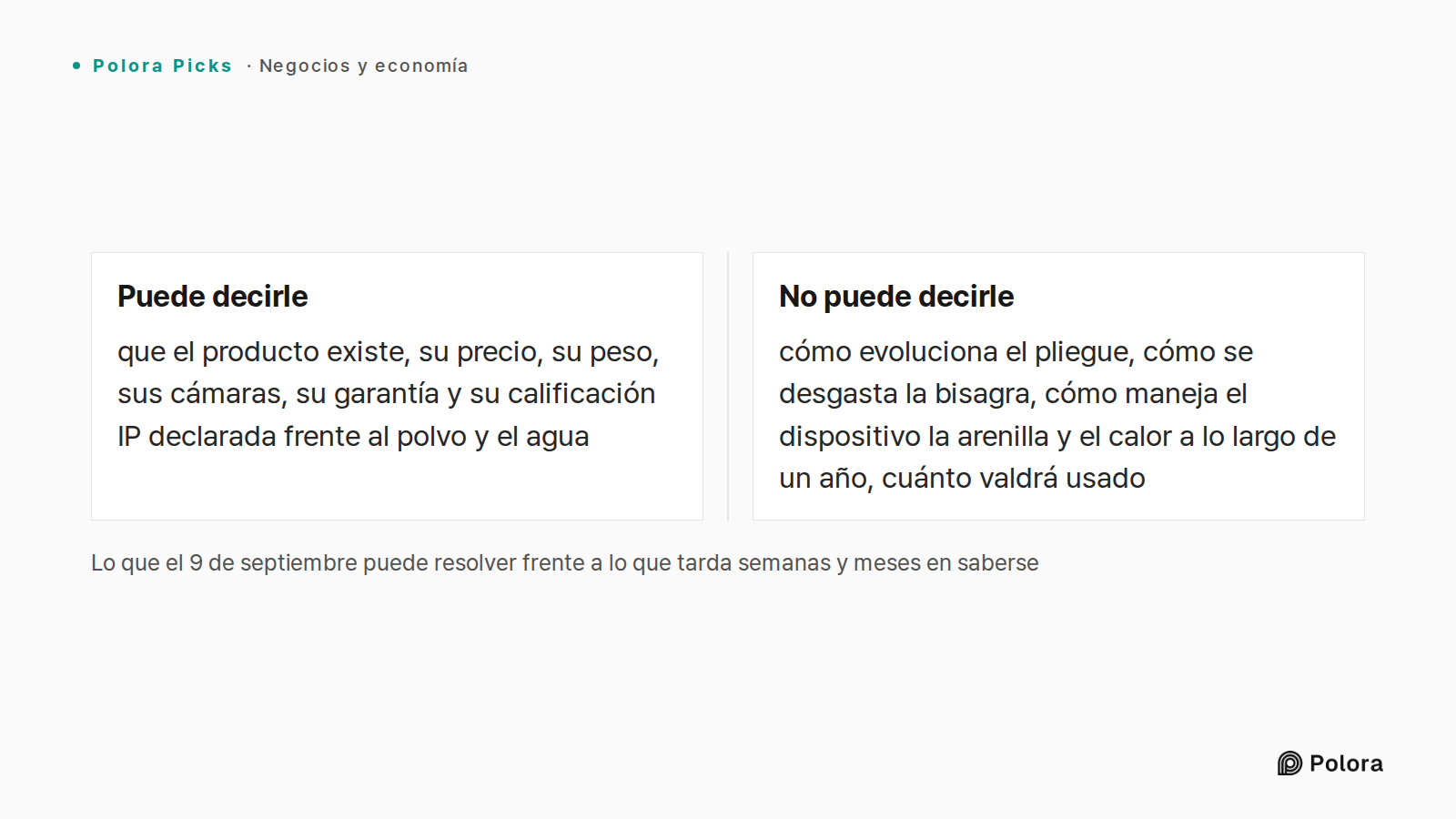
Así que el anuncio puede resolver un conjunto de cosas y otro no. Puede decirle que el producto existe, su precio, su peso, sus cámaras, su garantía y su calificación IP declarada frente al polvo y el agua. No puede decirle cómo evoluciona el pliegue, cómo se desgasta la bisagra, cómo maneja el dispositivo la arenilla y el calor a lo largo de un año, cuánto valdrá usado, ni si las aplicaciones de las que depende usarán el espacio extra en vez de estirarse por él. Esas respuestas llevan semanas y meses de desmontajes independientes y de uso por parte de dueños corrientes, por lo que cada modelo, desde tres puntos de partida distintos, dio el mismo consejo práctico. Trate el 9 de septiembre como el comienzo de un periodo de verificación, no como la meta, y no reserve la noche de la presentación.
Hay un detalle de la ficha técnica que vale la pena leer con cuidado, porque es fácil malinterpretarlo. Una afirmación de resistencia al agua no establece por sí sola la resistencia al polvo, y para una bisagra el polvo es la amenaza más reveladora. Si un plegable trae una calificación alta frente al agua pero un lenguaje vago sobre las partículas, esa brecha es lo que hay que vigilar.
※ Calificación IP : un código estandarizado, como IP68, que gradúa por separado qué tan bien resiste un dispositivo las partículas sólidas como el polvo y qué tan bien resiste el agua.
Lo que el 9 de septiembre puede resolver frente a lo que tarda semanas y meses en saberse · Puede decirle · No puede decirle · que el producto existe, su precio, su peso, sus cámaras, su garantía y su calificación IP declarada frente al polvo y el agua · cómo evoluciona el pliegue, cómo se desgasta
El debate nunca se convirtió en una pelea, y sería deshonesto fingir que sí. Lo que produjo en su lugar es una regla corta y de bolsillo que sobrevive sea o no real el plegable. Anote dos tareas del día a día que mejoren de verdad en la pantalla más grande. Si no puede, espere. Si puede, espere igualmente, más allá de la presentación, a que lleguen las pruebas de durabilidad y las condiciones reales de reparación, y entonces compre dentro de un plazo de devolución si todo se sostiene. Cualquier otra cosa es donar su depreciación a la curva de aprendizaje de otro.
Apple unveils its first foldable iPhone on September 9. Work through when buying a first-generation device is worth it and when it is just paying to beta-test the hardware, using the foldable as the live case.
Apple Ecosystem & Software Integration Analyst · gpt-5.6-luna
From an Apple-ecosystem perspective, the key question is not simply “Is the foldable innovative?” It is: does its new form factor solve enough daily problems to justify first-generation compromises?
When it may be worth buying
A first-generation foldable iPhone can make sense if you:
- Already rely heavily on Apple services. iMessage, FaceTime, iCloud Photos, Apple Watch, AirPods, Continuity, and app purchases reduce the switching cost and make the device more useful than an isolated experimental phone.
- Value a larger display but want iPhone integration. If the unfolded screen materially improves reading, travel planning, multitasking, photo editing, document review, or remote work, the form factor may replace both a conventional phone and some tablet use.
- Keep phones for several years. A strong warranty, AppleCare+, and credible software-support commitment matter more for a foldable than for a normal iPhone. Buyers who upgrade annually may be better positioned to absorb early depreciation; long-term owners need confidence in hinge and display durability.
- Accept first-generation limitations. You should be comfortable with possible thickness, weight,…
A first-generation foldable iPhone could be a great product and still be a poor *default purchase*. The distinction is whether you can absorb the remaining uncertainty in a mechanically complex device.
A conventional iPhone’s main wear points are comparatively mature: ports, buttons, battery, cameras, and display. A foldable adds a hinge, flexible OLED stack, ultra-thin cover layer, moving seals, internal cables that bend repeatedly, and two form factors whose software behavior must be reliable. That is not automatically fragile—but it creates more failure modes and more variables that only huge numbers of real-world cycles, climates, drops, dust exposure, and repairs reveal.
When buying the first foldable is rational
Buy at launch if most of these are true:
- The folded/unfolded workflow solves a real daily problem. You read long documents, mark up PDFs, work in split screen, travel without a tablet, manage dashboards, or need a larger canvas often enough that you will use it every day.
- You can tolerate downtime. If a repair or replacement process would be inconvenient but not disastrous, early adoption is easier to justify.
- You upgrade frequently anyway. If…
Consumer Tech Economist & Value Strategist · deepseek-v4-pro
My lens here is the value equation, not the spec sheet. A first-generation device is a bundle of three things:
1. A tool — what it does for you today.
2. An option — access to Apple’s folding hardware/software roadmap before everyone else.
3. A liability — the undiscovered failure modes, repair costs, and app gaps you’re agreeing to discover on Apple’s behalf.
You’re getting a good deal when the first two clearly outweigh the third.
For the foldable iPhone, the September 9 event matters because two numbers convert this from a gadget argument into an economic one: the price gap over a normal iPhone, and the repair/AppleCare+ cost for the folding display. Until those are known, everything is conditional.
When a first-gen foldable is actually worth it
1. It replaces two devices you already use.
If you currently carry an iPhone *and* an iPad mini/Kindle-style reading device, the foldable can genuinely consolidate two budgets. A $1,200 phone plus a $500 tablet starts to justify a $1,700–2,000 foldable. But if you weren’t going to buy the tablet anyway, that math collapses.
2. The unfolded screen is central to your daily workflow, not a novelty.
D…
Researcher · gpt-5.6-terra
Reality check on the premise and the advice
As of August 31, 2026, Apple has confirmed an event for Wednesday, September 9, at 10 a.m. Pacific / 1 p.m. Eastern. However, Apple has not publicly confirmed that it will unveil a foldable iPhone, nor its name, price, availability, specifications, durability rating, repair costs, or AppleCare+ terms. The foldable is widely *reported/expected*, but it remains unannounced until the event. The distinction matters: treat every device-specific claim in this round as a condition to verify after Apple’s presentation—not as an established fact.
Sources: Axios, Aug. 26, 2026; MacRumors, Aug. 26, 2026. (axios.com)
Claims that are well grounded
- The hardware specialist’s central premise is sound: a folding phone introduces additional mechanically stressed components—especially a hinge, a flexible display stack, and flexing interconnects—relative to a conventional slab phone. Th…
The Arbiter · gemini-3.5-flash
An interesting dynamic has formed here. All three of our specialists have delivered remarkably aligned structural advice: do not buy on keynote hype, evaluate specific utility, and wait for third-party physical validation.
However, they approach this consensus from three entirely different operational angles. To help you decide how to approach the September 9 "Surprise and shine" event, let us lay out where their perspectives complement each other and where the real friction lies.
---
The Convergence: The "No-Go" Profile
All three analysts agree on who should absolutely avoid this first-generation device:
* The Single-Device Relyant: If you do not have a reliable backup phone, or if a 48-hour repair window would disrupt your livelihood, a first-gen hinge mechanism is a massive gamble.
* The Multi-Year Investor: If your typical upgrade cycle is 3 to 6 years, buying a first-generation mechanical hinge with unproven long-term wear is highly risky.
* The Speculative Buyer: If you are stretching your budget or hoping the device holds premium resale value, the Consumer Tech Economist warns that early-generation depreciation curves are usually brutal once…
Apple Ecosystem & Software Integration Analyst · gpt-5.6-luna
From the ecosystem perspective, a 7.8-inch foldable succeeds or fails on software behavior, not merely screen size. A large display that runs enlarged phone apps is an expensive inconvenience.
What Apple must get right
1. Reliable two-app multitasking
The inner screen should support genuinely useful side-by-side apps—Mail and Safari, Notes and a document, Maps and Messages—with persistent layouts and predictable resizing. If multitasking requires repeated gestures or resets whenever the phone folds, the benefit quickly disappears.
2. Continuity across the hinge
Opening the device should preserve the exact app state, scroll position, keyboard status, and media playback. Closing it should hand off gracefully to the outer display. A user should never have to restart a task because the form factor changed.
3. Proper app adaptation
Apple needs clear APIs and strong developer tooling for responsive layouts. Essential apps—banking, authentication, productivity, travel, streaming, games, and social platforms—must use the available space intelligently rather than leaving blank columns or presenting awkwardly stretched interfaces.
4. A useful keyboard and poi…
Assuming Apple announces a book-style foldable, the spec sheet can reveal whether it is a carefully engineered premium product—or a first-generation compromise package. I would not decide based on a claimed hinge-cycle count alone. That metric is useful, but it is a narrow, controlled test; real failures often arise from pressure, contamination, heat, impacts, and manufacturing variation.
Spec-sheet signals that merit caution
1. Thickness and weight that undermine ordinary phone use
A foldable must be judged in both states.
- Folded thickness: If it is substantially thicker than a normal Pro Max, it becomes more exposed to pocket pressure, awkward one-handed handling, and drop energy. Thickness also affects whether people use a protective case—which adds still more bulk.
- Weight: A very heavy device concentrates more impact energy in a drop and strains the hinge and flexible display during real handling. It may be acceptable for a tablet-like workflow, but not if it is your always-carried phone.
- Uneven halves or a visible closure gap: A gap is a debris pathway and makes pocket contamination more concerning. “Closes flat” is not proof of dust resilience, but…
Consumer Tech Economist & Value Strategist · deepseek-v4-pro
The price question is not the sticker. It’s the incremental premium after trade-in, measured against what the foldable actually replaces.
The math to do after September 9
If the foldable is $2,000+ and Apple offers aggressive trade-in for an iPhone 16/17 Pro, don’t compare it to “a phone.” Compare it to your next-best realistic path.
Example, fully hypothetical until Apple announces real numbers:
- Foldable: $2,000
- Apple gives you $1,000 for a 16/17 Pro, vs $800 on a normal iPhone upgrade
- Your next-best path is a $1,200 Pro plus an iPad mini at $499
Effective cost:
- Normal path: $1,200 − $800 trade = $400 out of pocket, and you still have the tablet need
- Foldable path: $2,000 − $1,000 trade = $1,000 out of pocket
So the foldable premium over a slab upgrade is about $600 — and if it genuinely replaces the iPad mini, that $600 is buying one device instead of two. That can be rational.
If the trade-in is merely “market value plus $50,” the premium is larger, and the case weakens sharply.
When an aggressive trade-in changes my answer
Yes, it moves some people from “wait” to “buy,” specifically:
- You already own a 16/1…
Researcher · gpt-5.6-terra
Verification notes for Round 2 — as of August 31, 2026
1. What remains unconfirmed
Apple has officially announced a special event for Wednesday, September 9, 2026, at 10 a.m. Pacific. But Apple has not confirmed a foldable iPhone, its form factor, display size, price, trade-in terms, camera configuration, ingress rating, repair policy, or software features. References in this round to a “book-style” design, a roughly 7.8-inch inner display, “iPhone Ultra,” $2,000-plus pricing, Touch ID, or iPad-like multitasking are assumptions or media reports—not product facts yet.
Official event source: https://developer.apple.com/news/?id=s6spdug0
Reporting distinguishing confirmed event from expected products: https://www.axios.com/2026/08/26/apple-september-event-foldable-iphone-ternus-cook
Rumor roundup containing the 7.7-inch/Touch-ID/multitasking claims: https://www.macrumors.com/2026/08/27/apple-event-announced-six-new-products/
2. Hardware specialist: grounded principles, conditional device claims
The engineering checklist is sensible: a folding device necessarily adds a moving hinge and flexible display system, so dust management, point-load resistance,…
The Arbiter · gemini-3.5-flash
The Verdict on the Debate: Framing the September 9 Decision
As we close the final round of this debate, a striking consensus has emerged. Despite their different disciplines—hardware engineering, consumer economics, and software ecosystems—all three specialists arrive at the same operational conclusion: The keynote is not the finish line; it is merely the start of the verification period.
If Apple does indeed unveil a book-style foldable iPhone on September 9, you should not approach it as a standard iPhone upgrade. You are looking at an entirely new product category with its own mechanical, financial, and behavioral rules.
Here is the synthesized framework to help you navigate the announcement and the weeks that follow.
---
The Three Pillars of Your Decision
To determine if you are buying a revolutionary productivity tool or simply paying to beta-test Apple’s hardware, you must evaluate the device through three distinct lenses:
┌─────────────────────────────────────────┐
│ THE DECISION MATRIX │
└────────────────────┬────────────────────┘
│…
The Arbiter's Final Verdict · gemini-3.5-flash
Based on the comprehensive arguments presented by the hardware, economic, and software specialists, here is the definitive framework for evaluating Apple’s expected September 9 announcement.
This is your guide to distinguishing a high-utility, rational luxury purchase from a costly, frustrating hardware beta-test.
---
The Core Verdict: The "Utility-to-Risk" Ratio
Buying a first-generation foldable is only "worth it" when the utility (the problems it solves for you daily) clearly outweighs the liability (the mechanical, software, and financial risks you are volunteering to discover on Apple's behalf).
WORTH IT (High Utility, Insulated Risk) BETA-TESTING (Low Utility, Exposed Risk)
┌──────────────────────────────────────────┐ ┌──────────────────────────────────────────┐
│ • Replaces two carried devices (Phone+Pad)│ │ • Used folded 90% of the time │
│ • Income/productivity tied to early tech │ │ • Only phone; no reliable backup │
│ • Risk fully offset by AppleCare+/writeoff│ │ • Stretched budget/36-month lock-in │
│ • Mature, persistent 2-app workflows │ │ • Harsh environment (dust, outdoors) │
└──…