수수료는 손해로 느껴지지만 놓친 할인은 별로 아깝지 않기 때문입니다. 어느 쪽으로 부르든 손님이 내는 가격은 같습니다. 경제학자 리처드 세일러는 1970년대 미국 카드업계가 그 차이를 현금 할인으로 불러 주길 원했다고 썼습니다.
비즈니스와 경제 · 2026-11-09
안내문은 둘, 가격은 같다
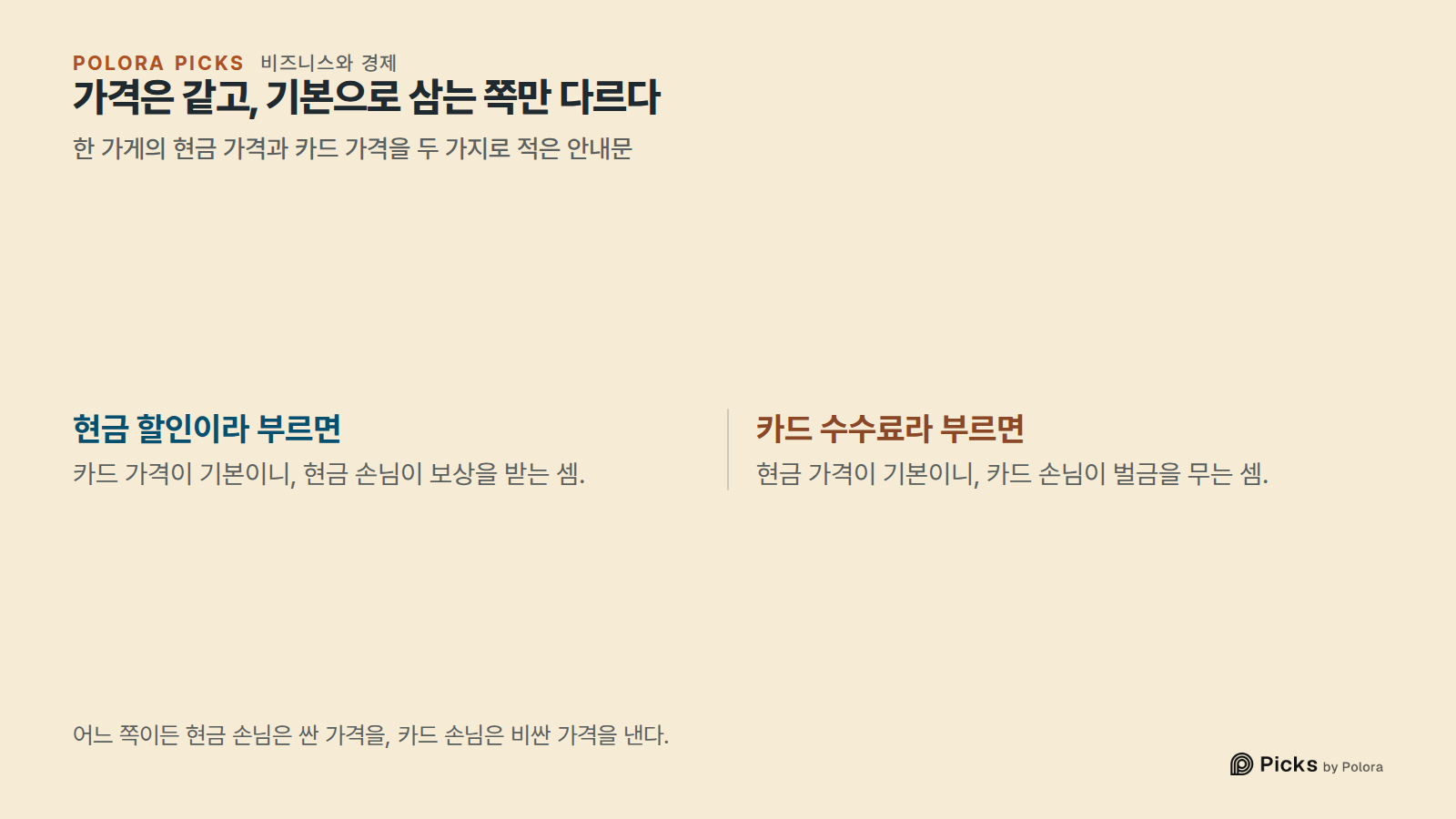
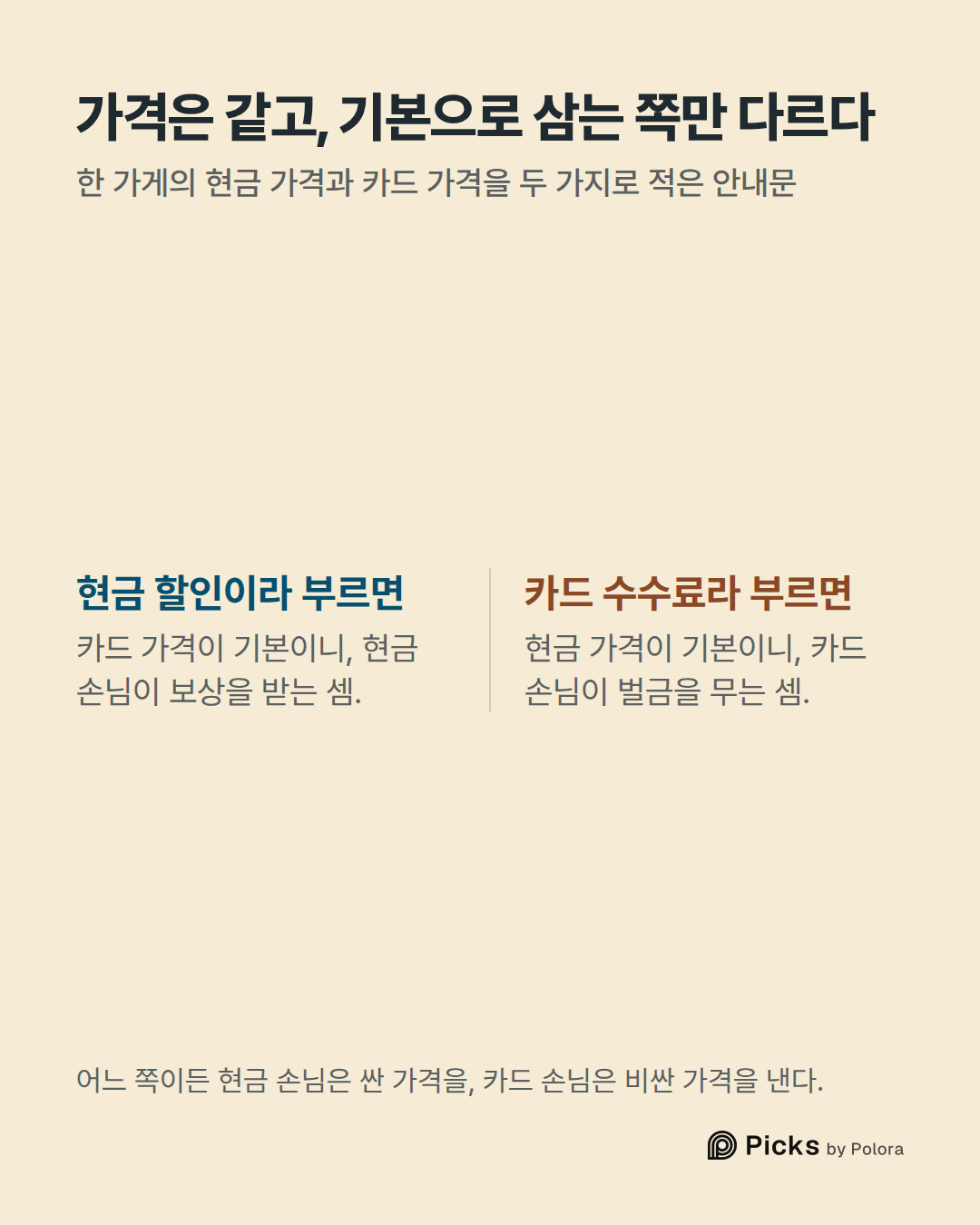
주유소 가격 안내판에 가격이 두 개 적혀 있다고 해 봅시다. 현금으로 내면 싼 가격, 카드로 내면 비싼 가격입니다. 어떤 주인은 그 차이를 현금 할인이라고 부르고, 다른 주인은 카드 수수료라고 부릅니다. 어느 쪽이든 현금 손님은 싼 가격을, 카드 손님은 비싼 가격을 냅니다. 달라지는 돈은 한 푼도 없습니다.
달라지는 것은 어느 쪽을 진짜 가격이라고 부르느냐입니다. 카드 가격이 기본이면 현금 손님이 보상을 받는 셈이고, 현금 가격이 기본이면 카드 손님이 벌금을 무는 셈입니다. 카드로 돈을 버는 쪽은 수십 년 동안, 손님이 이 둘 가운데 어느 이야기를 듣게 되는지에 촉각을 곤두세워 왔습니다.
여기에 놀라운 사실이 하나 더 숨어 있습니다. 카드 손님에게 돈을 더 받지 않는 가게에서 현금으로 낸다고 해서, 카드 비용이 한 푼도 섞이지 않은 가격을 내는 것은 아닙니다. 십중팔구 가게가 카드 때문에 치르는 비용을 함께 나눠 내고 있습니다.
한 가게의 현금 가격과 카드 가격을 두 가지로 적은 안내문
현금으로 내도 카드 수수료는 이미 가격에 들어 있다
가게는 카드를 받을 때마다 돈을 옮겨 주는 은행과 카드 결제망 회사에 수수료를 냅니다. 결제 업계 소식지 닐슨 리포트에 따르면 2024년 미국 가맹점들은 카드 결제 11.902조 달러에 대해 이런 수수료로 1872억 달러를 냈습니다. 카드로 100달러를 쓸 때마다 약 1.57달러꼴입니다. 모든 종류의 카드를 합친 평균이라, 결제 하나하나에 이만큼 붙는다는 뜻은 아닙니다.
대부분의 가게는 무엇으로 내든 같은 가격을 받습니다. 그러니 이 비용도 임대료나 전기요금처럼 진열대 가격에 얹어 메웁니다. 그 가격은 현금으로 내는 사람까지 모두가 냅니다.
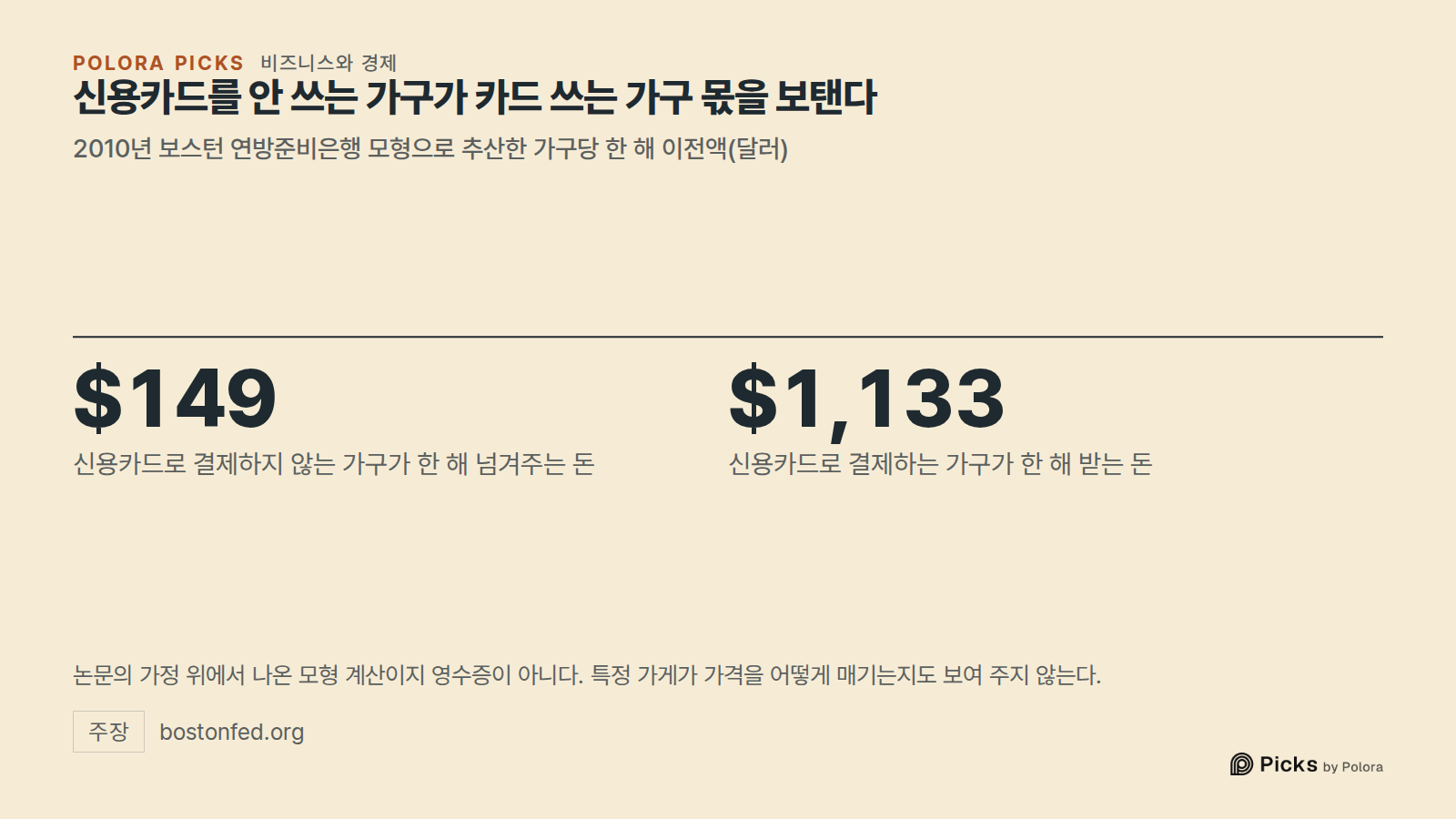
미국 보스턴 연방준비은행의 경제학자들은 이것이 어떤 결과를 낳는지 재 보려 했습니다. 2010년 논문에서 이들은 신용카드로 결제하지 않는 가구가 한 해 149달러를 신용카드 사용자 쪽으로 넘겨주고, 신용카드로 결제하는 가구는 한 해 1,133달러를 받는다고 추산했습니다. 논문은 앞의 집단을 현금 사용자라고 부르지만, 지폐로 내는 사람만 가리키는 것은 아닙니다. 이 수치는 논문이 세운 가정 위에서 나온 모형 계산이지 영수증이 아니며, 어느 특정 가게가 가격을 어떻게 매기는지도 보여 주지 않습니다. 그래도 돈이 흐르는 구조는 보여 줍니다. 가격이 하나뿐인 가게에서는 진열대 가격에 이미 카드 비용이 실려 있고, 현금 할인은 그 수수료의 일부를 돌려주는 셈입니다.
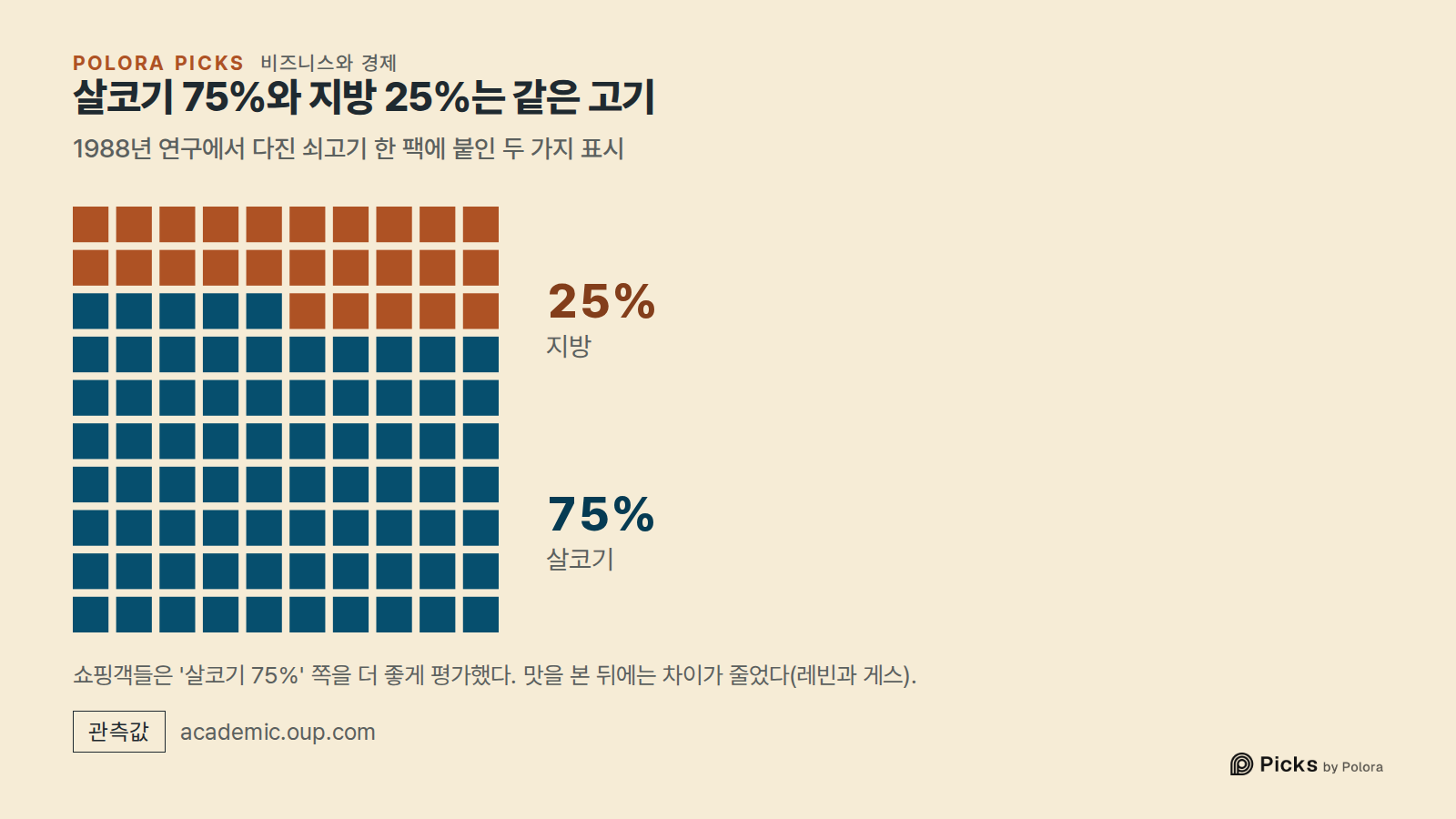
말만 바꿔도 판단이 달라진다는 것은 심리학자들이 거듭 보여 주었습니다. 1988년 연구에서 어윈 레빈과 게리 게스는 쇼핑객들에게 다진 쇠고기를 평가하게 했습니다. 한쪽에는 '살코기 75%', 다른 쪽에는 '지방 25%'라고 적었습니다. 같은 고기였는데 '살코기 75%' 쪽이 더 좋은 평가를 받았습니다. 실제로 맛을 본 뒤에는 그 차이가 줄었습니다.
1982년 의학 학술지 뉴잉글랜드 저널 오브 메디신에 실린 연구에서 바버라 맥닐과 동료들은 폐암 치료법을 환자 238명, 대학원생 491명, 의사 424명에게 설명했습니다. 수술 결과를 생존율로 알려 주면 사망률로 알려 줄 때보다 수술이 눈에 띄게 더 매력적으로 보였습니다. 의사들도 예외가 아니었습니다.
이런 연구가 잰 것은 한정된 상황에서의 평가 점수와 가상의 선택입니다. 어느 가게가 표현 하나로 돈을 얼마나 더 버는지는 보여 주지 않습니다. 다만 밑에 깔린 사실이 똑같아도 '더 낸다'와 '아낀다'는 같은 말로 들리지 않는다는 것은 보여 줍니다.
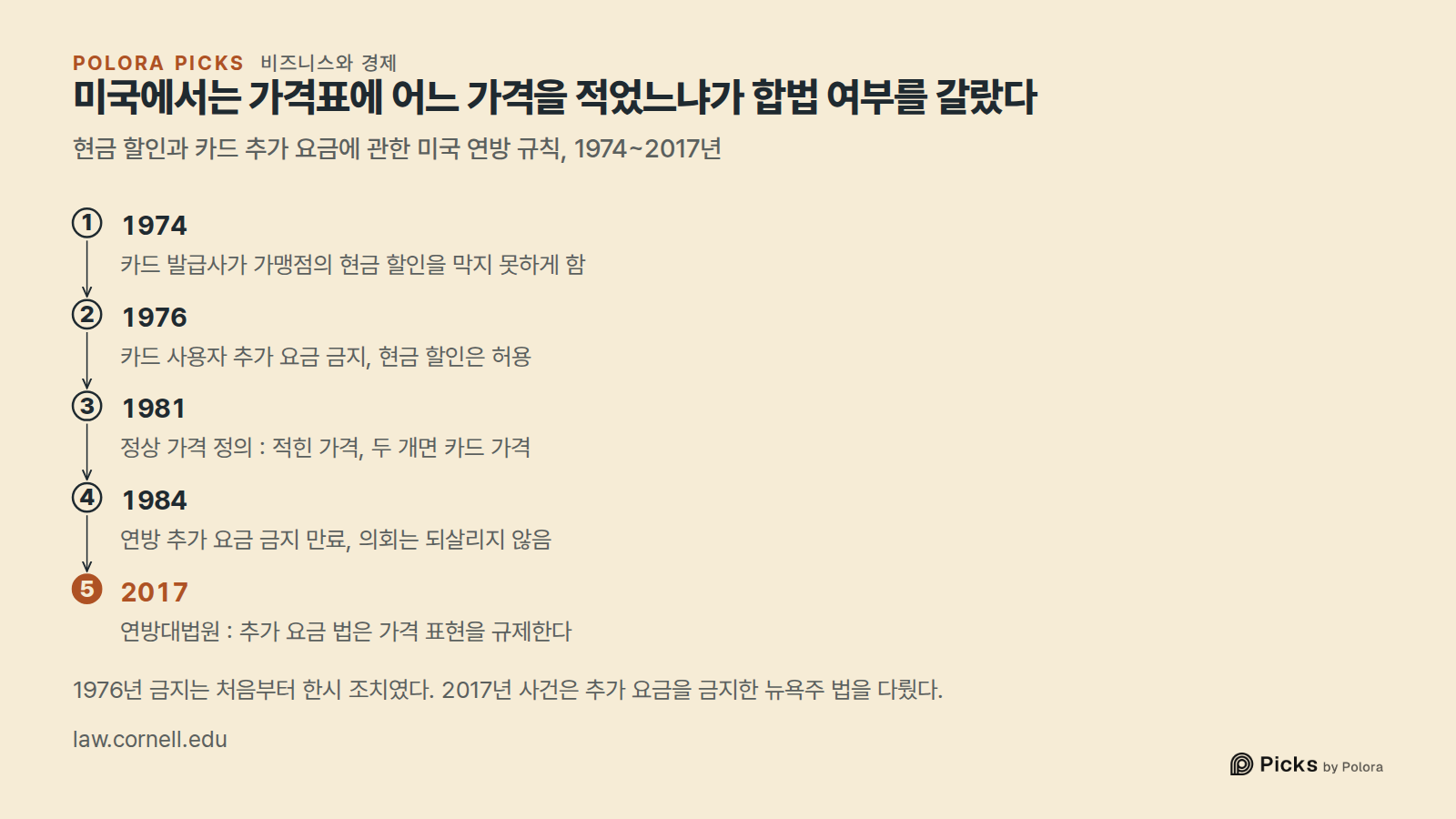
미국에서는 이 문제를 안내문 쓰는 가게 주인에게만 맡겨 두지 않았습니다. 1974년 미국 의회는 대출 조건 공개법(Truth in Lending Act)을 고쳐, 카드 발급사가 가맹점의 현금 할인을 막지 못하게 했습니다. 1976년에는 한발 더 나아가, 현금 할인은 그대로 허용하면서 가맹점이 카드 사용자에게 추가 요금을 붙이는 것을 금지했습니다. 다만 이 금지는 처음부터 한시 조치였습니다.
그러자 낱말을 어떻게 정의하느냐가 중요해졌습니다. 법은 할인을 정상 가격에서 깎아 주는 것으로, 추가 요금을 현금 손님에게는 받지 않고 카드 사용자에게만 정상 가격보다 더 받는 금액으로 정의했습니다. 1981년 의회는 정상 가격 자체도 정의했습니다. 가격표나 안내판에 적힌 가격이 하나면 그 가격이고, 가격을 두 개 적었거나 하나도 적지 않았으면 카드 가격이라는 것입니다. 이 정의대로라면 같은 두 가격도 어느 쪽이 가격표에 붙어 있느냐에 따라 합법이 되기도, 불법이 되기도 했습니다. 같은 1981년 개정은 현금 할인으로 인정받는 폭에 걸려 있던 5% 상한도 없앴습니다.
연방 차원의 추가 요금 금지는 1984년 만료됐고, 의회는 이를 되살리지 않았습니다. 추가 요금을 금지한 뉴욕주 법을 다룬 2017년 익스프레션스 헤어 디자인 대 슈나이더먼 사건에서, 미국 연방대법원은 이 역사를 되짚었습니다. 그리고 그런 법은 판매자가 가격을 어떻게 표현하는지를 규제하므로 표현의 자유 문제라고 보았습니다.
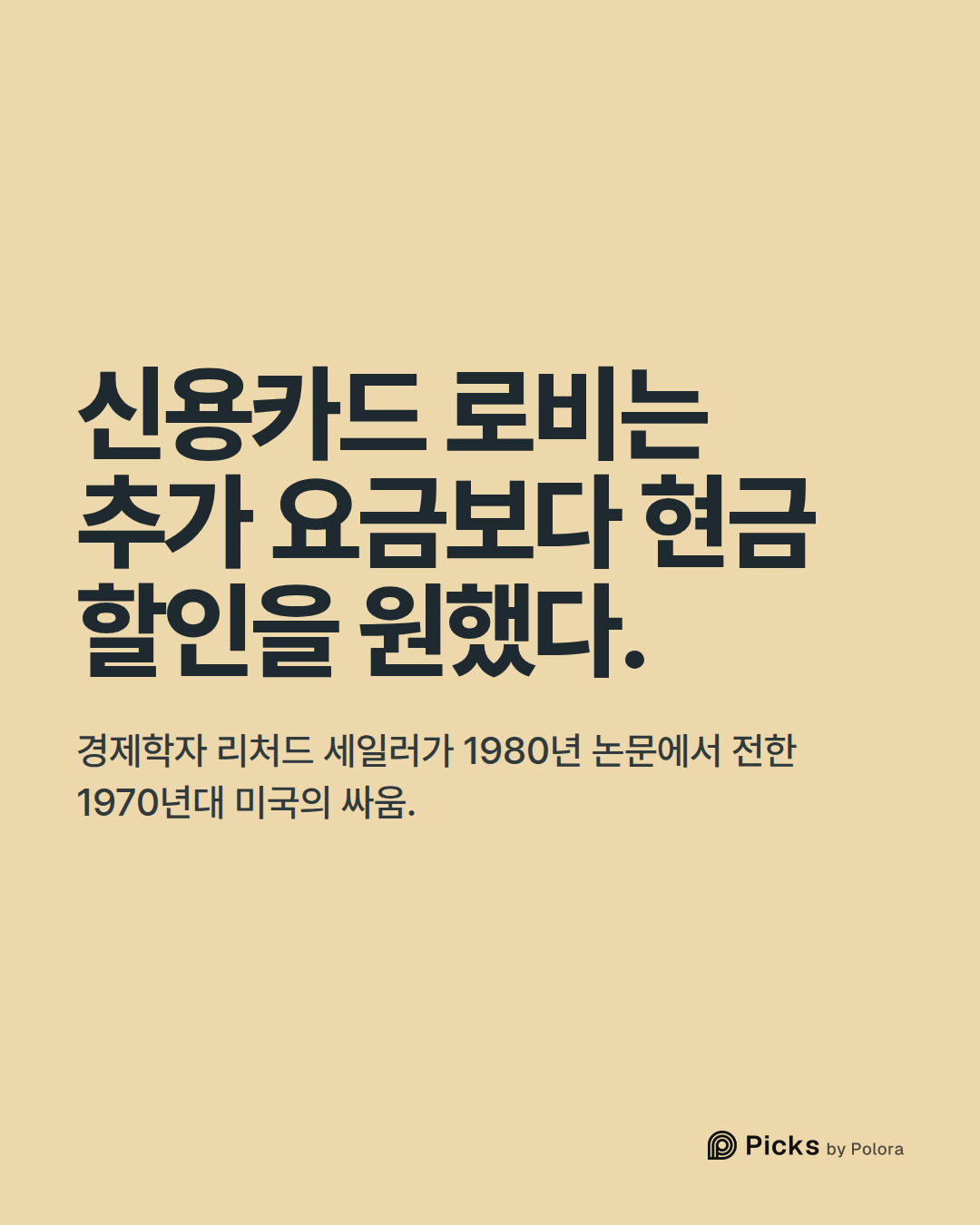
훗날 노벨경제학상을 받은 경제학자 리처드 세일러는 1980년 논문에서 이 싸움을 예로 들었습니다. 그는 의회가 어떤 식으로든 법안을 통과시킬 기세가 보이자 '신용카드 로비는 실질보다 형식에 관심을 돌렸다'고 썼습니다. 현금 손님과 카드 손님 사이에 가격 차이가 생긴다면, 그것이 '신용카드 추가 요금이 아니라 현금 할인의 형태를 띠기를' 바랐다는 것입니다.
이유에 대한 그의 설명은 이렇습니다. 놓친 할인은 그냥 흘려보낸 기회처럼 느껴지지만, 추가 요금은 주머니에서 돈이 빠져나가는 것처럼 느껴진다는 것입니다. 그는 각주에서 1975년 미국 상원 청문회에서 연방준비제도이사회의 제프리 부처가 한 증언을 인용합니다. 부처 자신은 추가 요금과 할인을 똑같이 다뤄야 한다는 입장이었지만, 비판하는 쪽의 주장도 전했습니다. '추가 요금은 신용카드 사용자에게 주는 벌칙이라는 느낌을 주고, 할인은 현금 손님에게 주는 보너스로 여겨진다'는 것입니다.
이것은 로비가 무엇을 원했는지에 대한 세일러의 설명이고, 공개된 청문회 기록이 이를 받쳐 줍니다. 다만 로비 쪽이 내부에서 어떤 논리를 폈는지 보여 주는 기록은 아닙니다.
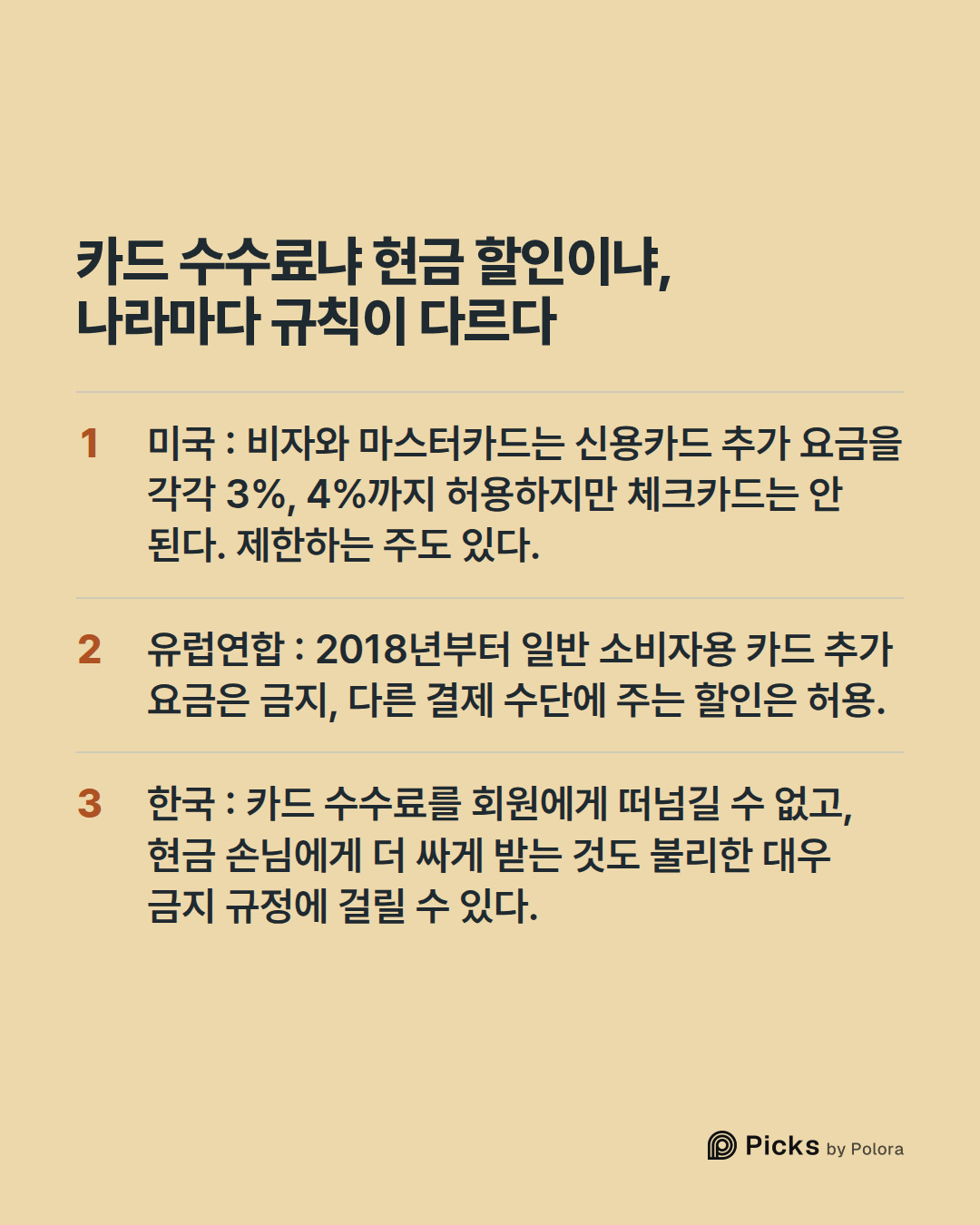
미국에서는 이제 카드 수수료를 드러내 놓고 받을 수 있습니다. 비자와 마스터카드의 공개 규정은 가맹점이 신용카드 결제에 추가 요금을 붙이는 것을 허용합니다. 상한은 비자가 3%, 마스터카드가 4%이고, 두 곳 모두 가맹점이 카드를 받는 데 실제로 드는 비용을 넘을 수 없습니다. 체크카드는 두 회사 규정 모두 추가 요금 대상이 아니고, 비자는 선불카드도 제외합니다. 이것은 카드 회사가 정한 한도일 뿐 어디서나 허용된다는 뜻은 아닙니다. 추가 요금을 제한하는 주도 있습니다. 비자가 2023년 8월에 낸 안내는 그런 주로 코네티컷, 메인, 매사추세츠, 오클라호마를 꼽으면서, 이 목록이 빠짐없는 것은 아닐 수 있다고 덧붙입니다.
이 규칙은 다시 바뀔 수도 있습니다. 2005년에 시작된 소송에서 비자·마스터카드와 미국 가맹점들 사이에 나온 수정 합의안이 2026년 6월 법원의 예비 승인을 받았고, 최종 승인을 남겨 두고 있습니다. 최종 승인 심리는 2026년 11월 16일로 잡혔다고 보도됐습니다. 많은 가맹점이 이 합의에 반대 의견을 냈습니다.
유럽연합은 두 낱말 사이의 선을 법으로 그었습니다. 개정 지급결제서비스지침에 따라 가맹점은 일반 소비자용 체크카드와 신용카드 결제에 추가 요금을 받을 수 없고, 이 금지는 2018년 1월 13일 이후의 결제에 적용됩니다. 같은 지침은 다른 관련 규정을 지키는 한, 특정 결제 수단을 쓰는 손님에게 가격을 깎아 주는 것은 명시적으로 허용합니다. 유럽연합에서는 카드 수수료는 금지, 다른 결제 수단에 주는 할인은 허용인 셈입니다.
한국은 한 걸음 더 나아갑니다. 여신전문금융업법은 가맹점이 카드로 결제한다는 이유로 카드 회원을 불리하게 대우하는 것도, 카드 수수료를 회원에게 떠넘기는 것도 금지합니다. 현금 손님을 우대하고 싶었던 한 가게 주인이 이 조항에 헌법소원을 냈지만, 헌법재판소는 2014년 이를 받아들이지 않았습니다. 그러니 한국에서는 안내문에 어떤 말을 쓰든, 현금 손님에게 더 싸게 받는 것 자체가 카드 회원을 불리하게 대우하지 말라는 규정에 걸릴 수 있습니다.
결국 가격 차이는 같아도 느낌은 다릅니다. 어느 가격을 기본으로 정하느냐가, 다른 쪽 가격이 벌칙으로 들릴지 보상으로 들릴지를 정합니다. 미국에서는 이 선택을 두고 의회에서 다툼이 벌어졌고 나중에는 연방대법원까지 갔습니다. 유럽연합에서는 이제 두 낱말이 법 앞에서 서로 다른 대접을 받습니다.
분명히 해 둘 한계가 하나 있습니다. 여기서 인용한 연구 가운데, 부르는 이름 하나만으로 사람들이 계산대에서 실제로 하는 행동이 얼마나 달라지는지 잰 것은 없습니다. 실험실 연구는 말이 끌어당기는 힘을 보여 주고, 역사는 사람들이 그 말을 두고 싸웠다는 것을 보여 줍니다. 실제 계산대에서 그 효과가 얼마나 큰지는 아직 답이 나오지 않았습니다. 그리고 안내문 하나만 보고는 그 가게가 왜 그 말을 골랐는지 알 수 없습니다. 주인은 그저 가격을 적어 둔 방식대로 설명했을 수도 있고, 그 지역의 규칙을 따랐을 수도 있습니다.
Why do shops call it a "cash discount" instead of a "card fee" when the price difference is exactly the same?
Alpha · deepseek-v4-pro
Because the two wordings don't describe different prices; they describe different baselines.
If the card price is the "real" price, then paying cash is a reward — you're getting something back. If the cash price is the "real" price, then paying by card is a penalty — you're being charged extra. The two signs show the same two numbers, but one makes the card buyer feel punished and the other makes the cash buyer feel rewarded. Since losses tend to feel worse than equivalent gains, a "card fee" pushes customers away from cards, while a "cash discount" nudges them toward cash without making card payers feel they've been penalized. That is the framing effect: same arithmetic, different emotional weight.
There's a second reason, and it's about cost. Card payments carry merchant fees, so the higher card price is often the price that covers those fees. Calling the gap a "cash discount" lets the shop keep the card price as the normal one and offer cash a reduction. It also protects card use: the card networks and, in the US, the credit card lobby have historically preferred "discount" to "surcharge" for exactly that reason. Richard Thaler wrote in his 1980 paper that the credit card lobb…
Beta · gpt-6-sol
I agree with Alpha’s central answer, but I would change one implication: “cash discount” is not merely a friendlier synonym for “card fee.” The arithmetic can be identical, while the label changes the price customers treat as normal—and, in some jurisdictions, the legal treatment. The US Supreme Court’s account of the 1970s rules and the 1981 Cash Discount Act makes that distinction unusually concrete: with one posted price, what counted as a *surcharge* depended on that posted “regular price”; with two posted prices, the statutory regular price was the card price. The federal surcharge ban expired in 1984. (supremecourt.gov)
For the manuscript, the strongest checks and corrections I found are:
- Fees and the shared shelf price: The Nilson Report gives the stated 2024 figures—$187.20 billion in merchant fees on $11.902 trillion in US card purchases, or roughly $1.57 per $100. That is an aggregate across card products, not the fee on every transaction or evidence of any particular shop’s margin. The Boston Fed supports the mechanism: where merchants charge a common price, costs of acc…
Gamma · gemini-3.1-pro
I have checked the remaining claims in the manuscript, focusing on the psychological studies, the Thaler paper, and the pending settlement. Here is what I found:
* Thaler's 1980 account and Bucher's testimony: The manuscript's description is accurate. In his 1980 paper "Toward a positive theory of consumer choice" (*Journal of Economic Behavior & Organization*), Richard Thaler wrote that the credit card lobby "turned its attention to form rather than substance" and preferred the "cash discount" framing because consumers view a surcharge as an out-of-pocket loss. In footnote 6, he cites 1975 Senate testimony by Jeffrey Bucher of the Federal Reserve Board, who reported that critics argued a surcharge "carries the connotation of a penalty" while a discount is "viewed as a bonus." (Source: https://bear.warrington.ufl.edu/brenner/mar7588/Papers/thaler-jebo1980.pdf, verified via secondary citations).
* Levin and Gaeth (1988): The manuscript accurately reflects this study. Published in the *Journal of Consumer Research*, the study ("How Consumers Are Affected by the Framing of Attribute Information Before and After Consuming the Product") tested "75% lean" versus "25% fat"…
Researcher · gpt-6-luna
Verification findings
- The core framing claim is supported, with a limit. Thaler’s 1980 paper says the credit-card lobby preferred cash discounts to card surcharges, reasoning that a missed discount feels like an opportunity cost while a surcharge feels like an out-of-pocket cost. That supports attributing the preference to Thaler’s account; it does not independently establish the lobby’s internal motives. The cited evidence is Thaler’s paper and the testimony he references.
Address: https://bear.warrington.ufl.edu/brenner/mar7588/Papers/thaler-jebo1980.pdf (bear.warrington.ufl.edu)
- The US legal history is substantially right, but the distinction was legally specific—not simply a choice of wording. Federal law allowed cash discounts in 1974; the 1976 surcharge provision was temporary and ceased to be effective in 1984. The 1981 amendment removed the former 5% cap on qualifying cash discounts. The statute defines a discount as a reduction from the regular price; the Supreme Court’s account explains how the posted price determined the regular price in the circumstances…
The Arbiter · gpt-6-sol
The voices agree on the central distinction: the two signs can show the same prices while making different prices feel “normal.” Alpha emphasizes the psychological framing; Beta adds that a discount and a surcharge have not always been legally interchangeable. The Researcher found support for Thaler’s account of the card lobby’s preference, but not direct evidence of the lobby’s internal reasoning. (eur-lex.europa.eu)
The remaining publication issues are about scope and certainty, not the arithmetic. The EU rule bars surcharges on covered payment methods while allowing reductions for a payment method, so its position needs both halves stated. The Korean statute bars disadvantaging cardholders; the court decision provides stronger support for the manuscript’s cash-favouring example than the statute alone. US network caps should not be mistaken for permission under every state’s law, and the record has not settled the manuscript’s definitive jurisdiction list. ([eur-lex.europa.eu](https://eur-lex.europa.eu/legal-content/EN/TXT/?qid=1789437916553&uri=CELEX%3A02015L2366-20250117&utm_source=open…
The Arbiter's Final Verdict · gpt-6-sol
Verdict: the manuscript’s central explanation stands, but its legal details need tightening before publication. A “cash discount” and a “card fee” can produce exactly the same two prices. They differ in which price is presented as normal: the first sounds like a reward for paying cash; the second sounds like a penalty for using a card. Thaler’s 1980 paper says the US credit-card lobby preferred the discount framing. That is evidence for the historical account, not proof of why any particular shop chooses its wording.
The manuscript’s supporting claims fare as follows:
- Card costs and common prices: The Nilson Report’s 2024 figures support the stated $187.20 billion on $11.902 trillion—about $1.57 per $100 *in aggregate*, not the fee on each purchase. The Boston Fed’s model supports the mechanism and the $149 and $1,133 estimates. Its “cash” category is broader than banknotes. Neither source esta…