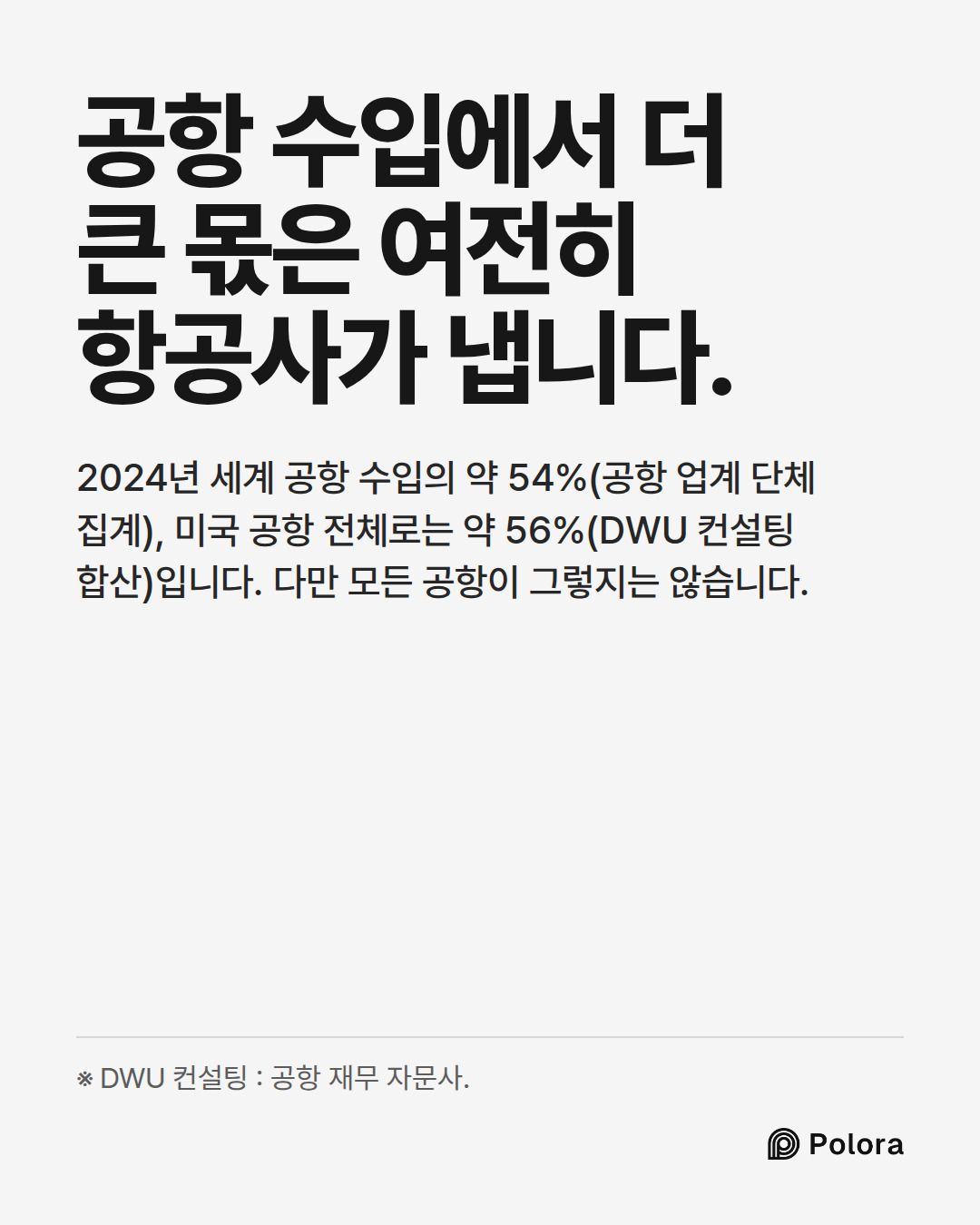
합계로는 아닙니다. 세계 공항 전체로도, 미국 공항을 모두 합쳐도 항공사가 내는 돈이 더 큽니다. 다만 공항마다 다릅니다. 미국 공항 수입의 44%는 항공사 밖에서 나오는데, 그중 가장 큰 몫은 상점이 아니라 주차와 지상 교통입니다.
비즈니스와 경제 · 2026-10-17
항공사가 내는 돈이 여전히 더 크지만, 미국에서는 차이가 작다
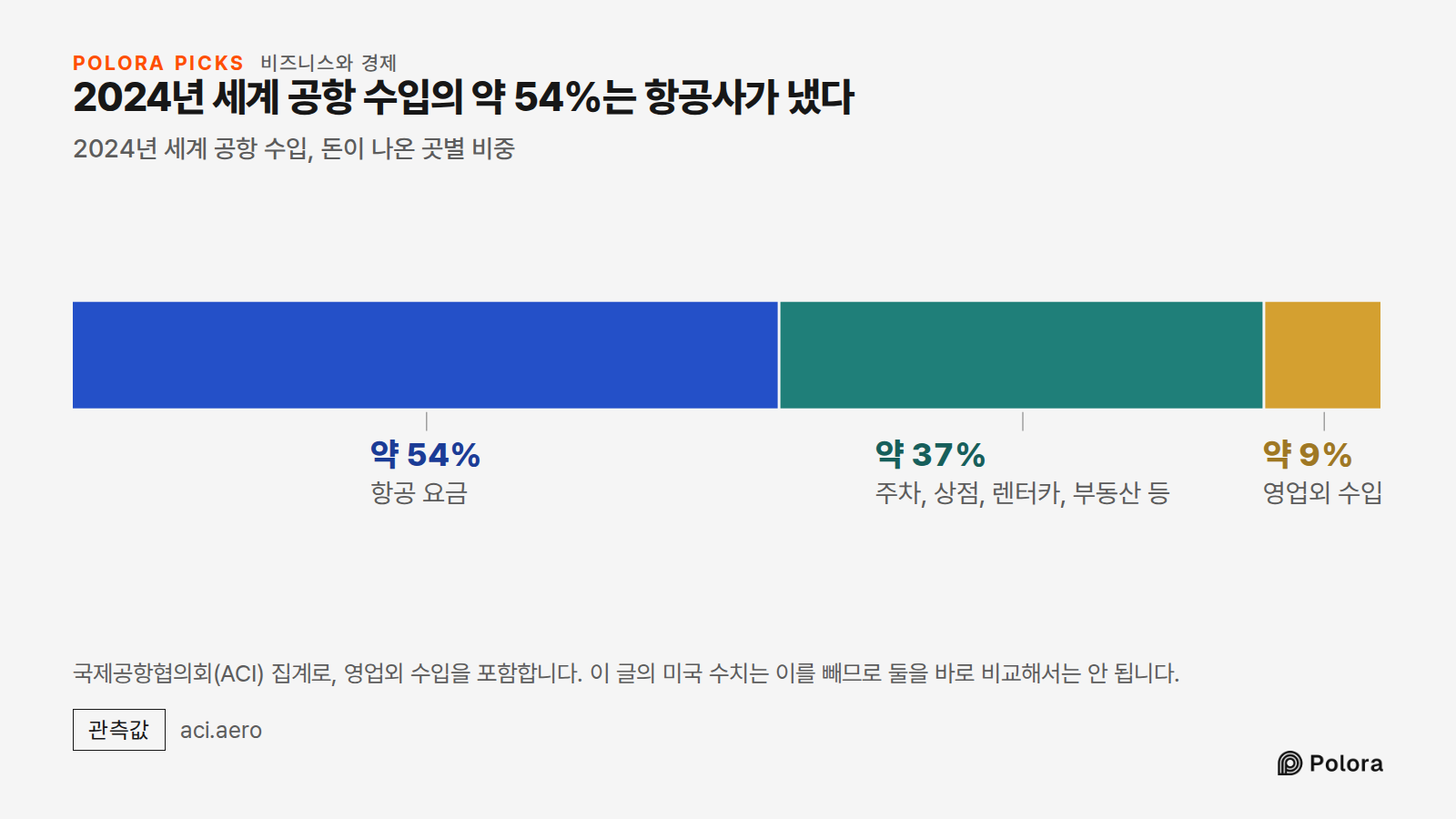
짧게 답하면, 적어도 합계로는 아닙니다. 2024년 세계 공항 수입의 약 54%는 항공 요금에서 나왔습니다. 항공 요금은 항공사가 공항에 내는 돈입니다. 비행기를 착륙시키고 세워 두고, 승객을 터미널로 들이고 내보내는 값입니다. 약 37%는 여행객과 기업이 공항에서 쓰는 그 밖의 돈에서 나왔습니다. 주차와 상점은 물론 렌터카와 부동산 임대도 여기에 들어갑니다. 남은 9%는 영업외 수입으로, 공항 운영과 상관없이 들어오는 돈입니다. 이 수치는 세계 공항들의 업계 단체인 국제공항협의회(ACI)가 집계했습니다.
미국에서는 그 차이가 더 작습니다. 미국 공항은 해마다 연방항공청(FAA)에 회계 보고서를 냅니다. 공항 재무 자문사 DWU 컨설팅이 2026년 7월 21일까지 들어온 2025 회계연도 보고서 417건을 합산했습니다. 영업 수입은 모두 345억 달러였습니다. 그중 193억 달러가 항공사에서, 152억 달러가 그 밖의 곳에서 나왔습니다. 대략 56 대 44입니다. 다만 이것은 DWU가 더한 합계일 뿐 확정된 전국 수치가 아닙니다. 공항은 보고서를 고칠 수 있고 새 보고서도 계속 들어오고 있어서, 지금 DWU의 집계 화면에는 424개 공항이 잡혀 있습니다.
두 수치는 재는 방식이 다릅니다. ACI는 영업외 수입까지 합계에 넣지만 미국 수치는 이를 뺍니다. 그러니 두 비율을 같은 것을 잰 것처럼 나란히 놓아서는 안 됩니다. 또 둘 다 여러 공항을 더한 합계입니다. 전체로 어느 쪽이 더 큰지는 보여 주지만, 어느 쪽에 공항이 몇 개씩 속하는지는 보여 주지 않습니다.
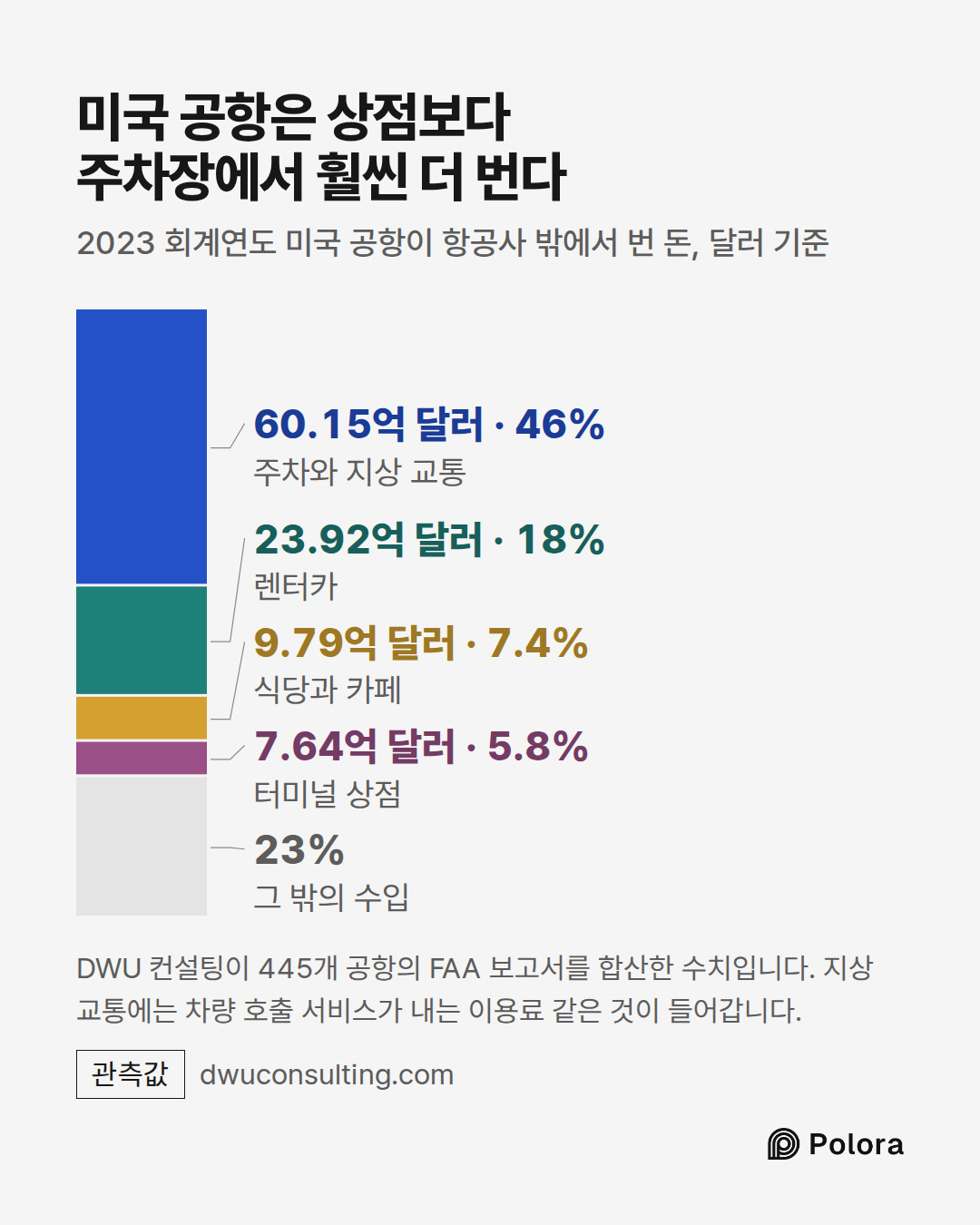
질문은 주차장과 상점을 한데 묶지만, 미국 공항에서 둘은 크기가 전혀 다릅니다. 게다가 둘을 합쳐도 항공사 밖에서 나오는 돈의 일부일 뿐입니다. ACI는 2026년 6월 웨비나 자료에서 2024년 북미 공항의 비항공 수입 가운데 주차가 43.2%를 차지했다고 밝혔습니다. 상점은 6.9%, 식음료는 7.6%였습니다. ACI는 다른 어느 지역도 주차 비중이 이만큼 높지 않다고 덧붙였습니다.
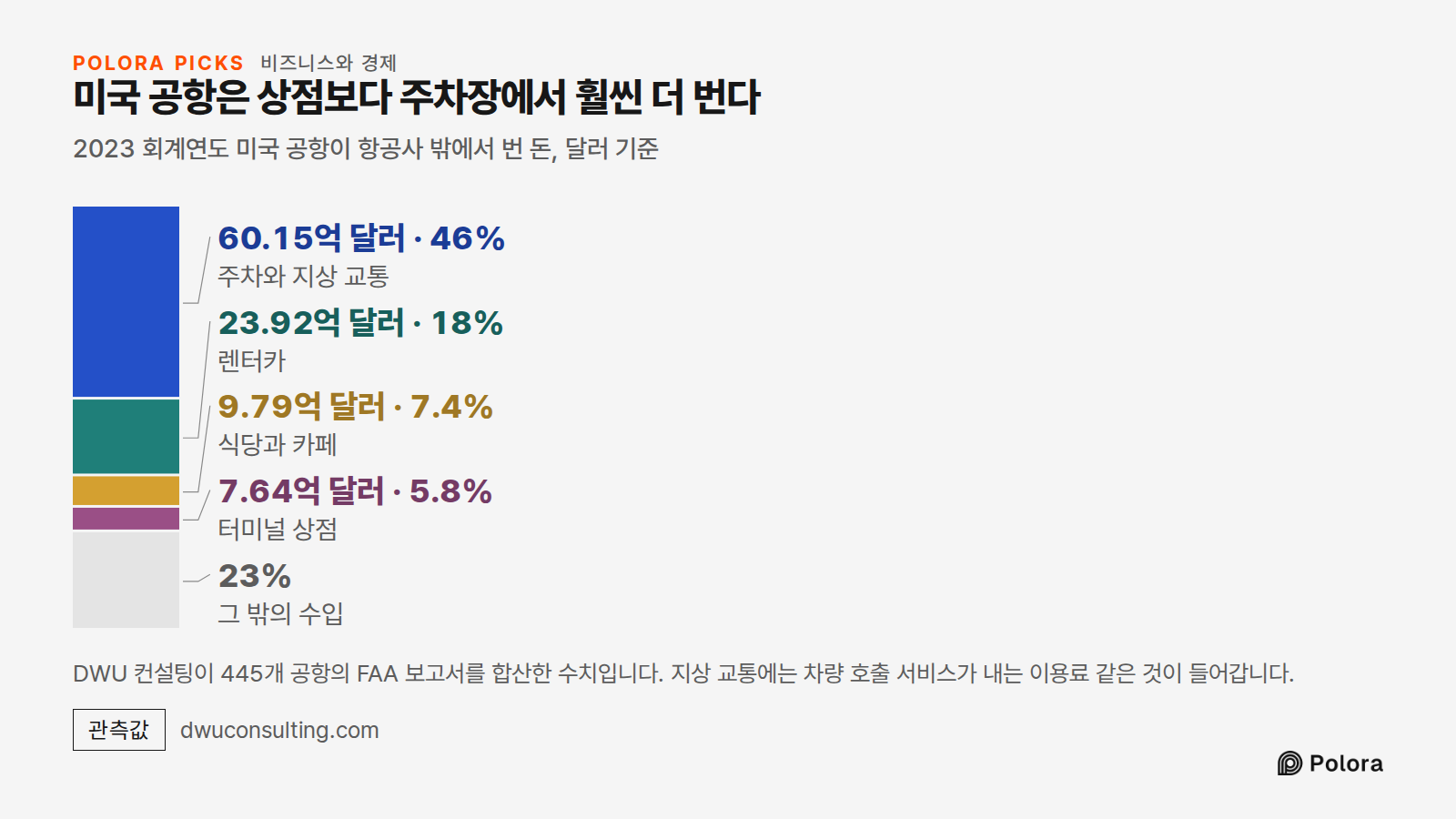
FAA 보고서는 같은 그림을 금액으로 보여 줍니다. DWU가 2023 회계연도 445개 공항의 보고서를 합산했더니, 항공사 밖에서 나온 132.16억 달러 가운데 60.15억 달러, 약 45.5%가 주차와 지상 교통에서 나왔습니다. 지상 교통에는 차량 호출 서비스가 공항에 내는 이용료 같은 것이 들어갑니다. 렌터카 회사는 공항 안의 카운터와 주차 구역을 쓰는 대가로 23.92억 달러, 18.1%를 냈습니다. 터미널 상점은 7.64억 달러, 식당과 카페는 9.79억 달러로 둘을 합쳐 약 13%였습니다. 더 최근인 2025 회계연도 DWU 수치에서도 주차와 지상 교통이 69억 달러, 렌터카가 25억 달러로 순서는 바뀌지 않았습니다.
커피 한 잔, 면세점 쇼핑백은 작은 조각일 뿐입니다. 큰돈은 사람들이 공항까지 어떻게 오고 차를 어디에 세워 두는지, 그리고 차를 빌려주는 회사들에서 나옵니다.
평균 뒤에는 큰 차이가 숨어 있습니다. DWU는 2025 회계연도 수치를 공항 규모별로도 나눴습니다. 대형 공항에서는 영업 수입의 약 59%가 항공사에서 나왔고, 중형 공항에서는 50%였습니다. 소형 공항은 반대여서, 영업 수입의 58%를 항공사 밖에서 벌었습니다. 그러니 전국 수치만으로는 어느 한 공항에 대해 알 수 있는 것이 별로 없습니다.
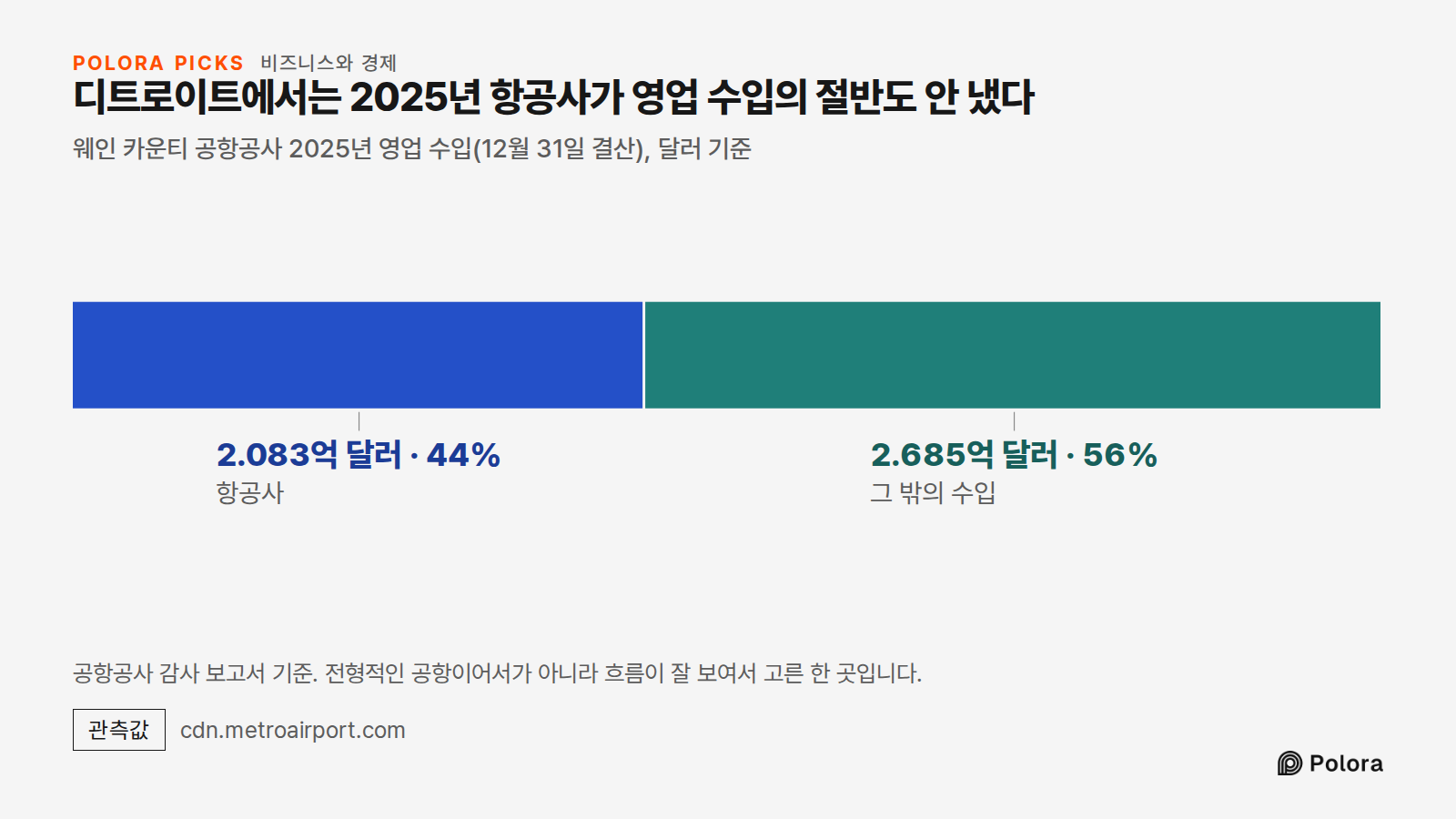
미국 디트로이트 메트로폴리탄 웨인 카운티 공항을 보면 이렇습니다. 이 공항을 운영하는 웨인 카운티 공항공사는 2025년 연말 결산 감사 보고서에서 영업 수입 4.768억 달러를 보고했습니다. 그중 항공사가 낸 돈은 2.083억 달러로 약 44%이고, 2.685억 달러는 다른 곳에서 나왔습니다. 주차 요금 수입은 1.08억 달러로, 디트로이트 메트로 공항의 소매 수입 1,410만 달러보다 훨씬 큽니다. 다만 주차 수치는 윌로런 공항까지 운영하는 공항공사 전체의 것이라, 디트로이트 메트로 공항만의 수치는 아닙니다.
물론 한 공항의 수입 구성이 모든 공항에 들어맞지는 않습니다. 디트로이트를 든 것은 이 흐름이 잘 보여서이지, 전형적인 공항이어서가 아닙니다.
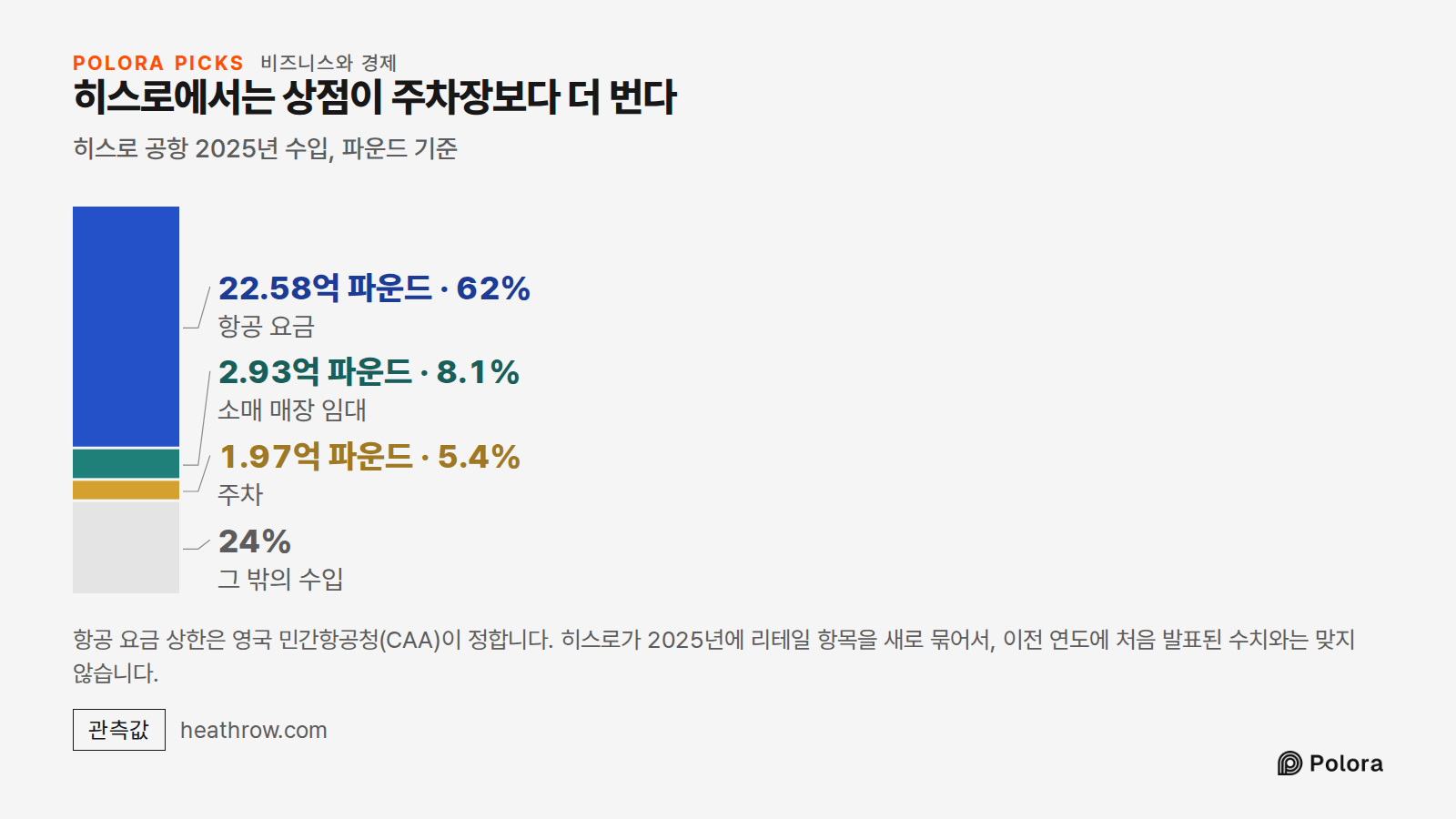
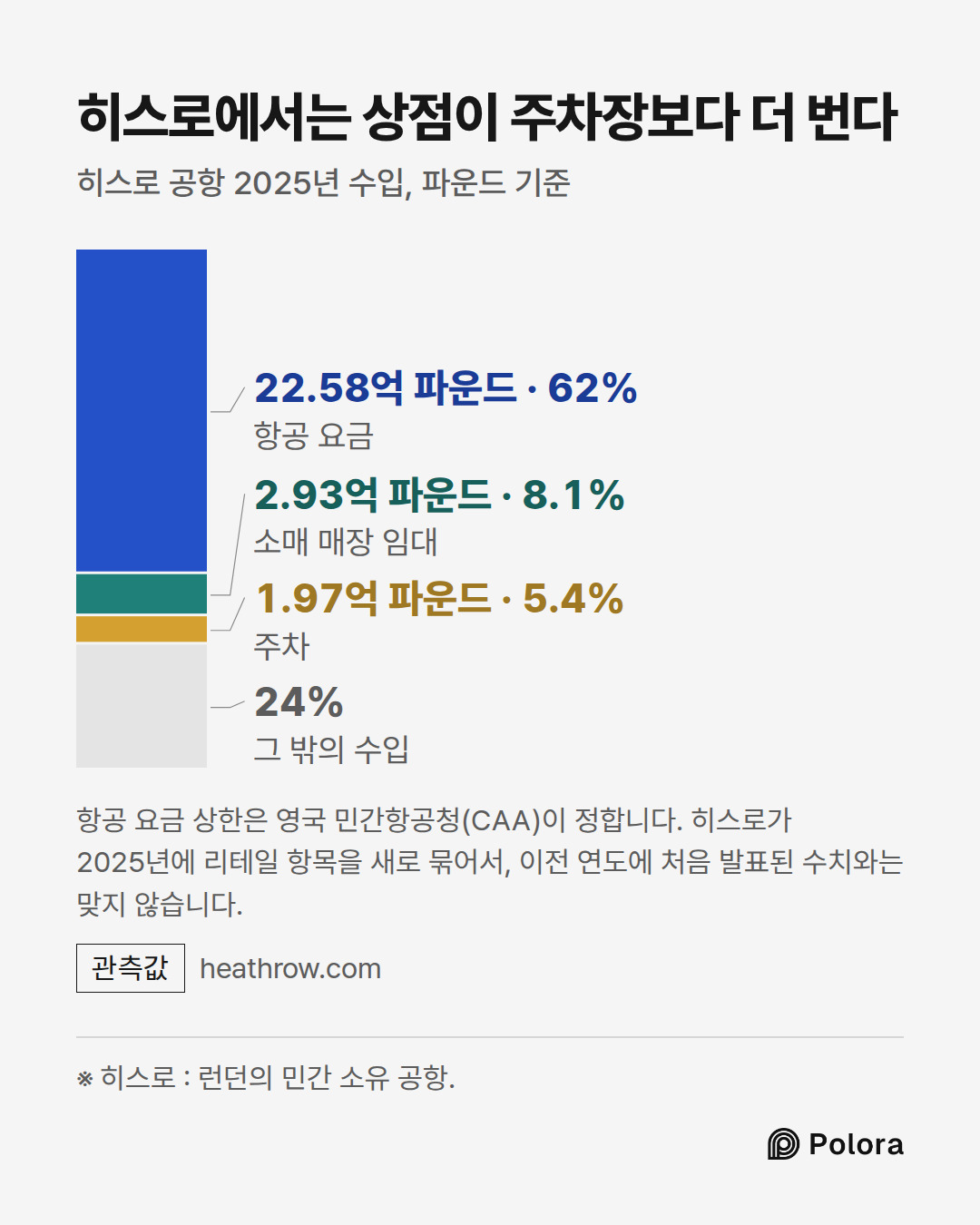
런던 히스로 공항은 민간 소유이고, 항공사에 받을 수 있는 요금의 상한은 규제 기관인 영국 민간항공청(CAA)이 정합니다. 2025년 히스로는 수입 36.23억 파운드를 보고했고, 그중 약 62%인 22.58억 파운드가 항공 요금에서 나왔습니다.
히스로 보고서에는 7.91억 파운드짜리 '리테일' 항목이 있는데, 여기에는 주차 수입도 들어 있습니다. 그 안에서 주차 수입은 1.97억 파운드로 전체 수입의 약 5%였고, 소매 매장 임대 수입은 2.93억 파운드였습니다. 이 공항에서는 상점이 주차보다 더 법니다. 다만 히스로가 2025년 보고서에서 리테일 항목을 새로 묶었기 때문에, 이 수치는 이전 연도에 처음 발표된 수치와 맞지 않습니다.
누가 공항을 소유하고 누가 요금 상한을 정하느냐에 따라 장부의 모양이 달라집니다. 모든 공항에 들어맞는 답이 하나일 수 없는 또 다른 이유입니다.
미국의 대형 공항은 상당수가 시, 카운티, 공공 공항공사의 소유입니다. 디트로이트의 웨인 카운티 공항공사가 그런 예입니다. 이들은 '항공사 이용 계약'이라는 장기 계약으로 항공사가 낼 돈을 정합니다. 여기서 중요한 것은 이 계약이 항공사 밖에서 들어오는 돈을 어떻게 셈하느냐입니다.
잔여비용 방식(residual) 계약에서는 공항이 먼저 자기 비용을 모두 더합니다. 그다음 주차, 렌터카, 상점 등에서 번 돈을 빼고, 남은 금액을 항공사에 청구합니다. 주차장에서 1달러를 더 벌면 항공사 청구서가 그만큼 줄어드는 셈입니다. 그 대신 항공사는 공항의 비용이 반드시 메워지도록 보장합니다. 디트로이트 공항의 감사 보고서에도 이 계산법이 적혀 있고, DWU는 디트로이트, 시카고 오헤어, 샌프란시스코를 이 방식으로 운영되는 공항으로 꼽습니다.
사용료 방식(compensatory) 계약에서는 항공사가 자기가 쓰는 공간과 시설 값만 내고, 공항은 다른 곳에서 번 돈을 그대로 가집니다. DWU는 뉴욕 JFK와 보스턴을 여기에 넣습니다. 로스앤젤레스, 덴버, 애틀랜타 같은 여러 대형 공항은 두 방식을 섞은 혼합형을 쓰는데, 항공사 밖에서 번 돈의 일부를 항공사와 나누는 경우가 많습니다. 이 분류는 DWU가 지금 붙인 것이라, 계약이 갱신되면 바뀔 수 있습니다.
그러니 잔여비용 방식 계약을 맺은 공항에서는 주차장과 상점에서 번 돈이 항공사 청구액을 낮추고, 그만큼 그 공항 장부에서 항공사가 차지하는 비중도 작아집니다. 이것이 전국 합계에 얼마나 영향을 주는지는 측정된 적이 없습니다.
세계 공항 전체로도, 미국 공항을 모두 합쳐도 항공사가 여전히 더 큰 몫을 냅니다. 다만 모든 공항이 그렇지는 않습니다. 미국 공항은 영업 수입의 절반 가까이를 항공사 밖에서 얻고, 그중 가장 큰 단일 항목은 상점이 아니라 주차와 지상 교통입니다. 잔여비용 방식 계약을 맺은 공항에서는 그 돈이 항공사에 얼마를 청구할지에 그대로 반영됩니다.
공항들은 주차 수입을 꼼꼼히 지켜봅니다. 여행 습관이 바뀌면 이 수입도 흔들리기 때문입니다. 그래서 요즘은 승객을 태우고 내려 주는 차량에 매기는 이용료가 주차와 함께 논의됩니다. DWU 수치에 따르면 2024 회계연도 댈러스 포트워스 공항의 차량 호출 이용료 수입은 3,900만 달러였고, 주차 수입은 2.094억 달러였습니다. 이 수치는 공항이 직접 낸 보고서가 아니라 DWU의 분석에서 나온 것입니다.
Do airports make more money from parking and shops than from airlines?
Alpha · deepseek-v4-pro
No, not for most airports — but the question mixes two very different money streams.
Airlines still pay the larger share.
The broad global picture has aeronautical charges at roughly 54% of 2024 airport revenue, with about 37% coming from all non-aeronautical sources and 9% from non-operating income. So even if you lump parking, shops, food, car rental and everything else together, airlines still bring in more.
In the United States the gap is narrower. Adding up FAA filings for fiscal 2025 gives about $19.3 billion from airlines against $15.2 billion from all other operating sources — around 56/44. That is close, but airlines are still the larger of the two.
But parking and shops are not equal partners.
This is where the question goes wrong. In North America, car parking is about 43% of non-aeronautical revenue. Shops are only around 7%, and food and drink about 7.6%. In dollar terms from US figures, parking and ground transportation were roughly $6.0 billion, rental car concessions about $2.4 billion, while terminal shops brought in under $0.8 billion and restaurants under $1.0 billion.
So the real non-airline engine is the car park, not the duty-free bag. If the q…
Beta · gpt-6-sol
Usually no—but “parking and shops” is much narrower than “everything airlines don’t pay.” ACI World reports that aeronautical revenue made up 54% of airports’ total revenue worldwide in 2024, versus 37% from non-aeronautical businesses such as parking, shops, restaurants and car rental. Those figures support the manuscript’s overall answer, not a claim that airlines out-earn *parking and shops at every airport*. (aci.aero)
For the US, DWU Consulting’s aggregation of 417 FAA fiscal-2025 filings puts operating revenue at $19.3 billion aeronautical and $15.2 billion non-aeronautical—roughly 56/44. Its newer breakdown puts parking *and ground transportation* at $6.9 billion and rental cars at $2.5 billion. Neither category is parking alone; nor is all non-aeronautical revenue money paid directly by travellers. The 417 filings were a snapshot extracted on July 21, 2026, not a fixed final national total. The FAA confirms that airports can amend their filings. ([dwuconsulting.com](https://dwuconsulting.com/dwu-ai/us-airport-industry-…
Gamma · gemini-3.1-pro
I agree with the overall premise that airlines pay the larger share at most major airports, though the exact mix depends heavily on the airport's size and agreement structure.
To clear up a few remaining verification points from the research brief:
1. Heathrow 2025 Figures:
I checked Heathrow's 2025 Annual Report. I can confirm the top-line numbers stated in the manuscript: Heathrow reported £3,623 million in total revenue, with £2,258 million coming from aeronautical charges (roughly 62%) and £791 million from retail. The manuscript's claim that retail out-earns parking at Heathrow holds up at the macro level, as retail forms the largest non-aeronautical block there. (heathrow.com)
2. Residual vs. Compensatory Agreements:
The manuscript correctly describes how residual agreements work. I verified this against the Transportation Research Board's (TRB) ACRP Report 36, *Airport/Airline Agreements—Practices and Characteristics*. The report confirms that under a residual structure, airlines guarantee that the airport's costs are covered, and non-aeronautical revenues (like parking and concessions)…
Researcher · gpt-6-luna
Verification update: several claims are supported, but the turns above overstate what the data establish and contain an important Detroit correction.
- Global figures: ACI World’s March 17, 2026 release says that in 2024 aeronautical revenue was 54% of total airport revenue and non-aeronautical revenue 37%. It does not establish that airlines bring in more than parking and shops at most individual airports. Nor does that release confirm the manuscript’s finer breakdown of parking, retail and food-and-beverage shares.
Source: https://aci.aero/2026/03/17/policymakers-must-support-airport-investment-as-global-air-travel-demand-rises/ (aci.aero)
- US FY2025 figures: DWU’s overview supports its July 21, 2026 snapshot of 417 airports: $34.5 billion in operating revenue, including $19.3 billion aeronautical and $15.2 billion non-aeronautical. It also reports that large hubs were 59% aeronautical, medium hubs 50/50, and small hubs 58% non-aeronautical. These are a dated DWU aggregation of FAA filings, not a final, fixed FAA national total. DWU’s c…
The Arbiter · gpt-6-sol
The voices agree on the key distinction: parking and shops are only part of non-aeronautical revenue. The global and US figures discussed compare *all* non-aeronautical revenue with aeronautical revenue, so they cannot be presented as a direct parking-and-shops total. DWU’s US figures also combine parking with ground transportation in one reporting line; they do not isolate parking receipts. (dwuconsulting.com)
The strongest challenge to the manuscript’s wording is “at most airports.” The cited global and US totals add up dollars across airports. They show an aggregate split, not how many individual airports have airline revenue above parking and shops. DWU’s hub-size breakdown makes that distinction consequential: large hubs lean toward aeronautical revenue, medium hubs are near even, and small hubs lean toward non-aeronautical revenue. (dwuconsulting.com)
For the manuscript’s fact-check, the Researcher found that Detroit’s audited 2025 report conflicts with its date and figures. Beta and the Researc…
The Arbiter's Final Verdict · gpt-6-sol
Generally, no in the aggregate figures checked—but it depends on the airport. ACI World reports that aeronautical revenue made up 54% of global airport revenue in 2024, while *all* non-aeronautical revenue—not just parking and shops—made up about 37%. A dated aggregation of US airport filings likewise puts aeronautical operating revenue ahead, $19.3 billion to $15.2 billion for all other operating revenue. (ACI World; DWU Consulting)
That does not prove airlines bring in more at *most individual airports*: totals across airports cannot tell us how many airports fall on either side. Detroit’s airport authority, for example, reported more non-airline than airline operating revenue in 2025. Nor should “parking and shops” be treated as the whole non-airline side—it also includes such sources as rental cars and property. ([Wayne County Airport Authority audited report](https://cdn.metroairport.com/uploads/business_documents/PDFs/Finance/CAFR/55154%20-%20Wayne%20County%20Airport%20Authority%20A…