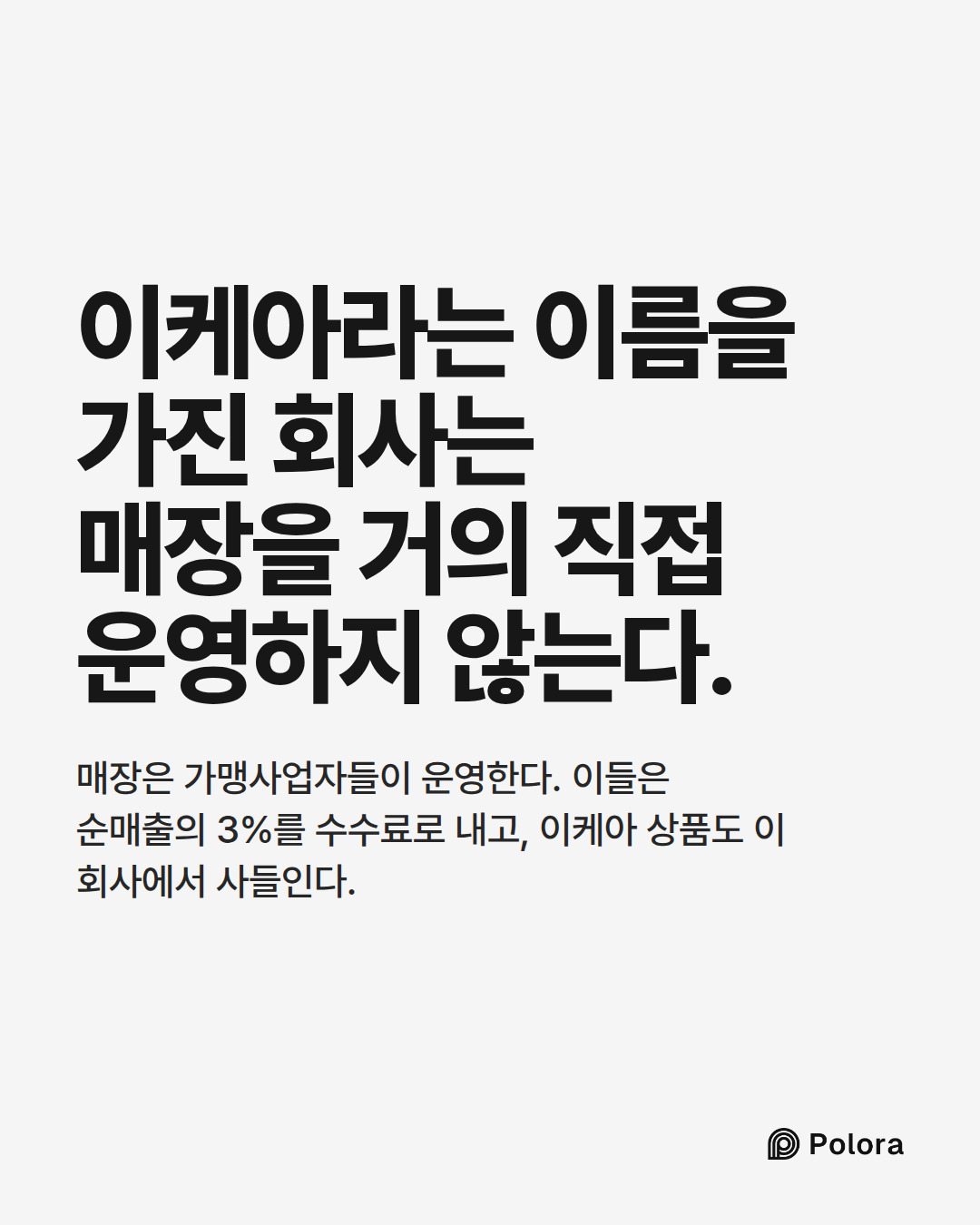
둘 다다. 이케아라는 이름을 가진 회사는 매장을 거의 직접 운영하지 않는다. 매장들에서 매출의 3%를 수수료로 받고, 그 매장들에 물건을 팔아 훨씬 큰 매출을 올린다. 어느 쪽이 이익을 더 내는지는 밝히지 않는다.
비즈니스와 경제 · 2026-10-18
내가 가는 이케아 매장을 운영하는 회사는 아마 '이케아'라는 이름의 주인이 아니다
이케아가 뭐냐고 물으면 대부분 매장을 떠올릴 것이다. 파란 상자 같은 건물, 미트볼, 납작한 상자에 담겨 차까지 들고 간 책장. 틀린 답은 아니다. 다만 세계 거의 모든 매장에서 그 답은 조금 어긋난다.
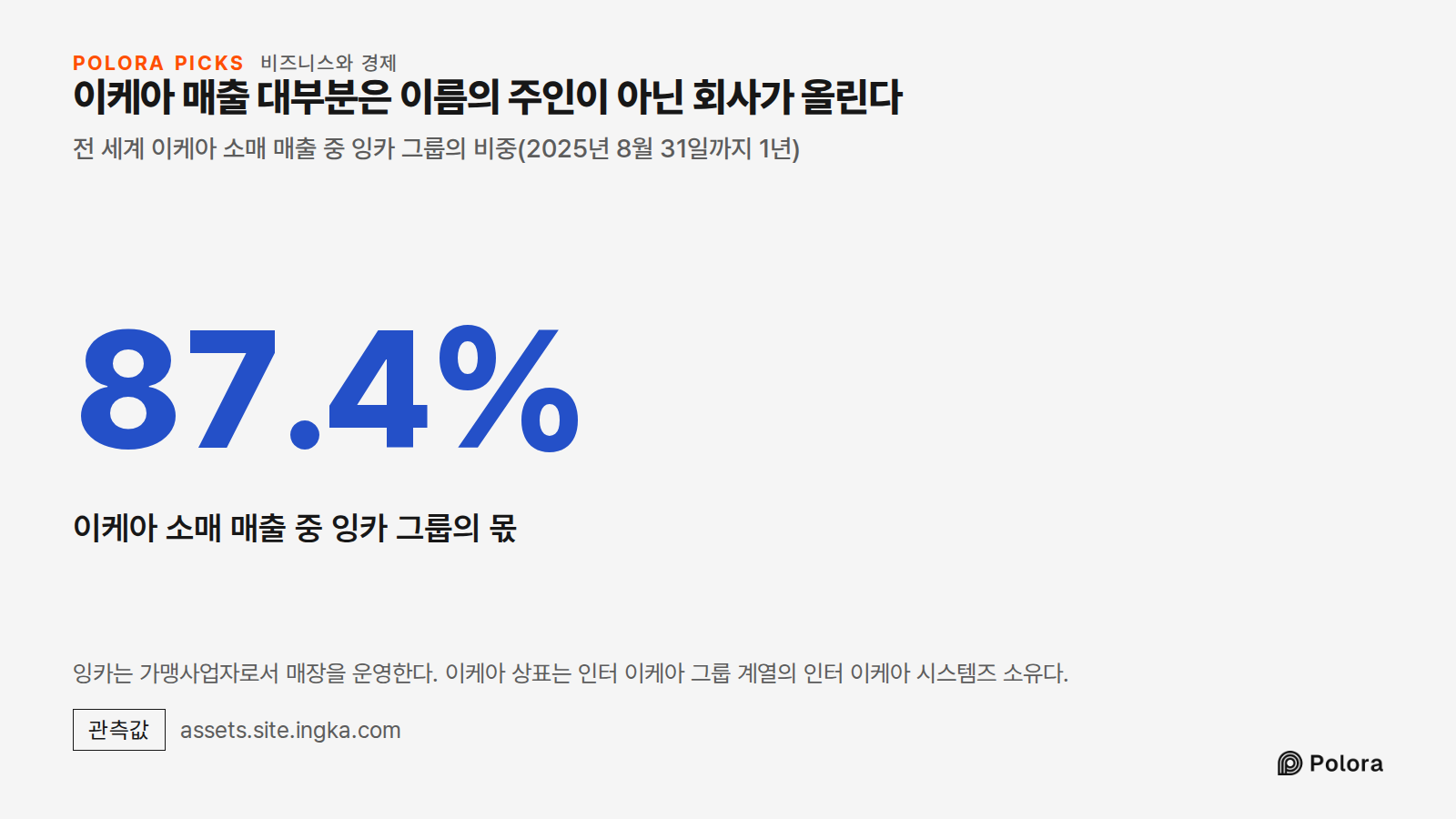
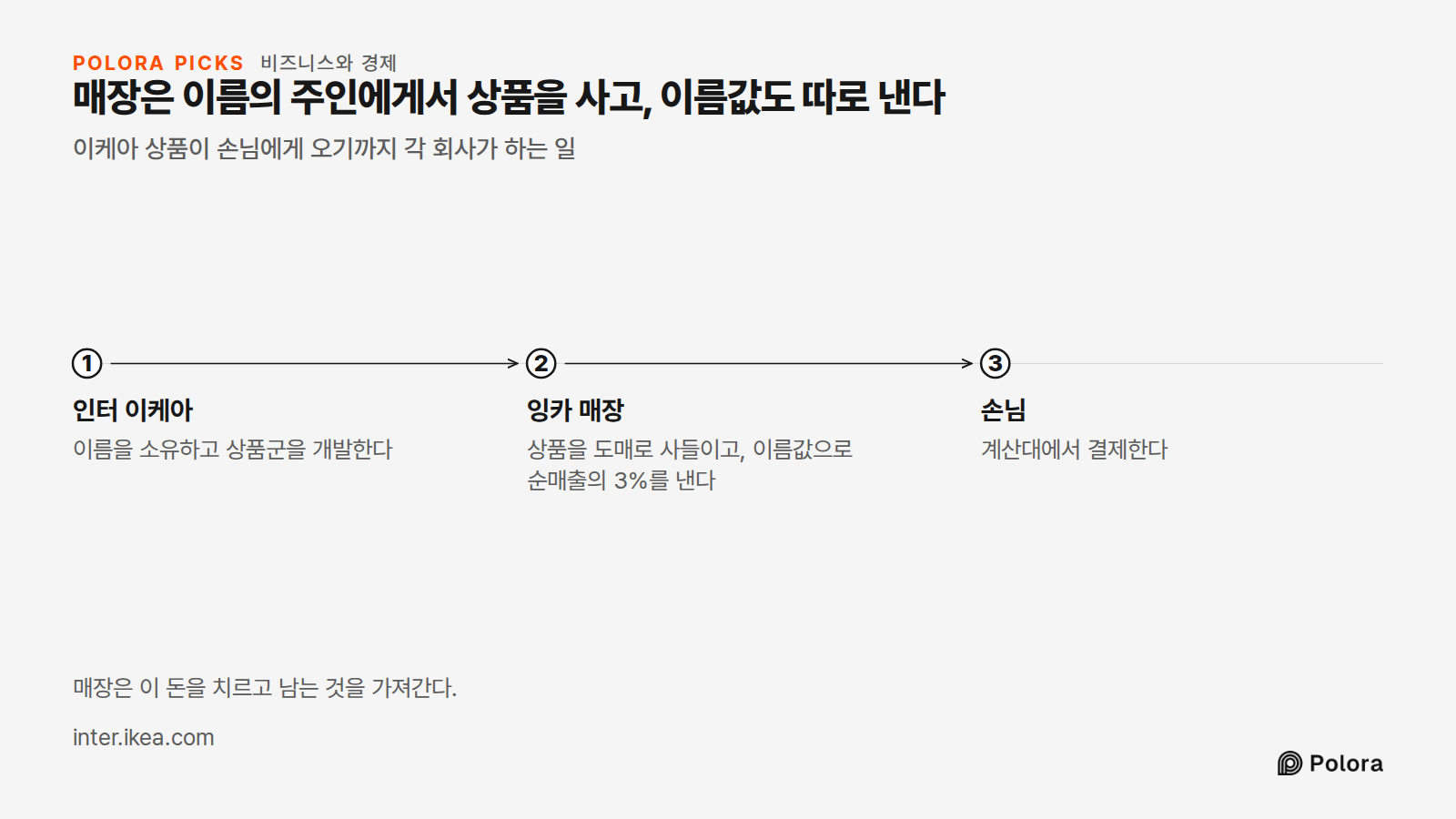
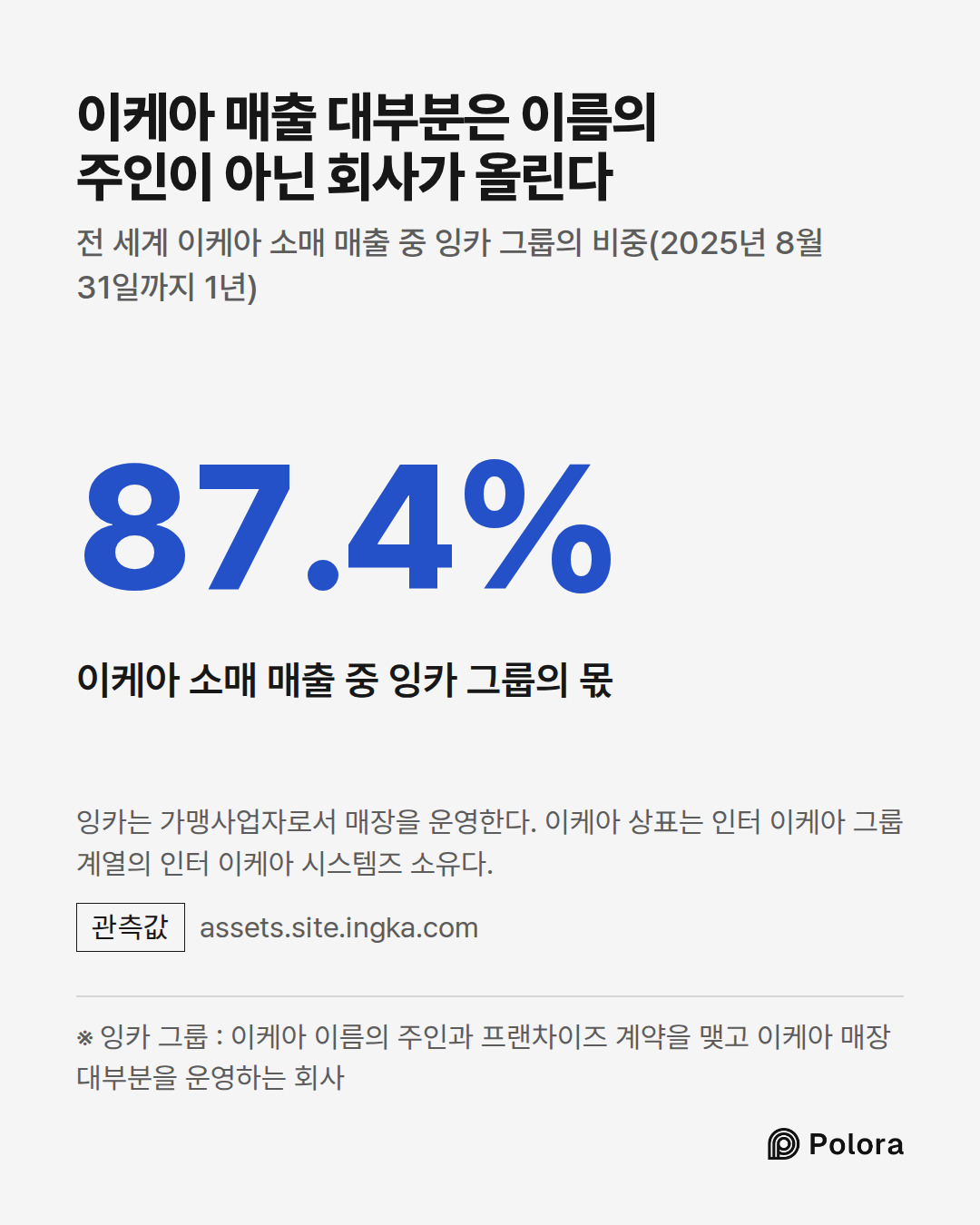
우리가 가는 이케아 매장을 운영하는 회사는 십중팔구 잉카 그룹(Ingka Group)이다. 2025년 8월 31일까지 1년 동안 전 세계 이케아 소매 매출의 87.4%를 올린 회사다. 그런데 잉카는 간판에 적힌 이름의 주인이 아니다. 이케아 상표의 주인은 인터 이케아 그룹 계열의 인터 이케아 시스템즈라는 다른 회사다. 이케아 매장을 어떻게 꾸려야 하는지 정한 규칙, 이케아가 '이케아 콘셉트'라고 부르는 것도 이 회사의 것이다. 잉카는 이 회사와 계약을 맺고 이케아 매장을 운영하는 가맹사업자 가운데 가장 큰 곳이다. 가맹사업자 그룹이 몇 곳인지는 출처마다 조금 다르다. 인터 이케아의 그해 연차보고서는 인터 이케아가 직접 소유한 사업까지 넣어 13곳으로, 잉카의 자주 묻는 질문 페이지는 12곳으로 적는다.
이름의 주인이 직접 운영하는 매장은 아주 적다. 이케아에 따르면 네덜란드 델프트의 매장 한 곳을 빼면 모든 이케아 매장이 프랜차이즈 계약으로 운영된다. 인터 이케아 그룹은 발트해 연안 국가들의 이케아 매장도 소유하고 있지만, 연차보고서에 따르면 이 매장들 역시 프랜차이즈 체계 아래에서 운영된다. 이케아에서는 매장을 소유하는 것과 프랜차이즈로 운영하는 것이 별개의 일이다.
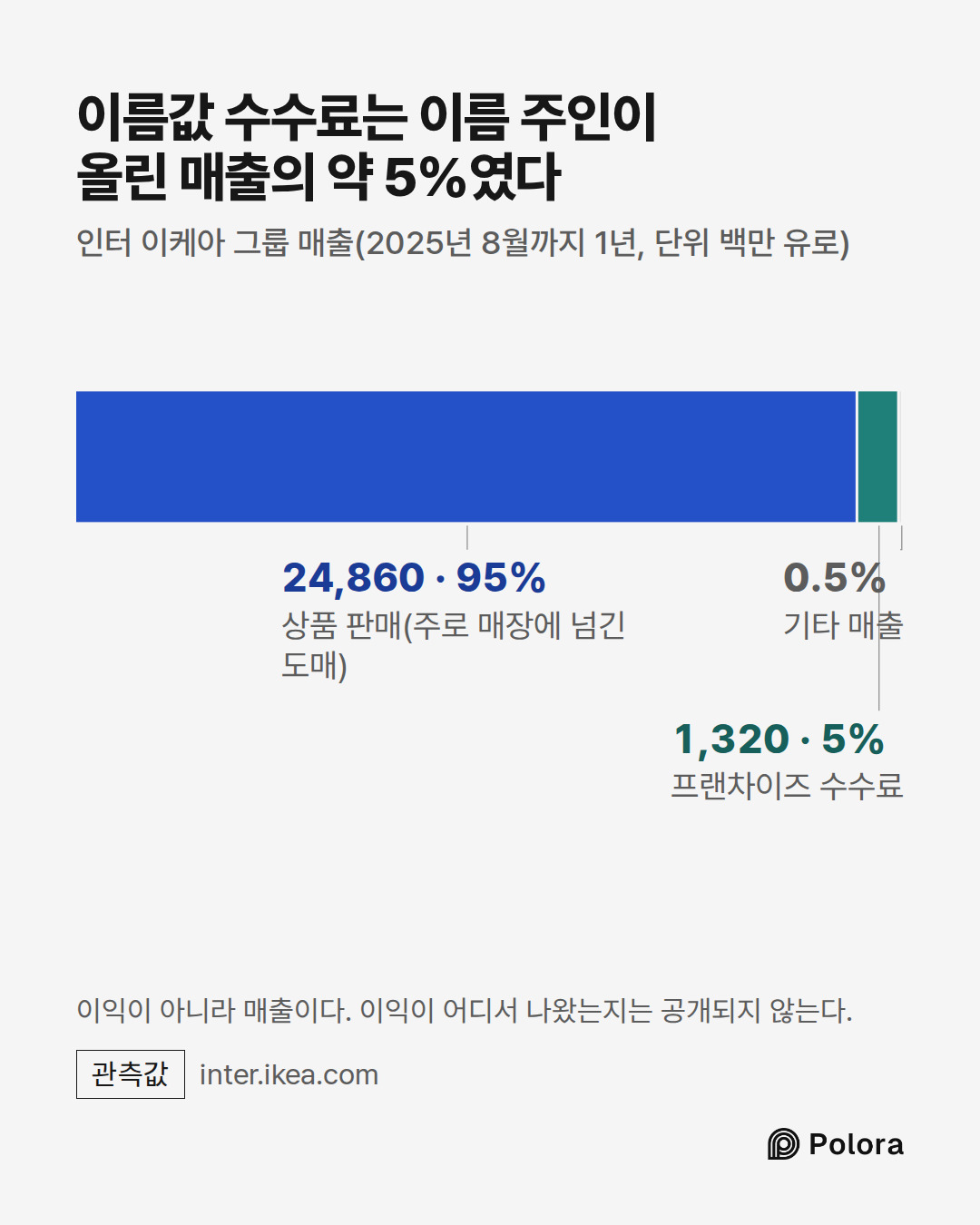
가맹사업자가 돈을 주고 사는 것은 이름, 그리고 그 이름에 딸린 허가다. 인터 이케아의 설명에 따르면 가맹사업자는 해마다 순매출의 3%를 수수료로 내고, 그 대가로 이케아 상표를 쓰고, 이케아 상품을 팔고, 이케아 매장을 운영할 수 있다. 2025년 8월까지의 회계연도에 이 수수료는 모두 1,320백만 유로였다. 소매 매출이 줄어든 탓에 전년의 1,348백만 유로보다 적다.
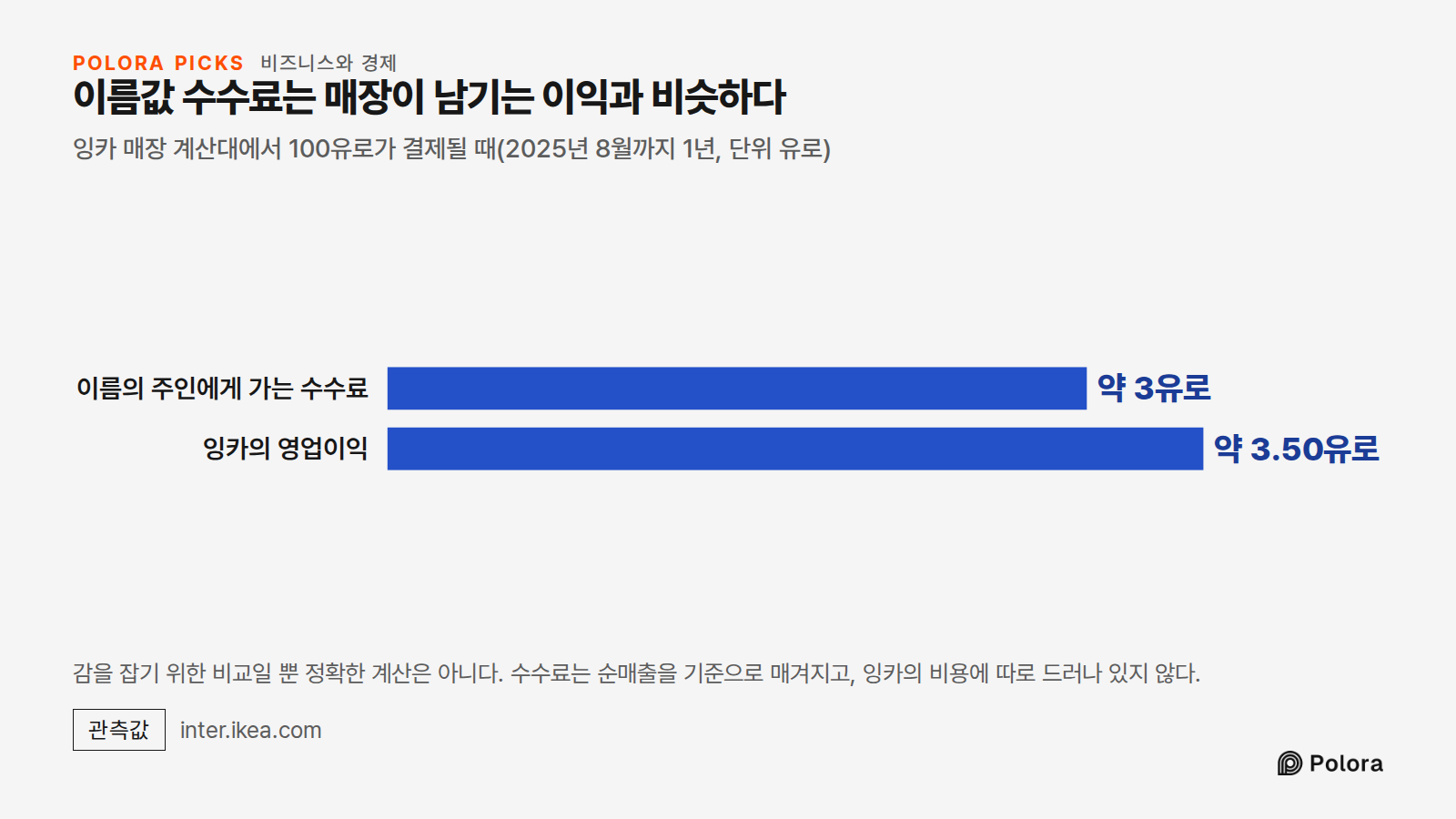
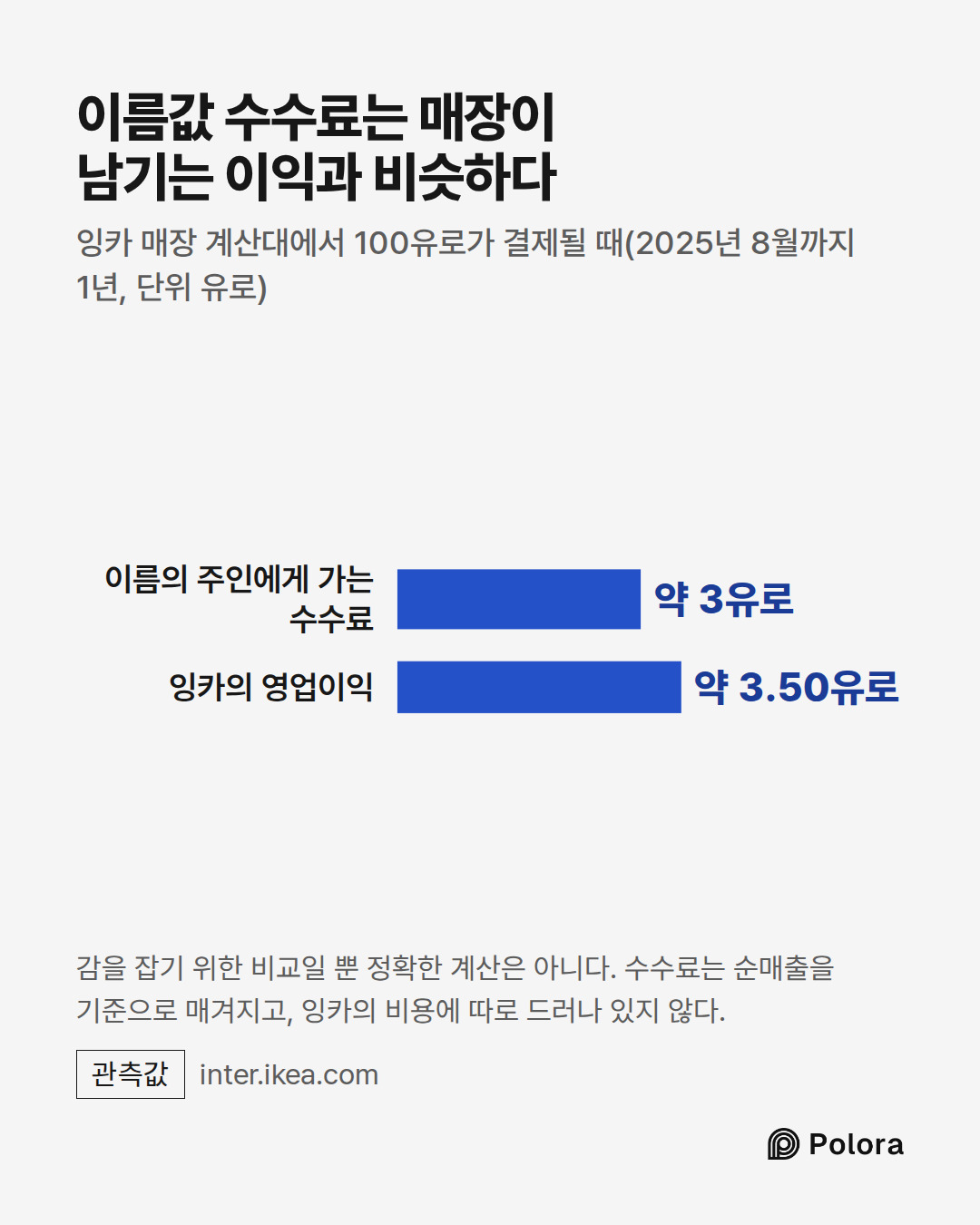
3%는 작아 보이지만, 매장이 남기는 몫과 나란히 놓으면 달라 보인다. 잉카가 발표한 영업이익은 1,464백만 유로이고, 잉카는 이를 매출의 3.5%라고 설명한다. 거칠게 말하면 잉카 매장 계산대에서 100유로가 결제될 때 약 3유로는 이름의 주인에게 가고, 잉카에 영업이익으로 남는 것은 약 3.50유로다. 감을 잡기 위한 비교일 뿐 정확한 계산은 아니다. 수수료는 순매출을 기준으로 매겨지고, 여기 인용한 수치에는 잉카의 비용 가운데 수수료가 따로 드러나 있지 않다.
잉카는 자신이 낸 수수료 액수를 따로 공개하지 않는다. 약 390억 유로인 잉카의 이케아 소매 매출에 3%를 곱하면 약 12억 유로가 나오고, 전체 가맹사업자가 낸 1,320백만 유로에 잉카의 몫 87.4%를 곱해도 비슷한 값이 나온다. 둘 다 발표된 수치가 아니라 추정치다. 수수료가 매겨지는 순매출이 잉카가 발표하는 소매 매출과 꼭 같지는 않기 때문이다.
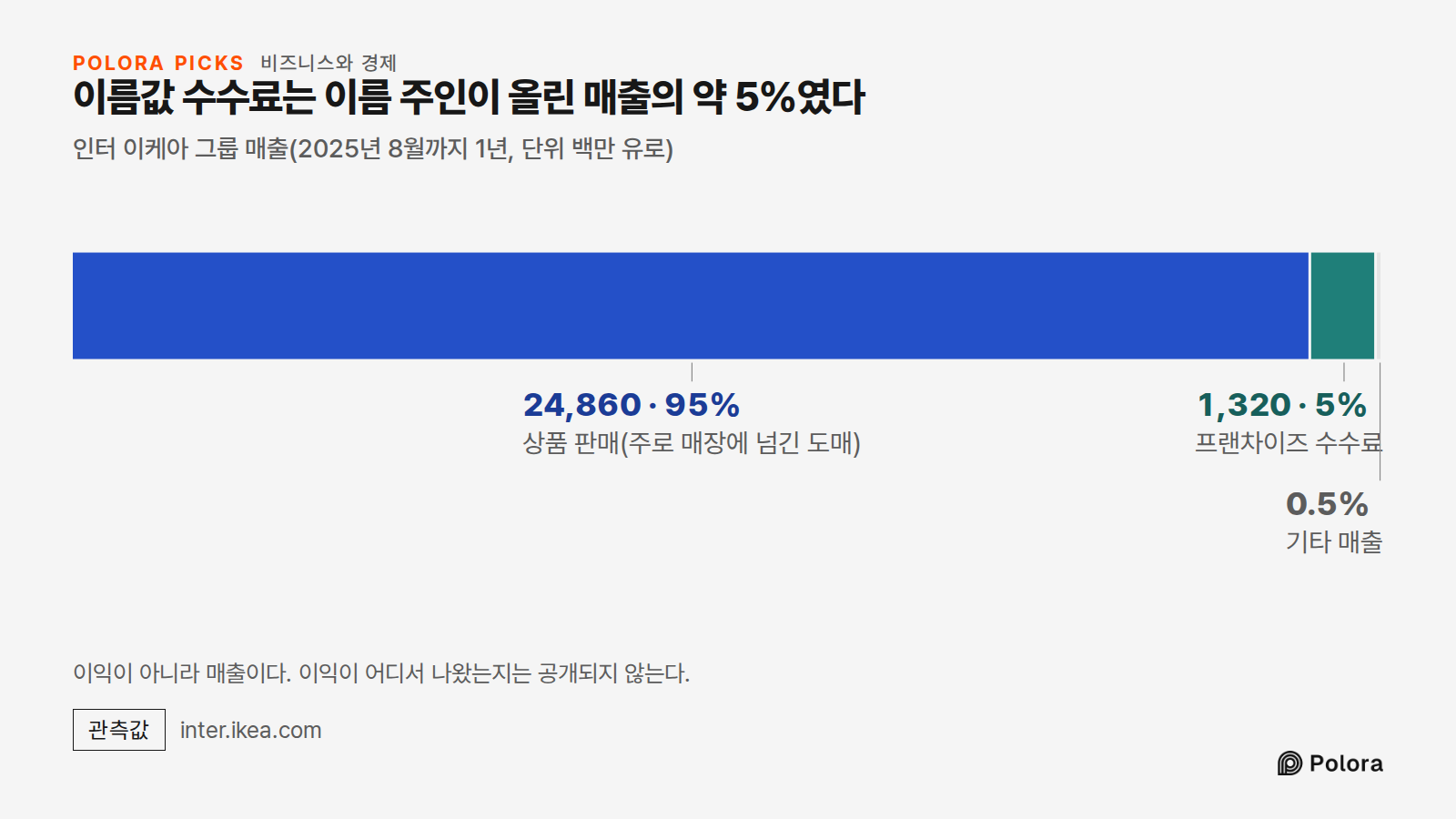
수수료가 전부라면 답은 '이케아는 이름을 판다'일 것이다. 하지만 수수료가 전부는 아니다. 2025년 8월까지 1년 동안 인터 이케아 그룹의 매출은 26,306백만 유로였고, 프랜차이즈 수수료는 그중 약 5%에 그쳤다. 나머지 대부분인 24,860백만 유로는 그룹이 '상품 판매'라고 부르는 매출이다. 주로 가맹사업자에게 이케아 제품을 도매로 넘긴 매출이고, 여기에 직접 소유한 델프트와 발트해 연안 국가들 매장의 소매 매출이 더해진다. 가구만이 아니라 이케아가 파는 모든 품목이 여기에 들어간다.
무엇을 팔지 정하는 것도 이 회사다. 인터 이케아는 이케아 상품군을 개발하고, 그중 약 10%는 자체 공장에서 만들며 나머지는 800곳이 넘는 외부 공급업체에서 사들인다. 잉카는 자체 보고서에서 인터 이케아를 "우리의 프랜차이즈 본사이자 도매 공급자"라고 부른다.
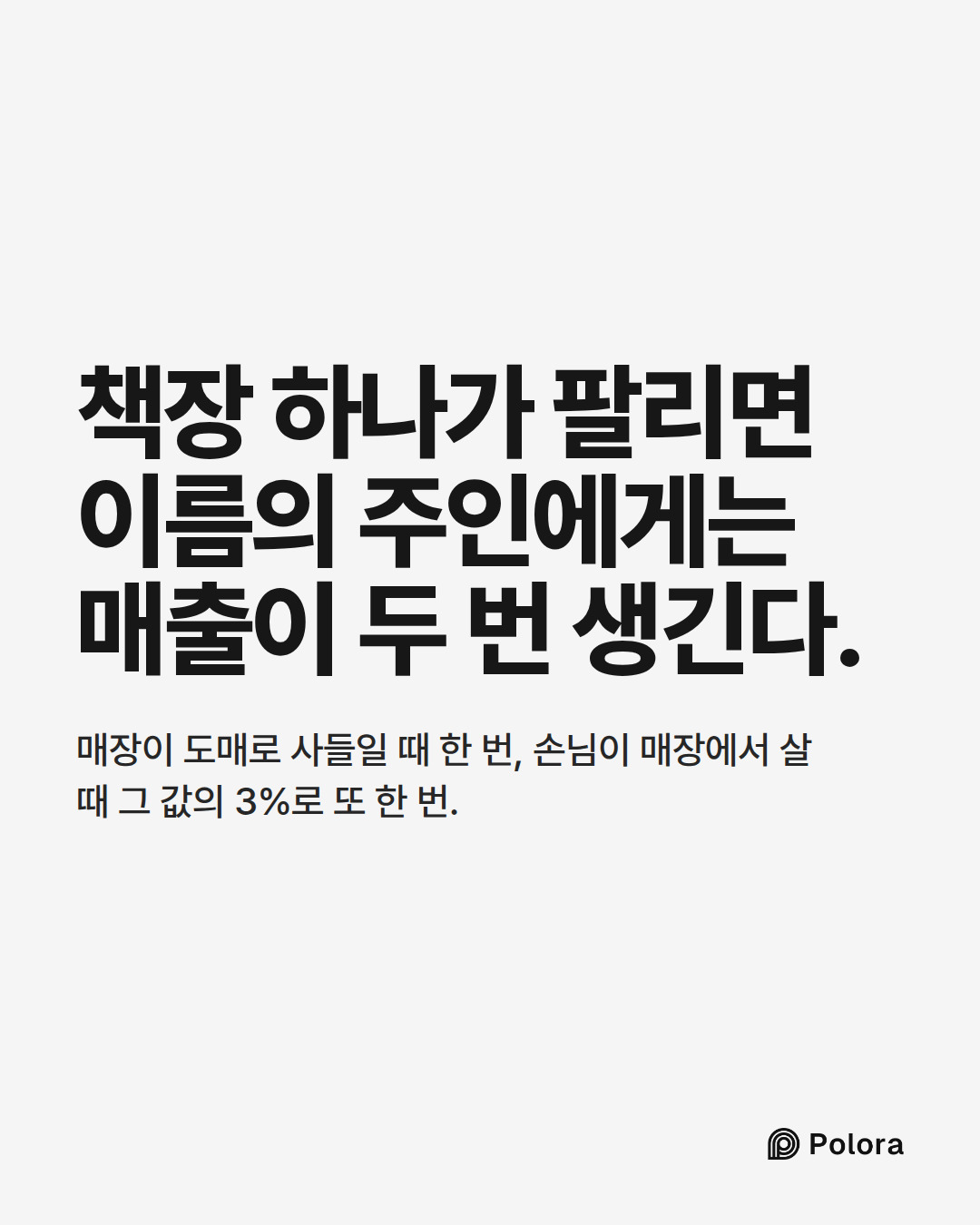
그러니 책장 하나가 팔리면 이름의 주인에게는 매출이 두 번 생긴다. 매장이 도매로 사들일 때 한 번, 손님이 매장에서 살 때 그 값의 3%로 또 한 번. 그해 인터 이케아 그룹의 영업이익은 1,725백만 유로, 순이익은 1,496백만 유로였다. 순이익은 전년의 2,199백만 유로에서 줄었는데, 그룹은 미국 관세를 비롯한 조달 비용 상승을 이유로 들었다. 같은 시기에 그룹은 매장에 넘기는 도매가격을 전년 수준으로 묶어 두고 있었다.
다만 매출이 곧 이익은 아니다. 앞의 이익은 그룹 전체를 합친 숫자이고, 인터 이케아는 그중 얼마가 상품 판매에서, 얼마가 수수료에서 나왔는지 공개하지 않는다. 도매는 매출이 커도 마진이 얇을 수 있지만, 남의 매출에 매기는 수수료는 따로 드는 비용이 적다. 그러니 이익에서 이름이 차지하는 몫은 매출 비중인 5%보다 클 수도 있다. 공개된 재무제표만으로는 둘 중 어느 쪽이 더 많이 버는지 가릴 수 없다.
이케아가 이렇게 둘로 나뉜 것은 의도된 구조다. 이케아에 따르면 1980년대 초 사업이 커지자 창업자 잉바르 캄프라드는 이케아 콘셉트를 지키면서 해외로 뻗어 나갈 방법으로 프랜차이즈 체계를 택했다.
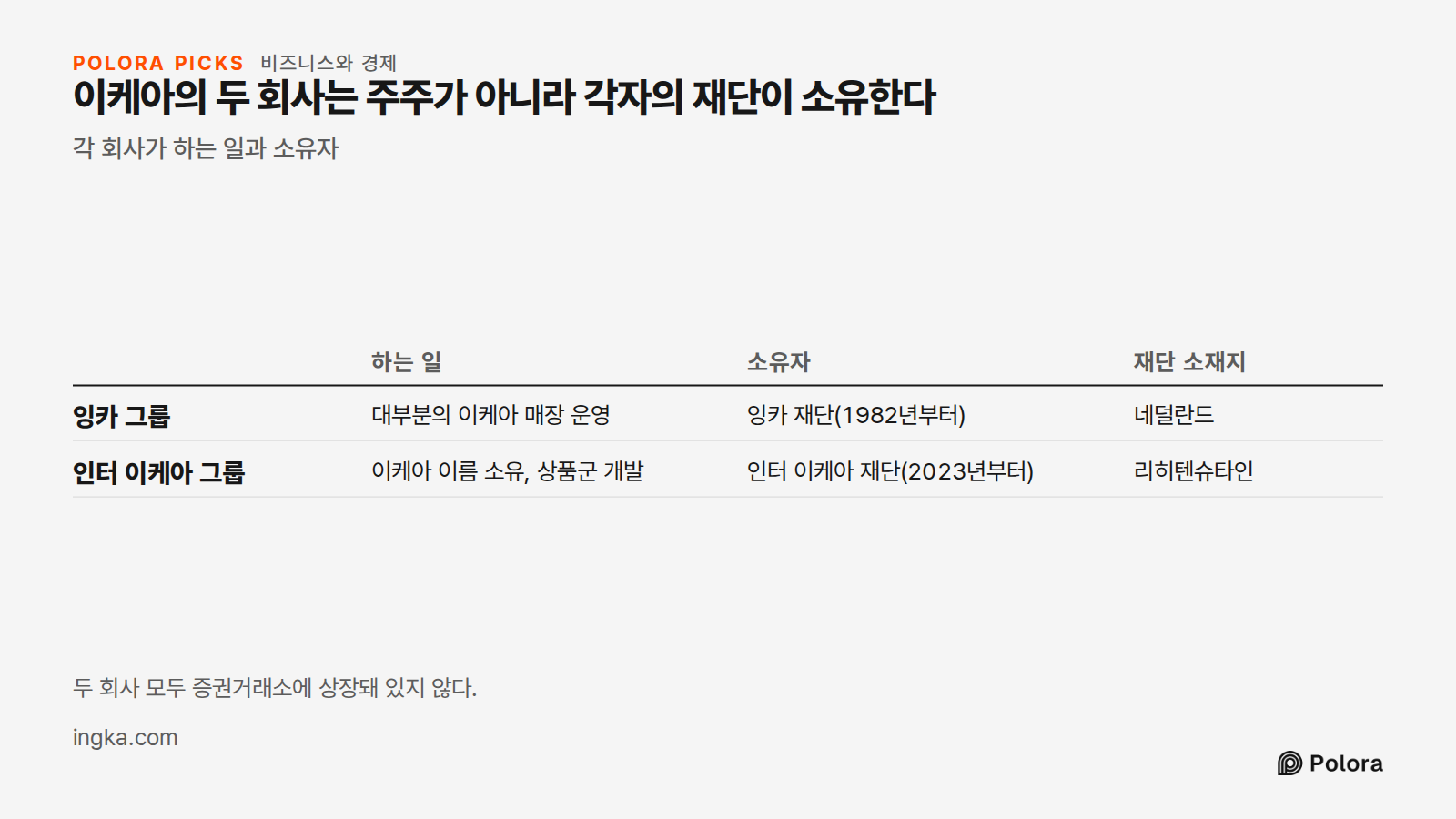
1982년 캄프라드는 잉카의 소유권을 네덜란드의 잉카 재단(INGKA Foundation)에 넘겼다. 잉카는 어느 증권거래소에도 상장돼 있지 않다. 2025년 8월까지 1년 동안 낸 순이익 1,411백만 유로 가운데 85%는 회사에 재투자됐고 15%는 배당으로 재단에 갔다. 이 재단은 이케아 재단(IKEA Foundation)에 자금을 대는 것을 자선 목적으로 삼는다.
이름 쪽은 리히텐슈타인의 별도 재단 아래 있다. 인터 이케아 그룹의 최종 소유자는 인터 이케아 재단인데, 이 재단은 개인 수익자가 없고 둘 수도 없다고 밝힌다. 이 재단은 2023년에 생겼다. 1989년에 세워져 그때까지 인터 이케아를 소유하던 인테로고 재단이 둘로 나뉘면서, 인테로고에는 투자 사업이 남고 이케아 사업은 새 재단이 맡았다. 이케아의 어느 쪽에도 누구나 살 수 있는 주식은 없다.
그래서 가구일까, 이름일까. 둘 다다. 다만 답은 대부분의 사람이 들여다볼 곳에 있지 않다. 이케아라는 이름을 가진 회사는 거의 모든 매장의 매출에서 수수료를 받고, 그 매장들이 팔 물건을 직접 넘겨 훨씬 큰 매출을 올린다. 둘 중 어느 쪽이 이익을 더 내는지는 재무제표가 말해 주지 않는다.
우리가 계산대에서 돈을 내는 회사는 이름을 가진 회사의 가장 큰 고객이다. 이름의 주인에게서 상품을 사 오고, 이케아라는 이름을 쓰는 대가로 순매출의 3%를 내고, 남는 것을 가져간다.
Does IKEA make its money selling furniture, or selling the IKEA name?
Alpha · deepseek-v4-pro
The short answer: furniture — but by a more interesting route than most people assume.
IKEA is not one company, so the question has to be answered at two levels.
Take the company that actually owns the name and the IKEA Concept: Inter IKEA Group. In the financial year to 31 August 2025 it reported revenue of €26,306 million. Its franchise fees were €1,320 million — only about 5% of revenue. The rest, €24,860 million, was what it calls sales of goods: wholesale sales of IKEA products to franchisees, plus a little company-owned retail. So the owner of the trademark does not mainly rent out its name. It is mostly a wholesale supplier. It earns on the bookcase when it sells the bookcase to the store, and only secondarily when the store pays 3% of the till price for the right to call itself IKEA.
For the retailer you actually visit — almost always Ingka Group — the answer is even more plainly furniture. Ingka made about 87.4% of all IKEA retail sales and reported operating profit of €1,464 million, roughly 3.5% of sales. It makes that by selling goods to customers. The 3% franchise fee is a big cost against that thin margin, but it is not Ingka's income.…
Beta · gpt-6-sol
Both—but “selling furniture” is the better answer if we mean revenue, not necessarily profit. In FY25, Inter IKEA Group, which owns the IKEA Concept and brand, reported €24.86 billion in sales of goods and €1.32 billion in franchise fees. Franchisees pay 3% of net sales for the right to use the trademarks and operate under the concept. The goods figure is chiefly wholesale sales to those franchisees, though it also includes sales at Inter IKEA-owned retail operations. (inter.ikea.com)
That distinction matters because the retailer and the brand owner are not generally the same company. Ingka Group runs the largest retail operation, while Inter IKEA supplies the range and grants the franchise rights. The brand is therefore both a source of fee income *and* the framework through which Inter IKEA sells products to retailers. (ingka.com)
I would qualify Alpha’s last step: a 5% share of revenue does not establish a 5% share of profit. The published group income statement gives total costs and profit, not a clean comparison of profit earned from licensing ve…
Gamma · gemini-3.1-pro
The manuscript’s premise stands regarding corporate structure and revenue, but I agree with Beta that equating revenue size with profit generation requires more caution.
Based on the manuscript’s claims and my live search, here is the verification of the remaining unchecked points:
1. The 1989 founding of the Interogo Foundation
The manuscript's date is correct. While the manuscript editor only found this on Wikipedia and noted the foundation's site just said "the 1980s," a live search confirms that Interogo Foundation's own corporate site explicitly states it was "established in 1989" (Source: https://www.interogofoundation.com/about-us/in-brief).
2. Ingka's 87.4% retail sales share vs. 88%
The manuscript correctly uses 87.4%. The 88% figure found in some press releases is simply rounded up from the exact figure published in the Ingka Group Annual Summary and Sustainability Report FY25. The manuscript is safe to use 87.4%.
3. The €1.2 billion fee estimate and operating income
Applying Ingka's 87.4% share of retail sales to the €1,320 million total franchise fees collected by Inter IKEA yields roughly €1,153 million, making "about 1.2 billion euros" a mathemati…
Researcher · gpt-6-luna
The live sources broadly support the FY25 figures, but they also expose a few places where the manuscript—or the debate—needs more careful wording.
- Inter IKEA’s revenue mix: Its FY25 summary reports €26,306 million in total revenue, including €24,860 million in sales of goods and €1,320 million in franchise fees. Inter IKEA says sales of goods are mainly wholesale sales to IKEA franchisees, but also include retail sales from Delft and IKEA Retail Baltics. Thus, the revenue figures support “mostly selling goods,” but they do not show which activity produces more profit. Inter IKEA FY25 results · FY25 financial summary
- 13 franchisee groups, with an important distinction: Inter IKEA’s FY25 annual report says 13 groups operate IKEA customer meeting points, but identifies IKEA Baltics and Delft as Inter IKEA-owned. It also says Baltics continues to operate under the franchise system. So “13 franchisee groups” is the cu…
The Arbiter · gpt-6-sol
The voices agree on the corporate distinction: Inter IKEA owns the name and supplies products; Ingka runs most of the shops. Inter IKEA’s FY25 accounts record €24,860 million in sales of goods and €1,320 million in franchise fees. Those figures establish the *revenue mix*, not which activity contributed more profit. That is the consequential disagreement: Alpha’s profit conclusion goes beyond what the cited accounts establish, as Beta, Gamma and the Researcher point out. (inter.ikea.com)
For the manuscript, the Researcher’s checks leave three qualifications: use Inter IKEA’s FY25 count of 13 franchisee groups rather than the unqualified “12”; label Ingka’s roughly €1.2 billion fee as an estimate, since the fee is based on net sales; and do not treat the Baltic stores’ ownership as proof that they operate outside the franchise system. (inter.ikea.com)
One source disagreement can be closed: Gamma found, and I checked, Interogo Foundation’s own statement that it was established in 1989. The Res…
The Arbiter's Final Verdict · gpt-6-sol
Verdict
By revenue, IKEA makes far more from selling goods than from licensing its name. By profit, the public figures discussed here do not settle which earns more. That distinction is the manuscript’s essential correction, not a reason to abandon its premise.
IKEA is not a single retailer. Inter IKEA Group owns the brand and concept, supplies the range, and collects franchise fees; Ingka Group runs most IKEA retail sales. In FY25, Inter IKEA reported €24.86 billion in sales of goods—mainly wholesale sales to franchisees, but including some retail sales—against €1.32 billion in franchise fees. The fee is 3% of franchisees’ net sales. Thus the name is a consequential source of income and control, but the evidence for “mostly furniture” is a revenue comparison, not a profit breakdown. Inter IKEA FY25 results · FY25 financial summary
What the manuscript can keep—and what it must qualify
- Structur…