갤런당 몇 센트입니다 : 미국 업계 단체는 세전 10에서 15센트로 봅니다. 매출총이익은 매장에서 더 많이 나오지만, 2025년에 매장을 흑자로 지킨 것은 기름이었습니다.
비즈니스와 경제 · 2026-10-10
미국 주유소가 기름 1갤런에서 남기는 돈은 10센트 안팎이다
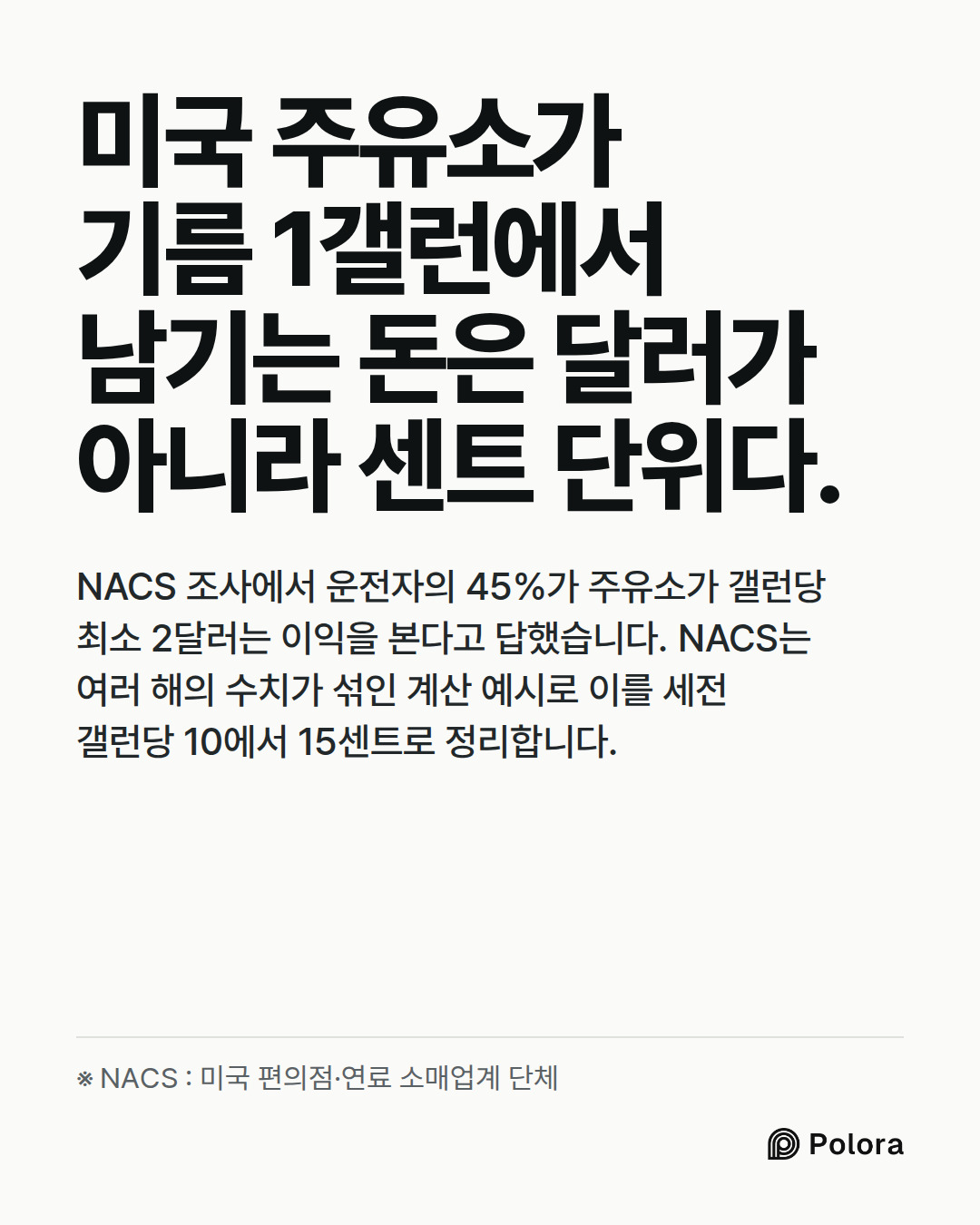
주유소가 기름 1갤런을 팔면 얼마가 남느냐고 물으면, 미국 운전자 상당수는 꽤 큰 액수를 떠올립니다. 미국 편의점·연료 소매업계 단체인 NACS가 소비자 조사를 했더니, 운전자의 45%가 주유소가 갤런당 최소 2달러는 이익을 본다고 답했습니다. NACS는 2021년부터 이 조사를 계속 인용해 왔습니다. 실제 이익은 센트 단위입니다.
NACS는 계산 예시 하나로 이를 보여 주는데, 이 예시에는 여러 해의 수치가 섞여 있습니다. 출발점은 갤런당 매출총이익 35센트로, 2020년 업계 평균입니다. 매출총이익은 주유소가 기름을 사 온 값과 판 값의 차이로, 주유소 자체 비용을 빼기 전의 금액입니다. 이 금액에서 저장 기지에서 주유소까지 기름을 실어 오는 데 약 6센트, 카드 수수료로 8.4센트(2023년 자료 기준), 매장 운영에 6센트, 주유기와 지붕 구조물, 지하 탱크 설치비를 갚는 데 2센트, 재고 변동과 도난으로 1센트가 나갑니다. 다섯 가지 비용을 더하면 23.4센트이고, 법인세 전에 남는 돈은 약 11.6센트입니다. 다만 같은 페이지에는 총비용이 약 22센트로도 적혀 있습니다. NACS는 이를 세전 갤런당 10에서 15센트로 정리합니다.
예시의 매출총이익은 2025년 초의 실제 수치와 비슷했습니다. 당시 휘발유는 갤런당 약 3.11달러였고 매출총이익은 35.7센트였습니다. NACS에 따르면 지난 5년간 매출총이익은 평균 갤런당 약 38센트였고, 가격이 안정된 시기에 세전 이익은 15센트 안팎입니다. 이 정도 규모는 예전에도 비슷했습니다. 2006년 미국 공영 라디오 NPR은 주유소 주인의 몫을 갤런당 12에서 14센트로 보도했습니다. 이 글의 내용은 모두 미국 이야기입니다. 주유소를 누가 소유하는지, 기름에 세금이 얼마나 붙는지, 주유소가 얼마를 남기는지는 나라마다 크게 다릅니다.
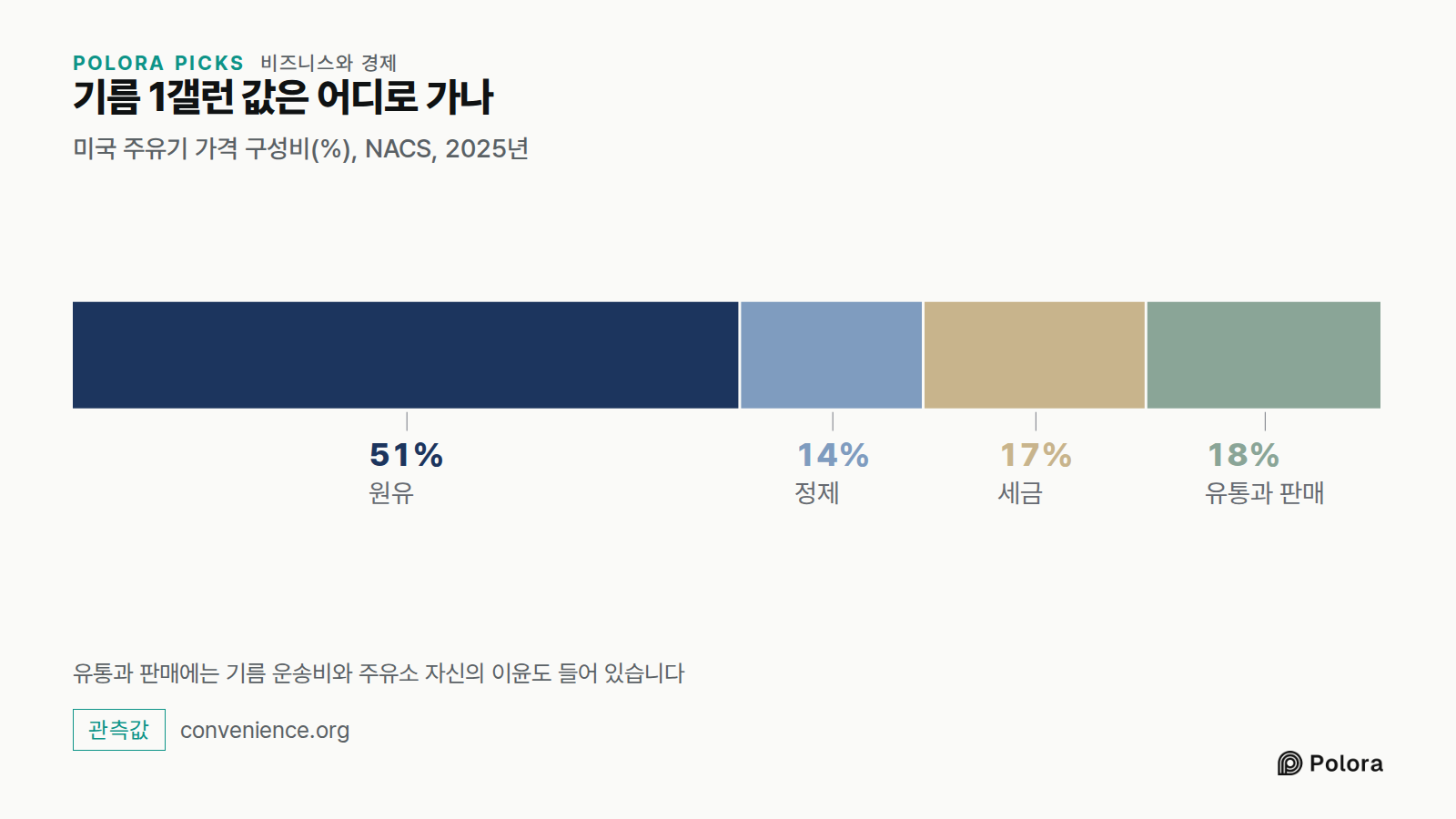
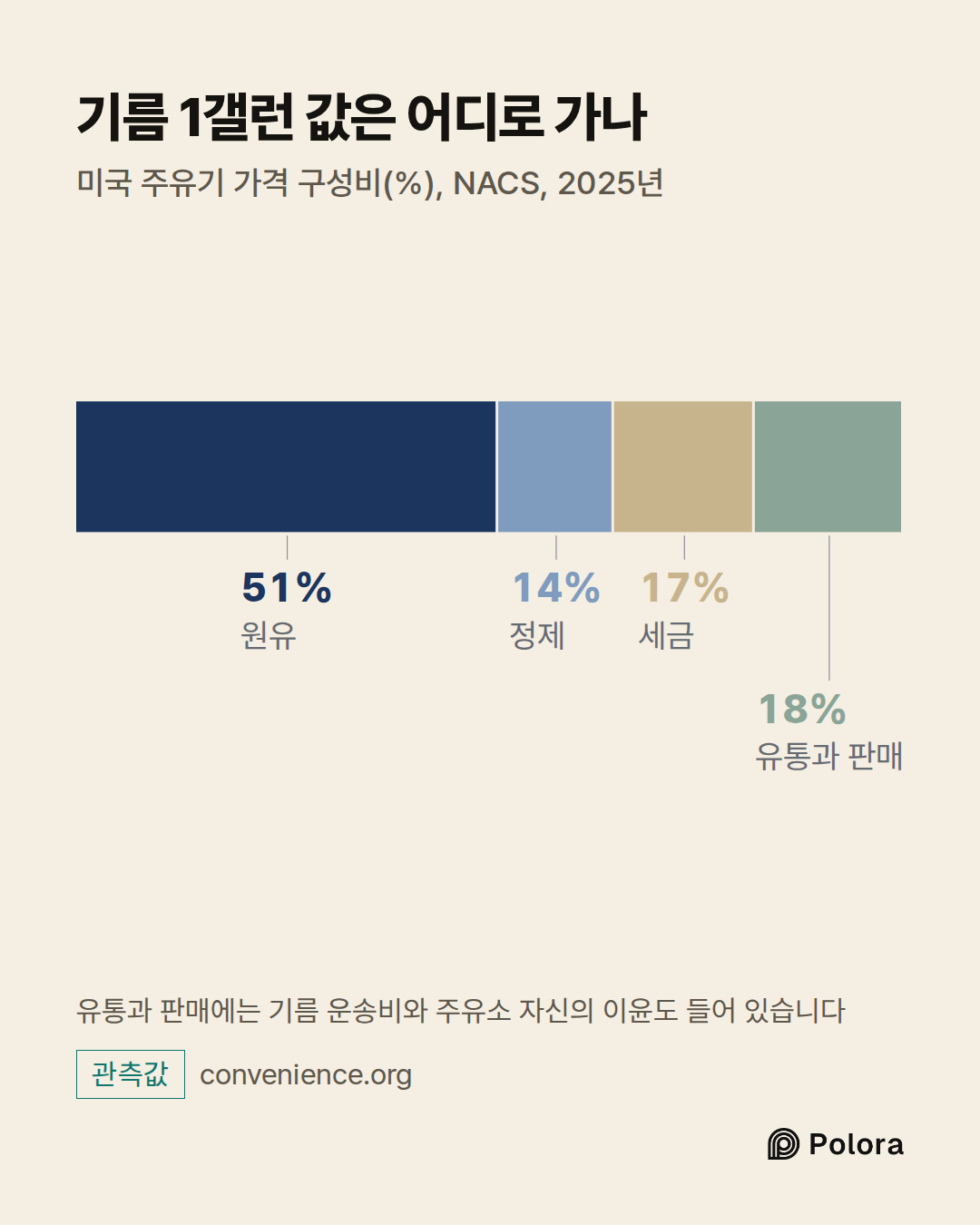
기름값 대부분은 주유소를 그냥 거쳐 갑니다. NACS의 2025년 분석에 따르면 주유기에 찍힌 가격의 약 51%는 원유값, 14%는 정제 비용, 17%는 세금이었습니다. 나머지 18%가 유통과 판매 몫인데, 여기에 주유소까지 기름을 실어 나르는 비용과 주유소 자신의 이윤이 함께 들어 있습니다. 원유 1배럴 가격이 1달러 움직이면 주유기 가격은 갤런당 약 2.4센트 움직입니다.
카드 수수료는 운전자가 거의 신경 쓰지 않는 비용입니다. 수수료는 세금을 포함한 결제 금액 전체에 비율로 매겨집니다. 2025년 미국 편의점 업계가 낸 카드 수수료는 역대 최고인 213억 달러였고, 그중 약 46억 달러는 유류세와 판매세에 붙은 수수료였습니다. 매장이 대신 걷어 정부에 넘기기만 하는 돈입니다.
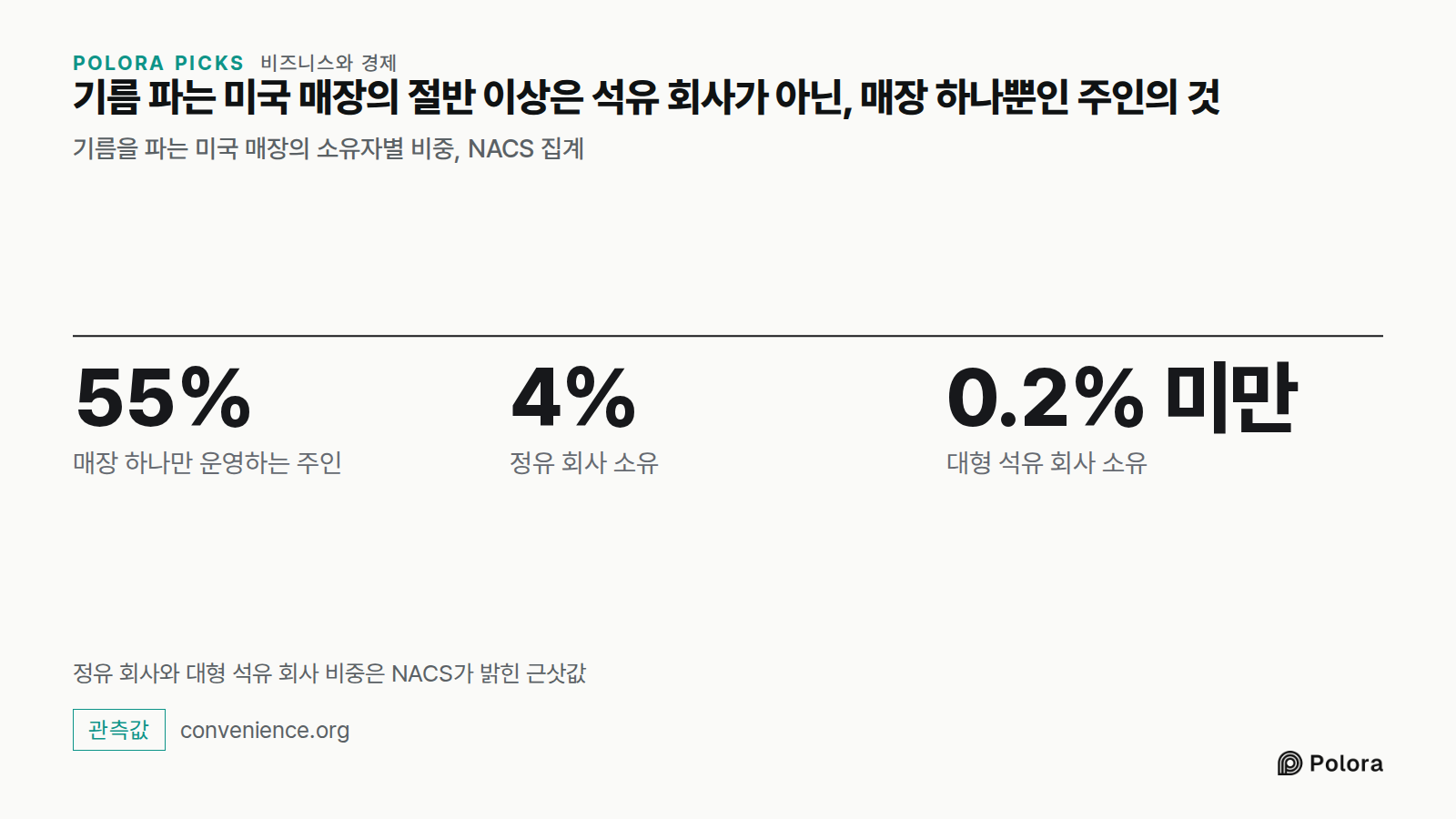
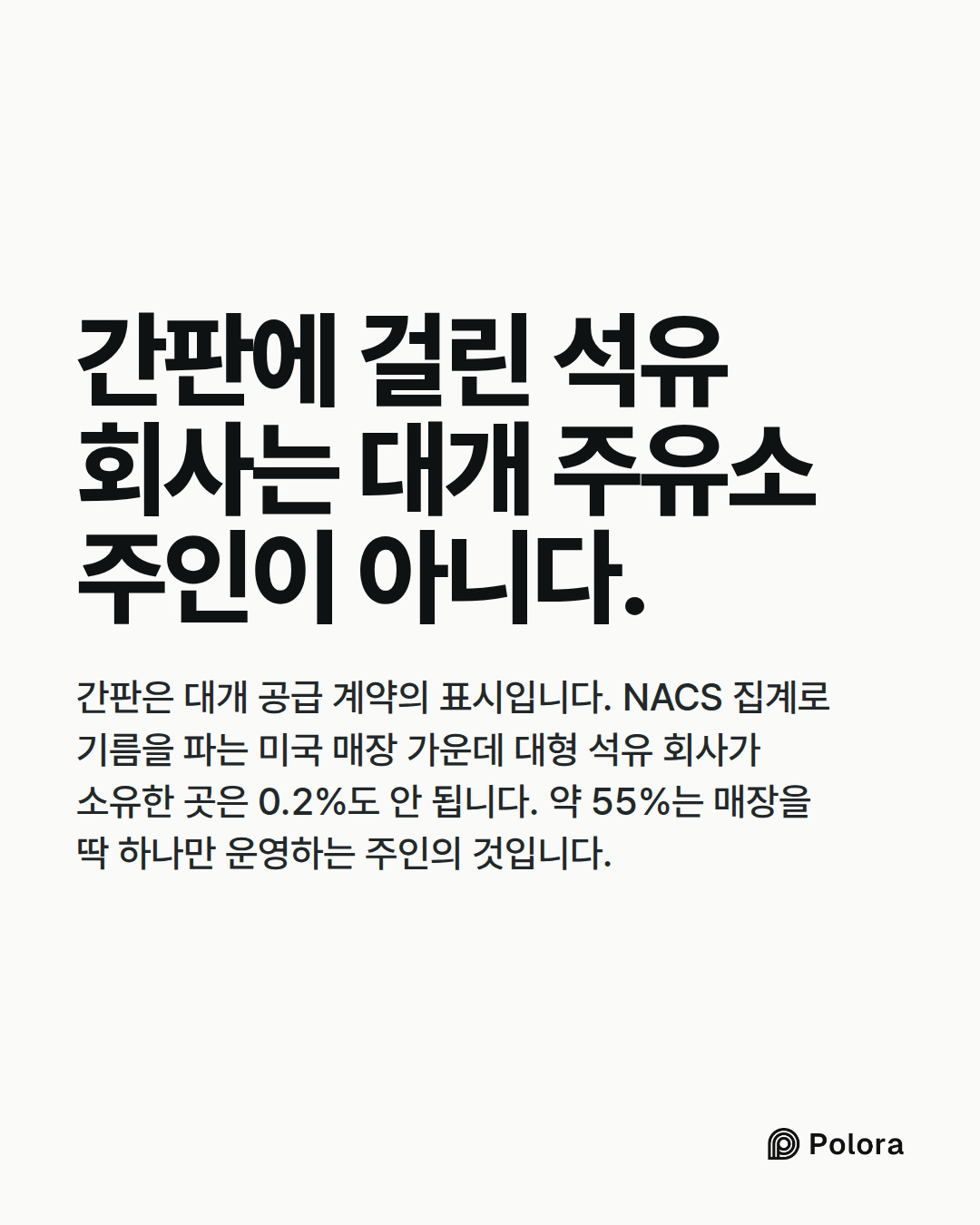
미국에서 기름을 파는 매장은 120,000곳이 넘고, 미국인이 사는 기름의 약 80%를 편의점이 팝니다. 기름을 파는 매장의 약 55%는 매장을 딱 하나만 운영하는 주인의 것입니다. NACS 집계로 대형 석유 회사가 소유한 곳은 0.2%도 안 되고, 정유 회사가 소유한 곳은 약 4%입니다.
그렇다면 주유기 위에 걸린 셸이나 셰브론 간판은 무슨 뜻일까요? 대개는 공급 계약의 표시입니다. 주인은 그 회사의 기름을 사겠다고, 때로는 10년 넘게 사겠다고 약속하고, 그 회사 이름을 내겁니다. 5대 석유 브랜드 아래 가맹점으로 운영되는 매장만 합쳐도 15,000곳이 넘습니다. 작은 주유소 주인은 자기 브랜드를 따로 키울 여력이 없는 경우가 많습니다. 그러니 운전자 눈에는 석유 회사 이름만 보이고, 많은 사람이 석유 회사가 주유소를 직접 운영한다고 여기게 됩니다.
주유소 주인이 정합니다. 다만 기름을 사 오는 값과 자신이 맺은 공급 계약의 범위 안에서입니다. 주인은 업계에서 랙(rack)이라 부르는 지역 저장 기지에서 기름을 직접 받아 오거나, 공급업체에 배달을 맡깁니다. 배달을 맡기면 보통 더 비쌉니다. 대형 석유 브랜드 간판을 단 주유소도 기름을 더 비싸게 사 오는 편인데, 공급업체가 브랜드 이름과 함께 다른 서비스도 제공하기 때문입니다. 판매량, 계약 조건, 위치가 모두 영향을 주고, NACS는 두 주유소의 도매가가 갤런당 10에서 20센트까지 차이 날 수 있다고 말합니다.
그다음 주인은 근처 주유소를 봅니다. NACS의 2025년 조사에서 운전자의 72%는 주유소를 고를 때 가격이 가장 중요하다고 답했고, 69%는 갤런당 5센트를 아끼려고 5분을 돌아가겠다고 했습니다. 갤런당 이익이 10센트 안팎인 장사에서 이웃보다 5센트 비싸게 써 붙인 주유소는 손님을 상당수 잃을 수 있습니다.
이 경쟁을 알면 운전자 눈에는 거꾸로 보이는 현상이 설명됩니다. 도매가가 오를 때 가장 먼저 간판 가격을 올린 주유소는 손님을 다른 곳에 빼앗길 위험이 있습니다. 그래서 많은 주인이 버티면서 인상분 일부를 떠안습니다. NACS는 이를 누가 먼저 피하나 겨루는 치킨 게임에 비유합니다. 가격이 오르는 그 며칠 동안 주유소의 이윤은 줄어드는 경향이 있습니다.
도매가가 내릴 때는 순서가 대체로 뒤집힙니다. 주인은 간판 가격을 자기 원가보다 천천히 내리면서 앞서 떠안은 몫을 되찾을 수 있습니다. 운전자들은 기름값이 오를 때는 솟구치고 내릴 때는 느릿느릿 내려온다고 느끼는데, 세인트루이스 연방준비은행 연구진을 비롯한 경제학자들은 이를 "로켓과 깃털"이라고 부릅니다. NACS는 이 말이 모든 가격 변동에 들어맞지는 않는다고 덧붙입니다. 이 표현이 빠뜨리는 것은 주유소 쪽 사정입니다. 주유소의 이윤은 가격이 오르는 동안 가장 얇을 때가 많고, 운전자가 주유소가 한몫 챙긴다고 가장 굳게 믿는 때가 바로 그때입니다.
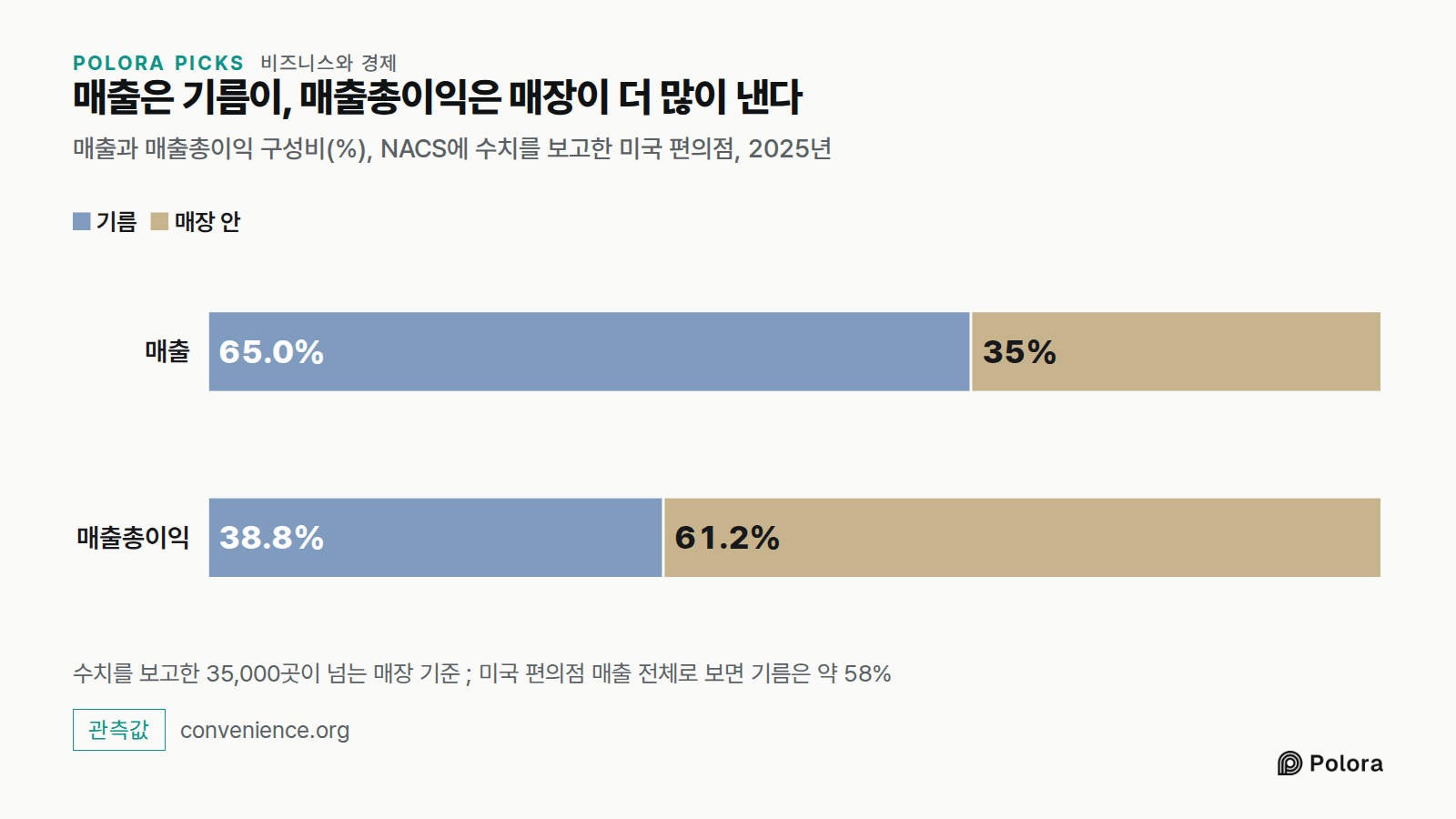
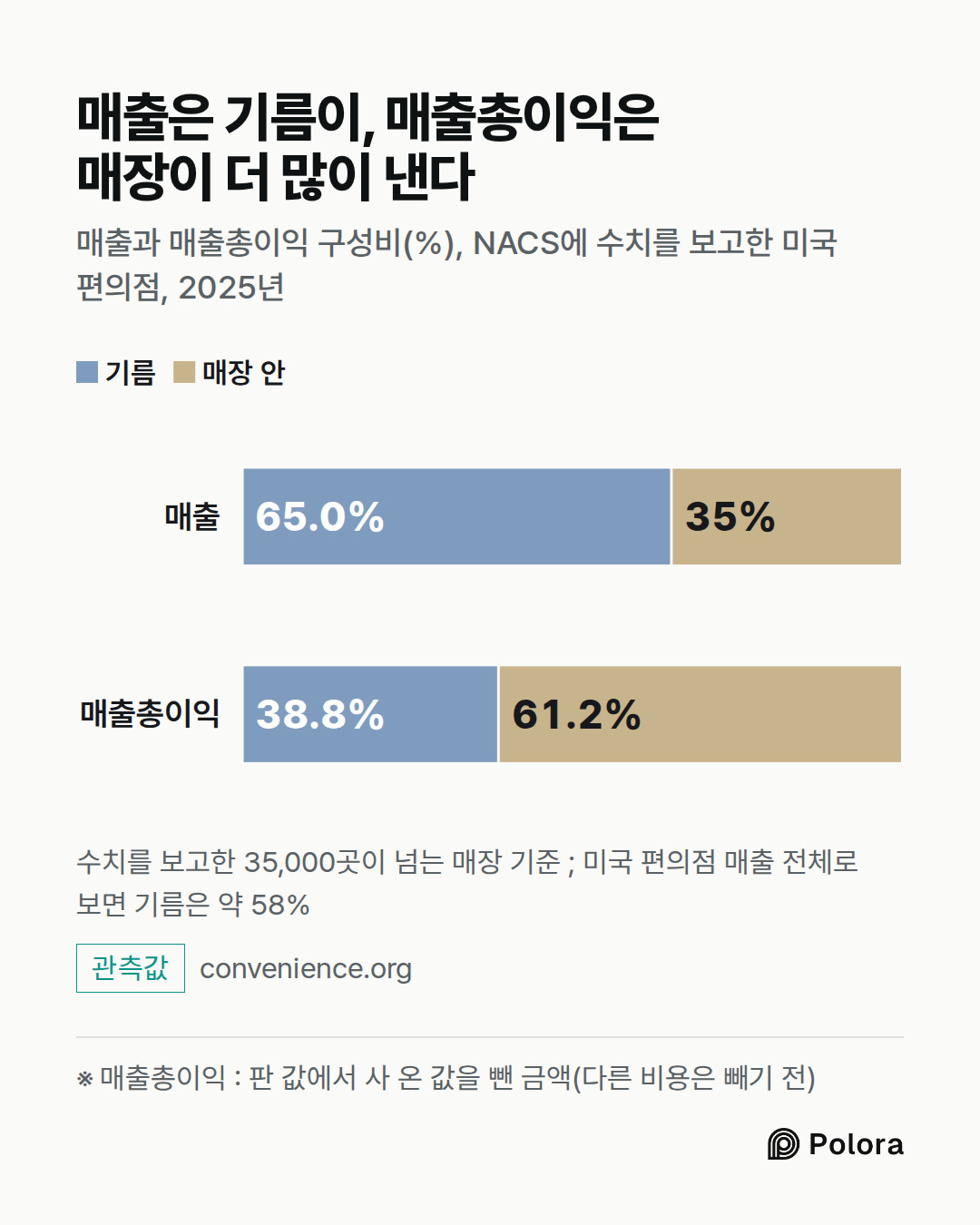
NACS가 2025년 수치를 모은 35,000곳이 넘는 매장에서 기름은 매출의 65.0%를 차지했지만 매출총이익에서는 38.8%에 그쳤습니다. 음료와 과자부터 즉석 조리 음식까지 매장 안에서 파는 모든 것이 나머지 35%의 매출을 올렸고, 매출총이익의 61.2%를 냈습니다. 65%는 수치를 보고한 매장들의 비율이고 업계 전체의 비율은 아닙니다. 미국 편의점 매출 전체로 보면 8,175억 달러 가운데 기름이 4,763억 달러로, 약 58%였습니다.
차이는 원가에 얹는 이윤의 크기에서 나옵니다. 기름 1갤런은 원가보다 몇 센트 비싸게 팔리지만, 매장에서 따라 주는 음료나 샌드위치는 값에서 이윤이 차지하는 비중이 훨씬 큽니다. 그래서 주유기는 차를 세우게 만드는 장치이고, 매출총이익의 대부분을 벌어 온 곳은 매장입니다.
그러나 매출총이익이 이야기의 전부는 아닙니다. 최근 몇 년 사이 기름 이윤은 크게 올랐습니다. NACS는 갤런당 이윤을 2017년 21.73센트, 2018년 23.35센트로 집계했고, 2025년에는 40센트를 넘었습니다. 비용도 올랐습니다. 매장 운영비는 2021년에서 2025년 사이 23.3% 늘었고, 매장당 월 인건비와 복리후생비는 5년 동안 약 80,000달러에서 약 104,000달러로 늘었습니다. 이윤도 비용도 NACS의 계산 예시와 이만큼 멀어졌으니, 그 예시의 10에서 15센트를 2025년에 주유소가 갤런당 남긴 돈으로 읽어서는 안 됩니다.
2025년에는 이 압박이 매장 자체에까지 닿았습니다. NACS는 모든 비용을 빼고 나면 매장 안에서 일어나는 평범한 구매 한 건마다 7센트씩 손해였다고 보고, 그해 매장이 이익을 낸 것은 기름 이윤 덕분이었다고 결론 내렸습니다. 매출총이익은 여전히 매장이 더 많이 냈지만, 비용을 빼고 나니 매장을 흑자로 지킨 것은 주유기였습니다.
평균은 체인 사이의 큰 차이도 가립니다. 싼 기름값을 내세워 성장한 체인 머피 USA는 2025년 소매 기름 이윤을 갤런당 28.1센트로 발표했습니다. 이 회사의 연료 사업은 1,488.7백만 달러를 벌어 상품 판매의 869.0백만 달러보다 많았습니다. 다만 이 연료 수치에는 회사 자체의 공급·도매 사업과 재생연료 크레디트 판매가 함께 들어 있어서, 주유기만으로 번 돈을 보여 주는 수치는 아닙니다.
수치는 해마다 움직이고, 한 해의 이윤이 다음 해를 말해 주지는 않습니다. 그래도 사업의 뼈대는 그대로입니다. 기름 1갤런의 값은 대부분 원유, 정제, 유통, 세금이고, 주유소가 갖는 몫은 몇 센트입니다. 지붕에 걸린 이름은 대개 주인이 아니라 기름 공급업체의 것입니다. 가격은 주인이 길 건너 주유소를 보며 정하고, 주인은 도매가가 오르는 동안 가장 적게 버는 경향이 있습니다. 그리고 매출총이익은 대개 매장이 더 많이 내고, 주유기는 사람을 불러들이며, 2025년 같은 해에는 살림까지 떠받쳤습니다.
Do gas stations make money selling gas?
Alpha · claude-sonnet-5
[Alpha]: I checked the two most load-bearing numbers.
The 45% / $2-a-gallon survey claim holds up, though the date doesn't. "a stunning 45% of drivers think that retailers make at least $2 a gallon in profit per gallon, according to a NACS consumer survey" — this is confirmed, but it's a line NACS (via columnist Jeff Lenard) has repeated since at least November 2021, not something new to 2025. The manuscript should not imply this is a fresh 2025/2026 survey.
The 35-cent margin / 13-cent net breakdown is basically right but mislabeled by year. The manuscript's $3.11-a-gallon, 8.4-cents-card-fee numbers trace to the same NACS "Who Makes Money Selling Gas?" page, and a secondary source confirms "the average fuel gross margin was 35.7 cents per gallon as of January 30, 2025" and "about 22 cents of that went to costs, including roughly 8.4 cents in card processing fees, leaving about 13 cents per gallon in net margin before taxes". So the brief's suspicion was correct: these are 2025 figures stitched onto a page whose language reads as evergreen. The manuscript should say "as of early 2025" rather than implying an averaged five-year figure.
The NACS "Who Makes Money" page i…
Beta · gpt-6-sol
[Beta]: Yes—U.S. stations can make money selling gasoline, but the amount left per gallon after costs is much smaller than the pump price suggests. The manuscript’s answer stands. Its arithmetic, however, needs a correction that Alpha’s account missed.
NACS’s worked example starts with a 35-cent gross margin, then lists five costs: 6 cents to deliver fuel from the terminal, 8.4 cents in card fees (identified as 2023 data), 6 cents in store operating expenses, 2 cents in equipment amortization, and 1 cent for inventory fluctuation. Those add to 23.4 cents, leaving 11.6 cents, not 13 cents, before income tax. The manuscript omits delivery from its cost list and calls roughly 22 cents the total. Moreover, NACS explicitly chooses its 2020 average gross margin of 35 cents for that exercise; the $3.11 pump price and 35.7-cent observed margin refer to early 2025. This is an illustration assembled from different periods, not one measured 2025 station account. NACS’s broader description is 10–15 cents a gallon before tax. (convenience.org)
The store-versus-…
Gamma · gemini-3.1-pro
[Gamma]: I have checked the remaining claims and can confirm or correct the following based on primary sources:
The 45% / $2 survey: As Alpha noted, this claim is real but dated. My search shows NACS’s Jeff Lenard cited this "stunning 45%" figure in an article titled *Who Makes Money Selling Gas?* first published in November 2021, not 2025.
"Rockets and feathers": The manuscript is correct that economists use this term, but it needs an economic source, not NACS. The Federal Reserve Bank of St. Louis (in a 2022 FRED Blog post) explicitly defines "rockets and feathers" as "asymmetric pass-through" where "gas prices rise faster when oil prices increase (like a rocket) than they fall when oil prices decrease (like feathers)." The manuscript's description perfectly matches the economic consensus.
Murphy USA's fuel vs. merchandise contribution: The manuscript claims Murphy USA's fuel business contributed $1,488.7 million against $869.0 million from merchandise in 2025. My review of Murphy USA's Q4 2025 earnings release confirms these exact figures for the full year 2025. However, as the research brief suspected, "total fuel contribution" for Murphy USA includes not just r…
Researcher · gemini-3-7-flash
Check on the claims and requested verifications:
* The 45% / $2-a-gallon survey claim:
Confirmed on NACS’s *Who Makes Money Selling Gas?* page: *"In fact, a stunning 45% of drivers think that retailers make at least $2 a gallon in profit per gallon, according to a NACS consumer survey."* This line dates back to an article published in late 2021 by Jeff Lenard and was carried forward into subsequent updates (including the February 2025 version). It should not be presented as a new 2025 survey finding.
Source: NACS – Who Makes Money Selling Gas?
* Arithmetic and breakdown on per-gallon margin ($3.11 price / 35-cent margin / net cents):
NACS’s illustrative breakdown uses a 35-cent gross margin based on its 2020 annual average, alongside early 2025 price context ($3.11) and 2023 card fee data (8.4 cents). NACS lists the following costs out of the 35 cents:
* Delivery / distribution: 6¢
* Card processing fees: 8.4¢ (2023 data)
* Store operating expenses: 6¢
* Equipment amortization (pumps, canopy, tanks): 2¢
* Inventory fluctuation/theft: 1¢
Total costs equal…
The Arbiter · gpt-6-sol
The voices agree on the central distinction: a station’s markup on gas is not the same as what it keeps after costs, and in-store sales can supply most *gross* profit even when fuel is crucial to the business after expenses.
One source-level conflict matters for the verdict. Alpha accepted NACS’s “35 cents minus about 22 cents leaves about 13 cents” example. Beta and the Researcher added the five costs printed on that same NACS page and got 23.4 cents, leaving 11.6 cents. I checked the page: NACS itself prints both the five-item list and the 22-cent total. The disagreement is therefore in the published source, not just between the voices. The example also combines figures from different years; it should not be presented as one observed 2025 gallon. (convenience.org)
A second distinction remains important: the reported 65% fuel share of sales describes the NACS reporting-store measure discussed here, while the cited industry-wide sales totals imply about 58%. Neither sales share establishes which side contributes more *profit after expenses*. The verdict can weigh the…
The Arbiter's Final Verdict · gpt-6-sol
Yes. In the United States, gas stations can make money selling gas—but a pump price is not a station’s profit. The evidence supports a margin measured in cents per gallon, not dollars. It does not support treating “13–15 cents on a typical 2025 gallon” as a measured, current industry average.
The manuscript’s premise stands, with these corrections and limits:
- Per-gallon profit: NACS’s worked example uses a 35¢ gross margin but combines figures from different years. Its five listed costs add to 23.4¢, leaving 11.6¢ before income tax—even though the page also prints a conflicting 22¢ cost total. NACS’s broader 10–15¢ description is safer than the manuscript’s precisely stated 13–15¢. The cited claim that 45% of surveyed drivers guessed at least $2 a gallon appears on that page, but should not be described as a new survey.
- Store versus pump: NACS’s 2025 reporting-store figures put fuel at 65.0% of sales and 38.8% of gross profit; in-s…