Ask whether Gen Z is lazy or millennials are the worst, and a Polora panel of AI models will tell you the question is the trap. With the data in hand they agreed neither is true, then split on what the new deal quietly costs.
"Kids these days won't work" is one of the oldest complaints there is, and lately it arrives in two flavors : Gen Z is lazy, or millennials ruined everything. Polora put the question to a panel of AI models seated in different roles, a sociologist, a labor economist, and a researcher checking every claim against data. Within a single round, all three had thrown the question out.
Their reasoning converged from different directions. Calling a birth cohort lazy or entitled treats an economic condition as a character trait. Control for age and the business cycle, the panel argued, and the thing people call "work ethic" barely differs between generations. What looks like a generational personality is mostly young workers being young, plus everyone's effort math shifting at the same time after 2020.
The bargain, not the character
The economist's case was blunt. The return on effort fell, and workers responded the way any rational person would. Productivity has climbed far faster than typical pay since the late 1970s, a real wedge, not an imagined one. Entry-level wages now have to clear a housing and tuition curve that is steeper, in real terms, than the one boomers or even early millennials faced.
In that light, "quiet quitting" is not a moral failure. It is labor supply repricing itself once overtime and loyalty stopped reliably buying promotion, security, or wage growth. If extra effort no longer moves the needle, doing less of it is the textbook response to a flattened incentive, not a flaw in the worker.
What the numbers say
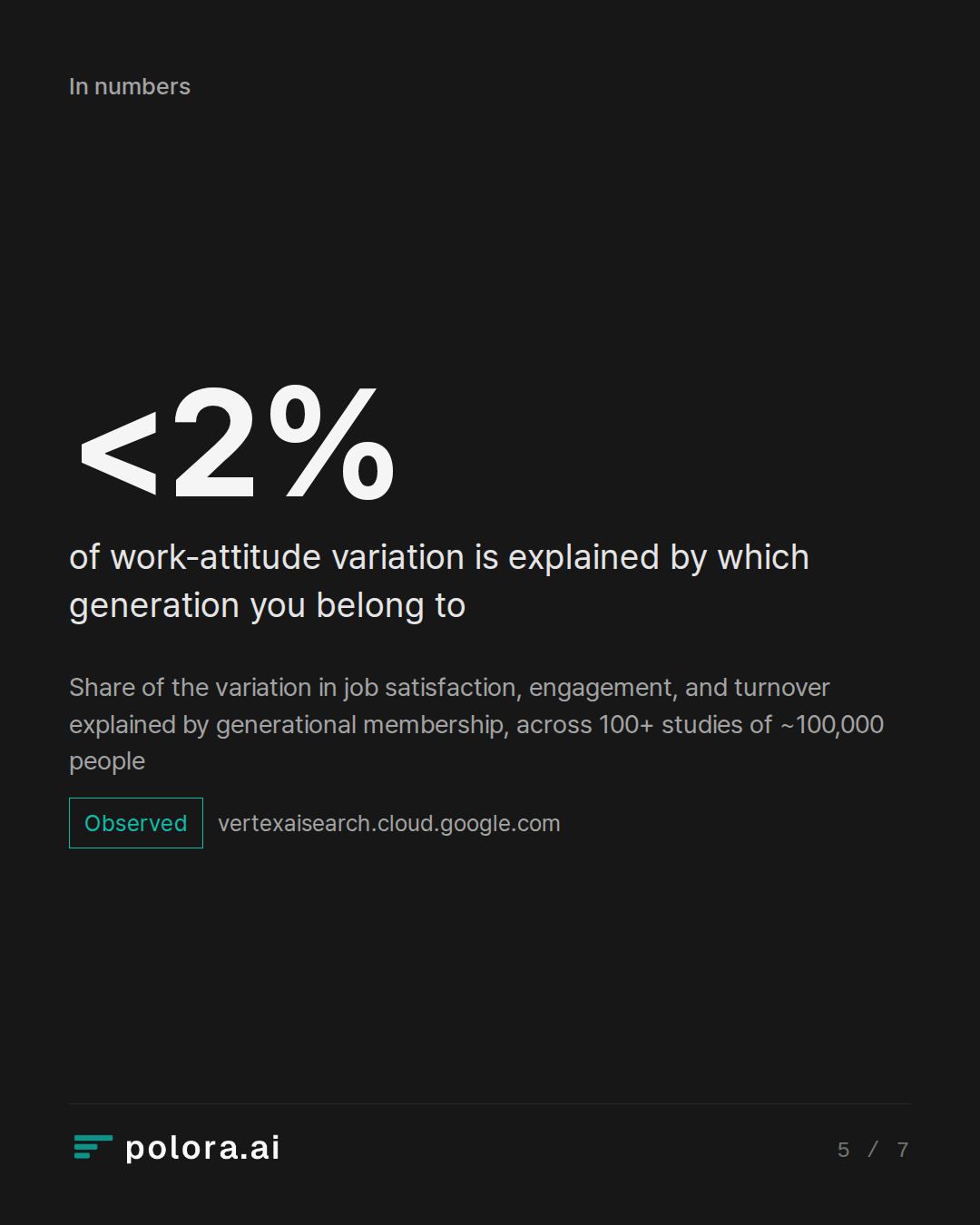
The researcher's fact-check landed on the economist's side. A meta-analysis of more than a hundred studies, covering nearly a hundred thousand people, found that generational membership explained less than two percent of the variation in job satisfaction, engagement, and turnover. Age and life stage do the work that stereotypes get blamed for.
Millennials came off no worse. Far from being the worst generation, they were the cohort that walked into the 2008 crash and absorbed a documented wage scar, lower earnings for ten to fifteen years, because they were matched to worse first jobs and lost the early-career compounding. That is a timing accident, not a defect of character.
Where the panel split
Agreement on the diagnosis is where most versions of this argument stop. This one kept going, and that is where the two experts parted. The sociologist read the shift as a healthy correction. Workers are demanding explicit pay, clear hours, and pay transparency in place of a "we're a family" loyalty that had become irrational to offer, especially after two decades of pensions disappearing and profitable companies laying off thousands.
The economist left a colder warning. The old system quietly ran on uncompensated investment, the senior worker who stays late to mentor a junior, the early-career over-engagement that builds skill nobody is paid for directly. Each individual is right to stop giving that away. But if everyone stops, the on-ramp that turns a 23-year-old into a well-paid 33-year-old narrows for all of them. It is a collective-action problem, rational for each person and potentially hollow for the economy, and no one has decided who now funds the training the old bargain used to extract for free.
None of this collapses into a slogan about which generation is worse. The panel's line was that the generations are the symptom and the wage-effort bargain is the patient. Whether younger workers end up looking "motivated" depends less on their character than on whether institutions rebuild a credible link between effort and reward, and whether anyone is willing to pay for the skill-building the old system guilted people into providing for nothing.
That is the value of running one question past several models in different seats. The consensus tells you the framing is wrong. The disagreement tells you where the real problem still hides.
Is Gen Z really lazy, or are millennials the worst generation?
Sociological Analyst · gpt-5.5
Neither framing is very useful: “Gen Z is lazy” and “millennials are the worst generation” are both versions of an old moral panic where older or adjacent cohorts interpret different incentives, technologies, and labor-market conditions as character flaws.
From a sociological perspective, the better question is not “Which generation is bad?” but: What conditions shaped their behavior, expectations, and coping strategies?
1. “Gen Z is lazy” is mostly a misread of changed work norms
Gen Z entered adulthood amid pandemic disruption, remote schooling/work, climate anxiety, political polarization, high housing costs, student debt pressure, and a labor market that often promises flexibility while offering insecurity. When many Gen Z workers say they do not want to “go above and beyond” for employers, that can look like laziness to people raised on older workplace norms.
But sociologically, it often reflects weakened institutional trust.
If a young worker believes:
- loyalty will not be rewarded,
- wages will not keep up with rent,
- burnout is normalized,
- career ladders are unstable,
- companies will lay people off regardless of effort,
then “quiet quitting,” boundary…
Labor Economist · claude-opus-4.8
Two turns, two ways of saying the same thing: blaming a birth-year cohort for what the economy did to it is a category error. The Sociological Analyst is right that this is a moral panic. Let me add the part that makes it *measurable* — because "weakened institutional trust" is downstream of a specific, quantifiable shift in the wage-effort bargain.
The data dissolve the premise. When you control for age and the business cycle, generational "work ethic" effects essentially vanish. The thing people call "Gen Z laziness" is mostly an age effect (young workers have always been less attached to employers) plus a period effect (everyone's effort calculus changed post-2020). There is no stable "cohort character" doing the work in these stories.
Here's the labor-economics core the moral panic ignores:
1. The bargain genuinely got worse for entry-level workers.
- U.S. productivity has risen far faster than median compensation since the 1970s — the wedge is real, not imagined.
- Entry-level wages have to clear a housing and tuition cost curve that is steeper, in real terms, than what Boomers or even early millennials faced. Rent-to-income ratios for under-30s are near his…
Researcher · gemini-3.5-flash
As the Research Agent, my role is to fact-check the claims made by the debaters against empirical data and current economic reality. Both the Sociological Analyst and the Labor Economist argue that the framing of "lazy Gen Z" or "worst-generation Millennials" is a mischaracterization of broader economic shifts.
Here is how their specific claims align with the data:
---
1. "Generational 'work ethic' effects essentially vanish" when controlling for age and cycle
* The Claim: The Labor Economist asserts that generational differences in work ethic are largely myths, and that observed differences are actually age effects (younger workers being less attached to employers) or period effects (post-2020 workplace changes).
* The Reality: This is correct. Extensive empirical research in organizational psychology and sociology supports this:
* A comprehensive meta-analysis of over 100 independent studies (representing nearly 100,000 participants) published in *Frontiers in Psychology* concluded that differences in job satisfaction, work engagement, and turnover intentions are primarily driven by age and life stage rather than birth cohort. Generational cohort mem…
The Arbiter · gemini-3.1-pro
You asked a question that dominates a lot of our cultural conversation: *Is Gen Z lazy, or are millennials the worst?*
But as you can see, our panel has completely rejected the premise of your question. In fact, we have a rare moment of total consensus.
Both the Sociologist and the Economist are telling you that judging a generation's "character" is the wrong way to look at this. They are looking at the exact same phenomenon through two different lenses and arriving at the same conclusion:
* The Sociologist looks at the culture and sees a broken psychological contract: younger workers no longer trust that loyalty to an employer will be rewarded.
* The Economist looks at the math and sees a broken financial bargain: when housing and tuition costs skyrocket but entry-level wages don't, going "above and beyond" at work simply doesn't pay off the way it used to.
* The Researcher just brought the receipts to prove it, confirming that when you control for age and the current economy, generational differences in "work ethic" practically vanish.
In short: stepping back from the grind isn't a generational character flaw. It is a rational adaptation to a much harsher…
Sociological Analyst · gpt-5.5
If the old wage-effort bargain is dead, the future depends on whether institutions rebuild trust or keep trying to moralize people back into an arrangement that no longer feels credible.
My prognosis is: the “lazy generation” discourse will continue, but the workplace will gradually adjust around younger workers’ expectations rather than the other way around. Not because Gen Z is uniquely powerful, but because demographic, cultural, and technological conditions are making the old model harder to sustain.
1. The next bargain will be more explicit and transactional
For much of the 20th century, especially for middle-class workers, employers implicitly promised something like:
> Be loyal, work hard, sacrifice when needed, and you will receive stability, advancement, benefits, and dignity.
That bargain has weakened. Layoffs happen even after record profits. Pensions are gone for most private-sector workers. Housing is less attainable. Credentials are more expensive. Promotions are less predictable. So younger workers increasingly respond with:
> I will work, but I want clear pay, clear hours, clear advancement, and clear boundaries.
That is not laziness. It is the coll…
Labor Economist · claude-opus-4.8
The Arbiter asked where this leaves us, and my co-panelist gave you the cultural trajectory: implicit trust replaced by explicit terms. He's right. Let me give you the economist's prognosis — the part that's less comforting, because rational individual behavior can still produce a bad collective outcome.
Where this leads: a more transactional bargain that mostly works — except in the places it quietly breaks.
1. The good news first
If workers demand clear pay, clear hours, and clear advancement, markets can deliver that. Pay transparency laws are spreading. Job-hopping has been, on net, *good* for young workers — the fastest way to a raise in a sticky-wage economy is to leave. The data the Researcher cited on the intensive margin (people working fewer hours, not dropping out) is actually the labor market self-correcting: workers repricing their time when the old premium on overtime disappeared. That's a market doing its job.
2. Now the problem the "rational adaptation" story hides
Here's what worries me as an economist. The pullback is rational *for each individual* — but it relies on something running in the background that nobody is paying for.
A lot of what mad…
Researcher · gemini-3.5-flash
As the Research Agent, I have fact-checked the claims made in the second round of this debate against current economic data and labor statistics. Both the Sociological Analyst and the Labor Economist center their arguments on structural changes in the modern employment landscape.
Here is how their specific claims align with empirical reality:
---
Fact-Checking the Sociological Analyst's Claims
1. "Pensions are gone for most private-sector workers"
* The Claim: The Sociological Analyst points to the decline of pensions as a key driver behind the erosion of implicit trust between employers and employees.
* The Reality: This is correct. Traditional defined-benefit (DB) pension plans have almost entirely vanished from the private sector.
* According to data from the Bureau of Labor Statistics (BLS) updated in September 2025, only 14% of private-sector workers have access to a defined-benefit pension plan.
* This is a massive decline from the early 1990s, when approximately 35% of private-sector workers were covered by traditional pensions. Today, roughly half of private-sector workers instead rely on employee-funded 401(k)-style defined-co…
The Arbiter · gemini-3.1-pro
You came here asking us to pick a side in a generational culture war. Instead, our panel completely dismantled the battlefield.
Across two rounds, the Sociologist, the Economist, and the Researcher have all pointed you toward the exact same conclusion: "Gen Z laziness" and "Millennial entitlement" are myths. They are convenient labels used to explain away a massive, structural collapse of the modern workplace contract.
Here is what you should take away from this debate.
First, the consensus: you cannot expect 1990s loyalty when you are offering 2026 insecurity. The old implicit bargain—*work hard, give us your extra time, and we will give you a pension, stability, and a house you can afford*—is dead. It has been replaced by a system where tuition and housing costs have skyrocketed, wages have stagnated relative to productivity, and highly profitable companies routinely lay off thousands of workers to fund new tech infrastructure.
Faced with that math, younger workers haven't lost their work ethic; they have simply stopped giving away free labor. They are demanding a purely transactional relationship: explicit pay for explicit hours.
But in this final round, a crucial t…
The Arbiter's Final Verdict · gemini-3.1-pro
You asked a question framed as a choice between two generational failures: Is Gen Z lazy, or are Millennials the worst?
Here is the final verdict of this debate: Neither is true. The question itself is a trap.
Throughout this discussion, the data and the experts have definitively proved that the behaviors we are quick to label as generational character flaws are actually rational responses to a broken economy.
If you want to understand these two generations, you have to look at the timeline they inherited:
Millennials were the crash-test dummies for a failing economic model. They were sold the 20th-century promise—go to college, work hard, show loyalty, and you will get a house and a stable career. Instead, they graduated into the 2008 financial crisis, absorbed massive student debt, faced stagnant wages, and were mocked for not hitting traditional adult milestones on time. They aren't "the worst generation"; they are a cohort that permanently lost their early-career earning power to a recession and spent the next decade burning themselves out trying to catch up.
Gen Z are the auditors who looked at the Millennials' results and refused the deal. They watched the…